Exploiting the Role of Position Feature in Chinese Relation Extraction
Peng Zhang
1,2, Wenjie Li
1, Furu Wei
1, Qin Lu
1, Yuexian Hou
2 1Department of Computing, The Hong Kong Polytechnic University, Hong Kong
2
School of Computer Science and Technology, Tianjin University, China
E-mail: {cspzhang, cswjli, csfwei, csluqin}@comp.polyu.edu.hk, [email protected]
Abstract
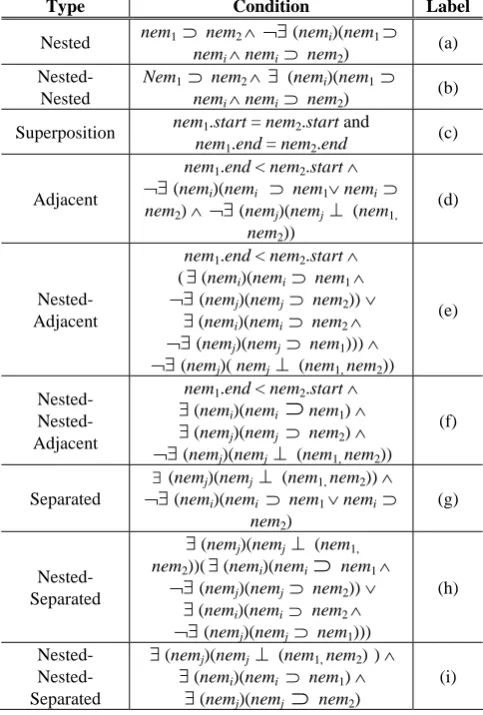
Relation extraction is the task of finding pre-defined semantic relations between two entities or entity mentions from text. Many methods, such as feature-based and kernel-based methods, have been proposed in the literature. Among them, feature-based methods draw much attention from researchers. However, to the best of our knowledge, existing feature-based methods did not explicitly incorporate the position feature and no in-depth analysis was conducted in this regard. In this paper, we define and exploit nine types of position information between two named entity mentions and then use it along with other features in a multi-class classification framework for Chinese relation extraction. Experiments on the ACE 2005 data set show that the position feature is more effective than the other recognized features like entity type/subtype and character-based N-gram context. Most important, it can be easily captured and does not require as much effort as applying deep natural language processing.
1.
Introduction
The research in relation extraction was promoted by the Message Understanding Conferences (MUCs) (MUC, 1987-1998) and the Automatic Content Extraction (ACE) program (ACE, 2002-present). According to the ACE program, an entity is an object or a set of objects in the world and a relation is an explicitly or implicitly stated relationship among entities. For example, the sentence “George Bush traveled to France on Thursday for a summit” conveys the ACE-style relation “Physical. Located” between the two entities “George Bush (Person)” and “France (Location)”, where “Physical” and “Located” are the pre-defined relation type and subtype.
In text, an entity may have more than one entity mention. Mentions are co-referent with each other and inherit the entity type and subtype from the corresponding entity they belong to. For example, “George W. Bush” and “the president of the United States” are two different mentions with different linguistic expressions but they refer to the same person and belong to the same person entity. Extraction of semantic relations between entities or entity mentions can be very useful in many NLP applications, such as information extraction, question answering and ontology construction.
In general, the task of relation extraction is to decide the semantic relations between two entities (or entity mentions1) in the context (e.g. in a sentence, or a small piece of text). Since relation types and subtypes are predefined, this task is usually modeled as a classification problem. Many methods, such as feature-based methods (Kambhatla 2004; Zhou et al 2005) and kernel-based methods (Zelenko et al. 2003; Culotta and Sorensen, 2004;
1
In this paper, we consider the relations between two entity mentions.
Zhang et al 2006; Zhou et al 2007), have been proposed in literature. In this paper, we are particularly interested in feature-based methods.
Kambhatla (2004) employed Maximum Entropy models with features derived from word, entity type, mention level, overlap, dependency tree and parse tree. Zhou et al (2005) further incorporated the base phrase chunking information. The above two works both adopted overlap features, which implicitly reflect the position feature of two entity mentions. Jiang and Zhai (2007) systematically explored a large space of features for relation extraction and evaluated the effectiveness of different feature subspaces. They concluded that using basic unit features was generally sufficient to achieve state-of-art performance, while over-inclusion of complex features might hurt the performance.
The feature-based methods draw much attention from researchers. However, to the best of our knowledge, existing feature-based methods did not explicitly incorporate the position feature, which can be very useful in our observations. This motivates us to further study the position information between two named entity mentions for Chinese relation extraction. Experiments on the ACE 2005 data set show that the position feature can be more effective than the other recognized features like entity type /subtype and character-based N-gram context. Meanwhile it can be easily captured with less effort than applying deep natural language processing.
shows that 9-Position feature outperforms 3-Position feature by 10.5% of F-measure for RTDR and 9.2% of F-measure for RSDR when incorporating with the other two features.
Precision Recall F-measure Entity + Context
+ 9-Position 0.70126 0.457767 0.553937 Entity + Context
+ 3-Position 0.637885 0.34575 0.448436
Table5. Comparison of 9-Position and 3-Position over relation types in the test dataset
Precision Recall F-measure Entity + Context
+ 9-Position 0.677718 0.419771 0.518431 Entity + Context
+ 3-Position 0.668024 0.313276 0.426528
Table 6. Comparison of 9-Position and 3-Position over relation subtypes in the test dataset
4.
Discussion on 9-Position and 3-Position
We discuss the class imbalance problem of 9-position and 3-position in the task of relation extraction.The class imbalance problem typically occurs when, in a classification problem, there are many more instances of some classes than others. In such cases, standard classifiers tend to overwhelmed by large classes and ignore the small ones, and then cause a significant bottleneck in performance (Japkowicz 2000 and Chawla et al. 2004).
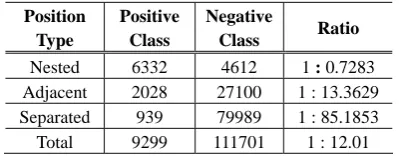
Unfortunately, the task of relation extraction encounter imbalance problems (Culotta et al. 2006 and Kambhatla 2006), i.e., there are many more “NONE”(negative)class relation instances than predefined (positive) classes. As we can be seen from Tables 7 and 8, the ratio of positive to negative class on the whole ACE corpus is 1: 12.01.
Position Type Positive Class
Negative
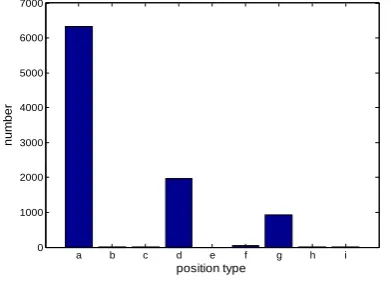
Class Ratio Nested 6325 2347 1 : 0.37 Adjacent 1978 13501 1 : 6.82 Separated 928 39808 1 : 42.87 Nested-Nested 1 1858 1 : 1858 Nested-Adjacent 0 10119 1 : INF Nested-Separated 1 31039 1 : 31039 Nested-Nested-Adjacent 50 3480 1 : 69.6 Nested-Nested-Separated 10 9142 1 : 914.2 Superposition 6 407 1 : 67.84 Total 9299 111701 1 : 12.01
Table 7. The ratios of positive to negative class on 9-Position types
Position Type
Positive Class
Negative
Class Ratio Nested 6332 4612 1 : 0.7283 Adjacent 2028 27100 1 : 13.3629 Separated 939 79989 1 : 85.1853 Total 9299 111701 1 : 12.01
Table 8 The ratios of positive to negative class on merged 3-Position types
As shown in Section 3, 9-Position outperforms 3-Position. This can be attributed to the fact that 9-Position is more discriminative than 3-Position, and the imbalance problem of the three main positions (i.e., Nested, Adjacent, Separated) in 3-Position is much worse than the one in 9-Position.
5.
Conclusion
In this paper, we study the role of the position feature in Chinese relation extraction. Nine types of position information between two named entity mentions are defined and then used as one of the features in relation classification. Experiments on the ACE 2005 data set show that the position feature is quite effective.
6. Acknowledgements
This work was supported in part by the HK Research Grants Council (Grant No. CERG PolyU 5211/05E), Natural Science Foundation of China (Grant No. 60603027), and Applied Basic Research Project of Tianjin of China (Grant No. 05YFJMJC11700).
7. References
Bunescu R. and Mooney R. (2005). A Shortest Path Dependency Tree Kernel for Relation Extraction, In Proceedings of HLT/EMNLP, pages 724-731.
Culotta A. and Sorensen J. (2004). Dependency Tree Kernels for Relation Extraction, in Proceedings of ACL, pages 423-429.
Jiang J. and Zhai C. (2007). A Systematic Exploration of the Feature Space for Relation Extraction. In proceedings of NAACL/HLT, pages 113-120.
Kambhatla N. (2004). Combining Lexical, Syntactic, and Semantic Features with Maximum Entropy Models for Extracting Relations. In Proceedings of ACL, pages 178-181.
Zelenko D, Aone C. and Richardella A. (2003). Kernel Methods for Relation Extraction. Journal of Machine Learning Research 3:1083-1106
Zhou G., Su J., Zhang J., and Zhang M. (2005). Exploring Various Knowledge in Relation Extraction. In Proceedings of ACL, pages 427-434.
of COLING/ACL, pages 825-832.
Joachims T. (1998). Text categorization with Support Vector Machines: Learning with many relevant features.
In Proceedings of European Conference on Machine Learning.
Manevitz L. M. and Yousef M. (2001) One-class svms for document classification. Journal of Machine Learning Research, 2(Dec):139-154
Zhou G., Zhang. M, Ji D. and Zhu Q. (2007). Tree Kernel-based Relation Extraction with Context-Sensitive Structured Parse Tree Information. In Proceedings of EMNLP, pages 728-736.
Chawla N., Japkowicz N. and Kolcz A. (2004) "Editorial: Special Issue on Learning from Imbalanced Datasets,"
SIGKDD Explorations, 6(1):1-6.
Japkowicz, N. (2000). Learning from imbalanced data sets: a comparison of various strategies. In Papers from the AAAI Workshop on Learning from Imbalanced Data Sets. Tech. rep. WS-00-05, Menlo Park, CA: AAAI Press.
Culotta A. McCallum A, Betz J.(2006) Integrating Probabilistic Extraction Models and Data Mining to Discover Relations and Patterns in Text. HLT-NAACL, pages 296-303
Kambhatla N.(2006) Minority Vote: At-Least-N Voting Improves Recall for Extracting Relations. In Proceedings of ACL, pages 460-466.
Appendix. Nine Position Types
nem1
nem2
nem1 nem2
nem2 nem1
nem1
nem2
nem2 nem1
nem2 nem1
nem2 nem1
nem2 nem1
nem1
nem2
(i) Nested-Nested- Separated
(a) Nested (b) Nested- Nested (c) Superposition
(d) Adjacent (e) Nested- Adjacent (f) Nested-Nested- Adjacent
(g) Separated (h) Nested- Separated