Proceedings of Recent Advances in Natural Language Processing, pages 213–222, 213
Self-Adaptation for Unsupervised Domain Adaptation
Xia Cui and Danushka Bollegala
Department of Computer Science University of Liverpool
Ashton Street, Liverpool L69 3BX, United Kingdom
{xia.cui, danushka.bollegala}@liverpool.ac.uk
Abstract
Lack of labelled data in the target do-main for training is a common problem in domain adaptation. To overcome this problem, we propose a novel unsuper-vised domain adaptation method that com-bines projection and self-training based approaches. Using the labelled data from the source domain, we first learn a pro-jection that maximises the distance among the nearest neighbours with opposite la-bels in the source domain. Next, we project the source domain labelled data us-ing the learnt projection and train a clas-sifier for the target class prediction. We then use the trained classifier to predict pseudo labels for the target domain unla-belled data. Finally, we learn a projec-tion for the target domain as we did for the source domain using the pseudo-labelled target domain data, where we maximise the distance between nearest neighbours having opposite pseudo labels. Experi-ments on a standard benchmark dataset for domain adaptation show that the proposed method consistently outperforms numer-ous baselines and returns competitive re-sults comparable to that of SOTA includ-ing self-traininclud-ing, tri-traininclud-ing, and neural adaptations.
1 Introduction
A machine learning model trained using data from one domain (source domain) might not necessarily perform well on a different (target) domain when their distributions are different. Domain adapta-tion (DA) considers the problem of adapting a ma-chine learning model such as a classifier that is trained using a source domain to a target domain.
In particular, in Unsupervised Domain Adaptation (UDA) (Blitzer et al.,2006,2007;Pan et al.,2010) we do not assume the availability of any labelled instances from the target domain but a set of la-belled instances from the source domain and un-labelled instances from both source and the target domains.
Two main approaches for UDA can be identi-fied from prior work: projection-basedand self-training.
Projection1-based methods for UDA learn an embedding space where the distribution of fea-tures in the source and the target domains become closer to each other than they were in the origi-nal feature spaces (Blitzer et al., 2006). For this purpose, the union of the source and target feature spaces is split into domain-independent (often re-ferred to as pivots) and domain-specific features using heuristics such as mutual information or fre-quency of a feature in a domain. A projection is then learnt between those two feature spaces and used to adapt a classifier trained from the source domain labelled data. For example, meth-ods based on different approaches such as graph-decomposition spectral feature alignment (Pan et al.,2010) or autoencoders (Louizos et al.,2015) have been proposed for this purpose.
Self-training (Yarowsky,1995;Abney,2007) is a technique to iteratively increase a set of labelled instances by training a classifier using current la-belled instances and applying the trained classifier to predict pseudo-labels for unlabelled instances. High confident predictions are then appended to the current labelled dataset, thereby increasing the number of labelled instances. The process is iter-ated until no additional pseudo-labelled instances can be found. Self-training provides a direct so-lution to the lack of labelled data in the target
do-1we consider the terms
main in UDA (McClosky et al.,2006;Reichart and Rappoport,2007;Drury et al.,2011). Specifically, the source domain’s labelled instances are used to initialise the self-training process and during sub-sequent iterations labels are inferred for the target domain’s unlabelled instances, which can be used to train a classifier for the task of interest.
So far in UDA projection-learning and self-trained approaches have been explored separately. An interesting research question we ask and an-swer positively in this paper is whethercan we im-prove the performance of projection-based meth-ods in UDA using self-training? In particular, recent work on UDA (Morerio et al., 2018) has shown that minimising the entropy of a classifier on its predictions in the source and target domains is equivalent to learning a projection space that maximises the correlation between source and tar-get instances. Motivated by these developments, we propose Self-Adapt, a method that combines the complementary strengths of projection-based methods and self-training methods for UDA.
Our proposed method consists of three steps.
• First, using labelled instances from the source domain we learn a projection (Sprj) that maximises the distance between each source domain labelled instance and its near-est neighbours with opposite labels. Intu-itively, this process will learn a projected fea-ture space in the source domain where the margin between the opposite labelled nearest neighbours is maximised, thereby minimis-ing the risk of misclassifications. We project the source domain’s labelled instances using Sprjfor the purpose of training a classifier for predicting the target task labels such as posi-tive/negative sentiment in cross-domain sen-timent classification or part-of-speech tags in cross-domain part-of-speech tagging.
• Second, we use the classifier trained in the previous step to assign pseudo labels for the (unlabelled) target domain instances. Differ-ent strategies can be used for this label infer-ence process such as selecting instances with the highest classifier confidence as in self-training or checking the agreement among multiple classifier as in tri-training.
• Third, we use the pseulabelled target do-main instances to learn a projection for the target domain (Tprj) following the same pro-cedure used to learn Sprj. Specifically, we
learn a projected feature space in the target domain where the margin between the op-posite pseudo-labelled nearest neighbours is maximised. We project labelled instances in the source domain and pseudo-labelled in-stances in the target domain respectively us-ingSprj andTprj, and use those projected in-stances to learn a classifier for the target task.
As an evaluation task, we perform cross-domain sentiment classification on the Amazon multi-domain sentiment dataset (Blitzer et al., 2007). Although most prior work on UDA have used this dataset as a standard evaluation benchmark, the evaluations have been limited to the four domains
books,dvds,electronic appliancesandkitchen ap-pliances. We too report performances on those four domains for the ease of comparison against prior work. However, to reliably estimate the gen-eralisability of the proposed method, we perform an additional extensive evaluation using 16 other domains included in the original version of the Amazon multi-domain sentiment dataset.
Results from the cross-domain sentiment clas-sification reveal several interesting facts. A base-line that uses Sprj alone would still outperform a baseline that uses a classifier trained using only the source domain’s labelled instances on the tar-get domain test instances, without performing any adaptations. This result shows that it is useful to consider the label distribution available in the source domain to learn a projection even though it might be different to that in the target domain.
On the other hand, training a classifier us-ing the pseudo-labelled target domain instances alone, without learningTprj further improves per-formance. This result shows that pseudo labels in-ferred for the target domain unlabelled instances can be used to overcome the issue of lack of la-belled instances in the target domain.
Moreover, if we further use the pseudo-labelled instances to learnTprj, then we see a significant im-provement of performance across all domain pairs, suggesting that UDA can benefit from both projec-tion learning and self-training.
adapta-tion methods (Louizos et al., 2015; Ganin et al.,
2016;Saito et al.,2017;Ruder and Plank,2018).
2 Related Work
Self-training (Yarowsky, 1995) has been adapted to various cross-domain NLP tasks such as docu-ment classification (Raina et al.,2007), POS tag-ging (McClosky et al., 2006; Reichart and Rap-poport,2007) and sentiment classification (Drury et al., 2011). Although different variants of self-training algorithms have been proposed (Abney,
2007;Yu and K¨ubler,2011) a common recipe can be recognised involving the following three steps: (a) Initialise the training dataset, L = SL, to the labelled data in the source domain, and train a classifier for the target task using L, (b) apply the classifier trained in step (a) to the unlabelled data in the target domainTU, and append the most confident predictions as identified by the classifier (e.g. higher than a pre-defined confidence thresh-oldτ) to the labelled datasetL, (c) repeat the two steps (a) and (b) until we cannot append additional high confidence predictions toL.
Another popular approach for inferring labels for the target domain is co-training (Blum and Mitchell, 1998), where the availability of multi-ple views of the feature space is assumed. In the simplest case where there are two views available for the instances, a separate classifier is trained us-ing the source domain’s labelled instances that in-volve features from a particular view only. Next, the two classifiers are used to predict pseudo la-bels for the target domain unlabelled instances. If the two classifiers agree on the label for a particu-lar unlabelled instances, then that label is assigned to that instance. Co-training has been applied to UDA (Yu and K¨ubler, 2011; Chen et al., 2011), where the feature spaces in the source and target domains were considered as the multiple views. The performance of co-training will depend on the complementarity of the information captured by the different feature spaces. Therefore, it is an im-portant to carefully design multiple feature spaces when performing UDA. In contrast, our proposed method does not require such multiple views and does not require training multiple classifiers for the purpose of assigning pseudo labels for the tar-get domain unlabelled instances, which makes the proposed method easy to implement.
Tri-training (Zhou and Li,2005) relaxes the re-quirement of co-training for the feature spaces to
be sufficient and redundant views. Specifically, in tri-training, as the name implies three separate classifiers are trained using bootstrapped subsets of instances sampled from the labelled instances. If at least two out of the three classifiers agree upon a label for an unlabelled instance, that la-bel is then assigned to the unlala-belled instance.
Søgaard(2010) proposed a variation of tri-training (i.e. tri-training with diversification) that diversi-fies the sampling process and reduces the num-ber of additional instances, where they require ex-actly two out of the three classifiers to agree upon a label and the third classifier to disagree. It has been shown that the classic tri-training algorithm when applied to UDA acts as a strong baseline that outperforms even more complex SoTA neu-ral adaptation methods (Ruder and Plank, 2018). As later shown in our experiments, the proposed Self-Adaptmethod consistently outperforms self-training, tri-training and tri-training with diversifi-cation across most of the domain pairs considered.
Projection-based approaches for UDA learn a (possibly lower-dimensional) projection where the difference between the source and target feature spaces is reduced. For example, Structural Cor-respondence Learning (SCL) (Blitzer et al.,2006,
2007) learns a projection using a set of domain invariant common features called pivots. Differ-ent strategies have been proposed in the litera-ture for finding pivots for different tasks such as the frequency of a feature in a domain for cross-domain POS tagging (Blitzer et al., 2006; Cui et al.,2017a), mutual information (Blitzer et al.,
2007) and pointwise mutual information ( Bolle-gala et al., 2011, 2015) for cross-domain senti-ment classification. Cui et al.(2017b) proposed a method for learning the appropriateness of a feature as a pivot (pivothood) from the data dur-ing traindur-ing, without requirdur-ing any heuristics. Al-though we use projections in the proposed method, unlike prior work on projection-based UDA, we
do not require splitting the feature space into do-main independent and dodo-main specific features. Moreover, we learn two separate projections for each of the source and target domain, which gives us more flexibility to address the domain-specific constrains in the learnt projections.
are labelled as negative. 3 star reviews are ignored because of their ambiguity. In addition to the la-belled reviews, the Amazon multi-domain dataset contains a large number of unlabelled reviews for each domain. We use the official balanced train and test dataset splits, which has 800 (pos), 800 (neg) training instances and200(pos),200(neg) test instances for each domain. We name this dataset as the Multi-domain Adaptation Dataset (MAD).
One issue that is often raised withMADis that it contains only four domains. In order to robustly evaluate the performance of an UDA method we must evaluate on multiple domains. Therefore, in addition toMAD, we also evaluate on an extended dataset that contains 16 domains. We name this dataset as the Extended Multi-domain Adaptation Dataset (EMAD). The reviews for the 16 domains contained inEMADwere also collected byBlitzer et al.(2007), but were not used in the evaluations. The same star-based procedure used in MAD is used to label the reviews inEMAD. We randomly select20%of the available labelled reviews as test data and construct a balanced training dataset from the rest of the labelled reviews (i.e. for each do-main we have equal number of positive and nega-tive labelled instances in the train datasets). Like-wise inMAD, we generate 162 = 240pair-wise domain adaptation tasks fromEMAD.
We train an `2 regularised logistic regression as the target (sentiment) classifier, in which we tune the regularisation coefficient using validation data. We randomly select 10% from the target domain labelled data, which is separate from the train or test data. We tune regularisation coeffi-cient in [0.001,0.01,0.1,1]. We use 300 dimen-sional pre-trained GloVe word embeddings ( Pen-nington et al., 2014) to create BonG embeddings for uni and bigrams. We found that a maximum of 100epochs to be sufficient to reach convergence in all projection learning tasks for all domains. The source code implementation ofself-adaptwill be made publicly available upon paper acceptance.
4.1 Effect of Projection Learning and Pseudo-Labelling
Our proposed method consists of 3 main steps as described in Section 3: source projection ing, pseudo labelling and target projection learn-ing. UsingMAD, in Table1, we compare the rel-ative effectiveness of these three steps towards the
overall performance in UDA usingk = 1 for all the steps. Specifically, we consider the following baselines.
NA: No-adaptation. Learn a classifier fromSL and simply use it to classify sentiment on target domain test instances, without performing any do-main adaptation.
Sprj: Learn a source projectionSprjand apply it to projectSLto obtainS∗
L=A
∗
+◦ SL+∪A
∗ −◦ SL−. Train a sentiment classifier usingSL∗ and use it to classify target domain test instances.
Sprj+PL: Use the classifier trained usingS∗
Lon target domain unlabelled data to create a pseudo-labelled datasetTL0. Train a sentiment classifier on S∗
L∪ TL0 and use it to classify target domain test instances.
Sprj+Tprj: This is the proposed method includ-ing all three steps. A target projection Tprj is learnt using TL0 and is applied to obtain TL0∗ = B∗+◦ TL0+∪B∗−◦ TL0−. Finally, a sentiment classi-fier is trained usingS∗
L∪ TL0∗and used to classify target domain test instances.
With all methods, we keepk= 1in the nearest neighbour feature representation in (1) for the ease of comparisons. Confidence thresholdτ is tuned in the range[0.5,0.9]using cross-validation. From Table1 we see thatSprj consistently outperforms NA, showing that even without using any infor-mation from the target domain, it is still useful to learn source domain projections that discrim-inates instances with opposite labels. When we perform pseudo labelling on top of source projec-tion learning (Sprj+PL) we see a slight but consis-tent improvement in all domain-pairs. However, when we use the pseudo labelled instances to learn a target projection (Sprj +Tprj) we obtain the best performance in all domain-pairs. Moreover, the obtained results are significantly better under the stricterp <0.001level over theNAbaseline in 7 out of 12 domain-pairs.
S − T NA Sprj Sprj+PL Sprj+Tprj
B-D 73.50 74.25 74.50 76.25
B-E 64.00 73.25** 73.50** 77.50** B-K 68.50 75.25* 76.00* 78.75**
D-B 74.00 75.50 75.50 75.50
D-E 64.75 71.25* 71.50* 74.25**
D-K 71.50 75.00 76.25 79.75**
E-B 67.25 74.50* 75.25** 76.25**
E-D 66.75 67.75 68.00 69.50
E-K 76.00 81.00 81.00 81.00
K-B 63.00 73.75** 73.75** 75.00**
K-D 71.25 71.25 71.00 72.50
K-E 69.00 77.50** 78.00** 78.25**
Table 1: Target domain test data classification accuracy for the different steps in the proposed method (k = 1). S − T denotes adapting from a sourceS to a targetT domain. The best result for each domain-pair is bolded. Statistically sig-nificant improvements over NA according to the binomial exact test are shown by “*” and “**” re-spectively atp= 0.01andp= 0.001levels.
with smaller numbers of unlabelled data such as gourmet food (168 labelled and 267 unlabelled train instances). This is encouraging because it shows that the proposed method can overcome the lack of labelled instances via pseudo labelling and projection learning.
4.2 Comparisons against Self-Training
Ruder and Plank (2018) evaluated classical general-purpose semi-supervised learning meth-ods proposed for inducing pseudo labels for un-labelled instances using a seed set of un-labelled in-stances in the context of UDA. They found that tri-training to outperform more complex neural SoTA UDA methods. Considering the fact that Self-Adapt is performing pseudo-labelling, sim-ilar to other self-training methods, it is interesting to see how well it compares against classical self-training methods for inducing labels (Yarowsky,
1995;Abney,2007;Zhou and Li,2005;Søgaard,
2010) when applied to UDA. Specifically, we consider the classical self-training (Yarowsky,
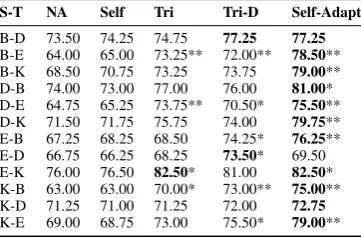
1995;Abney,2007) (Self), Tri-training (Zhou and Li, 2005) (Tri) and Tri-training with diversifica-tion (Søgaard, 2010) (Tri-D). For each of those methods, we use the labelled data in the source domain as seeds and induce labels for the unla-belled data in the target domain. Table2 reports the results onMAD.
We re-implement the classical self-training methods considered by Ruder and Plank (2018) and evaluated them against the proposed
self-adapt on the same datasets, feature representations and settings to conduct a fair comparison. All clas-sical self-training methods were trained using the source domain labelled instancesSLas seed data. As discussed in Section3.2, similar toSelf-Adapt, we observed that the performance did not signifi-cantly increase beyond the first iteration for any of the classical self-training methods in UDA. Con-sequently, we compare all classical self-training methods for their peak performance, obtained after the first iteration. We tune the confidence thresh-old τ for each method using validation data and found the optimal value of τ to fall in the range [0.6,0.9]. k is a hyperparameter selected using validation dataset forSelf-Adaptin comparison.
Experimental results onMADandEMADare shown respectively in Tables2and4. From those Tables, we see that Self-Adapt for most of the domain pairs performs similarly or slightly worse thanNA. AlthoughTriandTri-DoutperformNA on all cases, we found that those two methods are highly sensitive to the seed instances used to ini-tialise the pseudo-labelling process. We find the proposed Self-Adapt to outperform all classical self-training based methods in 11 out of 12 do-main pairs in MADand in all 16 target domains inEMAD, showing a strong and robust improve-ment over classical self-training methods. This re-sult shows that by combining source and target do-main projections with self-training, we can obtain superior performance in UDA in comparison to us-ing classical self-trainus-ing methods alone.
S-T NA Self Tri Tri-D Self-Adapt B-D 73.50 74.25 74.75 77.25 77.25 B-E 64.00 65.00 73.25** 72.00** 78.50** B-K 68.50 70.75 73.25 73.75 79.00** D-B 74.00 73.00 77.00 76.00 81.00* D-E 64.75 65.25 73.75** 70.50* 75.50** D-K 71.50 71.75 75.75 74.00 79.75** E-B 67.25 68.25 68.50 74.25* 76.25** E-D 66.75 66.25 68.25 73.50* 69.50 E-K 76.00 76.50 82.50* 81.00 82.50* K-B 63.00 63.00 70.00* 73.00** 75.00** K-D 71.25 71.00 71.25 72.00 72.75 K-E 69.00 68.75 73.00 75.50* 79.00**
Table 2: Target domain test data classification ac-curacy of classical self-training methods when ap-plied to UDA.
4.3 Comparisons against Neural UDA
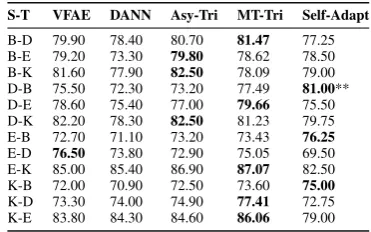
In Table 5, we compare Self-Adapt against the following neural UDA methods on MAD: Variational Fair Autoencoder (Louizos et al.,
Asymmet-Target Domain NA Sprj Sprj+PL Sprj+Tprj
apparel 71.39 75.31 75.66 76.68*
baby 68.00 71.06 71.37 72.63
beauty 69.66 73.20 73.18 73.70
camera and photo 68.46 73.46 74.02 74.54*
computer and video games 61.78 67.38 67.85 68.11*
gourmet food 72.34 81.13** 82.89** 83.15**
grocery 71.01 76.90* 77.57 * 78.14*
health and personal care 65.85 68.38 68.67 69.24
jewelry and watches 68.90 77.86** 79.11** 79.79**
magazines 65.28 71.54* 71.45* 72.16*
music 66.27 70.69 70.89 71.41
outdoor living 71.97 76.77 78.01* 78.93*
software 65.72 69.56 69.60 70.31
sports and outdoors 66.56 70.18 70.67 71.02
toys and games 69.57 72.82 73.22 73.65
video 64.19 67.59 68.37 68.97
Table 3: Average classification accuracy on each target domain inEMAD for the steps in the pro-posed method (k= 1).
ric Tri-training (Saito et al.,2017) (Asy-Tri), and Multi-task Tri-training (Ruder and Plank, 2018) (MT-Tri). We select these methods as they are the current SoTA for UDA on MAD, and report the results from the original publications in Table5.
Although only in 3 out of 12 domain-pairs Self-Adaptis obtaining the best performance, the dif-ference of performance betweenDANNand Self-Adapt is not statistically significant. Although MT-Triis outperformingSelf-Adaptin 8 domain-pairs, it is noteworthy thatMT-Triis using a larger feature space than that of Self-Adapt. Specif-ically, MT-Tri is using 5000 dimensional tf-idf weighted unigram and bigram vectors for repre-senting reviews, whereas we Self-Adapt uses a 300 dimensional BonG representation computed using pre-trained GloVe vectors. Moreover, prior work on neural UDA have not used the entire un-labelled datasets and have sampled a smaller sub-set due to computational feasibility. For exam-ple, MT-Triuses only 2000 unlabelled instances for each domain despite the fact that the original unlabelled datasets contain much larger numbers of reviews. This is not only a waste of available data but it is also non-obvious as how to subsam-ple unlabelled data for training. Our preliminary experiments revealed that the performance of neu-ral UDA methods to be sensitive to the unlabelled datasets used.3 On the other hand, Self-Adapt does not require sub-sampling of unlabelled data and uses all the available unlabelled data for UDA. During the pseudo-labelling step,Self-Adapt au-tomatically selects a subset of unlabelled target
in-3Unfortunately, the source code for MT-Tri was not avail-able for us to run this method with the same set of features and unlabelled dataset that we used. Therefore, we report the results from the original publication.
Target Domain NA Self Tri Tri-D Self-Adapt
apparel 71.39 71.38 73.96 73.89 76.68
baby 68.00 67.96 69.71 69.84 72.63
beauty 69.66 70.54 71.73 70.49 73.70
camera and photo 68.46 68.44 71.31 71.28 74.54* computer and video games 61.78 62.28 64.65 64.93 68.11* gourmet food 72.34 74.10 75.39 77.88 83.15** grocery 71.01 71.83 75.22 74.29 78.14* health and personal care 65.85 66.08 67.10 67.07 69.24
jewelry and watches 68.90 71.04 76.67** 76.21** 79.79** magazines 65.28 65.34 67.58 67.47 72.16* music 66.27 66.22 68.82 68.27 71.41
outdoor living 71.97 74.01 76.21 74.79 78.93* software 65.72 65.47 67.36 67.53 70.31
sports and outdoors 66.56 66.87 69.22 68.05 71.02
toys and games 69.57 70.03 71.76 72.32 73.65
video 64.19 64.88 66.34 67.49 68.97
Table 4: Average classification accuracy on each target domain inEMADof classical self-training based methods when applied to UDA.
stances that are determined to be confident by the classifier more than a pre-defined thresholdτ. The ability to operate on a lower-dimensional feature space and obviating the need to subsample unla-belled data are properties of the proposed method that are attractive when applying UDA methods on large datasets and across multiple domains.
S-T VFAE DANN Asy-Tri MT-Tri Self-Adapt
B-D 79.90 78.40 80.70 81.47 77.25
B-E 79.20 73.30 79.80 78.62 78.50
B-K 81.60 77.90 82.50 78.09 79.00
D-B 75.50 72.30 73.20 77.49 81.00**
D-E 78.60 75.40 77.00 79.66 75.50
D-K 82.20 78.30 82.50 81.23 79.75
E-B 72.70 71.10 73.20 73.43 76.25
E-D 76.50 73.80 72.90 75.05 69.50
E-K 85.00 85.40 86.90 87.07 82.50
K-B 72.00 70.90 72.50 73.60 75.00
K-D 73.30 74.00 74.90 77.41 72.75
K-E 83.80 84.30 84.60 86.06 79.00
Table 5: Classification accuracy compared with neural adaptation methods. The best result is bolded. Statistically significant improvements overDANN according to the binomial exact test are shown by “*” and “**” respectively at p = 0.01andp= 0.001levels.
5 Conclusions
References
Steven Abney. 2007. Semisupervised Learning for Computational Linguistics, 1st edition. Chapman & Hall/CRC.
Sanjeev Arora, Mikhail Khodak, Nikunj Saunshi, and Kiran Vodrahalli. 2018. A compressed sensing view of unsupervised text embeddings, bag-of-n-grams, and LSTMs. InInternational Conference on Learn-ing Representations.
John Blitzer, Mark Dredze, and Fernando Pereira. 2007. Biographies, bollywood, boom-boxes and blenders: Domain adaptation for sentiment classi-fication. InProc. of ACL, pages 440–447.
John Blitzer, Ryan McDonald, and Fernando Pereira. 2006. Domain adaptation with structural correspon-dence learning. InProc. of EMNLP, pages 120–128.
Avrim Blum and Tom Mitchell. 1998. Combining la-beled and unlala-beled data with co-training. In Pro-ceedings of the eleventh annual conference on Com-putational learning theory, pages 92–100. ACM.
Danushka Bollegala, Tingting Mu, and Yannis Gouler-mas. 2015. Cross-domain sentiment classifica-tion using sentiment sensitive embeddings. IEEE Transactions on Knowledge and Data Engineering (TKDE), 28(2):398–410.
Danushka Bollegala, David Weir, and John Carroll. 2011. Using multiple sources to construct a senti-ment sensitive thesaurus for cross-domain sentisenti-ment classification. InACL/HLT’11, pages 132 – 141.
Danushka Bollegala, David Weir, and John Carroll. 2013. Cross-domain sentiment classification using a sentiment sensitive thesaurus. IEEE Transactions on Knowledge and Data Engineering, 25(8):1719 – 1731.
Minmim Chen, Kilian Q. Weinberger, and John Blitzer. 2011. Co-training for domain adaptation. In
NIPS’11.
Xia Cui, Frans Coenen, and Danushka Bollegala. 2017a. Effect of data imbalance on unsupervised domain adaptation of part-of-speech tagging and pivot selection strategies. In Proc. of the Wokshop on Learning With Imbalanced Domains: Theory and Applications (LIDTA) at the European Confer-ence on Machine Learning and Principles and Prac-tice of Knowledge Discovery in Databases (ECML-PKDD), pages 103–115.
Xia Cui, Frans Coenen, and Danushka Bollegala. 2017b. TSP: Learning task-specific pivots for un-supervised domain adaptation. In Proc. of the European Conference on Machine Learning and Principles and Practice of Knowledge Discovery in Databases (ECML-PKDD), pages 754–771.
Brett Drury, Lu´ıs Torgo, and Jose Joao Almeida. 2011. Guided self training for sentiment classification. In
Proceedings of Workshop on Robust Unsupervised and Semisupervised Methods in Natural Language Processing, pages 9–16.
Yaroslav Ganin, Evgeniya Ustinova, Hana Ajakan, Pascal Germain, Hugo Larochelle, Franc¸ois Lavi-olette, Mario Marchand, and Victor Lempitsky. 2016. Domain-adversarial training of neural net-works. Journal of Machine Learning Research, 17(59):1–35.
Arthur Gretton, Karsten M Borgwardt, Malte Rasch, Bernhard Sch¨olkopf, and Alex J Smola. 2006. A kernel method for the two-sample-problem. In Ad-vances in neural information processing systems, pages 513–520.
Diederik P. Kingma and Jimmy Ba. 2014. Adam: A method for stochastic optimization. CoRR, abs/1412.6980.
Christos Louizos, Kevin Swersky, Yujia Li, Max Welling, and Richard S. Zemel. 2015. The varia-tional fair autoencoder. CoRR, abs/1511.00830.
David McClosky, Eugene Charniak, and Mark John-son. 2006. Reranking and self-training for parser adaptation. InProceedings of the 21st International Conference on Computational Linguistics and the 44th annual meeting of the Association for Compu-tational Linguistics, pages 337–344. Association for Computational Linguistics.
Pietro Morerio, Jacopo Cavazza, and Vittorio Murino. 2018. Minimal-entropy correlation alignment for unsupervised deep domain adaptation. In Interna-tional Conference on Learning Representations.
Sinno Jialin Pan, Xiaochuan Ni, Jian-Tao Sun, Qiang Yang, and Zheng Chen. 2010. Cross-domain senti-ment classification via spectral feature alignsenti-ment. In
Proc. of WWW, pages 751–760.
Jeffery Pennington, Richard Socher, and Christo-pher D. Manning. 2014. Glove: global vectors for word representation. InProc. of Empirical Methods in Natural Language Processing (EMNLP), pages 1532–1543.
Rajat Raina, Alexis Battle, Honglak Lee, Benjamin Packer, and Andrew Y. Ng. 2007. Self-taught learn-ing: Transfer learning from unlabeled data. In
ICML’07.
Roi Reichart and Ari Rappoport. 2007. Self-training for enhancement and domain adaptation of statisti-cal parsers trained on small datasets. InACL 2007, pages 616 – 623.
Sebastian Ruder and Barbara Plank. 2018. Strong baselines for neural semi-supervised learning under domain shift. pages 1044–1054.
Anders Søgaard. 2010. Simple semi-supervised train-ing of part-of-speech taggers. InProceedings of the ACL 2010 Conference Short Papers, ACLShort ’10, pages 205–208, Stroudsburg, PA, USA. Association for Computational Linguistics.
Vincent Van Asch and Walter Daelemans. 2016. Pre-dicting the effectiveness of self-training: Appli-cation to sentiment classifiAppli-cation. arXiv preprint arXiv:1601.03288.
David Yarowsky. 1995. Unsupervised word sense dis-ambiguation rivaling supervised methods. In Pro-ceedings of the 33rd Annual Meeting on Association for Computational Linguistics, ACL ’95, pages 189– 196, Stroudsburg, PA, USA. Association for Com-putational Linguistics.
Ning Yu and Sandra K¨ubler. 2011. Filling the gap: Semi-supervised learning for opinion detec-tion across domains. In Proceedings of the Fif-teenth Conference on Computational Natural Lan-guage Learning, pages 200–209. Association for Computational Linguistics.