University of South Carolina
Scholar Commons
Theses and Dissertations
2015
Methods for Determining Grease Service Levels in
an AH-64D Intermediate Gearbox Using
On-Board Sensors
Travis Steven EdwardsUniversity of South Carolina - Columbia
Follow this and additional works at:https://scholarcommons.sc.edu/etd
Part of theMechanical Engineering Commons
This Open Access Thesis is brought to you by Scholar Commons. It has been accepted for inclusion in Theses and Dissertations by an authorized
administrator of Scholar Commons. For more information, please [email protected].
Recommended Citation
Edwards, T. S.(2015).Methods for Determining Grease Service Levels in an AH-64D Intermediate Gearbox Using On-Board Sensors.
M
ETHODSF
ORD
ETERMININGG
REASES
ERVICEL
EVELS IN ANAH-64D
I
NTERMEDIATEG
EARBOX USINGO
N-B
OARDS
ENSORSby
Travis Steven Edwards
Bachelor of Science
University of South Carolina, 2012
Submitted in Partial Fulfillment of the Requirements
For the Degree of Master of Science in
Mechanical Engineering
College of Engineering and Computing
University of South Carolina
2015
Accepted by:
Abdel Bayoumi, Director of Thesis
Joshua Tarbutton, Reader
A
CKNOWLEDGEMENTSI would first like to thank Dr. Abdel Bayoumi for allowing me the opportunity to
be a part of the CBM team and giving me the support to pursue this degree. Of course I
would not be to this point in my life if it were not for the continued support from my
friends and family, especially my parents, Roger and Laura Edwards. I am also very
grateful to have such an excellent team of operators and support staff who are involved
with CBM that made being a part of this program so rewarding, especially Erin
Ballentine and Thomas Hartmann. I would also like to thank Andrew Patterson for
reviewing my thesis multiple times and always making himself available to provide
A
BSTRACTThe intermediate gearbox (IGB) on the AH-64D was chosen as the subject for this
study based on the persistent grease leaks that require grounding aircraft. The aircraft is
not currently equipped with a method of detecting grease loss during flight, so techniques
for analyzing the usefulness of old metrics and possible new techniques can be tested.
The main objective of this study is to use the aircraft’s on-board sensors to develop a
method of determining the lubrication level of the IGB. Currently, the most reliable
method for detecting a fault on the aircraft is through the use of vibration-based condition
indicators (CIs). The results of this research show a negative correlation between
vibration and grease service levels when analyzing specific CIs for the IGB on the
AH-64, which can be basis for automated leak detection.
Another objective of this study is to quantify the standard operational grease level
for IGBs in the AH-64 fleet. This standard would be created by measuring the amount of
grease left in each gearbox after burping. This grease level would then be used to insure
that if lubricant was leaking out of the component, it is due to a fault instead of an
overfilled article. If the level is the same for each gearbox then a new standard can be
implemented to prevent burping. By being able to use an installed on-board sensor to
indicate the level of grease in the gearbox this would relieve the burden of the maintainer
from having to check the level every 25 flight hours. The soldier would then be able to
For this analysis three gearboxes of similar condition were used. Each one was
run for two hours at five different grease service levels of 0%, 25%, 50%, 75%, and
100%, based on the Army Depot standard amount of 964 grams. These gearboxes were
tested on the USC tail rotor drivetrain (TRDT) test stand according to a test plan defining
operational conditions. The test plan specifies torque and speed values that are similar to
those experienced by the component during flight. The existing on-board modernized
signal processing unit (MSPU) CIs, the raw time-domain data, and temperature data were
collected and analyzed to try and identify a CI to indicate grease level.
By using statistical analysis tools and some know fault cases. CIs can give the
user a different view into the operation of the gearbox as opposed to standard vibration
analysis. This happens to hold true for this experiment, in which investigation of the two
CIs, output bearing energy and input bearing energy, revealed an inverse correlation
between grease level and vibration magnitude. Out of the two algorithms mentioned, the
input bearing energy had the strongest correlation, making it the best candidate for
monitoring grease level through vibration in the field. The raw vibration data collected,
unlike the conditioned MSPU, data was too noisy and did not yield any valuable results.
It was also noted that gearbox temperature increased as the grease service level increased;
this was unexpected because it was believed that the greater the service level of the
component, the lower the operating temperature would be. This trend was more stable
and consistent from gearbox to gearbox than the one seen using the vibration data. These
results prove that it is possible to monitor the quantity of grease in the gearbox through
on-board sensors, and also serve as a testament to the usefulness of putting
T
ABLE OFC
ONTENTSAcknowledgements ... iii
Abstract ... iv
List of Tables ... ix
List of Figures ...x
List of Symbol... xii
List of Abbreviations ... xiv
CHAPTER 1: Introduction ...1
1.1 Background ...1
1.2 Literature Review ...2
1.3 Problem Definition ...5
1.4 Solution Proposal ...5
1.5 Overview ...7
CHAPTER 2: Condition Monitoring Theory and Techniques ...9
2.1 Run-to-failure Management ...9
2.2 Time-Based Maintenance ...9
2.4 Testing ...11
2.5 IGB Overview ...12
2.6 Sensors ...13
2.7 Digital Signal Acquisition ...14
2.8 Temperature Analysis ...14
2.9 Vibration Analysis...15
2.10 Time-Domain Analysis ...16
2.11 Frequency-Domain Analysis ...18
CHAPTER 3: Experimental Program and Test Facility ...22
3.1 IGB ...23
3.2 Instrumentation and Data Acquisition System ...24
CHAPTER 4: Experimental Procedures ...28
4.1 Gearbox Changeout ...28
4.2 Pre-run Procedures ...29
4.3 Running Procedures ...30
CHAPTER 5: Experimental results and discussion of current condition indicators ...32
5.1 Raw Vibration Results ...33
5.2 MSPU CI Results ...36
5.3 Temperature Results ...42
5.5 Grease Ejection Results ...48
CHAPTER 6: Conclusion ...51
References ...54
Appendix A – Pre-Run Inspection ...58
L
IST OFT
ABLESTable 4.1. List of Tests ... 28
L
IST OFF
IGURESFigure 1.1 Tail Rotor Gearbox Vertical Bearing Energy measured over time ...6
Figure 2.1 Diagram of Intermediate Gearbox [7] ...12
Figure 2.2 Sweep test results for virgin grease and an IGB and TGB grease sample ...13
Figure 2.3.A flowchart of signal processing analysis [14] ...16
Figure 2.4 Flow chart of transforming raw vibration into a CI value [15] ...21
Figure 3.1 Comparison between the aircraft and USC test stand ...22
Figure 3.2 Internal view of the IGB [7] ...24
Figure 3.3 Model of MSPU ...25
Figure 3.4 Sensor layout of the IGB ...27
Figure 4.1 A comparison, from a previous experiment, of worn gear teeth (left) to healthy teeth (right)...29
Figure 4.2 Breather port adapter setup ...30
Figure 5.1 List of IGB condition indicators monitored by the MSPU...32
Figure 5.2 An example of a FFT made from vibration data ...33
Figure5.4 Gearbox #3 vibration results ...35
Figure 5.5 Graph displaying two CI values for gearbox #1, Output Bearing Energy(Left) and Input Bearing Energy(Right)...37
Figure 5.6 Graph displaying two CI values for gearbox #2, Output Bearing Energy(Left) and Input Bearing Energy(Right)...38
Figure 5.7 Graph displaying two CI values for gearbox #3, Output Bearing Energy(Left) and Input Bearing Energy(Right)...39
Figure 5.8 Graph displaying normalized Output Bearing Energy CI results across gearboxes ...40
Figure 5.9 Graph displaying normalized Input Bearing Energy CI results across gearboxes ...41
Figure 5.10 Temperature of gearbox #1 at various grease levels ...43
Figure 5.11 Temperature of gearbox #2 at various grease levels ...44
Figure 5.12 Temperature of gearbox #3 at various grease levels ...45
Figure 5.13 Temperature correlation to grease lubrication level ...46
Figure 5.14 Estimated grease level based on the sensor fusion equation created ...48
L
IST OFS
YMBOLSRMS is the root mean square value of dataset x(n)
xn is a data series of length N
N is the number of points in dataset x(n)
G(f) is the representation of g(t) in the frequency domain
g(t) is any arbitrary signal in the time domain
xn is a data series of length N
K is the Kurtosis of the signal x of length N
xi is the amplitude of the signal of the i-th sample
̅ is the arithmetic mean of the signal x
di is the amplitude of the i-th point of the difference signal
̅ is the arithmetic mean of the difference signal d
N is the length of the difference signal
EL is the estimated grease level
B is constant of value -0.0115
L
IST OFA
BBREVIATIONSAED ... Aviation Engineering Directorate
AH ... Attack Helicopter
CBM ... Condition-Based Maintenance
CI... Condition Indicator
DAQ ... Data Acquisition
FM4 ... Fourth Order Figure of Merit
FPG ... Flat Pitch Ground
GBS ... Ground Based Station
HUMS ... Health Usage Monitoring System
IGB ...Intermediate Gearbox
MSPU ... Modernized Signal Processing Unit
SCARNG ... South Carolina Army National Guard
TGB... Tail Rotor Gearbox
TRSP ... Tail Rotor Swashplate
USC ... University of South Carolina
CHAPTER
1:
I
NTRODUCTION1.1 Background
Historically, it has been observed that some of the most common maintenance
faults for the attack helicopter (AH)-64D gearboxes are related to leaking or ejected
grease. Some of these issues present only an inconvenience to maintenance crews, while
others require extensive maintenance procedures or part removals [1]. Though the
maintenance actions are relatively minor, the frequency of the fault causes the cost to add
up over time. The intermediate gearbox (IGB), which changes the angle of the drive train
and has been chosen as the subject of this study due its propensity to leak grease
Condition monitoring technologies that determine the health of a machine are
crucial for implementing novel maintenance practices; this set of ideas is called
Condition-Based Maintenance (CBM). Industry standards for CBM focus mainly on
vibration analysis, with some input from temperature signatures [4]. Vibration has
proven itself to be a better indicator of failure because it displays a slow trend over time
whereas temperature change is much more sudden and tends to occur near the very end of
a component’s life. Therefore vibration is considered a more promising candidate for
1.2 Literature Review
In the past, researchers have mostly focused their efforts on mechanical faults of
machine components with sensors through condition-based maintenance, but seldom look
at how to determine lubrication level in bearings and gearboxes. A few engineers have
shown interest in gearbox element lubrication level and have conducted several studies in
the past using different CBM techniques.
Lee et al. was able to accurately predict gearbox lubrication in wind turbine
planetary gears by using partial swarm optimization and weighted k-nearest neighbor
algorithms on vibration data with an average confidence level of 87%.
The experiment ran 100 lubrication samples in a 10:1 planetary gearbox at 11
different levels. Each test was run at 4,000 rpm with various loading on a test bed that
consisted of a motor and generator. The data was later divided into 990 training samples
and 110 test data sets and analyzed using KNN. Both the current and vibration signals
were studied from the gearbox
The study needs to be further analyzed because only one gearbox was used and
the findings focused heavily on a current signal, which cannot be collected for the
AH-64D using on-board sensors for the IGB. The gearbox was also not exposed to the same
loading conditions as an AH-64 and contained planetary gears instead of duplex gears.
The group also neglected to analyze temperature as a possible source of grease level
indication.
Parikka et al. found that in roller element bearings the most sensitive frequencies
frequencies were the most sensitive to lubrication changes. He also found temperature to
be strong indicator of lubrication level because operating conditions decreased by 50°F
throughout the experiment. He believed this correlation may possibly be used in the
determination of optimal re-greasing interval and quantity.
His group used a bearing test stand that was run for approximately 225 hours with
15kN of load applied at a speed between 0 and 2,500 rpm. Temperature, vibration, and
acoustic emission were monitored continuously throughout the experiment. The bearing
was tested until regreasing was necessary and then continued to run. The experiment was
completed three different times with comparable results from each series.
This failed to analyze other rotating machinery and only studied a bearing, not
looking at the regreasing of gearboxes. The study was also completed at a speed and
torque that was much lower than the standard operating rpm for the AH-64. The data
was also processed using a small amount of condition indicators. This study was more of
a proof of concept because no prediction or statistical analysis was conducted.
Niknam et al. used acoustic emission to try and identify when rotating component
was dry or lubricated. He successfully completed this study, but only on components that
were running between 60-100 Hz.
Eight rotational speeds (30-100 Hz) and four levels of radial load were applied to
various dry and lubricated bearings. The acoustic emissions data was recorded
throughout all of the runs and analyzed.
An acoustic emission recorder is not a common sensor on the aircraft and to
weight. The work was only presented as a proof of concept because there was no
analysis done to prove how much grease had been lost from the rotating component. In
order to implement this in the field and be able to service properly a correct amount of
grease would need to be applied to the gearbox to avoid over servicing.
Nooli et al. did work to prove that the simultaneous mechanical and thermal
effects of the gearbox cause it to lose viscosity, which leads to the loss of grease in the
aircraft gearbox. He showed that current condition indicators on the aircraft were not
viable for TGB grease leakage detection. His work called for further explanation into the
cause of this grease property change and how it affects the overall life of the IGB.
His team tested three different tail rotor gearboxes that were lubricated a specified
amount and gradually drained as the test progressed, all of the grease ejected after 150
hours of testing. The purpose of this work was to try and detect faults due to tooth wear
of a component. Each of these articles were test under normal flight loading conditions
and were run for an average of 500 hours, some ran longer than others.
This work did not look at temperature in-depth as a source for grease detection.
Also there was no conclusion as to a possible earlier indicator for grease leakage on the
gearbox. There have been further advances in the condition indicators on the gearbox
since this work was published, which could be analyzed further and possibly hold the
answer to an early leak detection algorithm.
His work called for further explanation into the cause of this grease property
of using software and sensors native to the aircraft to determine the grease lubrication
level in the IGB on the AH-64 [14, 20, 21, 29].
1.3 Problem Definition
To detect physical changes in the helicopter components, condition indicators
(CIs) are calculated using various algorithms. However, there are limitations on the
extent at which CIs can detect problems since each of these algorithms is not targeted to
every specific type of fault. Presently, there is no CI value to tell the maintainer the
lubrication level, so it must be checked every 25 flight hours by a maintainer using a
special tool designed for checking both the tail rotor and intermediate gearboxes.
This problem introduces the two objectives of this work: One is to create a safer,
more reliable helicopter by establishing a CI that can detect grease loss and allow the
maintainer to properly service the gearbox without the need to add any additional sensors
to an aircraft. The second is to accurately quantify the amount of grease that the gearbox
is serviced with to help prevent the further unnecessary loss of lubrication from the IGB.
If an indicator can be created from this CI, which warns when the grease level has
dropped, then maintainers can skip level testing every 25 flight hours which will lead to
time savings and cost avoidance.
1.4 Solution Proposal
Experimentation is required to determine if a correlation exists between the grease
service level and the vibration magnitude of the IGB. If no correlation exists, current
maintenance practices are confirmed and a grease level monitoring system via vibration
One of the benefits of having components run on a test stand rather than on an
aircraft is that experiments can be conducted safely and are more cost effective. The
safety of the testing setup has allowed the University of South Carolina (USC) to conduct
an experiment in which three tail rotor gearboxes (TGB) were run-to-failure, which
averaged out to 500 hours each, with no grease in the component housing. During one of
those runs, it was noticed that the vibration levels changed after being serviced with
grease, leading to this investigation. The change due to grease addition appeared in the
Tail Rotor Gearbox Vertical Bearing Energy CI (Figure 1.1). Grease was added on
January 15th and a significant drop in vibration can be seen following that date (denoted
by the red arrow).
Figure 1.1 Tail Rotor Gearbox Vertical Bearing Energy measured over time
Though this change was noted, no further research was conducted and the
correlation between grease level and vibration remained unconfirmed and
uncharacterized. The expected outcome of further experimentation is that the grease
level is a critical factor to the performance of the helicopter and that when the grease
using on-board CIs, maintenance practices can be changed from the current time-based
scheduling to a condition-based procedure contingent on vibration levels in the gearbox.
Furthermore, if the correlation is determined to be consistent between gearboxes, a
standard minimum grease service level can be set.
1.5 Overview
This thesis is formatted into six chapters that go through the research experiment
conducted; starting from the theory and practice and ending at the results and suggestions
for future work. This chapter introduces the goals of the research, condition-based
maintenance, define the project, and suggest a solution for how to solve the problem.
The second chapter presents the theory and background of the project by first
introducing three different maintenance practices and the positive and negative ideas
associated with machine maintenance. Then it transitions into how to properly test
components and the specific options for sensors. Finally, digital source collection
practices are covered and how to analyze the specific types of data that were acquired
during this experiment.
The third chapter gives an overview of the experimental setup, including the test
stand at USC, and then goes into detail about the sensor setup first through the different
data acquisition systems used, and then the specifications of each type of sensors from
which data is collected.
The fourth chapter covers the actual experiment conducted and the parameters in
which it followed during testing. These include the change outs of the gearboxes and the
The fifth chapter is the results of the experiment mentioned above. These include
the raw vibration data that came from the USC DAQ and a select few CIs from the health
usage monitoring system (HUMS) box that is installed on most of the aircraft. Other
results include operating temperature of the gearbox and grease ejection for the duration
of the tests.
The sixth chapter concludes the work, explaining the benefits of the work and the
CHAPTER
2:
C
ONDITIONM
ONITORINGT
HEORY ANDT
ECHNIQUES2.1 Run-to-failure Management
Run-to-failure is an idea that was institutionalized at the height of the Industrial
Revolution. The objective is to maximize the productivity of each machine by running it
until it stops working. This style of maintenance is the basis of the quote, “If it ain’t
broke, don’t fix it.” While this style does get the most life out of each component, the
downtime and financial burden placed on the company during the unforeseen
maintenance outweighs the benefit of longer life.
2.2 Time-Based Maintenance
Time-based maintenance, also known as preventative maintenance, attempts to
head off the problems caused by the run-to-failure method by scheduling service times.
This method of servicing equipment is implemented according to standards set forth by
the manufacturer so that certain actions will occur at specific intervals of run-time. A
common example of this form of upkeep is oil changes being performed between every
3,000-7,500 miles on automobiles. This maintenance practice does allow for a smaller
stock of parts and less standby equipment, but the constant maintenance being performed
on the component makes it more vulnerable to failure. Time based maintenance does
make the user aware of downtime, but it still does not maximize the life of the
2.3 Condition-Based Maintenance (CBM)
By utilizing condition-based maintenance, the operator can be warned when the
component is about to fail through sensor-based analysis of the machine. Through data
collected, such as vibration and temperature, the maintainer can be notified when the
performance is degrading. If done correctly, a user can schedule maintenance closer to
the time-of-failure and at a time that is convenient to the rest of the facility. Condition
indicators (CI) are algorithms that are a more quantifiable way to describe the health of a
component without having to wait until failure. Temperature and vibration are two
reliable sources of data for CIs that may detect faults in a component that would not be
noticed through normal operation inspections. Temperature also serves as a good
condition indicator because a sudden rise indicates a component is near the end of its
service life and needs to be taken offline immediately. This form of service does have a
high initial start-up and requires frequent access to equipment [13]. CBM is the most
preferred form of maintenance because it gives the user the ability to see how the
machine is functioning and allows him to properly control downtime.
2.3.1 Smart Predictive Systems (SPS)
The SPS method is the future of machinery maintenance: it combines historical
data, test stand data, and simulation data to create algorithms that can predict the amount
of life left in a component based on the operating conditions. It takes data collected using
condition-based maintenance a step further because it can accurately predict the run time
of a particular component by fusing the three aforementioned data sources. In CBM,
thresholds on a component can only be applied based on testing, but those thresholds are
testing should be completed so that reliable CIs can be created. Being based on statistical
information from failure history and test stand data, it yields the best results for
predicting component failure based on average operating conditions [12]. The best
model is one that combines physics based simulations and reliability information and will
lead to steady improvement in prognostics maintenance in the future.
2.4 Testing
A test stand is used as a platform to get reliable data that would otherwise have to
come from the field. Testing facilities can be equipped with single components or entire
drive systems based on the need. This makes them a more cost effective option than
running an entire machine just to test a single component. Furthermore, the environment
can be controlled and faults can be introduced into the system where safety is not a
significant risk; unlike if the same procedure were being performed in the field. When
dealing with a system like an aircraft, it is much easier to perform a modification to a test
stand than on an aircraft in the fleet. One of the goals of testing is to be able to accurately
compare data between components run on a test stand to the data that would come off of
an article being run in the field.
Although testing in a controlled environment may not exactly replicate every
extreme situation seen by an aircraft it can still provide valuable information about the
operating characteristics. Being able to have control over certain variables allows the test
stand operator to create some conditions, like a misaligned driveshaft, that are more
extreme than normal conditions. Testing allows for the upper limits of the flight
envelope to be pushed and surpassed in a safe environment so that the limits of
2.5 IGB Overview
The purpose of the IGB on the AH-64D is to change the direction of the drive as
well as output speed. The main components of the IGB are the input rolling bearing,
input duplex bearing, output duplex bearing, and output roller bearing. The primary
lubricant on the IGB is NS 4405-FG grease, which has lithium complex as thickener and
is of NLGI grade 000 [21]. The AH-64 uses grease as a lubricant because of its high
viscosity characteristics; this allows the lubrication of the gearboxes to continue to
function if the component happened to be damaged.
A naturally occurring fault of the IGB is the ejection of grease from the breather
port; even newly serviced AH-64D IGBs have been found to eject large volumes of
grease. This fault could require the aircraft to land for immediate maintenance, which is
the focus of this experiment (Figure 2.1).
Figure 2.1 Diagram of Intermediate Gearbox [7]
A common belief is that the ejection occurs when the grease is exposed to
in-flight operating conditions. The physical and rheological properties of the grease change
after a certain period of time even when the temperatures are within operating limits [3].
of mechanical and thermal loads. Rheological characterization of the IGB grease
samples revealed reduction in their apparent viscosities when compared to the virgin
grease at shear rates tested (Figure 2.2).
Figure 2.2 Sweep test results for virgin grease and an IGB and TGB grease sample
2.6 Sensors
Sensors commonly used in the CBM field collect vibration, temperature, acoustic,
speed, and torque data. Vibration is normally collected through piezoelectric devices
known as accelerometers, and is regarded as one of the most critical pieces of data
collection for CBM. Although an increase or decrease in amplitude may indicate a
change in the system, this is not always true; therefore, every change in vibration source
should be well characterized [13]. The system’s speed is measured with a magnetic
correct speed and also plays a vital role in calculating some CIs which require knowledge
of the exact speed of rotation. Along with speed, torque is also measured using the USC
DAQ. This ensures that nothing critical is being altered by a component on the drivetrain
that would stop power from being transmitted. Temperature is normally collected
through thermistors on the aircraft which detect overheating in components, usually
indicating imminent failure. Thermocouples are used on the test stand to provide a wider
measurement range. Temperature and vibration analysis techniques can be used to
provide managers with information that will allow them to achieve improved reliability
and availability by detecting failures before they occur [13].
2.7 Digital Signal Acquisition
An analog signal is a signal that is continuous in both time and amplitude. In
contrast, a digital signal is discrete in both the time and the amplitude and can only accept
a finite number of values. The continuous time domain is used to convert a signal to the
discrete time domain signal, where the analog signal is sampled at certain intervals of
time [11]. When trying to find out the best method to collect digital signal the user needs
to know the desired resolution, the sample rate, and the expected frequencies to measure.
2.8 Temperature Analysis
The temperature analysis used focuses on normal thresholds set on a components
current temperature and thermal time gradient. Once it exceeds these limits, failure is
expected. The short time between reaching the threshold limit and failure makes
temperature monitoring a poor way to predict a components health. Despite the short
system, such as grease loss, because the different operating condition might change the
steady state temperature of the gearbox.
2.9 Vibration Analysis
Predictive maintenance through vibration is based on two ideas: (1) all common
failure modes have unique vibration signatures that can be isolated and identified, and (2)
the amplitude of that signature will not change unless altered by the system dynamics
[13]. Discussed in the next sections are the CIs, based on time and frequency data, most
relevant to the IGB, which was used in this experiment. The block diagram shown below
in Figure 2.3 demonstrates how raw vibration data is used create a CI value that can be
used to determine whether or not a vehicle is fit for continued use. Not only can the
health of the component be observed, but the life of a component can be predicted by
Figure 2.3 A flowchart of signal processing analysis [14]
2.10 Time-Domain Analysis
Time-domain data is the most basic form of data that comes from a vibration
sensor; its output is vibration versus time. Time-domain plots are critical for all linear
motion machinery, but are often difficult to use to diagnose one specific component in a
system. Their ability to show the health of the system by representing the total
displacement at any time does make them a useful tool for CBM practices [12].
2.10.1 RMS Value
would be .577 volts. The main usage of this parameter is to view the overall condition of
the gearbox without identifying exactly what is the problem [15].
RMS is the root mean square value of dataset x(n)
xn is a data series of length N
N is the number of points in dataset x(n)
2.10.2 Maximum Amplitude
The maximum amplitude is simply the peak of a waveform in either a time or
frequency domain. Although it may be a simple concept, it can be a very powerful
indicator of performance. It can be used to measure fault progression over a period of
time because a larger defect should result in higher vibration.
2.10.3 Time Synchronous Average
Time synchronous averaging is a way of detecting a signal in uncorrelated noise
by sampling based off a trigger (like a tachometer pulse) to achieve a better
understanding of the condition of the system [21]. To do this properly, every frequency
has to be analyzed individually. It is a useful parameter for identifying faults in a specific
component because when comparing a certain frequency with an expected signal, the
change and error can be calculated. An example is a small fluctuation in speed can look
like a frequency shift even though no damage has occurred to the system. This particular
tachometer pulses rather than a theoretical number, but others cannot so a new domain
analysis needs to be established.
2.11 Frequency-Domain Analysis
Frequency-domain analysis is the most widely used diagnostic tool for predictive
maintenance. The main concept behind this parameter is changing the time series data
into the frequency domain using integral techniques. Since the time domain only allows
a fault to be established in the system and not further investigated another technique
needs to be used. Frequency-domain analysis approaches are more precise, so condition
monitoring that can focus on frequencies generated by an exact component, allowing
analysis of faults directly instead of the entire systems response to the fault.
2.11.1 Fourier Transform
The Fourier Transform is the most widely used technique for getting frequency
data. It is a very simple and efficient algorithm that saves valuable computational when
calculating the standard discrete Fourier transform (DFT). The DFT takes a time domain
signal and calculates all of the frequencies present in the signal. It is a lossless
transformation where only the dependent variable is changed, the time domain to the
frequency domain. This is a critical device when analyzing a device that is as sensitive to
frequency changes as a drivetrain.
G(f) is the representation of g(t) in the frequency domain
2.11.2 Gear Failure Diagnostic Techniques
Gear signals normally yield harmonics of associated shaft speeds. The
frequencies can be dependent on three different variables: tooth deflection due to the
torque in the system which can cause spalls or cracks, an error in manufacturing which
caused the tooth spacing to be off, and uniform wear over all the teeth [12]. The next
condition indicator presented is the main source of data collected in this paper; although
other techniques were used they did not yield the desired results.
2.11.3 Kurtosis
The absolute Kurtosis is defined as the fourth statistical moment of a signal about
the mean of the signal [15]. The purpose of this tool is to identify how sharp the peaks
are in any signal.
K is the Kurtosis of the signal x of length N
xi is the amplitude of the signal of the i-th sample
̅ is the arithmetic mean of the signal x
2.11.4 Fourth-Order Figure of Merit
The fourth-order figure of merit, FM4, was an early gear diagnostic technique of
time-based approaches [12]. It uses the Kurtosis of the current operating condition, generated
by subtracting the time domain data from the baseline gear mesh pattern, and is then
normalized by the difference signal’s variance squared [9] (Figure 2.4). One of the only
drawbacks of FM4 is that if more than one gear tooth fails, the response becomes less
pronounced [15].
FM 4 is the fourth-order figure of merit
di is the amplitude of the i-th point of the difference signal
̅ is the arithmetic mean of the difference signal d
Figure 2.4 Flow chart of transforming raw vibration into a CI value [15]
2.11.5 Bearing Energy
Bearing Energy uses a bandwidth that includes the IGB’s ball bearing frequencies
and has reject frequencies that are associated with other drive shafts in the system [17].
There are no fault cases associated with this CI, and it is purely based on theoretical
CHAPTER
3:
E
XPERIMENTALP
ROGRAM ANDT
ESTF
ACILITYFor over 15 years, the University of South Carolina (USC) has been collaborating
with the South Carolina Army National Guard (SCARNG). Combined efforts between
two parties led to a fully developed CBM Research Center within the USC Department of
Mechanical Engineering that hosts several aircraft component test stands in support of
CBM objectives. At the USC test stands, different CIs have been tested and validated to
detect faults that occur over the lifetime of various drivetrain articles including such
components as the AH-64D forward hanger bearing, aft hanger bearing, IGB, TGB, and
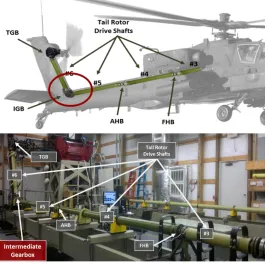
The test stand emulates the complete tail rotor drivetrain (TRDT) from the main
transmission to the tail rotor swashplate assembly. The TRDT is comprised of actual
aircraft hardware and is capable of handling drive shafts installed at the maximum
allowable misalignment of two degrees. Structure, instrumentation, data acquisition
systems, and supporting hardware are installed according to military standards. The test
stand’s two 800 horsepower motors are capable of exceeding 150% of the actual aircraft
drivetrain loading. The test stand was designed and built to accommodate the use of
various HUMS and is currently equipped with a Honeywell MSPU. USC’s own data
acquisition results have been validated with data obtained from actual airframes. The
testing facility is also capable of being modified to test new and existing drivetrain
components of military and civilian aircraft, including the ARH-70, CH-47, and UH-60
drivetrains [1].
3.1 IGB
The purpose of the IGB on the AH-64D is to change the drive direction as well as
output speed. The main components of the IGB are the input rolling bearing, input
duplex bearing, output duplex bearing, and output roller bearing (Figure 3.2). The IGB is
outfitted with two accelerometers and four thermocouples. The accelerometer and
Figure 3.2 Internal view of the IGB [7]
3.2 Instrumentation and Data Acquisition System
3.2.1 MSPU
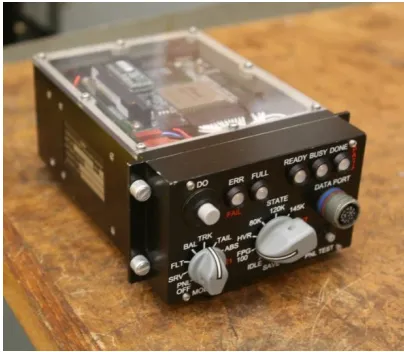
The MSPU is a Honeywell product that is the standard data acquisition unit for all
AH-64 aircraft participating in the HUMS program. It contains a high speed data
acquisition card, which can accommodate up to 36 accelerometer channels with
bandwidth of 1.5 KHz to 96 KHz, eight tachometers, two blade tracker channels, eight
general purpose analog or discrete channels, and eight low level analog signals [16].
Additional features of the MSPU include having a built in sensor test function to allow
the maintainer to diagnosis if a sensor is functioning correctly. It also has the capability
to calculate additional parameters which have been deemed by the aviation engineering
directorate (AED) as reliable to diagnose the mechanical systems through vibration. The
MSPU displays its results through a graphic user interface program known as PC-Ground
Based Station (GBS), which shows the user the current condition of each component on
Figure 3.3 Model of MSPU
3.2.2 Data Acquisition (DAQ)
Since the MSPU only outputs processed data, a second data acquisition unit is
required to capture raw vibration results and monitor additional parameters. USC has
equipped its test facility with a modular National Instruments DAQ unit with vibration
sensors and thermocouples which collect data off of the input motor, forward hanger
bearing, aft hanger bearing, intermediate gearbox, tail rotor gearbox, and tail rotor
swashplate. Other sensors have also been installed that allow for the collection of speed
and torque from both the input and output motor.
Data monitoring, storage and system control are all handled through the National
Instruments hardware, programmed in the LabVIEW environment. Operators monitor
the data on indicators that display current sensor values necessary to determine the
correct operation of the facility. In addition, the software has built in checks that check
the current value against the cut-off value used on the aircraft and alert the operator if the
On the back end, data is stored at different rates to facilitate analysis after runs are
completed. Temperature data is recorded at 30 Hz because it changes slowly over a run.
Speed and torque are updated at 60 Hz, since the load steps are changed quickly and
vibration is recorded at the fastest rate, 48 kHz.
3.2.3 Instrumentation
To replicate the data coming off of the MSPU the sensors that are used for USC’s
DAQ are in close proximity and in the same orientation as the military devices (Figure
3.4). The test stand is equipped with two different types of accelerometers, a spark plug
and bracket type. The spark plug configuration is a Dytran 3062A accelerometer that has
a frequency range of .48 Hz to 10 kHz and can read up to 500 G’s. The Dytran 3077A is
the bracket style accelerometer used on the stand and it covers the frequencies from .5 Hz
to 5 kHz and can read up to 500 G’s.
The thermocouples on the test stand are in the same location as where the
thermistors would be on the aircraft. The thermocouples used are Type K, which is the
most inexpensive and common style used, and have the capability to read between -201
°C and 1349 °F, which is well within the gearbox operating range. In spite of their
commonality, the sensitivity, 41µV/°C, is accurate enough for this application, making
v
Figure 3.4 Sensor layout of the IGB 1
Thermocouples
2
Accelerometer
1
1
1
CHAPTER
4:
E
XPERIMENTALP
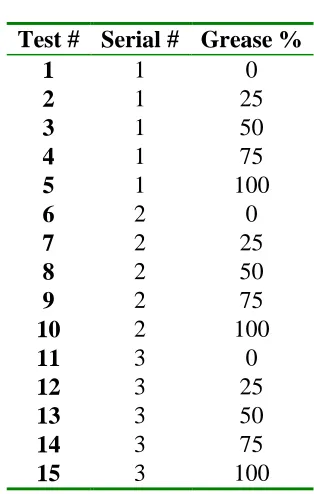
ROCEDURESThis experiment was conducted using three intermediate gearboxes, each run at
five different service levels of grease (0%, 25%, 50%, 75%, and 100%); these levels will
be calculated based off of the Army standard for a fully lubricated gearbox (964 grams of
grease). These tests totaled approximately 34 hours of testing. It was decided that all of
the gearboxes should start at 0% grease and increase to 100% as shown in Table 4.1.
Table 4.1. List of Tests
Test # Serial # Grease %
1 1 0
2 1 25
3 1 50
4 1 75
5 1 100
6 2 0
7 2 25
8 2 50
9 2 75
10 2 100
11 3 0
12 3 25
13 3 50
14 3 75
15 3 100
4.1 Gearbox Changeout
After every fifth test in Table 4.1 the IGB was removed and left to sit overnight
second. A borescope was used to check the lubrication level of the gearbox(Figure 4.1).
During this part of the procedure, any damage to the gearbox could be noted.
Figure 4.1 A comparison, from a previous experiment, of worn gear teeth (left) to healthy teeth (right)
4.2 Pre-run Procedures
The operators consider the test stand as an actual aircraft and it is treated with the
same standards. Before each run, an inspection of the test stand is conducted. Additional
inspection measures were implemented (i.e. grease ejection monitoring, and the removal
of unnecessary equipment from the test stand since a new experiment was being
conducted). Additionally, the operators carefully monitor the data collection equipment
to ensure the measurements appear accurate and the ejected grease is collected. Excess
burped grease would normally dispense over the gearbox, but a special collection device
Figure 4.2 Breather port adapter setup
4.3 Running Procedures
The USC TRDT test stand operated with the standard test profile, shown in Table
4.2, built to simulate the flight characteristics of the AH-64D gearboxes. These numbers
were agreed upon by AED and USC as the load steps to best represent the damage
accrued by the gearboxes during flight. Flat Pitch Ground (FPG) 101 is when the aircraft
is sitting with no pitch in the blades and the rotor is running at 101% of maximum speed,
approximately 4863 rpm. During this time, a survey is taken and data is collected by the
Table 4.2. Modified TRDT Load Profile
Load Step Run Time (minutes)
Elapsed Time (minutes)
Speed (rpm)
Torque (ft-lbs) HP
FPG 101 00:05-00:15 10 4863 111 30
Normal 00:15-01:05 50 4863 371 100
FPG 101 01:05-01:15 10 4863 111 30
Normal 01:15-02:05 50 4863 979 264
CHAPTER
5:
E
XPERIMENTAL RESULTS AND DISCUSSION OF CURRENTCONDITION INDICATORS
The main objective of this experiment was to determine if a trend for vibration
with different grease service levels exists across multiple gearboxes. This analysis was
done for three different gearboxes by using two different vibration analysis techniques:
one used the CI values from the MSPU (Figure 5.1) and the other was looking at known
frequencies of interest in the raw vibration data. The CI values were taken directly from
the PC-GBS. The raw vibration data was collected by the USC DAQ at 48 kHz from an
accelerometer in a similar position to that of the aircraft standard.
5.1 Raw Vibration Results
The raw vibration results were collected off of the USC DAQ and analyzed using
a FFT. A list of important operating frequencies of the IGB was used to analyze the data.
A band of ±1% was placed on the important frequencies to account for shifts in peaks due
to this analysis being done on a real system which may not have the same aircraft
standard operational speed of 4863 rpm every time it conducts an experiment. An
example FFT is shown below as well as some of the results from the IGBs (Figure 5.2).
Figure 5.2 Example of a FFT made from vibration data
It has been proven that it is possible to identify the vibration signatures of
different components of the system from a sensor located on a single component. For
example, when looking at the IGB vibration data, the natural frequencies of the aft hanger
bearing can be observed in the results taken from the IGB. Although this interference
makes it harder to observe trends in the data of a single component, it allows a more
complete model to be produced because it accurately represents the entire aircraft much
the extra data is filtered out and the results are based only on the IGB frequencies of
interest.
The IGB frequency results were computed using the method stated above by
selecting the magnitude of vibration at nearly 80 different frequencies. These come from
the Army’s list of calculated natural frequencies of the system components visible from
IGB sensors. These results were graphed and the slope was compared between gearboxes
at different service levels. A sample of these results for three frequencies (25.51 Hz, 27
Hz, and 33.78 Hz) is graphed below (Figure 5.3-5.4); the full list of slopes can be found
in Appendix B.
Figure 5.3 Gearbox #1 vibration results
The three frequencies shown above are just an example of all the frequencies
analyzed. The ideal trend would be downward starting at 0% grease and ending linearly
0 0.2 0.4 0.6 0.8 1 1.2
0% 20% 40% 60% 80% 100%
example frequencies: 25.51 Hz magnitude has a small trend upward, the 27 Hz result has
no trend, and the 33.87 Hz result has a slight upward trend.
Figure 5.4 Gearbox #3 vibration results
For gearbox #3 the results are exactly what were expected coming into this
experiment. All of the frequencies shown above have a sharp downward trend starting
0% grease level going to 100%. However, they are not ideal because the points do not
directly trend down, an example of this is in the 25.51 Hz result, the 25% and 50%
vibration magnitude were higher than 0%, and the 75% data point was lower than 100%.
Although the three example frequencies in gearbox #3 displayed the expected a
sharp downward trend as grease level increased versus vibration the results were not
consistent with gearbox #1. The non-repeatability between gearboxes makes the grease
estimation through the vibration’s maximum amplitude a poor indicator for the aircraft.
0 0.1 0.2 0.3 0.4 0.5 0.6 0.7
0% 20% 40% 60% 80% 100%
Since there was no correlation between the frequencies for both gearboxes no further
analysis was done for those values. After analyzing the rest of the critical frequencies for
the IGB in a similar fashion to the process that was described above, it was concluded
that none of the frequencies displayed the ideal characteristic of a lower vibration level as
grease level increased for any of the gearboxes tested. This could have been due to a
small amount of data points analyzed which could have been the cause for the less than
ideal results. More points analyzed could have also led to a stronger result showing that
there was no correlation to the data. The vibration for the gearboxes was further
processed to establish a trend between vibration and grease level.
5.2 MSPU CI Results
The MSPU calculates 24 different CI values for the IGB. All of these values were
graphed with respect to grease service level and then compared to one another based on
gearbox. Out of all the CI’s analyzed, only two had a common correlation between
vibration amplitude and grease service level, Output Bearing Energy and Input Bearing
Energy, for that reason only the results for these indicators are shown. The vibration
plots are displayed to put emphasis on the trend for each gearbox through all the grease
level changes. The figures below (Figure 5.5-5.7) each show the data for one run broken
up by CI. During the course of a run, the vibration is expected to decrease because the
grease has a break-in period and then after that time the changing conditions will not
affect the grease performance. The additional figures at the end of the section (Figure
5.8-5.9) are the normalized results for the two promising CI values for all of the
Figure 5.5 Graph displaying two CI values for gearbox #1, Output Bearing Energy(Left) and Input Bearing Energy(Right)
The MSPU vibration results displayed in the figure above show little correlation
for vibration being a good indicator for grease level. The data trend for both output and
input bearing energy are varied for gearbox #1 with several grease service levels having
higher amplitude than the lower level. However, the results do display a negative trend a
grease level increases making them an acceptable candidate for further analysis.
It is theorized that the CI values have dispersion between the grease levels
because they were run a different torque values before a survey was taken, so that the
progression upward by the vibration amplitude at a certain grease level is a product of the
increased torque load on the gearbox. This phenomenon is clearly shown (Figure 5.5) and
is evident throughout the rest of the results.
R² = 0.0024
0 0.2 0.4 0.6 0.8 1 1.2 1.4
0% 25% 50% 75% 100%
A m p litu d e ( g) Grease Level
R² = 0.001
0 0.5 1 1.5 2 2.5 3 3.5
0% 25% 50% 75% 100%
Figure 5.6 Graph displaying two CI values for gearbox #2, Output Bearing Energy(Left) and Input Bearing Energy(Right)
The MSPU vibration results for gearbox #2 display a better trend than the first
gearbox analyzed when considering input and output bearing energy. The correlation for
output bearing energy is very high and has a downward trend that does not contain as
many points that have a higher vibration level for a lower grease level. The input bearing
energy has a higher slope but there is one point, the 75% grease service level, where the
vibration is lower than a higher grease service level, 100%. Some of the grease service
levels may appear to only have two data points, but in actuality they have three because
there is some overlap between two of the results. Overall, this gearbox shows the desired
trend of lower vibration amplitude as grease service level increases, and justifies further
research for another gearbox to be examined.
R² = 0.4142
0 0.2 0.4 0.6 0.8 1 1.2 1.4 1.6
0% 25% 50% 75% 100%
A m p litu d e ( g) Grease Level
R² = 0.2993
0 1 2 3 4 5 6 7
0% 25% 50% 75% 100%
Figure 5.7 Graph displaying two CI values for gearbox #3, Output Bearing Energy(Left) and Input Bearing Energy(Right)
For gearbox #3 the MSPU vibration results for input and output bearing energy
were nearly identical to what was expected from the condition indicators versus grease
service level. Overall the condition indicators we lower than the previous grease level
except for the 25% iteration for the output bearing energy. The trend for the input
bearing energy CI was not as stable it raised and lowered from grease level to grease
level, but ultimately resulted in a high correlation for the results.
To make sure that these were the best CI values to conduct future analysis with
for grease level detection, all of the gearbox results were graphed together in one figure
and analyzed (Figure 5.8-5.9). These results were normalized to account for the different
baseline vibration levels that were recorded for each gearbox so that they could be
compared against one another.
R² = 0.4979
2.4 2.9 3.4 3.9 4.4 4.9 5.4 5.9 6.4
0% 25% 50% 75% 100%
A m p litu d e ( g) Grease Level
R² = 0.508
2.4 2.9 3.4 3.9 4.4 4.9 5.4 5.9 6.4
0% 25% 50% 75% 100%
Figure 5.8 Graph displaying normalized Output Bearing Energy CI results across gearboxes
The results for the output bearing energy display a negative trend of time that
confirms the expected results. There are also no grease levels that had a higher vibration
value than the previous result making it a good candidate for grease level prediction.
There was a 34% correlation resulting in a moderately negative relationship between the
Output Bearing Energy CI magnitude levels and the grease levels.
R² = 0.1142
0 0.2 0.4 0.6 0.8 1 1.2
0% 10% 20% 30% 40% 50% 60% 70% 80% 90% 100%
A
m
p
litu
d
e
(
g)
Figure 5.9 Graph displaying normalized Input Bearing Energy CI results across gearboxes
The correlation between Input Bearing Energy CI and grease level was 45%
resulting in a moderately negative correlation. This is a stronger trend than output
bearing energy making it a better indicator for grease level than output bearing energy.
Like the previously investigated CI, input bearing energy also showed no signs of the
grease level having a vibration magnitude than the previous amount.
All of the gearboxes exhibited all of the expected characteristics in this
experiment through the Input Bearing Energy CI and the Output Bearing Energy CI.
When changing grease levels from run to run all of the resulting trends from the input and
output bearing energy had negative trends.
These results are exactly what were expected to occur; that the less grease a
gearbox contains the higher the vibration level of that component will be. Using these
R² = 0.2041
0 1 2 3 4 5 6
0% 20% 40% 60% 80% 100%
MSPU algorithms show improvement over the trend of vibration frequencies of interest,
because they monitor a wide range of frequencies.
5.3 Temperature Results
On the aircraft, temperature plays an important role as an indicator for the health
of a component. The purpose of temperature readings throughout testing was to make
sure that the article was not being damaged due to running in a state with a low grease
service level. Like vibration qualities, each gearbox has a different standard operating
temperature. When that value starts to increase rapidly, it is a good indicator that the
component is going to fail shortly. The 0% grease service level was originally believed
to have the highest average temperature because there is more friction at the gear contact
surfaces of the gearbox. Thermal readings are taken on the IGB at the input duplex
bearing, input rolling bearing, output duplex bearing, and output roller bearing. For
visual purposes these values were averaged together and plotted for each run conducted
Figure 5.10 Temperature of gearbox #1 at various grease levels
After analyzing the results from gearbox #1, it can be seen that there is not a very
noticeable change from run to run. An interesting result is that the temperature actually
increased as the amount of grease increased, from 130.8°F average temperature at 0%
grease to 139.7°F at 100% grease (Figure 5.11). It is important to note that the torque
affects the temperature of the grease. This is seen at the beginning of the run when the
torque is at 371 ft.-lbs. and goes back down around the one hour mark because a survey is
taken at 111 ft.-lbs. It increases again at the last value of 979 ft.-lbs. All of the gearboxes
in this experiment were tested in the same facility with an ambient temperature around
Figure 5.11 Temperature of gearbox #2 at various grease levels
The temperature profile for gearbox #2 shows similar results to the first test
article. The gradient increases with the service level, but it is not by a great amount
(Figure 5.12). The average temperature for the 0% grease run was 125.1°F and for 100%
grease it was 143.8°F. The increase in temperature due to torque is still evident in this
gearbox, as it can be seen temperature drops down at a lower torque around 1.4 hours
dues to a survey being taken. The temperature for the 25% run is initially higher, due to
being run just after a previous test was conducted and still having residual temperature in
Figure 5.12 Temperature of gearbox #3 at various grease levels
Gearbox #3 shows some of the characteristics of an expected trend for a gearbox
with different grease levels (Figure 5.13). Although the 100% grease is the second
highest average temperature value, the largest is the 0% grease value. The lowest
average temperature for this article was at 25% grease at 160°F and has a maximum
average value of 198°F with the gearbox running on no grease. Again it can be noted that
with the exception of the 0% grease run the 100% grease article had the highest average
temperature. It was determined that the 0% grease level was two standard deviations
away from the mean and considered to be an outlier and was not used for any further
analysis.
When placing the average values on one graph an interesting trend is observed.
That for all of the gearboxes there was a positive trend for temperature when more grease
Figure 5.13 Temperature correlation to grease lubrication level
This graph may be the most stable way to determine the lubrication level of a
gearbox on the AH-64. The slope of each of the lines is very similar between each
gearbox. Note that the 0% grease temperature reading for TE-003 was removed because
it was more than two standard deviations from the mean, making it an outlier. As such,
the potential of using temperature as an indicator of service level is very high. The
resulting slope of the line indicates that the correlation between temperature and grease is
a 6°F drop per every 25% of grease lost from the gearbox. Possible explanations for the
positive correlation between temperature and grease level are that the grease is an
additional resistance to the gear system and it allows the hottest parts of the gearbox to
5.4 Sensor Fusion Results
Since the expected correlation between grease service level and sensor data were
observed from the output bearing condition indicator, input bearing condition indicator,
and temperature further analysis was conducted to come up with a better predictor of
grease than what was obtained from each sensor individually. To do this, SPSS Modeler
Version 16 was used to statistically analyze all of the condition indicators obtained from
the MSPU and temperature results, and then the best combination to predict the level of
grease in the gearbox based on a test set of data the was displayed. Based on this method
the following equation was returned as the best predictor of grease service level.
EL is the estimated grease level
A is constant of value 0.007906
B is constant of value -0.0115
C is constant of value -0.008396
The resulting equation excluded the output bearing condition indicator because
SPSS found that it did not add a significant change to the overall prediction equation.
Following this equation a graph of grease prediction was formed based on testing data
(Figure 5.14). This confirms my results found in the MSPU results section because out
of all the MSPU CIs SPSS analyzed, one of strongest indicators of grease loss was input
Figure 5.14 Estimated grease level based on the sensor fusion equation created
As shown in the figure, the equation does not yield optimal results for correlating the two
sensor results to grease level. It does well at predicting the 50% and 75% values, but is
very poor when trying to estimate 0%, 25%, and 100%. This small correlation could be
due to the fact that enough data points were not collected during the run so there is not
enough data available to make an accurate prediction of the grease level. This could have
been improved by taking more surveys during the runs, by making the experiments
longer, or running more tests on each gearbox.
5.5 Grease Ejection Results
A secondary objective of the study was to try and quantify the amount of grease that
“burps” from the gearbox when it is fully serviced to the depot standard of 964 grams of
lubricant. If the amount cannot be standardized amongst all gearboxes then it could
0% 10% 20% 30% 40% 50% 60% 70% 80% 90% 100%
0% 10% 20% 30% 40% 50% 60% 70% 80% 90% 100%
Esti m ate d Gr e ase Level

![Figure 2.1 Diagram of Intermediate Gearbox [7]](https://thumb-us.123doks.com/thumbv2/123dok_us/8430282.1387820/28.612.192.409.427.568/figure-diagram-of-intermediate-gearbox.webp)

![Figure 2.3 A flowchart of signal processing analysis [14]](https://thumb-us.123doks.com/thumbv2/123dok_us/8430282.1387820/32.612.103.522.77.388/figure-flowchart-signal-processing-analysis.webp)
![Figure 2.4 Flow chart of transforming raw vibration into a CI value [15]](https://thumb-us.123doks.com/thumbv2/123dok_us/8430282.1387820/37.612.157.454.72.472/figure-flow-chart-transforming-raw-vibration-ci-value.webp)
![Figure 3.2 Internal view of the IGB [7]](https://thumb-us.123doks.com/thumbv2/123dok_us/8430282.1387820/40.612.216.393.70.243/figure-internal-view-igb.webp)