ISSN(Online): 2320-9801
ISSN (Print): 2320-9798
I
nternational
J
ournal of
I
nnovative
R
esearch in
C
omputer
and
C
ommunication
E
ngineering
(An ISO 3297: 2007 Certified Organization)
Vol. 4, Issue 1, January 2016
Performance Analysis of DOA Algorithms
A.Rafega Beham
Asst. Professor, Dept. of ISE, New Horizon college of Engineering, Bangalore, India
ABSTRACT: The direction-of-arrival (DOA) estimation algorithms using antenna arrays are widely applied in large areas of research fields and have received great attention in literature. Mobile communication, Sonar and Radar, MANET are just some examples among a large number of possible applications. For example, in military application, it is very important to recognize the direction of any threat. Another example of commercial application is to identify the direction of an emergency cell phone call so that the rescue unit can act in time to the right location. Angular separation ability enhances reception in Signal-of-Interest direction and minimizes interference in Signal-of-Not-Interest direction. Direction of Arrival (DOA) algorithms are used for estimation of a number of incident plane waves on the antenna array and their incidence angles. In this paper conventional and high resolution DOA algorithms (MUSIC, ESPRIT) are discussed and compared. The parameters which affect the performance of these algorithms are also discussed.
KEY WORDS: DOA estimation, RADAR, High resolution algorithms, MUSIC, ESPRIT
I. INTRODUCTION
Array processing finds numerous applications in wireless communications, radar and sonar, and is a promising topic for emerging technologies such as wireless sensor networks. Other applications include seismology, radio astronomy, medical diagnosis, biomedicine, and imaging Array processing is an area of signal processing that has powerful tools for extracting information from signals collected using an array of sensors. The information of interest in the signal corresponds to either the content of the signal itself as often found in communications or the location of the source or reflection that produces the signal in radar and sonar systems. These signals propagate spatially through a medium and the wavefront is captured by the sensor array. A sensor array has better performance than the single sensor in signal reception and parameter estimation. Its high spatial resolution provides an efficient way to estimate the direction-of-arrival of multiple signals. The sensor array data is processed to extract useful information. Some statistical and adaptive signal processing techniques, including parameter estimation and adaptive filtering are extended to sensor array applications.
Direction-Of-Arrival (DOA) estimation is one of the most important research problems in array processing.DOA estimation is used in various applications such as radar,sonar,communications,etc.There are a variety of methods for the DOA estimation used including spectral estimation, minimum-variance distortion less response estimator, linear prediction, maximum entropy, and maximum likelihood. In addition to previous methods, the most famous methods used in DOA are eigenstructure methods, including many versions of MUSIC algorithms (Zahernia et al., 2011; Wang et al., 2010), minimum norm method (Gorodnitsky et al., 1993) and ESPRIT method (Lavate et al., 2010). In this paper discussion about DOA algorithms, radar data model, comparison of conventional and subspace methods and the parameters which affects the performance of these algorithms are presented.
II. DOA ESTIMATION
The process of estimating the direction of arrival of signal of interest that impinges on the array of sensor model is termed as DOA estimation. DOA estimation involves a correlation analysis of the array signals, followed by eigen analysis and signal and subspace formation.
A. Fundamental Principles of DOA algorithms:
ISSN(Online): 2320-9801
ISSN (Print): 2320-9798
I
nternational
J
ournal of
I
nnovative
R
esearch in
C
omputer
and
C
ommunication
E
ngineering
(An ISO 3297: 2007 Certified Organization)
Vol. 4, Issue 1, January 2016
delays are dependent on the DOA of the signal. There are three main categories of methods that process this information to estimate the DOA. The direction of a source is parameterized by the variable theta θ
B.DOA algorithms
The first approach to carrying out space time processing of data sampled at an array of sensors was spatial filtering or beam forming. The conventional beam former is application of Fourier based spectral analysis to spatio-temporally sampled data. Later adaptive beam formers and classical time delay estimation techniques were applied to resolve closely spaced signal sources. The spatial filtering approach, however suffers from fundamental limitations: its performance, in particular is directly dependent upon the physical size of the array, regardless of the available data collection time and signal to noise ratio. The extension of time-delay estimation methods to more than one signal, and the limited resolution of beam forming together with an increasing number of novel applications renewed interest of researchers in statistical signal processing. As applications expanded the interest in accurately estimating relevant temporal as well as spatial parameters grew. Sensor array signal processing emerged as an active area of research and was centered on the ability to fuse data collected at several sensors to carry out space-time processing. The methods have proven useful for solving several real world problems; perhaps most notably source localization in radar, sonar and wireless communication.
The introduction of subspace based estimation techniques marked the beginning of a new era in the sensor array signal processing literature. The subspace based approach relies on certain geometrical properties of the assumed data model, resulting in a resolution capability which is not limited by the array aperture, provided the data collection time and/or SNR are sufficiently large and assuming the data model accurately reflects the experimental scenario.
C. Brief review of DOA algorithms: 1. Classical “Delay and Sum” Beamformer
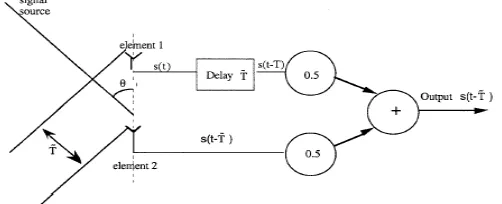
The basic idea behind the operation of this simple and highly intuitive Spectral based beam former is that the system should seek to coherently sum the received signals at the different sensors in the antenna array given an incident signal
from direction θ. Equation1 gives the expression for the spatial spectrum for this method. Given the angle that maximizes Equation 1, Equation 2 gives an equation for the weight that should be applied to the array outputs to extract the signal incident upon the array from that direction.
PDS (θ) = aH(θ) R a(θ) (1)
W = a(θ) (2)
The disadvantage of this method is that it only works with one signal source. Multiple sources have peaks in the spatial spectrum, which are not necessarily at the correct angles.
Figure 1 .delay and sum beamformer
ISSN(Online): 2320-9801
ISSN (Print): 2320-9798
I
nternational
J
ournal of
I
nnovative
R
esearch in
C
omputer
and
C
ommunication
E
ngineering
(An ISO 3297: 2007 Certified Organization)
Vol. 4, Issue 1, January 2016
2. MVDR Estimator
This is the ML method of spectrum estimation, which finds the ML estimate of the power arriving from a point source in direction assuming all other sources as interferences. In beam- forming literature, it is known as the MVDR beam former as well as the optimal beam former since in the absence of errors, it maximizes the output SNR and passes the look-direction signal undistorted. For a DOA estimation problem, the term “maximum likelihood” is used for the method that finds the ML estimate of the direction rather than of the power, as is done by this method. This method uses the array weights, which are obtained by minimizing the mean output power subject to unity constraint in the look direction. An expression for the power spectrum is given by
PMV(θ) = 1 / a(θ)H R-1 a(θ) (3)
This method has better resolution properties than the Bartlett method but does not have the best resolution properties of any method.
3. Linear Prediction Method
This method estimates the output of one sensor using linear combinations of the remaining sensor outputs and minimizes the mean square prediction error, that is, the error between the estimate and the actual output. Thus, it obtains the array weights by minimizing the mean output power of the array subject to the constraint that the weight on the selected sensor is unity. An expression for the array weights and the power spectrum is given, respectively,
w = u1R-1 / u1HR-1 u1 (4) PLP(θ) = u1HR-1 u1 / | u1HR -1
a(θ) | 2 (5)
Where, u1 is a column vector of all zeros except one element, which is equal to one.The linear prediction methods perform well in a moderately low SNR environment and are a good compromise in situations where sources are of approximately equal strength and are nearly coherent.
4. Maximum Entropy method (MEM):
This method finds a power spectrum such that its Fourier transform equals the measured correlation subjected to the constraint that its entropy is maximized. The solution to this problem requires an infinite dimensional search, which may be transformed to a finite dimensional search using the duality principle, leading to
PME(θ) = 1/ wTq(θ)
5. Maximum likelihood method:
This method estimates the DOA’s from a given set of array samples by maximizing the log-likelihood function. The likelihood function is the joint probability density function of the sampled data given the DOA’s and viewed as a function of the desired variables i.e, the DOA’s. The method searches for those directions that maximize the log of this function, the log-likelihood function. The ML criterion signifies that plane waves from these directions are most likely to cause the given samples to occur. The maximization of the log-likelihood function is a nonlinear optimization problem.
Other schemes, such as the alternating projection method and the expectation maximization algorithm, have been proposed for solving this problem in general as well as for specialized cases, such as unknown polarization, unknown noise environments, and contaminated Gaussian noise. A fast algorithm based upon Newton’s method developed for estimating frequencies of sinusoids may be modified to suit the DOA estimation based upon ML criterion. The ML method gives a superior performance compared to other methods, particularly when the SNR is small, the numbers of samples are small, or the sources are correlated, and thus is of practical interest. For a single source, the estimates obtained by this method are asymptotically unbiased, that is, the expected values of the estimates are equal to their true values. In that sense, it may be used as a standard to compare the performance of other methods. The method normally assumes that the numbers of sources are known.
6. Eigen structure Methods
ISSN(Online): 2320-9801
ISSN (Print): 2320-9798
I
nternational
J
ournal of
I
nnovative
R
esearch in
C
omputer
and
C
ommunication
E
ngineering
(An ISO 3297: 2007 Certified Organization)
Vol. 4, Issue 1, January 2016
schemes applicable for a correlated noise field that exists in situations of multipath has been presented in literature to show that Pisarenko’s method is an economized version of these schemes restricted to equi spaced linear arrays.
7. Conventional (Bartlett) Beam former
The conventional (or Bartlett) beam former is a natural extension of classical Fourier based spectral analysis to sensor array data . In this method a rectangular window of uniform weighting is applied to the time-series data to be analysed. For bearing estimation problems using an array, this is equivalent to equal weighting on each element. Thus, by steering the array in direction, this method estimates the mean power. This beam former simply
works by maximizing the output power for a given input signal and look direction θ. For an array of arbitrary geometry, this algorithm maximizes the power of the beam forming output for a given input signal.
The array output is given as X(t) = a(θ) s(t) + n(t)
The problem of maximizing the output power is then formulated as,
max E{ W HX(t) X H(t)W } = max W H E{X (t) X H(t)}W = max {E | s(t) |2 | W Ha(θ) |2 + 2 |W|2} (7)
The weight vector is given as
WBF = a(θ) / Sqrt( a H(θ) a(θ) (8)
The resolution of this method is limited by the beamwidth of the effective antenna aperture of the antenna array.
8. Minimum Variance (Capon) Beam former
The basic idea of this DOA estimation algorithm is that it attempts to minimize the power contributed by noise and an
interference signals coming from directions other than θ. while maintaining a fixed gain in the “look direction” θ under consideration. This is the spatial analog of a sharp temporal processing band pass filter. This spatial band pass filter overcomes the limitations of the Bartlett beam former in that it can resolve signals that are closer than a beamwidth in separation. The optimal W can be found using eg. The technique of Lagrange multipliers, resulting in
WCAP = R-1a() / a H() R-1 a() (9) PCAP() = a H() R-1 a() (10)
Capon’s beam former outperforms conventional beam former. Because the conventional beam former concentrates the received signal along one direction, namely the bearing of interest. The spectral leakage from closely spaced sources is therefore reduced through the resolution capability of the capon’s beam former is still dependent upon the array aperture and clearly on the SNR. However, it is not quite as robust as the Bartlett beam former.
9. Subspace based methods:
The intrinsic properties of the Eigen structure of the covariance matrix were directly used to provide a solution to an underlying estimation model. These methods also called as Eigen structure methods.
These methods rely on the following properties of
i. The space spanned by its eigenvectors is partitioned into the signal subspace and the noise subspace ii. The steering vectors corresponding to the directional sources are orthogonal to the noise subspace. In practice, the search may be divided into two parts.
i.find weight vector that is contained in the noise subspace or is orthogonal to the signal subspace
ii.search for directions such that the steering vectors associated with these directions is orthogonal to this vector.
9.1. MUSIC Algorithm:
Data collected from
each sensor elements
Estimate eigen vectors of covariance matrix
ISSN(Online): 2320-9801
ISSN (Print): 2320-9798
I
nternational
J
ournal of
I
nnovative
R
esearch in
C
omputer
and
C
ommunication
E
ngineering
(An ISO 3297: 2007 Certified Organization)
Vol. 4, Issue 1, January 2016
The MUSIC method is relatively simple and efficient Eigen structure method of DOA estimation. Either Eigen value decomposition of correlation matrix or singular value decomposition of the data matrix is used to estimate the signal and noise subspaces. Once the noise subspace has been estimated, a search for directions is made by looking for steering vectors that are as orthogonal to the noise subspace as possible. This is normally accomplished by searching for peaks in the MUSIC spectrum given by
PM() = a H() a() / a H() a() (11)
Where = Un UnH denotes an by K–M dimensional matrix with its K–M columns being the eigenvectors corresponding to the K–M smallest Eigen values of the array correlation matrix.
If M signals impinge upon the array, then R contains M large Eigen values compared to the rest of K-M Eigen values. The M Eigen vectors corresponding to those M Eigen values span the signal subspace, and the space spanned by the eigenvectors corresponding to the remaining K-M Eigen values is called the noise subspace. These two subspaces are orthogonal to each other. Since the steering vectors corresponding to the M signals span the same subspace as the eigenvectors corresponding to the largest M Eigen values, they are also orthogonal to the noise subspace. Thus the direction of arrival is determined by searching through the array manifold corresponding to all angles, and finding the M elements that are most orthogonal to the estimated noise sub spaces.
For the case of a single source, the DOA estimate made by the MUSIC method asymptotically approaches the CRLB, that is, when the number of snapshots increases infinitely, the best possible estimate is made. For the multiple sources, the same holds for the large SNR cases, that is, when the SNR approaches infinity. The CRLB gives the theoretically lowest value of the covariance of an unbiased estimator.
9.2. ESPRIT:
The ESPRIT algorithm uses the structure of the ULA steering vectors in a slightly different way. The observation here is that A has a so called shift structure. The sub matrices A1 and A2 are defined by deleting the first and last rows from A( EQ) respectively, i.e,
A = [ A1 .. last row] = [first row … A2 ] (12) BY the structure of A() (eqn) A1 and A2 are related by the formula A2 = A1 Φ (13)
where Φ is a diagonal matrix having the roots ejΦm , m=1,2,..M. on the diagonal. Thus the DOA estimation problem can be reduced to that of finding Φ. Analogously to the other subspace based algorithms, ESPRIT relies on the properties of the Eigen decomposition of the array covariance matrix. Applying this deletion information we get, U1 = A1 T , U2 = A2 T (14)
Where Us has been partitioned conformably with A into the sub matrices U1 and U2 . Combining equations yields
U2 = A1 Φ T , U1 = T-1Φ T , (15)
Which by defining = T-1Φ T , becomes
U2 = U1 (16)
and Φ are related by similarity transformation , and hence have the same Eigen values. ESPRIT algorithm stated as:
i. Compute the Eigen decomposition of the array covariance matrix. ii.
Form U1 and U2 from the M principal Eigen vectors. iii.
The DOA estimates are obtained by applying the formula to the Eigen values of .
III. DATA MODEL
Consider a K element radar array that transmits a coherent burst of M pulses at a constant pulse repetition frequency. Signal returns are composed of L range gates, M pulses, and K antenna array samples, the data may be represented by the three-dimensional data set. This KLM data set will be referred to as the CPI data cube. In general, a target present in a particular range bin during some CPI may be modelled as producing following base-band vector signal (after pulse compression and demodulation)
Target signal X (t) = s (t) a (θ)+N(t) (1)
ISSN(Online): 2320-9801
ISSN (Print): 2320-9798
I
nternational
J
ournal of
I
nnovative
R
esearch in
C
omputer
and
C
ommunication
E
ngineering
(An ISO 3297: 2007 Certified Organization)
Vol. 4, Issue 1, January 2016
X(t)=[x1(t) . . xk(t)] T + N(t)= A(θ) S(t)+N(t) (2)
The spatial covariance matrix is given by R = E { X(t)X H(t) }
=AE{s(t)sH(t)}AH +E{N(t)NH(t)} (3)
IV. SIMULATION RESULTS
Simulation Results are obtained for beam forming techniques and high resolution subspace based techniques. Simulation is performed for number of antenna elements 12, wavelength λ =0.03,interelement spacing D=0.03 λ. From
the Fig.1 it is evident that when the angular separation between the incident signals is large, the conventional beam former resolves the targets well in the spectrum.
Fig. 1
ISSN(Online): 2320-9801
ISSN (Print): 2320-9798
I
nternational
J
ournal of
I
nnovative
R
esearch in
C
omputer
and
C
ommunication
E
ngineering
(An ISO 3297: 2007 Certified Organization)
Vol. 4, Issue 1, January 2016
Fig.2
V. CONCLUSIONS
Performance evaluation of high-resolution DOA estimation algorithms including beam forming techniques, high resolution algorithms like MUSIC, ESPRIT has been carried out. All the algorithms were tested by varying the parameters such as i) number of antenna elements, ii) antenna element spacing, iii) number of samples and iv) angular separation between the incident angles. The result showed that Performance of DOA algorithms improves by using more elements in the antenna array and more samples.
REFERENCES
1. A fast DOA estimation algorithm based on Subspace projection,IEEE conference Publications,2014
2.Chadwick, A., “Superresolution for high-frequency radar,” IET Radar, Sonar and Navigation, Vol1,No 6, 431–436, 2007. 3. Zhang, X., X. Gao, G. Feng, and D. Xu, “Blind joint DOA and dod estimation and identifiability results for MIMO radar with different transmit/receive array manifolds,” Progress In Electromagnetics Research B, Vol. 18, 101–119, 2009. 4. Bencheikh, M. L. and Y. Wang, “Combined esprit-rootmusic for DOA-dod estimation in polarimetric bistatic MIMO radar,” Progress In Electromagnetics Research Letters, Vol. 22, 109–117,2011. 5. Liang, G. L., K. Zhang, F. Jin, and G. P. Zhang, “Modified MVDRalgorithm for DOA estimation using acoustic vector hydrophone,”2011 IEEE International Conference on Computer Science and Automation Engineering, 327–330, 2011. 6. Yang, P., F. Yang, and Z.-P. Nie, “DOA estimation with subarray divided technique and interporlated esprit algorithm on a cylindrical conformal array antenna,” Progress In Electromagnetics Research, Vol. 103, 201–216, 2010. 7. Yang, P., F. Yang, Z.-P. Nie, H. Zhou, B. Li, and X. Tang, “Fast 2-d DOA and polarization estimation using arbitrary conformal antenna array,”