2017 3rd International Conference on Electronic Information Technology and Intellectualization (ICEITI 2017) ISBN: 978-1-60595-512-4
A New DOA Estimation Method Based on
Spatial Structure of Array Signals
MingYue Zhai
ABSTRACT
DOA Estimation is a core item of smart antenna in FDD system. In this paper, an equidistant linear array is divided into two identical sub-arrays, and then a DOA matrix is constructed, the eigenvector matrix of which is the array manifold of the signal. After obtaining the array manifold through eigenvalue decomposition, the DOA of signal can be estimated further. Basing on the theoretical analysis, computer simulation is presented in this paper.
KEYWORDS
FDD; DOA; Signal Spatial Structure
INTRODUCTION
Along with the development of society and economy, mobile communication has become one of the main methods of communication. The rapid development of the market requires more and more advanced technologies to ensure the capacity and quality of communication systems. In recent years, smart antenna has been receiving increasing attention, which can effectively improve capacity of system and better system’s signal-noise ratio. Smart antenna can improve the frequency utilization rate and further improve system’s capacity when it is used in TDMA system. Meanwhile, smart antenna can also be combined with different duplex _______________________
modes. In the TDD mode, since the identical frequency is used by up-link and down-link signals, the directional emission of the down-link beam can use the parameters obtained by the up-link beam-forming. In contrast, the frequencies used by up-link and down-link are different in the FDD mode, the directional emission of the down-link beam can’t use the parameters obtained by the up-link beam-forming. Under this circumstance, the direction-of-arrival (DOA) of up-link is the only parameter can be utilized and is also the only bridge connecting the up-link and down-link signals. Therefore, the DOA estimation is a core question of smart antenna technology in the FDD mode[1].
In document [2], two parallel linear antenna arrays are used to evaluate the two-dimensional arrival angle of radar signals. In mobile communication, due to the distance between base station and mobile station far outweigh the height of base station antenna, the azimuth of the arrival signal is generally only considered irrespective of the elevation angle. Under the document[2], a linear array is divided into two sub-arrays of equal structure to construct the DOA matrix of the signal, and then determining the arrival angle by the eigenvalue decomposition.
SIGNAL MODE
Supposing we use a linear array, and the number of element is M0. Dividing the antenna array into two sub-arrays, the array element number of the first sub-array is
) ,..., 2 , 1
( M , and the other is (L,L1,...,LM1) , M0 M L1 . Where, 2
L , is an integer.
Assuming the total number of users is K(KM ), the signal received by the array element k in the first sub-array can be expressed as:
) ( ) ( )
(
1
sin ) 1 (
t n t s e
t
x i k
K
i
c d w k j
k
i
M
k1,2,..., (1)
The signal received by the array element k in the second sub-array can be expressed as:
) ( )
( )
( 1
1
sin ) 2 (
t n t s e
t
y i k L
K
i
c d w L k j
k
i
k1,2,...,M (2)Where, si(t)is the modulation signal of the user i, nk is the noise received by the array element k , w is the carrier frequency.
Using the matrix representation, we can re-express the xk(t) and yk(t)as:
) ( ) ( )
(t A S t N t Y y (4)
where,X(t)[x1(t),x2(t),...,xM(t)]T,Y(t)[y1(t),y2(t),...,yM(t)]T, T
M x
t
n
t
n
t
n
t
N
(
)
[
1(
),
2(
),...,
(
)]
,Ny(t)[nL(t),nL1(t),...,nLM1(t)]T, )]( ),..., ( ), (
[a1 1 a2 2 aK K
A ,
] ,...,
,
[ ( 1)sin( 1) ( 1)sin( 2) c(L 1)sin( K) d
jw L
c d iw L
c d jw
e e
e
diag
T c d M jw c
d jw
i i
i i
e e
a( )[1, sin(),..., ( 1) sin()] ,i 1,2,...,K .
Aiming at this signal mode, we can make supposing like following[4]: M K, and a1(1),a2(2),...,aK(K) are linear independent of each other. The noise is a Gaussian random variable with mean zero and variance 2, and the noises are statistically independent; therefore, E{Nx(t)NX(t)H}2I ,
I t
N t N
E{ y( ) y( )H}2 . The matrix PE{S(t)S(t)H} is positive definite.
From this signal model, we can see that we did not consider the multipath effect of users. Therefore, the mobile communication environment used in this model is an open suburban area or a rural area [5].
The auto-correlation matrix of signal X(t) is expressed as
} ) ( ) ( { )
( H
XX t E X t X t
R , the cross-correlation matrix of signal X(t) and Y(t) is
expressed as RYX(t)E{Y(t)X(t)H}, using the formulas (3) and (4), we can get
I APA
t
RXX( ) H 2 ,RYX(t)APAH .
Where, PE{S(t)S(t)H}. If LM , then all the elements of are zero.
Otherwise, except the element (1,L) , (2,L1) , (ML1,M) are 2 , the elements remaining are zero. We will change the into zero matrix according to the estimated noise variance (refer to Algorithm Step 3), so in the derivation below the will be omitted.
After the assumption and treatment, we can use the method and principle in document[2] to get the following formula:
A
A R RYX XX
*
0 (5)
Where, RXX0 APAH,
* 0
XX
R express the pseudo inverse matrix[6], which can
H i i K
i i
XX VV
R
1
2 *
0
1
, where, i and Vi are the eigenvalue and the eigenvector
of the RXX respectively. Since matrix is a diagonal matrix, equation (5) suggests
that column vectors of the array manifold A is the eigenvectors of matrix RYXRXX0*, and the diagonal elements corresponding to the diagonal matrix is eigenvalue of the matrix RYXRXX0*. Let RRYXRXX0*, and call that the DOA matrix[2] (as can be seen from the equation above, R has only K non-zero eigenvalues[1]).
DOA ALGORITHM BASED ON SIGNAL SPACE FEATURES
According to the eigenvalue decomposition of DOA matrix, we can get the DOA estimation algorithm like following: (1) According to the received signal, estimating the auto-correlation matrix RXX of X(t) and cross-correlation matrix
YX
R of X(t),Y(t). In this paper, we use the progressive unbiased estimator[7]:
K
t
H
XX X t X t
N R
1
) ( ) ( 1
,
K
t
H
YX Y t X t
N R
1
) ( ) ( 1
. (2) Calculating the eigenvalue
(1,2,...,N) and eigenvector ((V1,V2,...,VN)) of RXX ; (3) From formula (18), we can see that the user’s number K is the larger number in 1,2,...,N (the smaller eigenvalue corresponds to the variance of the noise, so the variance of noise can be taken as the average of the smaller eigenvalues so that the in the formula (8) can be changed into zero matrix); (4) Constructing DOA matrix R according to the formula (19); (5) Calculating the eigenvalues and eigenvectors of R, from which selecting K larger eigenvalues i and their corresponding eigenvectorsZi; (6)
Constructing search function
K
i
i i Z
Z a
f
1 |2
) 1 ( ) ( |
1 )
(
, i1,2,...L, where, Zi(1)
is the first element of the eigenvector Zi. The angle corresponding to the peak value of f() is the arrival angle of the user i.
NUMERICAL SIMULATION
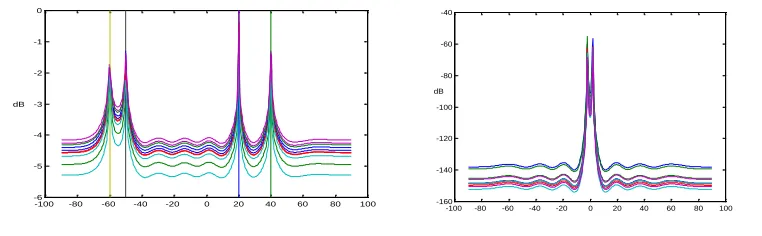
users is (-60, -50, 20, 40). The results are shown as the Fig.1; the vertical axis of the figure is in units of dB, the peak corresponding to the abscissa is the user’s DOA. A total of 10 trials were conducted. Test two: this test is used to verify the resolution ratio. User’s number is 2, incidence angle is (-2, 2). The remaining parameters are consistent with the test one, and the results is shown in Fig.2.
CONCLUSIONS
[image:5.612.104.485.346.464.2]In this paper, a straight linear array is divided into two identical sub-arrays, and then estimating the DOA according to the array signal spatial structure. In this method, the eigenvalue decomposition feature of signal’s auto-correlation and cross-correlation matrix is fully used to construct DOA matrix of array signal, the eigenvector corresponding to the non-zero eigenvalue of this matrix does is array manifold, and the user’s arrival angle can be obtained through searching the extreme value of function. The results of computer simulation suggests this method is feasible and the resolution ratio is also high.
Figure 1. Four users. Figure 2. Two users.
REFERENCES
1. M.L. Yao, L. Jin, Q.Y. Yin. A DOA Estimation Algorithm Based on Spatial Features for Multi-user Cyclic Cumulative Domain[J]. Journal of Communication, 2016,5,(21):36~40.
2. Q. Y. Yin, R.W. Newcomb, L. H. Zou. Estimating 2-D Angles of Arrival via Two Parallel Linear Arrays[J]. Proc. Of IEEE ICASSP, 2008, (4):2803 ~2806.
3. LAL C. Godara. Applications of Antenna Arrays to Mobile Communications, Part I: Performance Improvements, Feasibility, and System Considerations[J], Proceedings of The IEEE, July 2017, Vol. 85, No. 7:1031-1060.
4. X.D. Zhang. Modern Signal Processing [M]. Beijing: Tsinghua University Press, 2015,5.
5. Y.A. Liu, etc. Broadband Wireless Access and Wireless LAN[M]. Beijing: Beijing University of Posts and Telecommunications Press, 2014,12.
6. X.H. Wu, C.D. Chen, Z.F. Qian. Matrix Theory[M]. Shanghai: Tongji University Press, 2015,3.
7. M. Wax, T. Shan, T. Kailath. Spatiao-Temporal Spectral Analysis by Eigenstructure Method[J]. IEEE Trans. On ASSP, Aug. 2014, vol. ASSP-31:817-827.
-100 -80 -60 -40 -20 0 20 40 60 80 100 -6
-5 -4 -3 -2 -1 0
µ½´ï½Ç£¨¶È£© dB
-100 -80 -60 -40 -20 0 20 40 60 80 100 -160
-140 -120 -100 -80 -60 -40