Evaluation of Mechanical Properties and
Optimization of Surface Roughness of Hybrid
Composite Material
Jarinson 1, Dhinesh1, Geethan1, Mariya Santhiayagu Rinson1 ,Thanumoorthy 2
U.G. Student, Department of Mechanical Engineering, Francis Xavier Engineering College, Vanarpettai, ,Tirunelveli,
Tamil Nadu , India1
Associate Professor, Department of Mechanical Engineering, Francis Xavier Engineering College, Vanarpettai,
Tirunelveli, Tamil Nadu, India2
ABSTRACT: The mechanical properties of Aluminium magnesium alloy based composites were investigated and analyzed. In this research, we have manufactured Aluminium metal matrix composites in which Magnesium oxide used as an alloying element and Fly ash is the reinforcement materials. The Aluminium metal matrix composites were manufactured by using stir casting method. The cast Aluminium metal matrix composites were machined to required dimensions for testing. After that, mechanical tests were conducted on the composites prepared. The tests carried out are tensile test, Impact test and Corrosion test. The test results were studied and analyzed. The mechanical properties were determined and corrosion test was carried out.
KEYWORDS: Aluminium- Magnesium oxide alloy, Composite, Fly ash, and Stir Casting.
I.INTRODUCTION
In recent decade, Aluminium-magnesium composites have potentially grown up in engineering structural applications ranging from automobile & aerospace industries to marine industries. Due to high strength to weight ratio, makes Al-mgO composite a favorable material. Aluminium-Magnesium alloys also constitute a important category among Aluminium foundry alloys. Aluminium alloys with Magnesium, offers better corrosion resistance, better wear resistance excellent cast ability, good machine ability property and easy weld ability. Metal Matrix Composites (MMCs) have attractive combination of properties like high specific modulus and strength, enhanced elevated temperature properties, wear resistance, good abrasion resistance properties. Due to these attractive properties, MMCs are being considered for a wide range of applications in space shuttles, commercial airliners, electronic substrates, bicycles, automobiles and golf clubs. MMCs have been in existence for the past 30 years and a wide range of MMCs has been studied. However, majority of MMCs are still in their development stage of production, and whose manufacturing processes are not well established. A major drawback of MMCs is their high cost of fabrication, which has placed limitations on their actual applications. Generally, low density metals are advantageous for the fabrication of MMCs and metals like Aluminium, magnesium and titanium are the popular matrix materials of current interest.
II. LITERATURE REVIEW
B. T. Ramesh et al. (2012)
achieving an improved combination of properties. Our paper deals through to fabricate Hybrid Composite by heating Al 2024 in furnace at a temperature of around 4000 C. E-Glass fiber & Fly ash will be added to the molten metal with changing weight fractions and stirred strongly. Then the ensuing composition will poured into the mould to obtain hybrid composite casting. Aluminium alloy (2024) is the matrix metal used in the present investigation. Fly ash and e- glass are used as the reinforced materials to produce the composite by stir casting. Fly ash is selected because of it is less expensive and low density reinforcement available in great quantities as solid disposal from thermal power plants. The Test specimen is prepared as per ASTM standards size by machining operations to conduct Tensile, Compression, Hardness, and wear test. The test specimens are furnished for tensile, compression strength and wear as per ASTM standard E8, E9 and G99 respectively using Universal Testing Machine and pin on disk machine. It is seen that the fabricated MMC obtained has got enhanced mechanical strength.
:
E. Manikandan et al. (2013)Aluminium matrix composites (AMCs) are widely used for high performance applications such as automotive, military, electricity and aerospace industries because of their improved physical and mechanical properties such as light weight, high strength, good corrosion resistance, malleability, etc., Al 6061 aluminium alloy is reinforced with 1.0, 1.5, 2.0, 2.5 weight percentage of Magnesium Oxide (MgO) particles through powder metallurgy method with optimum sintering temperature
:Kesavuluet al. (2014)
Metal matrix composites [MMC] are most important materials used for recent works in the industry and engineering applications. Fly ash particles are used in metal matrix composites, are low costand low density are available in large quantities of waste by product in power plants. The adding of fly ash with aluminium reinforcement by using stir casting process it can reduces the cost and density of aluminium material. Metal composite processes are improved mechanical properties like strength, hardness, low density and good wear resistance compared to other metals. In this study,aluminium clad and fly ash chemical analysis is studied before and after mixing and forming as particulate metal matrix composite and comparing the mechanical, physical properties of the MMC at varying % of fly ash addition. By comparison at various levels 15% of fly ash the MMC gives good mechanical and physical properties. This type of MMC is widely useful in light weight vehicles and aerospace application.
Keywords: Fly Ash FA, AA6063 Alloy, Aluminium Matrix Composites, Compocasting Method, Microstructure, Thermal Expansion, Mechanical Properties.
R. Harikrishnanet al. (2013)
Technology is advancing, demand of the hour is increasing and to face that engineers are also ready. Maintaining the economic production with optimal use of resources is of prime concern for the engineers. Aluminum alloy materials or simply composites are combinations of materials. They are
made up of combining two or more materials in such a way that the resulting materials have certain design properties on improved properties. The Aluminum alloy composite materials consist of high specific strength, high specific stiffness, more thermal stability, more corrosion and wear resistance, high fatigue life Conventional materials like Steel, Brass, Aluminium etc will fail without any indication. Cracks initiation, propagation will takes place within a short span. Now a day to overcome this problem, conventional materials are replaced by Aluminium alloy materials. Aluminium alloy materials found to the best alternative with its unique capacity of designing the materials to give required properties. In this experimental work Various mechanical properties test have been conducted by varying mass fraction of SiC and fly ash Magnisium with Aluminum to attain maximum tensile strength.
III.OBJECTIVEOFPROPOSEDWORK
1. The main objective of this project is to form a hybrid metal matrix using the Aluminium alloy, MgO & fly ash.(stir casting)
2. And to study the mechanical behavior of various proportion of the matrix formed.
3. Then optimization of surface roughness of composite material in milling operation using taguchi design method.
4. Then the material will be tested and analysed by its strength and the wear and mechanical prope
IV.WORKINGMETHODOLOGY
Metal cutting
Change to metal solid phase to liquid phase
Weighing & Making fine powder of composition
Adding the compositions
Makes the cast by stirring
Casting the molten material
Preparation of material for testing
Metal cutting
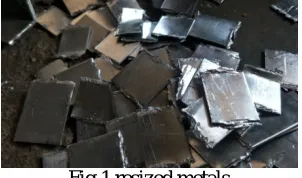
Making the small piece of aluminium through the metal cutting process that aluminium pieces are suitable for the melting process. This metal is having small size for achieving the melting as easily. These metal cuttings to the cutting tools like a hammer, tong holder, chisel. Aluminium metals are cutting into small size of material by the cutting tools
Fig 1 resized metals
Change to metal solid phase to liquid phase
Weighing & making fine powder of composition
The composite material like mgo and fly ash are initial measure of material for mixing proper ratio it is noted on table. These composite materials are need as a fine powder. Hence these materials are formed as fine powder for proper mixing with base material. If it is not fine powder, the performance of the composite is insufficient
Fig 3 composition in fine powder Adding the compositions
The composition material mixing after the base metal reaches the melting point. After the achievement of melting point, the metal is mixed with each other by stir caster. While the stir casting process is carried out the composite material are added slightly.
Fig 4 adding compositions Makes the cast by stirring
The stir casting process carried out by stir casting equipment. It is showing on above figure. When the power supply is ON the stir casting motor starred to rotate. This equipment is handled by safety equipment like gloves, mask and safety guards. The slag is formed on upper surface of molten material. It created a blow holes. Hence, it need to remove by steel
Fig 5 stir casting in sonicater furnace
Casting the molten material
Fig 6 casted metal Preparation of material for testing
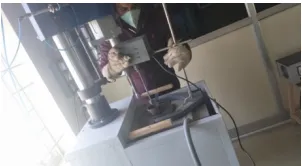
The material will prepared for the testing by using the machine like the lathe, hacksaw blade & holder and Abrasive paper for finishing
Fig.7 lathe operation
VI.RESULTANDDISCUSSION
Specimen Composition
1 Al 96 %, MgO 2%, Fly ash2%
2 Al 98%,Fly ash 2%
3 Al 98%,MgO 2%
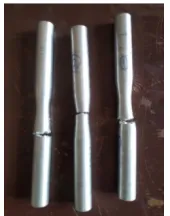
TENSILE TEST
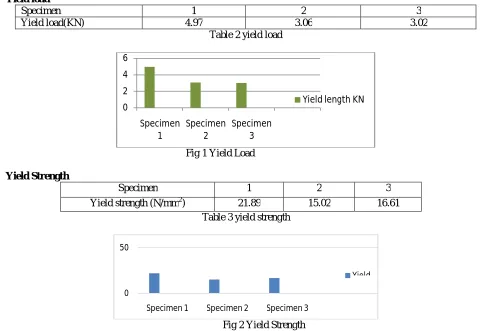
Yield load
Specimen 1 2 3
Yield load(KN) 4.97 3.06 3.02
Table 2 yield load
Fig 1 Yield Load
Yield Strength
Specimen 1 2 3
Yield strength (N/mm2) 21.89 15.02 16.61
Table 3 yield strength
Fig 2 Yield Strength
From the above chart, it is noted that the maximum stress with standing capacity of material increases with increase in Fly ash content. In the present project the yield strength is more in Al-MgO-Fly ash when compared to the Al-MgO MMC
Table 4 tensile strength
0 2 4 6
Specimen 1
Specimen 2
Specimen 3
Yield length KN
0 50
Specimen 1 Specimen 2 Specimen 3
Yield …
Specimen 1 2 3
Tensile Strength
Fig 4.3 Tensile Strength
From the above chart, it is noted that the maximum stress with standing capacity of material increases with increase in Fly ash content. In the present project the Tensile strength is more in Al-MgO-Fly ash when compared to the Al-MgO MMC
Hardness Test
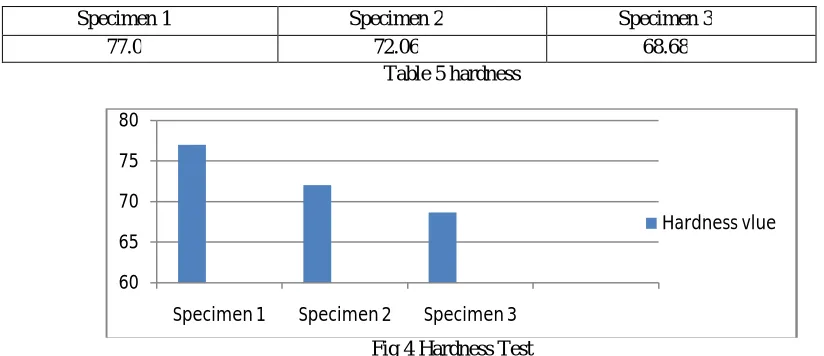
Brinells hardness testing machine is used to measure hardness. Load used on Brinells hardness test was 300g at dwell time 15 sec for each sample. The result of Brinells hardness test is given below in table.
Specimen 1 Specimen 2 Specimen 3
77.0 72.06 68.68
Table 5 hardness
Fig 4 Hardness Test
The above graph shows the hardness increases with increase in Fly ash content. In the present project the hardness test is more in Al-MgO-Fly ash when compared to the Al-MgO MMC
WEAR TEST:
42 44 46 48 50 52
Specimen 1 specimen 2 Specimen 3
Tensile Strength …
60 65 70 75 80
Specimen 1 Specimen 2 Specimen 3
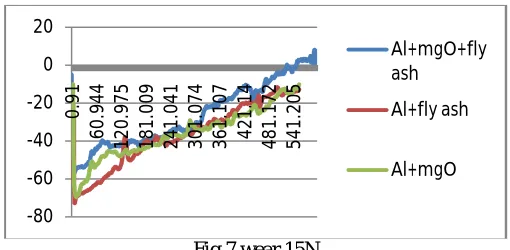
and the wear properties also be analyzed equal interval of time. The load be applied in three manner. 5N, 10N, 15N loads are applied to the wear properties for three different compositions.
The specifications of the pin on disc wear test machine are TR-20LE-PHM400-CHM600. The comparison chart is given below for different loads. The disc radius is the 100mm.
For 5N:
Fig 5 wear 5N
For 5N load will applied on the work piece by the pivot joint type arm one end of the arm is applied the load and the another end the work piece holded. Then the disc rotates 500rpm at the 5N load. The process will repeated for three different composition.
For 10N:
Fig 6 wear 10N
For 10N load will applied on the work piece by the pivot joint type arm one end of the arm is applied the load and the another end the work piece holded. Then the disc rotates 500rpm at the 10N load. The process will repeated for three different compositions
For 15N:
Fig 7 wear 15N
For 15N load will applied on the work piece by the pivot joint type arm one end of the arm is applied the load and the another end the work piece holded. Then the disc rotates 500rpm at the 15N load. The process will repeated for three different compositions
VII.CONCLUSION
The Tensile Strength of Al-MgO-Fly ash metal matrix composite is more when to the Al-MgO metal matrix composite. The Yield Strength of Al-MgO-Fly ash metal matrix composite is more when to the Al-MgO metal matrix composite. From the Hardness value increases with the addition of Al-MgO-Fly ash metal matrix composite. Impact test will be continued up to 2joules after that it will break.
REFERENCES
1. B. T. Ramesh a, R. P. Swamy b, Koppad Vinayak Assistant Professor. “Mechanical Characterization of Al-2024 Reinforced with Fly Ash and E-Glass by Stir Casting Method” International Journal of Innovative Research in Science, Engineering and Technology Vol. 3, Issue 11, November 2014
2. E. Manikandan, P. Balaji, I. Madhan Ram, G.G. Sozhamannan4, Velmurugan and V.S.K. Venkatachalapathy “Tribological Behavior of Aluminium (Al)-Magnesium Oxide (MgO) Composite” Journal of Material Science and Mechanical Engineering (JMSME)
3. Kesavulu A, F.AnandRaju, Dr. M.L.S.Deva Kumar “Properties of Aluminium Fly Ash Metal Matrix Composite” International Journal of Innovative Research in Science, Engineering and Technology Vol. 3, Issue 11, November 2014
4. R. Harikrishnan1, TTM. Kannan, P. VijayaKumar, S. Giridharan “Evaluation of Mechanical Properties of Aluminum Metal Matrix Composites (Al+Sic+Mg+flyash)” International Journal of Research in Mechanical Engineering Volume 3, Issue 3, May-June, 2015, pp. 14-18
5. Alaa Mohammed Razzaq, Dayang Laila Majid, Mohamad R. Ishak, and Uday M. Basheer “Influence of fly ash on the microstructure and mechanical properties of AA6063 alloy using compocasting technique” Mater. Express, Vol. 9, No. 1, 2019
6. P.Satishkumar, S.Dharmalingam, K.Raja, K.Lingadurai, G.Padmanaban “Investigation on Electrochemical Micro Machining of Al 6061-6% wt Gr based on Taguchi design of experiments” International Journal of ChemTech Research CODEN (USA) Vol.7, No.01, pp 203-211, 2014 7. Shanmughasundaram,R. Subramanian,G. Prabhu “Some Studies on Aluminium – Fly Ash Composites Fabricated by Two Step Stir Casting
Method” European Journal of Scientific Research