UNIVERSITI TEKNIKAL MALAYSIA MELAKA
Control and Stabilize System for Temperature in Operation Theatre
by Using Microcontroller
This report submitted in accordance with requirement of the Universiti Teknikal Malaysia Melaka (UTeM) for the Bachelor’s Degree in Electronics Engineering
Technology (Industrial Electronics) with Honours
by
NURHANIS BT LOKMANULHAKIM B071110134
900817-07-5730
UNIVERSITI TEKNIKAL MALAYSIA MELAKA
BORANG PENGESAHAN STATUS LAPORAN PROJEK SARJANA MUDA
TAJUK: Control and Stabilize System for Temperature in Operation Theatre by Using Microcontroller
SESI PENGAJIAN: 2014/15 Semester 2
SayaNURHANIS BT LOKMANULHAKIM
mengakumembenarkanLaporan PSM inidisimpan di PerpustakaanUniversitiTeknikal Malaysia Melaka (UTeM) dengansyarat-syaratkegunaansepertiberikut:
1. Laporan PSM adalah hak milik Universiti Teknikal Malaysia Melaka dan penulis. 2. Perpustakaan Universiti Teknikal Malaysia Melaka dibenarkan membuat salinan
untuk tujuan pengajian sahaja dengan izin penulis.
3. Perpustakaan dibenarkan membuat salinan laporan PSM ini sebagai bahan pertukaran antara institusi pengajian tinggi.
4. **Sila tandakan ( )
SULIT
TERHAD
TIDAK TERHAD
(Mengandungimaklumat yang
berdarjahkeselamatanataukepentingan Malaysia sebagaimana yang termaktubdalam AKTA RAHSIA RASMI 1972)
(Mengandungimaklumat TERHAD yang telahditentukanolehorganisasi/badan di manapenyelidikandijalankan)
AlamatTetap:
No 1 Quarters Mardi, Kampung Padang Kangar, 32800, Parit Perak.
Tarikh: ________________________
Disahkan oleh:
Cop Rasmi:
Tarikh: _______________________
** JikaLaporan PSM ini SULIT atau TERHAD,
iv
DECLARATION
I hereby, declared this report entitled “Control and Stabilize System for Temperature in Operation Theatre by Using Microcontroller” is the results of my
own research except as cited in references.
Signature : ……….
Author’s Name : NURHANIS BT LOKMANULHAKIM
v
APPROVAL
This report is submitted to the Faculty of Engineering Technology of UTeM as a partial fulfillment of the requirements for the degree of Bachelor of ElectronicsEngineering Technology (Industrial Electronics) with Honours. The member of the supervisory is as follow:
vi
ABSTRAK
vii
ABSTRACT
viii
DEDICATION
ix
ACKNOWLEDGEMENT
x
TABLE OF CONTENT
Abstract ii
Dedication iii
Acknowledgement iv
Table of Content v
List of Tables vi
List of Figures vii
List Abbreviations, Symbols and Nomenclatures viii
CHAPTER 1: INTRODUCTION 1
1.1 Background 1
1.2 Problem Statement 2
1.3 Objective 2
1.4 Scope of Project 3
1.5 Project Significance 3
CHAPTER 2: LITERATURE REVIEW 4 2.1 Introduction of Operation Theatre 4
2.1.1 Ventilation inside the Operation Theatre 5
2.1.1.1 Conventional Ventilation Systems for Operating Theatres 5
2.1.1.2 Mixing Ventilation 6
2.1.1.3 Parallel Flow Ventilation 7
2.1.1.4 Op-box Ventilation 9
2.1.2 Amount of the Particles inside the Operation Theatre 10
2.1.2 1 History of ISO 14644 11
2.1.2.2 ISO 14644-1 12
2.1.2.3 ISO 14644-2 13
2.1.3 Temperature inside the operation theatre 13
xi
2.2 Microcontroller 16
2.2.1 Microcontroller PIC 16F 16
2.3 Temperature Sensor LM 35 18
2.4 Previous Project 20
2.4.1 The Temperature Control System Using PLC 20
2.4.2 Room Temperature Controlling Using PIC 21
CHAPTER 3: METHODOLOGY 22
3.1 Project Development 22
3.2 Create a cording 24
3.3 Circuit Design 25
3.3.1 Proteus Software Design 26
3.3.2 Testing Circuit on Breadboard 27
3.3.3 PCB Developer Process 28
3.3.3.1 Step 1: Circuit printing 28
3.3.3.2 Step 2: UV Curing 28
3.3.3.3 Step 3: PCB Developer 29
3.3.3.4 Step 4: Etching 30
3.3.3.5 Step 5: Photoresist Stripper 31
3.3.3.6 Step 6: Drilling 32
3.3.4 Component Installation Process 32
3.3.5 Soldering Process 33
3.4 Hardware Implementation 33
3.5 Project Overview 38
3.6 Flow of the process 40
3.7 Gantt Chart 41
CHAPTER 4: RESULT AND DISCUSSION 42
4.1 Result 42 4.1.1 LCD Display 43
4.1.2 Redesign Hardware Implementation 44
xii
4.2.1 Time Analysis 46
4.2.2 Quantity and Type of Ice Analysis 48
4.2.3 Distance of Temperature Sensor Analysis 49
4.2.4 Distance Path Travel Ice Analysis 50
4.2 Discussion 52
CHAPTER 5: CONCLUSION & FUTURE WORK 54 5.1 Conclusion 54 5.2 Future Work 55
REFERENCES 56
APPENDICES
xiii
LIST OF TABLES
2.1 The ISO 14644 Series 11
2.2 ISO 14644-1 Cleanroom Standards 12
2.3 Required testing (ISO 14644-2) 13
2.4 Optional testing (ISO 14644-2) 13
2.5 Desripition of Pin LM35 19
2.6 Difference between PIC and PLC 20
4.1 Data Collection within 1 Hour 47
4.2 Quantity and Type of ice corresponding to the time 49
xiv
LIST OF FIGURES
2.1 The Operation Theatre 4
2.2 Mixing Ventilation 7
2.3 Horizontal Parallel Flow Ventilation 8
2.4 Vertical Parallel Flow Ventilation 9
2.5 Op-box Ventilation 10
2.6 Pin Diagram PIC 16F876A 18
2.7 LM35 19
3.1 Flowchart of project development 23
3.2 The main function of the coding 24
3.3 Process flowchart of making PCB board 25
3.4 Schematic Drawing of the circuit 26
3.5 ARES PCB Layout 27
3.6 UV Curing Machine 29
3.7 PCB Developer Process 29
3.8 Etching Machine 30
3.9 After Etching Process 30
3.10 Photoresist Stripper Process 31
3.11 After Process of Photoresist Stripper 31
3.12 Drilling Process of the PCB Board 32
3.13 The Cooling System Box 33
3.14 The Operation Theatre Box 34
3.15 Installation of Heater Pad 34
3.16 Installation of Temperature Sensor 35
3.17 Installation Path of Ice 35
3.18 Installation of the Blower Fan 36
3.19 Installation of Piping 36
3.20 View inside the Controller Box 37
xv
3.22 Overview of Project 38
3.23 Flowchart of the Project Process 40
4.1 Condition of temperature equal or more than 23 ˚C 43 4.2 Condition of temperature between 23 ˚C until 19 ˚C 43
4.3 Condition of temperature less than 19 ˚C 43
4.4 LCD display the first data reading 44
4.5 LCD display the data reading after 5 minutes 44
4.6 LCD display the data reading lowest than minimum range 44
4.7 Previous Hardware Implementation 45
4.8 Latest Hardware Implementation 46
4.9 Graph Time versus Temperature within 1 Hour 48
4.10 Previous path of ice 51
xvi
LIST OF ABBREVIATIONS, SYMBOLS AND
NOMENCLATURE
ACH -Air Change per Hour
ASHRAE -American Society of Heating, Refrigerating and Air-Conditioning Engineers
C -Celsius
Cm -Centimeter
IDE -Integrated Development Environment
FED -Federal
LAF -Laminar Air flow
LCD -Liquid Crystal Display MOH -Ministry of Health
MPLAB -Microprocessor Laboratory
OT -Operation Theatre
PCB -Printed Circuit Board
PIC -Peripheral Interface Controller PLC -Programmable Logical Controller
SD -Standard
V -Volt
° -Degree
1 This chapter presents the overview for overall description for this project. Thus, it is including the background of project, objective and scope. The organization of the report also state in this chapter for the preview of the report ahead.
1.1 Background
Operation theatres require special attention in terms of air ventilation, temperature, and humidity. This is because, any negligence can come right side-effects. The temperature inside the operation theatre needs to be controlled because it can influence three main requirements which is avoided humidities that can contribute to the risk of infection to the patients, to conserve the patient resource, and last promote the comfort and working efficiency of the staff. For example, the humidity inside theatre should be maintained between 50 to 60%. One of the reasons this requirement needs to be met is that if the percents humidity in the room exceeds 60% chance of bacteria / fungi exist will be higher. If the percentage of humidity to be 78% of the bacteria already exist and fungus will occur. Other than that, when the temperature was uncontrolled it can contribute to the non-effective working environment which can affect the concentration of the team. Besides that, stable temperature should be emphasized because if the temperature dramatically decrease or increase it can affect the patient. The low temperature can cause bacteria breeding while the temperature is
INTRODUCTION
2 too high can cause complication to post-operative patients. Therefore, one new system to be introduces.
This system is able to control and stabilize the temperature in the operating room. Besides that, it is an interesting point where the system will use different method of air conditioning. Instead of using air conditioner, this system will used a block of ice for supply the cold air through the operation theatre. Therefore, the temperature in the operating theater is very important to ensure a smooth process surgery.
1.2 Problem Statement
3
1.3 Objective
The objectives of this project are to:
To implement a new method of technology.
To stabilize the temperature inside operation theatre using blower and heater.
1.4 Scope of Project
This research will cover on designing one system that can control and stabilize temperature inside the operation theatre. Besides that, this system also will implement a new method system. Instate using air-condition, the system will apply a block of ice for supplying cool air toward operation theatre. Other than that, the research will cover on the operation of PIC16F876A microcontroller. This controller will trigger either heater or blower for stabilize the room. In addition the scope also is focus on the application of temperature sensor for detecting the surrounding temperature.
1.5 Project Significance
4 A literature review is a body of text that aims to review the critical points of current knowledge for any related information so as to enhance the understanding of the concept and certain terminology which is used throughout this research.
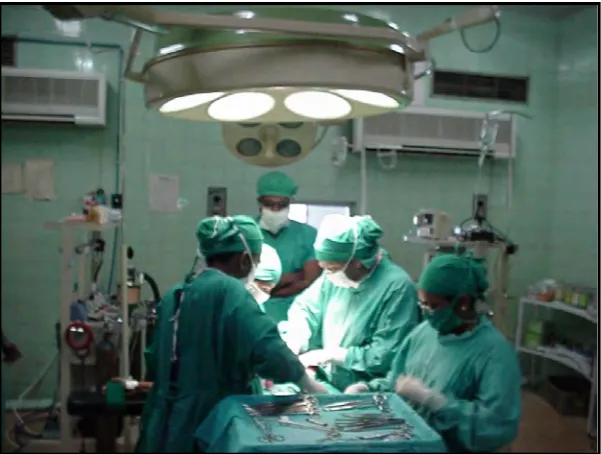
[image:19.595.169.470.437.664.2]2.1 Introduction of Operation Theatre
Figure 2.1: The Operation Theatre
LITERATURE REVIEW
5 Operation theatre was a room for performing a surgery. In the operation theatre there has table and chair at the centre of the room. The team involve with the operation theatre are surgeons and nurses.
The surgeons will wear street clothes with an apron to protect them from blood stains. The operation will be handling with unsterilized instruments, hand-threaded needles. Operation theatre can be class into two categories. First categories is superspecialty operation theatre while second once is general operation theatre. Superspeciality operation theatre conducts operations of Neurosciences, Orthopedics (Joint Replacement), Cardiothoracic and Transplant Surgery (Renal, Liver). General operation theatre includes Ophthalmology and all other basic surgical disciplines. District hospital operation theatre and FRU operation theatre would fall under this category.
When handle with operation theatre, there are many things that need to take a serious look. This is because, in this room it will involve with the person life. So that, five mains things that need to be consider while built up the operation theatre.
The five main things are:
(a) ventilation of the room (b) amount of particle contains (c) temperature needed
(d) humidity
(e) pressure inside the room
However, there are too many standard guidelines in the world regarding the operation theatre. We in Malaysia use the British Medical Council as the references to organize our own standard that been provided by Ministry of Health (MOH).
2.1.1 Ventilation inside the Operation Theatre
6 airborne bacteria, thermal comfort, and humidity level. The ventilation system is considered as the main contributor to the efficiency and function of an operating theatre. Level of comfort and level of airborne contaminant need to be control because patients wound after surgery easily get infection.
Thus, the planning and designing of ventilation systems in operating theatres is crucial so that both infection rates and operating costs are lowered. Based on the journal written by Agne Nilsson (2002), there are many types of ventilation system has been practice for operation theatre. From the journal he had conclude some ventilation system regarding his study.
2.1.1.1Conventional Ventilation Systems for Operating Theatres
There are various ventilation systems that have been designed and installed in the operating theatre. Normally, the designed and installed was classifies into two main categories which is mixing ventilation and parallel flow ventilation.
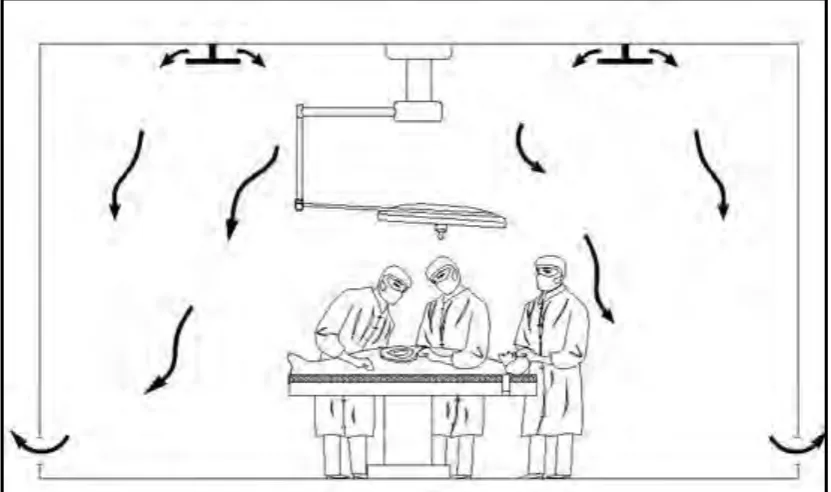
2.1.1.2Mixing Ventilation
7 Figure 2.2: Mixing Ventilation
2.1.1.3Parallel Flow Ventilation
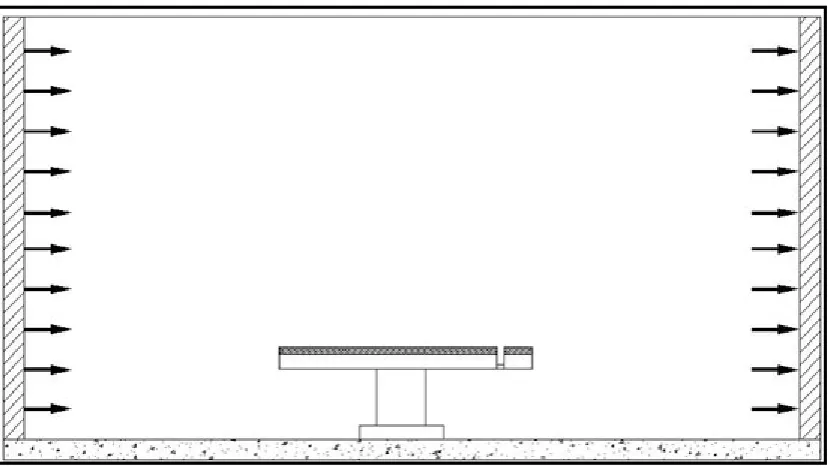
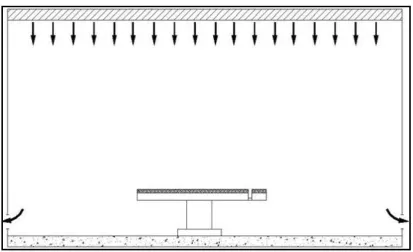
The parallel flow ventilation operates based on the principle that supply air is conducted parallel through the room. The parallel flow ventilation systems can be horizontal or vertical flow. They have been used as conventional ventilation for operating theatres. Parallel flow ventilation is also commonly referred to as Laminar Air Flow system whereby the laminarity or uni-directionality of the air flow is said to exist in the operating theatre. H. Laufman from the Institute for Surgical Studies, Montefiore Hospital and Medical Centre, New York, once debated that laminar air flow cannot be achieved in an actively used operating theatre.
8 To further worsen situation, the horizontal supposedly uni-directional air flow would be disturbed by convection up-currents, thus generating turbulence and entrainment of contaminants.
Figure 2.3: Horizontal Parallel Flow Ventilation
9 Figure 2.4: Vertical Parallel Flow Ventilation
2.1.1.4Op-box Ventilation