Investigation on the Effect of Dimethylether in
Compression Ignition Engine
Deepak Kumar M
1,*Karthick M
2, Dineshbabu D
3, Srikanth P
4, Ramachandran M G
5Department of Mechanical Engineering, Velammal Engineering College, Chennai, India1,2,3,4,5
ABSTRACT: This project investigates the use of dimethyl ether in diesel engines as alternative fuels. DME is produced by the conversion of various feed stock such as natural gas, coal, oil residue sand bio-mass. Diesel – Dimethyl Ether (BDE) wastested in a 4-cylinder direct-injection diesel engine to investigate the performance and emission characteristic softheengineunderfiveengineloadsatthemaximumtorque.DME’sdieselengine- compatible properties are its high cetane number and low auto-ignition temperature. In addition, it’s simple chemical structure and high oxygen contentresultinsoot- re ecombustionin engines. The dimethylether issued as an alternative fuel mean stone hence the engine combustion. The Diesel 100% (only diesel), and DDE50 (diesel 50% and Dimethyl lether50%) and DME 100% (only dimethylether) were tested in the engine. There sults indicate that when compared with neat diesel, the engine performance increased and emission level decreased with adding the dimethylether with diesel. In comparison with neat diesel, the DDE50 blends have50% higher brake thermal efficiency (BTE). The experimental results showed that the CO, HC and NOx emission is decreased for all DDE blends. The brake specific fuel consumption (BSFC) decreased for all DDE blends compared to neat diesel fuel
KEYWORDS: Di methyl ether, diesel, alternative fuel, compression ignition engine
I. INTRODUCTION
Di-methyl ether (DME) is aliquefiedgaswithhandlingcharacteristicssimilartothoseofliquefied petroleum gas (LPG) [1]. It can be produced from a variety offered-stock such as natural gas, crude oil, residual oil, coal, waste products and bio-mass. Many investigations have been carried out on DME to determine its suitability for use as a fuel in diesel- cycle engines [1,2]. DME has the appearance of an excellent, efficient alternative fuel for use in a diesel engine, with almost smoke-free combustion. This is not only because of it low auto-ignition temperature and its almost instantaneous vaporization when injected into the cylinder, but al so because of its high oxygen content (around35%bymass) and the absence of C– C bonds in the molecular structure[1,2]. With a properly designed DME injection and combustion system, nitrogen oxides (NOx) emissions can also meet ultra-low emission vehicle (ULEV) limits[3]. The well-to-wheels energy efficiency of heavy and light-duty DME-fuelled vehicles is projected to be 22.5%and19%,respectively[4].This is comparable to LPG and compressed natural gas(CNG)fuelled vehicles but less than the highest energy efficiency of 26% indirect-injection (DI) dieselfuelledvehicles [4].Ontheotherhand,thewell-to-wheels carbon dioxide(CO2)emissions ofaDME-fuelled vehiclearecomparable tothoseusingDIdieselor CNGfuelledengines [4].However, anoxidation catalystwouldbenecessary tomeetULEVcarbon monoxide(CO) and hydrocarbon(HC) emission limits[5].
DME was also found to be an excellent gas turbine fuel with emission properties comparable to natural gas[6]. DME-fuelled turbine also allows achieving a significant performance improvement through thermo chemical recuperation with 44% higher power output and an 8% decrease of the specific CO2 emissions compared to the present plant [7]. However, DME is not a suitable fuel for spark- ignition (SI) engines due to it shighcetane number, though the burning velocity is similar to hydro carbon fuels [8]. The easily-induced knock would limit the operation of SI engines.
II. DIMETHYLETHER IN BRIEF
Di-methyl ether (DME) is alique field gas with handling characteristics similar to those of lique fied petroleum gas (LPG). It canbe produced from a variety of feed-stock such as natural gas, crude oil, residual oil, coal, waste products and bio-mass. Many investigations have been carried out on DME to determine its suitability for use as a fuel in diesel-cycle engines.
DME has the appearance of an excellent, efficient alternative fuel for use in a diesel engine, with almost smoke-free combustion. This is not only because of it slow auto ignition temperature and its almost instant an when injected to the cylinder, but al so because of its high oxygen content (around35%bymass) and the absence of C–C bonds in the mole collar structure. Witha properly designed DME injection and combustion system, nitrogen oxides (NOx) emissions canal some etultra-lowemission vehicle (ULEV) limits. The well-to-wheels energy efficiency of heavy-and light-duty DME- fuelled vehicles is projectedtobe22.5%and19%, respectively. This is comparable to LPG and compressed natural gas(CNG) fuelled vehicles but lessthanthehighestenergyefficiencyof26%in direct-injection(DI)diesel fuelled vehicles.
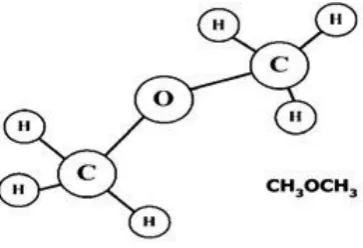
Fig. 1 Structure of Dimethyl ether
Production of Dimethyl ether
A feasibility study on the production of 99.5% dimethyl ether (DME) is to be performed. The plant is capable of producing 50,000 metric tons of DME per year via the catalytic dehydration of methanol over an acid zeolite catalyst. The goal is to design a grass-roots facility, which safely and efficiently produces DME. DME is used primarily as a propellant. DME is miscible with most organic solvents and it has a high solubility in water. Recently, the use of DME as a fuel additive for diesel engines has been investigated due to its high volatility (desired for cold starting) and high cetane number.
C. Properties of Dimethyl ether
Property Diesel DME
Chemicalformula CxHy C2H6O
Molecularweight 190-220 46
DensityofliquidatNTPa (kg/L)
0.84 0.668
ViscosityatNTPa(c P) 2.6 -
Oxygencontent(wt.%) - 34.8
Sulfurcontent(ppm) 250 -
Boilingtemperature(0C) 180-360 -24.9
Auto ignition
temperatureinair(0C)
315 235
Flammabilitylimitinair (vol%)
0.6-6.5 3.4-17
Stoichiometric air fuel ratio(AFRs)
14.6 9
Heat of vaporization at NTPa(kJ/kg)
250 460
Lower heating value (MJ/kg)
42.5 28.4
Cetanenumber 40-55 55-66 Table.1 Properties of Dimethyl ether
III. EXPERIMENTAL STUDY
Table.2 Specification of the engine test rig
IV. RESULTS & DISCUSSION
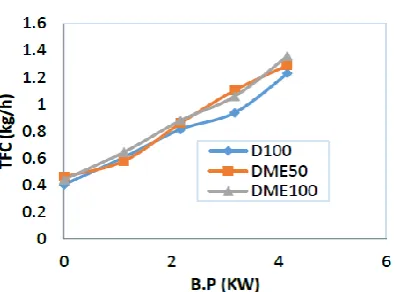
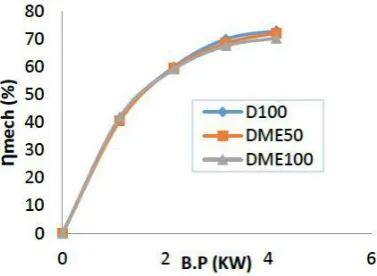
Fig 3 – 6 depicts the various performance parameters of the compression ignition engine running with diesel and dimethyl ether blends. It can be observed that adding dimethyl ether blend with the diesel fuel gives out almost the same performance as running with diesel fuel. Hence dimethyl ether serves as a suitable alternate fuel to replace a significant amount of the conventional diesel fuel. It can also be observed from Fig 7 – 9 that significant amount of NOx and HC emissions are reduced with the use of dimethyl ether blends.
Fig. 2 Experimental test rig
Fig. 3. Variation of total fuel consumption with brake power for DME blends
Numberof cylinders 1
Number of stroke 4 stroke
Compression ratio 17.5:1
Ratedpower 4.4kW
Cylinder bore anddiameter (mm) 87.5&110
Dynamometer Eddycurrent
Ratedspeed 1500rpm
Fuels Diesel
Fig. 4. Variation of specific fuel consumption with brake power for DME blends
Fig. 5. Variation of mechanical efficiency with brake power for DME blends
Fig. 7 Variation of NOx emissions with brake power for DME blends
Fig. 8 Variation of HC emissions with brake power for DME blends
V. CONCLUSION
DME is the appearance of an excellent, efficient alternative fuel for use in a diesel engine, with almost smoke-free combustion. This is not only because of its low auto ignition temperature and its almost instantaneous vaporization when injected into the cylinder, but also because of its high oxygen content and the absence of C–C bonds in the molecular structure. With a properly designed DME injection and combustion system, nitrogen oxides (NOx) emissions can also meet ultra-low emission vehicle (ULEV) limits.
REFERENCES
[1] Verbeek RP, Van Doom A, van Walwijk M. Global assessment of di-methyl ether as an automotive fuel. Second ed., 96.OR.VM.029.1/RV, TNO Road-Vehicles Research Institute; 1996.
[2] Arcoumanis C. The second European Auto-Oil programme (AOLII).European Commission, vol. 2. Alternative Fuels for Transportation; 2000. [3] Fleisch TH, Meurer C. DME, The diesel fuel for the 21st Century? In: AVL conference engine and environment; 1995.
[4] Verbeek R, Van der Weide J. Global assessment of di-methyl ether: comparison with other fuels. SAE Paper 971607; 1997.
[5] Kapus PE, Cartellieri WP. ULEV potential of a DI/TCI diesel passenger car engine operated on di-methyl ether. SAE Paper 952754; 1995. [6] Basu A, Wainwright JM. DME as a power generation fuel: performance in gas turbines. In: PETROTECH-2001 conference; 2001.
[7] Cocco D, Tola V, Cau G. Performance evaluation of chemically recuperated gas turbine (CRGT) power plants fuelled by di-methyl ether (DME). Energy 2005;31:1446–58.
[8] Djebaı ¨Li N, Paillard C. Burning velocities of dimethyl ether and air. Combus Flame 2001; 125:1329–40.
[9] Kapus P, Ofner H. Development of fuel injection equipment and combustion system for DI diesels operated on di-methyl ether. SAE Paper 950062, SAE Trans J Fuel Lubr 1995; 104(4):54–9.
[10] Sorenson SC, Glensvig M, Abata D. Di-methyl ether in diesel fuel injection systems. SAE Paper 981159, SAE Trans J Fuel Lubr 1998; 107(4):438–49.
[11] Teng H, McCandless JC, Schneyer JB. Thermo-chemical characteristics of di-methyl ether – an alternative fuel for compression-ignition engines. SAE Paper 2001-01-0154, SAE Trans J Fuel Lubr 2001; 110(4):96–106.
[12] Edgar B, Dibble RW, Naegeli DW. Auto ignition of di-methyl ether and di-methoxy methane sprays at high pressures. SAE Paper 971677, SAE Trans J Fuel Lubr 1997; 106(4):625–639.
[13] Francisco JS. On the competition between hydrogen abstractions versus C–O bond fission in initiating di-methyl ether combustion. Combus Flame 1999; 177:312–6.
[14] Masterton WL, Slowinski EJ. Chemical principles.W.B. Saunders Company; 1997.