Scatterer Characterization Based on the Condiagonalization
of the Sinclair Backscattering Matrix
Georgios Kouroupis* and Vassilis Anastassopoulos
Abstract—In this paper, we revisit the condiagonalization of the Sinclair backscattering matrix, to overcome the Huynen decomposition issues, so as to correctly extract scatterer polarimetric properties. The correct extraction of scatterer polarimetric properties will lead to the correct classification of the scatterer predominant scattering mechanism. Huynen used the congruence transformation by a special unitary matrix to diagonalize the Sinclair matrix into a real and nonnegative diagonal matrix. He also expressed the special unitary matrix in terms of the polarization ellipse parameters and associated them with the scatterer orientation, asymmetry, and skip angle. Unfortunately, this association was found misleading. As a result, it makes the scatterer characterization ambiguous, for it is based on the scatterer skip angle and the diagonal matrix. To overcome these ambiguities, we perform the diagonalization procedure founded on the consimilarity transformation by a special unitary matrix, as proposed by L¨uneberg. In order to correctly extract the scatterer asymmetry degree and orientation, we express the special unitary matrix in terms of an asymmetry operation and a pure rotation operation. Moreover, we integrate the scatterer skip angle in the diagonal matrix of the consimilarity transformation by having it complex, leading to an unequivocal scatterer characterization.
1. INTRODUCTION
Synthetic Aperture Radar (SAR) polarimetry studies the way in which a radar signal interacts with a real target, i.e., a scatterer, aiming to deduce its polarimetric properties [1]. Scatterer polarimetric properties may be broadly divided into intrinsic and extrinsic ones. Intrinsic scatterer properties regard inherent structural properties, which are associated with the predominant scattering mechanism of the scatterer, and therefore they must be independent of the relative position of the scatterer with respect to the radar line of sight (LOS). Extrinsic scatterer properties are regarded as those directly affected by the position of the scatterer in relation to the local system of reference of the radar, such as the scatterer rotation around the radar LOS and asymmetry. Generally, when a transmitted polarized electromagnetic wave is scattered from a target, its polarimetric properties are subject to changes. These changes are directly linked to the target polarimetric properties, and they are summarized in the so-called Sinclair backscattering matrix S [2]. The values of S are dependent on the polarization configuration of the SAR antenna, where in most cases it forms a real orthogonal basis, the so-called HV basis. The HV basis forms a plane, the HV plane, which is perpendicular to the radar LOS. When the backscattering matrix is diagonal, it is considered to represent the optimal scattering response of the scatterer on the HV plane, and based on it the scatterer polarimetric properties may be deduced. Therefore, the classification of the scatterer into elemental scattering mechanisms becomes feasible. However, an arbitrary scatterer may not present an optimal scattering response on the HV plane due to its complex structure. The scatterer polarization optimization problem is thus translated to that of diagonalizing the backscattering matrix [3].
Received 9 January 2019, Accepted 16 August 2019, Scheduled 12 September 2019 * Corresponding author: Georgios Kouroupis ([email protected]).
One of the most long-standing approaches in extracting the polarimetric properties of a scatterer from the diagonalization of the backscattering matrix is the Huynen Coherent Target Decomposition (CTD) [4]. Huynen to diagonalize the Sinclair backscattering matrix made use of the congruence transformation of the Graves power scattering matrix by a special unitary matrix [5, 6]. The resulting diagonal matrix is a real and nonnegative matrix that contains the so-called coneigenvalues of S. The special unitary matrix, by which the scattering matrix is brought to its optimum form, is a unitary matrix that belongs to the special unitary group SU(2), and it contains the so-called coneigenvectors of S. The diagonal matrix is involved with the scatterer inherent properties. The coneigenvalues of the diagonal scattering matrix though, being real and nonnegative, are not capable of classifying the dominant scatterer scattering mechanism on their own. Consideration of the scatterer skip angle is required. However, the skip angle is treated as an extrinsic property of the scatterer, like its initial orientation angle and asymmetry degree. Huynen, intuitively associated the extrinsic properties of the scatterer with the parameters of the polarization ellipse, which are derived from the special unitary matrix [6]. Unfortunately, this association was found misleading [7–9]. Hence, the scatterer extrinsic properties must not be associated with the polarization ellipse parameters. It follows that since the scatterer classification is dependent on the skip angle, which as a parameter of the polarization ellipse was found misleading, it becomes ambiguous. Additionally, the skip angle should be an inherent scatterer property involved with the coneigenvalues of the diagonal matrix of S and therefore it should not be part of the special unitary matrix parameterization.
To overcome the issues of the Huynen decomposition, we perform the diagonalization procedure of the backscattering matrix founded on the consimilarity transformation by a special unitary matrix [10]. Dallmann and Heberling in [11] have supported this as well. We express the special unitary matrix only in terms of an asymmetry operation and a pure rotation operation, avoiding the polarization ellipse parameterization. The asymmetry operation expresses the asymmetry of the scatterer, while the pure rotation operation expresses the rigid rotation of the scatterer through its orientation angle around the radar LOS. The orientation angle of the scatterer is the angle by which the symmetry axis of the scatterer lying on the HV plane is rotated with respect to the horizontal unit vector of the HV basis. The asymmetry degree of the scatterer is obtained as the degree to which the initial scattering response of the scatterer deviates from the scattering response of its symmetric component, as proposed by Cameron et al. [12]. The symmetric component of the scatterer results from the action of the pure rotation operation on the diagonal matrix. In this way, we unambiguously assess the scatterer true extrinsic properties, its orientation and asymmetry degree. Furthermore, the diagonal matrix of the consimilarity transformation, which contains the coneigenvalues of scattering matrixS, is complex. The magnitudes of the complex coneigenvalues correspond to the real and nonnegative coneigenvalues of the Huynen decomposition, while the phase difference between the complex coneigenvalues corresponds to the scatterer skip angle. In this way, the scatterer skip angle is integrated in the diagonal matrix, as it should be for being an inherent scatterer property. Thus, we assuredly extract the scatterer inherent properties. Ultimately, the correct extraction of both extrinsic and intrinsic properties of the scatterer leads to its unambiguous characterization.
2. HUYNEN’S COHERENT TARGET DECOMPOSITION
Huynen approached the polarization optimization problem by assuming the Graves congruence transformation as follows
S=USDUT (1)
whereUis a special unitary matrix, andSDis a real and nonnegative diagonal matrix [5, 6]. Equation (1) holds considering U = U, where the overbar stands for complex conjugate. This is done for the sake of the uniformity of treatment of mathematical decompositions, as Bebbington and Carrea did in [3]. Equation (1) is referred to as the polarimetric equation. The matrix SD describes the optimum response of the target, and matrix U describes the orthonormal elliptical polarization change of basis. The superscript T in Equation (1) stands for matrix transpose. Huynen presented the following parameterization for matrices SDand U of the polarimetric equation
SD = mHe+iξH
1 0
0 tan2γ H
U = U(ψH)U(τH)U(νH) =
cosψH −sinψH
sinψH cosψH
cosτH isinτH
isinτH cosτH
e+iνH 0
0 e−iνH
(3)
The parameterization given in Eqs. (2) and (3) generates a set of five independent parameters, where each one is connected to the polarimetric properties of the scatterer. mHstands for the maximum
radar cross section of the target (mH > 0); ψH stands for the orientation angle related to the target
orientation around the LOS(ψH ∈ (π/2, π/2]); τH stands for the helicity angle related to the target
asymmetry (τH∈[0, π/4]); νH stands for the skip angle related to single- and multi-bounce scattering
(νH ∈[−π/4, π/4]); γH stands for the polarizability angle related to the target polarization sensitivity
(γH ∈ [0, π/4]); and ξH is a remainder phase factor connected with the electrical properties of the
scatterer [6]. The subscriptH is inserted to signify that these parameters are derived from the Huynen decomposition. In this factorization, the real angle parameters represented by the polarization ellipse parameters, ψH, τH, and νH, of the unitary matrix U correspond to target extrinsic properties, while
the remaining parameters, mH and γH, which are associated with diagonal matrix SD, correspond to
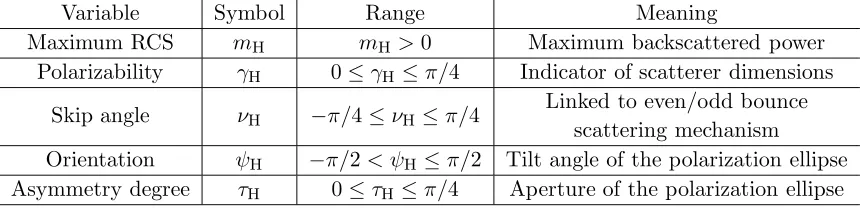
target intrinsic properties. The Huynen five independent parameters are presented in Table 1.
Table 1. The five Huynen independent parameters of an arbitrary scatterer.
Variable Symbol Range Meaning
Maximum RCS mH mH>0 Maximum backscattered power
Polarizability γH 0≤γH≤π/4 Indicator of scatterer dimensions
Skip angle νH −π/4≤νH≤π/4
Linked to even/odd bounce scattering mechanism
Orientation ψH −π/2< ψH≤π/2 Tilt angle of the polarization ellipse
Asymmetry degree τH 0≤τH≤π/4 Aperture of the polarization ellipse
Huynen defined a scatterer as fully symmetric if and only if it is diagonalized by a real orthogonal rotation matrix. The angle argument of the real orthogonal rotation matrix corresponds to the scatterer orientation angle. Even more, a scatterer is considered fully symmetric when it presents an axis of symmetry on the plane perpendicular to the LOS, which is none other than the HV plane. Thus, the angle, through which the symmetry axis of the fully symmetric scatterer is rotated in relation to the horizontal unit vector of the HV basis, is the orientation angle of the scatterer. When the scatterer is plainly symmetric, presenting some degree of asymmetry, based on the Cameron decomposition, we may obtain its maximum symmetric component that will lie on the HV plane [12]. The maximum symmetric component is the optimized scattering response of the scatterer from which the asymmetry contribution has been eliminated. This is the reason that every Cameron maximum symmetric component of a plainly symmetric scatterer can be brought to its optimal diagonal form by a real rotation operation. Consequently, the Cameron real rotation operation describes the misalignment of the symmetry axis of the plainly symmetric scatterer with the horizontal unit vector of the HV basis. Hence, it measures the real rotation angle of the scatterer around the LOS. The asymmetry of the scatterer is measured as the degree to which the initial scattering response of the target itself deviates from the scattering response of the maximum symmetric component of the target. When the asymmetry degree assumes its maximum value, the scatterer becomes fully asymmetric, and it cannot present an axis of symmetry on the HV plane. This also makes the orientation angle of the fully asymmetric scatterer meaningless. Hence, a scatterer may be symmetric, with any degree of asymmetry, when it can present an optimum scattering response on the HV plane, with an orientation angle equal to the misalignment of the scatterer axis of symmetry with the horizontal unit vector of the HV basis.
Conversely, Huynen’s asymmetry degree is represented by the ellipticity of the polarization ellipse, which, despite being rather intuitive, is found incapable of actually describing the asymmetry degree of a scatterer. More specifically, Titin-Schnaider in [8] has found that the more asymmetric the targets are, the less the Huynen parameter τH can represent the asymmetry degree of the scatterer. Additionally,
basisU, which does not always correspond to the real orientation angle of the scatterer [13]. In [8], it was also found that the Huynen orientation angle was dependent on the ellipticity angle of the polarization ellipse. This makes the Huynen orientation angle dependent on the asymmetry degree of the scatterer, which is rather irrational. A study of comparison between the Cameron and Huynen orientation angles is provided by Schneider et al. in [14] as well. Consequently, the parameters of the polarization ellipse cannot be associated with the extrinsic properties of the scatterer. Also, Cameron and Rais in [13] observed that irrational results may occur when trying to represent the Huynen elemental scatterers on the Poincar´e sphere whose axes are the polarization ellipse parameters. It seems that, given the visualization of the Poincar´e sphere, the dihedral becomes unaffected by changes in asymmetry as the trihedral is unaffected by changes in rotations. This is fundamentally erroneous because dihedral is a fully symmetric scatterer.
Moreover, in the Huynen factorization, the scatterer skip angle is part of the scatterer complex rotation, and thus it is treated as an extrinsic property, which also seems rather irrational. To overcome this, one may integrate the matrix U(νH) inside the diagonal matrix SD, making it complex provided
that it is permitted since they are both diagonal, to let it be treated as an inherent scatterer property, as in Equation (2) of [9]. Still, it will also lead to conflicting results. The ambiguity is derived because the polarizability angle and skip angle of the scatterer would still be independent variables. This makes them meaningless if they are both taken on their own, while their coupling in a product form will result in ambiguities in special cases when either one becomes zero [13]. In addition to the latter, Huynen’s factorization produces misleading results when |λ1|=|λ2|, with |λ1|and |λ2|being the magnitudes of
the real and nonnegative coneigenvalues, because the unitary congruence is always satisfied for every real vector [15]. Consequently, since the matrix SD is real and nonnegative and both of its coneigenvalues
have the same magnitude, it becomes impossible to classify the predominant scattering mechanism of the scatterer. From the above it is inferred that the optimum diagonal matrix SD should be complex
but with a different factorization from the one presented in [9]. In the proposed approach, we present such a diagonal matrixSDin which not only do we integrate the skip angle in the diagonal matrix SD, thus making it complex, but we also make the scatterer polarizability dependent on it. In this way, we accommodate for the aforementioned ambiguities. Moreover, we extract the real orientation angle and asymmetry degree of the scatterer in accordance to the Cameron approach, which is considered undisputed [8].
3. EXTRACTION OF THE SCATTERER EXTRINSIC PROPERTIES
In this work, in order to correctly extract the scatterer polarimetric properties, we exploit the L¨uneberg polarimetric equation that is based on the consimilarity transformation by a unitary matrix [10]. We can have the resulting diagonal matrix of the consimilarity transformation be complex [16]. The L¨uneberg polarimetric equation, again forU=U, is given next
S=USDU− 1
(4) where the matrixSDis a complex diagonal matrix equivalent to the initial scattering matrix S, and U
is again a unitary matrix that that belongs to the SU(2), which corresponds to the complex rotation that brings the scattering matrix to its optimum diagonal form. The overbar stands for complex conjugate while superscript−1 stands for matrix inverse. The diagonal matrixSDcontains the complex
coneigenvalues of S, while the special unitary matrixU contains the coneigenvectors of S.
The complex unitary matrixU must contain the information of both the scatterer real orientation and asymmetry. In the following, we may expressU in terms of an asymmetry operationTand a pure rotation operation R as in
U=TR (5)
with
R=
cosψ −sinψ sinψ cosψ
. (6)
The angle ψ corresponds to the orientation angle of the scatterer. The asymmetry operator T can be obtained as trivially as
Provided that U belongs to the SU(2) and that R is a real orthogonal matrix, it follows that the asymmetry operator Tis a unitary matrix, which also belongs to SU(2). For the matricesT and R, it holds that
TR=R−1T−1∗ (8)
where the superscript ∗ stands for complex conjugate transpose. Substituting Eqs. (5) and (8) into Eq. (4), we get
S=TRSD
(R−1T−1)∗−1 (9)
which leads to
S=TRSDR−1T− 1
(10)
Given Equation (7), Equation (10) is satisfied by an infinite number of combinations of matricesT
and R. However, there exists only one combination that corresponds to the actual asymmetry degree and orientation angle of the scatterer. Based on the Cameron decomposition, a scatterer that is not fully asymmetric always presents an axis of symmetry on the HV plane. The misalignment angle between the scatterer symmetry axis and the horizontal unit vector of the HV basis corresponds to the orientation angle of the scatterer. On the other hand, the orientation angle of the scatterer regards the angle by which the physical scatterer is rotated around the radar LOS, and thus it must not be affected by the asymmetry of the scatterer. In view of the latter, the symmetry axis of a scatterer, with any degree of asymmetry, would be placed on the HV plane at the same angle, in relation to the horizontal unit vector of the HV basis, as if the scatterer were fully symmetric. Hence, the orientation angle of a plain symmetric scatterer would be the same as if the scatterer were fully symmetric. Therefore, given that the orientation angle of a fully symmetric scatterer is extracted by means of a similarity transformation, we can extract the orientation angle of a plain symmetric scatterer by means of a similarity transformation as well. This is expressed as follows
S =PDP−1 (11)
where D is a complex diagonal matrix that contains the eigenvalues of the scattering matrix S, and
P is a unitary matrix that contains the eigenvectors of S, which also belongs to the SU(2). Clearly, in the framework of SAR polarimetry, the matrix D cannot represent the optimal response of the scatterer, neither does the matrixPrepresent the elliptical polarization change of basis. However, since Equation (11) is a similarity transformation and the matrix P a unitary matrix that belongs to the SU(2) group, then the matrix Prepresents a 3D rotation, none other than that of the scatterer. More specifically, the matrix P represents the 3D rotation of the scatterer, from which we can extract the three Euler angles, ϕP,ψP, and θP, which describe the orientation of the scatterer, with respect to a fixedx,y,zcoordinate system. Additionally, since thezaxis always corresponds to the radar LOS, the rotation of thexy plane around thezaxis corresponds to the misalignment angle between the scatterer symmetry axis and the horizontal unit vector of the HV basis, and is represented by the angle ψP. Hence, the orientation angle of the scatterer is the angle ψP, and we are interested in estimating it. Besides that, in the framework of SAR polarimetry angles ϕP andθP are meaningless.
There is a one to one correspondence between a special unitary matrix, e.g., the matrixP, with a real orthogonal matrix Q that belongs to the group of 3-dimensional special orthogonal rotation matrices, SO(3) [1]. In short, the SO(3) group represents a 3D rotation and is generated by all elementary rotations
Qx(a) =
⎡
⎣ 10 cos0a −sin0 a 0 sina cosa
⎤
⎦ (12)
Qy(β) =
⎡
⎣ cos0β 01 sin0β −sinβ 0 cosβ
⎤
⎦ (13)
Qz(ω) =
⎡
⎣ cossinωω −cossinωω 00
0 0 1
⎤
The matrixQx represents the rotation around thex-axis with a rotation anglea. Similarly, the matrix
Qy represents the rotation around they-axis with a rotation angle β, while the matrixQz represents the rotation around the z-axis with a rotation angle ω. The aforementioned correspondence is that an SU(2) matrix is homomorphic to an SO(3) matrix and is expressed via Equation (15).
SU(2)∼= SO(3)/Z2. (15)
From the above we get [1]
Qx(a) = Q(P(cosα/2,−isinα/2)) (16)
Qy(β) = Q(P(cosβ/2,−sinβ/2)) (17)
Qz(ω) = Q
P
e−iω/2, 0 (18)
Observing Equations (16) through Equation (18) it is seen that a special unitary matrix of the SU(2) group, e.g., matrix P, represents a pure 3D rotation. The angles of rotation, of the matrix P, around each of the 3 axes are exactly half the angles of rotation that are presented in the unitary matrix Q
of the SO(3) group. Hence, we can easily obtain the angles of rotation of matrix P from matrix Q. Considering Equation (17), it follows that the scatterer orientation angleψP can be derived as half of the angle β of Qy(β), i.e., ψP =β/2. We shall signify the real orientation angle of the scatterer with ψKA, i.e., ψKA =ψP =β/2. The orientation angleψKA ranges in (−π/2,+π/2], and it must also obey
the rules of the conservative scatterers as presented in [7]. In this way, the angle ψKA matches the
Cameron orientation angle, ψC, of the scatterer.
Given that ψKA is well defined, it makes the asymmetry operatorTa unique characteristic of the
scatterer that corresponds to its true asymmetry contribution. Furthermore, from Equation (10) we can take
SDR=RSDR−1 (19)
where R = R(ψKA) making SDR the symmetric component of the plain symmetric scatterer. The
asymmetry degree of the plain symmetric scatterer is the degree to which the initial scattering response deviates from the scattering response of its symmetric component, as proposed by Cameron. To measure this deviation degree, we make use of the vectorial form of the above scattering responses. The vectorial form of a matrix is obtained by means of the V transformation, which is provided next
A=V (A) whereA=
⎡ ⎢ ⎢ ⎣
A11
A12
A21
A22 ⎤ ⎥ ⎥
⎦, when A=
A11 A12
A21 A22
. (20)
It follows that the asymmetry degree can be measured as
τKA = cos−1
(S,SDR)
S SDR
(21)
whereS is the vectorial form of the initial scattering response of the scatterer, andSDR is the vectorial
form of the symmetric component of the scatterer taken from Eq. (19). Notation ... stands for the norm of a complex vector, and (,) stands for the inner product between two complex vectors.
The angleτKA of Eq. (21) ranges in [0, +π/4). WhenτKA= 0, it corresponds to a fully symmetric
scatterer, while when 0 < τKA < π/4, it corresponds to a plain symmetric scatterer. In the case
when the scatterer is fully symmetric it holds that S = SDR. This makes Equation (10) a similarity
transformation, identical to Equation (11). This overcomes the Shlivinski problem. In the case where the scatterer is fully asymmetric, it is expected that τKA would be equal to +π/4. However, when
the scatterer is fully asymmetric, its symmetric component does not exist, which makes Eq. (21) meaningless. Nevertheless, in this case we can assign τKA = +π/4. Additionally, when the scatterer is
fully asymmetric, the determinant of the unitary matrixU that condiagonalizes Sin Eq. (4) is equal to ±i, wherei2 =−1. The unitary matrixUin this case does not belong to the SU(2). Hence, a scatterer is considered to be plain symmetric only when it is condiagonalizable by a unitary matrix that belongs to the SU(2) group, having an orientation angle equal toψKA and an asymmetry degree equal to τKA.
special case of the latter. It should be clear by now thatψKA andτKA do not correspond to the tilt and
ellipticity angles of the polarization ellipse, as the Huynen parameters do. For this reason, the subscript KA has been inserted; so as to differentiate between the parameters of the proposed parameterization and the Huynen parameters, which are signified by the subscript H.
4. SCATTERER INTRINSIC PROPERTIES AND CHARACTERIZATION
In light of Eqs. (5), (6), and (7), we may see Eq. (10) as the transformation to obtain the optimal scatterer scattering response from which the orientation and asymmetry contributions of the scatterer are eliminated. Considering Equation (10), the diagonal matrixSD can be parameterized as follows
SD=mKAe+iξKA
1 0
0 γKA
(22)
with
mKA = |λ1|withmKA>0 (23)
ξKA = 2θ1 withθ1 ∈[0, π) (24)
γKA = λ2
λ1
eiνKA with|γKA| ∈[0,1] (25)
νKA = 2(θ2−θ1) = 2Δθwith θ1,2 ∈[0, π) and νKA ∈[0,2π) (26)
The matrix SD is a complex diagonal matrix equivalent to the initial scattering matrix S [17].
λ1 and λ2 are the complex coneigenvalues, and θ1 and θ2 are their respective phases, while Δθ is the
phase difference between the two coneigenvalues. mKA is the maximum response of the target provided
that the first coneigenvalue λ1 is always the largest. Notation |...| signifies again the magnitude of a
complex number. γKAis the complex polarizability, νKAthe skip angle, andξKAthe nuisance remainder
phase associated with the inherent electrical properties of the scatterer having nothing to do with its geometry. The subscript KA has again been inserted to differentiate between the parameters of the proposed approach and those of the Huynen decomposition, which are signified by the subscript H.
The elemental scattering mechanism of a scatterer can be extracted solely by using Eq. (22). In Eq. (25) by making γKA dependent on νKA, it overcomes the ambiguities that are derived in the
Huynen decomposition, in whichνH is part of the complex rotation of the congruence transformation.
The ambiguities of the scatterer intrinsic properties discussed in Section 2 can only be overcome by incorporating the skip angle in the polarizability parameter of the scatterer and not by merely making the diagonal scattering matrix complex. Observing Equation (22), the scatterer is considered horizontally oriented. Moreover, |γKA| can range in [0, 1], and in the case where|γKA|= 0 the scatterer would be
the dipole. In this case, Eq. (26) becomes meaningless. When |γKA|= 1 and νKA = 0, the geometric
structure of the scatterer corresponds to that of the trihedral. When |γKA| = 1/2 and νKA = 0, the
geometric structure of the scatterer corresponds to that of the cylinder. When|γKA|= 1 andνKA =π,
the geometric structure of the scatterer corresponds to that of the dihedral. When |γKA| = 1/2 and
νKA = π, the geometric structure of the scatterer corresponds to that of the narrow dihedral. When
|γKA|= 1 and νKA =±π/2, the geometric structure of the scatterer corresponds to that of the quarter
wave device. When|γKA|= 1/2 andνKA=±π/2, the geometric structure of the scatterer corresponds
to that of the narrow quarter wave device. Therefore, the geometric structure of any scatterer may be constructed unambiguously given any combination of |γKA|and νKA. Different combinations of |γKA|
and νKA that produce each elemental scattering mechanism are shown in Table 2.
The helices are presented when|γKA|= 0, which is the same as in the dipole case. However, since
Table 2. Inherent properties of elemental scattering mechanisms.
Elemental Scattering Mechanism Inherent Scatterer Properties γKA |γKA| νKA
Dipole 0 0 ∼
Cylinder 0.5 0.5 0
Narrow 1/4 Wave Device ±0.5i 0.5 ±π/2
Narrow Dihedral −0.5 0.5 π
Trihedral 1 1 0
1/4 Wave Device ±i 1 ±π/2
Dihedral −1 1 π
5. EXPERIMENTAL RESULTS
Here, in Table 3 through Table 11 examples of scatterer polarimetric characterization are provided using the proposed method. The scatterers are drawn from a real fully polarimetric scene. Additionally, for comparison reasons we provide the polarimetric characterization of the scatterers based on the Cameron and Huynen CTDs. More specifically, we provide a comparison of the scatterer common polarimetric properties that are ambiguous, i.e., the skip-, orientation-, and symmetry angle, that are derived from all three CTDs. All results are in degrees. In this way, it becomes easy to see the differences that occur among the three CTDs. Moreover, we consider the results of the Cameron decomposition undisputed, and we base our comparison on their results.
From Table 3, Table 4, and Table 5, it is observed that when the scatterer asymmetry is low, lower than 1◦, the Huynen CTD produces correct results. This is expected considering that in these cases the scatterers are considered as highly symmetric.
From Table 6, Table 7, and Table 8, it is observed that when the scatterer asymmetry is slightly high, between 1◦ and 5◦, the Huynen CTD produces misleading results. In this case, while the Huynen CTD correctly extracts the asymmetry degree of the scatterer, it completely misestimates the scatterer orientation angle and consequently misestimates the scatterer skip angle as well.
From Table 9, Table 10, and Table 11, it is observed that when the scatterer asymmetry is high, greater than 5◦, the Huynen CTD produces erroneous results. This is also expected considering that the more asymmetric a scatterer is, the less the Huynen asymmetry parameter represents its true asymmetry degree. Obviously, since the scatterer asymmetry degree cannot be estimated correctly, it follows that
Table 3. Polarimetric properties of scatterer #1.
S1 Cameron CTD Proposed CTD Huynen CTD
Skip angle 0.8740 0.5971 0.2149
Orientation angle −39.3429 −38.2751 −39.1185
Symmetry degree 0.8874 0.7477 0.6478
Table 4. Polarimetric properties of scatterer #2.
S2 Cameron CTD Proposed CTD Huynen CTD
Skip angle 4.5228 4.5026 5.1304
Orientation angle −4.4798 −4.4793 −4.3519
Table 5. Polarimetric properties of scatterer #3.
S3 Cameron CTD Proposed CTD Huynen CTD
Skip angle 16.4204 16.1883 14.0965
Orientation angle −8.2886 −8.2812 −7.5687
Symmetry degree 0.6167 0.6256 0.7720
Table 6. Polarimetric properties of scatterer #4.
S4 Cameron CTD Proposed CTD Huynen CTD Skip angle −14.6484 −14.5059 0.1402 Orientation angle 0.1285 0.1198 −43.6081
Symmetry degree 2.6456 3.6614 3.6595
Table 7. Polarimetric properties of scatterer #5.
S5 Cameron CTD Proposed CTD Huynen CTD Skip angle −45.5198 −46.3792 −10.2017 Orientation angle −4.1245 −4.0519 25.0211
Symmetry degree 4.3616 4.4630 5.1935
Table 8. Polarimetric properties of scatterer #6.
S6 Cameron CTD Proposed CTD Huynen CTD Skip angle −19.3982 −20.4028 3.7164
Orientation angle 7.7894 7.3436 23.1720
Symmetry degree 3.5886 3.7400 3.2314
Table 9. Polarimetric properties of scatterer #7.
S7 Cameron CTD Proposed CTD Huynen CTD
Skip angle 71.0427 69.5693 14.0624
Orientation angle −0.5077 −0.4971 17.8003
Symmetry degree 6.7917 7.2231 11.3249
Table 10. Polarimetric properties of scatterer #8.
S8 Cameron CTD Proposed CTD Huynen CTD
Skip angle −71.1678 −66.2567 8.9524 Orientation angle −3.1742 −3.1268 25.1589
Symmetry degree 5.7156 7.0964 15.6391
Table 11. Polarimetric properties of scatterer #9.
S9 Cameron CTD Proposed CTD Huynen CTD
Skip angle 39.0975 38.3176 0.3835
Orientation angle 8.8853 8.8441 37.2704
Symmetry degree 6.8151 6.9870 19.7671
with the results of the Cameron procedure, making it evident that our approach produces the correct polarimetric characterization of any arbitrary scatterer. The advantage of the proposed approach is that not only does it estimate the polarimetric properties of a scatterer but it also provides the true asymmetry contribution of the scatterer represented by the operator T.
6. CONCLUSIONS
It has been discussed that a scatterer is fully symmetric when it presents an optimum scattering response on the plane perpendicular to the LOS. This is translated to the feasibility to bring any arbitrary scatterer to its optimal diagonal scattering response by means of a real rotation operation. On the other hand though, based on the consimilarity transformation, the target scattering response, with any degree of asymmetry, can always be brought to its optimum diagonal form by means of a special unitary matrix. The latter contains both the orientation and asymmetry contributions of the scatterer. The orientation angle of the scatterer regards the angle by which the physical scatterer is rotated in relation to the radar LOS. Moreover, the orientation angle of the scatterer regards the rotation of the scatterer symmetry axis in relation to the horizontal unit vector of the HV basis. However, the orientation of the scatterer must be independent of the asymmetry of the scatterer. It follows that the symmetry axis of a non-fully asymmetric scatterer would be the same as if the scatterer was fully symmetric. Thus, the real orientation angle of a scatterer can only be derived from a similarity transformation as in Equation (11). Having correctly extracted the orientation angle of the scatterer, it becomes straightforward to define the scatterer symmetric component and asymmetry degree, as in Eqs. (19) and (21) in accordance to the Cameron decomposition. This also makes the operator T a unique characteristic of the scatterer, representing its true asymmetry contribution.
The scatterer optimum diagonal form is then regarded as the scatterer scattering response from which the asymmetry and orientation contributions have been eliminated. Additionally, the scatterer optimum diagonal form is now complex, in which the information of the scatterer skip angle is integrated. Moreover, by making the scatterer complex polarizability dependent on the scatterer skip angle, it overcomes the ambiguities regarding the connection of the scatterer polarizability angle and the skip angle imposed in the Huynen decomposition. One may observe that the proposed complex polarizability γKA takes the same values as the Cameron complex parameter for any fully symmetric elemental
scattering mechanism. Moreover, the proposed scatterer orientation angle and asymmetry degree are in full agreement with their Cameron counterparts. This is not only expected but it is also desired because the polarimetric properties of a scatterer must be independent of the procedure that optimizes the scatterer scattering response. Ultimately, we have proposed a parameterization of the polarimetric equation from which all scatterer polarimetric properties are unequivocally extracted. In this way, the predominant scattering mechanism of a scatterer, with any degree of asymmetry, can be unambiguously classified.
REFERENCES
1. Lee, J. S. and E. Pottier, Polarimetric Radar Imaging: From Basics to Applications, Taylor & Francis Group, CRC Press, New York, 2009.
2. L¨uneburg, E., S. R. Cloude, and W. M. Boerner, “On the proper polarimetric scattering matrix formulation of the forward propagation versus backscattering radar systems description,”
3. Bebbington, D. and L. Carrea, “On mathematical and physical principles of transformations of the coherent radar backscatter matrix,” IEEE Transactions on Geoscience and Remote Sensing, Vol. 50, No. 11, 4657–4669, November 2012.
4. Huynen, J. R., “Physical reality and mathematical process in radar polarimetry,” 1991 Seventh International Conference on Antennas and Propagation, ICAP 91 (IEE), Vol. 1, 257-261, York, 1991.
5. Graves, C., “Radar polarization power scattering matrix,” Proceedings of the IRE, Vol. 44, No. 2, 248–252, 1956.
6. Boerner, W. M., W. L. Yan, A. Q. Xi, and Y. Yamaguchi, “On the basic principles of radar polarimetry: The target characteristic polarization state theory of Kennaugh, Huynen’s polarization fork concept, and its extension to the partially polarized case,” Proceedings of the IEEE, Vol. 79, No. 10, 1538–1550, 1991.
7. Cameron, W. L. and H. Rais, “Conservative polarimetric scatterers and their role in incorrect extensions of the Cameron decomposition,” IEEE Transactions on Geoscience Remote Sensing, Vol. 44, No. 12, 3506–3516, 2006.
8. Titin-Schnaider, C., “Comparison between Huynen and Cameron monostatic parameters,” Radio Science, Vol. 47, No. 4, 2012.
9. Dallmann, T. and D. Heberling, “On the coneigenvalue decomposition of Sinclair matrices,”PIERS Proceedings, 2714–2718, Prague, Czech Republic, July 6–9, 2015.
10. L¨uneberg, E., “Radar polarimetry: A revision of basic concepts,” Direct and Indirect Methods in Scattering Theory, Gebze, Turkey, 1996.
11. Dallmann, T. and D. Heberling, “On the connection between Jones matrix and Sinclair matrix,”
PIERS Proceedings, 258–262, Prague, Czech Republic, July 6–9, 2015.
12. Cameron, W. L., N. N. Youssef, and L. K. Leung, “Simulated polarimetric signatures of primitive geometrical shapes,” IEEE Transaction on Geoscience Remote Sensing, Vol. 34, No. 3, 793–803, 1996.
13. Cameron, W. L. and H. Rais, “Derivation of a signed Cameron decomposition asymmetry parameter and relationship of Cameron to Huynen decomposition parameters,”IEEE Transactions on Geoscience and Remote Sensing, Vol. 49, No. 5, 1677–1688, 2011.
14. Schneider, R., I. Hajnsek, H. Kimura and J. S. Lee, “Comparison of orientation angle estimation methodes over coherent scatterers,” EUSAR 2006 — 6th European Conference on Synthetic Aperture Radar, Dresden, Germany, 2006.
15. Shlivinski, Y. and E. Heyman, “Physical models for polarimetric SAR analysis,”IEEE Transactions on Antennas and Propagation, Vol. 56, No. 8, 2664–2672, 2008.
16. Horn, R. A. and C. R. Johnson,Matrix Analysis, 2nd Edition, Cambridge University Press, USA, 2013.
17. L¨uneberg, E., “Aspects of radar polarimetry,” Turkish Journal of Electrical Engineering &