ISSN 2286-4822 www.euacademic.org
Impact Factor: 3.1 (UIF) DRJI Value: 5.9 (B+)
Teachers’ Sense of Efficacy Scale: The Study of
Validity and Reliability
Dr. ORNELA BILALI Faculty of Educational Sciences “A. Xhuvani” University Elbasan, Albania
Abstract:
Teachers’ Sense of Efficacy Scale (TSES) was developed by Tschannen-Moran and Anita Woolfolk Hoy (2001), an attempt to provide an instrument with strong reliability and validity. The purpose of the present study was to explore the validity and reliability of the Albanian version, of the Teachers’ Sense of Efficacy Scale applied to student teachers. Data in this study were collected from a total number of 92 students enrolled in the third year of the Bachelor study program: "Elementary Teacher" and "Preschool Teacher". Measurements were made at two stages of development Pedagogical Practice. Descriptive statistics, Principal-axis factoring with varimax rotation, and Scree Test were used to explore the data analyses. Results revealed that the Albanian version of the Teachers’ Sense of Efficacy Scale had high reliability coefficient which was α = .94 (before practice) and α= .96 (after practice), as estimated by Cronbach alpha coefficient. Factorial analysis found that, items of the Teachers’ Sense of Efficacy Scale yielded a single factor with an eigenvalue of 7.10, which explains and the unifactor solution accounted for 59% of the total variance.
Key words: Teachers’ Sense of Efficacy Scale, Student teachers,
Validity, Reliability.
Introduction and Theoretical Framework
with strong reliability and validity. It is a measuring instrument recently, which was developed in response of persisting problems related to the previous measurement instruments. Teachers’ Sense of Efficacy Scale (TSES) is very specific to the tasks of teaching and provides comprehensive factors. It is superior to previous instruments on the efficacy of teachers for the fact that there is a unified structure and stable factors as well as evaluates a wide range of skills, which are considered important for teachers to teach better.
This instrument is used extensively in studies on the teacher efficacy by many scholars as: Turkovich (2011), Al-Mehrzi, Al-Busaidi, Ambusaidi, Osman, Amat and Al-Ghafri (2011), Fives and Buehl (2010).
Teachers’ Sense of Efficacy Scale is available online: http://people.ehe.osu.edu/ahoy/files/2009/02/tses.pdf
Teachers’ Sense of Efficacy Scale
Teachers’ Sense of Efficacy Scale stem by measure which named the Ohio State teacher efficacy scale (OSTES). OSTES was examined in three separate studies. In the first study, the original 52 items were reduced to 32 and in the second, the scale was further reduced to 18 items made up of three subscales. In the third study, 18 additional items were developed and tested. The resulting instrument had two forms, a long form with 24 items and a short form with 12 items. Finally, the factor structure, reliability, and validity of the new measure was examined as well as the appropriateness of the new scale for both preservice and inservice teacher populations. (Moran & Hoy, 2001)
1= Nothing, 3= Very Little, 5= Some Influence, 7= Quite A Bit, 9= A Great Deal.
Reliability and Validity of Teachers’ Sense of Efficacy Scale
According Moran and Hoy (2001), the validity of the content is created by a panel of experts and support the existing literature. The validity of the construction was verified by factor analysis and comparison of existing instruments. External validity was established through a series of pilot tests, which also defined reliability as a measure of internal consistency. Factorial analysis consistently showed three factors: Efficacy in Student Engagement, Efficacy in Instructional Practices, and Efficacy in Classroom Management. These three factors accounted for 54% (long form) and 65% (short form) variance for teachers in service. Factorial structure for pre-service teachers, it is often less evident for those surveyed, therefore the best choice for pre-service teachers is a factor. When determining the key factors (Principal axis -factoring) carried only one factor to be issued by the reaction of pre-service teachers. In both instances 24-point or 12-point all statements charged to this factor from 0.60 to 0.85 and accounted for 57% and 61% of the variance for pre-service teachers1
The general reliability of Teachers’ Sense of Efficacy Scale is high with Cronbach Alpha = .90
Method Participant
The sample of this study consisted of 92 students enrolled in the third year of the Bachelor study program: "Elementary
783-Teacher" and "Preschool 783-Teacher". 95 % are female and 5% are male. 84% of the samples are at the age of 22. 60% are students in Elementary Teacher program study and 40% are students in Preschool Teacher program study.
Procedures
Since Teachers’ Sense of Efficacy Scale is not used in any similar study in Albania, and the source in the literature is available in English translation and adaptation was used in Albanian. After the translation process, which was made by a lecturer of English at the University, was taken expert opinion on the validity of the content.
Measurements were made at two stages of development Pedagogical Practice, at the end of serial practice and the end of 8-week practice.
Data analysis
The collected data were analyzed using Statistical Package for Social Sciences (SPSS), version 17th software. Teachers’ Sense of
Efficacy Scale reliability was evaluated using Cronbach’s alpha and the internal consistency. For the structure validity of the scale, principal axis factor analysis with varimax rotations and Screen Test was used.
Results and Discussion
Reliability analysis of the Teachers’ Sense of Efficacy Scale (short form)
Teachers’ Sense of Efficacy Scale requires a response by choosing a level of nine choices (1 for Nothing, 3 for Very Little, 5 for Some Influence, 7 for Quite A Bit, 9 for A Great Deal).
The Teachers’ Sense of Efficacy Scale have resulted in a high coefficient of reliability, as before practice (α = .94), and after performing pedagogical practice (α = .96). Henson (2001b), has recommended that for general research purposes, reliability should be at least 0.80. According to Field (2005), this is a good level of internal consistency.
Table 1. Results of Cronbach’s alpha coefficient
Before practice After practice
TSES .94 .96
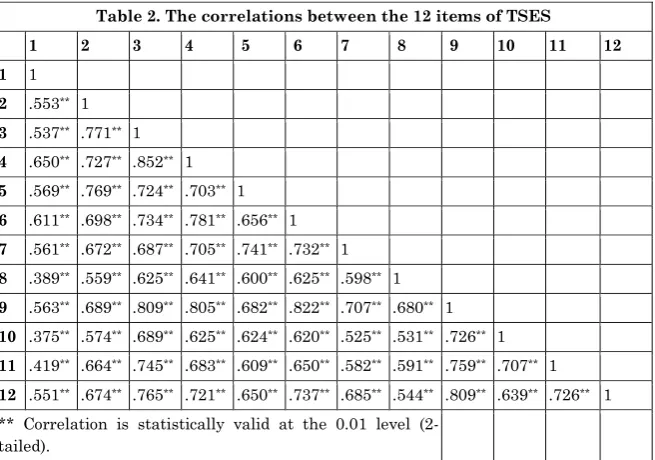
By inspection of the item correlations containing TSES, it was concluded that there is no correlation under .30 and correlations generally ranging by moderate to strong (see Table 2).
Table 2. The correlations between the 12 items of TSES
1 2 3 4 5 6 7 8 9 10 11 12
1 1
2 .553** 1
3 .537** .771** 1
4 .650** .727** .852** 1
5 .569** .769** .724** .703** 1
6 .611** .698** .734** .781** .656** 1
7 .561** .672** .687** .705** .741** .732** 1
8 .389** .559** .625** .641** .600** .625** .598** 1
9 .563** .689** .809** .805** .682** .822** .707** .680** 1
10 .375** .574** .689** .625** .624** .620** .525** .531** .726** 1
11 .419** .664** .745** .683** .609** .650** .582** .591** .759** .707** 1
12 .551** .674** .765** .721** .650** .737** .685** .544** .809** .639** .726** 1 ** Correlation is statistically valid at the 0.01 level
Factorial analysis of Teachers’ Sense of Efficacy Scale (short form)
The 12 items of the TSES (Moran & Hoy, 2001)), which was adapted in Albanian were includes in a factorial analysis (Principal axis factoring with varimax-rotation), to identify possible factors associated with Teachers’ Sense of Efficacy Scale (short form).
It is proven if the data are suitable for conducting factorial analysis. The sample included in this study exceeds the minimum ratio 1 to 5 (5 persons for a variable), defined by Tabachnick and Fidell (2007). Index Kaiser-Meyer- Olkin for sample suitability for conducting factorial analysis was .94. This index is significantly higher than the minimum level .6, allowed to perform factorial analysis of defined by Kaiser (1974). Bartlett's Test, resulted statistically valid (p <.05) (see Table 3). The data are suitable for conducting factorial analysis.
Table 3. KMO dhe Bartlett's Test
Kaiser-Meyer-Olkin Measure of Sampling Adequacy. .945 Bartlett's Test of Sphericity Approx. Chi-Square 944.417
Df 55
Sig. .000
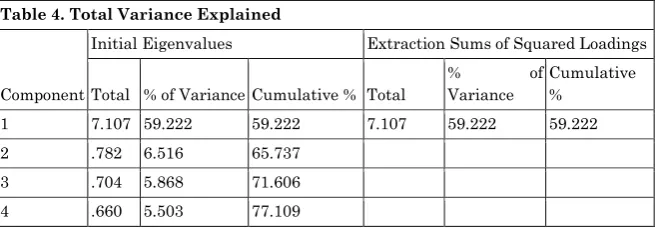
Factorial analysis of 12 items revealed a single factor with a characteristic value (eigenvalue) of 7.10, which explains 59% of variation (Table 4).
Table 4. Total Variance Explained
Component
Initial Eigenvalues Extraction Sums of Squared Loadings
Total % of Variance Cumulative % Total
% of
Variance
Cumulative %
1 7.107 59.222 59.222 7.107 59.222 59.222
2 .782 6.516 65.737
3 .704 5.868 71.606
5 .475 3.960 81.069
6 .448 3.732 84.801
7 .399 3.328 88.129
8 .356 2.965 91.095
9 .333 2.771 93.866
10 .290 2.416 96.282
11 .234 1.953 98.235
12 .212 1.765 100.000
Extraction Method: Principal Component Analysis.
By inspection of the Scree Test (Catell, 1996), it was concluded a clear interruption after the second component (Figure 1).
Figure 1. Scree Test
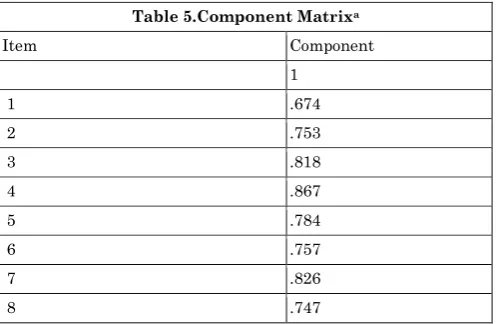
The 12 items (variables) evidenced a distinct load factorial to this factor alone. Correlation between items (variables), ranging from 0.67 to 0.87 (see Table 3.4)
Table 5.Component Matrixa
Item Component
1
1 .674
2 .753
3 .818
4 .867
5 .784
6 .757
7 .826
9 .757
10 .681
11 .788
12 .761
Extraction Method: Principal Component Analysis. a.1 components extracted.
Factorial analysis of 12 items revealed a single factor with a characteristic value (eigenvalue) of 7.10, which explains 59% of variation. This result is supported by previous studies conducted by Moran and Hoy, 2001; Al-Mehrzi etc. 2011 concerning student teachers (pre-service teachers). Similarly the survey results Fives and Buehl (2010), suggest that one factor is more convenient for the teacher responds before the service. Cheung (2006), the Chinese version of TSES, short form administered to 728 elementary school teachers, found that the scale is unidimensionale. Also in the study of Isler (2008), the Turkish version of TSES, short form administered with 805 elementary math teachers, a factor was acceptable. Lin and Gorrell (2001) indicate that the efficacy of the teacher is a cultural construct-oriented, which should be specified with caution when applied to teachers in different countries.
Findings about the validity and reliability of the Teachers’ Sense of Efficacy Scale (Moran & Hoy, 2001), Albanian version, are an added contribution to of the research literature in Albania. It is recommended to use this scale, in similar studies in Albanian reality.
REFERENCES
Journal 14 (Learning Innovation and Intervention for Diverse Learners): 52-59, 2011. ISSN 1818-4952
Field, A. (2005). Discovering statistics: Using SPSS for windows. London: SAGE Publications
Fives, H. & Buehl, M. (2010). Examining the Factor Structure of the Teachers’ Sense of Efficacy Scale. The Journal of Experimental Education, 78, 118–134
Henson, Robin K. (2001) “Teacher Self-Efficacy: Substantive Implications and Measurement Dilemmas.”
Isler, I. (2008). Teachers’ perceived efficacy beliefs and perceptions. Regarding the implementation of 2004 primary mathematics Curriculum. A thesis submitted to The graduate school of Social Sciences of Middle East Technical University Ankara, Turkey
Kaiser, H. (1974). An index of factorial simplicity.
Psychometrika, 39,31-6
Lin, H., & Gorrell, J. (2001). Exploratory analysis of pre-service teacher efficacy in Taiwan. Teaching and Teacher Education, 17, 623-635.
Tabachnick, B.G. & Fidell, L.S. (2007). Using multivariate statistics. (5th edition). Boston: Pearson Education Tschannen-Moran, M.,& Woolfolk Hoy, A. (2001). Teacher
efficacy: Capturing and elusive construct. Teaching and Teacher Education, 17, 783-805