Trust perceptions of online travel information by different
content creators: Some social and legal implications
Abstract
Consumers are increasingly turning to the online environment to provide information to assist them in making purchase decisions related to travel products. They often rely on travel
recommendations from different sources, such as sellers, independent experts and, increasingly, other consumers. A new type of online content, user-generated content (UGC), provides a
number of legal and social challenges to providers and users of that content, especially in relation to areas such as defamation, misrepresentation and social embarrassment. This paper reports research that examined the level of trustworthiness of online travel information from these different sources. The study used a survey of Australian travel consumers (n=12,000) and results support the notion that there are differences in the level of trust for online travel information from different sources. Respondents ‘tended to agree’ that they trusted information provided by travel agents, information from commercial operators and comments made by travellers on third party websites. However, the highest level of trust was afforded to information provided on State government tourism websites. These results suggest that greater trust is placed in online travel comments when they are on a specific travel website than when they are on a more generic social networking website. However, respondents were ‘not sure’ that they trusted comments made by travellers on weblogs and on social networking sites. Some 88% of respondents that had not visited UGC websites (or were unsure if they had) indicated that they thought that UGC would be useful in the future – suggesting that they feel that any concerns they may have in relation to legal and social problems resulting from its use will be resolved.
Introduction
These days, consumers are increasingly using the Internet to source information to assist them in making purchase decisions, particularly for ‘experience’ goods (such as travel) – where
information about the experience cannot always be easily gathered before purchase. In this environment, consumers often rely upon travel product recommendations from different sources, such as sellers, independent experts and, increasingly, other consumers. Consumers can post ‘content’ online in a number of formats, such as text reviews, images and pictures (this content being commonly known as user-generated content or UGC). A number of legal and social issues associated with this type of online content are discussed, as they can potentially affect the level of trust placed in this content. The study examines the level of trustworthiness of online travel information from different information sources through a survey of Australian travel consumers that had subscribed to an online newsletter with Tourism New South Wales, the tourism body representing the largest State in Australia. The survey resulted in a large number of responses (n=12544) and examined how users perceived the level of trustworthiness of different categories of content travel information creators.
Purchase Decisions and Product Recommendations
Consumers have different strategies for finding information about a product or service of interest that they wish to purchase. Senecal and Nantel (2004) discuss literature that relates consumers’ choices of information sources to the type of product or service being sought. They note that goods can possess either search or experience qualities. Information about goods with search qualities can be determined prior to purchase – that is, much can found out about the product or service beforehand. Information about goods with experience qualities cannot easily be
category of being experience goods (Bei, Chen and Widdows, 2004). Alternatively, Smith, Menon and Sivakumar (2005) suggest that the consumption of goods involves hedonic and/or utilitarian dimensions. Utilitarian goods are predominantly purchased for functional needs. Hedonic goods are purchased for ‘socio-emotional’ benefits and experiences such as fantasy, fun and pleasure. Although some goods can satisfy the criteria for both utilitarian and hedonic, it is reasonable to conclude that travel purchases fall into the category of hedonic goods.
One of the common sources of information that tends to be sought embraces product
recommendations – where advice is offered (either general or specific to consumers) in relation to the selection of a particular product or service. Senecal and Nantel’s (2004) research
suggested that:
Consumers that consulted a product recommendation were more likely to purchase the product than those who did not. In addition, Smith et al (2005) found that in the absence of recommendations consumers looking to purchase conducted even more searches for information.
Consumers were more influenced by recommendations for an experience product (wine) than for a search product (calculator).
WOM information, with negative WOM information being particularly influential in shaping future decision-making (Chatterjee, 2001). However, when negative WOM information is provided with the specific goal to vent frustration or anger, its influence on the receiver tends to be lower as it is not perceived to be as constructive or useful (Wetzer, Zeelenberg & Pieters, 2007). The success of WOM information exchanges is potentially associated with the close links or ties that exist between the person conveying the information (the product or service
recommender) and the listening consumer. Duhan, Johnson, Wilcox and Harrell (1997) discuss the notion of tie strength. A tie is weak if the recommender is just an acquaintance or is not known to the consumer. A tie is strong when the consumer knows the recommender personally. A significant advantage of strong tie recommenders is that they can evaluate product and service alternatives on the basis of what the consumer prefers due to their understanding of the
consumer. Weak tie recommendation sources, however, are not limited to the social circle of the consumer and can thus be more numerous and more varied (Duhan et al, 1997). It is important to remember that most WOM (in the traditional sense) comes from those people with whom the consumer has strong ties.
to trust and be more influenced by this type of information than by more commercial sources such as travel agents or accommodation operators (Litvin et al, 2008). In addition, information derived from logical, well-reasoned and persuasive reviews can positively influence the likelihood of product purchases (Park, Lee and Han 2007).
Content in the Online Environment
The complexity associated with consumer search choices on the Internet is recognised by Peterson and Merino (2003), who suggest that the Internet is a complex phenomenon that is not completely understood and that the way in which consumers search for information for purchase decisions is also a complex phenomenon which is not completely understood. However, it is likely that consumers will continue to use the Internet as a source of information for purchase decisions (Peterson and Merino 2003). An example of an impersonal source is the typically encountered electronic recommender system, which is an automated system that provides advice to consumers about goods that would suit them (Burke 2000). Recommender systems usually operate according to some programmed algorithm and make their calculation based upon the personal profile of the consumer (usually stored in a database).
In the online world, recommendations sources can come from (Senecal and Nantel, 2004):
Other consumers
Human experts
Expert systems (these are electronic recommendation systems that will recommend a particular product or service based upon a consumer’s profile).
information (or online consumer reviews). Online consumer reviews can have the dual tasks of providing useful information and can also act as a recommender. The mere provision of online peer recommendations is seen as being important for consumers as it can provide a means by which they are assisted in the managing the volume of information available to them online for purchase decisions (Smith, Menon and Sivakumar, 2005).
A common term for the content generate by consumers on websites is User-Generated Content (or UGC). In marketing terms, UGC sites are effectively a form of consumer to consumer e-marketing. They equate to electronic word-of-mouth marketing (eWOM), whereby somebody who has an opinion about a product or service shares their views, beliefs and experiences with other people (Ahuja, Michels, Walker & Weissbuch, 2007). Fernando (2007) suggests that UGC, or social media, is the polar opposite to traditional forms of media and marketing since content is generated by the consumer rather than by the marketer.
Consumers can use the Internet to access information that they would have traditionally received from ‘real world’ sources. Some examples are (Peterson and Merino 2003; Litvin et al, 2008):
Websites instead of traditional mass media advertising and/or information normally acquired from a salesperson
eWOM instead of traditional WOM
Online independent sources (such as government tourism bodies) instead of their offline counterparts.
information is personalised to the consumer or just general recommendations (non-personalised). Indeed, tools such as blogs and social networking sites— for example Facebook and MySpace— have allowed consumers to become better informed than ever before – not only being able to add their own comments, but also being able to find other information and articles and ‘tag’ them with their own keywords (Buhler, 2006). Social networking sites typically operate by inviting members into their own personal networks. As this process ‘snowballs’ the size of the networks can grow. These communities rely upon the creation of UGC to continue operation (Trusov et al, 2008).
In an online context, word-of-mouth information exchanges occur when consumers create their own content on the Internet to share their experiences and views about products they have
purchased (Park et al, 2007). There is typically far more information available to the consumer in the online environment from eWOM than from traditional WOM. Often the level of exposure of consumers is only limited by their time and cognitive limits (Chatterjee, 2001). As suggested earlier, exposure to online consumer reviews can increase consumers’ intention to purchase a product and maximise the likelihood that they will buy a recommended product (Park et al, 2007; Senecal & Nantel, 2004). Park et al (2007) found that consumers’ purchasing intentions
or very unfavourable) experiences are more likely to provide online comments or reviews. These sites could be regarded as being more neutral than those sites sponsored by businesses (Litvin et al, 2008).
In the tourism context, the Internet is an important source of information for travellers. For instance, a majority of US travellers use the medium to search for travel information (Litvin, Goldsmith & Pan, 2008). According to Senecal and Nantel’s (2004) discussion of the types of products referred to earlier, the travel product could certainly be described as an experience product. Product recommendations or reviews from other consumers can be important to prospective purchasers where an experiential product (such as tourism) is concerned. In fact, Litvin et al (2008) discuss the nature of the hospitality and tourism products as being intangible, sometimes high risk goods that cannot be evaluated before consumption, making the
interpersonal influence quite important. In a study of the online search patterns faculty and staff of a major university in Taipei, Bei et al (2004) found that consumers searching for information about experience products tended to use online information sources more frequently than those searching for information about search products. Of these online sources, information from consumers and neutral sources was used more frequently and were regarded as being more important.
Trustworthiness of user-generated content
There is no universally accepted definition of ‘trust’. Chen (2006) discusses two ‘schools’ of trust. The first school regards trust as a belief or expectation about another party’s
latter view of trust and identifies three dimensions of trust: the level of competence, the level of benevolence and the level of integrity. However, this view generally relates to the relationship between the consumer and provider – so in this instance, where the trustworthiness of UGC is being examined – it is more appropriate to adopt the first school, where the trustworthiness of the party providing the UGC comment is considered.
Criticism regarding the power of UGC to persuade travelers about travel related decisions is based on the potential for ‘fake’ content to be posted by travel operators posing as independent reviewers. This effectively defeats the purpose of enabling UGC to influence travelers in their decision making process as the content added is no longer independent, objective or credible (Bray & Schetzina, 2006). One of the concerns raised about the use of UGC sites when planning travel is how the consumer can be assured that the reviews they are viewing are in fact
independent and hence trustworthy (Gretzel, 2006). One of the major concerns here is that businesses might use employees to act as consumers to pose positive comments on behalf of the business or to post negative comments about the competition (Litvin et al, 2008).
web sites is considered far more trustworthy (Wasserman, 2006). Websites that are independent, third-party type sites tend to be considered preferable to consumers compared to those which are clearly operated by a business with a vested interest (Senecal & Nantel, 2004). Thus, the forum in which recommendations is presented is quite important.
As already mentioned, a possible downside of UGC is that while traditional forms of word-of-mouth tends to come from people who are known to the consumer (i.e. friends, colleagues etc), online reviews are typically created by total strangers, resulting in some concern over the credibility of the source of review (Park et al, 2007, Litvin et al, 2008). As previously indicated, UGC as an information source typically reflects information exchanges that can be considered to represent weak ties between consumers.
tourism sites, classically embodied by Tripadvisor are typical of avenues that are founded on consumer created content. A further type of online information source that is encountered can be associated with the businesses or sellers of tourism products or services— commercial entities that have an interest in promoting consumer travel trade. Promotional information published on tourism or travel websites owned by private businesses tends to be treated sceptically by
consumers (Senecal & Nantel, 2004) - the assumption being that it is less trustworthy than the other sources of tourism information.
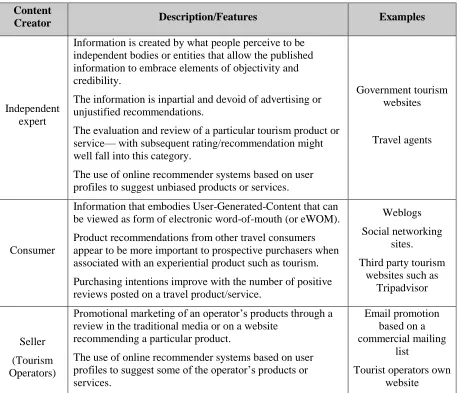
Table 1: Summary of the different content creators of online tourism information (adapted and derived from Senecal and Nantel, 2004; Bray & Schetzina, 2006; Gretzel, 2006: Park et
al, 2007; Litvin et al 2008). Content
Creator Description/Features Examples
Independent expert
Information is created by what people perceive to be independent bodies or entities that allow the published information to embrace elements of objectivity and credibility.
The information is inpartial and devoid of advertising or unjustified recommendations.
The evaluation and review of a particular tourism product or service— with subsequent rating/recommendation might well fall into this category.
The use of online recommender systems based on user profiles to suggest unbiased products or services.
Government tourism websites
Travel agents
Consumer
Information that embodies User-Generated-Content that can be viewed as form of electronic word-of-mouth (or eWOM).
Product recommendations from other travel consumers appear to be more important to prospective purchasers when associated with an experiential product such as tourism.
Purchasing intentions improve with the number of positive reviews posted on a travel product/service.
Weblogs
Social networking sites.
Third party tourism websites such as
Tripadvisor
Seller
(Tourism Operators)
Promotional marketing of an operator’s products through a review in the traditional media or on a website
recommending a particular product.
The use of online recommender systems based on user profiles to suggest some of the operator’s products or services.
Email promotion based on a commercial mailing
list
Clearly, there are several categories in which the creators of online tourism information or content can be grouped— each group being potentially perceived as having varying elements of trust. Table 1 summarizes the different creators of online tourism information content. It is within the dimensions of the different content creators that this study explores the trust issue with respect to online tourism information and users.
Legal and Social Implications of online content
The various legal and ethical issues associated with websites that publish UGC are one of the emerging challenges facing its proponents. Ibrahim (2008) suggests that social networking sites in particular facilitate new types of “deviance, fraud, deception and crime while enabling new types of communities and fraternities” (:245). One of the concerns with these types of websites is that they have contributions from a combination of amateur, semi-professional and professional people – some of whom do not necessarily understand the obligations that publishers have when dealing with the online environment (Humphreys, 2008). Furthermore, one of the major issues that may occur with online social networking content is the jurisdictional uncertainty that can emerge when the creators, hosts and readers of the content are located in different parts of the world. Whilst formal policies and regulations are easier to implement and follow within an organisation or even a nation, it is much more complicated when multiple countries are involved (Zapinta, 2007). Different countries will have their own legal and ethical frameworks in
Some of the commonly encountered legal issues that can occur with the posting of user-content are associated with copyright laws and, perhaps more relevant to the tourism field, information that may result in defamation claims. Fayle (2007) discusses how the providers of content have to be aware of potential intellectual property infringements as well as defamation when posting comments. Cases that relate to damaging the reputation of individuals due to postings on social network sites are starting to appear in the courts (Rosenblum, 2007). Fayle (2007) suggests that whilst the owners of websites that host such content might have some protection, people that post the comments may not – certainly in the United States anyway. The social networking websites that host content may also fall victim of non-disclosure, where for instance, users of the websites could become upset if they feel that they have not been fully informed of the risks associated with posting content (Lam and Churchill, 2007). Of course, one of the problems already mentioned is that of multiple identities; where fake content is posted as a form of deception to either improve the profile of a company’s product or damage the reputation of others (Ibrahim, 2008).
of their website to post reviews. These will often have more controls than a general social networking site. For instance, Travelocity (www.Travelocity.com) allow their website users to post reviews, but state quite clearly that profanity, hateful comments, personal messages,
information identifying individuals, review responses or website links are not allowed – and they reserve the right to edit or remove these reviews. In contrast, sites such as MySpace or Facebook have few restrictions that are placed on access to their websites or posting of information. In Facebook some options have recently been implemented in an attempt to prevent unwelcome contact with underage users (Rosenblum, 2007). This may be a possible reason as to why Rosserman (2006) found that the trust levels associated with general social networking websites were lower than other websites.
Research Questions
As previously outlined, there are several different types of online information categories that relate to travel information. Hence, one of the questions directing this research is how do users perceive these different types of travel information creators with respect to trust? In this study the authors are predominantly interested in the views of consumers who use the Internet to assist with their travel plans in relation to their opinions on UGC. However, linked with this is the idea that they need to place their use of UGC in context with other travel information and services that are available to them online. Thus, the more general research question relates to the levels of trust that consumers place in these different types of sources of information. To this end the authors examine the following hypothesis related to the sources of the information (consumer, seller-created or independent expert information).
H1: The level of trust placed by online travel consumers will be greater for independent
It is not as easy to generate a hypothesis in relation to levels of trust in seller-created information
versus consumer-created information. The literature suggests that levels of trust in seller-created
information may be compromised by the vested interested they may have in creating the
information. It also suggested that levels of trust in consumer-created information, whilst being
viewed as being independent, may be compromised by extreme or inappropriate postings.
However, we felt that the weight of the literature suggested that it would be preferred to
seller-created information.
H2 The level of trust placed by online travel consumers will be greater for consumer-created
travel information than for seller-created travel information.
Study Details
details for the prize draw if they chose to do so. The database of results and the prize database
were not linked.
Recipients who choose to participate in the survey, on a voluntary and anonymous basis, simply clicked on the web-link provided and responded to the survey questions online.
The use of a survey for data collection is appropriate (when compared with say, interviews or focus groups) as the researchers wanted to access the views of as many travel consumers as possible within the time constraints of the study. An online survey provides the means for achieving this. Online surveys have the advantage of being easier (and cheaper) to set up and administer than the paper alternative, especially if the paper survey is to be mailed to potential respondents. One of the limitations of using online surveys can be the difficulty of getting an acceptable response rate (Evans and Mathur 2006; Williamson 2002). The use of TNSW’s online newsletter as the means of distributing the survey meant that it was targeted specifically at travel consumers (controlled sampling is seen as a benefit of online surveys), so it was hoped that this would have a positive affect on the response rate. Some of the challenges associated with paper-based surveys can be also encountered with online surveys, such as problems with unclear questions and respondent bias (Evans and Mathur 2005; Williamson 2002). The online survey tool that was employed did not allow multiple entry of the survey in one session. Theoretically, it
would have been possible for a user to close down their browser and to open it again, or enter the
survey with another web browser, but we believe this to be unlikely.Noting these online survey issues, the researchers acknowledge that this to be one of the limitations of the study.
software that was then converted into SPSS (Statistical Package for the Social Sciences) for further analysis.
By the survey closing date, 13,281 people had participated in the study (a response rate of approximately 12%). It should be noted that not all respondents answered every question in the survey, as they were given the option not to answer questions if they so chose. Furthermore, some questions were not asked of all respondents (e.g., names of UGC sites they had used) where their previous responses to questions indicated a question was irrelevant. These factors should be taken into account when noting the total number of responses reported in the various tables in this article. Approximately 700 responses were not considered useful due to a lack of data, so in effect the useable number of responses was 12,544.
Respondent Profile
A demographic profile of survey participants is provided in Table 2. This profile is compared to that of the database of 110,000 users, provided by TNSW, to which the survey was sent out (see last column of table) to enable any potential response bias to be detected. Overall the sample surveyed is highly representative of the profile of users included in the database.
The age profile of participants in this study reflects the overall profile of the E-Scapes database. Approximately 51 percent of people were aged 30-49 years. A further 23 percent were 50-59 years. In terms of gender, the skew towards a higher proportion of female participants (61%) is reflective of the overall profile of the database. The profile of responses to the survey appears, therefore, to be able to be generalized to the population of travelers included in the database and certainly to ‘online’ travel consumers as a whole. The authors consider that it is reasonable to suggest that the results of the study could be generalized to apply to online travel consumers in
Table 2: Profile of Survey Respondents
Demographic Category N %
responded
% of TNSW database
Age Group
Under 19 years 39 0.5 0.2 20-29 years 893 10.0 10.6 30-34 years 972 11.4 12.1 35-39 years 1091 12.7 13.3 40-44 years 1155 13.5 13.9 45-49 years 1161 13.6 14.3 50-54 years 1103 12.9 13.0 55-59 years 874 10.2 10.2 60-69 years 1056 12.3 10.7 70 plus years 223 2.6 1.8
Total 8567 100.0 100.0
Gender
Female 5235 61.4 60
Male 3292 38.6 40
Total 8527 100.0 100.0
Country of Origin
Australia 8273 97.0 99.0
Other 259 3.0 1.0
Total 8532 100.0 100.0
Place of Origin
New South Wales 6210 72.8 68.1
Victoria 934 10.9 8.2
Queensland 713 8.4 7.6
Other States 362 4.2 14.5
Overseas 259 3.0 1.6
Australia – State not indicated
54 0.7 -
Total 8532 100.0 100.0
Gross Household Income/Year
Less than $52,000 2178 27.4 28.8 $52,000 - $77,999 1738 21.8 24.5 More than $78,000 4041 50.8 46.7
Total 7957 100.0 100.0
Results
In relation to the ‘independent expert’ sources, these come from travel agents and from government sponsored tourism bodies.
In relation to the ‘seller-created’ sources, these come from commercial operators and via specific email promotions.
‘Consumer-created’ sources are traveller comments provided on weblogs in general, on specific third party travel sites (such as Tripadvisor) and on social networking sites (such as MySpace). In relation to construct reliability, the trust scale was sourced from [Carmen – do you have
these details?]. It was not considered appropriate to use measures such as Cronbach’s alpha or
convergent/discriminant validity as there was never any intention to develop a composite
measure of trust from the different categories of website sources. Even simple correlations were
not appropriate to employ as it was voluntary for respondents to respond to trust levels in
different categories of information.
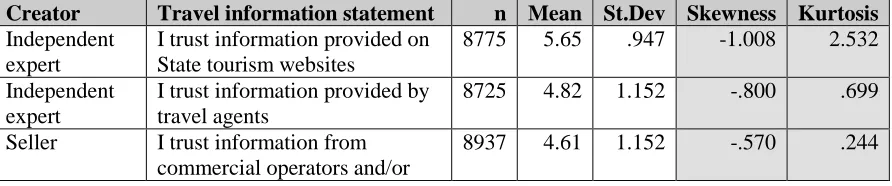
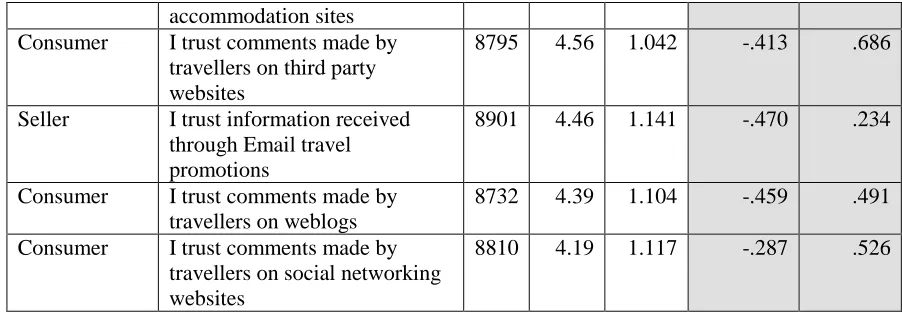
Table 3 indicates the sample size and distribution details for each of the travel information statements. The use of skewness and kurtosis measures to determine the normality of the
distributions could perhaps be considered to be unnecessary as the parametric tests which will be employed become more reliable as the sample size (n) becomes larger (Spiegel and Stephens 2008). However, the distributions each still fall within Newsom’s (2005) acceptable limits of normality for skewness and kurtosis.
Table 3: Sample Size and distribution of Level of Agreement with travel information statements
Creator Travel information statement n Mean St.Dev Skewness Kurtosis
Independent expert
I trust information provided on State tourism websites
8775 5.65 .947 -1.008 2.532
Independent expert
I trust information provided by travel agents
8725 4.82 1.152 -.800 .699
Seller I trust information from commercial operators and/or
accommodation sites Consumer I trust comments made by
travellers on third party websites
8795 4.56 1.042 -.413 .686
Seller I trust information received through Email travel promotions
8901 4.46 1.141 -.470 .234
Consumer I trust comments made by travellers on weblogs
8732 4.39 1.104 -.459 .491
Consumer I trust comments made by travellers on social networking websites
8810 4.19 1.117 -.287 .526
In determining whether differences between the mean scores for each of these statements is significant, a calculation of Levene’s statistic for the travel information statements (refer Table 4) suggests that there are statements which have variances that are not equal (that is,
homogeneity does not exist). Thus, the Games-Howell tests have been run for each statement (refer The Games-Howell results suggest that there are only two statements where the mean results are not significantly different (p<.01) – these being trust in comments made by travellers on third party websites and information provided by commercial operators. Note that there is only a difference of 0.05 in the mean results between these two statements (and 0.11 different in their standard deviations). There appears to be no specific reason as to why these statements in particular are not significantly different whilst all of the others are.
Table 5) in preference to the Tukey test, which relies on homogeneity (Coakes and Steed 2007). Table 4: Test of Homogeneity of Variances for level of agreement with travel information
statements Levene
Statistic df1 df2 Sig. 78.731 6 61668 .000
difference of 0.05 in the mean results between these two statements (and 0.11 different in their standard deviations). There appears to be no specific reason as to why these statements in particular are not significantly different whilst all of the others are.
Table 5: Games-Howell test for level of agreement with travel information statements Weblog traveller comm-ents Social network traveller comm-ents Third party traveller comm-ents Commercial Operator inform-ation Travel agent inform-ation State tourism inform-ation Email promotion inform-ation Weblog traveller comments
- .198* -.172* -.217* -.430* -1.262* -.069*
Social network traveller comments
-1.98* - -.370* -.415* -.628* -1.461* -.267*
Third party traveller comments
.172* .370* - -.045 -.258* -1.091* .103*
Commercial operator information
.217* .415* .045 - -.213* -1.046* .148*
Travel agent information
.430* .628* .258* .213* - -.833* .361*
State tourism information
1.262* 1.461* 1.091* 1.046* .833* - 1.194*
Email promotion information
.069* .267* -.103* -.148* -.361* -1.194* -
* mean difference sig. (p < .01)
As previously stated, the results suggest that the differences between the means for most of the statements are significant. However, it is important to consider the size of the samples as there are a large number of responses for each statement (ranging between n = 8725 to n=8937 responses for each statement). Uran (2005) warns that even very small differences can be statistically significant if the population is large. Oller (2006), in discussing statistically
may not be important. In this instance, Oller suggests that “A statistically significant correlation may account for very little variation and consequently may be practically unimportant”.
Having such a large sample in this instance, it is useful to consider the importance of the statistical differences that have been identified, and this is carried out by referring back to some other characteristics of the data. In this instance the authors consider ‘important’ to mean that the
results indicate a difference in the survey response according to the Likert scale that was
employed.
Returning to Table 3, it is obvious that travel consumers place more trust in travel information provided on State tourism websites and by travel agents (‘independent expert’ content) than they do in travel comments provided by travellers on weblogs and social networking websites
(‘consumer-created’ content).
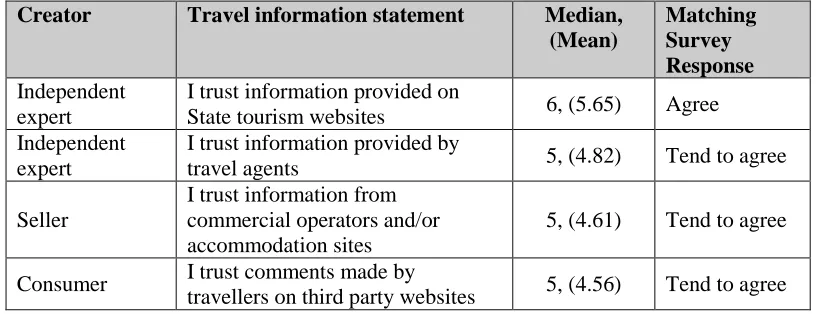
Table 6 shows the median and mean values for each of the travel statements (the mode was equal to the median value in all instances), with the matching survey response also shown (assuming the mean is rounded to the nearest response interval). The results for the three measures (median, mode, rounded mean) are identical for nearly all of the statements, the exception being
information received through Email travel promotions.
Table 6: Median and Mean and matching survey response for travel information statements
Creator Travel information statement Median, (Mean)
Matching Survey Response
Independent expert
I trust information provided on
State tourism websites 6, (5.65) Agree Independent
expert
I trust information provided by
travel agents 5, (4.82) Tend to agree
Seller
I trust information from commercial operators and/or accommodation sites
5, (4.61) Tend to agree
Consumer I trust comments made by
Seller I trust information received
through Email travel promotions 5, (4.46)
Tend to agree (Not sure)
Consumer I trust comments made by
travellers on weblogs 4, (4.39) Not sure
Consumer
I trust comments made by travellers on social networking websites
4, (4.19) Not sure
Taking into account these measures and the size of the sample, the authors feel that the responses can be categorised into three groups.
For all measures, respondents ‘agreed’ with the statement that they trusted information on State government sponsored tourism websites. This corresponded to response ‘6’ on the 1-7 Likert scale provided to survey respondents. Thus, H1 is supported.
In the same manner, respondents ‘tended to agree’ that they trusted information provided by travel agents, information from commercial operators and comments made by travellers on third party websites. This corresponded to response ‘5’ on the Likert scale. Very close to this group of responses was the trust placed in email travel promotions, with the mean measure (4.46) only marginally placing it closer to the ‘not sure’ response (‘4’ on the Likert scale) than the ‘tend to agree’ response.
Finally, both of the measures suggested that respondents were ‘not sure’ that they trusted comments made by travellers on weblogs and on social networking sites.
Thus, H2 is not supported. It appears that the source of the travel information is more complex
than just ‘seller-created’ and ’consumer-created’ information and that factors such as the location
of the information and the method of delivery (such as web site versus email) are also important.
The Effect of Having Used UGC
Given the results presented in the previous section, the authors were interested in examining the levels of trust in the different categories of online travel information according to whether the survey respondents had previously visited a UGC website.
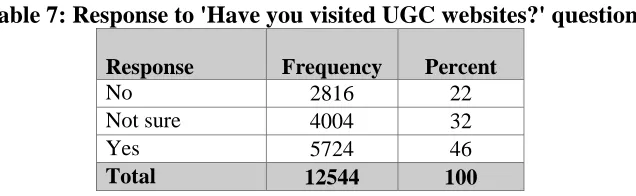
One interesting aspect that came out of this study is the number of respondents that indicated that they were ‘not sure’ if they had previously visited a UGC website, despite the fact that a
definition of the meaning of UGC was provided at the beginning of the survey (refer Table 7). Almost one in three respondents indicated that they were not sure if they had visited a UGC website.
Table 7: Response to 'Have you visited UGC websites?' question Response Frequency Percent
No 2816 22
Not sure 4004 32
Yes 5724 46
Total 12544 100
Respondents that had indicated that they were ‘not sure’ if they had visited a UGC website or had not visited such a site were asked a further question – if they thought UGC would be useful in the future (refer Table 8).
Table 8: Response to 'Will UGC be useful in the future?' question [Only answered by those that had not used UGC before or were unsure if they had]
Response Frequency Percent
No 749 12
Total 6252 100
The authors were interested to see if there were differences in the level of trust between previous users of UGC and those that had not used UGC. To establish this, Mann-Whitney tests were carried out between pairs of results for whether respondents had used UGC before (between the ‘no’/ ‘not sure’ and ‘not sure’/ ‘yes’ pairs) and whether UGC will be useful in the future
(between the ‘no’/ ‘yes’ pairs). Note that nearly nine out of ten of the respondents that had not used UGC thought that it would be useful in the future. Due to the fact that the sample size is so large (and it was expected that there would be significant differences in the results, as with Table 3), the values in Table 9 where there is no significant difference have been highlighted. Note that all of the ‘no’/ ‘yes’ pairs for the question relating to if UGC will be useful in the future showed a significant difference (p<0.05).
It is now possible to examine the differences between means for the question where respondents were asked if they had used UGC before. Note the change in mean trust levels, moving from respondents that had used UGC before to those that had not used UGC before. For each
statement bar one (comments by travellers on social networking sites are the [slight] exception) the means either increase or decrease as one moves from the ‘Yes’ responses, through ‘Not sure’ responses to the ‘No’ responses.
Table 9: Ratings of trust in travel information statements by use of UGC content and future usefulness of UGC content
Creator Travel information statement Overall (Mean, median) Used UGC (Mean, median)
UGC will be useful (for those that have
not used UGC or were unsure
if they had) Yes Not
sure
No Yes No
n=8725 to 8937 n=3035 to 3157 n=3290 to 3336 n=2399 to2434 n=5012 to 5086 n=664 to 679 Independent expert
I trust information provided on State tourism websites 5.65 6 5.56 6 5.67 6 5.74 6 5.72 6 5.54 6 Independent expert
I trust information provided by travel agents
4.82 5
4.67 5
4.87 o 5
4.92 o 5
4.91 5
4.79 5
Seller I trust information from commercial operators and/or accommodation sites 4.61 5 4.43 5
4.69 o 5
4.72 o 5
4.73 5
4.52 5
Consumer I trust comments made by travellers on third party websites 4.56 5 4.68 5 4.54 5 4.44 4 4.56 5 4.00 4
Seller I trust information received through Email travel promotions 4.46 5 4.30 4 4.53o 5
4.56 o 5
4.58 5
4.27 4
Consumer I trust comments made by travellers on weblogs
4.39 4 4.46 5 4.41 4 4.27 4 4.44 4 3.67 4 Consumer I trust comments made
by travellers on social networking websites
4.19 4
4.21 o 4
4.23 o 4 4.11 4 4.26 4 3.58 4 o
No significant difference (p>.05)
However, the situation is reversed when the results for consumer-created information are examined. In these instances, respondents that had visited a UGC website, or were not sure if they had visited one, tended to trust the content of the website more.
Table 10: Median and Mean and matching survey response for travel information statements by use of UGC content and future usefulness of UGC content Creator Travel information
statement Overall (Mean, median) Used UGC (Mean, median)
UGC will be useful (for those that have not used UGC) Yes Not
sure
No Yes No
Independent expert
I trust information provided on State tourism websites
Agree Agree Agree Agree Agree Agree
Independent expert
I trust information provided by travel agents Tend to Agree Tend to Agree Tend to Agree Tend to Agree Tend to Agree Tend to Agree Seller I trust information from
commercial operators and/or accommodation sites Tend to agree Not sure/ Tend to agree Tend to Agree Tend to Agree Tend to Agree Tend to Agree
Consumer I trust comments made by travellers on third party websites Tend to Agree Tend to Agree Tend to Agree Not sure Tend to Agree Not sure
Seller I trust information received through Email travel promotions Not sure/ Tend to agree Not sure Tend to Agree Tend to Agree Tend to Agree Not sure
Consumer I trust comments made by travellers on
weblogs Not
sure Not sure/ Tend to agree Not sure Not sure Not sure Not sure
Consumer I trust comments made by travellers on social networking websites Not sure Not sure Not sure Not sure Not sure Not sure
Once again, however, it is important to examine if these differences are important. These are presented in Table 10. For the independent expert sources of information the rounded means and median results show little important variation in the level of trust between respondents when their median and (rounded) mean results are mapped back to the original Likert scale.
no variation in the level of trust place in comments on social networking sites. This is consistently the lowest level of trust across all categories.
Discussion
The results support the notion that there are differences in the level of trust for online travel information from different sources. The highest level of trust was afforded to information provided on State government tourism websites. This result is consistent with the literature (for instance, Senecal and Nantel 2004; Park et al 2007), which suggested that independent websites would be viewed as being the most trustworthy. In this category, the bulk of respondents
‘agreed’ that the information was trustworthy. Government authorities would do well to understand the implications of this and to recognize their responsibility to provide
comprehensive and easy-to-access information for online travel consumers.
Respondents ‘tended to agree’ that they trusted information provided by travel agents, information from commercial operators and comments made by travellers on third party
websites. The result in relation to travel agents was expected, as they would be viewed as being independent. However, it is interesting to note that information from commercial operators falls into this category. Given the level of ‘mistrust’ suggested in the literature, it was expected that there would be lower levels of trust in this category. One possible explanation for this is that the questions related to information on the websites of these commercial operators. This is a finding that could be used by commercial operators to their advantage. If the information that they
provide on their websites is (mostly) viewed as being trustworthy, then this could be used as
vehicle to which the marketing of their own offerings can be linked. In relation to UGC,
respondents’ trust in postings by travellers on travel websites was also grouped into this
This is consistent with the discussion earlier in the article related to the legal and social aspects of online content. Websites such as Travelocity have stricter controls on the types and nature of reviews posted – consequently there is less likelihood that emotional or defamatory postings will occur on these websites when compared to some of the more general social networking websites. It would seem logical to assume that this leads to greater trust in these websites. Again, the potential lesson here is for businesses that intend to employ some form of user-generated content
on their websites. The results here suggest that businesses that employ controls to restrict
extreme postings may be considered to be more trustworthy.
Very close to this group of responses was the level of trust placed in email travel promotions, with the mean measure (4.46) only marginally placing it closer to the ‘Not sure’ response (‘4’ on the Likert scale) than the ‘tend to agree’ response. This ‘targeted’ seller created information was not seen to be as trustworthy as information on commercial websites. This may be due to the confrontational nature of email promotions as opposed to users accessing a website for travel
information at their own convenience.
Finally, respondents were ‘not sure’ that they trusted comments made by travellers on weblogs and on social networking sites. This is consistent with the findings of Wasserman (2006). The authors were surprised by the number of respondents that indicated they were ‘Not sure’ if they had visited a UGC website before. A definition of UGC was provided – but it may have been ‘skimmed’ or not understood by some respondents:
An interesting finding is that this trend is reversed for seller-created information, with more trust being placed in that category of online information by respondents that had not used UGC before. Perhaps there is a possibility that the lack of use of UGC sites (and greater trust in seller-created information) might relate to concerns about their level of trustworthiness. An interesting future study will be to examine the effect of age, gender and income level on these results to see if these trends can be explained by any of these demographic variables.
Earlier in this article the authors raised a number of legal and social issues that could lead to a lack of trust in websites incorporating UGC, especially in relation to general social networking websites. Whilst the results of the study suggest that independent and seller-created information is generally more highly rated that consumer created content, the reader is reminded that 88% of respondents that had not visited UGC websites before (or were not sure if they had) suggested that UGC would be useful in the future. This implies that there is likely to be an increase in the use of UGC despite the legal and social implications that come with its use.
Conclusion
This research reported on how travel consumers in Australia perceive the different travel
information creators with respect to trust. Three types of online content creators where identified as being important to the traveller providing them with decision-making information— these
What is User-Generated Content?
A growing number of web sites are incorporating features which enable the user, such as you, to contribute their own content enabling people to communicate about special interest topics or products or services through the internet. Such content is commonly referred to as ‘user-generated content’. In relation to travel and tourism, some examples of user-generated content include
ordinary people like yourself sharing their opinions about travel destinations, attractions and accommodation properties through blogs (weblogs) or other discussion forums
travellers submitting photos or videos to the internet to share their travel experiences with other online users (including family, friends or total strangers who may be interested)
consumers posting reviews of accommodation properties to sites such as tripadvisor.com
were the independent expert, the seller or tourism operator and the consumer. The study used on the online survey instrument to capture over 12,000 traveller responses to record their views on the trustworthiness associated with each of these information creators.
The highest level of trust associated with online travel information was that provided by
independent experts, followed by sellers and consumer-created information. The lowest levels of trust were placed in comments made by travellers on social networking websites, such as
Facebook. However, further analysis revealed that there were some differences in the levels of trust between travel consumers that had visited UGC travel websites and those that had not. Although the ranking of the overall information sources remained similar across the groups, respondents that had visited UGC websites were more likely to trust consumer-created
information than those that had not. Alternatively, those that had not visited UGC websites were more likely to place higher levels of trust in websites associated with seller-created information. Some 88% of respondents that had not visited UGC websites (or were unsure if they had)
indicated that they thought that UGC would be useful in the future – suggesting that they fell that any concerns they may have in relation to potential legal and social problems will be resolved.
Acknowledgements:
The authors wish to thank and acknowledge the Sustainable Tourism Cooperative Research Centre (STCRC) and Tourism New South Wales (TNSW) as the funding sponsors of this research.
References
Ahuja, RD, Michels, TA, Walker, MM & Weissbuch, M. 2007. “Teen perceptions of disclosure in buzz marketing”, Journal of Consumer Marketing, 24 (3): 151–159.
Bray, J. & Schetzina, C. 2006. Travel 2.0: “Harnessing the Power of User-Generated Content and Tagging”. Hospitality Upgrade. Fall: 28-29.
Buhler, J.E. 2006, Travel marketers hitch a ride with web 2.0, HotelMarketing.com,
[http://www.hotelmarketing.com/index.php/content/article/travel_marketers_hitch_a_ride_ with_web_20/], Retrieved: 27/09/2008.
Burke, R. 2000, "Knowledge-Based Recommender Systems" in Encyclopedia of Library and Information Science, ed. A. Kent, 1st edn, Routledge, US.
Chatterjee, P. 2001, "Online Reviews: Do Customers Use Them?", ACR 2001 Proceedings, eds. M.C. Gilly & J. Myers-Levy, Association for Consumer Research: 129-134.
Chen, C. 2006, "Identifying significant factors influencing consumer trust in an online travel site", Information Technology & Tourism, 8: 197-214.
Coakes, S.J. & Steed, L. 2007, SPSS Version 14.0 for Windows: Analysis without Anguish, John Wiley & Sons, Qld, Australia.
Duhan, D., Johnson, S., Wilcox, J. & Harrell, G. 1997, "Influences on consumer use of word-of-mouth recommendation sources", Journal of the Academy of Marketing Science, 25(4): 283-295.
Evans, J.R. & Mathur, A. 2005. "The value of online surveys", Internet Research, 15(2): 195-219.
Fayle, K. 2007. Understanding the Legal Issues for Social Networking Sites and Their Users. Legal Technology Centre, [http://technology.findlaw.com/articles/00006/010966.html], Retrieved 17/11/2008.
Fernando, A. 2007. “Social media change the rules: Say farewell to top-down and hello to consumer-led communication”, Communication World, 24 (1): 9-10.
Gretzel, U. 2006. “Consumer Generated Content – Trends and Implications for Branding”. e-Review of Tourism Research. 4 (3): 9-11.
Humphreys, S. 2008. “the challenges of intellectual property for users of Social Networking Sites: a case study of Ravelry”, Proceedings of Mind Trek, Tampere, Finland, Oct 6-9. Ibrahim, Y. 2008, "The new risk communities: Social networking sites and risk", International
Journal of Media & Cultural Politics, 4(2): 245-253.
La, S.K. and Churchill, E. 2007. “The social web: global village or private cliques”, Proceedings of the 2007 conference on Designing for User eXperiences, Chicago.
Litvin, S.W., Goldsmith, R.E. and Pan, B. 2008. “Electronic word-of-mouth in hospitality and tourism management”. Tourism Management, 29: 458-468.
Newsom, J. 2005, Practical Approaches to dealing with Non-Normal and Categorical Variables, Portland State University,
[Online][http://www.upa.pdx.edu/IOA/newsom/semclass/ho_estimate2.doc], Retrieved: 20/9/2008.
Oller, D.K. 2006, "Primer on Research: Interpretation of correlation", The ASHA Leader, 11(15): 24-26.
Park, D., Lee, J., and Han, I. 2007. “The Effect of On-Line Consumer Reviews on Consumer Purchase Intention: The Moderating Role of Involvement”. International Journal of Electronic Commerce, 11 (4): 125-148.
Peterson, R.A. & Merino, M.C. 2003, "Consumer information search behavior and the Internet", Psychology and Marketing, 20(2): 99-121.
Senecal, S. & Nantel, J. 2004. “The influence of online product recommendations on consumers' online choices”, Journal of Retailing, 80 (2): 159-69.
Smith, D., Menon, S. & Sivakumar, K. 2005, "Online peer and editorial recommendations, trust, and choice in virtual markets", Journal of Interactive Marketing, 19(3): 15-37.
Spiegel, M.R. & Stephens, L.J. 2008, Statistics, 4th edn, McGraw Hill, USA.
Trusov, M., Bucklin, R.E. & Pauwels, K.H. 2008, Effects of Word-of-Mouth Versus Traditional Marketing: Findings from an Internet Social Networking Site,
[http://papers.ssrn.com/sol3/Delivery.cfm/SSRN_ID1129351_code1012805.pdf?abstractid =1129351&mirid=1], Retrieved: 26/9/2008.
Uran, T. 2005, Statistics in Plain English, 2nd edn, Lawrence Erlbaum Associates, New Jersey. Wasserman, T. 2006. “Consumers Don’t Trust Blogs”, Brandweek, 47 (31): 10.
Wetzer, I.M., Zeelenberg, M. & Pieters, R. 2007. “Never Eat in That Restaurant, I Did!:
Exploring Why People Engage in Negative Word-Of-Mouth Communication”. Psychology and Marketing. 24 (8): 661-680.
Williamson, K. 2002. Research Methods for students, academics and professionals: Information management and systems, 2nd ed, Charles Sturt University, NSW, Australia.
Zapinta, L. 2007. eCommerce anyone? The Legal and Ethical aspects on online commerce. Webtravel2.com, [http://www.webtravel2.com/2007/12/29/ecommerce-anyone-the-legal-and-ethical-aspects-on-online-commerce/], Retrieved: 17/11/2008.