Cloud VaaS Framework for Cross-Platform Mobile Devices
Ambika Reddy
Mtech CS & E VTU RC Mysore
Abstract
In today’s world smartphones are playing an important role in providing cloud services to the end users. Cloud based Video-as-a-Service(VaaS) and multimedia contents are taking the major share in data communication these days. This paper presents the design and implementation of cloud infrastructure and invoking a cloud service from an android phone. The cloud service used is a video on demand Software-as-a-service(SaaS) streaming, which helps in playing a large and high quality video onto a mobile phone.
Keywords: cloud computing, mobile cloud computing, VaaS, SaaS, cross platform, Android.
1. Introduction
Today's scenario, Cloud computing services are very much essential for web users to accessing computing resources that is hardware and software over Internet. Virtualization is a core form of Cloud Computing. An Internet-connected machine and remote digital storage are used to make available a variety of services for business and personal applications. Among the many cloud computing scenarios the following is a list of a very few important ones.
• Infrastructure as a service (IaaS)
• Platform as a service (PaaS)
• Software as a service (SaaS)
• Storage as a service (STaaS)
• Security as a service (SECaaS)
• Multimedia as a service(MaaS)
• Video as a service(VaaS)
Also using Data for service provisions(Daas), Database based services(DBaas), Services by the test environment of a software(TEaas), Virtualization of desktop, Services from APIs(APIaaS), Services from Backend Process are a few other services emerging in the cloud computing scenario. In Past Cloud Computing is adopted by all companies due to its security issues but more recently these services used much larger in various business applications with a help of trusted service providers.
On the other hand, smartphones, tablets and other mobile devices have created a phenomenal revolution in the world of communication. However, smartphones aren’t “smart” without considering the apps that give their usability and adoption globally Phones have clearly evolved from their primary state of only providing call services to providing value added services such as broadband connectivity, location aware services, office suite, games, and sensors such as accelerometer, compass, barometer, etc. To provision customer with better services, several newer handhelds are being released each day with differing configuration and computing capability. But yet, smartphones are intrinsically limited by battery lifetime, memory and storage capacity. To handle this limitation, mobile devices are backed up with the power of cloud computing thus, rendering a new research area called the Mobile Cloud Computing. Mobile cloud computing enables mobile devices to use cloud services for data processing, storage and other processor-intensive tasks.
The convergence of cloud with mobile devices has drastically reduced the need for advanced handsets. It is really exciting to know that a feature phone with limited functionality and just a browser to access the cloud will suffice to perform any kind of extensive processing task. Many users already have a daily experience of using cloud services over mobile devices such as Gmail, Picasa, Facebook, LinkedIn, Dropbox, etc. In fact, today’s top giant in social networking, Facebook, estimates for more than 600 million mobile users, leading to almost 60% of its total user base. Apple iCloud and Amazon Silk Browser are two other mobile applications that leverage the cloud.
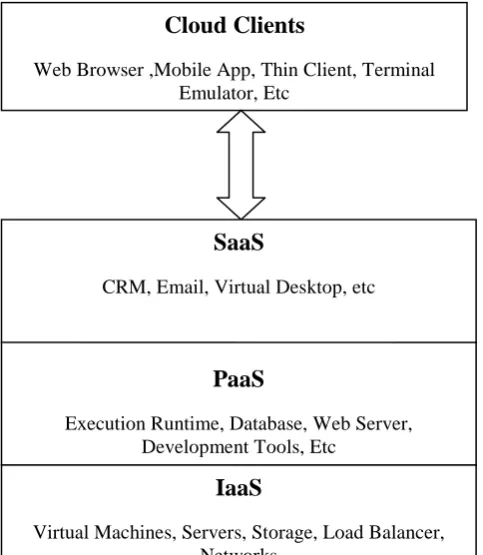
Figure 2: Cloud Computing Stack
A cloud service refers to software functions exposed as Web Service over the Internet. Web services have emerged as a set of open standards and are a way to expose some business logic over the Internet to other applications. Over the years, real time video streaming has been the promising application used in several sectors such as business, education, military, media and so on. The storage offered on a mobile device isn’t adequate enough to run a very large high quality video. This paper explores the design and implementation of Video-as-a-Service framework for Android platform on cloud environment. For this experiment, a Software-as-a-Service model is employed to stream a real time video from a cloud enabled machine to a mobile device. To realize this, a private cloud infrastructure has been setup and a Video On Demand Web service is deployed in it and accessed over an Android phone
2. Related Work
Video retrieval on mobile devices is a challenging and emerging research problem. Mobile devices have limited luxury in terms of processing power, storage capacity, display capability, etc. and therefore impose more challenges compared to viewing the video on a personal computer. Due to the mobility feature, ensuring network connectivity and providing considerable bandwidth to guarantee uninterrupted video dissemination is also a great challenge. There has already been a spur of research activity from academia and industry working on to address these issues. In this regard related work has been carried out by various authors as discussed below.
A. S. Baumgart et al[1] “ A Platform- Independent Adaptive Video Streaming Client for Mobile Devices,” (2005). In this paper A S Baumgart et al Presented an adaptive approach for platform independent mobile devices for disruption tolerant end-to-end optimized video streaming. This approach provides QoS attributes and connection level parameters are taken into consideration to provide video streaming capabilities with reasonable quality of service on all Java enabled phones.
G. Lam and D. Rossiter[2], “ A SOAP-Based Streaming Content Delivery Framework for Multimedia Web Services,” (2008). The unprecedented growth of World Wide Web necessitates the dissemination of multimedia content as Web services. Lam and Rossiter have proposed SOAP based streaming content delivery framework for multimedia Web services. The framework uses an extension of existing SOAP standards, called the SOAP streaming message exchange pattern, which allows streaming content to be transmitted between two SOAP nodes over HTTP protocol. The proposed framework is capable of delivering quality multimedia content to users with heterogeneous configurations and requirements.
O. Rendon, F. Pabon, M. Vargas and J. Guaca[3], “ Architectures for Web Services Access from Mobile Devices,” (2005). O Rendon et al proposed an architecture for accessing web services from mobile devices. Web service access on mobile devices differs from accessing it on a laptop / personal computer. Mobile devices demand high processing and memory requirements due to the processing overhead involved with Web service responses and due to the heterogeneity of the data formats used. Hence, in proposed architecture Java 2 Platform, Micro Edition (J2ME) Web Services API (WSA) and Short Messaging Service (SMS) have been presented to enable Web Service access from high and low end mobile devices respectively.
M. R. Martinez et al[4]“ Open911: Experiences with the Mobile Plus Cloud Paradigm,” (2011). In this paper M R Martienez et al proposed a reference or a base architecture called Open911 for the development of cloud-based applications that feed mobile devices either through native or web applications. This base architecture helps to fulfill user expectations to consume any kind of online services from mobile devices as equivalent to any personal computer.
S. M. Saranya and M. Vijayalakshmi[5], “ Interactive Mobile Live Video Learning System in Cloud Environment,” (2011). In this paper S M Saranya and M Vijayalakshmi have devised a mechanism to support interactive mobile live video learning system in cloud environment. The live lectures of the instructors are splitted as chunks and streamed to the cloud and on video request by the mobile user; the video is broadcasted to the student’ s mobile devices by creating a buffer in client’ s local memory.
P. Bahl et al[6] “ Advancing the state of mobile cloud computing,” (2012). In this paper P. Bahl et al have highlighted some issues on transitioning from a normal
Cloud Clients
Web Browser ,Mobile App, Thin Client, Terminal Emulator, Etc
SaaS
CRM, Email, Virtual Desktop, etc
PaaS
Execution Runtime, Database, Web Server, Development Tools, Etc
IaaS
cloud to a mobile cloud environment. The resource benefits of the cloud can be seamlessly utilized by the mobile devices without incurring delays and jitter, thus empowering mobile users from any fundamental constraints.
B. Gon Chun and P. Maniatis,[7] “ Augmented Smartphone Applications Through Clone Cloud Execution,” (2009). To handle the resource deficit of smartphones, B. Gon Chun and P. Maniatis have devised CloneCloud architecture by partially offloading the processing from the smartphone to a computational infrastructure hosting a cloud of smartphone clones. Different categories of augmented execution such as
Primary, Background, Mainline, Hardware and
Multiplicity have been proposed for the purpose of operating in diverse environments. The QoS attributes and connection level parameters are taken into consideration to provide video streaming capabilities with reasonable quality of service.
All the aforementioned approaches have proposed methodologies to address varied issues such as video retrieval, the rationale behind bridging the cloud and mobile environment, and so on. This paper discusses the elements of a designing and implementing a mobile cloud setup, the strengths of invoking a video service from a cloud environment to a mobile device and the difficulties that we faced during our implementation effort
3. Proposed System
Over the years, real time video streaming has been the promising application used in several sectors such as business, education, military, media and so on. The storage offered on a mobile device isn’t adequate enough to run a very large high quality video. The proposed system explores the design and implementation of VOD (Video on Demand) Software-as-a-Service framework for Android platform on cloud environment.
Real time video streaming has been the promising application used in several sectors such as business, education, military, media and so on. The storage offered on a mobile device isn’t adequate enough to run a very large high quality video. This paper explores the design and implementation of VOD (Video on Demand) SaaS framework for Android platform on cloud environment. For this experiment, a SaaS model is employed to stream a real time video from a cloud enabled machine to a mobile device. To realize this, a private cloud infrastructure has been setup using the Eucalyptus and a VOD Web service is deployed in it and accessed over an Android phone.
Main contribution in the system:
• Designing and implementing a mobile cloud setup,
• The strengths of invoking a video service from a cloud environment to a mobile device
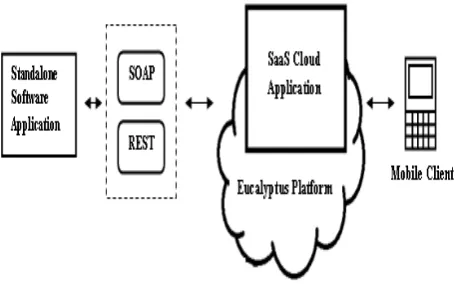
It uses two protocols SOAP and REST over HTTP to invoke the request and response. A standalone software application can serve only a fewer clients and is restricted to the system on which it is deployed. When the same application is exposed as a Web service on a cloud environment, it is offered as a service to all users on a pay per usage basis. These days, there is a shift from server-to-server to server-to-mobile endpoints communication. Thus, when a cloud service is invoked from a mobile device, it depicts a Mobile SaaS environment and reflects the multi-tenant architecture. Figure 3 below depicts the transition from standalone software to a cloud enabled software application by means of Eucalyptus framework and invocation of service through a mobile client.
Figure 2. Mobile SaaS Framework
4. Cross Platform
There are different kinds of mobile devices in the market with different operating systems such as iOS, Android, Blackberry, Windows Phone, Symbian, etc. In order to develop apps specific to a mobile device, the developer has to use the device specific SDK and its API’s to code apps in that platform. The source programming language used to develop apps in a specific platform also differs from one device to another. This creates a burden on the developer if he has to develop a certain app and target it to multiple platforms. Hence, there arises a need for
5. Implementation Progress
To implement a system successfully, a large number of inter-related tasks need to be carried out in an appropriate sequence. Implementation is the stage of the project when the theoretical design is turned out into a working system. Thus it can be considered to be the most critical stage in achieving a successful new system and in giving the user, confidence that the new system will work and be effective
The system is divided into two modules
Video API: It serves as a client program to access the deployed services from the cloud. It is synchronized with the Android phone.
Android Client: It serves as a interface to send request from the client android phone to the cloud and to receive response from the cloud by using simple object access protocol (SOAP).
5.1 Video API
A Video on demand Web service is created as a SOAP service using the Axis2 (Apache eXtensible Interaction System) framework and deployed in Tomcat server. The video on request is sent as an SOAP attachment to the end client. MessageReceivers are used for client / server communication in Axis2 environment. In order to support SOAP attachments, RawXMLINOutMessageReceiver is used. This class is embedded within the package “org.apache.axis2.receivers”. The service description file “services.xml” holds the messageReceiver details as below.
<service name="VideoService">
<parameter name="enableSwA">true</parameter> <parameter name="ServiceClass"
locked="false">video.VideoService</parameter> <operation name="getVideo">
<actionMapping>urn:getVideo</actionMapping> <messageReceiver class =
"org.apache.axis2.receivers.RawXMLINOutMessageRec eiver"/
>
</operation> </service>
The following describes the prototype SOAP request and response which was used with respect to the communication between video API and Android client. The SOAP request contains a request for a specific video and the SOAP response contains the video ID of the SOAP attachment.
SOAP Request
<?xml version='1.0' encoding='utf-8'?> <soapenv:Envelope
xmlns:soapenv="http://schemas.xmlsoap.org/soap/envelo pe/">
<soapenv:Body>
<video:getVideo xmlns:video="http://video"> <video:videoName>Test.wmv</video:videoName> </video:getVideo>
</soapenv:Body> </soapenv:Envelope>
SOAP Response <soapenv:Body
xmlns:soapenv="http://schemas.xmlsoap.org/soap/envelo pe/">
<swa:getVideoResp xmlns:swa="http://video"> <swa:video
href="urn:uuid:5236FE1226169060131362913193542" />
</swa:getVideoResp> </soapenv:Body>
5.2 Android Client
With the improvements in mobile network research, mobile devices have become popular clients to consume Web services. With the number of smartphones count overruling the population rate, it is highly evident that every person carries a smartphone and expects to consume services from his / her handheld device no matter at what time or at what place. In this paper, the Video API program was synchronized with an Android mobile phone which served as a client program to access our deployed services from cloud environment. Android is the first complete, free and open source mobile platform developed by the “Open Handset Alliance” group for use on cell phones, e-readers, tablet PCs and other mobile devices. Since its introduction, Android has been adopted by several manufacturers such as Samsung, HTC, Sony Ericsson, Motorola, etc. In order to invoke an SOAP service, an Android SOAP client program has been written. An Axis2 SOAP client program to invoke a Web service involves references to several client libraries which are in sizes of KBs and MBs. A mobile device cannot tolerate to have client applications with huge sizes due to its limited storage deficiency. Hence, a third party library called “ksoap2” is utilized to write light weight client programs to invoke SOAP web services.
play an video, this Video client app is a Web application which acts only as a user interface to display the video to the client.
6. Conclusion and Future Work
In this paper discussed the limitations of smartphones in terms of storage capacity, display capability and battery backup. To overcome these limitations, paper mention a framework that deploys a private SaaS model in order to invoke Video on Demand streaming service using an Android phone. The limitation of running a large video on a mobile device has been addressed through this model.
Future work provides a method downloading videos such as BitTorrents and also creation of the system that active clients can watch videos.
7. References
[1] A. S. Baumgart, H. Knapp, M. Schader, and S. Mill, “A Platform-Independent Adaptive Video Streaming Client for Mobile Devices,” The Seventh IFIP Int. Conf. on Mobile and Wireless Communication Networks, Sept. 2005, pp. 11-15.
[2] G. Lam and D. Rossiter, “A SOAP-Based Streaming Content Delivery Framework for Multimedia Web Services,” Proc. IEEE Asia-Pacific Services Computing Conference (APSCC), 2008, pp. 1097-1102, doi:10.1109/APSCC.2008.18.
[3] O. Rendon, F. Pabon, M. Vargas and J. Guaca, “Architectures for Web Services Access from Mobile Devices,” Proc. Third Latin American Web Congress (LA-WEB), Oct. 2005, pp. 93, doi:10.1109/LAWEB.2005.9.
[4] M. R. –Martinez, J. Seguel, M. Sotomayor, J. P. Aleman, J. Rivera, M. Greer, “Open911: Experiences with the Mobile Plus Cloud Paradigm,” IEEE Fourth Int. Conf. on Cloud Computing, July 2011, pp. 606-613, doi:10.1109/CLOUD.2011.96.
[5] S. M. Saranya and M. Vijayalakshmi, “Interactive Mobile Live Video Learning System in Cloud Environment,” IEEE Int. Conf. on Recent Trends in Information Technology, ICRTIT, June 2011, pp. 673-677, doi:10.1109/ICRTIT.2011.5972458.
[6] P. Bahl, R. Y. Han, L. E. Li, and M. Satyanarayanan, “Advancing the state of mobile cloud computing,” in Proc. Third ACM workshop on Mobile cloud computing
and services, 2012, pp. 21-28,
doi:10.1145/2307849.2307856.
[7] B. Gon Chun and P. Maniatis, “Augmented Smartphone Applications Through Clone Cloud
Execution,” Proc. Twelfth Workshop on Hot topics in Operating Systems (HotOS 09), May 2009, pp. 8-8, doi:10.1.1.156.5886.