ISSN(Online): 2320-9801
ISSN (Print): 2320-9798
I
nternational
J
ournal of
I
nnovative
R
esearch in
C
omputer
and
C
ommunication
E
ngineering
(An ISO 3297: 2007 Certified Organization)
Vol. 3, Issue 5, May 2015
Copyright to IJIRCCE DOI: 10.15680/ijircce.2015.0305083 4041
Performance Analysis of Spectral Amplitude
Coding Incoherent OCDMA System Based on
FBGs
M. Edries
1,*, I.F.Tarrad
2, A.M. Helaly
1, Ahmed Yahia
2Dept. of Electronics & Communication, Higher Institute of Engineering, El Shorouk City, Cairo, Egypt1 Dept. of Electronics & Communication, Faculty of Eng., Al-Azhar University, Nasr City, Cairo, Egypt2
ABSTRACT In this paper, the transmission performance of the incoherent Spectral Amplitude Coding SAC-OCDMA network is investigated for Fiber Bragg Grating (FBG), Zero Vector Combinatorial Code (ZVCC), Modified Double Weight (MDW), and Modified Frequency Hopping (MFH). The results have been shown and analyzed in terms of Bit Error Rate (BER) against number of simultaneous subscribers, code length, and data rate. The results indicate that ZVCC provides better BER performance than FBGs for large number of users, and less complex in hardware implementation. It is noted that MFH has limited number of users compared to other codes assuming the same parameters.
KEYWORDS: OCDMA, SAC, FBG, and BER.
I. INTRODUCTION
Optical Code Division Multiple Access (OCDMA) is a category of multiplexing - demultplexing and internetworking technology that encode/decode signal through simple and cost-effective passive optical components. OCDMA technologies exploit the large band width (B.W.) of optical fiber [1] and the advantages of CDMA, such as resistance to jamming, effective sharing, and time and space resources[2]. OCDMA has many advantages like security, self routing by code sequence, random and simultaneous access protocol, and good compatibility with wave division
multiplexing (WDM)
[3, 4] and time division multiplexing (TDM) [3, 4], but the main drawbacks of OCDMA is MAI that’s dominant for photo detector (PD) shot noise, dark current, and thermal noise. Among several kinds of OCDMA systems, spectral amplitude coding (SAC) scheme attracts increasing interest because multiple access interference (MAI) can be eliminated [5, 6] .
The intelligent design of code sequence is important to reduce the contribution of MAI to the total received power. Although MAI can be cancelled by balance detection scheme, a phase induced intensity noise (PIIN) arising from spontaneous emission of broad band source. It is important to design code word such that the effect of MAI and PIIN of the total received power is reduced. There are some detection techniques such as complementary detection technique, Modified-AND subtraction detection technique [17], and Single Photodiode Detection (SPD) [18]. Where modified-AND subtraction allows longer transmission distance or higher data rates or a larger number of users as compared to AND subtraction detection technique [19], but it has the same receiver complexity of AND subtraction detection technique. SPD allows to cancel interference in the optical domain by using only single photodiode rather than two photodiodes in any subtraction techniques, and reduces the amount of optical to electrical components and shot noise at receiver and decrease complexity .In OCDMA systems, minimization of cross correlation to very small value is an advantage.
ISSN(Online): 2320-9801
ISSN (Print): 2320-9798
I
nternational
J
ournal of
I
nnovative
R
esearch in
C
omputer
and
C
ommunication
E
ngineering
(An ISO 3297: 2007 Certified Organization)
Vol. 3, Issue 5, May 2015
Copyright to IJIRCCE DOI: 10.15680/ijircce.2015.0305083 4042
There is a new scheme to suppress PIIN and MAI in SAC-OCDMA is enabling bipolar encoding. The bipolar encoding in comparison with unipolar encoding provides a lower BER for the same number of users and also provides a higher data rate transmission. This technique is suitable with any codes that have ZCC property [20].
In such a system, the optical spectrum is amplitude coded by a different code for each channel to generate the OCDMA signals. The incoherent source appears as a good candidate for SAC as it is inherently broadband, a necessary characteristic of SAC [7].
In this paper we will investigate the transmission performance of SAC-OCDMA network, in terms of BER against number of simultaneous subscribers, code length, and data rate.
This paper is organized as follow. In section (2), we will discuss the structure of SAC-OCDMA using bulk-optic components and its drawbacks. In section (3), SAC-OCDMA using FBGs are discussed. The performance analysis of SAC using FBG is discussed in section (4). In section (5), we will do an evaluation and comparison study for various types of codes, and finally the conclusion are given in section (6).
II. SPECTRAL AMPLITUDE INCOHERENT OPTICAL ENCODER AND DECODER EMPLOYING
BULK-OPTIC COMPONENTS
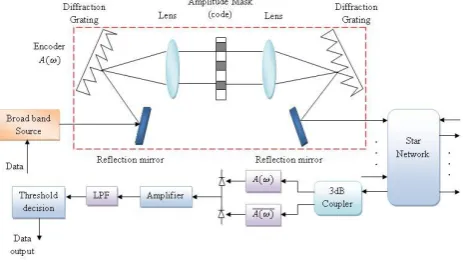
Spectral-amplitude optical encoder for the incoherent OCDMA is shown in the Fig. 1 [8, 9], which consists of a pair of uniform diffraction gratings, a pair of lenses and a spectral amplitude mask (4f system). After an optical pulse from a broadband light source is modulated by data, the first diffraction grating spatially decomposes its spectral components with a certain resolution. The first lens makes these spectral components implement maximal spatial separation and the spectral amplitude mask (corresponding to a user address codeword) filters these spectral components and passes the required spectral components (determined by the chosen user’s address codeword). After the mask, the remaining spectral components are reassembled by the second lens and second diffraction grating into a single optical beam to be sent to a network. In doing so, the spectral amplitude incoherent encoding is achieved.
In an OCDMA network, each transmitter employs a unique spectral-amplitude-mask, in order to guarantee the orthogonality between any two address codewords corresponding to the spectral-amplitude-masks. The encoded signal is broadcast to all receivers in the network such that all subscribers can share the optical channels. At the receiving end, the signal is actually decoded by a hybrid optical-electrical decoder, which is composed of a 3 dB coupler, two spectral amplitude filters and
Fig. 1 Structure of SAC-OCDMA
two differential photo detectors in a differential or balanced configuration. We assume that the spectral function of the spectral amplitude encoder is 𝐴(𝜔) [10], such that one of the filters in the decoder has the same spectral response,
𝐴(𝜔), and another filter, i.e. complementary filter, has the complementary response, 𝐴(𝜔). The outputs from these decoders are detected by two photo detectors connected in a balanced structure.
ISSN(Online): 2320-9801
ISSN (Print): 2320-9798
I
nternational
J
ournal of
I
nnovative
R
esearch in
C
omputer
and
C
ommunication
E
ngineering
(An ISO 3297: 2007 Certified Organization)
Vol. 3, Issue 5, May 2015
Copyright to IJIRCCE DOI: 10.15680/ijircce.2015.0305083 4043
been introduced to eliminate the MAI effect and preserve the orthogonality between users in the system. Several quasi-orthogonal code families are used in such SAC–OCDMA systems, such as maximal-length sequence (M-sequence) codes, Walsh–Hadamard codes, modified quadratic congruence codes, modified double weight and so forth. The SAC– OCDMA systems assign one unique spectral amplitude codeword for each network user to code the amplitude of light source spectrum. Noises existing in the SAC–OCDMA systems include shot noise, phase-induced intensity noise (PIIN), thermal noise, and so forth. Only shot and thermal noise are usually considered here since PIIN is almost negligible where relatively low levels of cross-correlation exist between users [11]. The permutation of the elements of a spectral amplitude mask, which represents a user address code, employs the bipolar codes with good correlation, such as m-sequence, Walsh-Hadmard, etc. The following analysis [12], gives a simplified idea on the effect of code sequence properties on OCDMA performance. Let 𝑋 = 𝑥0, 𝑥1, … , 𝑥𝑛 −1 and 𝑌 = 𝑦0, 𝑦1, … , 𝑦𝑛−1 be two binary 0,1
sequences such that their periodic cross-correlation is:
𝑅𝑥𝑦 𝜏 = 𝑥𝑖𝑦𝑖⊕𝜏
𝑛−1
𝑖=0
(1)
Where " ⊕ " represents modulo-n addition.
Define the complement of sequence 𝑋 to be 𝑋 = 𝑥 , 𝑥0 , … , 𝑥1 𝑛 −1 , where 𝑥 = 1 − 𝑥𝑖 𝑖 the periodic cross-correlation
sequence between 𝑋 and 𝑌is:
𝑅𝑥 𝑦 𝜏 = 𝑥𝑖
𝑛−1
𝑖=0
𝑦𝑖⊕𝜏 (2)
Since 𝑅𝑥𝑦 𝜏 = 𝑅𝑥 𝑦 𝜏 , a receiver will reject the interference from a user with the addres code 𝑌 through computing
𝑅𝑥𝑦 𝜏 − 𝑅𝑥 𝑦 𝜏 . Firstly, a unipolar m-sequence 𝑋 = 𝑥0, 𝑥1, … , 𝑥𝑛 −1 with the period n is obtained from the bipolar
version by replacing each binary 1 by a 1 and each -1 by a 0. Since the sequence 𝑌 is a sequence of cyclical left-shifts of 𝑋 i.e., 𝑌 = 𝑇 𝜏 and 𝑋 = 𝑋 𝜏, where T is the operator that shifts vectors cyclically to the left by one place and 𝜏
presents the number of times of cyclic shifts, namely, 𝑇𝑋 = 𝑥𝑛 −1, 𝑥0, 𝑥1, … , 𝑥𝑛 −2 , its discrete autocorrelation function
is:
𝑅𝑥𝑥 𝜏 = 𝑥𝑖𝑥𝑖⊕𝜏 𝑛−1
𝑖=0
= 𝑛 + 1
2 𝜏 = 1 𝑛 + 1
4 1 ≤ 𝜏 ≤ 𝑛 − 1
(3)
These results come from the shift and-add property of a m-sequence, that is, the modulo-2 addition of an m-sequence and any cyclic shift of the same m-sequence is another cyclic shift of the same sequence. In other words, half the 1’s in
𝑋 𝜏 coincide with the 1’s of 𝑋 while the other half the 1’s in 𝑋 𝜏coinced with the 0’s of 𝑋. A receiver will reject the
signal coming from the interfering subscriber with the address code 𝑋 𝜏through computing:
𝑍 = 𝑅𝑥𝑦 𝜏 − 𝑅𝑥 𝑦 = 𝑥𝑖𝑥𝑖⊕𝜏
𝑛−1
𝑖=0
− 1 − 𝑥𝑖 𝑥𝑖⊕𝜏
𝑛−1
𝑖=1
= 2𝑅𝑥𝑦 𝜏 − 𝑅𝑥𝑦 0 = 2 ×
𝑛 + 1
4 −
𝑛 + 1
2 = 0 (4)
Based on this idea, n cyclic-shift sequences of an m-sequence can be assigned to n subscribers as their address sequences such that such a network can support n simultaneous users without any interference, that is, all subscriber address codewords can implement completely mutual orthogonality in theory.
The advantages of spectral amplitude incoherent OCDMA encoding are as follows. The light source with the low price, stable performance and simple drive circuit, such as Light Emitting Diode (LED), and the direct detection can be employed. The implementation cost is low and the wavelength control is not required. Furthermore, a frequency spreading gain is totally independent of the modulation bandwidth (corresponding to the bit rate). The disadvantages are that the code length of address code and the number of users that can be supported in the system are constrained by the resolution of the diffraction grating and mask. In addition, the encoder and decoder using the bulk-optic components have a big volume and it is difficult to be mounted and packaged. At the same time, they have the poor operation stability.
ISSN(Online): 2320-9801
ISSN (Print): 2320-9798
I
nternational
J
ournal of
I
nnovative
R
esearch in
C
omputer
and
C
ommunication
E
ngineering
(An ISO 3297: 2007 Certified Organization)
Vol. 3, Issue 5, May 2015
Copyright to IJIRCCE DOI: 10.15680/ijircce.2015.0305083 4044
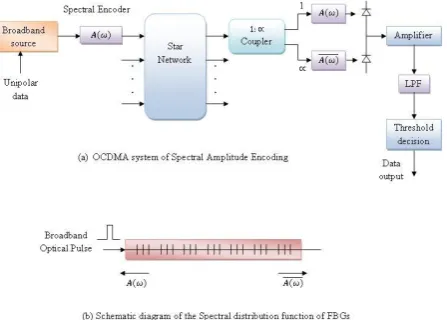
With the development and maturation of FBGs, they can be employed as the choosing wavelength filters to implement the spectral amplitude coding (SAC) such that the disadvantages of the bulk-optic spectral amplitude encoder/decoder can be overcome. The SAC OCDMA employing the FBGs in series or the linear array of FBGs, and the superposition FBGs, is extensively investigated and demonstrated [13]. The spectral amplitude encoding OCDMA based on FBGs is shown in Fig. 2 (a) [13], whose principle is the same as that of Fig. 1. The only difference is that the spectral components are chosen by employing the FBGs here rather than by using the diffraction gratings and the spectral amplitude masks in the above subsection. The purpose of using a 1: α coupler in Fig. 2 (a) is to make MUI (multiple user interference) received by PD1 be equal to MUI received by PD2, so that they counteract with each other. The spectral function of FBGs is illustrated in Fig. 2 (b), where A(ω) represents the reflection spectrum of FBGs and
A(ω) is the transmission spectrum of FBGs.
Fig. 2 Block diagram of SAC OCDMA using FBGs
IV. PERFORMANCE ANALYSIS OF SPECTRAL AMPLITUDE CODING
In the analysis of the BER performance of the spectral amplitude coding incoherent OCDMA system using FBG en/decoder, the effects of incoherent intensity –induced noise, shot noise of photodetector and thermal noise on the BER performance are taken into account. Assuming that (1) each light source is ideally unpolarized and its power
spectrum is flat over the bandwidth f0− ∆f 2, f0+
∆f
2 where f0is the central frequency of the optical source, ∆f is the
light source bandwidth in hertz;(2) each power spectrum component has identical spectral width; (3) each subscriber has the same optical power at the receiver; (4) the effect of PIIN, shot noise and thermal noise obeys Gaussian distribution (As a matter of fact, the total effect of PIIN and shot noise obeys negative binomial distribution [13]. However, in order to simplify the analysis, they are assumed to obey Gaussian distribution.), therefore, the power spectrum density (PSD) of received signal is given by [13]
r f = p
∆f dk ck(i) u f − f0−
∆f
2N −N + 2i − 2 − u f − f0−
∆f
2N −N + 2i
N
i=1 M
k=1
(5)
Where P is the effective optical power at the receiver, M is the number of simultaneous subscribers in the network ≤ p2, N = p2+ p is the code length of Modified Quadratic Congruence Codes (MQCC), d
k ∈ 0,1 indicates
the data bit of the kth subscriber and u(f) denotes the unit step function that is given by:
u f 1 f ≥ 0
0 f < 0 (6)
ISSN(Online): 2320-9801
ISSN (Print): 2320-9798
I
nternational
J
ournal of
I
nnovative
R
esearch in
C
omputer
and
C
ommunication
E
ngineering
(An ISO 3297: 2007 Certified Organization)
Vol. 3, Issue 5, May 2015
Copyright to IJIRCCE DOI: 10.15680/ijircce.2015.0305083 4045 p1 f =
p
∆f dk ck i cl(i) u f − f0− ∆f
2N −N + 2i − 2 − u f − f0−
∆f
2N −N + 2i
N
i=1 M
k=1
(7)
p2 f = p
p∆f dk ck i c (i) u f − fl 0− ∆f
2N −N + 2i − 2 − u f − f0−
∆f
2N −N + 2i
N
i=1 M
k=1
(8)
Thus, we have [13]
p1 f df =
p
N p + 1 d1
∞
0
+p
N dk
M
k=1,k≠l
(9)
p2 f df
∞
0
=p
N dk
M
k=1,k≠l
(10)
The average photocurrent I is the difference of the photocurrents of PD1 and PD2, which is given by [13]
I = I1− I2= ℜ p1 f df
∞
0
− ℜ p2 f df
∞
0
= ℜp
pdl (11)
Where ℜ denotes the responsivity of the PD, expressed as ℜ =ηe
hf0. Here η is the quantum efficiency; e is the
electron charge equal to 1.602 × 10⁻¹⁹ Coulomb and h is the Plank constant equal to 6.626× 10⁻³⁴J.s. In order to
compute the coherent time of the optical signals, expressed as:
τci=
pi2 f df ∞ 0
pi(f) ∞ 0
2, i
= 1,2 (12)
The integral of pi2 f needs to be calculated firstly, i = 1,2. Let’s take into account an example of the power
spectrum density p’(f) of the received superimposed signal, shown in Fig. 3, where a(i) indicates the amplitude of the ith spectrum chip (slot) with width Δf / N . The integral of p’2(f) can be expressed as [13]
p′ 2 f df ∞
0
=∆f
N a
2(i) N
i=1
(13)
Fig. 3 Power spectral density of the received signal r(f)
ISSN(Online): 2320-9801
ISSN (Print): 2320-9798
I
nternational
J
ournal of
I
nnovative
R
esearch in
C
omputer
and
C
ommunication
E
ngineering
(An ISO 3297: 2007 Certified Organization)
Vol. 3, Issue 5, May 2015
Copyright to IJIRCCE DOI: 10.15680/ijircce.2015.0305083 4046 p12 f df
∞
0
= p
2
N∆f cl i dkck i M
k=1
. dmcm i M m=1 N i=1 (14)
p22 f df ∞
0
= p
2
p2N∆f c i dl kck i M
k=1
. dmcm i M m=1 N i=1 (15)
Because the noises of PD1 and PD2 are mutually independent, then the power of noise sources that exist in the photocurrent can be expressed as [13]
I2 = I
12 + I22 + Ith2
= 2eB I1+ I2 + B I12τc1+ I22τc2 +
4kBT0B ZL
(16)
Where the first term comes from the shot noise, the second term represents the effect of PIIN, the third term indicates the effect on the thermal noise. Here, B is the noise-equivalent electrical bandwidth of the receiver, kB is
Boltzman constant, which is kB = 1.38 × 10⁻²³ J/K, T0 is the absolute noise temperature of the receiver, ZL denotes
the load impedance of the receiver. Substituting 12 into 16, we obtain:
I2 = 2eBℜ p
1 f df ∞
0
+ p2 f df
∞
0
+ Bℜ2 p
12 f df ∞
0
+ p22 f df ∞
0
+4kBT
0B
ZL
(17)
From 9, 10, 14, and 15, when all subscribers are sending data bit “1”, employing the average value as ck(i) ≈ M
p m
k=l
and the noise power can be given by [13]
I2 = 2eBℜ p
p2+p p + 1 + 2
p
p2+p p + 1 M − 1 + Bℜ
2 p2
(p2+p)∆f p + 1 + M − 1
M
p +
1
p2p(M − 1)
M p + 4kBT0B/ZL
= 2eBℜpp − 1 + 2M
p2+ p +
Bℜ2p2M
∆f(p + 1)p2
M − 1
p + p + M
+4kBT
0B
ZL
(18)
Assuming that all subscribers send equiprobably data bits “0” and “1”, and then we have [13]
I2 = Bℜ
2p2M
2∆f(p + 1)p2
M − 1
p + p + M + 2eBℜp
p − 1 + 2M
p2+ p
+ 4kBT0B/ZL (19)
Where the first term represents the power of PIIN noise, the second term indicates the power of shot noise and the third term denotes the power of thermal noise. From 11 and 19, the resulting average noise power of the system is given by [13]
SNR = I1− I2
2
I2
=
1 p2ℜ2psr2 Bℜ2p
sr2M
2∆f(p + 1)p2
M − 1
p + p + M + eBℜpsrp − 1 + 2Mp2+ p + 4kBT0B/ZL
ISSN(Online): 2320-9801
ISSN (Print): 2320-9798
I
nternational
J
ournal of
I
nnovative
R
esearch in
C
omputer
and
C
ommunication
E
ngineering
(An ISO 3297: 2007 Certified Organization)
Vol. 3, Issue 5, May 2015
Copyright to IJIRCCE DOI: 10.15680/ijircce.2015.0305083 4047
Where psr is the effective light power received by every subscriber. Since Gaussian approximation is employed, the
bit error rate of the system is [13]
Pb
=1
2erfc SNR/8 (21)
The next table contained the parameters employed in the system.
Optical center wavelength λ0= 1550 nm
Light source bandwidth ∆f =3.75 THz
User’s bit rate Rb = 500 Mbps
PD quantum efficiency η = 0.6
Receiver electrical bandwidth B = 250 MHz
Receiver noise temperature T0 = 300 K
Receiver load impedance ZL = 1030 Ω
Effective light power received by every subscriber.
psr = -10 dBm
Table -1- System parameters employed in the calculations
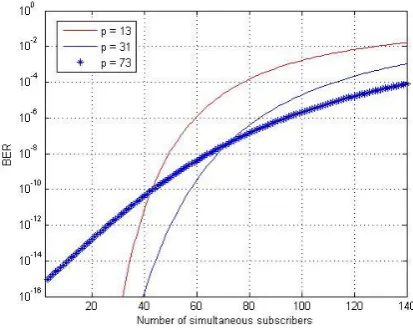
Fig. 4 shows the BER performance of SAC based on FBG versus the number of subscribers for various values of prime numbers for MQCC. When we make a comparison at any interception points between two prime numbers, we conclude that to get acceptable BER for large number of users we have to choose large prime numbers, and on the other hand small prime numbers gives acceptable BER for small number of users.
Fig. 4 BER vs. number of subscribers for SAC-FBG
Fig. 5 gives the variation curves of the BER with the effective light power received by every subscriber for p = 7 and the number of simultaneous users 49 for MQCC, where the solid line represents the BER for taking into account the effects of intensity, shot and thermal noises, the dashed line denotes the system BER with the effects of intensity and shot noises and the dotted line indicates the system BER with the effects of intensity and thermal noises. It can be seen that when the effective power P is big (i.e., > 10dBm), the intensity noise is the main limitation factor of the system performance. When the effective power is not large enough, the thermal and shot noises are the main limitation factors.
ISSN(Online): 2320-9801
ISSN (Print): 2320-9798
I
nternational
J
ournal of
I
nnovative
R
esearch in
C
omputer
and
C
ommunication
E
ngineering
(An ISO 3297: 2007 Certified Organization)
Vol. 3, Issue 5, May 2015
Copyright to IJIRCCE DOI: 10.15680/ijircce.2015.0305083 4048 Fig. 5 BER vs. effective power of each subscribers
Fig. 6 shows the variation traces of the BER versus the number of simultaneous subscribers for MQCC, taking into account the PIIN, shot and thermal noises. It can be seen that the system BER increases as the number of simultaneous subscribers increases and the BER decreases as the effective power received by every user increases.
Fig. 6 BER vs. number of subscribers for different values of effective power
V. COMAPRISON AND EVALUATION
In recent years, many codes have been proposed such as Modified Double Weight (MDW) code [14], Modified Frequency Hopping (MFH) [15], and Zero Vector Combinatorial Code (ZVCC) [16]. All these codes suffer from various limitations one way or another, the code construction is complicated (e.g., MFH) or the cross correlation isn’t ideal. However, the code construction not only depends on a cross correlation properties, the length is an important factor we have to consider as well. Long length is a disadvantage since the code is subject to either very wide band source or narrow filter bandwidths are requirements.
The SNR of ZVCC can be expressed as [16]:
SNR
=
ℜ2P sr2w2 L2 PsreBℜ
L N − 1 + w +
Psr2Bℜ2N
2∆vL2 N − 1 + w2 +
4KBT0B ZL
ISSN(Online): 2320-9801
ISSN (Print): 2320-9798
I
nternational
J
ournal of
I
nnovative
R
esearch in
C
omputer
and
C
ommunication
E
ngineering
(An ISO 3297: 2007 Certified Organization)
Vol. 3, Issue 5, May 2015
Copyright to IJIRCCE DOI: 10.15680/ijircce.2015.0305083 4049
ZVCC has long length and this is considered as disadvantage, we have to make a tradeoff between the length and MAI, because MAI is a dominant source of the noise. In MFH code, although the code length is shorter compared to ZVCC, the cross correlation always equal to unity and this contributes to PIIN, while in ZVCC always the cross correlation always equal to zero which eliminate the effects of PIIN. The properties of MDW, MFH, and ZVCC are listed in table 2. The table shows that MDW codes exit for any natural number n, while MFH codes exist for prime number p only, and ZVCC shows flexibility in terms of choosing the no. of users and the weight.
Code No. of users (N) Code length Weight (W) Cross
correlation (λ) SNR
MFH N = p2 n = p2+ p w = p + 1 λ = 1 2pΔv
BN(N 2 + p − 1)
MDW Any number n = 3N +
8
3[sin(
πN
2 )]
2
For (w = 4)
Even λ = 1 2
w
λ − 1 Δv
BN(N 2 +wλ − 2)
ZVCC Any number L = w × N Any number λ = 0 Eq. 22
FBG Any number n = p2 p λ = 1 Eq. 20
Table -2- various codes comparison
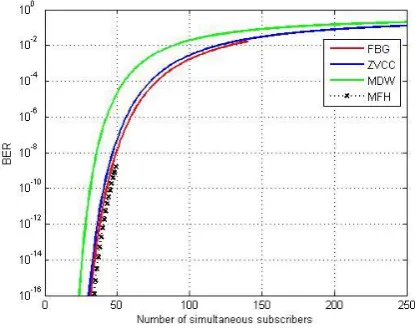
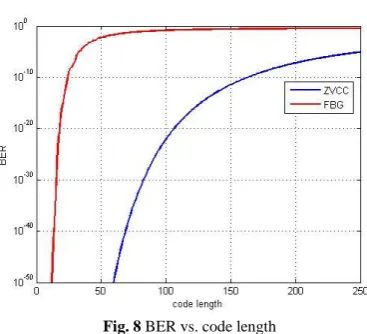
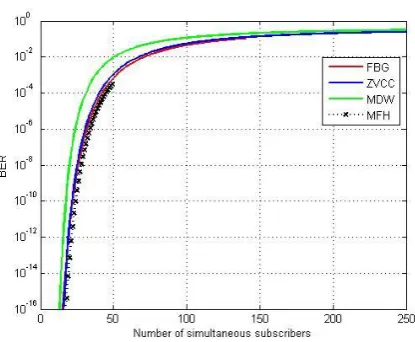
Fig. 7 shows the bit-error rate (BER) versus the number of users when different codes are used. In this figure the parameters listed in table 1 are used. It clearly shows that MDW has higher BER than other codes, while ZVCC and SAC-OCDMA based on FBG have almost the same BER performance assuming the same parameters in both cases.
Fig. 7 BER vs. number of subscribers
ISSN(Online): 2320-9801
ISSN (Print): 2320-9798
I
nternational
J
ournal of
I
nnovative
R
esearch in
C
omputer
and
C
ommunication
E
ngineering
(An ISO 3297: 2007 Certified Organization)
Vol. 3, Issue 5, May 2015
Copyright to IJIRCCE DOI: 10.15680/ijircce.2015.0305083 4050 Fig. 8 BER vs. code length
Fig. 9 shows the BER versus the number of users when different data rates are used for SAC-OCDMA based on FBG. It is observed that with increasing the data rate, the system performance degrades, i.e., at 60 users the BER for data rate 500 Mbps is 10-6 and the BER for data rate 1.5 Gbps is 3.2×10⁻³ .
Fig. 9 BER vs. number of subscribers for different data rates
ISSN(Online): 2320-9801
ISSN (Print): 2320-9798
I
nternational
J
ournal of
I
nnovative
R
esearch in
C
omputer
and
C
ommunication
E
ngineering
(An ISO 3297: 2007 Certified Organization)
Vol. 3, Issue 5, May 2015
Copyright to IJIRCCE DOI: 10.15680/ijircce.2015.0305083 4051 Fig. 10 BER vs. number of subscribers for different data rates
VI. CONCLUSION
In this paper, a complementary detection technique is used in SAC-OCDMA system. The results have been shown and analyzed in terms of BER against number of simultaneous users, code length, and data rate. It is concluded that the number of users in SAC-OCDMA system based on FBGs is sensitive to prime number, i.e., for large number of users we have to select large prime number to get acceptable BER. And it is noted that MFH has limited number of users compared to other codes assuming the same parameters, MDW give lower performance than other codes, and ZVCC has almost the same BER performance of SAC-OCMA system based on FBG but it is less complex in hardware implementation than SAC-OCDMA based on FBG. It is also observeds that with increasing the data rate, the BER in all systems degrades.
REFERENCES
1. John M. Senior: Optical fiber communication: Principles and Practice. - Second Edition, 15(4), 1988, pp52-54. 2. Enrico Forestieri: Optical communication theory and techniques: Springer.
3. Richard C. Dorf: The Handbook of Optical Communication Networks, CRC press.
4. Daniel Lopes: High Capacity Optical Networks Using OCDMA and OTDM Techniques, high frequency electronics, 2005.
5. M. Noshad and K. Jamshidi, “Code family for modified spectral-amplitude-coding OCDMA systems and performance analysis”, Journal of Optical Communication Network, vol. 2, no. 6, pp. 344-354, June 2010.
6. A. M. Alhassan, N. M. Saad, and N. Badruddin, “An Enhanced Detection Technique for Spectral Amplitude Coding Optical CDMA Systems”, IEEE Photonic Technology Letter, vol.23, no. 13, pp. 875-877, 2011.
7. H. A. Fadhil, S. A. Aljunid, and R. B. Ahmad. ” Design considerations of high performance optical code division multiple access: a new spectral amplitude code based on laser and light emitting diode light source”, The institution of engineering and technology, vol. 4, no. 1, pp. 29-34, May 2010.
8. D. Zaccarin, and M. Kavehrad: An Optical CDMA System Based on Spectral Encoding of LED. IEEE Photonics Technology Letters, Vol.4, No.4, April 1993, pp479 – 428.
9. M. Kavehrad, and D. Zaccarh: Optical Code-Division - Multiplexed Systems Based on Spectral Encoding of Noncoherent Sources. IEEE/OSA Journal of Lightwave Technology, Vol. 13, No. 3, March 1995, pp534 – 545.
10. J. Penon, W. Mathlouthi, S. LaRochelle, and A. L. Rusch, “An Innovative Receiver for Incoherent SAC-OCDMA Enabling SOA-Based
Noise Cleaning: Experimental Validation”, Journal of Lightwave Technology, vol. 27, no.
2, pp. 108-116, January 2009.
11. M. Anuar, S. Aljunid, N. Saad, and S. Hamzah, “New design of spectral amplitude coding in OCDMA with zero cross-correlation”, Optics communications, vol. 6, no. 13, pp. 2659- 2664, March 2009.
12. H. Yin and D. J. Richardson, “Optical code division multiple access communication networks”, Tsinghua University Press, Beijing and Springer-Verlag GmbH Berlin Heidelberg, 2007.
13. Zou Wei, H. M. H. Shalaby, and H. Ghafouri-Shiraz: Modified Quadratic Congruence Codes for Fiber Bragg- Grating-Based Spectral-Amplitude-Coding Optical CDMA Systems. IEEE/OSA Journal of Lightwave Technology, Vol. 19, No. 9, September 2001, pp1274 –
ISSN(Online): 2320-9801
ISSN (Print): 2320-9798
I
nternational
J
ournal of
I
nnovative
R
esearch in
C
omputer
and
C
ommunication
E
ngineering
(An ISO 3297: 2007 Certified Organization)
Vol. 3, Issue 5, May 2015
Copyright to IJIRCCE DOI: 10.15680/ijircce.2015.0305083 4052
14. S.A.Aljunid, ,M.Ismail, A.R.Ramli, Borhanuddin M Ali, and Mohamad Khazani Abdullah, “A NewFamily of Optical Code Sequences for Spectral-Amplitude-Coding Optical CDMA Systems” IEEE Photonics Technology Letters, Vol. 16, No. 10, October 2004.
15. Zou Wei, H. Ghafouri-Shiraz, "Codes for Spectral - Amplitude-Coding Optical CDMA Systems," Journal of Lightwave Technology, Vol. 50, August 2002, pp. 1209 -1212.
16. Swati Sharma, Preeti, “SAC-OCDMA with Zero Vector Combinatorial Code (ZVCC)”, IJCSMS International Journal of Computer Science and Management studies, Vol. 11,August 2011.
17. Somaya A. Abd El Mottaleb, Heba A. Fayed, Ahmed Abd El Aziz and Moustafa H.Aly, “SAC- OCDMA System Using Different Detection Techniques”, IOSR Journal of Electronics and Communication Engineering (IOSR-JECE), Vol. 9, Issue 2, Ver. III (Mar - Apr. 2014), PP 55-60.
18. H. M. R. Al-Khafaji, S. A. Aljunid, A. Amphawan, H. A. Fadhil, and A. M. Safar, “Reducing BER of spectral-amplitude coding optical code-division multiple-access systems by single photodiode detection technique”, J. Europ. Opt. Soc. Rap. Public. 8, 13022 (2013). 19. F. N. Hasoon, S. A. Aljunid, M. D. A. Samad, M. K. Abdullah, and S. Shaari, “Spectral amplitude coding OCDMA using AND
subtraction technique,” Appl. Optics 47, 1263–1268 (2008).