Analogy-Based Expectation Equilibrium
∗
Philippe Jehiel
†March 2001
Abstract
It is assumed that players bundle nodes in which other players must move into analogy classes, and players only have expectations about the average behavior in every class. A solution concept is proposed for multi-stage games with perfect information: at every
node players choose best-responses to their analogy-based expectations, and expectations are correct on average over those various nodes pooled together into the same analogy classes. The approach is applied to a variety of games. It is shown that a player may
beneÞt from having a coarse analogy partitioning. And for simple analogy partitioning, (1) initial cooperation followed by an end opportunistic behavior may emerge in the
Þnitely repeated prisoner’s dilemma (or in the centipede game), (2) an agreement need
not be reached immediately in bargaining games with complete information.
Key words: Game theory, bounded rationality, reasoning by analogy.
JELnumbers: C72, D81.
∗I would like to thank O. Compte, D. Ettinger, I. Gilboa, B. MacLeod, E. Maskin, G. N¨oldeke, R. Radner, A.
Rubinstein, L. Samuelson, R. Spiegler, and E. Dekel and three anonymous referees for many helpful comments made at various stages of this research. I have also beneÞtted from the comments made in seminars at Princeton University, Bonn University, Paris (ENS), NYU, Penn, the Institute for Advanced Study (Princeton), Yale, and the ATT Labs.
†CERAS, Paris and UCL, London. mailing address: C.E.R.A.S.-E.N.P.C., C.N.R.S. (URA 2036), 28 rue
1
Introduction
Received game theory assumes that players are perfectly rational both in their ability to form
correctexpectations about other players’ behavior and in their ability to selectbest-responses
to their expectations.
The game of chess is a striking example in which the standard approach is inappropriate.
In chess, it is clearly impossible to know (learn) what the opponent might do for every board
position.
In this paper, we investigate situations in which players form their expectations about
others’ behavior by analogy between several contingencies as opposed to for every single
contingency in which each of these other players must move.1 More precisely, each player i
bundlesnodes at which players other than imust move - a bundle is called ananalogy class.
And player ionly forms expectations about the averagebehavior in each analogy class that
he considers.
In other words, playeriis viewed here as simplifying what he wants to know (learn) about
others’ behavior:2 Player icategorizes nodes in which other players must move into analogy
classes. And only the average behavior in each analogy class is being considered by playeri.
We use the word ’analogy’ because in two nodes belonging to a same class, the expectation
formed by the player is the same. Besides, the equilibrium expectation in an analogy class will
be assumed to coincide with the effective average behavior in the class. Accordingly, nodes
which are visited more often will contribute more to the expectation, and the behaviors in
those nodes will contaminate the expectation used in all nodes of the analogy class (no matter
how often they are visited). The extrapolation (here of the expectation) from more visited
to less visited contingencies is - we believe - a key feature of the analogy idea.3
The aim of this paper is twofold. The Þrst objective is to propose a solution concept to
describe the interaction of players forming their expectations by analogy. This will be called
the analogy-based expectation equilibrium. The second objective is to analyze the properties
of analogy-based expectation equilibria in various strategic interaction contexts.
The games we consider are multi-stage games with almost perfect information and perfect
recall. That is, simultaneous moves and moves by Nature are allowed. But, in any stage, all
previous moves are assumed to be known to every player.4
1
This approach seems particularly appropriate in situations with many contingencies (like chess) so that learning behavior for every possible contingency seems too hard (impossible).
2This makes learning easier and successful learning more plausible.
3It should be noted that what is considered here is the idea of forming expectations by analogy as opposed
to acting by analogy (see discussion section).
4
The partitioning into analogy classes used by the players is given exogenously.5 It is
viewed as part of the description of the strategic environment. An analogy classαi of player
iis a set of pairs (j, h) such that player j, j 6=i, must move at node h. We require that if
two elements (j, h) and (j0, h0) belong to the same analogy class, the action spaces of player
j at nodehand of player j0 at nodeh0 are identically labelled.6
Playeri’sanalogy-based expectationβiis playeri’s expectation about the average behavior
of other players in every analogy class αi considered by player i - we will denote by βi(αi)
the expectation in the analogy class αi. An analogy-based expectation equilibrium is a pair
(σ,β) where σ is a strategy proÞle and β is an analogy-based expectation proÞle such that two conditions are satisÞed. First, for each player i and for each node at which player i
must move, player i’s strategy σi is a best-response to his analogy-based expectation βi.7
Second, for each playeriand analogy classαi, playeri’s expectationβi(αi) isconsistentwith
the average behavior in class αi as induced by the strategy proÞle σ (where the behavior
of playerj in node h , (j, h) ∈αi, is weighted by the frequency with which (j, h) is visited
according toσ - relative to other elements inαi).8
Clearly, if all players use the Þnest partitioning as their analogy devices, the strategy proÞle of an analogy-based expectation equilibrium coincides with a Subgame Perfect Nash
equilibrium. However, when at least one player does not use theÞnest partitioning, the play of an analogy-based expectation equilibrium will in general differ from that of a Subgame
Perfect Nash equilibrium (or even from that of a Nash equilibrium). We also note that in
Þnite environments an analogy-based expectation equilibrium always exists.
In the second part of the paper, we investigate a few properties of analogy-based
expec-tation equilibria in a variety of games. WeÞrst observe that sometimes a player maybeneÞt from having a coarse analogy partitioning as compared with theÞnest partitioning.
notationally heavy.
5One might think of the partitioning as resulting from the past experiences of the players and also from the
way the strategic interaction is framed to the players thus triggering some connections with past experiences (the so called framing effect, see Tversky-Khaneman1981).
6
Strictly speaking, it is enough to require that there is a bijection between the two action spaces. Note also that our formalism allows for analogies accross different players.
7More precisely, playeri’s strategyσ
i is a best-response (after every node where player imust move) to the behavioral strategy that assigns playerjto play according to the expectationβi(αi) at nodeh, for every (j, h) in the analogy classαiand for every analogy class αi.
8
Clearly, this is not so if this player plays against Nature or if other players have a dominant
strategy. Then a coarse partitioning has the sole effect of making this player ’s choice of
strategy possibly suboptimal without affecting the behaviors of others. But, otherwise, a
coarse partitioning of, say, playerimay well induce (in equilibrium) a change of strategies of
players other thani(as a response to a change of strategy of playeri). When such a change
of strategies is good for player i, player i may in equilibrium end up with a strictly higher
payoff.
We next apply the analogy-based expectation approach to the so called Þnite horizon
paradoxes. For simple analogy partitioning, we show both in the centipede game and in
theÞnitely repeated prisoner’s dilemma that there may be equilibria in which there is a fair
amount of cooperation throughout the game except possibly toward reaching the end of the
game at which time some opportunistic behavior may occur.
To illustrate the claim, consider a variant of the Þnitely repeated prisoner’s dilemma in
which there are many periods, there is no discounting and the exact values of the stage game
prisoner’s dilemma payoffs are independently drawn from period to period according to some
pre-speciÞed distribution (with Þnite support). And assume that both players categorize histories into two analogy classes according to whether or not some opportunistic behavior
was previously observed (within the game).
Playing cooperatively most of the time except if some opportunistic behavior previously
occurred or toward the end of the game (if the immediate gain from switching to an
oppor-tunistic behavior is sufficiently high) is part of an analogy-based expectation equilibrium.
To see this, consider the expectations induced by the behaviors just described. Each
player should expect the other player (1) to play opportunistically whenever some
oppor-tunistic behavior previously occurred and (2) to play cooperatively (on average) with a large
probability otherwise (if the number of repetitions is large). Given such expectations,
play-ing opportunistically is optimal whenever some opportunistic behavior previously occurred.
And, when no opportunistic behavior previously occurred, playing cooperatively in all but a
few periods toward the end is also optimal because players perceive that by playing
oppor-tunistically they will trigger a non-cooperative phase whereas by playing cooperatively they
expect the other player to continue playing cooperatively with a large probability.
The key reason why the logic of backward induction fails here is that players do not
perceive exactly when the other player will start having an opportunistic behavior. As a
result of this fuzzy perception (which is due to their analogy partitioning), players play
cooperatively most of the time because on average it is true that by playing cooperatively
It should be noted that players do consider playing opportunistically toward reaching
the end of the game, even if no opportunistic behavior previously occurred. This is so
whenever the immediate gain from playing opportunistically offsets the cost of triggering a
non-cooperative phase till the end of the game (as opposed to maintaining the cooperative
phase). In this sense, players do perceive the time structure of the interaction even though
they do not perceive the exact time structure of the strategy employed by their opponent.9
We also brießy consider the inÞnitely repeated prisoner’s dilemma. We observe that strategy proÞles in which some deviations are not punished can be sustained with the
analogy-based expectation approach. The point is that, while such a deviation would be proÞtable, it need not perceived as such if the corresponding node is bundled with nodes in which there
would be an effective punishment. As a result (of such an analogy partitioning), the involved
player perceives an average punishment, which deters him from deviating. Thus, in repeated
games, the analogy-based approach permits less systematic punishments than the standard
approach does.
Our next application deals with ultimatum and bargaining games. Suppose that players
can make any possible offer, but that they have expectations about the acceptance probability
only according to whether the offer is above or below a threshold (i.e., whether or not their
offer is generous). We show that (1) the responder in a take-it-or-leave-it offer game may
get a payoff that lies strictly above his reservation utility (i.e. his payoff from refusing any
agreement), (2) there may be no immediate agreement in a (complete information) bargaining
game in which players alternate making offers.
The effect of analogy reasoning here is to reduce the set of offers that players consider in
equilibrium. If a player makes a generous offer, he will always consider the least generous offers
among these. This is because (due to his analogy partitioning) he has the same (acceptance)
expectation for all such offers, and the least generous offer among these is clearly the one
he likes best given such an expectation. The analysis of ultimatum and bargaining games
follows.
In the last part of the paper, we provide some general discussion. WeÞrst differentiate the analogy-based expectation equilibrium from other solution concepts, in particular related to
the idea of imperfect recall (and of imperfect information).10 Second, we suggest two
princi-ples that may help structure analogy partitioning. TheÞrst principle applies to those games in which all players must move in the same nodes, and we consider the extra requirement
that a player should himself behave in the same way in all nodes associated with the same
9
The analogy approach thus permits an endogenous treatment of the end effect identiÞed in experiments (see Selten-Stocker1986).
analogy class. The second principle is that all analogy classes considered by every player
should be reached with positive probability along the played path. For both principles, we
provide examples in which the prediction of the analogy-based approach is in sharp contrast
with the conventional approach. We also analyze the issue of multiplicity of equilibria, and
we discuss some of the related literature on bounded rationality.
2
A general framework
2.1
The class of games
We consider multi-stage games with almost perfect information and perfect recall. That is, in
each stage every player knows all the actions that were taken at any previous stage (including
those exogenous events determined by Nature at any previous stage), and no information set
contained in the current stage provides any knowledge of play in that stage.11
In the main part of the paper, we will restrict attention to games with a Þnite number of stages such that, at every stage and for every player (including Nature), the set of pure
actions is Þnite. This class of (Þnite) multi-stage games with almost perfect information is referred to as Γ.12
The standard representation of an extensive form game in class Γ includes the set of
players i = 1, ...n denoted by N, the game tree Υ (specifying who moves when and over
which space, including the exogenous events chosen by Nature), and the preferences %i of
every playeriover outcomes in the game.
A node in the game tree Υ will be denoted by h; it contains information about all the
actions, including those by Nature, that were taken at any stage prior to nodeh. The set of
nodeshwill be denoted byH. The set of nodes at which playerimust move will be denoted
by Hi. For every nodeh∈Hi, we let Ai(h) denote playeri’s action space at nodeh.
Remark: When interpreting experiments, it may be meaningful to view the players as
being engaged in a variety of games as opposed to only one game.13 One can represent this
as a metagame made of an extra move by Nature in stage 0 which would determine the
effective game to be played (according to the frequency with which each (original) game was
played).
11
Also, simultaneous moves are allowed, but each player moves at most once within a given stage.
12
In some applications, we will consider inÞnite action spaces and/or inÞnitely many stages. The solution concept will easily generalize to these applications.
Classes of analogy:
Each playeriforms an expectation about the behavior of other playersj,j6=i. However,
player i does not form an expectation about every player j’s behavior in every contingency
h∈Hj in which playerj must move. He pools together several contingencies in which other
players must move, and he forms an expectation about theaveragebehavior in these pooled
contingencies. Such apoolis referred to as a class of analogy.
Formally, each playeripartitions the set{(j, h)∈N ×Hj, j6=i}into subsetsαi referred
to as analogy classes.14 The collection of playeri’s analogy classes α
i is referred to as player
i’s analogy partition, and it is denoted by Ani. When (j, h) and (j0, h0) are in the same
analogy class αi, we require that Aj(h) = Aj0(h0). That is, in two contingencies (j, h) and
(j0, h0) that player i treats by analogy, the action space of the involved player(s) should be the same.15 The common action space in the analogy classαi will be denoted byA(αi). The
proÞle of analogy partitions (Ani)i∈N will be denoted by An.
Remark: At Þrst glance, there is some resemblance between an analogy class and an information set in an extensive form game with incomplete information. However, note that
Ani refers to a partitioning of the nodes where playersother than i must move (as opposed
to a partitioning of the nodes where playerihimselfmust move as in the notion of playeri’s
information set).16
Strategic environment:
A strategic environment in our setup not only speciÞes the set of players N, the game
treeΥ and players’ preferences%i. It also speciÞes how the various players partition the set
of nodes at which other players must move into classes of analogy, which is summarized in
An. A strategic environment is thus formally given by (N,Υ,%i, An).
2.2
Concepts
Analogy-based expectations:
An analogy-based expectation for playeriis denoted byβi. It speciÞes for every playeri’s
analogy classαi, a probability measure over the action spaceA(αi). This probability measure
is denoted by βi(αi), and βi(αi) should be interpreted as player i’s expectation about the
14
A partition of a setX is a collection of subsetsxk⊆X such thatS k
xk=X andxk∩xk0 =∅fork6=k0. 15
More generally, we could allow the players to relabel the original actions of the various players as they wish. From that prespective, Aj(h) should only be required to be in bijection withAj0(h0) (as opposed to
being equal). Describing this and the subsequent notion of consistency would require heavy notations without adding anything to the concept. It is therefore ignored for expositional reasons.
16We will offer more discussion throughout the paper on the relationship between analogy reasoning and
average behavior in classαi.
Remark: Note again the different nature ofβi(·) and of playeri’s belief system in extensive
form games with incomplete information. Hereβi(αi) is an expectation (or belief) about the
average behaviorof players other thaniin classαi.(It isnota belief, say, about the likelihood of the various elements (j, h) pooled in αi.)
Strategy:
A behavior strategy for playeri is a mapping that assigns to each nodeh∈Hi at which
playerimust move a distribution over player i’s action space at that node.17
Formally, a behavior strategy for playeriis denoted byσi. It speciÞes for everyh∈Hi a
distribution - denoted σi(h)∈∆Ai(h) - according to which player i selects actions inAi(h)
when at nodeh. We also let σ−i denote the strategy proÞle of players other thani, and we
letσ denote the strategy proÞle of all players.
Sequential rationality:
The criterion used by the players to choose their strategies given their analogy-based
expectations is as follows. Given his analogy-based expectation βi, player i constructs a
strategy proÞle for players other than i that assigns playerj to play according to βi(αi) at
nodehwhenever (j, h)∈αi. (This is the most natural strategy proÞle compatible with player
i’s partial expectationβi.18) And the criterion considered by playeriis that of best-response
against this induced strategy proÞle after every node where playerimust move.
Formally, for everyβi and j6=i, we deÞne theβi-perceived strategy of playerj,σβji, as19
σβi
j (h) =βi(αi) whenever (j, h)∈αi.
Given playeri’s strategyσiand given nodeh, we letσi |hdenote the continuation strategy
of playeriinduced byσifrom nodehonwards. Similarly, we letσ−i |handσ|hbe the strategy
proÞles induced byσ−iandσ, respectively, from nodehonwards. We also letuih(σi |h,σ−i |h)
denote the expected payoffobtained by playeriwhen the play has reached nodeh, and players
behave according to the strategy proÞleσ.20
17
Mixed strategies and behavior strategies are equivalent since we consider games of perfect recall. The behavior strategy formulation is better suited to deÞne the consistency condition (see below).
18
If for everyhsuch that (j, h) ∈αi, the behavior strategy of player jat node his given byβi(αi), then the average of these (whatever the weighting of the various elements ofαi) must beβi(αi). A richer setup would allow playerito consider any strategy proÞle for players other thanithat is compatible with his partial knowledgeβi (see Remark 2 after the deÞnition of analogy-based expectation equilibria).
19
This deÞnes a strategy for player jbecause all (j, h) whereh∈Hj belong to one and only oneαi since the set ofαiis a partition of{(j, h)∈N×Hj, j6=i}.
20
Definition 1 (Criterion) Player i’s strategy σi is a sequential best-response to the
analogy-based expectation βi if and only if for all strategies σi0 and all nodes h∈Hi,
uhi(σi|h,σβ−ii|h)≥uhi(σi0 |h,σβ−ii|h).
Consistency:
In equilibrium, we require the analogy-based expectations of the players to beconsistent.
That is, to correspond to the real average behavior in every considered class where the
weight given to the various elements of an analogy class must itself be consistent with the
real probabilities of visits of these various elements.
We think of the consistency requirement as resulting from a learning process in which
players would eventually manage to have correct analogy-based expectations. In line with
the literature on learning in games (see Fudenberg-Levine 1998), we distinguish according
to whether or not consistency is also required for analogy classes that are reached with
probability 0 in equilibrium.21
To present formally the consistency idea, we denote by Pσ(h) the probability that node
his reached according to the strategy proÞleσ.
Definition 2 (Weak Consistency) Player i’s analogy based expectationβi is consistent with
the strategy proÞleσ if and only if for all αi ∈Ani:
βi(αi) =
X
(j,h)∈αi
Pσ(h)·σj(h)
/
X
(j,h)∈αi
Pσ(h)
(1)
wheneverPσ(h)>0 for some h andj such that(j, h)∈αi.
This deÞnition deserves a few comments. The view is that each playerihappens to make consistent (or correct) analogy-based expectations as a result of learning. Suppose players
repeatedly act in the environment as described above. Suppose further that the true pattern
of behavior adopted by the players is that described by the strategy proÞleσ. Consider player
iwho tries to forecast the average behavior in the analogy class αi, assumed to be reached with positive probability (according toσ).
The actual behavior in the analogy class αi is an average of what every playerj actually does in each of the nodes hwhere (j, h)∈αi, that is, σj(h). The correct weighting ofσj(h)
should coincide with the frequency with which node (j, h) is visited (according toσ) relative to
21
other elements inαi. The correct weighting ofσj(h) should thus bePσ(h)/
à P
(j,h)∈αi
Pσ(h)
! ,
which in turn yields expression (1).
It should be noted that DeÞnition 2 places no restrictions on playeri’s expectations about
those analogy classes that are not reached according to σ. The next deÞnition proposes a stronger notion of consistency (in the spirit of trembling hand or sequential equilibrium) that
places restrictions also on those expectations.
Formally, we deÞneΣ0 to be the set of totally mixed strategy proÞles, i.e. strategy proÞles σsuch that for every playerj, for every nodeh∈Hj at which playerj must move, any action
aj in the action space Aj(h) is played with strictly positive probability (thus implying that
σj(h) has full support onAj(h) for all j,h∈Hj).
For every strategy proÞleσ∈Σ0, all analogy classes are reached with positive probability. Thus, there is a unique analogy-based expectation βi that is consistent with σ in the sense
of satisfying condition (1) for all analogy classes αi. Denote this analogy-based expectation
by βihσi.
Definition 3 (Strong consistency) Playeri’s analogy-based expectationβi is strongly
consis-tent withσ if and only if there exists a sequence of totally mixed strategy proÞles ¡σk¢∞k=1 that converges toσ such that the sequence ¡βi
σk®¢∞k=1 converges to βi.
Solution concepts:
In equilibrium, we require that at every node players play best-responses to their
analogy-based expectations (sequential rationality) and that expectations are consistent. We deÞne
two solution concepts according to whether or not consistency is imposed for analogy classes
that are not reached along the played path. And we refer to a pair (σ,β) of strategy proÞle and analogy-based expectation proÞle as anassessment.
Definition 4 An assessment (σ,β)is a Self-ConÞrming Analogy-Based Expectation
Equilib-rium if and only if for every playeri∈N,
1. σi is a sequential best-response toβi and
2. βi is consistentwith σ.
Definition 5 An assessment (σ,β) is an Analogy-Based Expectation Equilibrium if and only
if for every playeri∈N,
1. σi is a sequential best-response toβi and
Remark 1: To the extent that the number of analogy classes αi considered by player
i is small, player i has few features of the other players’ behavior to learn, which makes
the consistency requirement more plausible from a learning perspective than in the perfect
rationality paradigm.
Remark 2: A priori there are strategies other thanσβi
−i that could generate the
analogy-based expectation βi.22 A more elaborate criterion than the one considered in DeÞnition 1
would view player ias playing a best-response against some strategy proÞle σ−0 i compatible with βi but not necessarily σ−βii. The corresponding solution concepts would be somewhat
more complicated to present (but most of the insights developed below would continue to
hold for such alternative speciÞcations).
Remark 3: We have assumed that player i’s analogy classes are partitions of the nodes
where playersother thanimust move. In some cases, it may be meaningful to allow players to
predict the behavior of other players also based on theirownbehavior. There is no difficulty
with allowing the analogy classesαi to also include nodes (i, h) such that at node hplayer i
must choose an action inA(αi) (the same action space as the one faced by the other players
involved in αi). However, it should be understood that the corresponding analogy-based
expectation βi(αi) is used by player i only to construct a strategy proÞle for players other
thani(see DeÞnition 1).23
Remark4: The setup could easily be extended to cover the case where players have private
information. However, this would signiÞcantly complicate the description of the setup. For
expositional (rather than conceptual) reasons, we have chosen to focus on games with almost
perfect information.
2.3
Preliminary results
We conclude this general presentation by making two simple observations. The Þrst one
shows the relation to subgame perfection when all players use theÞnest partitioning as their analogy device. The second one shows the existence of analogy-based expectation equilibria
inÞnite environments.
Formally, we say that all players use theÞnestanalogy partitioning if there are noi,(j, h),
(j0, h0)6= (j, h) andα
i ∈Ani such that (j, h)∈αi and (j0, h0)∈αi. We have:
Proposition 1 Consider an environment (N,Υ,%i, An) in which all players use the Þnest
22
In general (except forσβi
−i), to check thatσ−0i generates βi it is indispensable to know the frequency of visits of every nodeh∈αi(as given by the candidate strategy proÞleσ).
23
analogy partitioning. Then if (σ,β) is an analogy-based expectation equilibrium of (N,Υ,%i
, An),σ is a Subgame Perfect Nash Equilibrium of (N,Υ,%i).
Proof. When players use theÞnest analogy partitioning, strong consistency ofβwith respect
toσ implies thatσβi
−i =σ−i. Proposition 1 then follows from DeÞnition 1.
Remark: When at least one player, say player i, does not use the Þnest partition as his analogy device, the play of an analogy-based expectation equilibrium need not correspond to
that of a Subgame Perfect Nash Equilibrium. This is because in an analogy-based expectation
equilibrium (σ,β), playeri’s strategy σi is required to be a best-response toσβ−ii (after every
node h). But, σβi
−i need not (in general) coincide with σ−i as in a Subgame Perfect Nash
equilibrium. This will be further illustrated throughout the paper.
Proposition 2 (Existence) EveryÞnite environment(N,Υ,%i, An)has at least one
analogy-based expectation equilibrium.
Proof. The strategy of proof is the same as that for the existence proof of sequential
equilibria (Kreps and Wilson 1982). We mention the argument, but for space reasons we do
not give the details of it.
First, assume that in every nodeh∈Hi, playerimust choose every actionai ∈Ai(h) with
probability no smaller thanε(this is in spirit of Selten 1975).24 It is clear than an
analogy-based expectation equilibrium with such additional constraints must exist. Call (σε,βε) one
such proÞle of strategies and analogy-based expectations. By compactness properties (which hold in the Þnite environment case), some subsequence must be converging to say (σ,β),
which is an analogy-based expectation equilibrium.
3
Various e
ff
ects of analogy reasoning
3.1
Analogy reasoning can be good or bad
We wish to illustrate that bundling contingencies by analogy can either beneÞt or hurt a player. To this end, we consider the following environment. Two normal form gamesGand
G0 are being played in parallel. Game Gis played with probabilityν and game G0 is played with probability 1−ν. (In the formulation of Section 2, the game treeΥ consists of aÞrst
move by Nature about the selection of the game - according to the probabilitiesν and 1−ν
-then followed by the normal form gameGorG0 accordingly.) There are two players i= 1,2 inG and G0. In both Gand G0, player imust choose an action ai in the same Þnite action spaceAi.
In the game treeΥ, a node can be identiÞed with a normal form gameGorG0. We assume
that player 2 uses theÞnest partitioning (i.e., player 2 uses two analogy classes{(1, G)}and
{(1, G0)}).
We wish to compare the equilibrium payoffobtained by player 1 in each of the subgames
G,G0 according to whether player 1 uses the Þnestpartitioning or the coarsestpartitioning
(in the latter case player 1 pools together the two subgames Gand G0 into a single class of analogy{(2, G),(2, G0)}).
Claim 1: Suppose player 2 has a dominant strategy25in both gamesGandG0. Player 1’s
equilibrium payoff- in bothGandG0- is no smaller when player 1 uses theÞnest partitioning as opposed to the coarsest partitioning.
Proof. Whatever the partitioning of player 1, player 2 will in equilibrium select his dominant
strategy in bothGand G0. TheÞnest partitioning of player 1 allows player 1 to pick a best-response to player 2’s dominant strategy in bothGand G0, which is the highest payoffplayer
1 can hope to get (in bothG and G0) given player 2’s behavior.
Within the context of Claim 1, it is immediate to construct an example in which player 1
’s equilibrium payoffis strictly lower when he uses the coarse partitioning as opposed to the
Þnest partitioning. (Such an example must be such that player 2 ’s dominant strategy is not
the same in gamesGand G0 , and thus player 1’s analogy-based expectation is not accurate for gamesGand G0 in isolation.)
When player 2 has no dominant strategy, however, analogy reasoning may beneÞt player
1, as the following example shows.
Example 1: Consider the following situation
L M R
U 5,1 0,1 2,2
D 3,1 3,0 1,0
GameG
L M R
U 3,0 3,1 1,0
D 0,1 5,1 2,2
GameG0
where in each cell the left and right numbers indicate players 1 and 2’s payoffs, respectively.
Both games are assumed to be played with equal probability, i.e. ν = 12. In both Gand G0,
the action space of players 1 and 2 areA1 ={U, D}and A2={L, M, R}, respectively.
The example is such that both G and G0 have a unique Nash equilibrium, which is U R
in gameG and DRin gameG0. Thus, when both players use the Þnest partitioning, player
1 gets a payoffof 2 in both subgames.
Suppose now that player 1 uses the coarsest partitioning (while player 2 uses the Þnest).
The following assessment is an analogy-based expectation equilibrium.
25
Strategy proÞle: Player 1 playsDin gameGandU in gameG0. Player 2 playsLin game
Gand M in game G0.
Analogy-based expectations: Player 1 expects player 2 to playL and M each with
proba-bility 12 (in his unique analogy class{(2, G),(2, G0)}). Player 2 expects player 1 to playDin game Gand U in game G0.
To check that the above assessment is an equilibrium, note that given the strategy proÞle, players’ analogy-based expectations are consistent. Then given player 1’s analogy-based
expectation, player 1 chooses D (resp. U) rather than U (resp. D) in game G (resp. G0)
because 12(3 + 3)> 12(0 + 5). Given player 1’s strategy, player 2’s best-response isL in game
Gand M in game G0.
Finally, note that according to the above strategy proÞle player 1 gets a payoff of 3 in both Gand G0, which is strictly larger than 2 - the equilibrium payoffobtained by player 1 when he uses theÞnest partitioning.
The key feature of Example 1 is that player 2 does not play in the same way when player
1 uses the Þnest partitioning and when he uses the coarsest partitioning. It is still the case
that the coarseness of player 1’s partitioning induces player 1 not to optimize against player
2’s behavior inGandG0 (because the best-response would beU (and notD) in game Gand
D(and notU) in gameG0). However, it allows player 1 toÞnd it optimal to playD(resp. U) in gameG(resp. G0), which in turn induces player 2 to play an action that is more favorable to player 1.
Remark1: In the analogy-based expectation equilibrium shown in Example 1, both
play-ers 1 and 2 behave differently in games Gand G0. Thus, even by varying the payoffmatrix
of gamesG andG0, it is not possible to interpret the equilibrium outcome as emerging from an imperfect information (of either player) as to which game (G orG0) is being played.
Remark 2: In Example 1, when player 1 uses the coarsest partitioning, there is also
an equilibrium in which U R is played in game G and DR is played in game G0 as in the
Þnest partitioning case. Modify the speciÞcation of gameGso that player 2 has a dominant
strategy which is to playL. It can be checked that when player 1 uses the coarsest partitioning
the assessment shown in Example 1 is the only analogy-based expectation equilibrium in this
modiÞed example. Thus, in this modiÞed setup, player 1 beneÞts from the coarse partitioning in subgameG0 whatever the equilibrium under consideration.
Remark3: If one insists on having equilibria that employ pure strategies, player 2 should
have at least three actions for an example of the sort displayed in Example 1 to work.
Otherwise, similar conclusions can be derived with 2x2 games and mixed strategy equilibria.
both games Gand G0. Of course, an alternative interpretation is that the player other than
1 involved in gameGis not the same as the one involved in gameG0, say player 2 in gameG
and player 20 in game G0. The partitioning of player 1 considered above corresponds then to
{(2, G),(20, G0)}. For that interpretation, it is essential to allow player 1 to treat by analogy nodes in which severaldifferentplayers (here players 2 and 20) are involved.
3.2
Centipede game
Consider the centipede game CPK (Þrst introduced by Rosenthal 1982) and depicted in
Figure 1.
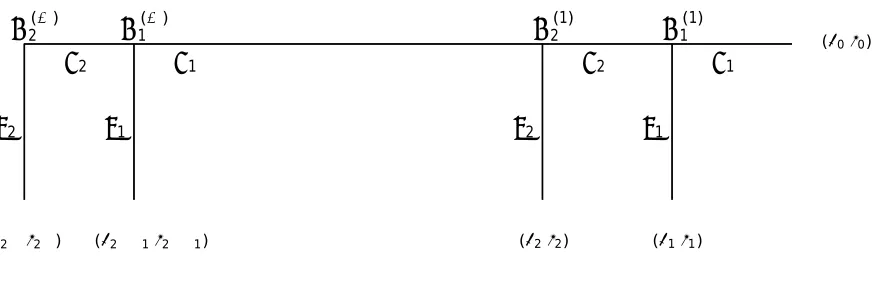
N2(K) N1(K) N2(1) N1(1)
(a2K,b2K) (a2K−1,b2K−1) (a2,b2) (a1,b1)
(a0,b0)
T2 T1 T2 T1
P2 P1 P2 P1
Figure 1: The centipede game
It is a (2K)-period extensive form game described as follows. There are two players
i= 1,2 who move in alternate order. In each period, the player whose turn it is to move,
say playeri, may eitherTake orPass, i.e. Ai={P ass, T ake}.26 If he Takes, this is the end
of the game. If he Passes, the game proceeds to the next stage where it is the other player’s
turn to move unless the game has reached the last period 2K in which case this is the end of
the game. Player 1 moves in the last period 2K, player 2 moves in the last but one period
and so on. Nodes at which player 1 must move are labelled N1(k), k = 1, ...K where N1(1)
designates the last node (i.e., period 2K) at which player 1 must move, N1(2) the last but
one, and so on tillN1(K) theÞrst node (i.e, period 2) at which player 1 must move. Similarly, nodes at which player 2 must move are labelledN2(k), k= 1, ...K where N2(1) designates the last node (in period 2K−1) at which player 2 must move, andN2(K)theÞrst node (in period
1) at which player 2 must move. If player 2 Takes at nodeN2(k), the payoffs to players 1 and 2 area2k and b2k, respectively. If player 1 Takes at node N1(k), the payoffs to players 1 and 2 area2k−1 and b2k−1, respectively. If player 1 Passes at nodeN1(1), the payoffs to players 1 and 2 area0 and b0, respectively. All at and bt,t= 0, ...2K are assumed to be integers that
satisfy for allk≥1:
a2k−1 > a2k−2 > a2k+1> a2k (2)
b2k−2 > b2k−3 > b2k> b2k−1
These conditions guarantee that (1) the unique Subgame Perfect Nash Equilibrium (SPNE)
of CPK is such that player 2 Takes in the Þrst period (this follows from a2k+1 > a2k and
b2k> b2k−1), and (2) in any periodt≤2K−2, both players are better offifTakeoccurs two
periods later, i.e. in periodt+ 2, than if it occurs in the current period t(this follows from
at> at+2 and bt> bt+2 for all t≤2K−2).
The prediction of the SPNE sounds relatively unintuitive, especially when the number of
periods 2K is large (because then taking in theÞrst node seems to induce very severe losses
for both players). As we now illustrate, the analogy approach explains why players may Pass
most of the time in the centipede game, at least for long enough versions of the game.
In order to deal with the effect of increasing the number of periods in CPK, we will
consider inÞnite sequences of integers (ak)∞k=0, (bk)∞k=0 satisfying (2). We will also assume that the difference between two consecutive payoffs is uniformly bounded from above. That
is, there exists∆>0 such that for all t≥0,
|at−at+1|<∆and |bt−bt+1|<∆. (3)
Regarding analogy partitioning, we will mostly consider the case in which both players
use the coarsest partitions as their analogy device. That is, each playeriis assumed to pool
togetherallthe nodesNj(k) at which playerj,j 6=imust move into a single class of analogy αi:
αi =
n
(j, Nj(k)),1≤k≤Ko.
The strategic environment is thus described by the set of playersN ={1,2}, the game tree
CPK, players’ preferences%i as deÞned by at,bt, and the analogy partitioning structureAn
as described byα1 and α2: (N, CPK,%i, An).
Player i’s analogy-based expectation βi reduces here to a single probability measure
βi(αi) =λi·P ass+ (1−λi)·T ake∈∆Aj, which stands for playeri’s expectation about the
WeÞrst consider assessments (σ,β) such that the strategy of every player is pure (i.e. for
everyi,h∈Hi,σi(h)∈Ai). And we consider the following condition:
K−1
K b2k+
1
Kb2k+1 > b2k+2 for all k≥0. (4)
Proposition 3 Suppose that condition (4) holds, and consider the environment(N, CPK %i
, An). There are two possible equilibrium paths corresponding to self-conÞrming analogy-based
expectation equilibria in pure strategies: Either player 2Takes in the Þrst period or the game
reaches period 2K in which player 1 Takes.
Proof. (a) WeÞrst prove that the two mentioned outcomes can be obtained as analogy-based expectation equilibrium outcomes.
(i) Observe Þrst that the Subgame Perfect Nash Equilibrium outcome corresponds to the analogy-based expectation equilibrium (σ,β) in which for i = 1,2 , βi(αi) = T ake and
σi(Ni(k)) =T ake for all k= 1, ...K.
(ii) Consider the strategy proÞle σ such that player 2 Passes always and player 1 Takes in the last period 2K.
To be consistent withσ, the analogy-based expectation of player 1 must be that player 2
Passes with probability 1, i.e. β1(α1) =P ass (since player 2 Passes always when he has to
move).
To be consistent with σ, the analogy-based expectation of player 2 must be that player
1 Passes with probability KK−1, since (according toσ) each node N1(k),k=K, ...1 is reached with probability 1, i.e. Pσ(N1(k)) = 1, (so that they have equal weighting), and player 1 Passes (with probability 1) in all nodes N1(k), k = K, ...2 and Takes in node N1(1). Thus, β2(α2) = KK−1P ass+K1T ake.
The (sequential) best-response of player 1 to the analogy-based expectationβ1 is to Take
in the last nodeN1(1). Thus, it is to play according to σ1.
When condition (4) holds, the best-response of player 2 to the analogy-based expectation
β2 is to Pass always (since by Taking at N2(k+1), player 2 would only get b2k+2, which is less than the expected payoff he gets by Passing at N2(k+1) and Taking at N2(k), say, i.e.
K−1
K b2k+
1
Kb2k+1> b2k+2). Thus, it is to play according toσ2.
Altogether the above considerations show that the assessment (σ,β) is an analogy-based
expectation equilibrium.
(b) It remains to show that there are no other possible outcomes in any pure strategy
self-conÞrming analogy-based expectation equilibrium. ObserveÞrst that if an outcome other than ’Player 2 Takes in theÞrst period’ emerges (as a self-conÞrming analogy-based
outcome. (This is because the unique analogy class of every player is then reached with
strictly positive probability.)
Consider the outcome in which playeriTakes at nodeNi(k), andNi(k)differs fromN2(K). If a pure strategy analogy-based expectation equilibrium leads to that outcome, it must be (by
consistency) that playeri’s analogy based expectation satisÞes βi(αi) =P ass, since on the
equilibrium path, playerj would always Pass. Player i’s best response to such a βi depends
on whether i = 1 or 2. If i = 1, player 1’s best response to β1(α1) = P ass is to Take at
node N1(1) (which corresponds to an outcome already identiÞed as a possible analogy-based
expectation equilibrium outcome). Ifi= 2, player 2’s best response to β2(α2) =P assis to
Pass always, which is in contradiction with player 2 Taking at nodeN2(k).
Finally, the outcome in which both players Pass in every period cannot be an
analogy-based expectation equilibrium outcome because whatever player 1’s expectation, player 1
strictly prefers Taking at nodeN1(1) to Passing always.
Comment1: The two outcomes mentioned in Proposition 3 remain equilibrium outcomes
even if player 1 uses a partitioning other than the coarsest, as long as player 2 uses the
coarsest partitioning.27
Comment 2: Consider the case where player 2 uses the coarsest partitioning and player 1
uses theÞnest partitioning (and condition (4) holds). As mentioned in Comment 1, Take by player 1 in the last node can be sustained as the equilibrium outcome of an analogy-based
expectation equilibrium. Note that in this equilibrium, player 2 behaves in the same way in
every node where he must move, which is to be related to his bundling ofallnodes in which
player 1 must move into a single class of analogy. We will suggest such aprinciplefor reÞning
analogy-based expectation equilibria in Section 4.
Proposition (3) leaves open what happens when condition (4) does not hold.28 And it
does not deal with equilibria in mixed strategies. The next Proposition provides the main
missing information (still assuming that conditions (2) and (3) hold):
Proposition 4 There exists an integermsuch that for allK > m: (1)(N, CPK,%i, An)has
an analogy-based expectation equilibrium(σ,β) in which each playeriPasses with probability
27
If one additionally requires that for allk,b2k<
b2k−1+b2k−2
2 , then these are the only possible outcomes of
self-conÞrming analogy-based expectation equilibria in pure strategies. (The point is that for a pure outcome other than that of the SPNE to emerge as a self-conÞrming analogy-based expectation equilibrium, it should be thatλ2≥12. But, then the best-response of player 2 toβ2(α2) =λ2P ass+ (1−λ2)T akeis to Pass always, thus leading to the wished conclusion.)
28
Take at the last node may then fail to be the outcome of an analogy-based expectation equilibrium in
purestrategies. This is, for example, the case when K−1
K b0+
1
1 in the Þrst K−m nodes, i.e. in every Ni(k), k = K, ...K−m. (2) Any self-conÞrming analogy-based expectation equilibrium of(N, CPK,%i, An) in which each playeriPasses with
probability1 in the Þrst node Ni(K) is such that each playeriPasses with probability 1 in the Þrst K−mnodes, i.e. in every Ni(k), k=K, ...K−m.
Proof. (1) Suppose βi(αi) = λi.P ass + (1−λi).T ake with λi ≥ 12 for i = 1,2. Under
condition (3),29 it is readily veriÞed that there exists an integer msuch that for allK > m, playeri’s best-response to βi requires Passing (with probability 1) in theÞrst K−mmoves
(at least) (because for some appropriately speciÞedm, Taking earlier is dominated by never
Taking).
Suppose that players 1 and 2 Pass with probability 1 in the Þrst node where they must
move. The consistency condition implies that the analogy-based expectation of player i,
βi(αi) =λi.P ass+ (1−λi).T ake, should satisfyλi≥ 12.
Together these two observations imply that the mapping
β = (β1,β2) →
Best-responseσ = (σ1,σ2)Consistency→ (β1hσi,β2hσi)
has aÞxed point such thatλi ≥ 1
2 fori= 1,2. Given the best-response to such analogy-based expectations, we may conclude.
(2) Suppose player i’s strategy requires him to Pass with probability 1 in node Ni(K)
for i = 1,2. By the consistency requirement it should be that player i’s analogy-based
expectationβi(αi) =λi.P ass+ (1−λi).T akesatisÞesλi ≥ 12 fori= 1,2. The best-response
toβi is to Pass at least in the Þrst K−mwhere he must move.
Proposition 4 (1) shows that irrespective of the length 2K of the game, there is an
equilibrium (possibly in mixed strategies) in which Take occurs in aÞnite number of periods
toward the end of the game.30 Proposition 4 (2) shows that there cannot be equilibria in
which Take occurs in the middle phase of the game (i.e. between period 3 and period 2K−2).
Comment 1: A prediction of the analogy setup (at least with the coarsest partitioning
and restricting attention to equilibria in which Take never occurs in the Þrst two periods) is that, by increasing the length ofCPK, the length of the end phase - in which Take may
occur - can never grow above someÞxed and bounded value.
Comment 2: It should be noted that the Subgame Perfect Nash Equilibrium outcome is
also an analogy-based expectation equilibrium outcome (in which Player 1 Takes in N1(K)
expecting player 2 to Take inα1). And that there is another equilibrium in mixed strategies
29Since all payoffs are integers satisfying (2), the differencesa
t−at+2,bt−bt+2are no smaller than 2. 30
in which Take may occur in theÞrst two periods (it is such that each playeri= 1,2 plays in
mixed strategies inNi(K)and Takes with probability 1 in all other nodes).
We now consider a slight modiÞcation of the environment in which the Subgame Perfect
Nash Equilibrium is no longer an equilibrium and Take can only occur toward the end of the
game. SpeciÞcally, assume the players not only play gameCPK, but also another game that
is the same as game CPK except that there are only two moves corresponding to Player 1
passing or not to the middle of the game and Player 2 passing or not from the middle to
the end of the game. Formally, let K be an odd number. Consider the game tree Υ such
that in stage 0 Nature selects either game CPK with probability νCP >0 or game F with
probabilityνF >0 where game F is described as follows.
GameF has the same two playersi= 1,2 asCPK and two moves. Player 2 moves in the
Þrst node denoted byM2. At nodeM2, player 2 must choose an action inA2 ={P ass, T ake}. If player 2 Takes, the game ends, players 1 and 2’ payoffs area2K and b2K, respectively. If
player 2 Passes, the game moves to nodeM1 where it is player 1’s turn to move. Player 1
must choose an action inA1 ={P ass, T ake}. If player 1 Takes, this is the end of the game
and the payoffs of players 1 and 2 are aK and bK, respectively; if he Passes, this is also the
end of the game and the payoffs to players 1 and 2 area0 and b0, respectively. We assume
thatK is larger than 2 so thata0> aK > a2K and b0 > bK > b2K.
Also, we assume that each playeriuses a single class of analogy. That is,
αi =
n
(j, Nj(k)),1≤k≤Ko [{(j, Mj)}
and we call (N,Υ,%i, An) the associated environment.
Proposition 5 Suppose that conditions (2) and (3) hold. There exists an integermsuch that
for allK > m,allself-conÞrming analogy-based expectation equilibria(σ,β) of(N,Υ,%i, An)
are such that playeri Passes with probability1 in Mi and in every Ni(k),k=K, ...K−m.
Proof. In gameF, whatever their analogy-based expectation, each playerichooses optimally
to Pass. This ensures that the analogy-based expectation of player i, βi(αi) = λi.P ass+
(1−λi).T akesatisÞesλi ≥νF >0 fori= 1,2. Given condition (3), this ensures that, for K
large enough, the best-response inCPK of each player iis at least to Pass in the Þrst node
where he must move, thus ensuring thatλi > 12 fori= 1,2. We may then conclude using the best-response argument in the proof of Proposition 4.
In the above analysis of the centipede gameCPK, we assumed that players use the coarsest
analogy partitioning. However, the insight that analogy reasoning may lead players to Pass
most of the time in long enough CPK would in general carry over, even when players use
Suppose, for example, that each player iconsiders two classes:
αendi = n(j, Nj(k)) such thatk≥ko
αmaini = n
(j, Nj(k)) such thatk < k
o
according to whether the end phase or the main phase of the game is being considered, and
call (N, CPK,%i, An) the corresponding environment.
Proposition 6 There exist m and an analogy-based-expectation equilibrium of(N, CPK,%i
, An) such that, for all K, each playeri Passes with probability1 at least in the ÞrstK−m
nodes where he must move.
Proof. If k−1
k b2k +
1
kb2k+1 > b2k+2 for all k ≤ k, then Player 1 Taking in the last node
N1(1) is an analogy-based expectation equilibrium outcome (this follows from the analysis in
Proposition 3).
Otherwise, using the argument in the proof of Proposition 4, it is readily veriÞed that there ismsuch that for, K large enough, there is an equilibrium (σ,β) satisfying (1)βi(αmaini ) =
λi,main·P ass+(1−λi,main)·T akewithλi,main≥ 12 fori= 1,2,and (2) playeri’s best-response toβi is to Pass with probability 1 at least in the Þrst K−mmoves.
3.3
(Finitely) Repeated Prisoner’s Dilemma
Consider the Prisoner’s DilemmaP D whose matrix payoffis represented as:
D C
D 0,0 1 +g1,−l2
C −l1,1 +g2 1,1
GameP D
withli,gi>0 fori= 1,2, where each playeri= 1,2 has to choose simultaneously an action
in{D, C}. We now consider several variants of repeatedP D. TheÞrst two variants illustrate how analogy reasoning may give rise to (non-trivial) end effects in the Þnitely repeated P D.
The third variant deals with the inÞnite repetition.
T-repetition: WeÞrst consider theT repetition ofP D with no discount factor, and we denote byP DT the corresponding game tree. Nodes inP DT correspond to histories of length
0 to T specifying the action proÞles played in earlier periods (if any). The history of length 0 is denoted by ∅, and a history h of length t > 0 is (a(1), ..., a(t)) wherea(k) = ³a(1k), a(2k)´
We consider the following analogy partitioning. Player 1 partitions the set of (2, h) into
two classes:31
α1 = {(2, h)|hcontains noD orh=∅}
α01 = {(2, h)|hcontains at least one D}
Player 2 is assumed to use the Þnest partitioning of the set of (1, h). We refer to An as
the corresponding partitioning, to N = {1,2} as the set of players, and to %i as player i’s
preferences over outcomes in P DT (as induced by the above matrix function and the no
discounting assumption).
Proposition 7 ForT sufficiently large, the path(a(k))T
k=1 witha(k)= (C, C)for allk≤T− 2, a(T−1) = (C, D) anda(T)= (D, D) is the equilibrium path of an analogy-based expectation equilibrium of (N, P DT,%i, An).
Proof. Suppose the proposed path corresponds to the analogy-based expectation equilibrium
(σ,β). By consistency, one should have:32
β1(α1) = T−2
T−1·C+
1
T −1 ·D
β1(α01) = D
ForT large enough (so that TT−−21 is sufficiently close to 1), player 1’s best-responseσ1toβ1 is to play Din the last period T or33 whenever one (or more) D has been played before. And
to playC otherwise.34
Player 2’s best-response σ2 toσ1 is to playDwhenever one (or more)Dhas been played
before and in the last two periodsT −1 and T. And to play C otherwise.35
The proof is completed by noting that the path generated by (σ1,σ2) corresponds to the
assumed path.
Remark 1: It is interesting to observe that in class α1 (resp. α0
1), Player 1 behaves in the same way in all histories hreached along the equilibrium path and such that (2, h)∈α1
(resp. α01).
31
Historyh = (a(1), ..., a(t)) is said to contain at least one D if there exist i =1,2 and k ≤t such that
a(ik)=D.
32
Note that the two analogy classes of player1are reached on this path.
33PlayingDin the last periodT is optimal whatever the expectation (it is a dominant strategy). 34
To see this, consider (the worst case at) period T −1 in which player 1 is supposed to play C. If he playsC (planning to play D next), his expected continuation payoff (given his expectation) is close to
1+ (1+g1) (corresponding to (C, D),(C, C). If he playsD (anticipating (D, D) will occur afterwards) his expected continuation payoffis close to (1+g1) + 0 (corresponding to (D, D),(C, D), which is smaller.
35
Player 2Þnds it optimal to playD in periodT−1because he knows that in any case player1will play
Remark 2: Suppose Player 2 uses the partitioning An2 of{(1, h)} obtained fromAn1 by
exchanging the roles of players 1 and 2. Then the path ((C, C), ...,(C, C),(D, D)) can be
sustained as an analogy-based expectation equilibrium path.
Stochastic T-repetition: We now consider a variant of P DT with T periods and no
discounting, but such that in each period there is a draw by Nature to determine the value
of eachgi for the current period (the values ofli are assumed to remain constant throughout
the game). To Þx ideas, we assume that the distributions are independent from period to period and accross players, and that in each period, gi takes valueg with probability ν and
gwith probabilityν whereν+ν = 1.36 We denote byz(t)the joint draw of (g1, g2) in period
t, and we assume that players are risk neutral. We denote byP Ds the associated game tree,
and by%i playeri’s preferences.
Nodes in P Ds correspond to histories of length 0 to T specifying the action proÞles
played in earlier periods (if any) and the draws by Nature in all periods up to (and including)
the current period. That is, the history of length 0 is z(1) specifying the draws g1 and g2
for the Þrst period. A history h of length t > 0 is ((a(1), z(1));...; (a(t), z(t));z(t+1)) where
a(k) =
³
a(1k), a(2k)
´
, z(k) = ³
g1(k), g(2k)
´
and a(ik) ∈ {D, C} stands for the action played by playeriin period kwhile g(ik)∈©g, gªstands for the period kdraw ofgi.
Each player ipartitions the set of (j, h) into two classes:37
αi = {(j, h)|hcontains noD}
α0i = {(j, h)|hcontains at least one D}
We deÞneuT = 1 + (ν·g+ν·g), and the sequence (ut)t<T recursively by38
ut= 1 + (ν·ut+1+ν·g).
We assume that uT < g and that no xt in this sequence is equal to g (which is satisÞed
generically). We deÞne mas the integer such thatuT−m+1 < g < uT−m. (Note thatmis no
larger thang, sinceut−ut+1>1 as long as ut+1< g.)
36
To keep in line with the class of games considered in Section 2, we assume that the draws of bothg1 and
g2 are immediately revealed to both players. However, this is immaterial for the analysis below.
37
Historyh= ((a(1), z(1));...; (a(t), z(t));z(t+1)) is said to contain at least oneD if there existi=1,2 and
k≤tsuch thata(ik)=D. It is said to contain noDotherwise.
38
Proposition 8 ForT large enough, the following strategy proÞle is part of an analogy-based
expectation equilibrium of (N, P Ds,%i, An) : For each player i, play D if one (or more) D
occurred so far; Otherwise, in all periodst,t < T−m, playC; in all periodst,T−m < t < T,
playC if g(it)=g andD if gi(t)=g; in period T, playD.
Proof. Given the assumed strategy proÞle σ and given that m is no larger than g, for T
large enough, the analogy-based expectationsβihσi that is consistent withσ should satisfy:
βihσi(αi) ≈ C
βihσi(α0i) = D
It can be checked that the best-response to such aβihσiis indeed σi.39
The logic of the equilibrium is as follows. Players rightly perceive that in class α0
i, i.e. if
someDwas played earlier, onlyDcan be expected next. In classαi, playerjchoosesCmost
of the time except toward reaching the end of the game: playeri’ expectation is thus close to
Cin this class. Given such an expectation, playericonsiders breaking the sequence ofC - by
playingD- only when the immediate gain gi from playingD is not too small relative to the
loss incurred by triggering a Dsequence. This occurs only toward the end of the game (i.e.
in the lastm+ 1 periods) when the draw ofgi is g (and also in the last period irrespective
of the realization ofgi(T)).
Remark1: The same result as in Proposition 8 carries over if the two classes considered by
playeriare now such thatαi contains only those (j, h) such that playeri(and not necessarily
playerj) has never playedD so far.
Remark 2: The above results suggest that analogy reasoning may provide an
explana-tion for the experimental evidence40 that players initially cooperate in the Þnitely repeated
prisoner’s dilemma and that there is an end effect in which players sometimes behave
oppor-tunistically (from periodT−mto period T).
Infinite repetition: We brießy consider the inÞnitely repeated prisoner’s dilemma in which both players have the same discount factor δ, g1 = g2 =g > 0 and l1 = l2 =l > 0.
The associated game tree is denoted byP Dδ, and playeri’s preference is denoted by%i.
As a preliminary comment, we Þrst observe that a cooperative outcome may emerge for some analogy partitioning, but not for others. We let αi denote player i’s partitioning of
(j, h) whereh= (a(1), ..., a(t)) is at-length history of action proÞles.
39
The sequenceut has been constructed precisely for that purpose.
Suppose playeri’s partitioningAni bears onlyover the actions played by player j. That
is, if h and h0 involve the same sequence of actions of player i, (j, h) and (j, h0) belong to the same analogy class. Then the only path that can be sustained as an analogy-based
expectation equilibrium of (N, P Dδ,%i, An) is the repetition of (D, D).
The point is that due to player i’s partitioning, player i will play D irrespective of his
expectation, since there is no effect identiÞed by playeri of i’s own actions on j’s behavior. As a result, only the repetition of (D, D) can emerge.
Of course, if each playeri partitions the set of (j, h) according to
αi = {(j, h)|hcontains noD}
α0i = {(j, h)|hcontains at least one D}
then the trigger strategy proÞle in which each playeriplaysC whenever noDwas played so
far and playsDotherwise is part of an analogy-based expectation equilibrium of (N, P Dδ,%i
, An).41
In the above examples, it is readily veriÞed that the analogy-based expectation equilibria
(σ,β) of (N, P Dδ,%i, An) are such that σ is a Subgame Perfect Nash Equilibrium of P Dδ. We now show that this need not be the case.
Example 2: Assume that 1−l > 12(1 +g). Player 2 uses theÞnest partitioning of (1, h). Player 1 partitions (2, h) into two classes:
α1 = n
(j, h)|hcontains no (D, C) and nok s.t a2(k)=a(2k+1) =Do
α01 = {(j, h)|(j, h)∈/α1}
DeÞne the following strategy proÞleσ:
1. For player 1: Play D if at least one (D, C) occurred so far or if player 2 played D in
two consecutive periods in the past. PlayC otherwise.
2. For player 2: PlayDif at least one (D, C) occurred so far or if player 2 playedDin two
consecutive periods in the past or if the last action proÞle is (C, C). Play C otherwise.
And deÞne player 1’s analogy-based expectation β1 as42: β1(α1) = 12C + 12D and
β1(α01) =D.
Claim 2: Forδ close enough to 1, (σ,β) is an analogy-based expectation equilibrium of
(N, P Dδ,%i, An). Yet, σ is not a Subgame Perfect Nash Equilibrium of P Dδ.
41
The associated analogy-based expectations are: βi(αi) =C andβi(α0i) =D.
Proof. The path generated byσ (starting from the nul history) is an alternation of (C, C)
and (C, D). Hence, the expression forβ1(α1). (β1(α01) =Dis the correct expectation.) It is readily veriÞed thatσ2 is a best-response toσ1. After an (D, C) occurs or player 2 playedD
in two consecutive periods, each playeri’s strategy requires playingD. Note that even player
1’ expectation is correct in this case, and the requirements for equilibrium are satisÞed. In
all other events and if the last action played by player 2 was C (resp. D), player 1 expects
(givenβ1 and the ensuing strategyσ1) to getuC (resp. uD) by playingC where
uD = 1
2(−l+ 1) +δ
uC
2
uC = 1
2(−l+ 1) +δ
uC+uD
2
(As δ gets close to 1, uD ≈(−l+ 1) and uC ≈2(−l+ 1).) If player 1 plays D instead of C
when the last action of player 2 isC (resp. D), player 1 expects to get 12(1 +g) +δu2D (resp. 1
2(1 +g)). When 1−l > 1
2(1 +g), player 1 prefers playingC in both cases.
The strategy proÞleσ is not a SPNE because player 1 should optimally prefer playingD
rather thanC on the equilibrium path when the last action proÞle is (C, C).
The effect of player 1’s treatment by analogy here is to allow to sustain strategy proÞles
in which player 1 is not punished after every deviation player 1 may consider. (In the above
example, player 1 is not punished if he playsDinstead ofCwhen player 2 is supposed to play
D.) Player 1 conforms to the prescribed strategy because he perceives an average punishment
in case of deviation (even if in some events there would be no actual punishment).
3.4
Bargaining and ultimatum games
In this subsection we wish to illustrate the effect of analogy reasoning in situations where the
action spaces are large at least in some nodes. A simple example is provided by the following
Take-it-or-Leave-it model. There are two playersi= 1,2 and a pie of size 1. Player 1 makes
a partition offer (x,1−x), x ∈ [0,1] to player 2 who may either accept or reject it.43 If he
accepts, players 1 and 2 getx and 1−x, respectively. If player 2 rejects the offer, player 1
gets 0 and player 2 gets an outside option payoff equal to vout, where 0 < vout < 1. Call
N ={1,2}the set of players,%i playeri’s preferences, andT Lthe game tree associated with
the above setup.
43
Standard analysis suggests that player 1 will propose (1−vout, vout) and that player 2 will
accept it. When player 1 forms his expectation about player 2’s probability of acceptance by
analogy, we now show that it may well be that either player 1 makes a much more generous
offer thanvoutto player 2 or that player 1 makes an offer that is rejected by player 2 depending on the partitioning.
SpeciÞcally, a node in T L at which player 2 must move can be identiÞed with x where (x,1−x) is the offer made by player 1. We assume that player 1 partitions the set of (2, x)
into two classes:44
αlow1 = {(2, x)|x < x≤1}
αhigh1 = {(2, x)|0≤x≤x}
whereα1low (resp. αhigh1 ) corresponds to the class of outrageous (resp. generous) offers.
Proposition 9 (1) When 1−x < vout, any analogy-based expectation equilibrium is such that there is no agreement: player 1 gets 0, player 2 gets vout. (2) Whenvout<1−x, there is a unique analogy-based expectation equilibrium in which player1 proposes(x,1−x), which
is accepted by player 2.
Proof. The analogy-based expectation of player 1 is of the formβ1(αr1) =λr·’Accepts’+(1− λr)·’Rejects’ with r =low, high. If λhigh >0 (resp. λlow >0), player 1’s best-response to
β1 cannot be to offer (x,1−x) with x < x (resp. x < 1). (1) When 1−x < vout, neither (1,0) nor (x,1−x) are acceptable by player 2. Only a disagreement can occur. (2) When
vout <1−x, λhigh= 1, λlow = 0, player 1 proposing (x,1−x) and player 2 accepting any offer (x,1−x) with 1−x≥vout gives rise to an analogy-based expectation equilibrium. It is also immediate to check that there is no other analogy-based expectation equilibrium.
Comment 1: The analysis of Proposition 9 is pretty similar to the one that would arise if
player 1 could only propose a partition offer in{(x,1−x),(1,0)}. Thus the analogy reasoning
here has the effect (through the working of the best-response correspondence) of reducing the
offers considered by player 1 in equilibrium.
Comment 2: Another setup which would give similar insights is one in which the
respon-der would not distinguish within the set of high offers (i.e., offers x such that x ≤ x) nor
within the set of low offers (i.e., offers x such that x > x).45 However, in a slightly more
elaborate model in which player 1 could not pick a deterministic offer, but could only affect
44
The intervals are closed as indicated to guarantee the existence of an equilibrium.
45