Partially Supervised Word Alignment Method
for Co-Extracting Opinion Target and
Opinion Words with Polarity Classification
Ramya V. V. 1, Shahad P. 2
M Tech Student, Department of Computer Science& Engineering, M.E.A Engineering College, Perinthalmanna,
Kerala, India1
Assistant Professor, Department of Computer Science& Engineering, M.E.A Engineering College, Perinthalmanna,
Kerala, India2
ABSTRACT: In recent years web technologies lead to an large quantity of user generated opinion in online systems. This large amount of opinion on web make them viable for use as data sources. As e-commerce is more and more popular, the number of customer reviews related to product receives grows rapidly. Hundreds or even thousands number of reviews are in online. It is very difficult to read and to make an informed decision on whether to purchase the product. In this case Mining opinion targets and opinion words from online reviews is an important tasks. Mainly two steps are involved to extract the opinion targets and opinion words from online reviews. First detecting opinion relations among words, it is based on alignment model. Alignment process identifying online opinion relations. Next step calculate the confidence of each candidate. Finally, extracted opinion targets or opinion words with higher confidence.
KEYWORDS: Opinion mining, Opinion target, Opinion word, Syntactic pattern, Confidence, Tagging, Supervised method
I. INTRODUCTION
Large number of reviews are in online, it is very difficult to read and to make an informed decision on whether to purchase the product or not . Opinion mining divided into two main categories first one Supervised method and another Unsupervised method. In supervised approaches, the opinion extraction task usually regarded as a sequence labeling task. The main limitation of these two methods is that labeling training data for each domain was impracticable and time consuming. Mining opinions target and opinion word from online reviews, it is very useful for customers and manufacturers. Customers can obtain summary of product information and direct supervision of their purchase actions. Manufacturers can improve the quality of their products in a timely fashion and obtain immediate feedback of product.
For example:
“This phone has a bright and big screen, but its resolution is very disappointing.”
Nearest-neighbour rules only consider nearest adjective/verb and noun/noun phrase pair. This approach cannot obtain precise results.
In this paper introduce a new approach, a word alignment model. It precisely extract the opinion relations among words and also it can capture more complex word relations, such as long span relations. “colorful” and “big” are opinion words ,that aligned with the opinion target word “screen”. The word alignment model can identify an opinion target and its corresponding modifier. Compared to previous nearest-neighbor rules identifying modified relations to a limited window. Several intuitive factors, such as word co-occurrence frequencies and word positions, into a unified model for indicating the opinion relations among words. Thus, we expect to obtain more precise results on opinion relation identification. The alignment model used in [5] has proved to be effective for opinion target extraction. However, for opinion word extraction, there is still no straightforward evidence to demonstrate the WAM’s effectiveness. Compared to traditional methods word alignment model yield better results for mining opinion targets and opinion words from online reviews.
Extracting opinion targets and opinion words is regarded as a word alignment process then proposed to calculate each candidate’s confidence . Finally, opinion targets and opinion word with higher confidence than a threshold are extracted.
II. RELATEDWORK
Previous methods mainly focused on sentiment analysis. Two approaches are used for this task, Supervised method and Unsupervised method. In the case of supervised methods, opinion target extraction as a sequence labeling task[2] but they require a large amount of annotated data for training and thus are less applicable compared with unsupervised methods. Mining opinion targets and opinion word is a fundamental and important task for opinion mining. To this end, there are two kinds of methods, syntax based[7] and alignment based methods. Syntax based methods usually exploited syntactic patterns ,this approach to extract opinion targets, many parsing errors are generated in this method when dealing with online informal texts. The most adopted techniques have been Nearest-Neighbour rules[3][5] and syntactic patterns[4]. Nearest Neighbour rules only consider the nearest adjective/verb to a noun/noun phrase in a limited window size as its modifier. Clearly, this strategy cannot obtain precise results. May parsing errors are generated in Syntactic method. Accordingly several syntactic patterns were designed. However, online reviews are informal writing styles, including grammatical errors, punctuation errors and typographical errors. This makes the existing parsing tools, which are usually trained on formal texts such as news paper reports, prone to generating errors. Syntax-based methods, which depend on parsing performance, suffer from parsing errors and often do not work well.
III.PROPOSEDMETHOD
Here propose a simple method for extracting opinion target and opinion word from online review based on word alignment model. In this paper, mine opinion targets and opinion word from online reviews is a challenging and important task in opinion mining. first , to mine opinion relations in sentences through partially-supervised word alignment model. Then, a graph-based algorithm is to estimate the confidence of each opinion target and opinion word (candidate), and the candidates with higher confidence than threshold will be extracted as the opinion targets and opinion word.
Opinion target: Object about which users express their opinions. Nouns or noun phrases are opinion target.
opinion words: The words that are used to express users opinions. Adjectives are opinion words.
For example:
"This phone has a bright and big screen, but its LCD resolution is very disappointing."
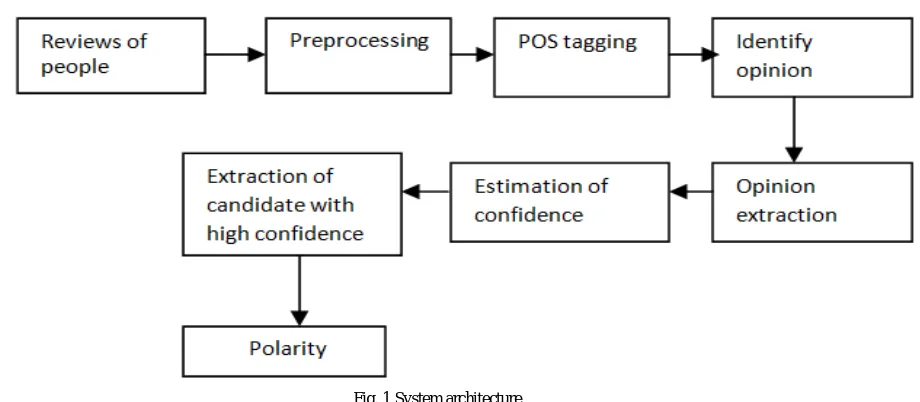
In the above example, three opinion words are "bright", "big" and "disappointing" and two opinion targets are "screen" and " resolution". Figure 1 represent the architecture system.
Fig. 1 System architecture
The entire system mainly includes following steps.
Preprocessing
Extraction opinion
Extract opinion with high confidence
Identify polarity
3.1 Partially-Supervised Alignment Model
linguistic parser to parse each review to split the text into sentences according to punctuation and to produce the part-of-speech tag for each word in sentences (whether the word is a noun, verb, adjective, etc). This process determine simple noun and verb groups (syntactic chunking).
Table. 1 Part-of-speech (POS) tagging
In word alignment model, which identifying opinion relations among words. All nouns/noun phrases in sentences are regarded as opinion target candidates, and all adjectives/verbs are regarded as opinion words. The syntactic patterns are not provide a full alignment, so a EM-based algorithm adopted, named as constrained hill-climbing algorithm[9], to determine the parameters. In this training process, the constrained hill-hill-climbing algorithm can ensure that the final model is marginalized on the partial alignment links. Particularly, in the E step, their method aims to identify the alignments which are consistent to the alignment links provided by syntactic patterns, Mainly two steps are involved.
Optimize towards the constraints.
Towards the optimal alignment under the constraints
Some constraints are used in word alignment model as follows:
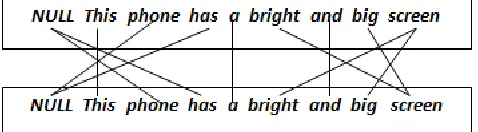
Nouns/noun phrases (verbs/adjective) must be aligned with adjectives/verbs (nouns/noun phrases) or a null
word.
Null word means that this word either has no modifiers or modifies nothing.
Other unrelated words, such as conjunctions ,prepositions, and adverbs, can only align with themselves.
Consider above two constraints, to obtain Fig.1 the following alignment results. where "NULL" means the null word, that means this word either has no modifier or modifies nothing From above example, the unrelated words are "This", "a" and "and". These are aligned with themselves. The word "Phone" and "has" modifies nothing and no opinion words to modify therefore, these two words align with "NULL" word.
Given a sentence S with n words, S = (w1, w2, . . . , wn), the word alignment is,
A^ ={(i, ai)| i ϵ [1,n], ai ϵ [1,n]} (1)
Where (i,ai) means that a noun/noun phrase(opinion target) at position i is aligned with its modifier(opinion word) at
position ai.
3.2 Opinion Associations Among Words
After alignment results[1], To get a set of opinion word and opinion target (candidates)pairs, each pair composed of a noun/noun phrase (opinion target candidates) and its corresponding modified word (opinion word candidate). Next, estimate the alignment probabilities between a opinion target Wt and a opinion word Wo,
P(Wt|Wo) = Count(Wt,Wo)/Count(Wo) (2)
Where P(Wt|Wo) means the alignment probability between opinion target and opinion words. Similarly, the
alignment probability P(Wo|Wt) by changing the alignment direction in the alignment process. Then calculate the
opinion association OA(Wt,Wo) between wt and Wo as follows:
OA(Wt,Wo)=(α * P(Wt|Wo) + (1 -α)P(Wo|Wt))^-1 (3)
Where α is a constant ,a harmonic factor used to combine these two alignment probabilities. In this paper, α= 0.5. Estimating Candidate Confidence[1] With Graph Co Ranking. Confidence of a candidates related to neighbor words. Confidence of a candidate (opinion target or opinion word) determined by its neighbors according to the opinion associations among them.
3.3 Graph Construction
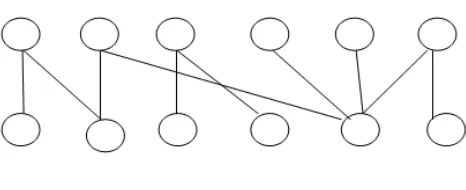
G = (V,E,W) is a Relation Graph, it is bipartite undirected graph. In relational graph G, V = Vt U Vo denotes the set of vertices. vt ϵ Vt denote opinion target candidates (the below nodes ) and vo ϵ Vo denote opinion word
candidates (the above nodes ). E denote edge set of the graph G, where eij ϵ E means that there is an opinion relation
between two vertices. It is worth noting that the edges eij is an edge between vt and vo and there is no edge between the
two same types of vertices. wij ϵ W means the weight of the edge eij. Graph based co-ranking algorithm to calculate
the confidence of each candidate pair. Finally, candidates with higher confidence than a threshold are extracted as the opinion targets or opinion words from online review
3.4 Candidate Confidence
Calculate the confidence of each candidate(Opinion target and Opinion word) through standard random walk with restart algorithm. Confidence of each candidate is,
Ct^(k+1) =(1-µ)*Mt0*Co^(k) +µ*It (4)
Co^(k+1) =(1-µ)*Mt0*Ct^(k) +µ*Io (5)
where Ct^(k+1) and Co^(k+1) are the opinion target candidate and opinion word candidate confidence, in the (k + 1)
iteration. Co^(k) and Ct^(k) are the confidence of an opinion target candidate and opinion word candidate in the k
iteration. Mt0 is opinion associations between opinion target candidate and opinion word candidate. mijϵ Mto means
the opinion association between the i-th opinion target candidate and the j-th opinion word candidate. where
Mt0*Co^(k) and Mt0*Ct^(k) are the confidence of an opinion target or opinion word candidate is obtained through aggregating confidences of all neighboring opinion word (opinion target) candidates together according to their opinion associations. The other ones are It and Io, which denote prior knowledge of opinion target candidate and opinion word candidate .
3.5 Classification of candidates
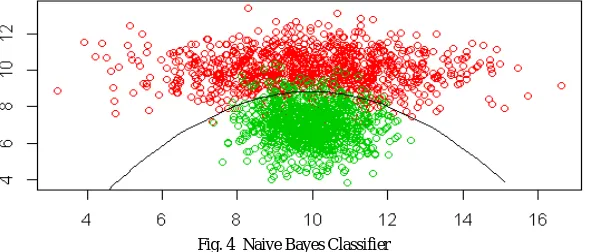
Naive Bayes Classifier method is used to classify the candidates. Positive and negative classification method is used in this paper. Initially Positive and negative word list are exist. Seed list initially contains some of the opinion words along with their polarity. From the tagged output all the opinion words were extracted. The extracted opinion words matched with the words stored in positive list, in this case the output is positive otherwise negative. Fig 4 represent Naive Bayes Classifier.
Fig. 4 Naive Bayes Classifier
IV.EXPERIMENTAL RESULTS
Table.2 comparison of four method
V. CONCLUSION
Word alignment is more precisely and more effective method for opinion mining. This method gives an idea a novel Partially-Supervised Word Alignment Method for co-extracting opinion targets and opinion words. It is mainly focused on detecting opinion relations between opinion targets and opinion words. Next construct an Opinion Relation Graph to estimate the confidence of each candidate. The items with higher ranks or confidence are extracted out. This approach is useful both customer and manufactures. Next classify the candidates into positive and negative class using naive Bayes Classifier
REFERENCES
[1] Kang Liu, Liheng Xu, and Jun Zhao," Co-Extracting Opinion Targets and Opinion Words from Online Reviews Based on the Word
Alignment Model", ieee transactions on knowledge and data engineering, vol. 27, no. 3, pp.636-650, march 2015.
[2] M. Hu and B. Liu, “Mining opinion features in customer reviews,” in Proc. 19th Nat. Conf. Artif. Intell., San Jose, CA, USA, pp. 755–760,
2004.
[3] T. G. Moe, W. Li, Moe, and Z. Sui, “A semi-supervised method for opinion target extraction”, pp. 275–276.
[4] Q. Zhang, Y. Wu, T. Li, M. Ogihara, J. Johnson, and X. Huang, “Mining product reviews based on shallow dependency parsing”, in Proc.
32nd Int. ACM SIGIR Conf. Res. Develop. Inf. Retrieval, Boston, MA, USA, pp. 726–727, 2009.
[5] G. Qiu, B. Liu, J. Bu, and C. Che, “Expanding domain sentiment lexicon through double propagation”, in Proc. 21st Int. Jont Conf. Artif. Intell., Pasadena, CA, USA, pp. 1199–1204,2009.
[6] B. Wang and H. Wang, “Bootstrapping both product features and opinion words from chinese customer reviews with cross inducing”, in Proc.
3rd Int. Joint Conf. Natural Lang. Process., Hyderabad, India, pp. 289–295,2008.
[7] G. Qiu, L. Bing, J. Bu, and C. Chen, “Opinion word expansion and target extraction through double propagation”, Comput. Linguistics, vol.
37, no. 1, pp. 9–27,2011.
[8] Fangtao Li, Chao Han, Minlie Huang, Yingju Xia, Shu Zhang, and Hao Yu, "Structure aware review mining and summarization", pp. 653–
661, 200.
[9] Qin Gao, Nguyen Bach, and Stephan Vogel," A semi-supervised word alignment algorithm with partial manual alignments ",In Proceedings of
the Joint Fifth Workshop on Statistical Machine Translation and MetricsMATR, pages 1–10, Uppsala, Sweden, Association for Computational Linguistics, pp.1-10, july 2010.
[10] Sharma, Richa, S. Nigam, and R. Jain, "Opinion mining of movie reviews at document level", 2014.
[11] Hemalatha, I. G. S. Varma, and A. Govardhan, "Preprocessing the informal text for efficient sentiment analysis", International Journal, 2012. [12] Xu and Liheng, ”Walk and learn: a two-stage approach for opinion words an opinion targets co-extraction", Proceedings of the 22nd