
Scholarship@Western
Scholarship@Western
Electronic Thesis and Dissertation Repository
12-12-2013 12:00 AM
An Access Control Model for NoSQL Databases
An Access Control Model for NoSQL Databases
Motahera SherminThe University of Western Ontario
Supervisor Dr. Sylvia Osborn
The University of Western Ontario Graduate Program in Computer Science
A thesis submitted in partial fulfillment of the requirements for the degree in Master of Science © Motahera Shermin 2013
Follow this and additional works at: https://ir.lib.uwo.ca/etd
Part of the Databases and Information Systems Commons, and the Information Security Commons
Recommended Citation Recommended Citation
Shermin, Motahera, "An Access Control Model for NoSQL Databases" (2013). Electronic Thesis and Dissertation Repository. 1797.
https://ir.lib.uwo.ca/etd/1797
This Dissertation/Thesis is brought to you for free and open access by Scholarship@Western. It has been accepted for inclusion in Electronic Thesis and Dissertation Repository by an authorized administrator of
(Thesis format: Monograph)
by
Motahera Shermin
Graduate Program in Computer Science
A thesis submitted in partial fulfillment of the requirements for the degree of
Master of Science
The School of Graduate and Postdoctoral Studies The University of Western Ontario
London, Ontario, Canada
ii
Abstract
Current development platforms are web scale, unlike recent platforms which were just
network scale. There has been a rapid evolution in computing paradigm that has created the
need for data storage as agile and scalable as the applications they support. Relational
databases with their joins and locks influence performance in web scale systems negatively.
Thus, various types of non-relational databases have emerged in recent years, commonly
referred to as NoSQL databases. To fulfill the gaps created by their relational counter-part,
they trade consistency and security for performance and scalability. With NoSQL databases
being adopted by an increasing number of organizations, the provision of security for them
has become a growing concern.
This research presents a context based abstract model by extending traditional role based
access control for access control in NoSQL databases. The said model evaluates and executes
security policies which contain versatile access conditions against the dynamic nature of
data. The goal is to devise a mechanism for a forward looking, assertive yet flexible security
feature to regulate access to data in the database system that is devoid of rigid structures and
consistency, namely a document based database such as MongoDB.
.
Keywords
iii
Acknowledgments
I humbly state my gratitude to the people who have guided me and contributed in making this
thesis possible. First and foremost, I acknowledge my profound sense of reverence towards
the Almighty for granting me the ability and confidence to successfully complete this thesis.
I express my deepest veneration for my supervisor and mentor, Professor Dr. Sylvia Osborn
for guiding me all through the course of my graduation work. Her vast knowledge and deep
understanding of different databases and access control mechanisms, her continuous
guidance, scholastic and moral support as well as her patience throughout the entire period of
my studies have been the constant catalyst. It has been a great pleasure and privilege for me
to have her as my supervisor.
I recognize that this thesis work would not have been possible without the Western Graduate
iv
Table of Contents
Abstract ... ii
Acknowledgments... iii
Table of Contents ... iv
List of Tables ... vii
List of Figures ... viii
List of Appendices ... ix
Chapter 1 ... 1
1 Introduction ... 1
Chapter 2 ... 5
2 Basics of NoSQL Databases ... 5
2.1 NoSQL: Classifications ... 5
2.2 NoSQL: Principle concept ... 8
2.3 NoSQL: Challenges ... 9
2.4 NoSQL: Type example ... 10
2.4.1 MongoDB ... 11
2.4.2 MongoDB: Security Concerns ... 16
Chapter 3 ... 19
3 Role Based Access Control ... 19
3.1 Overview ... 19
3.1.1 RBAC associations ... 20
3.1.2 Constraints ... 22
3.1.3 Security principles ... 24
v
Chapter 4 ... 29
4 Motivation and Objectives ... 29
4.1 Why NoSQL ... 29
4.1.1 Challenges ... 30
4.2 Play of NoSQL ... 31
4.2.1 Schemaless ... 32
4.2.2 Schema Migrations ... 34
4.2.3 Scalability and performance advantages ... 34
4.3 Motivation ... 37
4.4 A target example ... 40
Chapter 5 ... 42
5 Proposed Solution ... 42
5.1 A Context Aware RBAC Model ... 42
5.1.1 Definition of Model Elements ... 44
5.1.2 Relation Assignments ... 47
5.1.3 Access definition ... 49
5.1.4 Context Evaluation ... 50
Chapter 6 ... 52
6 Solution verification/evaluation ... 52
6.1 Access control enforcement ... 58
Chapter 7 ... 65
7 Conclusions and Future Work ... 65
7.1 Discussion and Conclusions ... 65
7.2 Future Work ... 66
References ... 68
vi
vii
List of Tables
Table 1: Classifications – NoSQL Taxonomy by Stephen Yen [33] ... 5
Table 2: Classifications – Categorization by Rick Cattell [5] ... 7
Table 3: Classifications – Categorization and Comparison by Scofield and Popescu [22, 28] 7 Table 4: ACID vs. BASE [4] ... 9
Table 5: Terminology and Concepts [43] ... 73
Table 6: DDL Query [43] ... 73
viii
List of Figures
Figure 1: MongoDB data model [35]... 13
Figure 2: Data model with embedded fields that contain all related information [35]. ... 13
Figure 3: Data model using references to link documents. Both the contact document and the access document contain a reference to the user document [35]. ... 14
Figure 4: Different RBAC Models ... 22
Figure 5: Context-Aware RBAC Model (CA-RBAC) [18, Figure 1] ... 27
Figure 6: NoSQL Datastore ... 32
Figure 7: Scale up with relational technology [40] ... 35
Figure 8: Scale out with NoSQL technology at the database tier [40] ... 36
Figure 9: Basic concept of a Context facilitated RBAC ... 44
Figure 10: Example of Context Expression ... 47
Figure 11: "Campaing" Collection ... 53
Figure 12: Sample Role Hierarchy with min, max and mutually exclusive ... 54
Figure 13: Sample data composition... 55
Figure 14: Available privileges on Campaign and Product data ... 56
Figure 15: Example set of contexts for a global agency ... 58
Figure 16: Function call for privilege list ... 60
Figure 17: Function call for role activation ... 60
ix
List of Appendices
Chapter 1
1
Introduction
The IT industry has come a long way since Web 2.0 when the nature of computing
started to shift from standalone software to a distributed service model and network
models replaced the internet as a development platform with desktop applications
migrating to cloud services. Since then it has been a constant race to develop the next
best computing concept to serve the ever-growing data mass, ever-evolving traffic
patterns, and constant high demand for performance. The market share of relational
database management systems (RDMBSs) is still the largest when it comes to storing
application data consistently regardless of the nature of the data or application. But the
nature and size of data is emerging as the major factor when designing an application
today.
Applications now run distributed over many servers, they get dynamically scaled on
demand and even the delivery model has been enjoying new approaches with the Cloud.
In contrast, RDMBSs have gotten less attention in terms of new approaches and as a
result are becoming a less obvious choice as data storage. To fill this gap, new types of
databases (DBs) have emerged called NoSQL (Not Only SQL) databases. These new
databases come equipped with horizontal scaling, high availability, low cost, and high
performance.
NoSQL databases present new storage architectures that are favorable to unrestrained
growth of data and traffic. These databases facilitate devising parallel algorithms (i.e.
MapReduce) designed to efficiently process the distributed data. The advent of NoSQL is
leading the approaches and methods of storing and analyzing information rich user data
to a brand new dimension. NoSQL exercises least amount of control over data where its
relational counterpart maintains rigid control over the structure and occurrence of data.
Relational systems use metadata to precisely control data type and heavily synchronized
processes to maintain data integrity. NoSQL uses loosely synchronized processes to
constraints but at the same time it provides almost no support for security at the database
level.
The main promoters of NoSQL databases are Web 2.0 companies such as Amazon,
Twitter, LinkedIn and Google which are challenged with unprecedented data, operation
volumes under tight latency constraints and massive infrastructure needs. NoSQL
databases represent the much needed data storage evolution in enterprise application
architecture, continuing the evolution of the past twenty years. In the 1990’s, vertically
integrated applications gave way to server architecture, and with Web 2.0,
client-server architecture transcended to three-tier web application architecture. In parallel, the
demands of web-scale data analysis added map-reduce processing into the mix and data
scientists started trading transactional consistency for incremental scalability and
large-scale distribution. The NoSQL movement emerged out of the later constellation [34].
Martin Fowler [24] states that NoSQL is an accidental neologism. NoSQL is an
observation and aggregation of common characteristics, lacking any prescriptive
definition. The evolution in data storage was motivated by the need to support large
volumes of data with database running on clusters. Relational databases are not designed
to run efficiently on clusters. Fowler aggregates the following common characteristics of
NoSQL databases in his book.
• Not using the relational model • Running well on clusters • Open-source
• Built for 21st century web estates • Schemaless
NoSQL, “Not Only SQL”, is not a replacement for relational databases. These databases
are developed to run on clusters consisting of commodity computers and therefore are
designed to be distributed and failure tolerant. To achieve this, database architects have to
step away from the ACID properties and make different trade-offs with transaction
management, query capabilities and performance. NoSQL databases are usually designed
to fit the requirements of most web services; most of them are schema-less systems that
The NoSQL security model is for the databases to be buried deep within an organization
and behind other systems. The security model expects the database to reside in a secure
environment, protected by firewalls. The irony is that it’s the web applications or social
media applications which have adopted the NoSQL databases and have made it popular.
Having an open front end, universally accessible from any web browser makes
development easier, but the open user-interface concept conflicts with the
behind-closed-door security model. This security concern is the main driving force in this thesis.
Access control is a fundamental security technique in systems in which multiple users
share access to common resources. It is the process of stating and enforcing security
policies that determine whether a subject (e.g., process, computer, user, etc.) is allowed to
perform an operation (e.g., read, write, update, delete, etc.) on an object (e.g., a tuple in a
database, a table, a file, a service, etc.). This mechanism maintains the subject's
permissions (rights to carry out an operation on an object) in a system in order to achieve
the desired level of security.
There are several access control models. Among those, role based accesses control
(RBAC) models are most widely mentioned as they provide systematic access control
security for Enterprise solutions. One of the main advantages of RBAC over other access
control models is the ease of its security administration [6]. RBAC enables an
organization to model its security mechanism to closely match the individual business
process. RBAC models are policy neutral [26]; they can support different authorization
policies, including mandatory and discretionary policies, through the appropriate role
configuration.
The recent paradigm shift in application architectures such as cloud computing,
distributed file system and non-structured data store imposes novel challenges for
authorization that are not addressed by the well-established RBAC models [9].
Researchers have proposed several RBAC extensions to address an ever increasing scope
of security requirements [2, 18, 32, 6, 10, 29, 23, 21, 21]. Most of these extensions are
conceived for a particular system or business process. These approaches come up short
The increasing popularity of NoSQL databases and the large volume of user related
sensitive information stored in these databases raises the concern for the confidentiality
and privacy of the data and the security provided by these systems. NoSQL data models
are flexible and can be designed according to application need or context. A context can
be used to define the parameters for which an operation can be executed in a system.
Context typically is application dependent. Usually, RBAC components are limited to
user, role, permission and constraint. The classic RBAC model cannot support enforcing
a security policy for contextual information such as state of data or application interface,
let alone an unstructured data model such as seen in NoSQL. In this thesis we use one of
the RBAC extensions to define an abstract security model for a specific NoSQL database
type, a Document Database.
We start with a brief overview of NoSQL and RBAC. Then in Chapter 4, we discuss the
architecture and security concerns of one of the popular document databases. Based on
this discussion we present an abstract model in Chapter 5. The rest of the thesis is
organized as follows. Chapter 6 contains the evaluation of the model against a sample
internal enterprise system where traditional RBAC fails. We investigate the authorization
requirements imposed by this system in this chapter. Chapter 7 contains conclusions and
Chapter 2
2
Basics of NoSQL Databases
The intent of this chapter is to discuss common concepts, techniques and patterns related
to NoSQL databases along with several classes of NoSQL and an individual NoSQL
product. In recent years a number of NoSQL databases have been developed mainly by
practitioners and web companies to fit their specific requirements regarding scalability
performance, maintenance and feature-set. Some of these databases are conceived from
the idea of Google BigTable or Amazon’s Dynamo or a combination of both. Because of
the variety of these approaches and the overlaps regarding the nonfunctional
requirements and the feature-set, it could be difficult to get and maintain an overview of
the non-relational databases. So there have been various approaches to classify NoSQL
databases, each with different categories and subcategories.
2.1
NoSQL: Classifications
In his presentation “NoSQL is a Horseless Carriage” [33], Yen suggests a taxonomy that
can be found in Table 1.
Table 1: Classifications – NoSQL Taxonomy by Stephen Yen [33]
Term Database
key‐value‐cache Memcached
Repcached Coherence Infinispan EXtreme Scale
Jboss Cache Velocity Terracoqa
Key-Value-Store keyspace
Flare Schema Free
RAMCloud Eventually-Consistent
Key-Value-Store
Dynomite SubRecord Mo8onDb Dovetaildb Ordered-Key-Value-Store Tokyo Tyrant Lightcloud NMDB Luxio MemcacheDB Actord Data-Structures Server Redis
Tuple Store Gigaspaces
Coord Apache River
Object Database ZopeDB
DB4O Shoal
Document Store CouchDB
Mongo Jackrabbit XML Databases ThruDB CloudKit Perservere Riak Basho Scalaris
Wide Columnar Store Bigtable
Hbase Cassandra Hypertable KAI OpenNeptune Qbase KDI
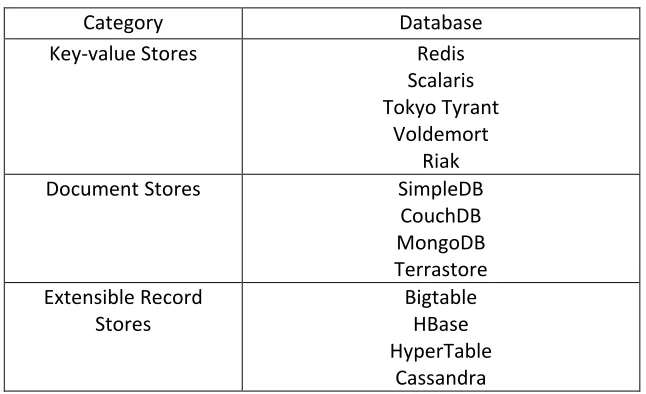
Similarly to the classifications mentioned above, Rick Cattel classifies different NoSQL
Table 2: Classifications – Categorization by Rick Cattell [5]
Category Database
Key-value Stores Redis
Scalaris Tokyo Tyrant
Voldemort Riak
DocumentStores SimpleDB
CouchDB MongoDB Terrastore Extensible Record Stores Bigtable HBase HyperTable Cassandra
In his presentation [28] at codemesh 2010, Ben Scofield of Viget Labs gave generic
introduction to NoSQL databases along with a categorization of different NoSQL
databases. The presentation contained a short comparison of classes of NoSQL databases
by nonfunctional categories as well as ratings of their feature coverage. Popescu [22]
summarizes Scofield’s ideas in his blog as presented in Table 3.
Table 3: Classifications – Categorization and Comparison by Scofield and Popescu
[22, 28]
Performance Scalability Flexibility Complexity Functionality
Key-Value Stores high high high None Variable (none)
Column stores high high moderate low minimal
Document stores
high variable (high)
high low variable (low)
Graph databases variable variable high high graph theory
Relational databases
variable variable low moderate relational algebra
2.2
NoSQL: Principle concept
This section gives an overview of some basic concepts in the NoSQL design model. The
CAP (consistency, availability and partition tolerance) theorem introduced by Eric
Brewer [4], refers to the three properties of shared-data systems namely data consistency,
system availability and tolerance to network partitions. This concept is widely adopted by
prominent Cloud vendors as well as the NoSQL faction. This theorem basically states
that current databases are better at consistency than availability and wide-area databases
can’t have both but this favors the side of NoSQL and influenced the design of
non-relational databases.
Brewer mentions a tradeoff between ACID and BASE systems and proposed to select
one or the other for individual use-cases: if a system or parts of a system have to be
consistent and partition-tolerant, ACID properties are required and if availability and
partition-tolerance are favored over consistency, the resulting system (i.e. NoSQL) can be
characterized by the BASE properties. ACID database (RDBMS) is transaction based and
it leverages data consistency and persistence principles from developers’ responsibility.
ACID transactions provide the following assurances:
Atomicity: All of the operations in the transaction will complete, or none will.
Consistency: The database will be in a consistent state when the transaction begins and
ends.
Isolation: The transaction will behave as if it is the only operation being performed upon
the database.
Durability: Upon completion of the transaction, the operation will not be reversed. [9]
The BASE approach, according to Brewer, forfeits the ACID properties of consistency
and isolation in favor of “availability, graceful degradation, and performance” [4]. The
acronym BASE is composed of the following characteristics: Basically Available,
Brewer contrasts ACID with BASE as illustrated in Table 4, yet considers the two
concepts as a spectrum instead of alternatives excluding each other. So an application
works basically all the time (basically available), does not have to be consistent all the
time (soft-state) but will be in some known-state state eventually [14].
Table 4: ACID vs. BASE [4]
ACID BASE
Strong consistency Isolation
Focus on “commit” Nested transactions Availability?
Conservative (pessimistic) Difficult evolution (e. g. schema)
Weak consistency – stale data OK Availability first
Best effort
Approximate answers OK Aggressive (optimistic) Simpler!
Faster
Easier evolution
2.3
NoSQL: Challenges
NoSQL database system takes a step away from the ACID principle of the relational
database to ensure either partition or availability. According to Brewer’s [4] CAP
theorem, a distributed database system will either trade availability to make sure the
database is consistent or it can favor availability over consistency when the database is
partitioned; but neither at the same time. This implies that if consistency and availability
are of primary concerns then it is achieved by not introducing partition in the database
system. Most of the NoSQL databases give priority to availability over consistency.
NoSQL databases are not mature enough compared to RDBMS and thus face several
challenges and concerns. One of the hurdles the application designers face is overhead
and complexity created by the different query processing language or API in each
NoSQL database in place of SQL. Each NoSQL database has different API and different
query systems, requiring a full learning curve for developers every time a new NoSQL
data with simpler operations on them. As a result complex query programming for the
databases can be often difficult. NoSQL databases are used primarily for specialized
projects, such as those that are distributed, that involve large amounts of data, or that
must scale. Lack of common query language, consistency support and transaction system
create impedance towards the adoption of NoSQL databases in certain types of business
applications like banking systems. RDBMSs are equipped with query optimization
engine because relational models ensure data independence and provide high level
support of ad-hoc query. But in NoSQL databases, the query needs to be implicitly
optimized during design time based on the particular architecture of the database itself,
the application nature and patterns of queries in the system. From this point of view
application designers and architects need to evaluate strengths and weaknesses of each
available NoSQL systems before its adoption and development. Lack of proper system
and management tools or lack of a proper theoretical foundation can make developing a
methodology for database design quite challenging.
A NoSQL database is not to be thought as a replacement for relational databases but
instead a better option for certain types of business. Instead of one model for all, we need
to look at the data and choose databases accordingly. The relational databases in use
today are established and mature tools with large industry and theoretical foundations.
But applications have different needs.
2.4
NoSQL: Type example
Although there are many classifications, two main classifications have gained the most
popularity – Key-value-stores and Document databases. Key-value-stores have a simple
data model in common: data is stored in unstructured records consisting of a key and the
values associated with that record. It is also called a Row Store because all of the data for
a single record is stored together, in something that we can think of conceptually as a row
Document databases are more complex than a simple key-value-stores and model more
meaningful data structures as they at least allow encapsulating key-value-pairs in a
logical definition. This classification of NoSQL stores each record and its associated data
in a concept called a “document” without any strict schema, thus eliminating the need of
schema migration efforts [36]. Everything related to a database object is encapsulated
together. Storing data in this way has the following advantages:
- Documents are independent units which makes performance better (related data is
read contiguously off disk) and makes it easier to distribute data across multiple
servers while preserving its locality.
- Application logic is easier to write. A document database basically stores data in
bulk thus eliminates any need of having logic in data or its queries like SQL. This
provides developers with full freedom to implement any business logic as the
need to translate the queries from application to database is absent.
- Unstructured data can be stored easily, since a document contains whatever keys
and values the application logic requires. In addition, costly migrations are
avoided since the database does not need to know its information schema in
advance. [37]
2.4.1
MongoDB
MongoDB is a schema-free document database written in C++ and developed in an
open-source project by the company 10gen Inc. [36]. According to its developers, the main
goal of MongoDB is to close the gap between the fast and highly scalable
key-value-stores and feature-rich traditional RDBMSs.
2.4.1.1
Databases and Collections
MongoDB databases reside on a MongoDB server that can host more than one of such
databases which are independent and stored separately by the MongoDB server. A
database contains one or more collections consisting of documents. Collections inside
determine and declare a table’s schema before inserting data, MongoDB collections do not enforce document structure. This flexibility facilitates the mapping of documents to
an entity or an object. Once the first document is inserted into a database, a collection is
created automatically and the inserted document is added to this collection. Such an
implicitly created collection gets configured with default parameters by MongoDB [35,
36].
MongoDB allows organizing collections in hierarchical namespaces using a dot-notation,
e. g. the collections agency.campaign, agency.product and agency.report residing under
the namespace agency. The MongoDB manual notes that “this is simply an
organizational mechanism for the user. The collection namespace is flat from the
database’s perspective”. ObjectId or $oid, a special 12-byte BSON type guarantees
uniqueness within the collection. The ObjectId is generated based on timestamp, machine
ID, process ID, and a process-local incremental counter. MongoDB uses ObjectId values
as the default values for _id fields. Appendix A lists comparison of MongoDB with SQL
in terms and concept.
2.4.1.2
Documents
The key decision in designing data models for MongoDB applications revolves around
the structure of documents and how the application represents relationships between data.
A document in MongoDB is a data structure comparable to an XML document, a Python
dictionary, a Ruby hash or a JSON document. In fact, MongoDB persists documents by a
format called BSON which is very similar to JSON but in a binary representation for
reasons of efficiency and because of additional data types compared to JSON.
Nonetheless, “BSON maps readily to and from JSON and also to various data structures in many programming languages” [35]. The following tables show the encapsulation of
{_id: <ObjectId1>,
username: “123xyz”, address: “127.0.0.1”}
db.< collection >. find ( { username: “123xyz” } );
db.< collection >. save ( { ... } );
Figure 1: MongoDB data model [35]
There are two ways that allow applications to model their data in documents: references
and embedded documents. With MongoDB, related data can be embedded in a single
structure or document. This approach is generally known as “denormalized” models.
Normalized data models on the other hand, describe relationships between related data
using references between documents. These two approaches create interesting
consequences while designing a security model on the context of data. Figures 1and 2
illustrate the approaches.
The MongoDB manual gives some guidance when to reference an object and when to
embed it as follows [36]-
Criteria for Object References –
- First-class domain objects (typically residing in a separate collection)
- Many-to-many reference between objects
- Objects of this type are often queried in large numbers (request all / the first n
objects of a certain type)
- The object is large (multiple megabytes)
Figure 3: Data model using references to link documents. Both the contact
document and the access document contain a reference to the user document [35].
Criteria for Object Embedding –
- 'Many' objects always appear with ( i.e. viewed in the context of) detail properties
- Object is not referenced by another object
- Performance to request and operate on the object and its host-object is crucial.
MongoDB developers claim that Embedding is like pre-joined data or single table
inheritance. It can be seen as One-to-One Relationships. "Belongs to" relationships are
often embedded that provide a holistic representation of entities with their embedded
attributes and relationships [38].
2.4.1.3
Query and API
MongoDB has its own ad-hoc query language named Mongo Query Language. It is a
JSON-like query language which is basically parameterized function calls using a variety
of query operators (Comparison, Logical, Evaluation, Geospatial, etc.) with names that
begin with a $ character. To retrieve certain documents from a database collection, a
query document is created containing the field conditions to match and then returns a
cursor. The cursor is iterated to access the resulting document. By default, the server
automatically closes a cursor after 10 minutes of inactivity or if client has exhausted the
cursor. To specify equality condition, a query document will have a form as { <field>:
<value> } to select all documents that contain the <field> with the specified <value>. In
MongoDB, the _id field is always included in results unless explicitly excluded. The
following example selects all documents in a fiction collection where the value of the
genre field is either 'Thriller' or 'Sci-Fi':
db.fiction.find( { genre: { $in: [ 'Thriller', 'Sci-Fi' ] } } );
The MongoDB server returns the query results in chunks. Chunk size does not exceed
4194304 bytes which is the maximum BSON document size. For most queries, the first
chunk contains 101 documents or just enough documents to exceed 1 megabyte.
Subsequent chunks are of 4 megabytes in size. For queries that include a sort operation
without an index, the server loads all the documents in memory to perform the sort and
MongoDB uses a RESTful API. REST (Representational State Transfer) is an
architecture style for designing applications that run on a network platform. Its
foundation is a stateless, client-server, cacheable communications protocol (e.g., the
HTTP protocol). RESTful applications use HTTP requests to post, read data and delete
data. The REST API of MongoDB provides additional information and write-access on
top of the HTTP status interface. While the REST API does not provide any support for
insert, update, or remove operations, it does provide administrative access, and its
accessibility represents vulnerability in a secure environment.
2.4.2
MongoDB: Security Concerns
Security was not a primary concern of MongoDB designers. As a result there are quite a
few security concerns in its design. MongoDB and other NoSQL databases are still very
new in the field with respect to their feature set, especially with the respect to security, so
fine-grained permissions or access control in these systems are yet to be provided. Based
on this MongoDB or NoSQL databases in general lose in an adoptability study for large
mission critical enterprises. Often developers need to devise scopes to maximizes its
advantages and minimize its weaknesses.
The relational model takes data and organizes it into many interrelated tables that contain
rows and columns. Tables reference each other through reference constraints that are
stored in columns as well. When querying the data, the desired information gets
collected from multiple tables, sometimes creating logical entities as ‘views’ having its
own set of security constraints. In contrast to that, a NoSQL database i.e. MongoDB
stores and aggregates data into documents using the JSON format. Each JSON document
can be thought of as an object to be used by the application. A JSON document might, for
example, take all the data stored in a row that spans several tables of a relational database
and aggregate it into a single document. Aggregating this information may lead to
duplication of information, but since storage is no longer cost prohibitive, the resulting
data model flexibility, ease of efficiently distributing the resulting documents and read
applications. As MongoDB databases (like other NoSQL databases) do not have strictly
defined database schemas, using JavaScript for query syntax allows developers to write
arbitrarily complex queries against irrelevant document structures.
Let’s say we have a MongoDB collection that contains some documents representing
books, some documents representing movies, and some documents representing music
albums. The following JavaScript query function will select all the documents in the
specified collection that were written, filmed, or recorded in the specified year:
function() {
var search_year = input_value;
return this.publicationYear == search_year || this.filmingYear == search_year ||
this.recordingYear == search_year; }
The statement in an application might look like this:
$query = 'function() {var search_year = \'' .$_GET['year'] . '\';' . As most NoSQL database
communicates to the server over the HTTP protocol, this function call from an
application reads the year from the address of a web browser and can expose an entire
database collection due to any ill intended request.
This illustrates that NoSQL database engines that process JavaScript (it is an interpreted
language) containing user-specified parameters can be vulnerable to injection attacks.
MongoDB, for example, supports the use of JavaScript functions for query specifications
and map/reduce operations. Most of the internal commands are actually short JavaScript
routines. JavaScript functions, stored in db.system.js collection, are also available to the
database users. The following statements can all be used in order to perform the same
equivalent query against the database with a where clause:
db.fiction.find( { year : { $gt: 2012 } } ); db.fiction.find( { $where: "this.year>2012" }); db.fiction.find("this. year > 2012");
In the second and third statements the where clause is passed as a string that might
contain values that were concatenated directly with values passed from the user. In the
fourth statement the query document is passing an entire JavaScript routine to the
database that will be executed against each document in the collection. This cannot be
used to modify the database directly, since the $where function is executed with the
database in read-only mode, however if an application uses this type of where clause
without properly sanitizing the user input, then an injection attack should work against
Chapter 3
3
Role Based Access Control
In Chapter 1 we introduced RBAC as one of the access control model candidate. The
basic RBAC model consists of users, roles and permissions. A RBAC enabled system can
enforce enterprise specific security policies, with complex role hierarchy and mutually
exclusive roles. These leverage any manual process of regulating and administrating any
access control management. RBAC can be implemented from very simple to very
complex level depending on the system requirement. A properly-administered RBAC
system enables users to carry out a range of authorized operations, and provides great
flexibility and breadth of application. We mentioned before about RBAC being policy
neutral, but it has the mechanisms to support three important security principles for any
enterprise solution, namely – least privilege, data abstraction and separation of duty.
3.1
Overview
The National Institute of Standards and Technology (NIST) defines RBAC as “Access
control based on user roles (i.e., a collection of access authorizations a user receives
based on an explicit or implicit assumption of a given role). Role permissions may be
inherited through a role hierarchy and typically reflect the permissions needed to perform
defined functions within an organization. A given role may apply to a single individual or
to several individuals.”
The RBAC model has the following principle components [10]:
1. U, R, P which are respectively the sets of users, roles, and permissions
2. UA ⊆ U x R, which is a many-to-many user assignment relation assigning user to roles.
3. PA ⊆ P x R, which is a many-to-many permission assignment relation assigning permissions to roles.
5. APA ⊆ AP x AR, a many-to-many permission to administrative role assignment relation.
6. AUA ⊆ U x AR, a many-to-many user to administrative role assignment relation.
The following logical assertions must hold at any given time by any system using RBAC
[16]:
( [ ] [ ] [ ] ; for any user u associated
with subject s, a role r belongs to the set of authorized role R[s] if and only if u is
authorized for r.
[ ] [ ] A[s] is the set of active roles for subject s. A subject can obtain a
privilege only if the subject has been assigned an active role.
[ ] [ ]; a subject can only activate roles (A[s]) from its
authorized role set (R[s])
[ ] [ ] [ ]; A subject can execute a
privilege only if the privilege is authorized for an active role for the subject.
Along with these there is the concept of session in RBAC. A user may log into different
sessions with different roles that he/she is member of. For example, in one session a user
may be logged in as a creative officer and in another as a regional approver.
3.1.1
RBAC associations
The entities in RBAC are logically connected to each other. The base RBAC model is
equipped with important association mechanisms. Basic RBAC relations are:
-Users are associated with roles.
-Roles are associated with permissions.
-A user has permission only if the user has an authorized role which is associated with
3.1.1.1
Permission to role association (PA)
Each role is associated with multiple permissions. These permissions define the privilege
to carry out particular operations in a system on particular resources. For example, a role
could grant a read permission to all executives, but an approve permission can only be
granted to a supervisor role. Role associations can be easily updated when new
permissions are introduced and roles can be deleted as organizational functions change
and evolve.
3.1.1.2
User to role association (UA)
Under the RBAC framework, users are granted membership into roles based on the
organizational structure. The operations that a user is permitted to perform are based on
the user's role. User membership in roles can be revoked easily and new memberships
can be created when needed. When a user activates a role, RBAC dictates that the user
cannot be granted more privileges than necessary to perform the operation. This concept
ensures the least privilege requirement [25].
These two associations simplify the administration and management of permissions; roles
can be updated without updating the permissions for every user on an individual basis.
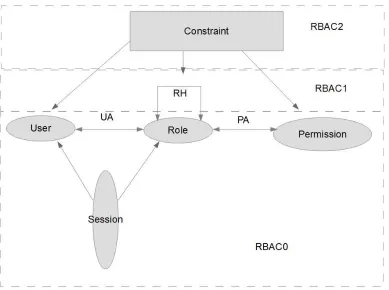
Figure 4: Different RBAC Models
The role hierarchy is introduced in RBAC1. This creates the requirement for separation of
duty. Roles can have overlapping permissions where different roles may execute the
same operations. Users can also have private roles that cannot be shared with other users.
This puts a constraint on the role inheritance. Constraints can be viewed as the most
important entity in the current RBAC model. The presence of constraints in the model
facilitates the expression of higher level security policy for organizations. For example, a
constraint can be applied when a security system has two mutually disjoint roles and
users cannot be permitted to gain membership in both roles. We discuss about constraint
in detail in the following section.
3.1.2
Constraints
Constraints have been introduced in RBAC2. Even though conflict of interest in the role
solution. The concept of conflicting permissions addresses conflict in terms of
permissions rather than roles. Defining conflict in terms of permissions ensures more fine
grained security than defining it in terms of roles. Conflict defined in terms of roles
allows provision of assigning conflicting permissions to the same role. But conflict
defined in terms of permissions eliminates this security gap [1]. Sandhu states in his
paper about RBAC models that the constraints in the user assignment relation have
counterparts in the privilege assignment relation [21]. The first of these constraints is the
mutually exclusive role. A mutual exclusion constraint is enforced on the assignment of
users to roles to avoid conflict of interest or possible fraud. When two roles are defined as
mutually exclusive, in terms of user to role association, it enforces that a user cannot
belong to both the roles and in terms of permission to role assignment, it enforces that the
same permission cannot be assigned to both roles. This constraint on PA restricts
execution of probable malicious operations. The mutual exclusion constraint facilitates
convenient role administration and decentralization without compromising any possible
organizational security policy. There are two classifications of role exclusion:
authorization time and runtime. They can be defined as:
Authorization time [16]:
[ ] [ ]
This implies that if two roles i, j are mutually exclusive, a user u can obtain one of i, j if
only the user doesn’t belong to the set of users authorized for the other role (M[i] or
M[j]).
Runtime [16]:
[ ] [ ] [ ] [ ] [ ]
This is a less restrictive constraint. This basically lets a user to be authorized for both the
activated at a time. This weakness in constraint is addressed by the security principle of
least privilege role set.
3.1.3
Security principles
Mutual exclusion constraint specifies several security principles to be ensured in RBAC.
Separation of duty and least privilege are not entities of RBAC but rather the RBAC
model supports development of such framework. Least privilege grants only the
necessary rights to complete a task and separation of duty places restrictions on
assignment of disjoint roles and permissions.
3.1.3.1
Least privilege
The principle of least privilege requires that any module in a computer abstraction layer
can only have access to information or privilege, pertaining to the purpose it’s supposed
to satisfy. This is a key design concept for protection of data and related logic. Cholewka
et. al. [7] present strict least privilege as a mechanism to solidify the security concern
around the privilege set available for a subject. According to them it distinguishes
between a person’s job and the tasks that a person must fulfill as part of his job. Strict
least privilege thus signifies the requirement of providing the user with just the
permissions to perform any steps of a workflow activity at any given time.
3.1.3.2
Separation of duties
One of the important advantages of using RBAC is that it provides enough granular
control that system administrators can implement proper separation of duties (SoD) in
any targeted applications. SoD is a classic security principle concerning conflict of
interest, the appearance of conflict of interest, wrongful acts, fraud, abuse and errors. A
crucial aspect of security is to separate permission in such a way that users cannot abuse
their privileges in order to execute or hide nonconforming activity. Proper separation of
duty requires that users cannot have conflicting responsibilities or be responsible for
reporting on themselves or their senior positions. Separation of duty requirements are
allowance” or “any bank cheque requires two different signatures”. NIST explains SoD
the following way:
“RBAC is . . . well suited to separation-of-duty requirements, where no single individual
has all permissions needed for critical operations such as expenditure of funds. Proper
operation of RBAC requires that roles fall under a single administrative domain or have a
consistent definition across multiple domains, so distributed applications might be
challenging” [17].
Separation of duty can be interpreted in various forms but the two main concepts in the
implementation are strong exclusion or static separation of duty (SSD) and weak
exclusion or dynamic separation of duty (DSD). Static separation of duty is the simplest
form of SoD; it defines role memberships that are mutually exclusive, and thus the
conflicting roles cannot both be in UA for a given user.
Dynamic Separation of Duties states that the same person can activate the purchasing role
and the approving role, but they cannot approve their own purchase. In the SSD model, a
user may not be members of both roles. In the DSD model, a user could be a member of
both roles, but could not function in both capacities for the same linked transactions.
The above two classifications of SoD address the issue of when an exclusion can be
enforced. This is not flexible enough in many business models while implementing
RBAC. The need to associate privileges of mutual exclusive roles to other nonexclusive
roles creates additional complexity. Kuhn [16] addressed the issue of how and which
privileges can be shared with mutual exclusion of roles and other roles by introducing
additional variety in mutual exclusion. In his paper, privileges in mutually exclusive roles
can be characterized as disjoint, denoted as complete exclusion in permission assignment.
This type of exclusion implies that if two roles i and j are defined to be mutually
exclusive (denoted as the mapping E (i , j)), then a privilege that is assigned to either of i
or j cannot be assigned to any other role k in the RBAC module;
[ ] [ ] This rule along with SSD can better enforce
Another type of exclusion is partial or shared. It says that between two mutually
exclusive roles (E(i , j )), the privilege set cannot be complete equal; at least one privilege
in i must not be in j; [ ] [ ] These two classifications in Kuhn’s paper [16] along with the two mutual exclusion rules described
in the Section 3.1.2 give us a variety of four SoD relations: authorization-time complete,
runtime complete, authorization-time partial and runtime partial. Authorization-time/
complete exclusion is the safest of the constraints. However, often implementation of
RBAC demands flexibility and then run-time/complete or run-time/shared exclusion can
ensure safety within a single user session.
3.2
Incorporating User Context Information into RBAC
Although RBAC makes an authorization decision based on a user’s role, it is not
sufficiently powerful to enforce rules that are dependent on runtime parameters or
contexts. A context-aware access control enables administrators to specify more precise
and fine-grain authorization polices for any application. Contexts can be information
about a user's current physical location, the devices being used, the network access node,
and current user activity. Additionally, there can be other conditions and characteristics
that may be relevant in defining a context e.g. temporal attributes of an operation to be
performed, geospatial attributes of resources to be accessed.
However, incorporating user context information to control access to a system is
complicated. First, it requires that extracting and embedding context information in a
system meets proper authenticity and integrity requirements. Second, the dynamic nature
of information may require revoking role membership with a change of context
information. This is challenging as it involves dynamic changes to policies during
deployment. A Context-Aware Role-Based Access Control (CA-RBAC) has been
proposed by Kulkarni and Tripathi [18] to support such requirements.
In this model the system sends a context query to one of the context agents for each
from interfaces. The access control layer is responsible for managing context-based
access to resources based on personalized permissions. The CA-RBAC programming
framework consists of operational layers - context management and access control. The
context management layer is responsible for aggregating data to generate context
information required by any system. Figure 5 shows the composition of the CA-RBAC
model.
Figure 5: Context-Aware RBAC Model (CA-RBAC) [18, Figure 1]
Kulkarni and Tripathi [18] established five key constraints on a system using the context
notion. The constraints are as follows:
1. Role admission and validation constraints: These constraints specify context-based
conditions that need to be satisfied before activating a role for a user, and also for
continuing a user’s membership in a role.
2. Context-based role permissions: Dynamic object binding causes role operations to
interface with different privileges under different context conditions.
3. Personalized role permissions: The operations that are accessible through role
information associated with a role member. In basic RBAC a role permission invoked by
any member of a role is executed on the same object. The CA-RBAC model transcends
the basic model when a permission invoked by different role members needs to be
invoked on different object instances based on each role member’s individual context.
4. Context-based permission activation constraints: These constraints are associated with
specific role permissions, and specify context-based conditions that need to hold for a
role member to execute such permissions.
5. Context-based resource access constraints: These constraints restrict a role member’s
Chapter 4
4
Motivation and Objectives
Developers now can turn any sound idea into software with the help of a number of open
source development frameworks and relational databases; add the Cloud into the equation
and developers freely ignore system maintenance, load balancing, scaling, etc. The
elasticity provided by cloud computing enables computational resources to be scaled up
with just seed funding instead of huge capital investments. This agility often makes the
software developers overlook long term effects. The community and collaborative nature
of the current web often makes a service bloom in unprecedented volume. A large
number of users produce a large amount of data. Suddenly, this rapid growth cannot be
contained within the relational database making the new software another start-up
disaster where overloaded database machines and resulting high response times destroy a
previously good user experience.
Modern relational database systems often impair a relatively successful service in the
area of flexibility and scalability. Due to data independence, SQL databases often
disguise a potential expensive operation with its high level interfaces. This can cause a
considerable amount of performance drop when the database grows beyond the planned
scale. This scalability failure and lack of a clear picture of consequences due to data
growth are leading more and more developers towards highly data dependent NoSQL
options. NoSQL database technology offers the flexibility, scalability and performance
that present-day web scale application developers demand.
4.1
Why NoSQL
An agile development cycle facilitates better solutions in terms of meeting real life
scenarios. As real life scenarios rarely follow a fixed set of parameters and end users’
are hard pressed to find the next best solutions for applications that can serve almost
without any prerequisite computational parameters. This boundless evolution in service
results in three major trends which are challenging the status quo of traditional databases.
These three trends are the industry favorites – Big data, Big users and Cloud computing.
Organizations are in a constant race in making more and more services available to end
users, to alleviate every aspect of a person’s everyday activities. They are exploring more
and more interfaces for users to connect with. This automatically makes more and more
users converge in the IT frontier and the more users, the bigger the volume of data with
little to no apparent structure. With numerous parties involved, the demand for
meaningful services run seamlessly among interfaces with ever-improved performance in
terms of highly responsive applications allowing more complex processing of data is
constantly raising more and more challenges for IT professionals. These are the driving
forces in the development and adoption of new technologies. One such technology is
NoSQL. NoSQL is becoming a popular alternative to relational databases, especially as
more enterprises recognize that operating at scale is better achieved on clusters of
standard, commodity servers and a flexible data model is often better for the variety and
type of data captured and processed.
4.1.1
Challenges
Big Data refers to the colossal growth in amount, diversity and rate of information being
produced and the bulk of applications that generate, store and process this data. While
this trend represents an incredible opportunity for enterprises across all industries,
delivering on the promise of Big Data is no trivial task. The main challenges in a
database context identified by MongoDB Inc. [41] are:
Data Volumes. In this era of social networks, applications can go viral overnight.
The underlying database is required to support rapid spikes in data volume and
throughput without downtime, without custom adoption and without
compromising performance. Application success depends on flexible and resilient
Real-Time Processing. Ever since the bloom of Web2.0, users expect
applications to behave as if the computational process doesn’t even exist.
Applications more often need to derive knowledge from collected data before
users identify the need for the information. This demands in-place, in real-time
processing of data without moving it to a separate module. The trivial batch
analytics in offline settings are not adequate for today’s service model.
Lightweight real-time analytics should be devised to serve content retroactively,
enable interactivity and improve user experience.
Rapid Evolution. This is a highly competitive market; organizations need to
address changes in business as fast as possible to be able to survive. An agile
development process promises rapid adoption of changes in user demand. One of
the ways is to keep adoption costs light. Schemaless data structures can offer
developers the leverage to keep pace in the race to serve the ever evolving, highly
demanding user group. Whoever satisfies the big user, succeeds.
Flexible Deployment. Requirements for deploying enterprise and consumer
applications have changed radically in only the last few years. As more
organizations engage in real-time interactions with consumers, they measure
response times in milliseconds and downtime means losing money. This demands
flexible replication over multiple data centers. Let it be an internal enterprise
application or a social media application, organizations need to deploy the
application or part of it on their own premises, in the cloud or in hybrid
environments to better utilize the various deployment models. [39]
4.2
Play of NoSQL
Traditional technologies struggle to accommodate the growth, diversity and volume of
data produced in current applications. For example relational databases were designed for
a static data model in which growth of data was controlled and predictable, predefined
center or even in-house. NoSQL plays a valid alternative in such a context where system
designers have limited control over structure, amount and nature of data.
4.2.1
Schemaless
As discussed before, schemalessness is one of the main reasons for interest in NoSQL
databases. Application developers have been frustrated with the staggering mismatch
between the relational model and the in-memory data structures. More often than not,
developers had to compromise in features or an efficient business model because the
relational database wasn’t sufficiently flexible.
In a relational database a tab le is created with command similar to the following-
Create table module (id int, modulename text, parentmodule int, submodule int)
Then this command to insert data in the above mentioned table fails due to the mismatch
of number of columns to insert as well as the mismatch of the data types: Insert into
module values ( 15,”xyz”, “rty”)
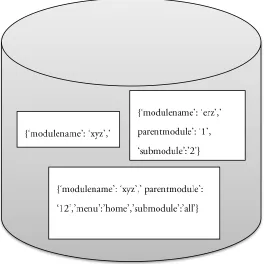
But NoSQL allows one to store any data –
Even though relational database can have blobs of unstructured data, it still cannot
translate the business model as seamlessly as a fast response model demands. The query
optimization fails once the data growth surpasses every forecast the developers made.
This massive data is processed in memory and again in the relational database. Even with
a design goal of minimizing to have business rules in the database, relational models have
their own structure to follow, thus limiting how an application can behave.
In NoSQL, developers can treat the database as just a place to dump the data. With
minimum maintenance, this becomes an alternative solution that is sympathetic to users
and thus it is very easy to get business owners to accept. Applications supported by
NoSQL get delivered faster, produce less impedance in any user flow and support
implementation of new modules more efficiently than relational models. At any point in
time an application module can be extended by introducing non uniform types.
Developers can even give users more control over their data by introducing custom fields,
which play less of a role in actual business process but rather they serve in user interface
for convenience. Being schemaless, NoSQL supports these last minute changes in
applications out of the box. But more often than we care to admit, developers get excited
about implementing the module and overlook the security holes presented by the absence
the of relational model’s access control. None of the NoSQL pioneers has a detailed level
security mechanism at place. Often developers will point out that it’s not efficient to
implement a fine grained security mechanism in place for NoSQL as it might feel like
tracing our steps back to the relational model.
Schemaless structures still have an implicit schema. Any code that manipulates the data
needs to make some assumptions about its structure, such as the name of fields. Any data
that doesn't fit this implicit schema will not be manipulated properly, leading to errors. A
class definition defines the logical fields one can use to manipulate it. This is effectively a
4.2.2
Schema Migrations
Businesses change hands, merge with other parties even change their service nature. But
information is money and every business wants all their data migrated in the new setup.
From a higher level view, migration seems safer in a relational database. But a relational
database is less tolerant of slight schema changes. It saves every change and puts version
control and more than often complicates the migrated model. In NoSQL on the other
hand there is no schema update, all developers need is to handle the codes handling
implicit schema. Schemaless stores can ease migration, since access code can be defined
to read from either the old structure or the mutated structure. Developers can make the
access codes to gradually migrate old structures to mutated structures. Once the old data
count becomes zero, the overhead becomes obsolete.
4.2.3
Scalability and performance advantages
The data stored in a relational database is rigidly structured by the layout of the tables,
the predesigned relations among these tables and the types of the columns. The need to
scale a relational database can be achieved by running it on more powerful and
specialized servers; organizations often acquire custom-made servers to scale their
relational database. Yet to scale beyond a certain point, the database must be distributed
across multiple servers. Relational databases don’t work inherently in a distributed
manner because joining their tables across multiple machines is expensive. Also,
relational databases aren’t designed to function with data partitioning, so distributing
their functionality is very tedious to achieve. To deal with the increase in concurrent
users (Big Users) and the amount of data (Big Data), applications and their underlying
databases need to scale using one of two choices: scale up or scale out. Scaling up
implies a centralized approach involving servers with larger capacity. Scaling out implies
a distributed approach that leverages many standard, commodity, physical or virtual
Figure 7: Scale up with relational technology [40]
Scaling up is the natural choice in applications with the relational model as the
underlying data storage. This choice is influenced by the fundamentally centralized,
shared-everything architecture of relational databases. These characteristics of a
relational database make it a less feasible candidate for scaling out. In order to scale out
database administrators have to be really careful about how to create and organize the
schema and structures, know about all the idiosyncrasies involved in a relational database
and these eventually results in making the maintenance and deployment exponentially
more complex and less resilient towards failure. Due to these reasons enterprises would
opt for increasing server capacity in terms of CPU, memory and discs. But this solution is
highly proprietary and increasingly expensive, unlike the low-cost, commodity hardware
typically used so effectively at the web/application server tier [40]. This is illustrated in
Figures 7 and 8: as the number of user increases, for both types of databases, an
application can scale out just by adding more web servers without affecting performance
and causing very little rise in system cost. Whereas in the case of database system, the
causing a sharp increase in system cost and reduced application performance. The picture
is different when NoSQL is in place; the system cost and application performance curve
is almost the same for application scale out and database scale out.
NoSQL databases have been conceived with the principle target to gain distributed, scale
out databases. They use a cluster of standard, physical or virtual servers to store data and
support database operations. To scale, additional servers are joined to the cluster and the
data and database operations are spread across the larger cluster. Since commodity
servers are expected to fail from time-to-time, NoSQL databases are built to tolerate and
recover from such failure making them highly resilient.
Figure 8: Scale out with NoSQL technology at the database tier [40]
NoSQL uses an easier and linear approach for database scaling. With the increase of
users, NoSQL simply adds new database servers to the cluster when a threshold is met. It
is often part of the database mechanism and thus abstracted away from application layer.
application always sees a single (distributed) system no matter how many replications
have taken place.
A distributed scale out approach is the less expensive between the two alternatives. The
servers to support scaling with required fault tolerance are complex in design and often
are custom made to serve individual business. Also licensing costs of commercial
relational databases end up being really high when used for scaling out, as most of them
provide pricing scheme with single server in the equation. NoSQL databases don’t have
either of the above issues. NoSQL databases are generally open source with priced for
maintenance, runs seamlessly in distributed setting and are relatively inexpensive.
A NoSQL database automatically distributes data across servers, without requiring
applications to participate and influencing the design of data or process. Servers can be
added or removed from the data layer on the go without causing service disruption.
NoSQL databases also support data replication to ensure high availability and support
disaster recovery and sharding to facilitate write-scale. For some NoSQL database (i.e.
MongoDB) the sharding can be programmed so that a load balancer only starts moving
data when a predefined threshold is met. This leverages monitoring and makes the
process easier. Couchbase [40] claims “A properly managed NoSQL database system
should never need to be taken offline, for any reason, supporting 24x365 continuous
operations of applications”.
4.3
Motivation
In the current software industry system architects and developers are tirelessly looking
for ways to deliver software faster. The distinction between what is urgent and what is
important is now becoming a matter of debate. The IT industry is growing faster and
wider, making this horizontal growth urgent while detailed security is the important
aspect and often derived from existing frameworks. While implementing security
measures with traditional frameworks, what developers often do is that they place tweaks
and patches rather than creating a new solution. As a result they often encounter
scenarios where they need to compromise between feature set and over-all security. Still
![Table 1: Classifications – NoSQL Taxonomy by Stephen Yen [33]](https://thumb-us.123doks.com/thumbv2/123dok_us/7793572.1292234/15.612.162.487.501.710/table-classifications-nosql-taxonomy-stephen-yen.webp)
![Table 4: ACID vs. BASE [4]](https://thumb-us.123doks.com/thumbv2/123dok_us/7793572.1292234/19.612.156.495.230.398/table-acid-vs-base.webp)
![Figure 2: Data model with embedded fields that contain all related information [35].](https://thumb-us.123doks.com/thumbv2/123dok_us/7793572.1292234/23.612.113.536.419.657/figure-data-model-embedded-fields-contain-related-information.webp)

![Figure 5: Context-Aware RBAC Model (CA-RBAC) [18, Figure 1]](https://thumb-us.123doks.com/thumbv2/123dok_us/7793572.1292234/37.612.122.539.228.403/figure-context-aware-rbac-model-rbac-figure.webp)
![Figure 7: Scale up with relational technology [40]](https://thumb-us.123doks.com/thumbv2/123dok_us/7793572.1292234/45.612.113.540.81.325/figure-scale-relational-technology.webp)
![Figure 8: Scale out with NoSQL technology at the database tier [40]](https://thumb-us.123doks.com/thumbv2/123dok_us/7793572.1292234/46.612.109.542.287.557/figure-scale-nosql-technology-database-tier.webp)
