ISSN (Print) : 2320 – 3765 ISSN (Online): 2278 – 8875
I
nternational
J
ournal of
A
dvanced
R
esearch in
E
lectrical,
E
lectronics and
I
nstrumentation
E
ngineering
(An ISO 3297: 2007 Certified Organization)
Vol. 5, Issue 5, May 2016
Design an Algorithm to Detect and Count
Small Size Object Using Digital Image
Processing
Gohil Asmitaba1 , Dhaval Pipalia2
PGStudent [Embedded], Dept. of ECE, School of Engineering, RK University, Gujrat, India1
HOD, Dept. of Electrical, School of Engineering, RK University, Gujrat, India2
ABSTRACT: This paper presents algorithm for small size object detect and count using Digital image processing in MATLAB .digital image processing can be used for small size with high accuracy.The image with different objects is captured by digital camera. There is an algorithm based on morphologic that converts the input image into a format such that the number of objects can be counted based on the components present in the enhanced image.using morphologic approach high accuracy is achieved.
KEYWORDS: digital image processing, object counting, edge detection, morphology.
I.INTRODUCTION
Images contain different types of objets and structures which may convey information.counting involves estimating the number of objects in an image,detecting involves presence the number of objects in an image.counting arises in many real time application such as counting grains in agriculture industry,counting cells in microscopic images,counting of number diamonds in industry etc.existing methods for counting involves a large amount of hardware which also adds to the cost or manual counting which is time consuming and may give erroneous results.now counting can be done with the technique involving digital camera and simple image processing method based on matlab,and hence counting could be performed with ease . there is same size and shape of objects are considered in an image[1].
Many studies used the image processing such as hough transform for object counting [2].but object size is reduced its give an erroneous result.using morphologic approach small size of object detect and count effectively .
This is a method for object detect and count small size object using Digital image processing:
A.Input Image
In this stage the input image is taken for processing image.Image is taken by camera.a file format such as PNG,JPEG etc.
B.Pre-Processing
Image pre-processing is a manipulation of an image so that result would be more suitable than the original image and hence it is a significant stage of an object recognition. First in the pre processing stage is to translate a picture into binary images. Binary image is having either 0 or 1 as a pixels intensity. The backdrop carries white pixels that are having 0 intensity and the forefront carries the black pixels that are having 1 intensity.[3].
The second step is to remove imperfections in the image and provide information on the form and structure of the image.morphological operations such as erosion and dilation used.[4]
C.Segmentation
Image segmentation is the division of an image into regions which correspond to different objects .it is typically used to locate objects and boundaries in image.
D.Detection
Segmengted areas in an image is labeled for detection of objects .
ISSN (Print) : 2320 – 3765 ISSN (Online): 2278 – 8875
I
nternational
J
ournal of
A
dvanced
R
esearch in
E
lectrical,
E
lectronics and
I
nstrumentation
E
ngineering
(An ISO 3297: 2007 Certified Organization)
Vol. 5, Issue 5, May 2016
II.RELATED WORKS
A.Wen-cheng Wang described an efficient method for grain counting in agricultural production[5] ,a method is
proposed based on computer vision and image processing technology.color image with (red,green,blue) is transformed to gray image by gray transformation.during the course of obtaining image,due to various factors ,the resulting image will always infected with some noise,so it needs denoising.median filtering is adopt for reducing the noise.binarization processing is used for distinguishing the background and objects clearly.it exist many methods for labeling.there is little counting error between computer and manual.the main reason is the overlapping among the grains.it needs better segmentation.
B. Xiaomin Guo, Feihong Yu introduces an efficient automatic cell counter basd on microscopic image[6]. The counter
separates the cell and background by histogram dual-threshold, fills the cell by Floodfill, and detects the cell using blob analysis.The system uses histogram information to separate object and background real time.histogram Information is used to calculate adjustable lower and upper threshold value.this value is used for segmentation of objects and background.this system uses region segmentation to segment the microscopic cell image so segmentation of the cell image is one the key steps in the cell counting system.blob analysis is used to detect blob in an image and make selected measurements of those blobs.the maximum relative error is 1.33% and the minimum relative error is 0% and the average relative error is 0.46%.
C.Haider Adnan Khan presented present a framework for cell segmentation and counting by detection of cell centroids
in microscopic images[7]. The method is specifically designed for counting circular cells with a high probability of occlusion.the proposed method is done with Contrast-Limited Adaptive Histogram Equalization to get contrast enhanced image.next performing global thresholding on enhanced image to get binary image and then compute the distance transform of the binary image.distance map is used to identify the cell centroids.Template matching is performed using the normalized cross correlation between template and distance map.finally the similarity matrix is complemented and all background pixels are set to –inf.the watershed transform is then applied on this complemented matrix.each region is labelled and counted to get the cell count. The experimental results show an excellent accuracy of 92% for cell counting even at a very high 60% overlap probability.
III.METHODOLOGY
According to algorithm ,first image of different objects are acquired with a colour digital camera as shown in fig.1.
ISSN (Print) : 2320 – 3765 ISSN (Online): 2278 – 8875
I
nternational
J
ournal of
A
dvanced
R
esearch in
E
lectrical,
E
lectronics and
I
nstrumentation
E
ngineering
(An ISO 3297: 2007 Certified Organization)
Vol. 5, Issue 5, May 2016
Here the objects are dispersed on black ground so that the image of objects can be separated from the back ground.captured images are stored in jpg format.in matlab captured image is read by the imread() function. The images acquired are colour images, so it is converted into grayscale image. The colour information is not necessary for further processing as it does not carry any useful information[2]. Matlab function converts the colour image to grayscale image by eliminating the hue and saturation information while retaining the luminance. It is necessary to differentiate the object and backgroung in grayscale image.one way to achieve this is to change the grayscale image into a binary image.from binary image ,individual object can be identified. thresholding is used to convert the grayscale image to a binary image,binary image has two colors white and black.when the gray level of pixel is greater than the threshold,that white color pixel is related to object and conversely black means pixel related to background.
Two basic morphological operations erosion and dilation.The dilation used for repair breaks in white objects can split apart black object.it takes two inputs.the first is the image which is to be dilated and second is a structuring element.the shapes and sizes of structuring element are selected according to the type of object,usually used shapes are diamond,disk,line,square,etc.in this paper we used disk as structuring element.
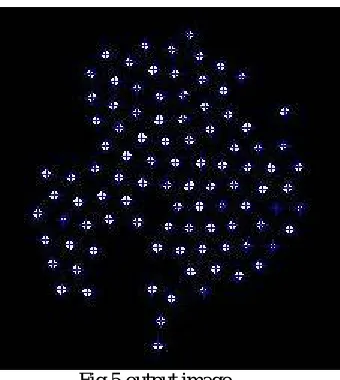
For counting of object from binary image,we need to identify wich foreground pixel corresponds to which object.in binary image the value 0 in each location is related to the background pixel.value 1 represents foreground object here object in binary image.the MATLAB function bwlabel() is used to count the objects.centroid of each object is computed and mark of count is superimposed on top of the image at centroid locations.
IV.PROPOSED ALGORITHM
According to proposed algorithm first objects are spread on the balck balckground and image is captured by colour digital camera.further the captured image is processed by matlab based method.fig.2. shows flowgraph for proposed algorithm.
ISSN (Print) : 2320 – 3765 ISSN (Online): 2278 – 8875
I
nternational
J
ournal of
A
dvanced
R
esearch in
E
lectrical,
E
lectronics and
I
nstrumentation
E
ngineering
(An ISO 3297: 2007 Certified Organization)
Vol. 5, Issue 5, May 2016
Here the captured image is colour image so covert it in to gray scale image because the colour information is not of importance for our analysis. For efficient counting of objects this grayscale image is converted into a binary image and morphological operations are then used on these binary images. Thresholding is used to convert the segmented image to a binary image. Then the objects touching each others are identified and separated by dilation process. This phase identifies individual object boundaries and marks the centre of each object for further processing. The objects are counted and labelled at the end.
V.RESULT ANALYSIS
Fig.1. show as original image it is clolor image usinge gray transformation it is converted to gray scale image . and fig.3. is gray scale image the morphological operation(dilation )and pre defining structuring element (disk)is used .fig.4 is binary image means each pixel has only one value either 0 or 1.thresholding value is given for separation of objects .this value is given between o to 1.
Fig 3 gray image Fig.4 binary image
(objects are acquired with white pixels and background is acquired with black pixels in fig.3 binary image pixels acquired with only two value 0 for white pixels and 1 for black pixels)
Fig.5.output image
ISSN (Print) : 2320 – 3765 ISSN (Online): 2278 – 8875
I
nternational
J
ournal of
A
dvanced
R
esearch in
E
lectrical,
E
lectronics and
I
nstrumentation
E
ngineering
(An ISO 3297: 2007 Certified Organization)
Vol. 5, Issue 5, May 2016
From above result shows it is clear that this algorithm provides 100% accuracy for small size(1 cm)object.If object size
is reduced and analysis result can get with 2% error.as shown in fig.6 with very small object size.
Fig.6 very small object size image
Fig.7 output result
Experimemt count is not same as actual count object.as shown in fig.7 boundary detection of object is not perfect shown.
Apply this algorithm on image as shown in fig.8
ISSN (Print) : 2320 – 3765 ISSN (Online): 2278 – 8875
I
nternational
J
ournal of
A
dvanced
R
esearch in
E
lectrical,
E
lectronics and
I
nstrumentation
E
ngineering
(An ISO 3297: 2007 Certified Organization)
Vol. 5, Issue 5, May 2016
Fig.8 is original image and output image is in fig.9 .result shows that original object size is same as to experiment object size.In this experiment edge detection is used for detect and count object but edge detection is not apply for very small size object is less than 1 cm.it is given result with many errors. Using our algorithm it give same object count as actual count.apply our algorithm on fig.8 and its result is shown in fig.10.
Fig.10 output image
VI.CONCLUSION
Image processing based on Matlab is effectively used to determine count of different objects. Traditionally object counting is done manually or may involve costly electronic systems. This can be replaced by proposed algorithm. The developed method is quick and low cost as there are no costly equipment and software. Good accuracy has been achieved in experimental results. It has been observed that for bigger objects the counting accuracy is more. Thereshold value is given different for different size of object. Size of disk structuring element has more effect on accuracy. Smaller the object is, less the size of disk structuring element should be. Accuracy can be increased by separating conglutination among the objects.
REFERENCES
[1] F.Ciontault, D.Gurin, J-P.Guillemin, B.Chopinet, “In-field Triticum aestivum ear counting using color-texture image analysis”, New Zealand Journal of crop and horticultural Science, 2008, vol.36, pp.117-130,2008.
[2] J. Jensen,“Hough Transform for Straight Lines”, Mini-project in Image Processing, 2007.
[3] Tedjokusumo, Adrianto, Heon Jeong, and Sang Woong Lee. "Robust character extraction across varying conditions based on local distribution." InICT for Smart Society (ICISS), 2013 International Conference on, pp. 1-4. IEEE, 2013.
[4] nick Efford.Digital Image Processing:A Practical Introduction Using Java.Pearson Education,2000.
[5] Grains Automatic Counting Method Based on Computer Version Wen-cheng Wang,Yu-mei Wang, Tao Ji. International Journal of Advancements in Computing Technology(IJACT) Volume4, Number13, July2012.
[6] Xiaomin Guo and Feihong Yu, “A Method of Automatic Cell Counting Based on Microscopic Image,” 5th International Conference on Intelligent Human-Machine Systems and Cybernetics, Vol. 1, Aug. 2013. pp. 293-296.
[7] Haider Adnan Khan and Golam Morshed Maruf, “Counting Clustered Cells using Distance Mapping,” 2013 International Conference on Informatics, Electronics and Vision (ICIEV), May 2013.
[8] D. Shi, L. Zheng, and J. Liu, “Advanced Hough transform using a Multilayer Fractional Fourier method”, IEEE Transactions on Image Processing, Vol. 19, No 6, pp.1558-1566, 2010.
[9] Abutaleb AS (1989)”Automatic thresholding of grey-level pictures using two-dimensional entropies.” Pattern Recognition, 47 (1), 22-32. [10] P. Zhao and Y. Li, “Grain counting method based on image processing,” in Proc. Int. Conf. Information Engineering and Computer Science, 2009.