117 | P a g e
IMAGE AUGMENTATION USING SWITCHING
MEDIAN FILTER
Dr. Rajashekhar B S
1Gagan G
2Mohan Raj
3Mahesh Biradar
4 1Department of ECE, Professor, SaIT (India)
2,3,4
Department of ECE, UG student, SaIT (India)
ABSTRACT
Filtering is a vital part of any signal processing system, which entails estimation of signal degradation and
restoring the signal satisfactorily with its features preserved intact. A new nonlinear filtering technique is
introduced for enhancement of images that are highly contaminated by impulse noise is called switching median
filter. The proposed filtering technique is more effective in eliminating impulse noise and preserving the image
features. The filter replaces a corrupted pixel by the median value or by its processed neighbouring pixel value.
So that the proposed filter output images are found to be pleasant for visual perception and also uncorrupted
pixels are left undisturbed and preserving the edges and fine details satisfactorily. The performance of the filter
is evaluated by applying it on different test images and the results obtained are presented. The proposed filter
has been shown to out-perform other existing filters in terms of noise elimination and feature preservation
properties. The proposed filtering performance is calculated using PSNR.
Keywords:
SMFE, PSNR, Image Augmentation, Image Filtering.I. INTRODUCTION
Filtering is a vital part of any signal processing system, which entails estimation of signal degradation and
restoring the signal satisfactorily with its features preserved intact. Several filtering techniques have been
reported in the literature over the years, suitable for various applications. Nonlinear filtering techniques are
preferred for de noising images which are degraded by impulse noise. These nonlinear filtering techniques take
into account for nonlinear nature of the human visual system. Thus, the filters having good edge and image
detail preservation properties are highly desirable for visual perception.
The median filter and its variants are among the most commonly used filters for impulse noise removal. The
median filters, when applied uniformly across the image, modify both noisy as well as noise free pixels,
resulting in blurred and distorted features [1-2]. Recently, some modified forms of the median filter have been
proposed to overcome these limitations. In these variants, namely, the switching median filters, a pixel value is
altered only if it is detected to have been corrupted by impulse noise [3-5]. These variants of the median filter
still retain the basic rank order structure of the filter. Salt-and-pepper noise is relatively considered for two
intensity levels in the noisy pixels, that is, 255 and 0. The impulse noise is detected using decision mechanism
with a pre-set threshold value [6] and the corrupted pixels alone are subjected to filtering. The window size is
increased to achieve better noise removal. However, the increased window size results in less correlation
118 | P a g e
II. LITERATURE SURVEY
A lot of methods have been improved to eliminate noises. Filters are one of the most common tools which are
used to eliminate noises. Many filters have been designed so far because of over plus of the noise varieties and
differences between the properties of these noises. Generally, filters are divided into two groups as linear and
non-linear. Linear filters have simple design and encoding and they are intended for general aim. These filters
can be used to smooth the images or enhance the edges but they have weak capacity for noise elimination.
Non-linear filters have been designed for specific aim and they produce better results. Non-Non-linear filters are divided
in many categories. Order statistic filter is one of the categories of non-linear filters. It is the most popular filter
for noise elimination [3].
One of the most important stages of signal and image processing is noise elimination. Noise is an unwanted
perturbation to a wanted analog or digital signal or image [1]. A noise can be categorized depending on its
source, frequency spectrum and time characteristics. Depending on a source, the noises are categorized into six
types: acoustic noise; thermal and shot noise; electromagnetic noise; electrostatic noise; channel distortions,
echo and fading; processing noise. On the other hand, depending on the frequency spectrum or time
characteristics, the noises are also categorized into six types: white noise; band-limited white noise; narrowband
noise; colored noise, impulsive noise, transient noise pulses [2].
The subject of this study is to investigate and improve the noise eliminating methods related to digital images.
Noise is unwanted pixels to be corrupted into digital images. The principal sources of noises in digital images
arise during image acquisition (digitization) and/or transmission. The performance of imaging sensors is
affected by a variety of factors such as bad focusing; motion and non-linearity of the sensors, etc. [1]. Type of
noises has to be known for elimination of noises in digital image. If the noise type is unknown, the filter which
will be applied to image can’t be known. In such a case all filters are applied to images and each image is
examined and then the filter which will produce the best result can be determined. The first problem occurs if it
is unknown that there is noise in images or if the type of noises is unknown. This problem has not been solved
yet.
III. BLOCK DIAGRAM OF PROPOSED SYSTEM
Fig1: Basic block diagram of SMFE.
119 | P a g e
Noisy image Decision mechanism
Filtering process
Image restoration
PSNR calculation
The input is taken as a grayscale image and then adding a percentage of impulse noise i.e. salt and/or pepper
noise to the original image due to addition of this noise we will get a blurred, corrupted image is called noisy
image.
The filtering technique proposed in our project detects the impulse noise in the image using a decision
mechanism. The corrupted and uncorrupted pixels in the image are detected by comparing the pixel value with
the maximum and minimum values in the selected window. If the pixel intensity lies between these minimum
and maximum values, then it is an uncorrupted pixel and it is left undisturbed. If the value does not lie within
the range, then it is a corrupted pixel and is replaced by the median pixel value or already processed immediate
neighbouring pixel in the current filtering window. Consider an image of size M×N having 8-bit grey scale pixel
resolution. The steps involved in detecting the presence of an impulse or not are described as follows,
161
162
159
163
63
167
255
255
255
164
255
255
255
255
165
0
255
255
255
166
255
159
255
167
Fig 2: Sliding filter window of size 3 x 3 over noisy image.
Step 1: A two-dimensional square filtering window of size 3 x 3 is slid over a highly contaminated image as
shown.
Step2) The pixels inside the window are sorted out in ascending order.
Step 3) Minimum, maximum and median of the pixel values in the processing window are determined. In this
120 | P a g e
Step 4) If the central pixel lies between minimum and maximum values, then it is detected as an uncorrupted
pixel and the pixel is left undisturbed. Otherwise, it is considered a corrupted pixel value. In the present case, the
central pixel value 255 does not lie between minimum and maximum values. Therefore, the pixel is detected to
be a corrupted pixel.
Step 5) The corrupted central pixel is replaced by the median of the filtering window, if the median value is not
an impulse. If the median value itself is an impulse then the central pixel is replaced by the already processed
immediate top neighbouring pixel Ai-1 , jin the filtering window. In the present case, the median value is also an
impulse and therefore, the pixel is replaced by its already processed top neighbour pixel value 214.
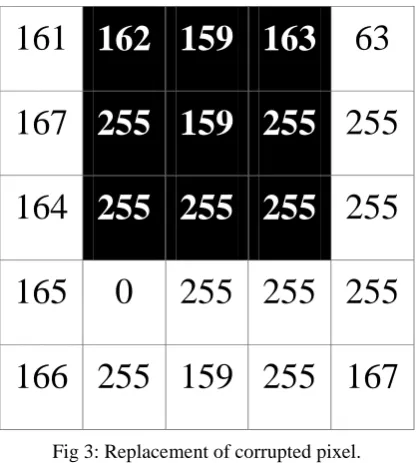
The below Fig shows the replacement of corrupted pixel. In this figure impulse noise value 0 is
replaced by 159.
161
162
159
163
63
167
255
159
255
255
164
255
255
255
255
165
0
255
255
255
166
255
159
255
167
Fig 3: Replacement of corrupted pixel.
The performance of proposed filter is compared with that of IDBA by applying them on peppers, moon,
cameraman images, corrupted with various densities of impulse noise.
The objective measures used for quantitatively evaluating the performance of the filters are Mean Square Error
(MSE) and Peak Signal to Noise ratio (PSNR) and these metrics are defined in equation as follows,
PSNR = 10 log10
Where, x(i,j) and f(i,j) denote, respectively, the intensity of (i,j)th pixel of the original and filtered images. In
order to prove the better performance of proposed filter, existing filtering techniques are experimented and
compared with the proposed filter for visual perception and subjective evaluation on peppers, moon, cameraman
121 | P a g e
IV. RESULTS
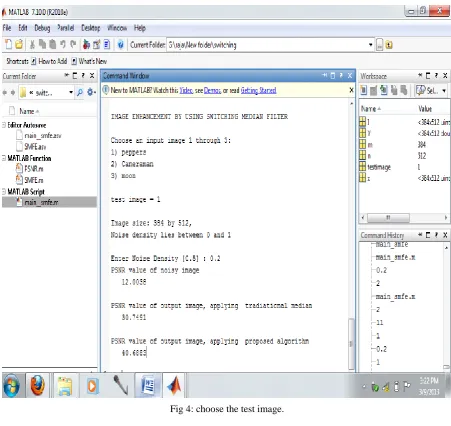
In the first step we are going to choose the test image. Here we are having 3 test images shown are,
Peppers
Cameraman
Moon
After display of this message choosing any one of the images at a time. Then checking the size of the image.
The noise density is added in terms of percentage and its range is denoted by 0-100% as 0-1. For example,
suppose the density of noise is 10% then it can be entered as 0.1.
122 | P a g e
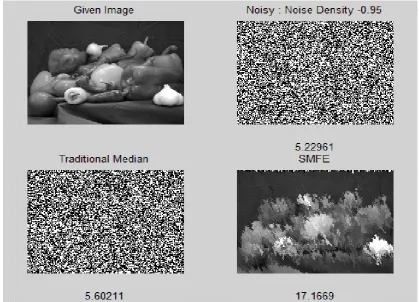
Fig 5: noise removal Performance of TMF&SMFE for 10% noise density in peppers image.
123 | P a g e
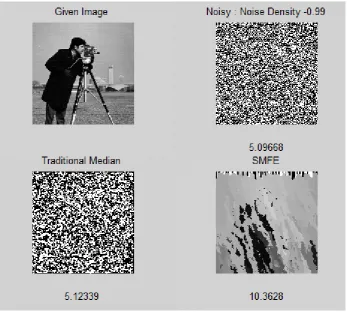
Fig 7: noise removal Performance of TMF&SMFE for 10% noise density in cameraman image.
124 | P a g e
Fig 9: noise removal Performance of TMF&SMFE for 10% noise density in moon image.
125 | P a g e
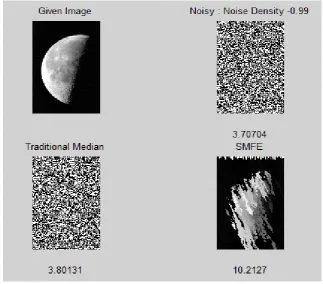
The figures 5-6 shows the noise removal Performance of TMF&SMFE for 10%-95% noise density in peppers
image, figures 7-8 shows the noise removal Performance of TMF&SMFE for 10%,99% noise density in
cameraman image. and figures 9-10 shows the noise removal Performance of TMF&SMFE for 10%,90% noise
density in moon image.
The values PSNR of objective measures obtained by applying the filters on peppers, moon, cameraman
test image contaminated with the impulse noise of various noise densities are summarized.
V. MATLAB DESCRIPTION
MATLAB, which stands for Matrix Laboratory, is a state-of-the-art mathematical software package, which is
used extensively in both academia and industry. It is an interactive program for numerical computation and data
visualization, which along with its programming capabilities provides a very useful tool for almost all areas of
science and engineering. Unlike other mathematical packages, such as MAPLE or MATHEMATICA,
MATLAB cannot perform symbolic manipulations without the use of additional Toolboxes. It remains however,
one of the leading software packages for numerical computation.
As you might guess from its name, MATLAB deals mainly with matrices. A scalar is a 1-by-1 matrix and a row
vector of length say 5, is a 1-by-5 matrix. We will elaborate more on these and other features of MATLAB in
the sections that follow. One of the many advantages of
MATLAB is the natural notation used. It looks a lot like the notation that you encounter in a linear algebra
course. This makes the use of the program especially easy and it is what makes MATLAB a natural choice for
numerical computations.
Some of the instructions used in this project are explained as follows.
CLEAR Clear variables and functions from memory.
CLEAR removes all variables from the workspace.
CLEAR VARIABLES do the same thing.
CLEAR GLOBAL removes all global variables.
CLEAR FUNCTIONS remove all compiled M- and MEX-functions.
CLEAR ALL removes all variables, global, functions and MEX links.
CLEAR ALL at the command prompt also removes the Java packages import list.
Clf clear the current figure
imread read the image
imwrite write the image
FPRINTF Write formatted data to text file.
INPUT Prompt for user input.
IMSHOW Display image in Handle Graphics figure.
VI. ADVANTAGES AND DISADVANTAGES
126 | P a g e
The filter has been shown to be quite effective in eliminating the impulse noise. The filtering operation is performed only on corrupted pixels, uncorrupted pixels are undisturbed, as a
result, misclassification of pixels is avoided.
The proposed filter output images are found to be pleasant for visual perception.
The essential features of the images, namely, edges and fine details are preserved satisfactorily.
2.DISADVANTAGES
This method not giving satisfactory result for completely white and dark images.
As the noise increases performance decreases.VII. APPLICATIONS
This is method is used for estimation of signal degradation and restoring the signal satisfactorily with its
features preserved intact.
The filters having good edge and image detail preservation properties are highly desirable for visual
perception.
The switching median filters, a pixel value is altered only if it is detected to have been corrupted by
impulse noise.
This filtering technique detects whether a pixel is noisy or noise-free.
VIII. CONCLUSION
The filtering technique proposed in this project detects the impulse noise in the image using a decision
mechanism. The corrupted and uncorrupted pixels in the image are detected by comparing the pixel value with
the maximum and minimum values in the selected window. If the pixel intensity lies between these minimum
and maximum values, then it is an uncorrupted pixel and it is left undisturbed. If the value does not lie within
the range, then it is a corrupted pixel and is replaced by the median pixel value or already processed immediate
neighbouring pixel in the current filtering window. A switching median filtering technique has been developed
in this paper.
The filter has been shown to be quite effective in eliminating the impulse noise. The filtering operation is
performed only on corrupted pixels, uncorrupted pixels are undisturbed, as a result, misclassification of pixels is
avoided. So that the proposed filter output images are found to be pleasant for visual perception and also the
essential features of the images, namely, edges and fine details are preserved satisfactorily. The proposed filter
has been shown to out-perform other existing filters in terms of noise elimination and feature preservation
properties. For a very high impulse noise contaminated image this filtering technique not completely removes
the impulse noise still it will have impulses so it will be reduced in the future work by increasing the filtering
127 | P a g e
REFERENCES
Pitas. I and Venetsanopolous . “A Nonlinear Digital Filters: Principles and Application”, Norwell, MA:
Kluwer, 1990.
Astola. Jand Kuosmanen.P, “Fundamentals of Nonlinear Digital Filtering”, Boca Raton, FL: CRC, 1997.
R. H. Chan Chung–Wa Ho, M. Nikolova, “Salt and Pepper Noise Removal by Median Type Noise
Detectors and Detail Preserving Regularization”, IEEE Trans on Image Processing, Vol. 14, No.10,
pp.1479-1485, Oct. 2005.
Bernstein, R.M., K. Edwards and E.M. Eliason, 1975, 'Synthetic Stereo and Landsat Pictures',
Photogrammetric Engineering, Vol. 42, pp.1279-1284.
Bu chanan , M.D., 1979, 'Effective utilization of colour in multidimensional data presentation', Proc. of
the Society of Photo-Optical Engineers, Vol. 199, pp. 9-19.
Lilles and , T.M. and R.W. Kiefer, 1980, 'Remote Sensing and Image Interpretation', John Wiley & Sons,
NewYork.
Digital processing of remotely sensed images', NASA Sp no. 431, Washington D.C.Abbins Jr, F.F., 1986,
'Remote sensing: Principles and Intrepretation', W.H. Freeman & co., New York.[8].
Lilles and , T.M. and R.W. Kiefer, 1980, 'Remote Sensing and Image Interpretation', John Wiley & Sons,
NewYork
Digital Image Processing for Image Enhancement and Information Extraction 2012 rajashekhar b s Salt –