BUILDING A BUSINESS CASE FOR A
“PROCESS-ORIENTED” ERP
NOVEMBER 2011
August 2011
You are a manufacturer in a process-related industry and you have a business to run. Markets are changing and the global economy is still in a fragile state of recovery, creating the need for better tools to manage operations. Enterprise Resource Planning (ERP) can play an important role in gaining efficiencies, reducing costs and enabling growth. But not all ERP solutions or ERP implementations are created equal and perhaps your current solution, or lack of a solution is holding you back. You have been assessing your current situation and educating yourselfand your company on the latest applications and technologies available and now you think you might be ready to start shopping for a solution.What do you need to look for and what business decisions are paramount to position you for the maximum business benefits? Once you answer these questions, you will be well on your way to building a business case for investment.
YOU’RE SPECIAL
Process manufacturers face many of the same macroeconomic challenges any manufacturer faces today. The cost of materials and transportation are rising, as well as fuel and energy costs to operate their plants. Customers and consumers have become more demanding; regulatory and compliance requirements are penetrating every industry. And the global economy is creating new
competition in a world which is increasingly “flat”.
Yet manufacturers in process-related industries also face some additional challenges created by the very processing that makes them different from discrete manufacturers. Instead of bills of material, process manufacturers tend to employ recipes or formulas, which may produce co-products and
by-products. Generally discrete manufacturers measure production by numeric quantities. A discrete “count” can be very precise and predictable, while process manufacturers typically measure by weight and volume with actual output quantities varying based upon yields achieved. They must deal with the kind of variability that can wreak havoc on the assumptions made by ERP solutions designed for discrete manufacturers.
Bi-directional lot traceability is quickly becoming a necessity as process manufacturers must track materials from suppliers, products delivered to customers, as well as materials anywhere within their manufacturing processes. Those lots have shelf lives and variable attributes associated with them, ranging from fat and mineral content to potency, all of which have the potential for impacting yield.
These are just some of the needs that create special requirements of ERP. If you must deal with any of these, or have other special needs, then you need
software that was specifically designed to address them. ERP solutions that address these process-related requirements have come a long way since the genesis of ERP, both in terms of functionality and underlying technology. So the question to ask yourself is this: Are your needs being adequately met today? Of course there may not be a simple yes or no answer to that question. You may be getting by with a “work-around” solution. You may be getting Key ERP
Requirements for Process Industries such as Chemicals, Food & Beverage and
Pharmaceuticals Recipe or formula
based manufacturing Co-product and
by-product tracking and costing
Lot traceability and recall
Quality control & assurance Attribute based
manufacturing rules Inventory dual units of
measurement Shelf life and
expiration management Special safety and
compliance requirements (BioTerrorism Act, HACCP, 21 CFR Part 11, MSDS) Consumer product promotions, pricing and rebates Customer specifications and certificates of analysis
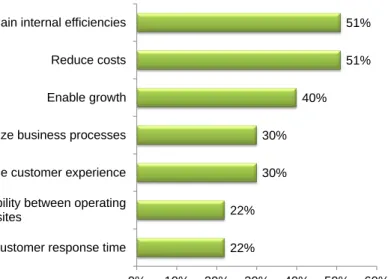
product out the door and meeting customer and compliance requirements. But are you operating efficiently? Could you be at significant risk in the event of a product recall? Is your current solution (or lack thereof) holding you back? Just for argument’s sake, let’s say there is room for improvement. The Mint Jutras 2011 ERP Solution Study found internal efficiencies and cost reductions were most often included in companies’ top three goals for ERP (Figure 1). Figure 1: “Top Three” Goals of ERP Implementations
Source: Mint Jutras 2011 ERP Solution Study Whether you are looking to reduce cost, improve efficiency, enable growth or better serve your customers, it may be time to take a serious look at solutions which help you to improve. The very definition of ERP as an integrated suite of modules may motivate those who struggle with a myriad of disconnected desktop or departmental applications to rethink their enterprise solution strategies.
BUILDING THE BUSINESS CASE
So let’s assume you know you need to do something. In all likelihood you have already considered the special functionality that process manufacturers require. Perhaps you have even found the solution that best fits your needs all around. But do you have the budget? How do you build a business case for the actual investment?
Regardless of where you sit in the organizational structure and hierarchy, you need to justify the effort and the expense. You may be leading a selection committee which must make your case to the Chief Financial Officer (CFO) or the Chief Executive Officer (CEO). Or you might be the CEO presenting to your Board of Directors, investors or the owner(s) of the company. Often times in these decisions, the bottom line is just that – the bottom line. How is this investment going to pay for itself? Will these be tangible, quantifiable results that are easily monetized? Or will you produce efficiencies and improved
22% 22% 30% 30% 40% 51% 51% 0% 10% 20% 30% 40% 50% 60%
Improve customer response time Improve interoperability between operating
sites
Improve the customer experience Standardize business processes Enable growth Reduce costs Gain internal efficiencies Data Source
From mid-July through the end of September Mint Jutras collected more than 1250 responses to an electronic survey for its 2011 ERP Solution Study. More than 900 responses were qualified by the participant’s knowledge of and involvement in ERP implementations. These responses were used to investigate ERP goals, challenges and status and also to benchmark performance of ERP implementations. Survey responses represented a broad range of industries, including 59 from process manufacturers and 54 from hybrid manufacturers who do both process and discrete manufacturing (e.g. food, chemical or pharmaceuticals might be packaged discretely).
productivity that could indirectly save money or help you produce more revenue?
CASE STUDY: OM HEALTHCARE LOGISTICS
One company that is confronted with the need to build a business case, not once, but repeatedly, is OM HealthCare Logistics (OM HCL). OM HCL is a full-service third-party logistics (3PL) and business process outsourcing (BPO) provider of end-to-end supply chain solutions for the medical device and life sciences markets, including pharmaceuticals. OM HCL’s customers are manufacturers in healthcare related industries.
OM HCL runs CDC Software’s Ross ERP. What makes them unique is that Ross ERP is used not only to run their own business, but can be utilized to run the ERP related functions for their customers. Application managed services (AMS) supporting ERP are an integral part of the outsourced business processes they offer.
So not only did OM HCL need to build a business case for ERP as part of those managed services, it also gets involved in helping its customers build their own business cases for ERP. Denise Odenkirk, Vice President, answers the question as to how they built their initial business case around Ross ERP. “It was part of our overall business plan to offer a complete system to manufacturers in the life sciences, including people, processes and technology. For the technology piece, a big driver was cost. Most of our customers that have a need to outsource order-to-cash processes are small to medium size businesses. We didn’t want to burden them with the costs of some of the larger ERP players which were also overkill for them in terms of functionality. We looked at a lot of different
solutions and while the bigger vendors might have been overkill, they also didn’t have a solution preconfigured for life science. “
While OM HCL must help their customers build their own business case, most prospective customers seeking a full order-to-cash and distribution and logistics solution come to them with no end-to-end system, knowing they have grown big enough that they need something that will give them the full suite of systems they currently lack. According to Ms. Odenkirk, “The real sale is selling the people who will be outsourcing the operation. CDC Software’s Ross ERP helps us sell because it is configured for life sciences. In looking at some other midmarket ERP vendors we found solutions needed to be configured screen by screen. Small to midsize businesses can’t afford the consulting required to do that. Starting from a blank sheet is also risky. What if you miss functionality? To have the needed functionality, pre-built, supporting life science process manufacturing was huge for us.
“We’ve worked closely with CDC Software along the way. Hopefully we’ve made them better and they have made us better – both have benefited from the relationship. Isn’t that the way it should be?”
If you recall, earlier we noted the top goals of ERP implementations. At the very top of the list were gaining efficiencies and reducing costs. In fact all of the process manufacturers we surveyed in the 2011 ERP Solution Study projected a “It was part of our
overall business plan to offer a complete system to
manufacturers in the life sciences, including people, processes and technology. For the technology piece, a big driver was cost.”
Denise Odenkirk, Vice President, OM HCL
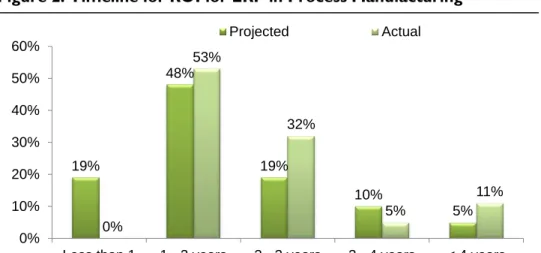
timeline for ROI. Presumably these goals were used to project actual bottom line improvements that contribute to the ROI. Figure 2 compares the projected timeline for ROI and the actual timeline when it was achieved. While it is clear that expecting ROI within a year proved to be overly optimistic, the fact that 53% actually achieved a return on their investment in ERP in a one to two year time period is impressive.
Figure 2: Timeline for ROI for ERP in Process Manufacturing
Source: Mint Jutras 2011 ERP Solution Study So where do these projected returns come from? Specific cost savings and efficiency gains will vary quite significantly from company to company and the potential is reflective of both current state and goals set. Some of the possible sources of savings are in inventory costs, as well as operating and administrative costs. Mint Jutras defined a World Class ERP implementation based on a
selected group of key performance indicators which measured results since ERP was implemented, progress against goals and current performance. Of course we cannot guarantee that the improvements were entirely as a result of ERP, but certainly ERP will have a very large influence either directly through specific savings, or through efficiency and productivity improvements through better processes. Those shown in the side-bar to the left are just a sample of the business benefits measured by the Mint Jutras ERP Solution Study, but these alone should present sufficient opportunity to build a business case for investment in Process ERP.
However, each company embarking on any type of ERP project needs to prioritize the goals for that project. The following is a list of possible goals against which Mint Jutras tracks progress in benchmarking performance. These represent either hard, quantifiable results that directly impact the bottom line, or softer measures that might have a more indirect impact. Consider these in building the business case to justify the time and expense of your ERP project:
Better visibility and transparency
Sustained growth without additional headcount 19% 48% 19% 10% 5% 0% 53% 32% 5% 11% 0% 10% 20% 30% 40% 50% 60% Less than 1 year
1 - 2 years 2 - 3 years 3 - 4 years < 4 years Projected Actual
Improvements measured since ERP
was implemented World Class was defined to be the top 15% in terms of performance of ERP implementations, measured by a composite of results achieved, progress against company goals and current performance. World Class Manufacturers: Increase in production output: 16% Reduced operating costs: 19% Reduced administrative costs: 15% Reduced inventory costs: 19% Reduction in cycle times: 16%
Average of All Process Manufacturers: Increase in production output: 6% Reduced operating costs: 11% Reduced administrative costs: 6% Reduced inventory costs: 10% Reduction in cycle times: 8%
Reduction of operating cost Reduction of administrative cost Reduction of inventory costs
Reduction or redeployment of headcount Better utilization of resources
Positive impact on bottom line profits
Reduction in time-to-decision (better decision-making)
Increase value-add to customers (e.g. better reporting, communication, collaboration, etc.)
Reduction of waste (non-value add, rework, scrap) Reduction of obsolete inventory
Increase in production volume
CASE STUDY: CALAFIA FARMS
Calafia Farms is one company that recently went through this cost justification and decision-making process. The company blends years of experience with the fresh insight of a start-up company. Calafia Farms’s majority partner is Sun Pacific, a grower of oranges and tangerines in California’s central valley. Its Cutie’s brand has been developed over time as a seedless tangerine that is small and easily opened.
Sun Pacific has a long history of selling to juice manufacturers but decided to eliminate the middleman and get into the juice business itself, resulting in the formation of Calafia Farms. About a year ago Sun Pacific approached Greg Steltenpohl, the original founder and owner of Odwalla juices to come on board and lead the newly formed company. Greg also brought in the former Vice President of Production of Odwalla to build out the plant and processes. Ricki
Reves, Calafia Farms’ controller joined the company as it was making a decision on which ERP to bring in to support those processes. At this point Calafia Farms had narrowed its choice down to CDC Software’s Ross ERP and one other vendor. The decision of which ERP to choose was largely based on experience. Having used Ross ERP in a prior company in a very similar business, Ricki said, “Ross understands a business driven by recipes, where lot traceability is a necessity, product recall is a very real possibility, and data collection on the floor needs to be in real time. The other company being considered was new in the food industry. We didn’t want to be their prototype. We need an ERP solution which can truly trace our product in two hours. My prior experience with Ross ERP proved to me they can handle our immediate needs and also handle our anticipated growth.”
Given these special needs one might think that justifying the expenditure would have been a slam dunk. However, this proved not to be the case. “Sun Pacific is a grower and they questioned why we would need an ERP system. They view the business almost entirely from the perspective of the value of the land and product and require that the back office support be very economical. Their preference is to throw all investment at the field – developing the land and the fruit, fertilizing, etc. Money is in processing the fruit, not an accounting system.
“Ross understands a business driven by recipes, where lot traceability is a necessity, product recall is a very real possibility, and data collection on the floor needs to be in real time.”
Ricki Reves, Controller, Calafia Farms
They were surprised to learn we needed an ERP system and asked why we could not operate manually.
“The justification, with the support of Greg and the COO, came in needing to know exactly what the costs are in producing the concentrated juice. We needed to create the recipe, determine the cost of machines and labor so that we knew exactly what we paid in the processing of that juice. That was what won over the produce people – cost.
“But we still needed to convince the board of directors, who were old school and had built the business by the seat of their pants. According to the board, this was ‘new-fangled.’ Computers? No pen and paper? But this was a different kind of business. Extracting and processing juice is different than growing and selling produce. Recent highly publicized food-related disasters, coupled with the need for traceability to protect Calafia Farms and the public in the event of a product recall helped make the case.
“Clear visibility to cost, ease of implementation and ease of use (to simplify training) and the breadth of the solution were all important factors.”
BUSINESS DECISIONS BEYOND FUNCTIONALITY
As noted above, those in the process related industries will require special features and functions, perhaps even a different set of modules. Yet while fit and functionality are of paramount importance, there are also other business decisions involved in choosing to make a first time purchase, or in replacing existing tools and technology.Not only have ERP solutions become more functional and feature-rich, but new ways of purchasing, paying for and deploying ERP add new considerations to the business decision-making process.
DEPLOYMENT OPTIONS
You can hardly turn a page (either real or virtual) today without some mention of cloud computing. But with all this hype circulating about the cloud, it is important to remember that how ERP is bought and sold is not the same as how it is deployed. Even for seasoned enterprise application buyers, terminology can be confusing. Software as a Service (SaaS). Cloud. On Demand. Hosted. On Premise. Perpetual license. Term license. Subscriptions. tenant. Multi-Instance. Do you know how all of these are different and where they have similarities?
Findings from the Mint Jutras 2011 ERP Solution Study found 38% of all manufacturers willing to consider purchasing ERP On Demand / SaaS (we use the terms interchangeably) and 39% would consider a hosted environment managed by their ERP vendor. The interest in traditional on-premise solution still leads with 57%, although this number has been declining over the last few years. (Survey respondents were asked to select all options they would consider if they were selecting an ERP solution today.)
But these percentages shift dramatically if we limit the responses only to process manufacturers. The willingness to consider SaaS drops to 33% while the Deployment Options
that would be considered today
All Manufacturing:
On Demand/SaaS: 42% Hosted and managed by
ERP vendor: 42% Hosted and managed by
a 3rd party: 21%
Traditional On-premise: 58%
Process Manufacturing:
On Demand/SaaS: 33% Hosted and managed by
ERP vendor: 60% Hosted and managed by
a 3rd party: 26%
Traditional On-premise: 42%
“The justification, with the support of Greg and the COO, came in needing to know exactly what the costs are in producing the
concentrated juice. We needed to create the recipe, determine the cost of machines and labor so that we knew exactly what we paid in the processing of that juice. That was what won over the produce people – cost.”
Ricki Reves, Controller, Calafia Farms
interest in solutions hosted and managed by the ERP vendor soars to 60% and the percentage who would stick to a traditional on-premise solution plummets to 42%. This shift is not so surprising when you consider the regulatory
compliance restrictions some process manufacturers face, including certification processes. In the United States these are primarily administered by the Food and Drug Administration (FDA) and companies are required to be recertified when major changes occur in their businesses. A major upgrade to an ERP solution qualifies for such a recertification. So while the decline in interest in traditional on-premise solutions indicates process manufacturers are ready for a change, they also want support and assurances and a measure of control. Hosted environments, as well as certain flavors of SaaS provide that added level of assurance.
So what are some of the most important considerations in choosing a
deployment model? Much of this decision could be based on internal strategies and directives which determine the priorities of how internal resources,
including headcount are used. These decisions are also influenced by your core competencies. Do you have IT expertise in house? Even if you do, does this IT staff have expertise in implementing, managing and supporting an ERP solution? And if you do not currently have this expertise in house, do you want to build it, or perhaps redirect any investment in new employees to other priorities like research and development or increased production? Or do you need to grow your staff to manage a growing number of contracts?
And certainly another issue to consider is financing? Do you prefer to avoid or defer capital expense in favor of treating your ERP solution as an operating expense? Which is better for your balance sheet?
If you have already invested in IT staff, hardware and infrastructure, networks and communication, leveraging that investment with an on-premise solution may be the best route. But if you have not, or even if you have and feel your current investment could be leveraged more strategically, moving to the cloud, either in a SaaS or hosted model, could be a better use of resources.
If you are looking to conserve cash, you may elect to initially subscribe to a cloud solution. If you are a larger organization, you may run on-premise at the corporate level, but elect to run cloud in certain plants or divisions. And if your business dynamics change, you may decide to migrate from cloud to on-premise, or vice versa. In these situations it is important that you consider software vendors who offer on-premise and cloud ERP solutions which provide the same functionality.
SUMMARY AND RECOMMENDATIONS
Understanding the special requirements of manufacturers in process-related industries is an important step in satisfying those needs. Like most
manufacturers today, they are faced with rising costs, demanding customers and consumers and global competition. But additionally, they face regulatory compliance requirements, including traceability and the potential for product recalls. Instead of bills of material, process manufacturers must manage recipes If you have already
invested in IT staff, hardware and
infrastructure, networks and communication, leveraging that investment with an on-premise solution may be the best route. But if you have not, or even if you have and feel your current investment could be leveraged more strategically, moving to the cloud, either in a SaaS or hosted model, could be a better use of resources.
or formulas, variable attributes such as potency, co-products and by-products. They must deal with the kind of variability that can wreak havoc on the assumptions made by ERP solutions designed for discrete manufacturers. Never have there been more options to consider, not only in terms of features and function available, but various deployment options which can help defray costs or turn capital investment into operating expense.
And yet ERP represents a significant investment in time, effort and money and therefore a business case must be built to justify that investment. However savings can be gained that directly impact the bottom line, savings in inventory, operating and administrative costs. But other goals can also result in both bottom and top line impact, providing visibility and transparency, as in the visibility to costs that Calafia Farms experienced. ERP gives all departments in the organization the ability to make better decisions faster decision. It can increase value-add to customers through communication and collaboration. And don’t forget the reduction of waste (non-value add, rework, scrap) and resulting increase in production.
Careful selection of a solution is the first step. But it is also important to set goals and these goals can help you build the business case for your ERP project. Treat ERP as part of your business. Establish a baseline of current performance; set goals for improvement; measure against those goals. World Class
implementations set higher expectations and achieve milestones and ROI faster.
About the author: Cindy Jutras is a widely recognized expert in analyzing the
impact of enterprise applications on business performance. Utilizing over 35 years of corporate experience and specific expertise in manufacturing, supply chain, customer service and business performance management, Cindy has spent the past 5 years benchmarking the performance of software solutions in the context of the business benefits of technology. In 2011 Cindy founded Mint Jutras LLC (www.mintjutras.com) , specializing in analyzing and communicating the business value enterprise applications bring to the enterprise.