TOWARDS ROBUST, ACCOUNTABLE AND MULTITENANCY-FRIENDLY CONTROL PLANE IN SOFTWARE-DEFINED NETWORKS
A Dissertation by
HAOPEI WANG
Submitted to the Office of Graduate and Professional Studies of Texas A&M University
in partial fulfillment of the requirements for the degree of DOCTOR OF PHILOSOPHY
Chair of Committee, Guofei Gu Committee Members, James Caverlee
Radu Stoleru Alex Sprintson Head of Department, Dilma Da Silva
August 2018
Major Subject: Computer Engineering
ABSTRACT
Software-Defined Networking (SDN) has quickly emerged as a new promising technology for future networks. Its decoupling of the logically centralized control plane from the data plane makes the network management more flexible. However, recently, there are several trends to the computer networks that bring new challenges to the SDN. First, with the rapid expansion of computer net-works, there will be much more network events along with the large volume of network traffic that brings the scalability issue to the SDN control plane. The scalability issue could bring even more challenging security threat. Second, the third-party applications in the SDN control plane are becoming more complex and prone to bugs/vulnerabilities. However, existing network diag-nosis tools cannot directly apply to the SDN since they cannot reason the root causes within the buggy/vulnerable application. Third, many enterprise networks migrate to the Infrastructure-as-a-Service clouds. However, existing IaaS clouds only allow the cloud administrator to enjoy the benefit of SDN. The cloud tenants are not able to enjoy the technique of SDN in the clouds due to several security and privacy issues. Motivated by these challenges, we aim to enhance several new features to the SDN control plane. Our target is to design a secure SDN control plane which is: 1) robust to handle spikes of data plane events and even flooding attacks; 2) accountable to give records and explanation about how the flow control decisions have been made to help the diagno-sis of networking problems; and 3) multitenancy-friendly to allow multitenancy management of network functions in the Infrastructure-as-a-Service clouds.
In this dissertation work, we propose three extensions to the SDN control plane to enhance the three new features. To make the SDN control plane robust, we design a scalable, efficient, lightweight, and protocol-independent defense framework for SDN networks to prevent the data-to-control plane saturation attack. To make the SDN control plane accountable, we provide fine-grained forensics and diagnosis functions in the SDN networks. To make the SDN control plane multitenancy-friendly, we introduce a new cloud usage paradigm: Bring Your Own Controller (BYOC), which offers each tenant an individual SDN controller, where tenants can deploy SDN
applications to manage their network. We also propose how to design a new SDN control plane from the scratch by integrating the three extensions. The evaluation results show that our solution can meet the needs and achieve a secure SDN framework.
ACKNOWLEDGMENTS
I would like to express my deepest thanks to my advisor, Dr. Guofei Gu, for his patient and thoughtful guidance and support for my Ph.D study. His help has not only improved my research skills, but also taught me how to become a better person in both work and life. Without his careful advising, I cannot complete my Ph.D study. I am also grateful to my committee members, Dr. James Caverlee, Dr. Radu Stoleru and Dr. Alex Sprintson. They generously provide their time and effort to help polish my research work and presentation.
I would like to express my gratitude to my mentors and colleagues during my internships in AT&T Lab and Palo Alto Networks, and this is to thank Dr. Abhinav Srivastava and Dr. Wei Xu for giving me the internship opportunities. I would like to thank Dr. Seung Won Shin for leading me to my first project when I was a fresh Ph.D student. I wish to thank my other team members, Zhaoyan, Chao, Jialong, Lei, Guangliang, Kevin, Abner, Yangyong and Patrick. I will never forget the time when we work day and night for our projects. I would especially like to appreciate my friends in Chinese Students and Scholars Association at Texas A&M University and Texas A&M China Hong Dance Society.
Most importantly, I take this opportunity to thank my parents. Whenever I get into trouble or bad times, they always stand behind me and give me support and encouragement. I wish they could always be healthy and happy.
CONTRIBUTORS AND FUNDING SOURCES
Contributors
This dissertation work was supported by a dissertation committee consisting of Professor Guofei Gu (advisor), Professor James Caverlee and Professor Radu Stoleru of the Department of Computer Science & Engineering and Professor Alex Sprintson of the Department of Electrical & Computer Engineering.
The Section 2 was co-authored by Lei Xu and Dr. Guofei Gu, and was published in Proceed-ings of the 45th Annual IEEE/IFIP International Conference on Dependable Systems and Net-works. The Section 3 was co-authored by Guangliang Yang, Phakpoom Chinprutthiwong, Lei Xu, Yangyong Zhang and Dr. Guofei Gu. The Section 4 was co-authored by Dr. Abhinav Srivastava, Lei Xu, Sungmin Hong and Dr. Guofei Gu, and was published in Proceedings of the 2017 IEEE International Conference on Computer Communications.
All other work conducted for the dissertation was completed by the student independently. Funding Sources
This dissertation work is based upon work supported in part by the Air Force Office of Scientific Research (AFOSR) under Grant No. FA-9550-13-1-0077, the National Science Foundation (NSF) under Grant No. CNS-0954096, CNS-1314823 and ACI-1642129, and a Google Faculty Research award. Any opinions, findings, and conclusions or recommendations expressed in this dissertation are those of the student and do not necessarily reflect the views of AFOSR, NSF and Google.
TABLE OF CONTENTS
Page
ABSTRACT . . . ii
ACKNOWLEDGMENTS . . . iv
CONTRIBUTORS AND FUNDING SOURCES . . . v
TABLE OF CONTENTS . . . vi LIST OF FIGURES . . . ix LIST OF TABLES. . . xi 1. INTRODUCTION . . . 1 1.1 Research Problems . . . 2 1.2 Solution Overview . . . 4
2. FLOODGUARD: MAKE THE SDN CONTROL PLANE ROBUST AGAINST FLOOD-ING ATTACKS . . . 7 2.1 Introduction. . . 7 2.2 Related Work . . . 10 2.2.1 SDN Scalability . . . 10 2.2.2 SDN Software Analysis . . . 10 2.2.3 SDN Security . . . 10 2.3 Problem Statement . . . 11
2.3.1 Background on Flow Rule Installation . . . 12
2.3.2 Adversary Model . . . 12
2.3.3 Motivation . . . 14
2.3.4 Research Challenges . . . 17
2.4 System Design. . . 17
2.4.1 System Architecture . . . 17
2.4.2 Proactive Flow Rule Analyzer . . . 19
2.4.3 Packet Migration . . . 24
2.4.3.1 Migration Agent . . . 25
2.4.3.2 Data Plane Cache . . . 27
2.4.4 Handling Dynamics . . . 28
2.4.5 Discussion . . . 30
2.5.1 Implementation . . . 31
2.5.2 FloodGuard Defense Effects . . . 31
2.5.3 Overhead Analysis . . . 34
2.6 Discussion and Conclusion of This Work . . . 37
2.6.1 Deployment of the Data Plane Cache . . . 37
2.6.2 Limitation of the Flow Table . . . 37
2.6.3 Why Use Proactive Flow Rules?. . . 38
2.6.4 Why not in Controller or Switch? . . . 38
2.6.5 Conclusion . . . 38
3. FORENGUARD: TOWARDS ACCOUNTABLE NETWORK FRAMEWORK IN THE SDN ERA . . . 40
3.1 Introduction. . . 40
3.2 Background and Example . . . 42
3.2.1 Abstract Model of SDN framework . . . 43
3.2.2 Threat Model and Assumptions. . . 45
3.2.3 Running Example . . . 46
3.2.4 Problem Statement . . . 47
3.3 Related Work . . . 49
3.3.1 Digital Forensics. . . 49
3.3.2 SDN Troubleshooting . . . 50
3.4 Modeling of the SDN Activities . . . 50
3.4.1 Data Plane Activities . . . 50
3.4.2 Control Plane Activities . . . 51
3.5 System Design. . . 53 3.5.1 System Architecture . . . 53 3.5.2 Preprocessor . . . 54 3.5.2.1 Static Analysis . . . 55 3.5.2.2 Instrumentation . . . 57 3.5.3 Activity Logger . . . 58
3.5.3.1 Data Plane Activity Collector . . . 58
3.5.3.2 Control Plane Activity Collector . . . 59
3.5.3.3 Causal Dependency Generator . . . 59
3.5.4 Diagnosis . . . 61 3.6 Evaluation . . . 63 3.6.1 Implementation . . . 63 3.6.1.1 Instrumentation . . . 64 3.6.1.2 Event Dispatching . . . 64 3.6.1.3 System Environment . . . 65 3.6.2 Effectiveness Evaluation . . . 65 3.6.2.1 Running Example . . . 65 3.6.2.2 Extended Evaluation . . . 66
3.6.2.3 Pinpoint the Problem in A11. . . 67
3.7 Discussion and Conclusion . . . 71
3.7.1 Limitation on Threat Model. . . 71
3.7.2 Extension to Other Controllers and Distributed Controllers. . . 71
3.7.3 Accuracy of the Static Analysis . . . 72
3.7.4 Room for Optimization. . . 72
3.7.5 Conclusion . . . 72
4. BYOC-VISOR: PROVIDING MULTITENANCY-FRIENDLY SDN SERVICES IN IAAS CLOUDS . . . 73 4.1 Introduction. . . 73 4.2 Problem Statement . . . 76 4.3 Related Work . . . 78 4.4 System Design. . . 79 4.4.1 System Architecture . . . 79 4.4.2 Topology Abstraction . . . 80 4.4.2.1 Abstraction Solution . . . 80
4.4.2.2 Dynamic Topology Handling . . . 82
4.4.3 Performance Improvement . . . 82
4.4.3.1 Message Cookie . . . 83
4.4.3.2 Edge-based Optimization . . . 84
4.4.4 User Controller Hypervisor . . . 84
4.4.4.1 User Controller Manager. . . 84
4.4.4.2 Message Guard Module . . . 85
4.5 Evaluation . . . 87
4.5.1 System Implementation . . . 87
4.5.2 Case Study . . . 88
4.5.2.1 Control-plane network functions . . . 88
4.5.2.2 Data-plane network functions. . . 88
4.5.3 Dynamic Handling . . . 89
4.5.4 Performance Overhead . . . 90
4.5.5 Scalability . . . 91
4.6 Discussion and Conclusion . . . 93
5. RE-DESIGN THE SDN CONTROL PLANE . . . 94
5.1 The Integration of Three Features into a New SDN Control Plane . . . 94
5.2 Lessons Learned. . . 96
5.2.1 Lessons from FLOODGUARDProject . . . 96
5.2.2 Lessons from FORENGUARDProject . . . 97
5.2.3 Lessons from BYOC-VISORProject . . . 98
6. CONCLUSION AND FUTURE WORK . . . 100
LIST OF FIGURES
FIGURE Page
1.1 Motivation and System Overview of My Dissertation Work . . . 2
2.1 Attack Process . . . 13
2.2 Conceptual Architecture . . . 18
2.3 States of FLOODGUARD. . . 19
2.4 Proactive Flow Rule Analyzer . . . 20
2.5 Sample Control-Flow Logic . . . 22
2.6 Migration Process . . . 26
2.7 Data Plane Cache. . . 28
2.8 Handling Dynamics . . . 29
2.9 Test Topology . . . 32
2.10 Bandwidth in Software Environment . . . 32
2.11 Bandwidth in Hardware Environment. . . 33
2.12 CPU Utilization under the Flooding Attack . . . 35
2.13 Overhead of Generating Proactive Flow Rules . . . 36
3.1 The Abstraction Model of the SDN Framework . . . 43
3.2 Attacking the LearningSwtich Application . . . 44
3.3 System Design of FORENGUARD. . . 54
3.4 Data Dependency Graph of the Running Example . . . 56
3.5 Challenge of Coarse-granularity. . . 57
3.6 Execution Traces of the Control Plane and State Transition Graphs of the Data Plane 61 3.7 Simplified Dependency Graph of Execution Traces of the Running Example. . . 64
3.8 Diagnosing a Disconnection Problem . . . 68
3.9 Overhead of FORENGUARD. . . 69
3.10 Log Data Generating Rate . . . 70
3.11 Scalability of FORENGUARD. . . 70
4.1 BYOC-Visor Conceptual Architecture . . . 74
4.2 BYOC-VISORArchitecture . . . 79
4.3 Sample Abstraction . . . 81
4.4 Test Environment for Case Study . . . 88
4.5 Communication Bandwidth and Port Stats during Migration . . . 89
4.6 Performance and Scalability Evaluation Results . . . 91
LIST OF TABLES
TABLE Page
2.1 Sample Applications . . . 14
2.2 Packet_In Handler Functions in Different Controllers . . . 14
2.3 The State Sensitive Variables in Applications . . . 30
2.4 Average Delay of the First Packet in Each New Flow . . . 34
3.1 Control Plane Operations . . . 52
1. INTRODUCTION
Software-Defined Networking (SDN) [1] has quickly emerged as a new promising technology for future networks, and its reference implementation, OpenFlow [2], is becoming widely used in recent years. It decouples the control plane from the data plane of the network. The logically centralized control plane (which is called controller) works as network operating system to flexibly and dynamically manage the forwarding behaviors of the data plane. Due to these reasons, many network functions, such as routing, measurement, traffic engineering and monitoring, are being built and deployed as SDN applications in the SDN control plane.
However, there are several trends to the computer networks that bring new security challenges to the SDN control plane. First, due to the rapid expansion of computer networks, the SDN control plane is required to handle large volume of network events and address potential denial-of-service (DoS) attacks. Second, with the increasingly complex types and functions, there are could be buggy or vulnerable SDN applications that may mislead the forwarding behaviors of the data plane. Thus, there is a need for network administrators to diagnose network problems and pinpoint the root causes within the buggy/vulnerable SDN applications. Third, more and more cloud networks adopt SDN as their network framework. The adoption of SDN in Infrastructure-as-a-Service (IaaS) clouds faces an obstacle which is that the cloud administrator does not allow the cloud tenants to enjoy the SDN technique to manage the tenant virtual networks due to several privacy and security concerns. In summary, the SDN control plane should be improved to fulfill the security needs from these trends.
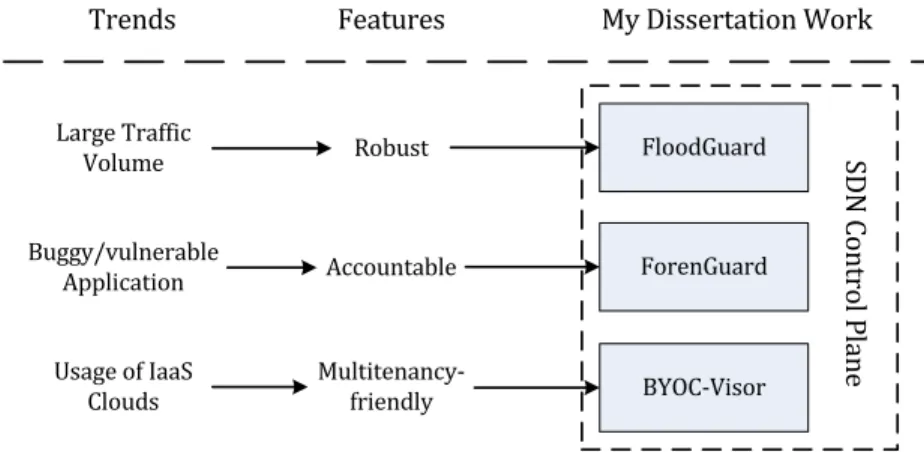
My dissertation research is motivated by the above problems. According to the new require-ments that come from the trends of networks, we aim to provide several new features to the SDN controller design. As illustrate in Figure 1.1, we enhance the following new features to the SDN control plane: 1) robust to handle spikes of data plane events and even flooding attacks; 2) account-able to give records of the running behavior of the network and explanation about how the forward-ing decisions have been made to help the diagnosis of networkforward-ing problems; and 3)
multitenancy-friendly to enable multitenancy management by the cloud tenants in IaaS clouds. The three goals for enhancing SDN control plane form the basis of this Ph.D. dissertation work.
FloodGuard Large Traffic Volume Buggy/vulnerable Application Usage of IaaS Clouds Robust ForenGuard BYOC-Visor SD N C o n tr o l P la n e Accountable Multitenancy-friendly
Trends Features My Dissertation Work
Figure 1.1: Motivation and System Overview of My Dissertation Work
1.1 Research Problems
First, we aim to make the SDN control plane robust to handle the large volume of network events and even the flooding attacks. Current OpenFlow implementations use a "southbound" protocol. When a switch receives a new flow for which there is no matching flow rules installed in the flow table (we call it a "table-miss" in this paper), the data plane will ask the control plane for actions. The "southbound" protocol of an OpenFlow controller introduces considerable overhead. A table-miss could consume resources (e.g., CPU, memory and bandwidth) in both control plane and data plane. This leads to issues in both scalability and security. While there are many studies and solutions on the scalability issue, there is very little research on the even more challenging security issue. Essentially, a large number of data plane messages will flood the control plane and could exceed the throughput and processing capacities of the control plane. An attacker can exploit it by launching dedicated denial of service attack (or data-to-control plane saturation attack) that floods SDN networks. As a result, this attack will overload the buffer memory of network devices, generate amplified traffic to occupy the data-to-control plane bandwidth, and consume the
computation resource of the controller in a short time. In Section 2, we study the defense against the data-to-control plane saturation attack.
Second, there could be buggy/vulnerable applications running in the SDN control plane. The security problem occurs in the control plane will have impact on the data plane forwarding behav-ior. Network users would like to have network diagnosis tool to pinpoint the root cause of for-warding problems. However, the emerging Software-Defined Networking (SDN) technique makes network security diagnosis much harder, because it decouples the control plane from the data plane and the logically centralized control plane is complicated and prone to security vulnerabilities. For example, when you observe a disconnection problem happen in a network running tens of SDN applications in the control plane, it is difficult to diagnose which application is exploited and how it makes the incorrect flow control decisions. Furthermore, since many existing SDN controllers are reactive and event-driven, the culprit events behind the misbehaving control plane are even much harder to be pinpointed. Fundamentally, there is a big gap in the SDN era, from observing the faulty forwarding behaviors in the data plane to finding out the root causes of the security problem in the SDN control plane. In Section 3, we study to bridge this gap by providing digital forensics that investigates the activities of the SDN framework and makes use of the recorded activities for networking security problems diagnosis.
Third, in the Infrastructure-as-a-Service (IaaS) cloud networking environment, the existing adoption of SDN limited. This is because, currently, many enterprises are embracing elastic com-puting offered via the cloud comcom-puting. Infrastructure-as-a-Service (IaaS) clouds provide enter-prises with on-demand computing resources along with networking and storage capabilities. The SDN technique also provides numerous benefits to enterprises. While enterprises encounter a dif-ficult situation when they migrate to public clouds – relinquishing control over their in-house SDN controller along with the entire suite of SDN applications running atop it. The cloud provider’s SDN controller that manages all OpenFlow-enabled hardware as well as software switches is not accessible to tenants. Despite tenants’ demand of diverse network security functions such as intru-sion detection and access control, most cloud providers only offer elementary network functions
such as ACL rules, load balancing, or a software suite with limited customizability. Losing access to the SDN controller deprives tenants of local and third-party SDN applications that cater their needs. Therefore, a cloud tenant desires an SDN controller to develop and deploy arbitrary SDN applications. In Section 4, we study the problem of allowing cloud tenants deploying customized security applications to manage their network.
1.2 Solution Overview
We aim to enhance the SDN control plane to be robust, accountable and multitenancy-friendly. As shown in Figure 1.1, we propose three extensions to the SDN control plane to achieve the goals. To make the SDN control plane robust, we design FLOODGUARD[3], a scalable, efficient,
lightweight, and protocol-independent defense framework for SDN networks to prevent the data-to-control plane saturation attack. FLOODGUARD addresses two research challenges including protecting the controller from being overloaded and preserving network policy enforcement dur-ing the saturation attack. To solve the first challenge, we migrate all the table-miss packets to a data plane cache component, which temporarily caches the packets to protect the data plane switches and forwards them to the controller in a rate limited manner. To solve the second challenge, we propose a solution that is based on proactively placing the potential rules into the switches to guar-antee the policy enforcement of the OpenFlow controller and its applications during the data-to-control plane saturation attack. We evaluate FLOODGUARDthrough a prototype implementation tested in both software and hardware environments. As shown in Section 2, the results show that FLOODGUARDis effective with adding only minor overhead.
To make the SDN control plane accountable, we leverage the concept of digital forensics that investigates the activities of the SDN framework and makes use of the recorded activities for net-working security problems diagnosis. We design a new system, FORENGUARD, which provides
fine-grained forensics and diagnosis functions in the SDN networks. FORENGUARD addresses three research challenges: What kinds of activities in the SDN framework are required for the diagnosis purpose? How to build the causal relationship between different activities? And how to automatically pinpoint the root causes when observing forwarding problems. To address these
problems, FORENGUARDleverages a model of the activities of the SDN framework, designs a new hybrid analysis approach that combines static analysis and dynamic profiling to track the informa-tion flows in the SDN framework, and provides a new funcinforma-tional module for automatic diagnosis. In Section 3, we show several use cases of FORENGUARDthat can quickly pinpoint the root causes
which make use of different software vulnerabilities to launch attacks. The evaluation results show that our system can provide fine-grained diagnosis for many types of networking problems and only introduce minor runtime overhead.
To make the SDN control plane multitenancy-friendly, we introduce a new cloud usage paradigm: Bring Your Own Controller (BYOC). BYOC offers each tenant an individual SDN controller, where tenants can deploy SDN applications to manage their network. There are several research challenges remaining including topology abstraction, performance concern and potential security attacks. We propose BYOC-VISOR[4], a network virtualization platform which is tailored to IaaS
clouds and provides customized, secure, and scalable services to tenants. To address the research challenges, BYOC-VISOR designs a new topology abstraction scheme (called V-Topo) that pre-vents the leaking of sensitive provider’s topology and provides the static view of the network even when the tenant VMs are frequently migrated, a new message tagging technique (called Message Cookie) to improve the performance and defend against the flooding attack, and a new functional module (called Message Guard) to monitor, profile, and filter undesired controller messages. As shown in Section 4, BYOC-VISOR supports different controller platforms and diverse SDN
ap-plications such as firewall, IDS, and access control. We implement a prototype system and the performance evaluation results show that our system has low overhead.
Last but not least, although we propose three frameworks to achieve the three features, there is still a gap from individual frameworks to an integrated system. To bridge this, we will discuss the additional design solutions and the remaining challenges. We will also discuss about the lesson learned from the three projects.
The remainder of this dissertation is organized as follows. The following three sections, Section 2, 3, 4, present the detailed motivation, research problems, design, implementation and evaluation
results of the FLOODGUARD, FORENGUARD, BYOC-VISORprojects. Section 5 discusses about the integration of the three projects and the lesson learned. Finally, Section 6 concludes the disser-tation work and provides the direction of my future research work.
2. FLOODGUARD: MAKE THE SDN CONTROL PLANE ROBUST AGAINST FLOODING ATTACKS∗
2.1 Introduction
SDN is designed to support fine-grained network management policies by decoupling the con-trol plane from the data plane. Current OpenFlow implementations use a "southbound" protocol. When a switch receives a new flow for which there is no matching flow rule installed in the flow table (we call it a "table-miss" in this thesis), the data plane will ask the control plane for actions.
The "southbound" protocol of an OpenFlow controller introduces considerable overhead. A table-miss could consume resources (e.g., CPU, memory and bandwidth) in both control plane and data plane. This leads to issues in both scalability and security. While there are many studies and solutions on the scalability issue [5, 6, 7, 8, 9], there is very little research on the even more challenging security issue. Essentially, a large number of data plane messages will flood the control plane and could exceed the throughput and processing capacities of the control plane. An attacker can exploit it by launching dedicateddenial of service attack(ordata-to-control plane saturation attack) that floods SDN networks [10, 11]. The attacker only needs to generate a large number of anomalous packets, with all or part of header fields of each packet are spoofed as random values. These incoming packets will trigger table-misses and sendpacket_inmessages to the controller. As a result, this attack will overload the buffer memory of network devices, generate amplified traffic to occupy the data-to-control plane bandwidth, and consume the computation resource of the controller in a short time. While some existing research has already discussed this attack and presented some solutions, e.g., AvantGuard [11], they do not provide a comprehensive solution yet. For example, AvantGuard can only defeat TCP-based flooding attacks, but not others (e.g., UDP, ICMP).
In this thesis, we study the data-to-control plane saturation attackin reactive controllers (e.g.
∗c 2015 IEEE. Reprinted, with permission from Haopei Wang, Lei Xu, and Guofei Gu, "FloodGuard: A DoS Attack Prevention Extension in Software-Defined Networks," in Proceedings of the 2015 45th Annual IEEE/IFIP International Conference on Dependable Systems and Networks (DSN), pp. 239-250, June 2015.
POX [12] and Floodlight [13]). The impact of this attack on different controller applications is quite different. Each application in the controller consists of multiple packet-processing policies. These policies are high-level and used to generate low-level flow rules to the data plane. The appli-cations need to analyze eachpacket_inmessages, extract required information (packet header, data path, inport and etc.) and process response OpenFlow messages. Different applications have different program logic, architecture and throughput. Similarly, the impact of this data-to-control plane saturation attack on the OpenFlow infrastructure differs in target applications. For example, a load balancing application is more vulnerable than a hub application. It is because the former one needs more programming complexity to handlepacket_inmessages and respond to traffic load dynamics. The flow rules generated by the load balancing application may frequently change dur-ing the saturation attack, which means this attack could consume network resources more quickly by attacking this application.
To defend against this attack, we have two research challenges as follows:
• How to keep the major functionality of the SDN infrastructure working when the saturation attack occurs?
• How to handle the flooding traffic without sacrificing benign traffic?
For the first challenge, we propose a solution that is based on proactively placing the poten-tial rules into the switches to guarantee the policy enforcement of the OpenFlow controller and its applications during the data-to-control plane saturation attack. Motivated by existing work [14, 15, 16], we attempt to use program analysis techniques to solve the first challenge. We define an important concept that will be used in this thesis, i.e., proactive flow rules. Proactive flow rules are all data plane level (low-level) flow rules that can be generated by an application based on current controller state. The proactive flow rules represent the forwarding actions for all possible incoming packets at this moment. In this thesis, we introduce a new approach that combines sym-bolic execution and dynamic application tracking to generate proactive flow rules. The proactive insertion of the flow rules can keep the major functionality of the network working.
However, even with the proactive insertion of the flow rules, the OpenFlow controller could still be vulnerable to the overloading problem during the data-to-control plane saturation attack. It is because most of flooding packets stay outside the logic of OpenFlow controller applications, i.e., the flooding traffic can hardly match proactive flow rules, which will actually send back and overload the OpenFlow controller. One simple solution to protect the OpenFlow controller can be dropping those packets if they cannot match any existing data plane flow rules. However, the naive drop solution inevitably scarifies some normal traffic, which may not be covered by current proactive flow rules. To solve the second challenge, we migrate all the table-miss packets to a data plane cache component, which temporarily caches the packets to protect the data plane switches and forwards them to the controller in a rate limited manner. The data plane cache is coordinated by the migration agent inside the OpenFlow controller, which provides utility to detect data-to-control plane saturation attack and limit the uploading rate of packet_in messages from the data plane cache.
To summarize, the contributions of this work include the following:
• We deeply study the behaviors of the data-to-control plane saturation attack and analyze its impact on different OpenFlow controller applications.
• We design FLOODGUARD, a scalable, efficient, lightweight, and protocol-independent de-fense framework for SDN networks to preventdata-to-control plane saturation attackby us-ingproactive flow rule analyzerandpacket migration. Proactive flow rule analyzer module provides a new approach that combines symbolic execution and dynamic application track-ing to derive proactive flow rules in runtime. Packet migration module migrates, caches, and processes table-miss packets by using rate limiting and round robin scheduling.
• We implement a prototype system and test it in different attack scenarios in both software and commodity hardware OpenFlow switch environments. We show the evaluation results of the protection of both the control plane and the data plane. Experiments show that FLOOD -GUARD provides a scalable and efficient security solution for SDN networks against
data-to-control plane saturation attacks. 2.2 Related Work
2.2.1 SDN Scalability
The data-to-control plane saturation attack is derived from the scalability problem in SDN research, which is how the control plane handles a large-scale network. Several papers have already studied this challenge. Onix [5] provides a distributed controller solution. Onix introduces a logically centralized but physically distributed controller framework which can share the work load. DIFANE [8] presents an approach to proactively compute low-level flow rules, distribute and then cache these rules into the data plane to handle a large number of incoming packets. However, it is not easy to directly apply this approach to our problem. We focus our problem domain on a reactive model while DIFANE uses a different model (it assumes proactive flow rules are given). Furthermore, a large number of generated fake packets will still cause high communication and computation burden in DIFANE. Our approach is a lightweight solution and provides packet-level migration, which guarantees the transparency to controller applications and end users. DevoFlow [9] introduces mechanisms for devolving control to a switch and finding elephant flows and micro-flows, which benefits to measurement requirement.
2.2.2 SDN Software Analysis
Some studies provide methods to analyze SDN control plane software. Pyretic [14] introduces some features to describe the model of an application from the abstraction point of view. Some ex-isting studies such as NICE [15], VeriCon [17] and [16] propose several methods to verify different features of control applications. In [18], the authors improve the performance of control software troubleshooting by using a minimal causal sequence of triggering events.
2.2.3 SDN Security
SDN security becomes a hot research topic in recent years. There are two main directions. SDN-supported security research targets to use SDN technique (which is relatively a new tech-nique) to solve traditional security challenges. Some papers such as Mahout [19] use traditional
statistic based aggregation solutions to prevent flooding attacks in OpenFlow networks. These attacks are targeting the end hosts while the data-to-control plane saturation attack is against the OpenFlow network infrastructure. In addition, statistic aggregation algorithms do not help because the data-to-control plane saturation attack utilizes micro-flows. Therefore, we argue that statistic-based solutions are not suitable for our problem. CloudWatcher [20] introduces the Network Se-curity Virtualization service to cloud networks. FRESCO [21] proposes a framework designed to facilitate the rapid design and modular composition of security applications. OpenSafe [22] improves the management of network monitoring applications.
Another direction is security for SDN which aims to protect and strengthen SDN-enabled in-frastructure. Our work belongs to this direction. AvantGuard [11] attempts to solve the same saturation attack challenge, and it is the closest work to ours. AvantGuard introduces a module which implements a SYN proxy and only exposes those flows that finish the TCP handshake. AvantGuard can effectively defeat TCP based saturation attacks. Its limitation is obvious that it is invalid to other protocols. Our approach aims to defeat more generic saturation attacks in SDN, not only limited to TCP protocol. FortNOX [23] introduces the tunneling attack and proposes a secu-rity enforcement kernel to defend against this attack. Rosemary [24] introduces a sandbox-based framework to safeguard the SDN control layer against malicious or faulty control applications. To-poGuard [25] studies the network topology poisoning attack and proposes an extension to mitigate against the attack. Sphinx [26] proposes a framework to detect known and potential attacks on SDN networks.
2.3 Problem Statement
In this section, we introduce some background knowledge about SDN, provide an adversary model of the data-to-control plane saturation attack, analyze the vulnerability in different Open-Flow applications and state our research problem.
2.3.1 Background on Flow Rule Installation
In OpenFlow networks, forwarding devices handle network flows based on the flow rules re-ceived from a controller. The controller installs flow rules to data plane in two approaches, i.e., proactively and reactively. In theproactiveflow installation approach, the controller could popu-late the flow rules before all traffic comes to the switch. In thereactiveflow installation approach, the controller could dynamically install or modify flow rules. The reactive approach enables the flexible management of forwarding behaviors based on current network situation. Thus, it could support more dynamic applications than the proactive approach. Currently most OpenFlow en-abled networks choose the reactive approach for their management. In our work we focus on reactive controllers and consequent security threats against them.
2.3.2 Adversary Model
We assume an adversary could produce a large number of micro-flows to an OpenFlow-enabled network by her own host or controlling many distributed bot hosts. The attack traffic can be mixed with normal traffic and is hard to distinguish. The control plane and the data plane will suffer from the saturation at the same time and their resources will be consumed in a short time.
We start from a simple scenario to illustrate how an adversary can flood the SDN infrastructure. There is an OpenFlow-enabled switch which receives an external input stream. The stream is mixed with traffic from both a benign host and a bot host which is controlled by an attacker. The attacker could generate flooding traffic and consequently launch the saturation attack to the OpenFlow switch. Here is a basic and typical process of flow control in OpenFlow switches. When a table-miss occurs, which means there is a new packet which data plane does not know how to handle, the data plane will buffer the packet and send apacket_inmessage which contains the packet header to controller if the buffer memory is not full. If the buffer is full, the message will contain the whole packet instead of only its header. The attacker can exploit it by launching dedicated data-to-control plane saturation attack that floods SDN networks. She can generate a large number of anomalous packets, which means all or part of fields of each packet are spoofed as random
values. These spoofed packets have a low probability to be matched by any existing flow entries in the switch. As a result, the flooding attack will significantly downgrade the performance of the whole OpenFlow infrastructure.
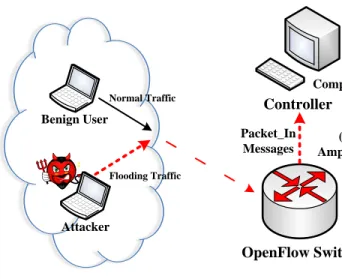
OpenFlow Switch Controller Benign User Attacker Normal Traffic Flooding Traffic Packet_In Messages (Overload the Buffer Memory) ( Generate Amplified Traffic) ( Saturate the Computation Resource )
Figure 2.1: Attack Process
Figure 2.1 illustrates the basic process of the attack. The first component which is affected is the OpenFlow switch. The buffer memory will be consumed soon and the throughput is affected a lot including the packet forwarding throughput and the data-to-control plane communication channel throughput. We have tested the impact of the saturation attack on an OpenFlow switch. In the Mininet [27] environment, a software switch is dysfunctional by about 500 packets/second of table-miss UDP traffic. A hardware switch is a little more capable, but still vulnerable. Besides the data plane switch, the bandwidth of data-to-control plane communication channel will also be occupied. In OpenFlow Specification 1.4 [28], if the buffer memory of a switch is full, the packet_in message will contain the whole body of each table-miss packet. That means the attacker can generate amplified traffic to occupy the data-to-control plane bandwidth. Suppose the data plane link and communication channel have the same capacity, amplification attack allows the attacker to consume less resources but cause more harm. At last, the control plane will suffer from the saturation attack, because the controller has to process eachpacket_in message and then
Application arp_hub ip_balancer route
Policy LLDP packet→drop srcip=1*, dstip=10.0.0.1→dstip=192.168.0.1 dstip=192.168.0.1→port(1)
ARP packet→broadcast srcip=0*, dstip=10.0.0.1→dstip=192.168.0.2 dstip=192.168.0.2→port(2)
Table 2.1: Sample Applications
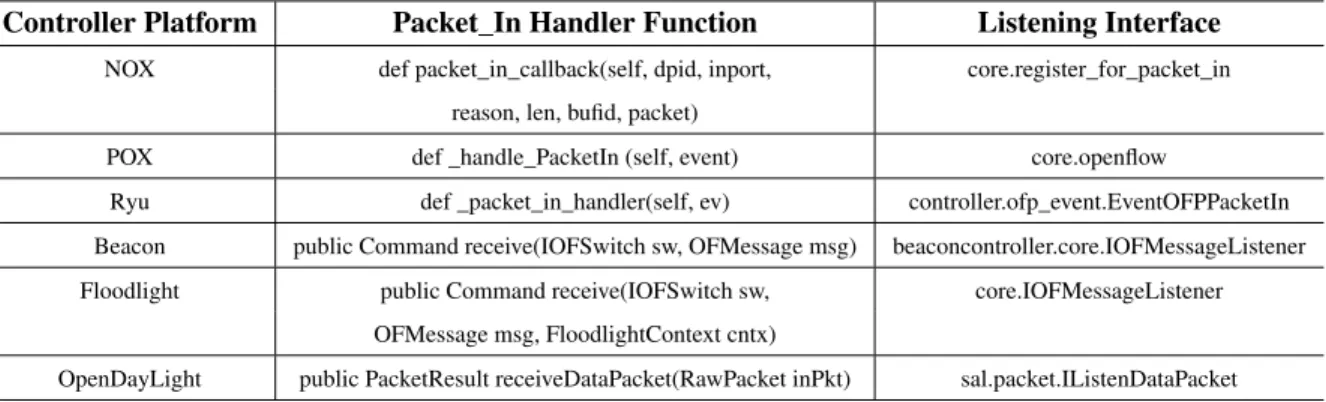
Controller Platform Packet_In Handler Function Listening Interface
NOX def packet_in_callback(self, dpid, inport, core.register_for_packet_in reason, len, bufid, packet)
POX def _handle_PacketIn (self, event) core.openflow
Ryu def _packet_in_handler(self, ev) controller.ofp_event.EventOFPPacketIn Beacon public Command receive(IOFSwitch sw, OFMessage msg) beaconcontroller.core.IOFMessageListener Floodlight public Command receive(IOFSwitch sw, core.IOFMessageListener
OFMessage msg, FloodlightContext cntx)
OpenDayLight public PacketResult receiveDataPacket(RawPacket inPkt) sal.packet.IListenDataPacket
Table 2.2: Packet_In Handler Functions in Different Controllers
respond to the data plane. The flooding traffic can easily overload the computation capability of the control plane in a short time.
2.3.3 Motivation
If we are able to pre-install all flow rules into the data plane and discard all other table-miss packets, the security problem is solved. However, it is unrealistic due to the dynamics of network policies. Each control application is composed of distinct packet-processing policies. Some poli-cies are dynamic which means they may vary from different network situations. For example, in a cloud network the routing policies should be updated when the topology changes. Thus, the controller has to update the flow rules when network state changes. The dynamic nature makes it impossible to pre-install all flow rules. Therefore, the application needs to analyze data plane messages and update its packet-processing policies. As described above, the dynamic nature can result in both the scalability issue and security vulnerability.
application, we define them asdynamicpolicies. Conversely, we define the unchanged policies as staticpolicies. For example, we suppose there is a developer who deploys three applications, as shown in Table 2.1, to manage a small network. Thearp_hubapplication is to drop all Link Layer Discovery Protocol (LLDP) packets and broadcast Address Resolution Protocol (ARP) packets. Theip_balancer application is to load balance the traffic destined to a public IP address and split the traffic based on the source IP address. Incoming traffic with a source IP address whose highest-order bit is 1 gets a private destination IP address 192.168.0.1 and is forwarded to one server replica. The remaining traffic gets another private destination IP address 192.168.0.2 and goes to the other server replica. The third one, therouteapplication generates routing path based on the destination IP address. Packet-processing policies in thearp_hubmodule are quite stable. However, those policies in the other two modules may update when topology changes. According to our definition, policies in the first module are static policies and those in the other two modules are dynamic policies. The reason why there exists dynamic policies is that there should be variables sensitive to the network state in the control application program. For example, the routing table in the third module is a state sensitive variable which is associated with the current network topology. We argue that the dynamic policies make applications vulnerable, since dynamic policies need to be updated during the transition of the data plane. In current OpenFlow protocol, the con-troller obtains the transition information of the data plane mainly from thepacket_inmessages. Hence, during the flooding attack, a large number ofpacket_inmessages will consume the re-source in the controller and, simultaneously, even mislead the control plane. Also, the dynamic policies will change unpredictably and frequently, which makes it hard to predict the trend of them. We suppose at any time we are able to know all the static policies and dynamic policies based on current network state, and then we can know what kinds of packet_in messages the control plane is able to process immediate responses to the data plane. We cannot simply drop other mes-sages because many applications are learning-based and some mesmes-sages that have not been learned by the applications may be useful in the future. These messages can be handled later when the controller becomes relatively idle after the attack. That kind of information will be quite useful for
the defense. For further description about our defense solution, we introduce a new concept, i.e., proactive flow rules.
Proactive Flow Rulesare all data-plane-level flow rules which can be generated by an appli-cation based on current controller state. In the above case in Table 2.1, each policy could generate one entry of flow rule. At a certain moment, we call all these possible flow rules as proactive flow rules. The proactive flow rules are dynamic and time-sensitive. At another moment, the proac-tive flow rules may be different because the policies have changed. Proacproac-tive flow rules represent the range ofpacket_inmessages which current control logic can handle at this moment. This concept is motivated from DIFANE [8] which introduces another similar concept calledlow-level authority rules. The authority rules are cached in the Authority Switches and need to be updated to handle dynamics. DIFANE caches these kinds of flow rules to keep packet processing in the data plane. We assume most of the flooding packets are out of the control logic, and we aim to use the proactive flow rules to roughly separate the benign packets and malicious packets. Moreover, there are still several issues in DIFANE. For instance, there is no systematical solution to generate and update the proactive flow rules dynamically. Our work attempts to design a systematical solution, and we will discuss it in the design section.
We also conduct a deep analysis of the OpenFlow program model. Typically each control ap-plication contains apacket_in handler functionto handlepacket_inmessages from the data plane. We summarize some popular controller platforms and their corresponding handler functions in Ta-ble 2.2. The handler functions have a variety of names in different controller platforms, but have similar features. The handler function is event-driven. Triggered bypacket_inmessages, the function then may take some actions to handle this packet and consequent flows. Even for the same input, the handler function of an application could enforce different actions. As mentioned above, it is because of the dynamic nature of the state sensitive variables. For example, in the route application in Table 2.1, the routing table is associated with the current network configuration and is state sensitive. Therefore, if we want to get the proactive flow rules, we need to know the current value of all state sensitive variables dynamically. We design a hybrid symbolic execution algorithm
which is described in the design section. 2.3.4 Research Challenges
The first one is to preserve major functionality of the network infrastructure when the saturation attack occurs. To achieve this, we design a new functional module called proactive flow rule analyzer, which is implemented in the control plane. It includes symbolic execution and dynamic application tracking to derive proactive flow rules in runtime. The proactive flow rule dispatcher component will install the proactive flow rules directly into the OpenFlow switch.
The second challenge is to handle table-miss packets without sacrificing benign packets. Sim-ply dropping table-miss packets seems one answer but obviously not a good one since it could drop some benign packets. Therefore, we migrate the table-miss packets to a data plane cache when the attack occurs, and then triggerpacket_inmessages back to the controller in a limited rate.
Our design meets the following objectives. First, our framework is lightweight, i.e., under nor-mal circumstances, only the monitoring component is active but others keep dormant. Second, our design is transparent to the controller applications and end hosts. Third, we merely add reason-ably low overhead and latency. Finally, our solution is independent of the protocol of attack traffic (unlike AvantGuard which only defends against TCP-based flooding attacks).
2.4 System Design
To address the security problems discussed in previous sections, we introduce FLOODGUARD,
a scalable, efficient, lightweight and protocol-independent defense framework for SDN networks to prevent data-to-control plane saturation attack. We present the detailed design of FLOODGUARD
in this section.
2.4.1 System Architecture
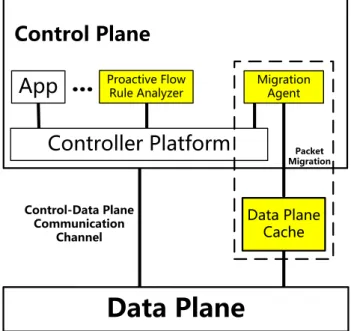
FLOODGUARDintroduces two new functional modules to existing OpenFlow infrastructure : 1) aproactive flow rule analyzermodule, and 2) apacket migrationmodule. The analyzer module is to enforce the major functionality of the network infrastructure when the saturation attack occurs. The packet migration module is to transmit benign network flows to the OpenFlow controller
Data Plane
...
Data Plane CacheController Platform
App
Migration AgentControl Plane
Control-Data Plane Communication Channel Proactive Flow Rule Analyzer Packet MigrationFigure 2.2: Conceptual Architecture
without overloading it. A conceptual architecture of FLOODGUARDis shown in Figure 2.2. The
proactive flow rule analyzermodule is implemented as a controller application above the controller platform. In thepacket migrationmodule, the migration agent component is also implemented as a controller application and the data plane cache component sits between the control plane and data plane.
We maintain a finite-state machine to manage the whole FLOODGUARD system. The state
machine is shown in Figure 2.3. Before all the states, FLOODGUARDhas some preparation work, i.e., using symbolic execution to generate a set of path conditions for eachpacket_inhandler function of each application. Compared with traditional symbolic execution method, we not only symbolize the input variables but also symbolize the global variables used in the packet_in handler function. After the preparation work, FLOODGUARDstarts from the Idle State. Initially, if there is no attack, both the proactive flow rule analyzer and the packet migration modules keep idle. When a saturation attack is detected, FLOODGUARDcomes to the Init State. The migration agent
component starts to redirect the table-miss packets to the data plane cache. The proactive flow rule analyzer module will dynamically track the running controller applications and convert the path
Idle Init Defense No Attack Finish Attack Detected Enforce Migration, Generate Flow Rules, Start Data Plane Cache
Proactive Flow Rules are Ready
Install and Keep Updating Proactive Flow Rules Attack Terminated Terminate Migration, Keep Handling Cached Packets Data Plane Cache Becomes Empty Attack Detected Again
Figure 2.3: States of FLOODGUARD
conditions which are generated before to proactive flow rules. At the same time, the data plane cache component begins to handle cached packets and generate packet_in messages to the controller. When the proactive flow rules are ready, FLOODGUARDcomes to the Defense State.
The analyzer module directly installs these rules to the data plane switches and keeps updating these flow rules. When the attack is detected to be over, FLOODGUARDcomes to the Finish State. The migration agent component stops migrating the table-miss packets and the data plane cache will keep handling unprocessed packets. When the data plane cache finishes processing all cached packets, it will become idle again. Our framework does not need any modification to existing SDN infrastructure and is transparent to both the control plane and data plane.
2.4.2 Proactive Flow Rule Analyzer
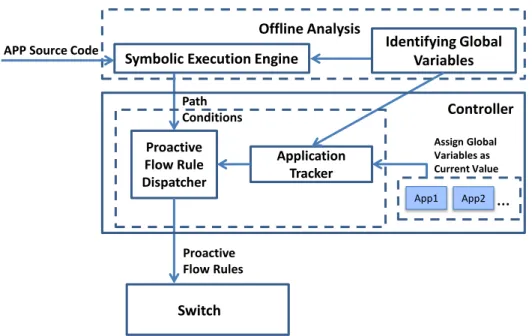
The proactive flow rule analyzer module is running as an application in the controller and consists of three components: (i) symbolic execution engine, (ii) application tracker, and (iii) proactive flow rule dispatcher. The architecture of the proactive flow rule analyzer module is shown in Figure 2.4.
The proactive flow rule analyzer module could be activated anytime when needed. For ex-ample, it can typically be activated right after the detection of the saturation attack, which is in-formed by (the flooding detection function in) the packet migration module. Once activated, the analyzer module generates the proactive flow rules and directly installs these rules into the data plane switches. Then the analyzer module keeps updating the proactive flow rules dynamically. In essence, the analyzer will leverage the logic of applications in the controller to generate proactive flow rules, which, to a great extent, covers all the possible upcoming packets that the application cares about. The challenge here is how to dynamically generate proactive flow rules. We introduce a new approach which combines symbolic execution and dynamical application tracking to address this challenge.
Symbolic Execution Engine
Identifying Global Variables Offline Analysis
APP Source Code
Application Tracker Proactive Flow Rule Dispatcher App1 App2 Assign Global Variables as Current Value Controller Proactive Flow Rules Switch
…
Path ConditionsFigure 2.4: Proactive Flow Rule Analyzer
In a reactive controller, the controller platform maintains the connections to the data plane and transforms OpenFlow messages into events. Upon the controller, OpenFlow applications provide multiple event handlers to process OpenFlow messages (e.g., PortStatus, PacketIn, Barrier). In this thesis, we only focus on thepacket_inevent handler. It is because from previous section,
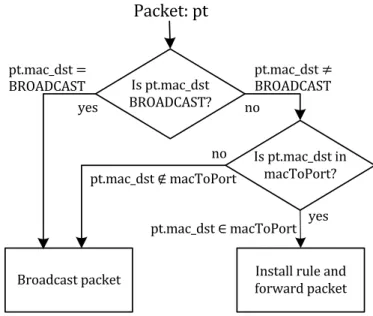
we know that thepacket_inhandler function is the main target of flooding attacks. The input ofpacket_in handler function is thepacket_inevent and the output is flow rules. We use a sample application, l2_learning application [12], and describe the corresponding control flow graph of itspacket_inhandler. First, we briefly describe the logic of this function. The input for this function is thepacket_in event. This function maintains a MAC-port mapping table, which can be learned from the source MAC address and incoming port of previouspacket_in messages. The function firstly checks if the destination MAC address of the packet is a broadcast address. If so, the function just simply broadcasts the packet. If not, the function will search this MAC address in the MAC-port mapping table. If this MAC address has not been learned before, the function has no idea which port to forward it so just broadcast it. If the MAC address has been learned before, the function installs a relative flow rule and forward this packet to the mapping port.
The control-flow logic ofpacket_inhandler function of the l2_learning is as follows. One for input whose destination MAC address is broadcast (pt.mac_dst =BROADCAST), one for input whose destination MAC address is not broadcast and not learned before (pt.mac_dst 6= BROADCAST and pt.mac_dst /∈macT oP ort) and the other for input whose destination MAC address is not broadcast but has been learned before (pt.mac_dst6=BROADCAST and pt.mac_dst∈
macT oP ort). TheBROADCAST is a constant value, and the value of the data structuremacT oP ort
is network state sensitive∗. From our analysis and discussion in the previous section, we identify the variable macT oP ort as astate sensitive variable. Suppose at a certain point in the running cycle, macT oP ort has a concrete value (i.e., {0x00000000000A : 01}. Consequently in the control-flow logic the first two branches only generatepacket_outmessages without any flow rules. Nevertheless, the third branch may generate a flow rule: mac_dst= 00 : 00 : 00 : 00 : 00 : 0A, action=output: 01, which is the proactive flow rule we can get at this moment.
Symbolic Execution [29, 30] is a practical way to generate proactive flow rules. Symbolic Exe-cution is a program analysis approach, which is capable of efficiently traversing possible branches
∗The key reason it is network state sensitive is because it will dynamically change and vary in every call back of the handler function.
Is pt.mac_dst BROADCAST? Packet: pt Is pt.mac_dst in macToPort? no pt.mac_dst ≠ BROADCAST
Broadcast packet Install rule and forward packet yes yes pt.mac_dst = BROADCAST no pt.mac_dst ∈ macToPort pt.mac_dst ∉ macToPort
Figure 2.5: Sample Control-Flow Logic
in a program. A symbolic execution engine will symbolize the input of a program and then exe-cute all the feasible paths at the beginning of the program. During executing each path, the engine records the accumulation of conditions that lead to this path, which is called "path conditions" or "path constraints". For example, in l2_learning application, the path condition for the third branch ispt.mac_dst6=BROADCAST and pt.mac_dst∈ macT oP ort. When the engine finishes the execution of all feasible paths, we get all path conditions of the program.
For the sake of reducing runtime overhead, we choose to run symbolic execution offline for gen-erating proactive flow rules. However, simply offline running symbolic execution on thepacket_in handler function as mentioned above cannot totally solve the problem. It is becausepacket_in handler function may contain state sensitive variables whose value will dynamically change. For example, in the l2_ learning application example, the initiate value ofmacT oP ortis empty. We can only assignmacT oP ortas its initial value, which means we will lose the third branch in the generated path conditions. To tackle the problem, we increment symbolic execution with dynamic application tracking. In detail, when we generate the path conditions offline, we symbolize both the input variables and the state sensitive variables. Then we use dynamic application tracking to locate state sensitive variables and extract them at runtime to derive proactive flow rules. In
the l2_learning example, we first symbolize the input variable (i.e., packet_in event) and the
macT oP ort. We get path conditions which are the three branches. When the saturation attack happens, we keep tracking the application to get the runtime value of macT oP ortand assign to the path conditions. Then we dynamically convert the path conditions to proactive flow rules.
To derive proactive flow rules, we need to locate state sensitive variable, which is highly related to program dynamics. For example,macT oP ortis a state sensitive variable. We find that all state sensitive variables are global variables to the function, which means to the handler function, the set of global variables is a superset of the state sensitive variables. The application program will call the handler function hundreds of times with different value of these variables. Therefore, we decide to symbolize input variables and all global variables used in the handler function to generate the path conditions. Then we can assign the value of these global variables dynamically to the path conditions and then generate our needed proactive flow rules. Motivated by this idea, we introduce a new approach which combines the symbolic execution and dynamic application tracking to meet our requirement. We summarize the algorithm of our approach as follows.
Algorithm 1:Generation of the Path Conditions (offline) Input: F = packet_in handler function
Output: P = a set of path conditions
input← ∅,global← ∅;
input= find_input_variables(F);
global= find_global_variables(F);
F0 = symbolize(F,input,global); P = symbolic_execution_engine(F0); returnP
We first separate the whole process into two steps. In the first step, our input is thepacket_in handler function and our desired output is the path conditions of this function. We first find input variables (e.g. packet_inevent) and the global variables which are used in the packet_in function. Next we symbolize both the input variables and the global variables. Then we use
Algorithm 2:Converting to Proactive Flow Rules (runtime) Input: P = a set of path conditions
Input: global0 = global variables with real-time value assigned Output: R= proactive flow rules
R ← ∅;
paths= assign_value(P,global0);
foreacheach path conditionpinpathsdo ifp.decision= Modify_State_Messagethen
R.add(convert(p.path_condition)); returnR
traditional symbolic execution algorithm to traverse possible branches, collect all path conditions and then generate the path conditions. This step will be relatively time consuming. However, the symbolic execution engine component could process this step offline in advance, which means it will not increase overhead to our system. This step is summarized in Algorithm 1.
The second step is dynamic analysis. In the state machine, when it goes to Init State, the application tracker component will process the second step. It will track and assign current value of the global variables to the path conditions. After this process, in the path conditions only input variables are symbolized. Then we use the proactive flow rule dispatcher component to analyze each path condition. We only consider the paths whose final handling decision is in a small set which is to generate Modify State Message (defined in OpenFlow Spec. 1.4.0) †. At last, we get the proactive flow rules that we want. This step is summarized in Algorithm 2. Figure 2.4 illustrates the process of dynamically generating proactive flow rules. In the l2_learning case as shown in Figure 2.5, the number of proactive flow rules is based on how many MAC-port pairs have been learned in themacT oP ort. After the proactive flow rules are ready, the analyzer component will install them to the data plane switches.
2.4.3 Packet Migration
Installing proactive flow rules during the attack will preserve the major functionality of the network infrastructure because those packets that mach these flow rules are what the SDN apps
mainly care about. For the unmatched packets (i.e., table-miss packets), one may think that we could simply drop them. However, in that case, some new network flows will not be monitored by the controller and thus be dropped. For example, in the above l2_learning application example, when we generate the proactive flow rules and install them into the switches, we may sacrifice the learning capability. After installing the proactive flow rules, new incoming network flows cannot not be learned by the controller. That is because the new incoming flows have not been learned before and thus cannot match any proactive flow rules. Therefore, we cannot simply drop the table-miss packets. That leads to our second challenge, i.e., how to handle the flooding packets without sacrificing benign packets? Our idea is to temporarily cache the table-miss packets after the installation of the proactive flow rules. We introduce thepacket migrationmodule. The packet migration module contains two components: migration agent and data plane cache.
2.4.3.1 Migration Agent
The migration agent component is the "brain" of the whole FLOODGUARD system. It has three main functions. The first function is to detect the saturation attack. Anomaly-based flooding detection is easy to get around by an attacker who is willing to slowly execute the attack. Only using real-time rate ofpacket_inmessages is not enough to detect the attack. Therefore, our detection algorithm makes use of both the real-time rate ofpacket_inmessages from the data plane and the utilization of the infrastructure (buffer memory, controller memory and CPU) to calculate current usage percentage of the capacity of our OpenFlow network. We identify there is a potential flooding attack based on certain anomaly threshold. When the migration agent detects the saturation attack occurs or ends, it will trigger the corresponding state transition in the state machine described above.
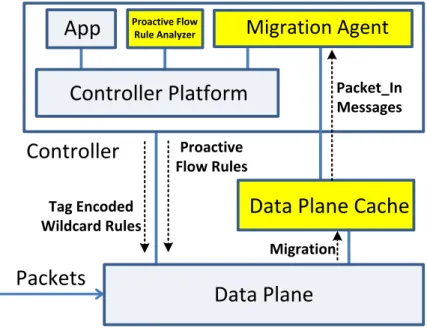
The second task of the migration agent component is to migrate table-miss packets to the data plane cache. When the saturation attack is detected, it will change the system state to the Init State, which will trigger both the proactive flow rule analyzer and the data plane cache. The migration agent component installs one entry of wildcard flow rule which has the lowest priority and forwards all table-miss packets to data plane cache. Therefore, the flooding packets will not
overload the switch or flood the controller. The data plane cache will temporarily store all the table-miss packets. Some packets will be given priority to triggerpacket_inmessages from the data plane cache.
Controller
App
Proactive Flow Rule AnalyzerTag Encoded Wildcard Rules
Packets
Data Plane Cache
Packet_In MessagesController Platform
Migration Proactive Flow RulesMigration Agent
Data Plane
Figure 2.6: Migration Process
However, the process has one obvious challenge. In OpenFlow protocol, apacket_in mes-sage contains both packet header and INPORT information. Due to the addition of data plane cache, the original INPORT information is lost in the process of migration. When we generate packet_in messages later in the data plane cache, we lose the original INPORT information. To solve this problem, we utilize a packet tag to preserve INPORT information. In OpenFlow specification, some fields are used for matching packet headers. We can borrow some reserved fields to tag table-miss packets (e.g. 8 bits TOS). Therefore, we modify the wildcard flow rule mentioned above which is to migrate the table-miss packets. In our implementation, we install multiple wildcard rules instead of only one rule. When the controller detects the flooding attack, it installs several wildcard rules to migrate table-miss packets with encoded INPORT information into tag. For each port there is a corresponding wildcard rule. We add one matching condition
which matches the incoming port and also add one action which preserves the INPORT informa-tion to the TOS field. For example, one wildcard rule could be: "inport = 1, acinforma-tions : set-tos-bits = 1, output : data_plane_cache". If the ingress switch has 6 ingress ports, we need 3 bits to encode INPORT information and the number of wildcard rules is 6. In the data plane cache, when we need to generatepacket_inmessages, we can decode the INPORT information from the TOS field. The whole process is shown in Figure 2.6.
When the data plane cache generatespacket_inmessages, it cannot directly send the mes-sages to the controller. It is because the controller platform distinguishes different datapaths (switches) from different connections (e.g., TCP session). If the data plane cache directly sends messages to the controller, the data plane cache will be identified as a new datapath. The third function of the migration agent component is to solve this issue. The data plane cache will send thepacket_inmessages to the migration agent component. Then the migration agent will raise packet_inevents with the original datapath information to other applications in the controller. Also, the migration agent instructs rate limit to data plane cache based on the utilization of system resource and the rate of incomingpacket_inmessages.
2.4.3.2 Data Plane Cache
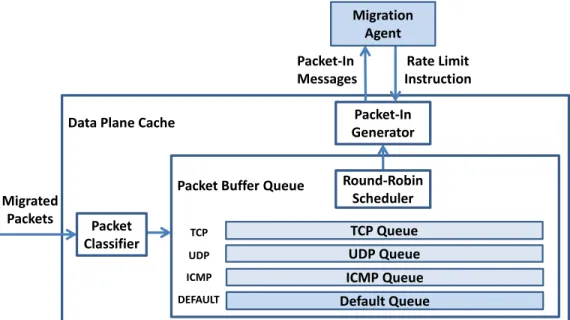
Data plane cache is a machine/device that temporarily caches table-miss packets during the saturation attack. During the data-to-control saturation attacks, most of the flooding traffic will be redirected the data plane cache instead of flooding the OpenFlow infrastructure. The data plane cache, as shown in Figure 2.7, has three functions: packet classifier, packet buffer queue, and packet_in generator. When a migrated table-miss packet arrives in data plane cache, the packet classifier parses the header of the packet and attaches it to its corresponding buffer queue. Specifi-cally, there are four packet buffer queues inside data plane cache based on the packet protocol, i.e., TCP, UDP, ICMP, and Default. Each packet buffer queue is based on FIFO (first-in, first-out) and embraces tail drop scheme, i.e., when new packets come to a full packet buffer queue, the earliest coming packet inside the packet buffer queue will be dropped. Among those four packet buffer queues, we adopt round-robin scheduling algorithm to pick the queue header packet for future
gen-eratingpacket_inmessages. The insight behind the round-robin-based packet buffer queue lies in the observation that an attacker normally exploit a specific protocol to launch attacks, e.g., TCP SYN flooding attack, UDP flooding attack, and ICMP flooding attack. Even if the attacker knows how our scheduling manner works and attacks the various protocols, the effect of the manner is the same as just using one queue and has no drawbacks. Lastly, the packet_in generator converts the scheduled packets intopacket_inmessages by decoding the INPORT information from the tag added before and sends them to the OpenFlow controller. The sending rate of packet_in generator is controlled by the migration agent inside the remote OpenFlow controller.
Data Plane Cache
Migrated Packets
Packet Buffer Queue
TCP Queue UDP Queue Default Queue TCP UDP DEFAULT Packet-In Generator Round-Robin Scheduler Packet Classifier Rate Limit Instruction Packet-In Messages Migration Agent ICMP Queue ICMP
Figure 2.7: Data Plane Cache
2.4.4 Handling Dynamics
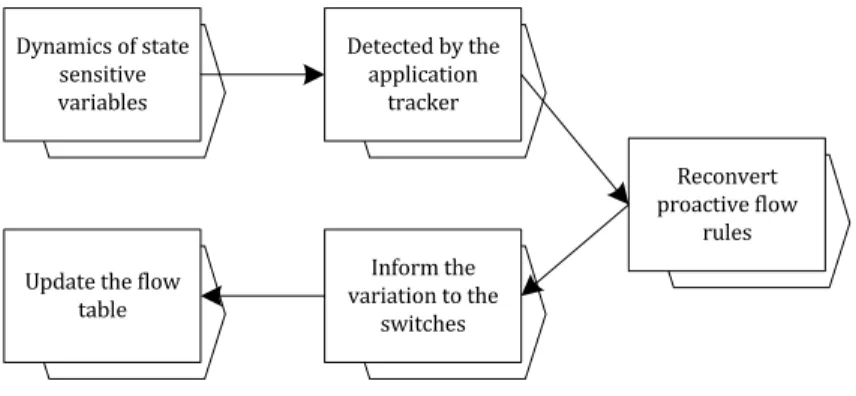
During the flooding attack, proactive flow rules may vary due to network dynamics. For ex-ample, in the ip_balancer application, the change of traffic in different flows will lead to the re-generating of flow rules. If we still use previous proactive flow rules in the data plane, it will lead to unpredictable results. Therefore, the proactive flow rules should keep consistent with current network state. To handle the dynamics, in the proactive flow rule analyzer module we constantly
update the proactive flow rules. We have several steps to update the proactive flow rules, as illus-trated in Figure 2.8. By frequently referencing to the global variables, any change of value can be easily identified by the application tracker component. Then this component can find correspond-ing path conditions and regenerate the proactive flow rules. At last, the control plane will update the latest proactive flow rules to the data plane switches. The variation should be quite simple as adding or removing a few matching rules. In the case shown in Table 2.1, if the incoming traffic with a source IP address whose highest-order bit is 1 gets a private destination IP address which changes to 192.168.0.2 and the remaining traffic changes to 192.168.0.1, the change can be de-tected by the analyzer. Then the proactive flow rule analyzer regenerates the proactive flow rules and reports the variation of two flow rules to the data plane switches. Consequently, the flow table in the OpenFlow switch has the latest matching rules which represents the current network state.
Dynamics of state sensitive variables Detected by the application tracker Reconvert proactive flow rules Inform the variation to the switches Update the flow
table
Figure 2.8: Handling Dynamics
There is a tradeoff between the performance and the accuracy. We can update the rules every time after a change. That will bring high accuracy, but also introduce relatively high overhead. We can also update the rules after a certain number of changes happen. That will increase the performance but reduce the accuracy. We can also update the rules based on a constant time interval (e.g., 1ms). We think the decision should be based on the actual situation and system features.
Application State Sensitive Variable (Type) Description l2_learning macToPort (dictionary) {mac address : INPORT} l3_learning arpTable (dictionary) {IP address : mac address and INPORT} ip_balancer servers (list) IP addresses of duplicated servers
service_ip (IPaddr) IP addresses of services
live_servers (dictionary) {IP address : mac and INPORT} of live duplicated servers memory (dictionary) {four tuples of packet header : flow record} of_firewall firewall (dictionary) {packet patterns : TRUE or FALSE}
table (dictionary) {switch data path : mac address} mac_blocker blocked (set) mac addresses of blocked hosts
Table 2.3: The State Sensitive Variables in Applications
2.4.5 Discussion
One issue in the deployment is that how many data plane caches are necessary for a large number of OpenFlow switches. Ideally, we only need to deploy one data plane cache to serve all switches. However, to be more scalable, we could also use a set of data plane caches, with each in charge of a subset of switches (e.g., a subnet of an enterprise network or a rack of a cloud network). Another concern is that the size of TCAM memory in switches may not be enough to install all proactive flow rules. Note that in our design, we do not add new extra rules. Instead, we just proactively install those rules in advance. If the TCAM memory is really limited, we have another design option which is to install and update the proactive flow rules into the data plane cache. In the data plane cache, for those packets who can find a match, we provide them a higher priority to triggerpacket_in messages. However, the system needs to sacrifice some performance for this design option. There is a tradeoff. According to the actual situation, the network administrator could make a decision between the two options.
2.5 Evaluation
In this section we introduce our implementation of FLOODGUARD and evaluate the