Document Management System
Security
Jonas Birm´
e
[email protected]
January 24, 2005
20 credits
Ume˚
a University
Department of Computing Science
SE-901 87 UME˚
A
Abstract
A common demand today is that software and systems must be secure but security mech-anisms are often implemented without first considering what a secure system is. A formal specification of what is allowed and not allowed in a secure system is the security policy. The SS-EN82045-1 standard is a standard that assures a certain level of quality in an elec-tronic document management system. This thesis presents an extendable framework to specify security policies for a document management system. As a reference implementa-tion, a security policy for a product called Zert Infologic is specified with this framework. Zert Infologic is a product that facilitates the management of product manuals in multiple languages. The framework models the security aspects: confidentiality and integrity, and are based on the Bell-LaPadula model of secure information flow and Clark-Wilson model of integrity. In this framework, security is specified with a set of rules that defines the secure and non-secure states of a system. A secure system is a system that can not reach a non-secure state. The security mechanisms to enforce the security policy for Zert Infologic are discussed and a requirement specification (with respect to security) is suggested.
Contents
1 Introduction 1 1.1 Background . . . 1 1.2 Thesis Description . . . 1 1.2.1 Goal . . . 2 1.2.2 Purpose . . . 2 1.2.3 Method . . . 2 1.2.4 Report Outline . . . 2 1.3 Related Work . . . 2 2 Background Theory 5 2.1 Document Management Standard . . . 52.1.1 Principles . . . 5
2.1.2 Document Life Cycle . . . 6
2.1.3 Initiation . . . 6 2.1.4 Development . . . 7 2.1.5 Approval . . . 7 2.1.6 Revision . . . 7 2.1.7 Archival . . . 8 2.1.8 Deletion . . . 8 2.2 Basic Theory . . . 8
2.2.1 Basic Set Theory . . . 8
2.2.2 Cartesian Product . . . 10 2.2.3 Powerset . . . 10 2.2.4 Lattice . . . 10 2.3 Defining Security . . . 11 2.3.1 Terminology . . . 12 2.3.2 Security Policy . . . 14
2.3.3 Access Control Matrix Model . . . 16
2.3.4 Discretionary Access Control . . . 18
2.3.5 Mandatory Access Control . . . 18
2.3.6 Bell-LaPadula Model . . . 18 iii
2.3.7 Clark-Wilson Model . . . 21
2.4 Enforcing Security . . . 23
2.4.1 Authentication Mechanisms . . . 24
2.4.2 Access Control Mechanisms . . . 25
2.4.3 Non-repudiation Mechanisms . . . 27
2.4.4 Integrity Mechanisms . . . 29
3 Document Management Security Policy 31 3.1 Security Aspects of SS-EN 82045-1 . . . 31
3.1.1 Information Security . . . 31
3.1.2 Aggregated Documents . . . 32
3.1.3 Approval . . . 32
3.1.4 Archivation . . . 32
3.1.5 Storage . . . 32
3.2 Security Requirements for SS-EN 82045-1 . . . 33
3.3 Document Management Policy Framework . . . 34
3.3.1 Definitions . . . 34
3.3.2 Rule-Based Policy Specification Language . . . 37
3.3.3 Specification Functions . . . 38
3.3.4 Basic Authorization Rules . . . 39
3.3.5 Derived Authorization Rules . . . 40
3.3.6 Policy Specification . . . 41
3.4 Security Policy Validation . . . 42
3.4.1 Access Control and Information Flow . . . 42
3.4.2 Integrity . . . 43
3.4.3 Traceability . . . 43
3.4.4 Rules . . . 43
3.5 Security Policy Example . . . 46
3.5.1 Meeting Protocol Management Policy . . . 47
4 Security Policy for Infologic 51 4.1 Detailed Description of Infologic . . . 51
4.1.1 Document Structure . . . 51
4.2 Threat Analysis . . . 53
4.2.1 Integrity . . . 54
4.2.2 Information Flow . . . 54
4.3 Infologic Security Policy . . . 55
4.3.1 Information Flow . . . 57
4.3.2 Operations . . . 60
4.3.3 Derived Rules . . . 61
4.4 Infologic Security Implementation . . . 63
CONTENTS v
4.4.2 Access Control Mechanisms . . . 63
4.4.3 Non-repudiation Mechanisms . . . 63
4.4.4 Repository Integrity Mechanisms . . . 64
4.5 Implementation Requirements for Infologic . . . 65
4.5.1 Must . . . 65 4.5.2 Should . . . 65 4.5.3 Could . . . 66 4.5.4 Would . . . 66 5 Conclusion 67 5.1 Future work . . . 68 References 69 A Set Definitions 73
List of Figures
2.1 Example of a weak security policy . . . 14
2.2 Example of a finite-state machine . . . 15
2.3 Portion of an access matrix . . . 16
2.4 Example of a basic classification system . . . 19
2.5 Access Control List . . . 26
2.6 Capabilities . . . 27
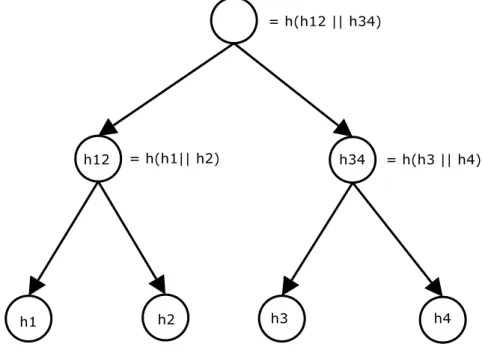
2.7 An example of a Merkle Hash Tree . . . 30
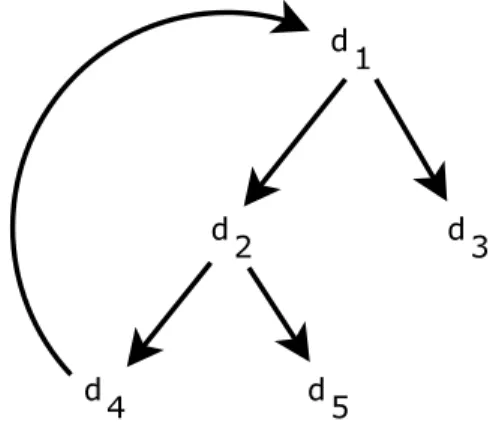
3.1 Example of a cyclic document structure . . . 35
3.2 The two security classifications in the meeting protocol policy . . . 47
4.1 Example of a document and its structure in Infologic . . . 52
4.2 Example of how documents are stored in a repository in Infologic . . . 52
4.3 A document expressed with the document management framework . . . 55
4.4 Overview of information flow in Infologic . . . 56
4.5 A more detailed figure of how information flow from Infologic . . . 56
4.6 Exporting and importing documents in Infologic . . . 58
4.7 Approval and publishing procedures . . . 59
List of Tables
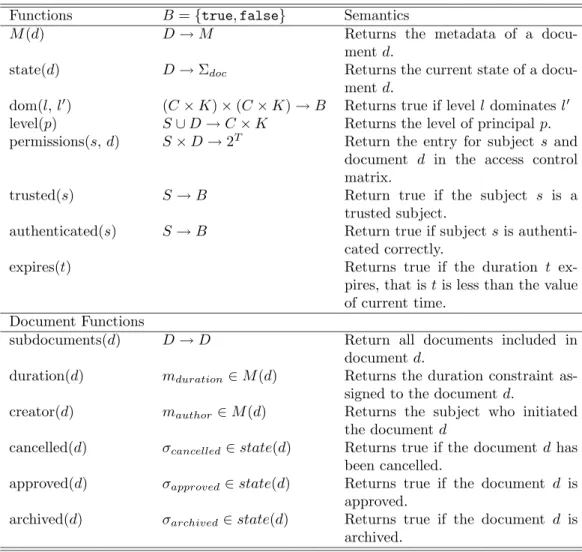
3.1 Specification Functions . . . 39
3.2 Utility Functions . . . 40
3.3 Example of an access control matrix . . . 40
3.4 Authorization Functions . . . 41
3.5 Access control matrix in a meeting protocol management system . . . 48
3.6 Operations in a meeting protocol management system . . . 48
4.1 Principals in Infologic . . . 57
4.2 Example of an access control matrix in Infologic . . . 57
4.3 Security classifications in Infologic . . . 58
4.4 Category combinations in Infologic . . . 58
4.5 The security levels of the principals in Infologic . . . 59
4.6 Operations . . . 60
Chapter 1
Introduction
A common requirement in software development today is that the product must be secure, but with no consideration of what security is, it is difficult to validate that the product is actually secure [1]. Is a software that encrypts all data by default a secure software? When is the security of a system breached? Security in a system is often only specified by an informal consensus among the participants, a specification prone to be ambiguous [2].
Bishop, author of the book Computer Security - Art and Science [3], emphasizes that a distinction between policy and mechanism is critical in the study of computer security. A security policy specifies what is allowed and not allowed in a software or a computer system, that is, it specifies what is secure and insecure. A security mechanism is a method, tool or procedure to enforce a security policy. Without an unambiguous specification it can be difficult to implement the “right” mechanisms and detect the real threats.
1.1
Background
Zert AB1is a company that develops software and offers services in the area of risk manage-ment. One of the critical tasks in risk management is document management, ensuring that integrity and consistency of the documents are maintained. To facilitate the management and development of product manuals in multiple languages, Zert AB offers a product called Zert Infologic2. A new version of Infologic is planned to be developed and it is important
this version is secure. There exists an industry standard for electronic document manage-ment systems called SS-EN 82045-1 [4]. The purpose of the standard is to ensure a certain level of quality assurance in an organization, and because a quality assured organization must be able to use this product, it is essential that Infologic also follows this standard.
1.2
Thesis Description
To define security in Infologic, the question to what is allowed and not allowed in Infologic must be answered.
1
Official homepage athttp://www.zert.se
2
The shorter name Infologic will be used from now on.
1.2.1
Goal
The goal of this master thesis project is to analyze what a secure document management system is, develop a framework to specify a security policy for this type of application, obtain a security policy for Infologic, identify the security mechanisms to be implemented and develop the requirement specification (with respect to security) for Infologic.
1.2.2
Purpose
Different types of security policies focus on different security properties3. Already in the
early 70s, Bell-LaPadula introduced a security policy with focus on confidentiality [5, 6] and both Biba [7] and Clark-Wilson have introduced policies with focus on integrity [3]4.
A combination of different types of policies yields a hybrid policy such as the Chinese Wall model [3]5 with focus on conflict of interest.
As both integrity and confidentiality are important properties in document management, it is interesting to study whether a combination of these policies can be used to develop a framework to specify security policies for a general document management system that follows the SS-EN82045-1 standard.
1.2.3
Method
First, the security aspects inferred by the SS EN-82045-1 document standard must be ob-tained and from these aspects, the requirements for the document management policy frame-work are specified. These requirements specify what must be considered when the frameframe-work is developed. Then, a threat analysis of Infologic is performed and with the framework a security policy for Infologic is written as a reference implementation to the framework. Fi-nally the security mechanisms to enforce the Infologic security policy are discussed, and a requirement specification (with respect to security) for Infologic is specified.
1.2.4
Report Outline
The outline of this thesis report is to first present basic and general theory for the presented work. Then the developed security policy framework is introduced followed by the reference implementation, a security policy for Infologic to be delivered to Zert AB. Finally, the requirement specification for Infologic is presented followed by a conclusion.
1.3
Related Work
The importance of involving security at an early stage of software development was also identified by Doan et.al. [1] which introduced a framework for secure software design. They proposed an approach to incorporate security in object oriented software development, by assigning security levels to elements, use cases, classes and sequence diagrams in UML (unified modeling language).
A document management system must be able to store documents, for example, in a content repository. Devanbu et.al. [10] addresses the problem with publishing information
3
These properties are described in more detail in section 2.3.1.
4
As presented in Bishop’s book “Computer Security” because the author of this thesis was unable to obtain the source article [8].
5
Also as presented in Bishop’s book “Computer Security” because the author of this thesis was unable to obtain the source article [9].
1.3. Related Work 3
from integrity critical databases, e.g. financial information, over a public network. The proposed solution reduces the trust required of the publisher by separating the roles of owner and publisher. Trusted signatures and techniques based on Merkle Hash Trees provide authenticity and non-repudiation.
These techniques were also found to be quite useful when publishing structured docu-ments as XML docudocu-ments [11]. XML is a format often used in information exchange and in this extension to [10], it is proposed that the authenticity of path queries and selection queries can be guaranteed without the need for trusted online signing keys.
Another problem, addressed by Liu et.al. [12], is that digital signatures do not feel as authentic as traditional seals, a cultural gap exists. They propose a solution where a visual image is incorporated in the document and then the document is digitally signed, as an extension to the X.509 v3 certificate structure.
Chapter 2
Background Theory
This chapter presents the necessary theory for the work of this thesis project. The document management standard is first described, followed by some basic theory in computer science and computer security. It is recommended to read this chapter but anyone with expert knowledge in computer security can skip the basic theory and only read the description of the document management standard.
2.1
Document Management Standard
The intended purpose for the SS-EN 82045-1 standard [4] is to be used in computerized systems, e.g. electronic document management systems or other electronic systems for product data.
2.1.1
Principles
The standard defines that each document is associated with a collection of metadata, or in other words, data that identifies and describes the document. The metadata can be implemented:
– as visual parts of a document.
– in a document file transferred between document management systems.
– associated with a document in a document management system.
– as a separate collection of data stored independently of the document.
A document is a single document, a compound document, an aggregated document or a document set. For example:
– text documents.
– diagrams, maps, etc.
– hypertext documents, HTML, XML, etc.
– multimedia documents.
A single document is a document associated with its own metadata, for example a business letter or a PM. A compound document is a single document consisting of other types of documents, e.g. a document including a spreadsheet. An aggregated document is a composition of documents, where each document is associated with its own metadata. The compound document has metadata but is not necessary a separate document of its own. A hypertext document is an example of a compound document. A document set has metadata describing the purpose with the set and a list of including documents. Every document in the set has metadata.
All documents must be version controlled, a modification to the content of a published document will create a new version of that document.
2.1.2
Document Life Cycle
The life cycle of a document can be divided into the following phases:
– Initiation – Development – Approval – Revision – Archival – Cancellation – Deletion
A detailed description of each phase above follows.
2.1.3
Initiation
This is the phase where the document is initiated. A document must be assigned a unique identification. The identification must be stable and not depend on how the document is presented. This phase does not include adding contents to the document, that is writing the document.
The visual appearance of a document can be controlled with style sheets or other types of electronic templates. A document is equal to another document as long as the contents is the same.
A document can have a classification to simplify the process of searching for relating documents. All the necessary information are stored in the metadata of the document and SS-EN 82045-1 suggests the following information1:
– the owner of the document.
– a document identifier.
– the title of the document.
– date of initiation and expiration date.
1
2.1. Document Management Standard 7 – a classification.
– security classification that can be changed without affecting the document version.
– access rights for persons and organizations.
– in the case with multiple languages the origin (native language) must be identified, that is which document is translated?
2.1.4
Development
This phase begins after the initiation phase and represent the activity of writing the actual document. The metadata could include:
– progress level.
– list of keywords.
– a summary.
– the source of the document.
All documents are stored in a storage or a so called electronic vault.
2.1.5
Approval
To ensure quality, every document must pass an approval process. A process defined by the organization, for example a document is first controlled internally by the organization (experts, etc) before the document is accessible by the public. The purpose is to check that the contents of a document agrees with the intended purpose of the document. A document must be under version control before the approval process can begin and it is important that all changes to a approved document are traceable. The following information is then added to the metadata:
– name of the person that approved the document and the approval date.
– comments related with the approval process.
All documents under version control are also stored in the electronic vault but the modifi-cation of the contents of a specific version must be prevented.
2.1.6
Revision
A revision to a document is either a modification of the contents or an alteration of the purpose of the document. It is important that every revision undergoes a controlled revi-sion process. The contents of a published document verrevi-sion can not be modified without initiating a new document version. This adds the following information to the metadata:
– name and organization responsible for the modifications.
– what has been done.
– when it was done.
2.1.7
Archival
A selection of document versions are stored in a physical more compact and not modifiable form, including the associating metadata. A purpose of archiving documents is for example to fulfil legal requirements or other obligations. The contents and the metadata of an archived document must be reproducible and prevented from modification. Also, the access to the document must be controlled.
For long-term archiving purposes the metadata of the archived document is comple-mented with:
– expiration date.
– access rights.
– security level.
– usage of digital signature.
– backup information.
2.1.8
Deletion
When all legal obligations of a document are expired, the contents and metadata of a document can be deleted. The document is also removed from the electronic vault. A deletion should also destroy all physical instances of the document, e.g. CD-ROM, video tape, etc.
2.2
Basic Theory
This section gives some basic knowledge in mathematics and computing science but anyone with good knowledge in set theory and computing science can preferably skip this part. The material in this section is adapted from a course text book in discrete mathematics [13] and the Wikipedia2.
2.2.1
Basic Set Theory
A set is an unordered collection of elements. An element in a set only exists once and ordering of the element is not considered, which means that the setA={1,2,2}is identical to B ={1,2} and set C={1,4} is identical toD ={4,1}. A set can have a finite or an infinite number of elements. A set with 0 elements is called thenull set or theempty set, Ø. The set of natural numbers is a set of infinite number of elements.
Subsets
Asubset AtoBis a set where every element inAis also a member inB, denoted asA⊆B. Aproper subset is a subsetAtoB andA is not equal toB,A⊂B. For example:
– The set of all men is a proper subset of all people.
– {1,3} ⊂ {1,2,3,4}
2
Wikipedia (http://wikipedia.org) is a free-content encyclopedia started in January 2001 and is available online.
2.2. Basic Theory 9 – {1,2,3,4} ⊆ {1,2,3,4}
The null set is a subset to every set Ø⊆Aand every set is a subset to itself,A⊆A.
Unions
The set of all elements which is either member inAor inB is denotedA∪Band called the union ofA andB. Basic properties of unions:
– A∪B=B∪A – A⊆A∪B – A∪A=A – A∪Ø =A For example: – {1,2} ∪ {a, b}={1,2, a, b} – {1,2, a} ∪ {a, b, c}={1,2, a, b, c} – {1,2} ∪ {1,2}={1,2} Intersection
The set of common elements of two sets A and B is called the intersection of A and B
which is denoted asA∩B. Twodisjoint sets are sets where the intersection is the empty set,A∩B= Ø. For example:
– {1,2} ∩ {a, b}= Ø
– {1,2, a} ∩ {a, b, c}={a} – {1,2} ∩ {1,2}={1,2}
Some basic properties of intersections:
– A∩B=B∩A
– A∩B⊆A
– A∩A=A
– A∩Ø = Ø
Complement
Therelative complement ofAin B is denoted byB\A, which is the set of all elements in
B but not inA, comparable with “subtraction”. Examples:
– {1,2} \ {a, b}={1,2} – {1,2, a} \ {a, b, c}={1,2}
2.2.2
Cartesian Product
Thecartesian product is the set of all ordered pairs of the setsX andY. Cartesian product of the setsX andY is denoted asX×Y. The set is defined as:
X×Y ={(x, y)|x∈X, y∈Y}
An example illustrates this relation.
Example 2.2.1: SetX is{A, K, Q, J,10,9,8,7,6,5,4,3,2} and setY is
{spades, hearts, diamons, clubs}then the cartesian product of these sets,X×Y is the set:
{(A, spades),(K, spades), . . . ,(2, spades),(A, hearts), . . . ,(3, clubs),(2, clubs)}
This product can be generalized to then-ary cartesian product which is defined as:
X1×. . .×Xn={(x1, . . . , xn)|x1∈X1, . . . , xn∈Xn}
For example, the set of all coordinates in a 3-dimensional cartesian coordinate system is
R×R×RandRis the set of all real numbers.
2.2.3
Powerset
Thepower set of a set S is written asP(S) or 2S, which is the set of all subsets ofS. For
example the setS ={A, B, C} has these possible subsets:
– {}(empty set) – {A} – {B} – {C} – {A, B} – {A, C} – {B, C} – {A, B, C}
Thus, the power set 2S is
{{},{A},{B},{C},{A, B},{A, C},{B, C},{A, B, C}}.
2.2.4
Lattice
In mathematics, a lattice is a partially ordered set (poset) where any two elements have a least upper bound and a greatest lower bound.
A partially ordered set is a set with a special relation that formalize the ordering of elements in a set. The relation is a binary relationR over a set P. A binary relation that isreflexive,antisymmetric andtransitive. For alla, bandcin P:
2.3. Defining Security 11 – ifaRbandbRathena=b (antisymmetry)
– ifaRbandbRcthenaRc(transitivity)
Example2.2.2: Consider some setPand the relation≤onP. Then≤is a partial ordering
relation if the conditions above are met, that is it is reflexive, antisymmetric and transitive (note that the ≤is only an example and could be an arbitrary binary relation where the conditions holds). For alla, bandcinP.
– a≤a(reflexivity)
– ifa≤bandb≤athena=b (antisymmetry)
– ifa≤bandb≤cthena≤c(transitivity) Now consider a partially ordered set (L,≤).
Definition 2.2.1. Lis a lattice if for all elements xandyof a partially ordered set L, the set{x, y}has both a least upper bound (supremum) and a greatest lower bound (infimum). The least upper bound is the greatest element of a partially ordered set. The greatest element of a subset S of a partially ordered set is an element of S which is greater than or equal to any other element ofS. Formally, given a partially ordered set (P,≤) then an elementg ofS⊆P is the greatest element of S if
1. s≤g, for all elementssofS
Infimum are dual to the concept of supremum, that is infimum of a subset of some set is the greatest element that is smaller than all other elements of the subset. Formally, the infimum of a subsetS of a partially ordered set (P,≤) is an elementl ofP such that:
1. l≤xfor allxinS, and
2. for anypinP such thatp≤xfor allxinS it holds that p≤l.
To summarize, a lattice (in mathematics) is a partially ordered set in which all nonempty finite subsets have both a supremum and an infimum. The term is derived from that a Hasse diagram [13] of this particular types of posets has the shape of a lattice.
2.3
Defining Security
Security engineering is a discipline that focus on building systems to withstand threats such as malicious attacks, errors, user mistakes and misfortune. Security engineering is common compared with software engineering. An area that focus on ensuring that things can be performed. In addition security engineering also focus on the things that must not be performed. In reality, it is far more complex since requirements of systems vary and system fails because designers often protect the wrong things [2].
An article [14] published in Security Focus News3 enlightens this complexity. The FAA
(Federal Aviation Administration) was supposed to perform a certification of the computer security at major traffic control centers in the U.S, but when the security certification was
3
Security Focus is a vendor-neutral site that provides security information to all members of the security community. Security Focus News offers news stories related to security and written by the SF staff.
audited by the Department of Transportation’s Office of Inspector General, it was found that the systems were still not sufficiently secured against attacks. The problem was how the certification was performed, and a major complaint was that the certification process was limited to only developmental systems and that deployed systems were overlooked. Another issue was that only major computer servers were checked and not end-user computers, with the result that many workstations on the network were never checked for vulnerabilities.
The notion that the security was insufficient was verified by an incident where controllers were not able to communicate with the planes for three hours. The computer controlling the radio system has crashed, and Los Angeles Times reported that it was caused by a worker neglecting to perform the monthly reboot of the computer, with the consequence that the computer was automatically shutdown after 49.7 days.
With the wider usage of computers and the increasing connectivity, the society is faced with a new type of threats. Attacks today is not only performed by hackers, hacking systems for fun, it has emerged to become a tool for terrorists. For example, a computer controlling the life support system for the South Pole Station, housing 50 scientists, was hacked during the most dangerous season in South Pole [15]. The station received an email demanding money and threatened to sell obtained information. In this case the attacker was captured before any harm was done, but this emphasize the importance of secure systems in every domain of the society.
But, what do we actually mean when we discuss computer security? What is a secure system, is there any definition of a secure system, and is it possible to have a complete secure community? What differs from security in the non-virtual society?
2.3.1
Terminology
Frequently used terms in computer security are defined here (from [2, 3, 16]):
An object is an entity that should be protected or in other ways relevant to the system and asubject is a user or a program (process). When both objects or subjects are referred to, they are called principals. Other presented definitions in section 2.3 are taken from [3, 16] unless otherwise noted.
There are three basic aspects in computer security: confidentiality, integrity and avail-ability. Anderson [2] argues that there are more aspects than these, but this thesis will use Bishop’s [16] view on security with only three aspects.
Confidentiality
Theconfidentiality aspect concern all access restrictions to information and resources. In-formation can be hidden or scrambled to limit the access to only concerned parties, or the information is protected by a virtual barrier enforced with for example the access control of an operating system.
Existence of data may also apply to confidentiality, because the existence may reveal more than the data itself. For example the number of employees who distrust a manager may not be as important as for the managing group to know that such poll was performed. Another example, if your organization normally never encrypt email, someone monitoring the traffic could conclude that something is about to happen when suddenly all emails are encrypted.
Hiding resources is also an important part of confidentiality, because the notion of system configuration and what operating systems are used, can help an attacker to find the weakest link in your protection.
2.3. Defining Security 13
Contrary to Anderson [2], secrecy and privacy is covered by the confidentiality aspect. Withsecrecy, it means to limit the amount of people having access to the information and privacy is the ability to protect personal secrets. Bishop makes no distinction between secrecy, privacy and confidentiality. The formal definition of this property follows.
Definition 2.3.1. Let X be a set of entities and let I be some information. Then I has the property ofconfidentiality with respect toX if no member ofX can obtain information aboutI.
Information is confidential to an entity if the entity is a member of the group that may not access the information. Thus, some entities have access to the information and the entities that do not, make up the setX.
Integrity
How much data can be trusted or the trustworthiness of data and resources is the aspect of integrity. It can be divided into data integrity, that is the integrity of the contents, and origin integrity, the source of the data is correct, which is also called authentication. Integrity violations can either beprevented or detected.
Prevention mechanisms tries to prohibit any unauthorized operations that attempts to change the data. A user can try to change data for which he or she is not authorized for or an authorized user can try to change the data in other ways than allowed, i.e. authorized user performing an unauthorized operation. Bishop gives a good example to explain this difference. Suppose an accounting system is running on a computer and someone hacks into the system and tries to modify the data, that is an unauthorized user tries to violate the integrity of the system. But what if an hired accountant tries to steal money by modifying the data and virtually transfer money to his own account, that is an authorized user tries to perform an unauthorized operation.
The detection mechanism tries not to prevent modification, rather making it possible to detect any modification violating the integrity. The data may be reported to be no longer trustworthy.
Definition 2.3.2. LetX be a set of entities and letI be some information or a resource. ThenI has the property ofintegrity with respect to X if all members ofX trustI.
Information I could also be information about origin or identity, the members of X
trust that this information is correct and this type of integrity is also known as authentica-tion. WhenI is a resource this definition defines that the resource is working correctly (as specified).
Availability
The ability to access information or a resource is referred to availability. A service can deliberately be blocked by an attacker making this aspect a part of computer security. These attempts are calleddenial of service attacks, or DOS-attacks for short, and can be difficult to identify and seperate from increased normal-usage. For example, if you are running a popular web site and suddenly one day the site hits a peak in load. Has the site become very popular and you have not enough servers to handle this increased popularity, or is it an attacker performing a denial of service attack? By manually analyzing every request, you would be able to conclude whether it is an attack or not, but it is difficult for a mechanism to prevent and detect the attack, because it would require usage-pattern analysis.
Definition 2.3.3. Let X be a set of entities and let I be a resource. Then I has the property ofavailability with respect toX if all members ofX can accessI.
2.3.2
Security Policy
An approach to security engineering is to structure the work in the order: threat model -security policy -security mechanisms [2]. A more software engineering adapted approach is to use a security engineering life cycle, which begins with analyzing the threats, define the policy, specify the security policy in a specification, design the system to follow the policy, implement mechanisms to ensure that users can not violate the policy and (as in software engineering) support maintenance [3].
Common with both approaches is that the most neglected part is the security policy and many organizations define the policy from vague statements [2]. A security policy should clearly state what is allowed and not allowed by the system and its participants. An example of a weak policy is found in Figure 2.1.
This policy is approved by Management. All staff should obey this security policy.
Data shall be available to those with a “need-to-know”.
All breaches of this policy shall be reported at once to Security.
Figure 2.1: An example of a weak security policy (adapted from Anderson’s book [2]) This policy adds more questions than answers, for example what or who determines which staff members need to know and are allowed to access the data? The policy also includes a mechanism with the statement that “all staff should obey...”. Is this enforced by the system or is it up to the staff members to be honest? It is clear that a distinction between policy and mechanism must be made.
Definition 2.3.4. Asecurity policy is a statement of what is, and what is not, allowed.
Definition 2.3.5. A security mechanism is a method, tool, or procedure for enforcing a security policy.
The difference can be illustrated with an example. A university has a policy that states that copying the work of another student is not allowed, in other words cheating is not allowed. The computer system at this university has a mechanism that prevents others from reading a user’s file. A student, Anna, has failed to use this mechanism correctly and forgot to protect her solution for an assignment, and the desperate student Johan (who must hand in the solution to the very same assignment in only one hour and has not even started) copies Anna’s assignment. Security is clearly breached since this is an attempt of cheating, but which one of them has breached the security?
Despite the fact that Anna has failed to protect her files, which should be fairly simple in this case, she has not breached security because the policy never states that a user must protect his files. Johan, on the other hand, has breached security because the policy clearly states that it is not allowed to copy another student’s work. In this case it would be simple for Anna to protect her work, but this may not always be the case. For example, if the solution was supposed to be mailed to the teacher, the network may not have adequate mechanisms to protect her work.
2.3. Defining Security 15
It is also possible to have a very weak security policy even when the mechanisms are sound [17]. For example the policy could state that all access must be authenticated and enforcing this authentication with passwords is a fairly strong mechanism, but a user could systematically always choose the same password as her login name without violating the policy.
Security policies may also be presented formally as a list of secure and non-secure states. Consider a computer system as a finite-state automaton with a set of transitions functions then a security policy can be defined as:
Definition 2.3.6. Asecurity policy is a statement that partitions the states of the system into a set ofauthorized, orsecure, states and a set of unauthorized, ornon-secure, states. And the definition of a secure system follows directly:
Definition 2.3.7. Asecure systemis a system that starts in an authorized state and cannot enter an unauthorized state.
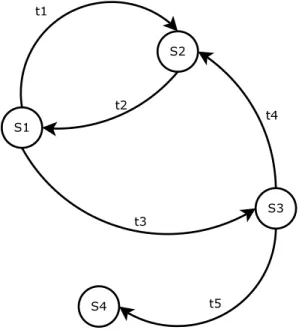
An interesting fact derived from these definitions is that the very same system may be secure under one policy but not under another policy. If the environment changes and the policy too, the system that used to be secure may no longer be secure. An example of a finite-state machine is presented in Figure 2.2. A security policy partitions the states into a set of secure statesA={s1, s2} and insecure statesU A={s3, s4}. Is this system a secure
system?
Figure 2.2: Example of a finite-state machine and in this example the secure states are s1
ands2
No, because there exists a transformation t3 that takes the system from a secure state s1
to a (by the policy specified) unsecure states3. Then, a formal definition of security breach
can be introduced.
The set of all possible states in a system is the set P and the subsetQ ofP is the set of all authorized states. A secure system has a system state that is always inQ, and if the system is inP\Qthe system is unsecure. The function of asecurity policy is to defineQand security mechanisms should prevent a system from entering a state inP\Q. A model that can precise these states in P4 are the access control matrix model introduced by Lampson
in 1971 [18].
2.3.3
Access Control Matrix Model
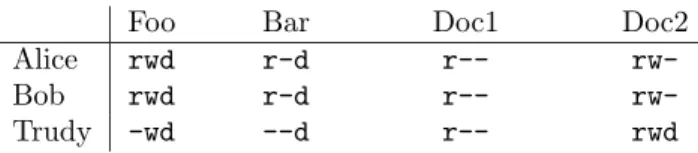
The access control matrix is a simple framework to describe the relationship between subjects and objects in a system. For example, this model is used in both operating systems and database systems.
An access control matrix is a systematic way of describing shared data or resources and controlling the access to these shared things. Lampson defined a system with a set of objects
O, a set of subjects5Sand an access functionAwhich is called an access matrix . An object
is an entity to be protected, a subject is an entity which has access to an object and which subjects can access which objects are determined by the access matrix. The rows of the access matrix are labeled by the subjects and the columns by the objects, thus element
A[i, j] specifies the access subjectihas to objectj. An element consists of a set of strings that specifies what type of access a subject has (access attributes or access permissions). For example “read” and “write” are typical access attributes but others can be specified as well. Figure 2.3 shows an example of an access matrix.
Subject 1 Subject 2 Subject 3
File 1 File 2 Process 1 Subject 1 owner, control owner, control call owner, read, write Subject 2
call read write wakeup Subject
3
owner, control
read owner
Figure 2.3: Portion of an access matrix (adapted from [18])
In this example,Subject 1hasread access toFile 1and hasowner access to both itself and Subject 2. It shows that a subject can also be an object if access to a subject must also be controlled.
Harrison et.al. [19] introduced a model to modify an access matrix by defining a set ofprimitive operations that alters the matrix. Formally an operation moves the system in state (S, O, A) to another state (S0
, O0
, A0
). The operations Harrison et.al. defined are: 1. Operationenterr intoa[s, o]
Add the rightrto the cella[s, o] in the access matrix. Ifa[s, o] already containsrthe operation has no effect.
4
The set is calledP from the termprotected states, that is the states which are protected by the access
control model.
5
Lampson originally called the set of subjects for the domain but the more “modern” term subject will be used in this thesis.
2.3. Defining Security 17
2. Operationdeleterfrom a[s, o]
Remove the rightrfrom the cella[s, o] and in the same way as inenterifris not in
a[s, o] the state is unchanged. 3. Operationcreate subjects
Adds a new row to the access matrix for subjects. The subject must not already exist in the matrix.
4. Operationcreate objecto
Adds a new column for objecto if the object not already exists. 5. Operationdestroy subject s
Removes a subject sfrom the access matrix. 6. Operationdestroy objecto
Removes an objecto from the matrix.
These operations can then be used to create new commands. For example creating a file in the UNIX file system could be performed by executing these primitive operations.
command create_file(p, f) create object f;
enter own into a[p, f]; enter r into a[p, f]; enter w into a[p, f]; end
In the example, a processpcreates a filef with read (r) and write (w) rights by the owner, and creating a new processqby an existing processpcould be performed with the following command:
command spawn_process(p, q) create subject q;
enter own into a[p, q]; enter r into a[p, q]; enter w into a[p, q]; enter r into a[q, p]; enter w into a[q, p]; end
The new processqis owned by the spawned processpand therandwrights make it possible for the processes to communicate with each other. Both examples above were adapted from Bishop’s book in computer security [16].
A security policy can use two types of access control: discretionary access control or mandatory access control and these can be used separately or combined.
2.3.4
Discretionary Access Control
In discretionary access control (DAC) it is left to the owner’s own discretion to determine the access to her files. This is the most common type of access control. For example, suppose a person is writing a self biography. She controls who is allowed or not allowed to read the biography. Her closest friend and mother are allowed to read it, but not her colleagues at work.
Definition 2.3.9. If an individual user can set an access control mechanism to allow or deny access to an object, that mechanism is adiscretionary access control (DAC).
2.3.5
Mandatory Access Control
Access control where the owner can not control who can access the owned objects is called a mandatory access control.
Definition 2.3.10. When a system mechanism controls access to an object and an indi-vidual user cannot alter that access, the control is amandatory access control (MAC). Information about both the subject and the object which the subject wants to access, is used to determine (by an external mechanism) whether the access is allowed or not. For example, a court could access a person’s criminal register without asking for consent by the person in question.
Now, some existing security policies, each with focus on one of the three security proper-ties described in section 2.3.1 are presented. A security policy with focus on confidentiality is simply called a confidentiality policy and a security policy dealing with integrity is called an integrity policy.
2.3.6
Bell-LaPadula Model
A confidentiality policy should prevent the disclosure of information and restrict the infor-mation flow. It is also referred to as aninformation flow policy. A model that has influenced a lot of other models are the Bell-LaPadula model [5, 6] and based on this model, Denning [20] provided a unifying view of all systems that restrict information flow. There are typing systems, based on this model, to capture the flow of information in a programming language [21] and compile-time certification of secure information flow [22].
This model corresponds to the security classifications used in military systems. The phrase “information is on a need-to-know basis”, used in more than one Hollywood movie, comes from this style of classifications. It is also called multilevel security, because informa-tion and subjects are placed in levels and informainforma-tion can only flow from a lower level to a subject on a higher level or same level.
Information at a higher level are more sensitive (and more important to keep confidential) than information at a lower level. A subject has asecurity clearanceand an object asecurity classification. Thus, objects at a higher security classification are not readable by a subject of lower clearance. An example of a classification system is shown in Figure 2.4 on the next page.
This model combines discretionary access control with mandatory access control in the order that if mandatory access was removed from the model, access are still controlled discretionary. To be able to really enforce the “need-to-know” principle, information flow at the same level must also be restricted, the model is expanded with a set of categories. All classifications are also assigned a category where the category should describe the type
2.3. Defining Security 19
TOP SECRET (TS) Thomas, Tammy Personnel Files
| | |
SECRET (S) Samantha, Sandra Electronic Mail Files
| | |
CONFIDENTIAL (C) Catarina, Claire Activity Log Files
| | |
UNCLASSIFIED (UC) Ursula, Ulaley Telephone List Files
Figure 2.4: Example of a basic classification system (adapted from [16]). The most sensitive level is at the top and subjects and objects are associated to the classification on the same row
of information, or the class of information. Objects can also be placed in more than one category at a time. The combination of a security classification (or clearance) and a security category form a security level. A subject is said to be cleared into a security level and an object is classified with a security level.
Let {NUC,EUR,US} be the set of all categories in a classification system. A person with access to the category set{NUC,US} does not have access to an entity of the category EUR. Even if this person has a higher security clearance than the entity, the person is not allowed to read the object. However, if the object is in any of the combinations of∅,{NUC},{US}this person may access the information. This relation is defined and calleddom (dominates).
Definition 2.3.11. The security level (L, C) dominates the security level (L0
, C0
) if and only ifL0
≤LandC0
⊆C. This forms a lattice6 under the
⊆ordering relation [20].
Example 2.3.1: (adapted from [3]). George has the security level (SECRET,{ NUC, EUR
}), document d1 is assigned (CONFIDENTIAL, { NUC }), document d2 has classification
(SECRET{EUR, US}), and documentd3is classified to (SECRET,{EUR }).
a) Georgedom d1because CONFIDENTIAL ≤SECRET and{ NUC} ⊆ { NUC, EUR}.
b) George¬dom d2 as {EUR, US}({NUC, EUR}.
c) Georgedom d3as SECRET ≤SECRET and {EUR} ⊆ {NUC, EUR}.
Bell-LaPadula defined two conditions called simple security condition and *-property (pronounced star-property). Simple security condition is also called “no reads up” (NRU) property, which means that information is not allowed to flow from higher to lower level. LetS be the set of subjects and O be the set of objects, the simple security condition can be defined as:
Definition 2.3.12. S can read O if and only if S dom O and S has discretionary read access toO.
The next condition, the *-property, is often referred to as “no writes down” (NWD) specifying that it is not allowed by a subject of higher clearance to write to a document at a lower level. If this was allowed, information at a higher level could be transferred to a subject at a lower level, with the help of a malicious subject adding the higher classified information to a document at a lower (and same) level as the low-level subject.
6
Definition 2.3.13. Scan write toOif and only ifO dom S andS has discretionary write access toO.
Asecure system is a system where both simple security condition and *-property holds. Bell-LaPadula formalizes this with abasic security theorem (according to [3]):
Theorem 2.3.1. Let Σ be a system with a secure initial state σ0 and let T be a set of
state transformations. If every element of T preserves, the simple security condition and the *-property, then everyσi, i≥0, is secure.
Let us consider a classification system with only one category and two security clearances: HIGH and LOW. What is the effect of changing the current classification of a subject or an object? If the classification of an object is raised from LOW to HIGH, then this object is no longer available to some subjects and if an object on HIGH clearance is lowered to LOW then everyone can access the object.
Raising classification (upgrading) is actually not a problem with this model, because the model only deals with manipulation of objects once their classifications are set. How and when the information is classified is not defined by the model. Allowing upgrading may violate the goals of the information flow system, since the goal of upgrading an object is to restrict access to the information. But, subjects at the lower level may already have accessed the information in prior the upgrade, and the goal of restricting the information might be violated.
A problem occurs when lowering a classification (declassification) because this is similar to a write-down. A document classified as HIGH and declassified to LOW has the effect that subjects at LOW level now can read the information written to the document. Information is written to a lower level, which is not allowed by the *-property. This problem is called thedeclassification problem.
The solution to this problem is called theprinciple of tranquility, a principle that prevents that subjects and objects change their security levels. In practice, this inflexibility could be a great limitation and is thereof divided into two forms.
Definition 2.3.14. The principle of strong tranquility states that security levels do not change during the lifetime of the system.
Definition 2.3.15. The principle of weak tranquility states that security levels do not change in a way that violates the rules of a given security policy.
The Bell-LaPadula model led to much controversy when it was introduced, and McLean [23, 24] (according to Bishop [3]) argued that the value of the Basic Security Theorem was overrated because it had no practical meaning in real systems. Bell-LaPadula responded that what they had introduced was an axiomatic model for security and Bell [25] (also according to Bishop) emphasized the nature of fundamental modeling and aspects in theory of science. Bell pointed out that the McLean model and Bell-LaPadula model defined security differently. Consider this example with two different definitions ofprime number.
Example2.3.2: Aprime number is an integern >1 that has only 1 and itself as divisors. Example2.3.3: Aprime number is an integern >0 that has only 1 and itself as divisors.
Both definitions are valid (mathematically) and consistent with the laws of mathematics. The question is, is the integer 1 prime or not? First definition says no, but the other definition says yes. Neither is “right” or “wrong”. This controversy raised questions about the very foundation of computer security.
2.3. Defining Security 21
2.3.7
Clark-Wilson Model
In systems where integrity is more important than confidentiality, it may be more interesting to have a security policy with focus on this aspect. For example, an inventory control system does not handle any confidential information but if the data would randomly change it would seriously affect the function of the system.
A model that focus on this aspect is the Clark-Wilson model [8] (according to [3]), a model based on transactions. The system is in aconsistentstate if a set of given consistency conditions hold. For example in an accounting system a consistency condition could be:
D+Y B−W =T B
D is the amount of money deposited so far today,W is the withdrawn money so far today andY Bis the total balance of all accounts at the end of yesterday. T Bis the total amount of money in all accounts so far today.
A transaction may leave the data in an inconsistent state. Consider a depositor trans-ferring money from one account to another. It requires two transactions, a withdrawal from the first account and an insertion to the other account. Each isolated transaction is incon-sistent and does not satisfy the stated consistency condition. However, both transactions combined in that order satisfy consistency. This serie of transactions are calledwell-formed transactions.
Another aspect with integrity requirements is the integrity of the transactions. Who or what examines that the transactions are well-formed? If only one person performs all depo-sitions, it is possible for that person to actually steal money from the bank. He could still perform a well-formed transaction, but to his own account. The consistency is maintained but not necessarily allowed by the bank policy. This is where the principle of separation of duty can be applied, by requiring that all depositions are performed by two different persons. In integrity policies there are three key principles: separation of duty, separation of function andauditing.
Integrity Principles
If more than one step is required for a critical operation, the principle of separation of duty states that two different persons should perform this operation. For example, if the operation is to install development code in a production system it is recommended to involve both the developer and a installer. The installer should not be anyone involved in the development. Part of this process is to validate that the code works in this new environment, and it is more likely to detect faults by a person that has not been a part of the development.
The principle of separation of function states that non-related operations or services should not be part of the same system. For example an MTA (mail transport agent) should not do anything else than deliver electronic email, making it easier to detect if it is not doing what it is intended to do. Another example is that developers do not develop code on the production system, because untested code could include errors and damage the production data.
Auditing is the process of analyzing all performed operations and who executed the operations. The purpose is to detect any unauthorized operations and other violating oper-ations. It involves logging which is the base of auditing, and thus very important to protect. A valid question is how can the integrity of logs be maintained and who audits the auditor? A solution is to apply the principle of separation of duty because auditing is a highly critical operation.
Clark-Wilson Model
Clark-Wilson defines the set of items that should be integrity controlled as the set of con-strained data items (CDI). Items which should not be controlled exist in the set of un-constrained data items (UDI). In our bank example the balance of all accounts would be CDIs. The requirement of consistency is met with a set of integrity constraints and the consistency condition in our bank example can be modeled as an integrity constraints in the Clark-Wilson model.
To conform to the integrity constraints, this model defines two sets of procedures: in-tegrity verification procedures (IVP) andtransformation procedures (TP). IVP checks that the data in a system is in a consistent state and a TP changes the state of the data in the system. The model is built of certification and enforcement rules, the first two certification rules follows.
2.3.1. Certification rule 1 (CR1): When any IVPs is run, it must ensure that all CDIs are in a valid state.
2.3.2. Certification rule 2 (CR2): For some associated set of CDIs, a TP must transform those CDIs in a valid state into a (possibly different) valid state.
In the bank example, an IVP controls that the accounts are balanced and depositing money (or withdrawal) is a TP. A set of CDIs is associated with a particular TP, called a certified relation, and letC be the certified relation. Then if a TPf operates on a CDIo, (f, o)∈C. This yields the following enforcement rule.
2.3.3. Enforcement rule 1 (ER1): The system must maintain the certified relations, and must ensure that only TPs certified to run on a CDI manipulate that CDI.
This is however not enough, an arbitrary person is not allowed to perform a specific TP. For example a janitor should not be allowed to balance an account. A user performing an operation must be added, and a set of triples (user,TP,{CDI set}) is defined. This relation capturing the association of users, TPs and CDIs, is calledallowed and enforced by:
2.3.4. Enforcement rule 2 (ER2): The system must associate a user with each TP and set of CDIs. The TP may access those CDIs on behalf of the associated user. If the user is not associated with a particular TP and CDI, then the TP cannot access that CDI on behalf of that user.
The certification for the allowed relation must also be added.
2.3.5. Certification rule 3 (CR3): The allowed relations must meet the requirements imposed by the principle of separation of duty.
Correct identification of all users performing a TP must be ensured, thus another en-forcement rule that states this must be added.
2.3.6. Enforcement rule 3 (ER3): The system must authenticate each user attempting to execute a TP.
No authentication is required when a user enters the system because the user is allowed to modify UDIs, but as soon as the user wants to modify a CDI object it must use a TP which requires authentication. Auditing in Clark-Wilson is satisfied by logging all TPs. The log in itself is a CDI and all TPs appends to the log. Yielding the following certification rule:
2.4. Enforcing Security 23 2.3.7. Certification rule 4 (CR4): All TPs must append enough information to recon-struct the operation to an append-only CDI.
2.3.8. Certification rule 5 (CR5): Any TP that takes as input a UDI may perform only valid transformations, or no transformations, for all possible values of the UDI. The transformation either rejects the UDI or transforms it into a CDI.
This certification rule states that information must not be certified when it enters the system. For example, a person depositing money in an Automated Teller Machine (ATM) could have by accident entered an incorrect amount of money deposited. This discrepancy will be detected by the personell when the ATM is opened and fixed before the deposit enters the account. In this case, the UDI is the deposited amount which the person entered, and before the transaction is performed the UDI is checked (any discrepancies are fixed) and transformed into a CDI.
Enforcement rules ER2 and ER3 state that a user is associated with each TP and all users executing a TP are authenticated. It does not prevent a user from creating a TP, and associate some entities and herself with that TP. If she would associate the TP with some UDI or any other unauthorized information, she could perform acts that violated integrity constraints. To prevent this, the last enforcement rule invokes the principle of separation of duty, which states that only a certifier is allowed to change the list of entities associated with a TP, and this certifier is not allowed to execute the TP which she has certified.
2.3.9. Enforcement rule 4 (ER4): Only the certifier of a TP may change the list of entities associated with that TP. No certifier of a TP, or of an entity associated with that TP, may ever have execute permission with respect to that entity.
A correct implemented system is designed to ensure that the enforcement rules of the Clark-Wilson model are followed. The certification rules often requires some assumption of what can be trusted and enforced outside the system implementation. What is unique with this model (compared with other integrity models) is that it makes a clear distinction between certification and enforcement [3]. A system should primarily focus on implementing mechanisms to ensure that the enforcement rules are satisfied.
2.4
Enforcing Security
When it is clearly defined what security for a system means (security policy), the next activity in security engineering is to implement tools or procedures to enforce the policy. These tools and procedures are called security mechanisms, and this section will describe some of the security mechanisms available today.
A common misinterpretation of security is that strong cryptography leads to stronger security. This is not entirely false, because it has some level of correlation, but it is important to understand that it does not solve the entire problem with security. Bruce Schneier7, in the first sentence of the preface of his book “Secret and Lies” [27], says:
I have written this book partly to correct a mistake.
The mistake, according to himself, is that in his book “Applied Cryptography” [26] he has written “It is insufficient to protect ourselves with laws; we need to protect ourselves with mathematics.” which he then claims is not true. Cryptography can not do any of that. The
7
reason is not that cryptography weakened, but cryptography is a branch of mathematics and “mathematics is logical; people are erratic, capricious, and barely comprehensible”, Schneier writes. He had discovered that the weak points had nothing to do with the mathematics but with hardware, buggy software and the people.
Encrypting passwords in a password file with 1024-bits one-way encryption algorithm makes it very difficult to decrypt the password file. But, it does not protect against the lazy user choosing a weak password, for example choosing the username as the password. To obtain access to a password protected system it is not necessary to break the password file, it is easier to guess the password. The old saying, “no chain is stronger than the weakest link” is highly applicable in security engineering.
2.4.1
Authentication Mechanisms
Password is one of the many mechanisms to authenticate a person. The goal of an authenti-cation mechanism is to have a tool or procedure that guarantee the authenticity of someone. For example, a driver’s license includes a photo of the driver which then can be compared with the person in question.
Authentication mechanisms can be grouped into three categories [28], with the weakest mechanism at the top.
– Knowledge - something you know.
– Ownership - something you have.
– Biological - something you are.
Knowledge
The weakest authentication mechanisms are the mechanisms which falls into this category. Knowledge based mechanisms use some secret information, only available to the authen-ticating person, to control the authenticity of this person. Example of this mechanism are password authentication and personal questions e.g. asking for mother’s maiden name. There are psychological issues with these types of mechanisms [2]:
– Prevent disclosure of the secret information to a third-party.
– Difficulties when entering the secret information.
– Difficulties with remembering the secret information.
An attack known associal engineering is a specific type of a fraud with the aim to make a person deliberately or undeliberately disclose some secret information. For example, calling someone and by impersonating a bank clerk obtain private account information.
Another human issue is if the secret is complex it can be very difficult to enter the correct information. For example, if the password for an ATM is long and complex the user can by mistake enter the wrong password, and if the user only has three attempts (as a brute force protection) to enter a valid password for an ATM she could falsely be denied access to the machine, even though she is the “right” person.
A problem related to long and complex secrets is that the secret can be very difficult to remember. For example a long password (more than 20 letters) is hard to remember, and a common solution is to write down the password on a note. Even worse, if the note is placed in junction to the protected entity.
2.4. Enforcing Security 25 Ownership
The ownership category requires a user to have a specific physical entity, for example a physical key to a lock. However, exactly as with knowledge, it is sufficient to only have this entity and that it is the owner of the key who unlocks the lock is not guaranteed. It is common to combine this with something you know, for example to get money from an ATM it is required to have both a credit card and the password associated with this password.
Until recently, this has been a sufficient mechanism. A relative new attack against ATMs is to copy the credit card and with a camera record the password. The attack is performed by assembling a little card reader “on top” of the real reader and with a small camera the password is recorded when a user enters the password. This information is then sent to a nearby mobile unit, managed by the attacker. The attacker then creates a replica with the obtained card information and with the obtained password he / she could take money from the associated account at another ATM.
Biological
Security mechanisms in this category are also known as biometrics and are based on the physical characteristic of the authenticating user. For example, a fingerprint, voice pattern or a photograph of the person.
Biometrics can also be combined with an ownership mechanism and replace the knowl-edge based password part. A problem with biometrics is that some biometric data must be public (in comparison with passwords which can be kept as a secret), for example finger-prints can be considered to be public. An attacker could obtain someone else’s fingerprint and bypass the biometric sensors to obtain illegal access to a resource. Waldmann et.al. [29] suggest a solution to this problem by protecting the verification data (digital representation of a fingerprint) transmitted between the biometric sensor and the ownership entity, for example a smart-card. This mechanism can be intrusive and in some cases a threat to the personal integrity, which could be an explanation to its limited use.
2.4.2
Access Control Mechanisms
An access control matrix is suitable for modeling access control but not necessarily a very efficient mechanism as it does not scale well. For example, an organization with 1000 employees and 10000 applications and documents would create a matrix with 10 million entries. There are basically two ways of implementing an access control matrix, either by columns (access control lists) or rows (capabilities). To obtain effective access control it must be combined with some kind of authentication of the subjects.
Access Control Lists
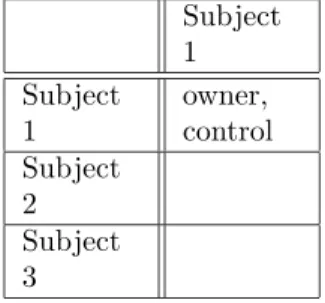
Storing the access control matrix a column at a time is also known as access control lists (see Figure 2.5 on the following page). An access control list contains a list of subjects and their access permissions for a specific object. Access control list is an advantage when the access control are discretionary, that is the users manage their own file security or the protection is data-oriented. It should not be used in an organization with many users (the access lists tends to grow) and the user population is constantly changing. When a subject (a user) is removed from the system, the subject must be removed from all objects in the system. Also, it can be very time consuming to find all objects a user are authorized to use.
Subject 1 Subject 1 owner, control Subject 2 Subject 3
Figure 2.5: Column-wise representation of an access control matrix is called an access control list
Example of an operating system that invokes access control lists is Unix8(and its variant
Linux). Files have the access rights of rwx, rights to read, write and execute a file. These access rights can be set for the owner, a group and others in the system. For example (adapted from [2]):
drwxrwxrwx Alice Accounts
The first flag indicates that the file is a directory, the first group determines the owner-access, the second the group rights and last the access rights for others. Then the owner and the group of this directory is specified. In this example anyone has full access to this directory. In the next example, the owner (Alice) has both read and write permissions and the group (Accounts) has only read permissions.
-rw-r--- Alice Accounts
A more fine-grained control over this simple access control can be achieved with the POSIX Access Control Lists [30], available for Unix and recently also available for Linux. This is an extension of the access control mechanism presented above with aminimal access control list and an extended access control list. The extended ACL adds the possibility to mask access permissions, giving access control with higher granularity.
Capabilities
When the matrix is stored a row at a time it is known ascapabilities (see Figure 2.6 on the next page), and the advantages and disadvantages are the opposite of access control lists. It is called capabilities because it models what a subject is capable of. A subjectSubject 1 is for example capable of readingFile 1 and writingFile 1. Capabilities provide a more efficient runtime checking, because in many cases it is a subject that performs an operation, for example read access for a file can already be controlled before the file is found.
An operating system to implement capabilities is Windows 2000, with a mechanism that overrides or complement the ACL in NT4. An object-oriented database called an Active Directory manages all groups and stores the permissions for each group. The database is indexed and searching can be performed on any attribute. For example, in Windows 2000 there exists a special type of program running in the background calledservices. The policy that only administrators can start and stop services is enforced by creating a group that is
8
![Figure 2.3: Portion of an access matrix (adapted from [18])](https://thumb-us.123doks.com/thumbv2/123dok_us/1578584.2712243/28.892.183.735.529.697/figure-portion-access-matrix-adapted.webp)
![Figure 2.4: Example of a basic classification system (adapted from [16]). The most sensitive level is at the top and subjects and objects are associated to the classification on the same row](https://thumb-us.123doks.com/thumbv2/123dok_us/1578584.2712243/31.892.242.685.118.252/figure-example-classification-adapted-sensitive-subjects-associated-classification.webp)