OCC ASIONAL PAPER SERIES
NO. 47 / JUNE 2006
THE REFORM AND
IMPLEMENTATION OF
THE STABILITY AND
GROWTH PACT
by R. Morris,
H. Ongena and
L. Schuknecht
ISSN 1607148-4 9 7 7 1 6 0 7 1 4 8 0 0 6In 2006 all ECB publications will feature a motif taken from the €5 banknote.
OCC ASIONAL PAPER SERIES
NO. 47 / JUNE 2006
THE REFORM AND
IMPLEMENTATION OF
THE STABILITY AND
GROWTH PACT
by R. Morris,
H. Ongena and
L. Schuknecht
1This paper can be downloaded without charge from http://www.ecb.int or from the Social Science Research Network electronic library at http://ssrn.com/abstract_id=807424.
1 The authors would like to thank Pierre van der Haegen, Philippe Moutot, Danielle Franco, Elena Flores, Marco Buti, Manfred Koch, Peter Wierts, Bernhard Manzke, the members of the Fiscal Policies Division of the ECB, in particular Marco Catenaro, José Marín, Philip Rother and Jean-Pierre Vidal, and two anonymous referees for providing very helpful suggestions. They would also like to thank Renate Dreiskena and Gerhard Schwab for their assistance in data matters. The views expressed in this paper are those of the authors and do not necessarily reflect those of the ECB.
© European Central Bank, 2006 Address Kaiserstrasse 29 60311 Frankfurt am Main Germany Postal address Postfach 16 03 19 60066 Frankfurt am Main Germany Telephone +49 69 1344 0 Website http://www.ecb.int Fax +49 69 1344 6000 Telex 411 144 ecb d
All rights reserved. Any reproduction, publication or reprint in the form of a different publication, whether printed or produced electronically, in whole or in part, is permitted only with the explicit written authorisation of the ECB or the author(s).
The views expressed in this paper do not necessarily reflect those of the European Central Bank.
ISSN 1607-1484 (print) ISSN 1725-6534 (online)
3
ECBOccasional Paper No. 47
June 2006
CONTENTS
CONTENTSABSTRACT 4
1 INTRODUCTION 5
2 SOME BACKGROUND TO THE SGP: THE
POLITICAL ECONOMY OF FISCAL RULES 5
2.1 Deficit and spending biases 5
2.2 The role and design of fiscal rules 8 3 THE EMU FISCAL RULES AND THEIR
IMPLEMENTATION: FROM MAASTRICHT
TO THE SGP REFORM 10
3.1 From Maastricht to the SGP 10
3.2 The “original” Stability and
Growth Pact 12
3.3 Experience under the original Pact 15
4 THE REFORM OF THE SGP 18
4.1 Changes to the preventive arm 19
4.2 Changes to the corrective arm 20
4.3 Governance 21
4.4 Assessments of the reform 22 5 THE IMPLEMENTATION OF THE REFORMED
PACT: FIRST EXPERIENCES AND
CHALLENGES 25
5.1 The implementation of the
reformed preventive arm 25
5.2 The implementation of the
reformed corrective arm 34
6 SUMMARY AND CONCLUSIONS 40
REFERENCES 41
EUROPEAN CENTRAL BANK
4
ECBOccasional Paper No. 47June 2006 ABSTRACT
Fiscal rules are instrumental for restraining deficit and spending biases in euro area Member States that could threaten the smooth functioning of Economic and Monetary Union (EMU). Ideally, f iscal rules should combine characteristics such as sufficient flexibility to allow for appropriate policy choices with the necessary simplicity and enforceability to actually discipline government behaviour. The Maastricht Treaty and the Stability and Growth Pact established such a rules-based framework for fiscal polices in EMU. However, the implementation of the Pact was less than fully satisfactory. One year ago, the Pact was reviewed and a reformed version adopted which emphasises more flexible rules and procedures, including more explicit room for judgement and discretion than in its original form. While its proponents argued that these revisions would strengthen commitment and implementation of the rules, others emphasised the risk of weakening the EU fiscal framework.
A year on from the SGP reform, this paper takes stock of how the EU fiscal rules have evolved and how they have been implemented from the Maastricht Treaty to the present day, including initial experiences with the implementation of the reformed Pact. The first indications are of a smoother and consistent implementation, but with consolidation requirements that are rather lenient while fiscal targets and projections point to only slow and back-loaded progress towards sound public finances in many countries. The assessment of the implementation of the revised rules is therefore mixed. It is of the essence that the provisions of the revised SGP be rigorously implemented in order to ensure fiscal sustainability.
JEL classification: E61, E62, H6
Key words: Stability and Growth Pact, Fiscal policy, Fiscal rules, EMU
5
ECBOccasional Paper No. 47
June 2006
1 INTRODUCTION
There is widespread consensus that sound fiscal policies are a precondition for sustainable economic growth. At the same time, there are well-grounded theories and ample evidence to suggest that governments do not always have the right incentives to pursue an appropriate fiscal course, or that they avail themselves of the means to do so. Unless restrained in some way, governments tend to spend beyond their means and incur large deficits and rising debt, which risks undermining economic stability and growth.
In recent decades fiscal rules have been adopted by a number of countries as a means of correcting such deficit and spending biases. In the euro area, an additional rationale for such rules stems from the increased potential for fiscal policy spillovers. The Maastricht Treaty and the Stability and Growth Pact (henceforth “the SGP” or “the Pact”) provide a rules-based framework which is designed to prevent and eventually correct excessive government deficits and ensure that Member States’ fiscal policies support the smooth functioning of EMU. However, the European fiscal rules came under increasing strain when a number of Member States – in particular the larger ones – incurred excessive deficits as defined by the Treaty. In March 2005 the EU’s finance ministers agreed on a number of changes to the SGP, with the stated aim of strengthening it and improving its implementation.
While the basic rules, notably the 3% and 60% limits on deficit and debt in relation to GDP, have remained in place, the reformed Pact is more flexible and provides more explicit scope for exercising judgement and discretion than in its original version. However, enforcement provisions, considered by many to be the main shortcoming of the Pact, were not improved. Reactions to the reformed Pact have been mixed. Proponents of the reform consider that better adaptation of the rules to differing economic circumstances and needs will enhance commitment to them and thereby facilitate their
enforcement. Opponents, by contrast, have criticised the changes as representing a watering-down of the rules, making them more complex and less transparent, and as a sign of a lack of commitment to fiscal discipline on the part of the Member States of the European Union. The ECB saw some of the changes as potentially helpful but also expressed serious concerns that other changes risked weakening the SGP. It therefore called for a rigorous and consistent implementation of the revised rules that would be conducive to fiscal discipline and would help restore the credibility of the EU fiscal framework.1
A year on from the SGP reform, this paper takes stock of the evolution of the EU fiscal rules and their implementation, and examines initial experiences with the revised framework. Section 2 provides some background to the SGP by recalling the basic rationale for fiscal rules, together with some of the issues related to their design and enforcement that have been highlighted in the literature. Section 3 then gives an overview of the EU fiscal rules and their implementation since the signing of the Maastricht Treaty up until the reform of the Pact. Section 4 provides an overview and brief assessment of the reform, while Section 5 examines initial experiences with the implementation of the new framework in the light of the updated stability programmes submitted by Member States and ongoing Excessive Deficit Procedures.2 Finally,
Section 6 concludes.
2 SOME BACKGROUND TO THE SGP: THE
POLITICAL ECONOMY OF FISCAL RULES 2.1 DEFICIT AND SPENDING BIASES
The primary rationale for fiscal rules such as those prescribed by the SGP relates to the observation that, unless restrained in some way,
1 See ECB (2005).
2 In this paper, our analysis focuses on the experience of euro area countries, although most of the provisions of the SGP also apply to the non-euro area Member States.
6
ECBOccasional Paper No. 47June 2006
fiscal policies are prone to deficit and spending biases. Evidence for such biases can clearly be seen in the fiscal performance of most industrialised countries in recent decades, with those in Europe being no exception. Between 1977 and 1991, when the Maastricht Treaty was signed, all of the current euro area countries except Finland and Luxembourg ran persistent budget deficits (see Table 1).3 The aggregate
deficit of the euro area countries was, on average, above 4% of GDP during this period, while deficit ratios in Belgium, Greece and Italy typically approached or exceeded 10%. As a consequence, government debt increased significantly, with the euro area aggregate debt-to-GDP ratio virtually doubling from 30% in 1977 to almost 60% in 1991. Meanwhile, expenditure-to-GDP ratios also increased sharply in most countries. Such developments were not confined to Europe: the US and Japan also ran persistent deficits, and witnessed similarly large increases in their debt ratios as well as, to a lesser extent, their spending ratios.
Over time, persistently high deficits and rising debt levels such as those experienced in the late 1970s and 1980s are likely to have a detrimental impact on economic stability and growth. From
the point of view of a central bank, profligate fiscal policies can also make it more difficult to conduct a stability-oriented monetary policy. Among other things, high deficit and debt levels may reduce the scope for governments to use fiscal policy as a tool for stabilising domestic demand, since deficits that are increasing from already high levels could spark fears concerning the sustainability of public finances. Excessive government borrowing may contribute to inflationary pressures and put upward pressure on interest rates, which would crowd out private investment. Higher debt also increases the interest payment burden, which for the euro area rose from around 2% of GDP in 1977 to around 5% in 1991, with the result that government spending tends to be diverted from more productive uses.
The economic literature has identified a number of reasons why deficit and spending biases are persistent, notwithstanding the well-understood benefits of fiscal discipline.4 Such biases
Table 1 Deficit and spending biases: fiscal developments in the euro area, United States and Japan, 1977-1991
(as a % of GDP)
Source: European Commission, AMECO database. Data for general government.
Average
budget balance Debt Total expenditure
1978-1991 1977 1991 Change 1977 1991 Change Belgium -8.0 59.5 127.1 67.6 50.7 52.4 1.8 Germany -2.2 26.8 39.5 12.7 46.7 45.8 -1.0 Greece -8.7 19.9 82.2 62.3 28.8 44.7 15.9 Spain -3.9 12.9 43.4 30.5 25.6 42.6 17.0 France -1.9 19.8 36.2 16.4 42.4 49.4 7.1 Ireland -8.1 60.0 94.4 34.4 40.1 38.4 -1.7 Italy -10.3 54.8 98.0 43.3 38.3 52.3 13.9 Luxembourg 1.9 11.9 4.1 -7.9 39.7 - -Netherlands -4.3 38.3 73.7 35.3 47.4 51.2 3.8 Austria -2.7 28.5 56.1 27.6 44.1 49.5 5.4 Portugal -6.4 27.3 57.7 30.3 28.9 38.9 10.0 Finland 2.9 7.8 22.4 14.6 39.9 54.0 14.1 Euro area -4.2 29.9 57.4 27.5 42.2 48.2 6.0 Japan -1.4 34.9 64.8 29.9 28.3 30.2 1.9 US -4.1 47.3 72.0 24.7 32.7 36.6 3.9
3 The start of this period, 1977, marks the first year for which data for government debt according to Maastricht definitions are available for all euro area countries.
4 For surveys, see Alesina and Perotti (1995b), Mueller (2003) and Schuknecht (2005); for new evidence in industrialised countries, see Balassone and Francese (2004).
7
ECBOccasional Paper No. 47
June 2006
ultimately derive from a combination of myopic behaviour and transaction costs in the political process. In democracies voters are represented by politicians who are in turn aided by administrations. The resulting institutional set-up, while varying across countries, generally gives rise to principal-agent relationships in which moral hazard and asymmetric information can easily lead to suboptimal spending and taxation decisions.
Within this framework, the first well-known origin of deficit bias is fiscal illusion. Voters do not fully understand the intertemporal budget constraint (i.e. the extent to which today’s tax and spending decisions will require future tax increases or expenditure reductions) because their so-called “information costs” are too high. Higher spending and/or lower taxes are therefore popular, even if they are not sustainable, and this creates an incentive for politicians to behave myopically. This is especially true in the period preceding an election, which can give rise to electoral cycles. Such behaviour is also likely to lead to asymmetric stabilisation, with higher deficits during recessions and more limited or no surpluses in booms (Buchanan and Wagner, 1977).5 The problem of myopic
behaviour may be exacerbated if governments alternate frequently, since a political party that does not expect to be re-elected will most likely assign very little weight to the future costs of its decisions. In fact, an incumbent government may even be interested in expanding the deficit, as this may force its political opponents to take unpopular decisions to deal with its consequences.
Spending biases can result from what is known as the common pool problem. The costs of public spending are borne primarily by the national (or in some countries the regional) tax base. The costs are thus widely spread, both geographically and across interest groups. By contrast, the benefits of individual spending programmes are often focused on a particular local constituency or sector (e.g. a decision to build a new road). Interest groups are therefore formed to lobby for such spending, while
politicians that represent particular constituencies or have links to the particular sectors concerned will tend to vote for inefficient spending ratios (Buchanan, Rowley and Tollison, 1986; von Hagen and Harden, 1994; Persson and Tabellini, 2000). Problems of
representation and distribution can also
exacerbate such biases. Fiscal policy may be impeded by “wars of attrition” across interest groups (Alesina and Drazen, 1991), while public debt may be seen as a means of distributing money from tomorrow’s rich (taxpayers) to today’s poor (recipients of benefits), as children and the unborn do not have lobbying power in that they cannot vote, and are thus underrepresented in the political process (Cukierman and Meltzer, 1989). Even if governments genuinely wish to correct fiscal imbalances, there are reasons why this may be difficult to achieve. Spending and deficit biases can be entrenched as a consequence of self-interested bureaucracies which, through various mechanisms, are able to secure budget allocations that are higher than would be economically efficient (Niskanen, 1971). Moreover, once fiscal imbalances have built up, their correction is likely to be marred by the problem of time inconsistency (Kydland and Prescott, 1977).6 Ex ante the government may
announce fiscal adjustment, but ex post there are likely to be economic or political reasons why it wants to renege on its promise and undertake additional spending. Hence economic actors have no reason to assume fiscal consolidation in their reaction functions.
5 There are numerous variants of election cycle models, and there is an increasing body of evidence on political business cycles. Recent empirical studies that are relevant in the EU context include Buti and van den Noord (2003) and von Hagen, Hughes-Hallet and Strauch (2001).
6 The problem of time inconsistency is typically used to explain the inflation bias of a government-directed monetary policy (Barro and Gordon, 1983). Even if the government commits itself ex ante to pursuing an anti-inflationary course, it will be tempted once wage contracts have been set to pursue an expansionary monetary policy that reduces real labour costs and stimulates additional employment. However, rational wage negotiators will ultimately anticipate this and money wages will adjust ex ante to the expected monetary expansion. The same logic can also be applied in the fiscal domain.
8
ECBOccasional Paper No. 47June 2006
Most theories of deficit and spending biases focus on these kinds of relationships between politicians, bureaucracies and an under-informed public. More recently, however, another strand of the literature has developed regarding the role played by financial markets in monitoring public finances.7 In principle,
financial markets should exert discipline on governments by pricing government debt in relation to the perceived risks of government insolvency.8 However, due to asymmetric
information and incentive problems, there is a widespread perception that the reactions of financial markets to fiscal developments can be deficient (i.e. they exhibit delayed, volatile and non-linear behaviour). In this context, financial market monitoring of fiscal positions can be seen as suffering to a certain extent from the same problems as monitoring by voters. In EMU the elimination of exchange rate movements between participant countries has arguably weakened one of the mechanisms through which financial markets can exert discipline on fiscal policies. The development of an integrated currency area-wide capital market also implies that the cost of additional borrowing in terms of higher interest rates is at least partly spread across the entire currency area rather than being confined to the Member State concerned. There may be some countervailing factors in EMU, such as the free movement of capital, which could subject euro area governments to more market pressure. However, there is at least potentially a further distortion of fiscal incentives stemming from the adoption of a single currency that could exacerbate deficit and spending biases. The sharing of a single currency implies that the spillover effects of excessive borrowing in one country on other countries is likely to be greater than would otherwise be the case. In recent years a considerable literature has developed on the issue of such spillovers or externalities as a rationale for EMU wide-fiscal rules.9 Given the combination of a single
monetary policy with decentralised fiscal policies, fiscal rules in EMU provide a means
of ensuring an adequate degree of fiscal policy co-ordination with a view to ensuring the overall cohesion of the euro area.10
2.2 THE ROLE AND DESIGN OF FISCAL RULES
Fiscal rules have been increasingly adopted in recent years as a means of constraining fiscal policy. Such rules can take many different forms and can consist of supposedly “hard” (i.e. legally binding) or “soft” (i.e. reputation-based) constraints on policymakers or some combination of the two. Fiscal rules supplement the monitoring of fiscal policy by voters and by financial markets. By providing a benchmark against which the actual course of fiscal policy can be assessed, a fiscal rule provides useful summary information which greatly reduces monitoring costs. This in turn should have a positive influence on the government’s incentive structure (Schuknecht, 2005). Complying with the rule should be rewarded, as expectations of fiscal discipline are translated into better election prospects and more favourable financing conditions. By contrast, failure to comply provides a signal that fiscal policy is inappropriate, which should have a correspondingly detrimental impact on the government’s fortunes.
The adoption of a fiscal rule per se is not, however, a sufficient condition for improving fiscal outcomes. The influence that a rule has on fiscal behaviour depends on its design and the way in which it is implemented. In particular, the rule and its rationale need to be understood and supported by all parties concerned (i.e. politicians, voters and markets), and credible enforcement mechanisms need to be in place.
7 For an overview of the links between fiscal policy and the financial markets, see ECB Monthly Bulletin, February 2006. 8 Some evidence of financial market monitoring has been found
(Afonso and Strauch, 2004; Bernoth, von Hagen and Schuknecht, 2004; Faini, 2004; Balassone, Franco and Giordano, 2004). An implicit assumption is that markets do not expect a (full) bailout.
9 See for example Detken, Gaspar and Winkler (2004). 10 See ECB (2001).
9
ECBOccasional Paper No. 47
June 2006
In recent years it has become customary to assess the quality of fiscal rules in relation to a set of criteria, of which the most frequently cited are those proposed by Kopits and Symansky (1998). According to Kopits and Symansky, optimal fiscal rules should be:
– Well-defined. The indicators that serve as targets, their institutional coverage (e.g. general versus central government) and the specification of escape clauses should be clear in order to facilitate monitoring and prevent creative accounting.
– Transparent. Accounting, forecasting and institutional arrangements should be clearly communicated, thereby reducing the scope for creative accounting or misrepresentation of facts.
– Adequate. The rule should be geared to the corresponding policy objective. For example, a rule aimed at ensuring the sustainability of public finances would preferably target the primary surplus or the debt-to-GDP ratio. – Simple. Rules should be simple in order to
enhance their appeal to politicians and the public. This favours rules expressed in terms of the actual (nominal) budget balance, as opposed to structural deficits that depend on more complex theoretical concepts.
– Flexible. Not all circumstances that affect public finances can be anticipated, and some flexibility is desirable to accommodate exogenous shocks beyond the control of the authorities, for example by allowing the operation of the automatic stabilisers. – Consistent. Fiscal rules should be consistent
both internally and with other macroeconomic policies or policy rules. For example, the fiscal rules should not promote an expansionary fiscal stance when there are already inflationary pressures.
– Enforceable. Fiscal rules need to be backed by appropriate constitutional or legal norms,
and the consequences of non-compliance, whether in the form of financial, judicial or reputational sanctions, should be clearly agreed upon.
– Efficient. Fiscal rules should be supported by efficient policy actions, for example, by making structural adjustments rather than having recourse to one-off measures. As Kopits and Symansky point out, however, no fiscal rule can fully combine all desirable attributes. For example, a rule specifying that the overall budget should always be in balance would be very simple and easy to understand for politicians and voters. However, this may not be consistent with macroeconomic stabilisation objectives if it results in a pro-cyclical fiscal policy (tightening in recessions and loosening during booms) which then places greater strain on monetary policy. A rule that takes into account the impact of the cycle on the budget balance might be more consistent and more flexible, facilitating the operation of the automatic fiscal stabilisers. However, it may be less transparent and harder to enforce, since estimates of the cyclically adjusted budget balance may be subject to considerable ex post revisions, which would then create uncertainty as to whether the rule is actually being complied with. Inevitably, some trade-offs between these optimal characteristics have to be made and priorities have to be balanced.
Regarding implementation and enforcement, a useful checklist is provided by Inman (1996) (see also Buti, Eijffinger and Franco, 2003). Adequate enforcement requires that compliance with the rule is assessed ex post and not only ex ante. It is not the setting of the budget but the actual execution of the budget in line with the rule that matters. In this context, the missing of targets should not easily be excusable. Enforcement should be undertaken by an independent agency, and compliance with the rules should be open to scrutiny by individual citizens or groups, who should be able to request an investigation. Penalties for non-compliance should be sufficiently large. It should also be
10
ECBOccasional Paper No. 47June 2006
difficult for politicians to change the rules themselves. Only if these conditions are mostly in place are fiscal rules likely to deter profligate fiscal behaviour. By contrast, fiscal rules are unlikely to have much of an influence on the government if the latter concludes that it will be easy to justify non-compliance.
In particular, the effectiveness of a fiscal rule crucially depends on how it deals with non-compliance or the missing of targets. Most fiscal rules include some element of conditionality, for example allowing deviations from the rule in the case of adverse surprises (e.g. a natural disaster or a severe recession). However, if such conditionality goes too far, it is liable to raise monitoring costs and invite moral hazard. For example, if compliance is conditional on a certain growth outcome projected by the government, the latter may be tempted to overestimate economic growth. If, as is then likely, growth turns out to be lower than projected, the government can argue that the failure to meet its fiscal target was due to exogenous factors beyond its control. Since the monitoring authority’s information set is usually inferior to that of the government, it is often difficult to challenge the latter’s version of events. In order to be effective, therefore, a fiscal rule needs to include an element of enforcement in terms of some target that must be achieved except in the most extreme circumstances, even if it could be argued that this might lead to some ex post inefficiencies, such as less fiscal discretion.
In the multilateral setting of EMU, some further considerations regarding the design of fiscal rules also need to be taken into account. Fiscal rules at the EU level need to constrain deficit and spending biases while also respecting the principle of subsidiarity and the fact that Member States remain fundamentally responsible for the conduct of their own fiscal policies. The EMU fiscal rules therefore need to be adequate with respect to securing the objective of sound public finances that support the smooth functioning of EMU, but should not further impinge on domestic policy choices.
This partly explains why the EMU fiscal rules focus on deficit and debt levels as opposed to, for example, expenditure even though excessive spending may be at the root of high deficits in some countries. The EMU fiscal rules also need to be robust with respect to the different economic and institutional characteristics of the various Member States, while also guaranteeing equal treatment.
There are therefore many factors to be taken into consideration when designing or assessing the appropriateness of fiscal rules for EMU. The following sections provide an overview of the EMU fiscal rules, their evolution, and the implications for fiscal policies in the euro area.
3 THE EMU FISCAL RULES AND THEIR
IMPLEMENTATION: FROM MAASTRICHT TO THE SGP REFORM
3.1 FROM MAASTRICHT TO THE SGP
To address concerns that large deficits and rising debt could threaten the smooth functioning of EMU, the Maastricht Treaty introduced into the European Community Treaty (henceforth “the Treaty”) a number of rules aimed at disciplining EU Member States’ fiscal policies. These include the prohibition of monetary financing of deficits by the European System of Central Banks (ESCB) (Article 101) and the so-called no-bail-out clause, which states that European institutions or Member States shall not be liable for or assume another Member State’s financial obligations (Article 103). The former contributes to a clear separation between monetary policy and fiscal policy, which should ensure that a stability-oriented monetary policy is not directly compromised by excessive government borrowing. The latter makes clear that in EMU, Member States do not have to bear the cost of financing other Member States’ debt, which should encourage financial markets to distinguish between different euro area governments’ debt instruments, thereby
11
ECB
Occasional Paper No. 47
June 2006
strengthening f inancial market discipline on fiscal policies.
In addition to these basic safeguards, the Treaty obliges Member States to avoid “excessive deficits” assessed against the reference values of 3% of GDP for the deficit and 60% of GDP for debt (Article 104). The sustainability of a government’s financial position, in the sense of not having a deficit that is excessive as defined by Article 104 of the Treaty, is one of the convergence criteria for adoption of the euro. Moreover, breaches of the reference values result in the initiation of an Excessive Deficit Procedure (EDP) with the aim of examining and, if necessary, correcting the situation. For Member States that have adopted the single currency, this procedure can ultimately lead to financial sanctions. However, the procedure as laid down in the Treaty is in no sense mechanistic, and ultimately leaves it to the discretion of the EU Council of Ministers of Economic Affairs and Finance (henceforth the “ECOFIN Council”) to decide whether to take action.
In the years that followed the signing of the Maastricht Treaty, the 3% reference value served as a simple yardstick of the success of f iscal policy and received considerable prominence in the public debate. It greatly facilitated monitoring of fiscal performance by the public and by f inancial markets, since in most countries the objective of qualifying for adoption of the euro attracted widespread support, and discussion of the costs and benefits of being “in or out” was very prominent in the political debate. Indeed, a number of governments staked their reputations on bringing deficits below 3% in time to be among the first wave of euro area countries and, as a consequence, f iscal balances in most EU Member States improved signif icantly in the run-up to monetary union (see Table 2).11 For the euro area as a whole, the general government deficit was reduced from 4.5% of GDP in 1991 to below 3% in 1997. The structural improvement
Table 2 Fiscal consolidaton in the run up to the single currency (as a % of GDP)
Source: European Commission, AMECO database.
Note: The figures presented in the table are those that are currently available under the ESA 95 accounting framework. They show that in 1997, the government deficit stood above the 3% of GDP reference value in two countries that entered EMU in 1999 (Spain and Portugal). The figures available at the beginning of 1998, when the decision on the countries entering EMU was taken, were based on ESA 79. Those figures showed deficits that complied with the 3% of GDP limit.
1991 1992 1993 1994 1995 1996 1997 General government budget balance
Belgium -6.0 -6.8 -7.0 -4.7 -4.4 -3.8 -2.0 Germany -3.2 -2.7 -3.4 -2.5 -3.2 -3.3 -2.6 Greece -11.4 -12.6 -13.6 -9.9 -10.2 -7.4 -6.6 Spain -4.2 -3.9 -6.6 -6.0 -6.5 -4.8 -3.1 France -2.0 -3.8 -5.6 -5.6 -5.5 -4.1 -3.0 Ireland -2.2 -2.4 -2.3 -1.5 -2.1 -0.1 1.1 Italy -9.7 -9.2 -9.1 -8.8 -7.4 -6.9 -2.6 Luxembourg 1.5 0.6 1.3 2.3 2.3 1.1 3.5 Netherlands -2.7 -3.6 -3.0 -3.5 -4.0 -1.7 -1.1 Austria -2.9 -1.9 -4.1 -4.8 -5.6 -3.9 -1.7 Portugal -5.5 -2.7 -5.6 -5.6 -5.2 -4.5 -3.4 Finland -1.5 -5.7 -7.8 -6.0 -6.2 -3.5 -1.2 Euro area -4.5 -4.7 -5.5 -4.9 -5.0 -4.2 -2.6 Cyclically adjusted budget balance
Euro area -5.4 -5.2 -4.6 -4.3 -4.5 -3.4 -2.0 General government debt
Euro area 57.4 59.2 65.0 67.6 72.2 73.9 73.5
11 For a more detailed overview of fiscal developments since the early 1990s, see Briotti (2004).
12
ECBOccasional Paper No. 47June 2006
12 The two Council Regulations are Council Regulation 1466/97 “on the strengthening of the surveillance of budgetary positions and the surveillance and coordination of economic policies” (the preventive arm), and Council Regulation 1467/97 “on speeding up and clarifying the implementation of the excessive deficit procedure” (the corrective arm). These are supplemented by a European Council Resolution on the Stability and Growth Pact and a Code of Conduct, although these are not legally binding.
13 Resolution of the European Council on the Stability and Growth Pact, Amsterdam, June 1997.
14 Non-euro area Member States submit convergence programmes.
15 On the role of budgetary policy in responding to cyclical developments in the context of the SGP see Stark and Manzke (2002).
in the budget balance was even more significant, amounting to more than 3 percentage points of GDP.
Nonetheless, concerns remained that the fiscal rules as set out in the Maastricht Treaty would not provide enough of a “stick” to ensure fiscal discipline once the “carrot” of participation in the single currency had been eaten. There were also concerns that mere compliance with the 3% of GDP reference value may not be sufficient to maintain or reduce debt to reasonable levels. Moreover, pro-cyclical fiscal policies would be the result if Member States were forced to increase taxes or reduce spending during recessions in order to keep their deficits below 3% of GDP. In terms of the Kopits and Symansky criteria, the 3% deficit rule was simple; however, on its own it was neither fully efficient nor adequate from a longer-term perspective. Such concerns led to the negotiation and signing of the SGP, which sought to put more flesh on the bones of the fiscal framework of the Maastricht Treaty.
3.2 THE “ORIGINAL” STABILITY AND GROWTH PACT
The SGP aims to prevent excessive deficits through policy surveillance and coordination, and to deter as well as correct excessive deficits by providing clear rules for the application of the EDP. It is primarily based on two Council Regulations, which in accordance with their aims and functions are often referred to as the “preventive arm” and the “corrective arm” (or “deterrent arm”) of the Pact.12 These were
backed by a solemn declaration of the European Heads of State or Government, which expressed Member States’ political commitment to implementing the rules in a strict and timely manner.13
Under the preventive arm, Member States submit annual stability programmes, which present information regarding their economic and fiscal policies.14 These programmes include
in particular the “medium-term objective” of fiscal policy and, where applicable, the
adjustment path towards it. In its original form, the SGP specified that the medium-term objective should be a budget that is “close to balance or in surplus”. The rationale was both to ensure fiscal positions that would be sustainable in the long run while also creating sufficient room for fiscal policy to help smooth output fluctuations in the short run without breaching the 3% of GDP deficit ceiling.15 The
generic term “close to balance or in surplus” reflected the fact that while budgets close to balance should, as a rule, be sufficient to ensure sustainable fiscal positions, some countries might wish to target surpluses with a view to reducing debt ratios more rapidly and preparing for the costs of ageing populations.
The Member States’ stability programmes are assessed by the Commission and may be examined by the ECOFIN Council, which can choose to make public its opinion on each programme. The preventive arm also includes an early-warning device whereby the Council can issue recommendations to Member States to take corrective measures if budgetary developments point to the risk of an excessive deficit. Overall, however, the emphasis of the preventive arm is on “soft” procedures which foster fiscal discipline and policy coordination through multilateral surveillance and peer pressure.
By contrast, the corrective arm relies on stricter and more formal procedures designed to enforce fiscal discipline in countries where deficits
13
ECBOccasional Paper No. 47
June 2006
have become excessive and are therefore giving rise to greater concern. To this end, the EDP already outlined in the Treaty was clarified and “speeded up”, in particular with regard to the following:
– Exceptional circumstances: The conditions under which a deficit above 3% could be deemed exceptional and temporary (and therefore not excessive) were defined strictly as cases in which a country experiences an annual fall in real GDP of at least 2%. A fall in real GDP of between 0.75% and 2% could also be deemed exceptional in the light of supporting evidence submitted by the Member State in question regarding the accumulated output loss and the abruptness of the downturn.
– The deadline for the correction of excessive
deficits: It was specified that the correction
of an excessive deficit should be completed “in the year following its identification unless there are special circumstances”, although the nature of such special circumstances was not explicitly defined. – The timing of procedural steps: A timetable
with precise deadlines for the various steps of the procedure was laid out whereby, in the event of non-compliance by a Member State with the recommendations and decisions of
the Council, the time between the reporting of a deficit above 3% of GDP and the imposition of sanctions should be no more than ten months.
– The nature of sanctions: It was clarified that, if the Council were to impose sanctions on a Member State, a non-interest bearing deposit would be required which, in the event of a further two years of non-compliance, would be converted into a fine.
With these clarifications, the corrective arm of the SGP provided for a strict and timely application of all elements of the EDP. Nonetheless, it fell short of the original proposal of the German government, which had supported a fully automatic sanctioning mechanism outside the standard Treaty framework (Stark, 2001). Such automatism was considered inappropriate by some Member States. The SGP that was finally agreed instead took the form of EU secondary legislation with decisions to be taken within the standard legislative framework (i.e. Council recommendations or decisions, adopted by qualified majority, on the basis of recommendations by the Commission). The Commission therefore preserved its “right of initiative”, while the Council ultimately retained discretion in taking decisions within an overall rules-based framework.
Box 1
THE EXCESSIVE DEFICIT PROCEDURE
An EDP is triggered whenever a country’s planned or actual deficit-to-GDP ratio exceeds the reference value of 3%. In addition, an EDP can be launched in the case of a debt-to-GDP ratio that is above 60% unless the ratio is sufficiently diminishing and approaching the reference value at a satisfactory pace.
Identifying excessive deficits (Articles 104(3)–(6)): The procedure is initiated by the preparation
of a Commission report (in accordance with Article 104(3) of the Treaty) on the economic and budgetary situation in the Member State concerned. This report examines, among other things, whether the breach of the reference value is exceptional (i.e. due to an unusual event outside the control of the Member State concerned, or because of a severe economic downturn) and
14
ECB
Occasional Paper No. 47
June 2006
The main steps of the Excessive Deficit Procedure
temporary (i.e. it would be corrected following the end of the unusual event or severe economic downturn). The Economic and Financial Committee and the Commission then give their opinions (in accordance with Articles 104(4) and 104(5) respectively) as to whether or not the deficit is excessive.1 On the basis of the Commission’s report and the aforementioned opinions, the ECOFIN Council then decides whether or not there is an excessive def icit (Article 104(6)).
Council recommendation (Article 104(7)): If the Council decides that an excessive def icit exists, the procedure then provides for a sequence of steps to be taken with a view to building up pressure on the Member State concerned to take corrective action. The first step consists of the issuance of a Council recommendation (Article 104(7)) to the Member State concerned, which follows immediately after a Council decision (under Article 104(6)) that a deficit is excessive. The recommendation sets, in particular, the deadline for the correction of the excessive deficit, which should be completed in the year following its identification unless 1 The Economic and Financial Committee is a committee of senior officials from national administrations and central banks which
advises the Commission and the ECOFIN Council on economic and financial issues.
DEFICIT AND DEBT REPORTING
Article 104(5) Commission opinion Article 104(3) Commission report Article 104(4) EFC opinion
Measures not implemented or inadequate
Excessive deficit not corrected within deadline Effective action Effective action
Measures not implemented or inadequate
No effective action No effective action No effective action Article 104(8) Decision Article 104(9) Notice Article 104(7) Recommendation Article 104(12) Abrogation Article 104(11) Sanctions Excessive
deficit corrected deficit correctedExcessive
Abeyance and monitoring
Article 104(6) Decision
15
ECBOccasional Paper No. 47
June 2006
there are special circumstances. It also sets a deadline for the Member State concerned to take effective action in compliance with the Council’s recommendation.
Council notice (Article 104(9)): If the Member State takes effective action in the form of
announced fiscal measures in response to the Council’s recommendation, the procedure is put in abeyance and the Commission and the Council then monitor the implementation of these measures and their effectiveness. If, by contrast, the Member State does not take effective action, the Council decides on this issue (Article 104(8)) and adopts a decision giving notice to the Member State to take measures to correct the situation (Article 104(9)). Council decisions under Articles 104(8) and 104(9) are also called for in case announced measures are subsequently not implemented or prove to be inadequate to correct the excessive deficit within the set deadline. Like the earlier Council recommendation, the notice sets a deadline for the correction of the excessive deficit and a deadline for effective action to be taken.
Sanctions (Article 104(11)): Once again, if effective action (in the form of announced measures)
is taken in response to the Council notice, the procedure is put in abeyance and developments are monitored. If, by contrast, no effective action is taken, the Council then imposes sanctions. Sanctions are also imposed if announced measures are subsequently not implemented or prove to be inadequate. Sanctions consist of a non-interest-bearing deposit combining a fixed element (equal to 0.2% of GDP) and a variable element, equal to one-tenth of the excess over the reference value, with a ceiling for the overall deposit of 0.5% of GDP. As long as the excessive deficit is not corrected, further deposits equal to one-tenth of the excess over the reference value (up to the aforementioned ceiling) would be required. After two years, deposits would be converted into fines.
Abrogation (Article 104(12)): The procedure comes to an end when the Council considers that
the excessive deficit has been corrected and abrogates its decision under Article 104(6).
3.3 EXPERIENCE UNDER THE ORIGINAL PACT
Notwithstanding the progressive fiscal consolidation made during the mid 1990s, by the time the SGP entered into force shortly before the introduction of the single currency in January 1999, most euro area Member States were still some way from achieving medium-term budgetary positions that were close to balance or in surplus. Further consolidation was therefore necessary in order to create room for the operation of the automatic fiscal stabilisers while maintaining a safety margin with respect to the 3% deficit ceiling (Buti, Franco and Ongena, 1998).
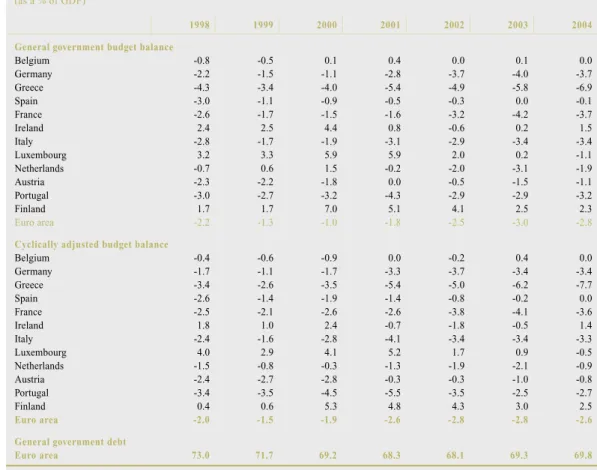
In the early years of the single currency, nominal budget balances generally continued to improve and, by 2000, the euro area budget deficit was
reduced to just 1.0% of GDP. However, fiscal consolidation slowed down and, from 2001 onwards, the euro area budget balance ratio started to deteriorate, increasing to 3.0% of GDP by 2003, with only a marginal decline to below this level in 2004.
This return to higher deficits in the euro area needs to be seen in a context of persistently poor economic growth and, more importantly, consolidation fatigue, which started soon after the launch of the single currency. Moreover, improving nominal budget balances in the early years of the Pact’s implementation initially contributed to the false perception that fiscal positions were also getting better. In fact in a number of countries, structural budgetary positions started to deteriorate as early as 2000 since, in a context of favourable economic
16
ECBOccasional Paper No. 47June 2006
Table 3 Fiscal developments under the Stability and Growth Pact
(as a % of GDP)
Source: European Commission, AMECO database. Data exclude receipts from the sale of Universal Mobile Telecommunications System (UMTS) licenses.
Note: The figures presented in the table are those currently available under the ESA 95 accounting framework. They therefore include all the statistical revisions that have taken place since 1998 in the euro area countries (in particular, in Greece and Portugal).
1998 1999 2000 2001 2002 2003 2004 General government budget balance
Belgium -0.8 -0.5 0.1 0.4 0.0 0.1 0.0 Germany -2.2 -1.5 -1.1 -2.8 -3.7 -4.0 -3.7 Greece -4.3 -3.4 -4.0 -5.4 -4.9 -5.8 -6.9 Spain -3.0 -1.1 -0.9 -0.5 -0.3 0.0 -0.1 France -2.6 -1.7 -1.5 -1.6 -3.2 -4.2 -3.7 Ireland 2.4 2.5 4.4 0.8 -0.6 0.2 1.5 Italy -2.8 -1.7 -1.9 -3.1 -2.9 -3.4 -3.4 Luxembourg 3.2 3.3 5.9 5.9 2.0 0.2 -1.1 Netherlands -0.7 0.6 1.5 -0.2 -2.0 -3.1 -1.9 Austria -2.3 -2.2 -1.8 0.0 -0.5 -1.5 -1.1 Portugal -3.0 -2.7 -3.2 -4.3 -2.9 -2.9 -3.2 Finland 1.7 1.7 7.0 5.1 4.1 2.5 2.3 Euro area -2.2 -1.3 -1.0 -1.8 -2.5 -3.0 -2.8
Cyclically adjusted budget balance
Belgium -0.4 -0.6 -0.9 0.0 -0.2 0.4 0.0 Germany -1.7 -1.1 -1.7 -3.3 -3.7 -3.4 -3.4 Greece -3.4 -2.6 -3.5 -5.4 -5.0 -6.2 -7.7 Spain -2.6 -1.4 -1.9 -1.4 -0.8 -0.2 0.0 France -2.5 -2.1 -2.6 -2.6 -3.8 -4.1 -3.6 Ireland 1.8 1.0 2.4 -0.7 -1.8 -0.5 1.4 Italy -2.4 -1.6 -2.8 -4.1 -3.4 -3.4 -3.3 Luxembourg 4.0 2.9 4.1 5.2 1.7 0.9 -0.5 Netherlands -1.5 -0.8 -0.3 -1.3 -1.9 -2.1 -0.9 Austria -2.4 -2.7 -2.8 -0.3 -0.3 -1.0 -0.8 Portugal -3.4 -3.5 -4.5 -5.5 -3.5 -2.5 -2.7 Finland 0.4 0.6 5.3 4.8 4.3 3.0 2.5 Euro area -2.0 -1.5 -1.9 -2.6 -2.8 -2.8 -2.6
General government debt
Euro area 73.0 71.7 69.2 68.3 68.1 69.3 69.8
growth, tax cuts were not matched by equivalent expenditure reductions. The fiscal consolidation that was achieved during the 1990s was largely attributable to an increase in the revenue-to-GDP ratio, which, for the euro area as a whole, rose from 44% in 1991 to 47% in 1999 (see Chart 1). However, after 1999 about two-thirds of the earlier increase in the revenue-to-GDP ratio was reversed.16 Meanwhile, primary
expenditure, which had been reduced by more than 1% of GDP in the run-up to EMU, started to increase again after 1999.
These developments very quickly put the SGP to the test. Several countries consistently failed to attain close to balance budgetary positions,
so that the first downturn (coupled with the above-mentioned tax cuts and, in some cases, statistical revisions) resulted in severe degradations of budget balances. Six euro area Member States have incurred excessive deficits since 1999: Portugal in 2001 (and again in 2005), Germany and France in 2002, the Netherlands and Greece in 2003, and Italy in 2004. Among these, only the Netherlands has in the meantime succeeded in correcting its
16 In this sense, recent experience in the euro area appears to support the findings of a growing body of literature on fiscal consolidation which argues that revenue-based fiscal adjustments tend to be less successful (i.e. less sustainable) than consolidations based primarily on expenditure restraint (Alessina and Perotti, 1995a; von Hagen, Hughes Hallet and Strauch, 2001). See also Briotti (2004) for an overview.
17
ECBOccasional Paper No. 47
June 2006
excessive deficit in a durable manner. Some Member States increasingly resorted to temporary measures to comply nominally with the rules. Moreover, owing to large statistical revisions, some excessive deficits were only identified several years after the 3% of GDP reference value was breached from an ex post perspective, after statistical corrections led to upward revisions of earlier deficit figures.17
Typically, this took place when initially reported deficits coincided with significant adverse deficit-debt adjustments, notably in Greece, Italy and Portugal.
Faced with deteriorating fiscal positions in a number of countries, the Council did not implement the Pact in the strict manner that was necessary. The first evidence of this came in early 2002 when the Council rejected Commission recommendations to issue early warnings to Germany and Portugal. Instead, the Council took the view that such a formal step was unnecessary in the light of commitments by these countries to take corrective measures.18 In
both cases, however, the 3% limit was breached and EDPs were subsequently launched.19
An even more significant deviation from the rules and procedures of the Pact came in November 2003 in the context of the EDPs against Germany and France. Having been given until 2004 to correct their excessive
Chart 1 Euro area fiscal developments 1991-2005: determinants and components
(as a % of GDP)
Source: European Commission, AMECO database.
general government net lending cyclically adjusted budget balance primary cyclically adjusted budget balance
-6.0 -4.0 -2.0 0.0 2.0 4.0 1991 1993 1995 1997 1999 2001 2003 2005-6.0 -4.0 -2.0 0.0 2.0 4.0
total revenue (left-hand scale)
total primary expenditure (left-hand scale) interest payments (right-hand scale)
43.0 44.0 45.0 46.0 47.0 1991 1993 1995 1997 1999 2001 2003 20051.0 2.0 3.0 4.0 5.0 6.0
deficits, it became clear by autumn 2003 that the measures taken by both countries would not be sufficient to comply with the Council’s recommendations. The Commission recommended that the Council should step up pressure on both countries by issuing “notices” (i.e. one step in the EDP before sanctions), while also suggesting an extension of the 2004 deadline by one year.20 However, the Council
failed to achieve the necessary qualified majority to adopt these decisions, and instead issued “conclusions” in which it put the procedures in abeyance in the light of commitments expressed by Germany and France to take effective action to correct their excessive deficits by 2005.21 These conclusions were
subsequently challenged by the Commission and annulled by the European Court of Justice (ECJ) on the grounds that the Council had not followed the rules and procedures as set out in the Treaty. In particular, the ECJ made clear that the Council could not, by itself, take
17 Regarding one-off measures and creative accounting see Koen and van den Noord (2005).
18 ECOFIN Council conclusions of 12 February 2002.
19 In the case of Portugal, a public finance audit in spring 2002 showed that the deficit had already exceeded 3% of GDP by a considerable margin back in 2001. Hence, the Commission’s recommendation for an “early” warning actually came after the reference value for the deficit had already been breached. 20 Commission recommendations of 18 November 2003 for
Council decisions giving notice to Germany and France to take measures to correct their excessive deficits.
18
ECBOccasional Paper No. 47June 2006
initiatives in the absence of an appropriate recommendation by the Commission and could not replace a “procedure” with political “conclusions”.22 In the wake of these
developments, many observers including the ECB started to express concerns about the credibility of the Pact and of EU fiscal policies.23
It would be wrong, however, to paint a totally negative picture of the experience under the original SGP. Fiscal deficit ratios in the euro area did not return to their pre-Maastricht levels and earlier trends of rapidly rising public debt and expenditure ratios were mostly brought to a halt. A number of countries did moreover succeed in complying with the rules. Among these, Belgium, Spain and Austria all consolidated their fiscal positions further and succeeded in reaching close to balance or in surplus budgets. Meanwhile, Ireland, Luxembourg and Finland, while loosening fiscal policy, did so having entered EMU with large budget surpluses, and their fiscal positions have remained broadly sound (although, deficits have recently re-emerged in Austria and Luxembourg). While overall fiscal consolidation may have largely stalled after 2000, there was no generalised loosening of fiscal policies in the euro area. It can therefore be argued that while the original SGP did not fully attain its objectives it did have a constraining effect on fiscal policies.
4 THE REFORM OF THE SGP
Criticisms of the SGP and proposals to reform it have been made ever since its inception. As actual fiscal developments moved further away from the Pact’s requirements, and political commitment to the rules waned, some of these criticisms gained prominence and became more widely accepted.
A frequent criticism of the original SGP was that it placed too much emphasis on formal compliance with rules and took too little account of economic circumstances. In this context, it
was argued that the close to balance or in surplus requirement, which was generally interpreted as implying the maintenance of a broadly balanced budget (in cyclically adjusted terms), failed to consider the specific circumstances of each Member State, in particular with regard to long-term fiscal soundness, public investment needs or the costs of structural reforms. According to this view, it does not make sense for countries with, for example, widely diverging debt levels to target exactly the same budget balance. The emergence of excessive deficits in a number of countries suggested that the mechanisms underlying the preventive arm (i.e. monitoring and peer pressure) were too weak to ensure progress towards sound fiscal positions. Meanwhile, when countries did incur excessive deficits, the Pact’s corrective arm was criticised for requiring prompt corrective action regardless of economic growth considerations. In particular, some critics of the Pact considered it inappropriate to require Member States to correct excessive deficits by tightening fiscal policy during periods of low growth, since this could dampen prospects for economic recovery. The Pact was also criticised for not paying sufficient attention to debt developments, as it did not clarify the application of the debt criterion of the Treaty. According to advocates of reform, such shortcomings contributed to a lack of commitment and ownership on the part of Member States, the Commission and the ECOFIN Council, which could partly explain difficulties in applying the rules and procedures. To address this, numerous proposals to improve or amend the rules were put forward. Prominent among these have been proposals to focus more on the quality of public finances (Blanchard and Giavazzi, 2004; Fitoussi and Creel, 2002), to shift the focus of the SGP away from deficits and onto debt and sustainability (Buiter and
22 Ruling of the ECJ of 13 July 2004 on the affair C-27/04 by the Commission of the European Communities against the Council of the European Union.
23 Statement of the Governing Council on the ECOFIN Council conclusions regarding the correction of excessive deficits in France and Germany, 25 November 2003.
19
ECBOccasional Paper No. 47
June 2006
Grafe, 2002, Pisani-Ferry, 2002), or to replace numerical rules with stronger fiscal institutions and market discipline (Wyplosz, 2005). While some commentators called for a complete overhaul of the rules, others defended the status quo or at most called for more incremental adjustment (Buti, Eijffinger and Franco, 2003; Bini Smaghi, 2004). Defenders of the existing rules argued that they were sufficient to preserve the sustainability of public finances in EMU while also allowing room for the, full operation of automatic stabilisers (Marin, 2002). The importance of relatively simple rules and limited discretion under the original SGP was stressed in particular with a view to supporting market and public monitoring of fiscal policies (Schuknecht, 2005). According to this view, the problem was not the rules per se, but deficient enforcement that undermined the deterrent power of the Pact (such as the need for a qualified majority in the Council and the problem of “sinners judging sinners”). This called for improvements in the implementation and enforcement of the rules rather than changes in the rules themselves (Gros, Mayer and Ubide, 2004).
Prior to the SGP reform there had already been a number of incremental refinements to the way the Pact was implemented. Over time, more attention came to be paid to the influence of the cycle, with cyclical-adjusted budget balances acquiring greater prominence, at least under the preventive arm. In November 2002 the Commission issued a communication with a broad set of proposals, some of which were subsequently adopted by the Council.24 In this
context, the initial emphasis on setting target dates for the achievement of balanced budgets was replaced by a Eurogroup commitment to annual improvements of underlying fiscal balances by at least 0.5% of GDP (see section 5.1). Following the procedural impasse in the context of the EDPs against Germany and France, however, the Commission decided to launch a more wide-ranging discussion on reforming the SGP, including the option of changing the Council Regulations.25 The
Commission’s proposals, along with other suggestions, were discussed at length by Member States in late 2004 and early 2005; the outcome of these discussions was an agreement to make changes to the SGP as set out in the ECOFIN Council Report of March 2005 and later implemented via amendments to Council Regulations 1466/97 and 1467/97.26 Further
specifications on the implementation of the reformed Pact were also included in the revised Code of Conduct. The reform adopted by the ECOFIN Council left the structure of the SGP in place, and did not alter the fundamental elements of the EU fiscal framework enshrined in the Treaty, such as the 3% and 60% reference values, which were outside the reform’s scope. Within this overall framework, however, the reform did introduce a number of significant changes.
4.1 CHANGES TO THE PREVENTIVE ARM
Under the preventive arm, the reform has introduced various refinements to the earlier provisions concerning the setting of and progress towards sound medium-term budgetary positions and to the elements that are to be taken into account when assessing Member States’ fiscal positions. These include: – The definition of the medium-term budgetary
objective: Rather than being required to
target “close to balance or in surplus” budgetary positions, each Member State now presents its own country-specific medium-term objective (MTO) in its stability or convergence programme, which is then assessed by the Council. These
country-24 See the Commission Communication to the Council and the European Parliament of November 2002 on strengthening the co-ordination of budgetary policies, and the ECOFIN Council report of March 2003 on strengthening the implementation of the SGP.
25 See the Commission Communication to the Council and the European Parliament of September 2004 on strengthening economic governance and clarifying the implementation of the SGP. See also Deroose and Langedijk (2005) for an overview of the European Commission’s motivations for and approach to reforming the SGP.
26 The changes are laid down in two new Council Regulations, No 1055/2005 and No 1056/2005 amending Regulations 1466/97 and 1467/97 respectively.
20
ECBOccasional Paper No. 47June 2006
specific MTOs are differentiated and may diverge from a position of close to balance or in surplus. They should provide a safety margin with respect to the 3% of GDP reference value, ensure rapid progress towards sustainability and, taking this into account, should allow room for budgetary manoeuvre, particularly with regard to the need for public investment. For euro area and ERM II Member States, a range for country-specific MTOs, in cyclically adjusted terms and net of one-off and temporary measures, has been set between -1% of GDP and “in balance or surplus”.
– The adjustment path to the medium-term
objective: Member States that have not yet
achieved their MTOs are expected to take steps to do so over the cycle. To this end, euro area and ERM II Member States should, as a benchmark, pursue an annual adjustment in cyclically adjusted terms, net of one-off and temporary measures, of 0.5% of GDP. The adjustment effort should be greater in good times, but could be more limited in bad times. Good times are defined as “periods where output exceeds its potential level, taking into account tax elasticities”, while the Code of Conduct specifies that the “change in the output gap could also be considered, especially when the output gap is estimated to be close to zero”. Member States that do not follow the required adjustment path should explain the reasons for not doing so in their programme update, and the Commission is entitled to issue “policy advice” to encourage Member States to stick to the adjustment path.
– Taking into account structural reforms: Member States may be allowed to deviate from the MTO or the adjustment path towards it if they undertake structural reforms, and in this context special attention is paid to pension reforms which introduce multi-pillar systems that include a mandatory, fully funded pillar. However, “only reforms which have direct long-term cost-saving effects, including by raising potential growth, and
therefore a verifiable positive impact on the long-term sustainability of public finances, will be taken into account”, and a safety margin with respect to the 3% reference value must be preserved at all times.
4.2 CHANGES TO THE CORRECTIVE ARM
With regard to the corrective arm, the changes introduced go in the direction of introducing more flexibility into the EDP, in particular by relaxing, adding specificity to or clarifying the availability of various escape clauses. The changes include:
– The definition of a “severe economic
downturn”: The benchmark for a severe
economic downturn is now a negative annual real GDP growth rate or an accumulated loss of output during a protracted period of very low annual real GDP growth relative to potential growth.
– Specification of the “other relevant factors”: The Treaty specifies that, in its report that constitutes the first step of an EDP, the Commission should take into account “all
other relevant factors, including the medium-term economic and budgetary position of the Member State”. However, neither the Treaty
nor the original SGP further elaborated what these other relevant factors might be. The reformed SGP now more explicitly spells out the relevant factors that should be taken into account. Regarding the medium-term economic position, these include, in particular, potential growth, the prevailing cyclical conditions, the implementation of the Lisbon Agenda, and policies to foster research and development and innovation. Relevant developments in the medium-term budgetary position include f iscal consolidation efforts in “good times”, debt sustainability, public investment, and the overall quality of public finances. Consideration should also be given to any other factors which, in the opinion of the Member State concerned, are relevant to a comprehensive assessment of the excess over