Procedia Computer Science 50 ( 2015 ) 421 – 426
1877-0509 © 2015 The Authors. Published by Elsevier B.V. This is an open access article under the CC BY-NC-ND license (http://creativecommons.org/licenses/by-nc-nd/4.0/).
Peer-review under responsibility of scientific committee of 2nd International Symposium on Big Data and Cloud Computing (ISBCC’15) doi: 10.1016/j.procs.2015.04.011
ScienceDirect
2nd International Symposium on Big Data and Cloud Computing (ISBCC’15)
Securing Multi-Cloud using Secret Sharing Algorithm
M.Muhil
a, U.Hemanth Krishna
a, R.Kishore Kumar
a, E. A. Mary Anita
aaDepartment of Computer Science and Engineering, S.A. Engineering College, Affilated to Anna university, Chennai-600077,India.
Abstract
Cloud computing is an emerging technology which is at the peak in the IT industry. Storing, accessing and processing of data in cloud environment are the cutting edge technology used all over the world. Cloud computing provides several service models and deployment models. These features provide easy data outsourcing with the help of third party storage service providers. The storage provider must assure that the data stored by the user is secure, they can query on the data and the result of the query must also be secure and not visible to the provider. Data encryption, homomorphic encryption, secret sharing algorithms is the techniques extensively used for securing data outsourcing. Main issues associated with data storage management are CIA (Confidentiality, Integrity, and Availability). But due to the reason that single cloud suffers from many security issues, users and
customers are opting for “multi-cloud” otherwise known as “cloud of clouds” or “interclouds”. These multi-clouds are secured by various techniques and one of them is Secret Sharing Algorithms. There are many different Secret Sharing Algorithms. This paper applies Shamir’s secret sharing scheme to secure data outsourcing in Multi-cloud.
© 2015 The Authors. Published by Elsevier B.V.
Peer-review under responsibility of scientific committee of 2nd International Symposium on Big Data and Cloud Computing
(ISBCC’15).
Keywords: CIA; Data outsourcing; Secret sharing algorithms
1.INTRODUCTION
1.1 Cloud Computing: An Overview
Cloud computing is a technology which is mainly about resource sharing with the motive of high availability and scalability, equivalent to providing utilities over a network. Cloud computing as a whole is providing services and resources on demand, that is on cloud(network).
Cloud computing, or in other words “the Cloud”, focuses mainly on effective resource sharing. Resources in cloud are not only accessed by multiple consumers rather dynamically reallocated based on its demand. This will improve resource allocation in cloud. In cloud computing, multiple consumers access one single server to retrieve data which gives them an advantage of not paying for many applications rather only to those which they consume. © 2015 The Authors. Published by Elsevier B.V. This is an open access article under the CC BY-NC-ND license
(http://creativecommons.org/licenses/by-nc-nd/4.0/).
Peer-review under responsibility of scientific committee of 2nd International Symposium on Big Data and Cloud Computing (ISBCC’15)
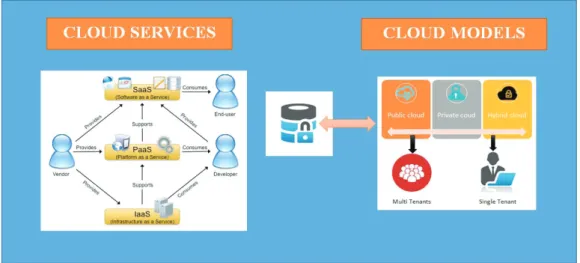
1.2 CLOUD SERVICE MODELS
x IAAS –Infrastructure as a service should fulfill the essential characteristics to support cloud services. It is built using a shared pool of computing resources, such as virtual compute, virtual storage, operating systems and virtual network. Building a cloud infrastructure is a phased approach, it begins with existing physical infrastructure, its elements and its process and extending to set a Virtualized classic data centers to maintain the data and enables faster resource provisioning. An example of IAAS providing company is Amazon EC2 and EMC2.
x PAAS – Platform as a service is within IAAS. Within the PaaS model, customers area unit supplied with associate degree package, artificial language execution setting, database, and internet server. they're not concern with the price and management within the hardware and package layers. PaaS is that the use of cloud computing to supply platforms for the event and use of custom applications. The PaaS solutions embody application style and development tools, application testing, versioning, integration, readying and hosting, state management, and different connected development tools. An example of PAAS is FORCE.COM, Microsoft azure.
x SAAS - Software-as-a-Service could be a computer code distribution model during which applications are hosted by a vender or service supplier and created accessible to customers over a network, usually the net. Example of software as a service is SALESFORCE.COM which provides CRM application on demand.
1.3 VARIOUS DEPLOYMENT MODELS IN CLOUD
x An organization gets access to a private cloud by renting it and also it gets all the permissions to access the resource for its private use. Example, a cloud developed to solve and serve business applications of a firm. x A service provider owns the public cloud and he provides it for public for rent. Resources can be owned
and also can be scaled in future based on end users requirements. Some examples of public cloud are Google, Amazon, Rackspace, Microsoft and Salesforce.
x A community cloud is almost equivalent to a private cloud but it serves to a group of users or in other words to a community. An example of a community cloud is the Media Cloud set up by Siemens IT Solutions and Services for the media industry [11]. A third party can maintain a community cloud or it also can be maintained in a collaborative fashion.
x Combination of multiple cloud infrastructure is known as hybrid cloud and the combination can be of any cloud like public, private or community. Hybrid cloud’s main objective is to resolve the problem of high
demand of resources, that is to obtain effective scalability and availability to serve the consumers with lag less and effective cloud service. In this fast developing world, all cloud users are opting for hybrid cloud so as to enjoy better performance cloud facility and security for their data.
Author name / Procedia Computer Science 00 (2015) 000–000 3
2.MULTI-CLOUD
Multi-cloud in general is a collection of several cloud infrastructures. In single cloud infrastructure, if the environment is subjected to any type of attack then the data confidentiality is lost and may lead to loss of data. This results in hindrance of data availability.[6]
Multi-cloud solves this type of security issue. Replication of data in several cloud infrastructure is one serious advantage of multi cloud.[7] So when one cloud structure is subjected to an attack, another cloud will provide the data. Thus the availability of data is not affected in this type of cloud.[7]
Still the attacks and security breaches on multi-cloud are a big threat to confidentiality and they should be prevented. To achieve this many techniques are welcomed and under use by many providers. Some of the techniques are secret sharing algorithms, homomorphic algorithms, Private Information Retrival(PIR) and many more.
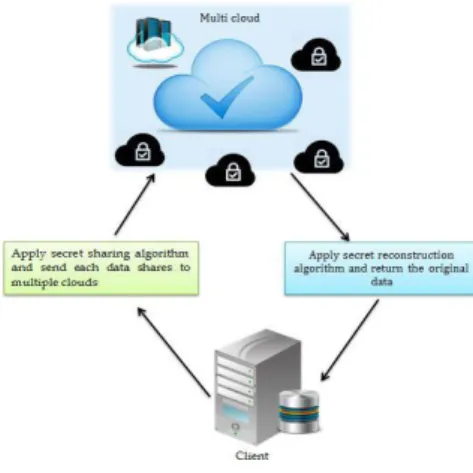
An example of Multi-cloud architecture is DepSky architecture. It is a combination of several different storage clouds. This architecture secures availability and confidentiality of data.[2]
DepSky model contains clients and a cloud of several cloud storage providers. The storage providers perform the task issued by clients.
Fig .1. Cloud services and Cloud deployment models
3.EMPLOYING SECRET SHARING ALGORITHM
This paper aims to provide a better way to secure cloud database and assure the cloud computing community with highly effective security measures [2]. To achieve this we are going to employ Shamir’s secret sharing
algorithm to reduce the risk of data intrusion and service availability in the cloud. 3.1 SHAMIR’S SECRET SHARING ALGORITHM
Data can be compromised or lost in the cloud. Hence securing the data is a vital process in the cloud environment. Therefore to secure the data in multi-cloud, Shamir proposed to store the data in more than one cloud and encrypt the same in the cloud before it transferred and saved.[1]
MATHEMATICAL DEFINITION:
The goal of the algorithm is to divide the data DATA into n pieces (DATA1, DATA2, DATA3, DATA4 …..
DATAn) so that,
1. Retrieving any k or more DATAi pieces makes DATA easily computable.
2. Retrieving any k-1 or fewer DATAi pieces leaves DATA thoroughly undetermined.
The above scheme is known as threshold( k, n). if k=n, then all pieces are available for reconstruction of DATA.
The objective of Adi Shamir’s secret sharing algorithm algorithm is that, k points are enough to define a polynomial of degree k-1.[1] Example, 2 points are sufficient to define a line.
Choose an approximate k-1 coefficients c0, c1, c2, c3….ck-1 in H, and let c0 = S, where S is the Secret data which is going to be stored in cloud. Build the polynomial H(z) = c0 + c
1z1 + c2 z2+……+ck-1zk-1. Then n points are defined, for example set i=1,2….n to retrieve ( i, H(i)) . A pair is formed with input to the polynomial and output. Given any subset of k of these pairs, using interpolation the coefficients of the polynomial can be found and the constant term a0 is the secret.
SHAMIR’S APPROACH:
The secret is divided into pieces by considering an approximate degree polynomial
H(z) = c0 + c1z1 + c2 z2+……+ck-1zk-1
In which c0 = S,S1 = H(1), S2 = H(2),…………, Sn = H(n) and represent each share as a point
(zi, G(zi) = yi)
EXAMPLE
The following example illustrates the algorithm. For understanding integer arithmetic is used instead of any other vector or scientific based arithmetic. Therefore the example provided does not ensure perfect secrecy, and is not a perfect example of Shamir's scheme.
ENCRYPTION AND PREPARATION
Consider 1999 as the secret data. Dividing it into 6 parts ( n = 6 ). Parts required to reconstruct the secret is 3 parts (k = 3).
2 numbers are selected in random. Let it be 154 and 19. c1 = 154 and c2 = 19.
Our polynomial to produce shares are:
H(z) = 1999 + 154z + 19z2 6 parts are constructed from the polynomial.
(1, 2172) ; (2, 2383) ; (3, 2632) ; (4, 2919) ; (5, 3244) ; (6, 3607)
Different single point is given to each participant, both z and H(z).
RECONSTRUCTION
Any 3 points is enough to reconstruct the secret.
Assume: (a0, b0) : (2, 2383) ; (a1, b1): (4, 2919) ; (a2, b2) : (5, 3244) Apply Lagrange basis polynomials:
l0 = a-a1/a0-a1 . a-a2/a0-a2 = 1/6a2 - 3/2a +10/3
l1 = a-a0/a1-a0 . a-a2/a1-a2 = 1/2a2 + 7/2a – 5
l2 = a-a0/a2-a0 . a-a1/a2-a1 = 1/3a2– 2a +8/3 Therefore,
۶ሺܢሻ ൌ ܊ܒǤ ܔܒሺܢሻ
ୀ
H(z) = 1999 + 154z + 19z2
4.SOLUTION METHODOLOGY
Cloud customers may expect on behalf of their past experience and requirements. But the best approach is to gather information about the best and efficient cloud service provider. Customers are also prescribed to ensure the level of security of these important characteristics of the cloud: Confidentiality, Integrity and Availability (CIA). [4]
Security in Cloud computing is organized into different sections: security categories, security in service delivery models and security dimensions.
Security in cloud services is dependent on the following :
x Strong network security should be applied in and around the service delivery platform. x Encrypting the data
x Access controls by authorization
Logs are to be strictly maintained and secured to note down the activities of the system
administrators and other restricted users. They can also be used to produce reports that mix events relating to different customers of the service. Security should be applied and maintained in both the organizations seeking cloud solutions and the service providers. Identity and Access Management (IAM), Good
governance, compliance, Availability, privacy, Data protection, Business Continuity and Disaster Recovery plans etc.. are some of the measures to ensure security in cloud.[5]
5.CONCLUSION
The purpose of this work is to study and secure the Multi-cloud using secret sharing algorithm. This objective is
achieved using Shamir’s secret sharing algorithm. This secret sharing scheme has a good foundation that provides an excellent platform for proofs and applications. Also the disadvantages of single cloud and advantages of multi cloud were addressed in this paper. Cloud computing is one of the current technology which is being discussed everywhere and it also satisfies the enterprise and its consumer by providing their requirements, but the data of the consumer and the enterprise should be safe and that has to be maintained and ensured by the administrator. Migration to multi cloud is encouraged by keeping in mind about its ability to reduce breaches and other security issues.
References
1. Md Kausar Alam, Sharmila Banu K, “An Approach Secret Sharing Algorithm in Cloud Computing Security over Single to Multi Clouds”, International Journal of Scientific and Research Publications, Volume 3, Issue 4, April 2013
2. Swapnila S Mirajkar, Santoshkumar Biradar, “Using Secret Sharing Algorithm for Improving Security in Cloud Computing”,
International Journal of Advanced Research in Computer Science & Technology, Vol. 2, Issue 2, Ver. 3
3. S.Jaya Nirmala , S.Mary Saira Bhanu, Ahtesham Akhtar Patel , “A comparative study of the secret sharingalgorithms for secure data in the cloud”, International Journal on Cloud Computing: Services and Architecture, Vol.2, No.4, August 2012
4. Md. Tanzim Khorshed, A.B.M. Shawkat Ali, Saleh A. Wasimi, “A surveys on gaps, threat remediation challenge, and some thoughts for proactive attack detection in the cloud computing”, School of Information and Communication Technology, CQ University QLD 4702, Australia. 15 August 2011.
5. Minqi Zhou, Rong Zhang, Wei Xie, Weining Qian, Aoying Zhou, “Security and Privacy in Cloud Computing: A Survey” ,Sixth International Conference on Semantics, Knowledge and Grids, August 2010.
6. Midong Yhou, Zygmunt J. Hass, Securing Ad-Hoc Networks, IEEE Networks Special Issue on Network Security, November/December 1999.
7. Mohammed A. AlZain, Eric Pardede, Ben Soh, James A. Thom, "Cloud Computing Security: From Single to Multi-clouds," hicss pp.5490-5499, 2012 45th Hawaii International Conference on System Sciences, 2012