Eleanor Knott
Beyond the field: ethics after fieldwork in
politically dynamic contexts
Article (Accepted version)
(Refereed)
Original citation:
Knott, Eleanor (2018) Beyond the field: ethics after fieldwork in politically dynamic contexts. Perspectives on Politics. ISSN 1541-0986 (In Press)
DOI:
© 2018 Cambridge University Press
This version available at: http://eprints.lse.ac.uk/87445/
Available in LSE Research Online: April 2018
LSE has developed LSE Research Online so that users may access research output of the School. Copyright © and Moral Rights for the papers on this site are retained by the individual authors and/or other copyright owners. Users may download and/or print one copy of any article(s) in LSE Research Online to facilitate their private study or for non-commercial research. You may not engage in further distribution of the material or use it for any profit-making activities or any commercial gain. You may freely distribute the URL (http://eprints.lse.ac.uk) of the LSE Research Online website.
This document is the author’s final accepted version of the journal article. There may be differences between this version and the published version. You are advised to consult the publisher’s version if you wish to cite from it.
Contexts
Eleanor Knott March 2018
Abstract
As researchers, when do our ethical obligations end? How should our ethical obligations respond to dynamic and unstable political contexts? Political scientists frequently work in dynamic political situations which can pose new ethical questions beyond those existing at the point of fieldwork. Yet, research ethics are often conceived in terms of a static, if not hermetically sealed, field that remains frozen in time at the point we conduct fieldwork and collect data. This article argues, first, that we need to consider more systematically how a dynamic field intersects with ethical obligations. Second, the article argues that new, and unexpected, ethical questions can emerge after exiting the field, including responsibilities to research participants, dissemination, and publication, and returning to the field, which should be a part of how we conceive of ethical obligations.
Please cite as: Knott, Eleanor (Forthcoming) ‘Beyond the Field: Ethics after Fieldwork in Politically Dynamic Contexts’,Perspectives on Politics. (conditionally accepted)
The best laid schemes o’ Mice an’ Men, Gang aft agley, An’ lea’e us nought but grief an’ pain, For promis’d joy!
Robert Burns - To a Mouse (1785)
Introduction
Political scientists frequently work in dynamic contexts which can change dramatically after exiting the field. This dynamism can pose new and unexpected ethical questions outside of those we conceived before and during field research. When it comes to ethics, the dynamic nature of research contexts and the ethical questions this dynamism poses beyond the field are often overlooked or sidelined in favour of ethical questions that arise within the field, as a site beyond our institutions and desks where we conduct research and gather data.1 In this article, I argue that questions
1
of ethics frequently arise beyond the field and form a crucial dimension of our overall ethical obligations.2 In other words, we have both a duty to think about and to address the questions of
ethics that arise beyond the field.
In considering ethics beyond the field, I do not intend that researchers should be encouraged, required or incentivized to be clairvoyants. Our role is not to be able to imagine, or predict, what changes may or may not occur after we have left the field. Rather, our task is to transform how we think of field research sites, as contingent contexts that might change. In turn, we should conceive of questions of ethics as an ongoing consideration, and obligation, that does not end when we leave the field.
The motivation for this article comes from my research in Crimea, where I conducted field research on Russian identification and engagement with Russia between 2012 and 2013. In a matter of three weeks in early 2014, Crimea shifted from an uncontested Autonomous Republic, within Ukraine, to an internationally disputed de facto republic within the Russian Federation. With these political-territorial changes, the lives of those who had participated in my research in Crimea were changed dramatically and, most likely, forever.
While Crimea’s annexation is a rare event, political scientists frequently work in dynamic and newly contested sites, such as the Middle East and North Africa (MENA) in the wake of the Arab Spring. While we might expect dynamism and contestation in authoritarian and quasi-authoritarian regimes, like Crimea, this article covers three issues with implications that include democratic contexts where states, like the US and the UK, can use research data for pernicious ends.3 First, are the ethical questions of engaging with research participants beyond the field who reside in dynamic and contested contexts. What ethical questions should be considered when we maintain contact with participants beyond the field? Second, are the ethical questions of disseminating research about dynamic and contested contexts. What questions do we need to ask about what we publish and when? Third, I discuss the ethical questions arising from choosing to return (or not) to the field. Finally, I reflect on how questions of ethics beyond the field intersect with policies which advocate for norms of data access and research transparency (e.g. DA-RT).
We Need to Talk About Ethics
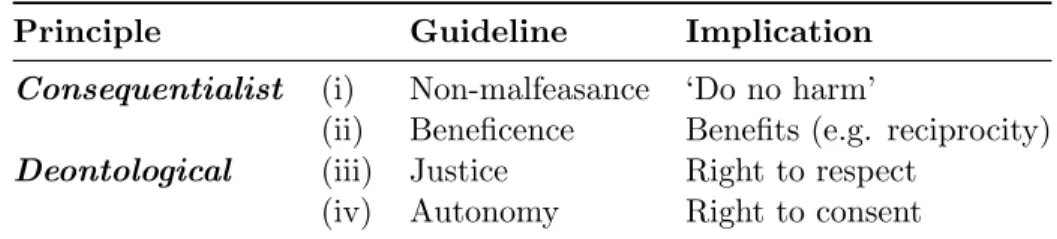
The 1978 Belmont Report set out four guiding ethical guidelines which form the backbone of insti-tutional ethics review (IRBs in the US) and underpin the everyday practice of ethics in the field.4 Most prominent, has been the consequentialist principle of reducing the harmful consequences of research for participants (i) and maximising the benefits of research for those who participate in
2
Beyond the field concerns the period after the formal stage of field research has been completed and once we have left the site (“the field”) where data was collected.
3
For example, data from a Boston College project on Belfast and IRA was seized by the UK government, see Parkinson 2014
4
Table 1: Ethical Principles and Guidelines Stemming from the Belmont Report
Principle Guideline Implication
Consequentialist (i) Non-malfeasance ‘Do no harm’
(ii) Beneficence Benefits (e.g. reciprocity)
Deontological (iii) Justice Right to respect (iv) Autonomy Right to consent
research (ii, Table 1).5 The Belmont report also requires researchers to recognize the deontological
principles of research: the rights of participants to be autonomous consenting participants (iii) and to be treated with respect and dignity in the process of research (iv).6
Political science, as a discipline and profession, had remained relatively silent on research ethics.7 More recently, in response to methodological innovations, like experiments, and the recognition that political scientists often conduct research in dangerous contexts, discussions of ethics have become more prevalent. Debates in political science, as well as across the social sciences, have also concerned the appropriateness of applying the Belmont criteria through institutional ethics review because of the biomedical origins of these criteria which some argue are inappropriate for social science.8
This article is less concerned less with the relevance of IRBs and more concerned with how the Belmont criteria are operationalised in the process of research. In particular, I draw attention to operationalising the Belmont criteria in particular for questions of ethics beyond the field, as much as within the field. For example, for harm, we need ways of conceptualising and operationalising harm, in terms of its form (e.g., physical, material, psychological, political, reputational), degree and locus (e.g., research participants, researchers, gatekeepers and research assistants, the wider context in which the research is conducted). These dimensions of harm are challenging to consider before and during field research. They can be even more challenging when we consider ethics beyond the field in unpredictable, dynamic and contested contexts.
In the following section, I review debates within the two prominent political science literatures-ethics of experiments and ‘dangerous’ field sites-to consider how each has addressed issues of ethical questions, such as conceptualising consent and harm. In particular, I note how each set of debates has discussed, to some extent, ethical questions beyond the field in passing but, to date, have not focused on these questions directly.
The Ethics of Field Experiments
With the explosion of field experiments in political science in diverse and complex contexts, ethical concerns about the conduct of experiments have garnered attention and concern, particularly since
5
Belmont Report 1978 6Murthy and Dingwall 2001 7
Schwartz-Shea and Yanow 2012 8
Bhattacharya 2014, Humphreys 2015, Yanow and Schwartz-Shea 2016; see also debates within sociology: Hoonaard 2011 , Schrag 2011: 125
the Montana Get-Out-the-Vote Scandal (GOTV) in 2014.9 In terms of assessing the locus of harm,
research participants in field experiments are usually unaware they are participating and subject to interventions in their lives. This can be crucial to the methodology of field experiments which are designed to avoid observation bias caused by participants knowing their behaviour is being observed (the Hawthorne effect).
As Teele argues, this is often (wrongly) presented as an ethical dilemma: between a question of methodological clarity and ethical responsibility. However, Teele argues, this is not an ethical dilemma so much as an ethical sacrifice, where we signal that methodology has priority over ethics.10 This, at least implicitly, has been the rebuttal of some scholars who argue that knowledge gained from experiments has a normative value.11 For example, some have argued that the kinds of knowledge gained are on critical topics (e.g. election behaviour, conflict) and might be hard to acquire from less interventionist methods, even if this knowledge is gained by causing potential harm, such as by manipulating democratic outcomes.12
These ethical sacrifices, in the name of data, have consequences on the context in which the research is conducted. These effects could include long-lasting effects downstream, because exper-iments can seek to alter the field after the experiment has ended. This is problematic because it is typically research participants, rather than social contexts, which are the focus of institutional ethics review. As Michelson explains, while research participants were the focus of academic de-bate over the Montana GOTV scandal, there is also the ethical question of whether the experiment influenced election results, as was raised by officials and politicians in Montana.13
More broadly, experiments (in particular those which might be seen as intervening in elections) can decrease the legitimacy and credibility of research and the academic profession, if not wider social distrust in political systems.14 In turn, scholars may find it difficult to research in that, or similar, contexts because of unwilling participants. Experimental methods can also provoke, or extenuate, a wider public distrust, from medicine to politics. For example, it is widely reported that with the coming of the AIDS epidemic in the US, the Tuskegee experiment had a lasting impact in terms of black communities’ mistrust of (predominantly white) government medical programs.15 Assessing harm, in terms of its forms, degree, and loci, in experimental methods is, therefore, a complicated endeavor which extends beyond the duration of the experiment.
9 Desposato 2015 10Teele 2014 11 Desposato 2015 12 Leeper 2014, Driscoll 2015 13Michelson 2016 14 Ibid
15Cohen 1999; However, as this Reverby argues, this does not necessarily determine practice four decades later, where evidence suggests that black Americans are no less likely than white Americans to take part in clinical trials see Reverby 2011.
The Ethics of ‘Dangerous Fieldwork’
The second domain in which discussions of ethics in political science predominate concerns the eth-ical questions arising from doing “dangerous fieldwork” in sites of recent, ongoing or pertained con-flict.16 Conducting “dangerous fieldwork” involves a complex locus of harm to assess: researchers and research participants can be exposed to dangerous degrees of psychological and physical harm. Participants add to this challenge by spanning a complex spectrum of violence, from victims, through combatants to perpetrators, whose competing perspectives and interests the researcher has to balance.17 For example, those perpetrating violence can also be especially willing to engage with researchers about life histories.18 The researcher has to navigate ways of minimizing the kinds of influence on the research that these different interests might seek to impose.19
Debates within “dangerous fieldwork” also require us to consider how researchers, as well as those researchers rely on including gatekeepers and research assistants, are a significant, though often overlooked, potential locus of harm. As Cramer et al. note, researchers can often overlook the harm they may themselves be exposed to. This can be for several reasons, including empathy for research participants and an institutional review process that emphasises concern for participants, and rarely for researchers.20 There can also be a cach´e attached to dangerous research, and a fetishisation of danger, in particular among graduate students who are incentivized to do more to stand out from their peers.
Assessing and limiting harm in “dangerous fieldwork” relies on the researcher’s “informed moral judgment” about the context in which they are working.21 Such judgments can be affected and impeded by the research process, including the researcher’s exposure to trauma which may make them more likely to expose participants to higher degrees of harm.22 Calculating harm includes considering whether the research should be conducted in the first place. It also includes deciding what materials are published and when, in particular when conflicts are ongoing and participants in the field, and the wider social context, remain at risk from dissemination of research materials.23 A more sceptical perspective, proposed by the anthropologist Fluehr-Lobban, suggests that it can be hard “or impossible” to assess, avoid or prevent harm that research participants (and researchers) might be exposed to because we cannot know or predict what will happen within the context of the field.24
This points to the importance of considering ethics beyond the field since we publish material after exiting the field. Our research has the potential to affect the field after we have left, while
16
Peritore 1990
17Smyth and Robinson 2001: 5, Malejacq and Mukhopadhyay 2016 18
Wood 2006
19Ukiwo 2011 goes further to describe how research participants in conflict zones might deliberately and strategically seek to lead or mislead researchers of conflict.
20Cramer, et al. 2011 21
Loyle and Simoni 2017 22
Cramer, et al. 2011
23Peritore 1990, Ellis 1995, Wood 2006 24
the field has the potential to change in significant ways, in terms of the level of violence and who holds power.25 Our evaluation of the harmful impact of publishing can be based on our knowledge of the field, and our relationships with research participants. As I discuss below, these evaluations become more challenging once we have left the field, and in particular when the field is dynamic and a newly contested context. We have to reconfigure our knowledge of the field against these changes while being beyond the field, where it can be difficult to gain the necessary knowledge to make such judgments.
Ethics and the Banality of a Post-Soviet Research Context
Before turning to questions of ethics beyond the field, I want to first reflect on institutional and research context of my study in Crimea. Compared to the US, where institutional ethics oversight via IRBs is federally mandated, there is greater variation in the UK between institutions in terms of the procedures and extent of ethics review.26 For example, the institution where I conducted my graduate training was, at the time, relatively laissez-fair when it came to institutional oversight and ethical review which, beyond the supervisor, involved little institutional involvement or oversight. The instances which would have required institutional ethical review would have been those involv-ing ‘vulnerable’ participants, such as minors. This is not the case across all UK institutions. For example, my experience of another UK institution with a large medical school is that all research conducted with human subjects must be reviewed by an ethics review board.
A further important institutional context concerns graduate training, where we had little in the way of discussion of research ethics beyond supervisory support. This is partly explained by how interviews in political science are conceived: as a method which extracts knowledge from elite informants as knowledge-holding actors, typically policymakers.27 Here, ethical questions primarily concern issues of consent, anonymity and what is “on” or “off” the record.28 By contrast, political scientists with an ethnographic sensibility conceive of interviews differently: as an evolving working relationship between researchers and research participants.29 Researchers use interviews to gain insight into multiple different perspectives, meanings and lived experiences from a diversity of participants.30 While this is not the case for all programs, within methods training classes in political science which emphasise elite interviews, there can be little scope to discuss the ethical questions of entering the everyday lives and realities, including living in people’s homes.
At the time of field research in 2012 and 2013, Crimea was an uncontested region of Ukraine
25
Zhao 2017
26See comparison of the UK, US and Australian ethics review process by Hoonaard 2011 27
Davies 2001, see also the Symposium edited by Leech 2002: on “Interview Methods in Political Science”, in particular Berry 2002, Goldstein 2002
28
Goldstein 2002 29
Fujii 2017
30Rather than studying elite knowledge and public opinion separately, I used interviews to engage with a diverse range of individuals, from journalists, students to the youth members of political parties, to examine their experience of being Russian.
and a fairly banal post-Soviet context.31 Ukraine was neither fully democratic nor autocratic. It
was not a site of conflict or potential violence. Yet it was systemically corrupt, in the throes of a corrupt and unpopular Yanukovych government. My greatest concern in Crimea was avoiding the gaze of, and connections with the state, especially the security services. This concern is typical of post-Soviet researchers, and those working in quasi-authoritarian and authoritarian regimes more broadly, who have to contend with high degrees of distrust of the state.32 Aside from jokes that
I was a “spy”, I was often faced with justifiable questions concerning what had brought me to Crimea and who was funding me. As best I could, I ensured participants of my independence as a researcher and personal motivation to study the topic. I was also clear how the research was funded by a UK research council, even if this proved challenging to explain.
My second concern was avoiding signed consent forms, which can provide an overly official and bureaucratic atmosphere to research and undermine the idea that research is voluntary.33 Using signed consent forms (as often required by IRBs) can sometimes heighten the potential harm to which participants are exposed, by making confidentiality harder. These concerns are typical of researchers working in quasi-authoritarian and authoritarian regimes, including post-Soviet space and the MENA region in the wake of the Arab Spring, and those working with vulnerable populations, such as sex workers.34 Instead, I sought oral consent, gained by explaining the purpose of the research to the participants (as best as I realistically could), by providing an information sheet and discussing the research with participants, in terms of who I was and its purpose.
Beyond this, Crimea was an accessible site to conduct field research in 2012 and 2013. Indi-viduals were easy to find (e.g. via social media, and existing contacts) and were willing to meet and discuss their experiences and, often, to act as gatekeepers for accessing further participants. Crimea was also accessible because little bureaucracy was involved. For example, I needed neither a visa nor research permit to conduct research in Ukraine and could travel visa-free to Crimea, by land or air, for up to 90 days. By contrast in more autocratic, post-Soviet field sites, such as Russia, researchers are required to acquire a researcher visa backed by an invitation from a local research institution.35 This creates a bureaucratic trail that might make some research more feasible than others. Today I could not access Crimea so easily and with the same relative invisibility. Now a de facto part of Russia, Crimea is accessible only via Russian research visas. Meanwhile, visiting Crimea from Russia is considered illegal under Ukrainian law making it hard to travel to Ukraine afterwards. It is possible that the only researchers, going forward, who will be able to conduct field research in Crimea will be those with Russian citizenship.
31I spent two field research trips in Crimea researching Russian identification and engagement with Russia, including Russian programs such as scholarship and facilitated migration schemes. I conducted around 55 interviews with a variety of residents in Crimea’s administrative centre, Simferopol, from students, youth members of political parties, to those engaged in civil society and pro-Russian cultural and political organisations. During these trips, I stayed in the home of a local family.
32 Gentile 2013, Wackenhut 2017 33 Gentile 2013 34Hemming 2009, Wackenhut 2017 35
The greatest ethical issue facing my research has been how Crimea changed since 2013. At the time, perhaps naively, Crimea’s status seemed so uncontested as to render these questions of Russian identification and engagement as banal, rather than an issue of contemporary contestation. Thus, what I (and the majority of the participants) had neither conceived of, nor predicted, were the events that would take place in the months after, that would take Crimea from a banal to a contested context in a matter of weeks, as the first case of territorial annexation in Europe since 1945.36
While Crimea might be an extreme case, it reflects a broader set of concerns regarding the research that political scientists frequently conduct in dynamic and contested contexts. In the context of the Arab Spring, researchers who have or are conducting field research in the MENA region face both new objects of analysis, from protests to repression, and new (and heightened) ethical challenges, to participants and themselves.37 In my graduate cohort also, colleagues faced similar challenges where the field changed during and after fieldwork, from research on minority groups in eastern Turkey to the practices of the state in western DRC. Changing field research sites, in other words, are likely a common occurrence. The point is that we have not been framing our ethical obligations with this understanding of the likeliness of, but at the same time unpredictable, change to the cases and contexts in which we work. At the same time, my contention that we have ethical obligations extends beyond contexts that become contested once researchers have left the field.
Ethics Beyond the Field
In the following sections, I discuss three ethical issues that arise beyond the field: engaging with those in the field, publishing about the field and returning to the field. These issues have all arisen in the process of working with Crimea as a dynamic and newly contested site, after leaving the field. However, these issues face many field researchers, whether they work in newly contested sites, like post-Arab Spring MENA countries such as Egypt, ‘dangerous’ contexts of ongoing or recent conflict, and across the spectrum from contexts which are authoritarian, quasi-authoritarian or liberal democracies. In other words, dynamic and newly contested contexts provide a most likely and salient context for having to address these ethical questions beyond the field. Yet, our ethical obligations extend beyond the field regardless of the kinds of research political scientists do in the way engage with and represent the field after the period of data collection has ended.
In focusing on these three issues-of engaging, publishing and returning-I return to the Belmont criteria to address how these questions intersect with harm minimisation, beneficence and the rights
36
Allison 2014 argues that the closest analogy for Russia’s annexation of Crimea is the Iraqi invasion and attempted annexation of Kuwait in 1990. In other words, Russia’s annexation of Crimea is qualitatively different to violence resulting from the break-up of Yugoslavia, as acts of secession from an ethno-federation and the resulting retaliation. Indeed, it has been Russia’s prerogative to compare Russia’s annexation Crimea to western involvement in Kosovo, to legitimise the need to pre-emptively protect ethnic Russians in Crimea to prevent a Kosovo-like massacre.
37
In the wake of the PhD researcher, Giulio Regeni, while conducting field research in Egypt these debates have been especially salient, see Glasius, et al. 2017, Wackenhut 2017
of participants to justice and autonomy (Table 2). Using this framework moves beyond a focus just on the principle of ‘do no harm’. For example, I consider how the assessment of harm intersects with the need to ‘give back’ to those research participants and assistants (by returning and sharing data) and with the rights we provide to participants and assistants to choose to participate in the research and their rights to be treated with dignity, respect and privacy in how we represent and engage with the field while being beyond the field.
Table 2: Applying Belmont Criteria to Ethical Questions Arising Beyond the Field Engaging Publishing Returning
Consequentialist (i) Non-malfeasance Hard to determine
What and when; Post-publication control and politi-cisation
Hard to determine
(ii) Beneficence Access to
materi-als
Ideal but challeng-ing
Deontological (iii) Justice Right to withdraw
Representation;
Privacy and
dignity
Privacy (iv) Autonomy Extent of consent Extent of consent
Engaging Beyond the Field
Field research, particularly immersive qualitative methods such as ethnography, interviews and focus groups, relies on establishing a network of contacts, gatekeepers, research assistants and research participants in the field research site.38 Interview-based field research requires developing “working relationships” with participants in the field through whom we observe the dynamics and inner logics of what we are studying.39 As Fujii highlights, these working relationships are critical for ethics too by providing the necessary space for the dignity and respect between researcher and participant, and which is more essential than establishing trust and rapport.40
These relations may be asymmetrical: we may enter the personal lives of our participants, but our participants are less likely to enter our personal lives. Such relationships may not be “real” relationships, like between friends or colleagues, but are researcher-participant relationships built within the field.41 These relationships, thus, have a certain power relationship which may be “reciprocal, asymmetrical or exploitative”.42 We also hang around with research participants, to be a part of their everyday life. Often, we can become friends with research participants, from the simple act of becoming a participant’s friend on Facebook, to establishing a relationship that can be crucial to immersive data collection and to feel more at home in the field.
38Malejacq and Mukhopadhyay 2016 39 Fujii 2017 40 Ibid 41Ellis 1995 42 England 1994: 243
We use our participants, as well as local research assistants, to learn about the field. We often use research participants and assistants as gatekeepers, to seek out other research participants and provide access to events, such as protests, meetings and commemorations which can be crucial for data collection and contextualization. In Crimea, research participants informed me of what was going on where, on where to go and how to get access. Through research participants, and the organisations they were part of, I was able to see the various expressions of Russian identification, such as the invite-only Russian cultural festival held every year. I was able to observe who was attending such events (primarily pensioners), what they were wearing (from military uniforms to the Russian tricolour) and how they were behaving.
Our participants may also use us, as political resources, within the social context of the field.43 In this sense, we have little control over the participants. We cannot control how participants use us within their webs of relations. Just as we cannot control the dynamism and unpredictability of the field, we cannot control who participants in our research become or what they do, for example, regarding their careers after the field research has ended.44
In turn, as a kind of research that is predicated on relationships, our ethical obligations to the participants, gatekeepers and research assistants require us to be able to assess and minimize the potential form and degree of harm to which they might be exposed. In the field, harm assessment and minimization concerns ensuring participants are informed about potential harm and risk, and consent to participate on this basis. Researchers are also required to inform and discuss with partic-ipants about the nature of anonymity and confidentiality, and data exposure, so that particpartic-ipants can make informed autonomous decisions about the degree of harm and risk they might be exposed to.
Our relations, however, extend beyond the field, as we maintain contact with those in the field or might seek to conduct long-distance strategies of research. In turn, our ethical obligations to these participants and assistants do not cease when we leave the geographical site of the field. For example, we have a responsibility to ensure participants’ data remains secure for as long as we retain it. In many instances, it can also be useful to maintain research relationships, to maintain contact and engaged in the field in ways that are useful for data collection, analysis, and reflection. Social media makes this increasingly feasible, with the ability to observe in real-time how developments are affecting research participants and how they are articulating themselves vis-`a-vis such developments. If we maintain these relationships beyond the field, then we maintain ethical obligations. Even if we do not maintain these relationships, we maintain ethical obligations to participants (and gatekeepers and assistants) to treat them with dignity, respect and privacy, for example in how we talk and publish about the field (which I discuss next).
We typically conceive of the period of informed consent as concerning the period in the field. This logic assumes the field stays relatively constant once we exit. This is not an assumption we can make as researchers who work in dynamic and unpredictable contexts, that can shift rapidly
43
Malejacq and Mukhopadhyay 2016 44Malejacq and Mukhopadhyay 2016
in the degree and form of contestation. There might be instances when we should re-seek consent, or address participants’ willingness to participate in research and be published about, if we plan to use the data for new purposes or unforeseen outlets. At the same time, we may not be able to contact participants to gain such consent, in particular if we are able to return to the field as I discuss below. This means we might need to have a more realistic engagement with the kinds of assurances we can offer participants about how their data will be used and seek initial consent on this basis.
Further, it might be ideal to call on participants when the field undergoes a period of rapid and significant change so that they can be a window into the field from beyond the field. At the same time, this poses questions of ethics that go beyond of focus on ethical obligations within the time and space of field research, and require us to reconsider the harm to which we are exposing those involved in our research and the nature of consent we acquired from participants.45 It might be also be ideal from a methodology perspective, also, to call on research assistants to continue to gather data when or if we cannot access the field. Of course, this poses forms and degrees of harm that are hard to conceive because of the uncertainty of the context, and our distance from it. In both cases, calling on participants and assistants might expose them to forms of harm, which may be hard to gauge and evaluate not least because distance may render these forms of harm less visible or even invisible to the researcher. This is not to suggest that it is necessarily possible to foresee all the forms and degree of harm to which participants, gatekeepers, assistants and researchers might be exposed when in the field, but more to emphasise how this becomes much harder from beyond the field.
With Russia’s annexation of Crimea, initially, I attempted to engage with research participants, given that it occurred just six months after I had left the field. Before long, I no longer felt comfort-able engaging with participants about annexation. I was disconnected from the field, and this field had shifted dramatically, politically and geopolitically. I was no longer able to sense potential harm to participants and to contextualize different perspectives on events. So removed, I felt uncomfort-able about prying when the day-to-day lives of those I knew had become so insecure.46 I could
observe some participants remaining in Crimea, some leaving; I could observe some participants supporting annexation while others opposed annexation. In other words, it would have been op-portune to collect data. To observe beyond the field how my participants experienced annexation, and how they positioned themselves vis-`a-vis annexation. Without the ability to understand the field, however, I no longer felt able to make judgments that were crucial to minimizing the potential degree and form of harm to participants in ways that became difficult to assess beyond the field, particularly those that have changed so dramatically.
45
Wackenhut 2017
46For example, annexation disturbed property rights, citizenship rights and pensions, which were usurped by the annexing Russian authorities.
Publishing Beyond the Field
The ethics of what we publish is central a question of ethics beyond the field. We make choices about how we use the material, what we write and when we seek to publish material in journals, and increasingly online (e.g. draft conference papers, blog articles).47 At the same time, we have professional incentives which promote an ethos of publish and perish; such an ethos might be in tension with the ethics of what should be published to minimize the potential for harm to and to ensure the dignity and respect of research participants. What is published, and when, is thus integral to the question of ethics.
It is imperative to think about the potential for harm to be caused, to research participants, assistants and gatekeepers and the wider context, by what material is published.48 In ‘dangerous’ research contexts, we are attuned to the notion that we need to think ethically about dissemination and publication, where the forms of potential harm are serious, such as material and physical harm to research participants and assistants, and political and physical harm to those in the wider social context.
Dynamic and contested, but not necessarily dangerous, contexts can also pose challenging and serious ethical question concerning what can be published beyond the field. Dissemination strategies must consider and take account of the unpredictability of the field in how we approach the use of the data. In simple terms, researchers should abide by standards of privacy, by upholding anonymity and confidentiality, to minimize the potential forms of harm and protect the rights of participants to dignity and privacy. However, anonymity is not at end in itself. In small research contexts, it might be clear to others in the social contexts who participants are even if they are anonymized. More broadly, then, researchers can adopt other strategies, such as using a layer of “protective abstraction” from the original material.49 For example, researchers can discuss data in a more aggregate way, in terms of common themes in the research, or taking research away from specific identification characteristics of participants or the social context towards the more abstract.50 The challenge is to match this against the desire to make a credible argument and to navigate regulatory frameworks of transparency, as I discuss below.
It is also challenging to assess the forms, degree and locus of harm, because of the context’s unpredictability. For example, as discussed above, the dynamics of the field can alter the nature of data and the relationship between research participants and the field significantly and, potentially, in ways that increase potential harm to these participants. In turn, this can affect the meaning, salience and sensitivity of the data that we have or may seek to publish in ways that might be harmful to research participants and the wider social context. For example, Brewer advocates a
47 Wackenhut 2017 48Wood 2006 49 Peritore 1990 50
For example, Goffman 2014 disguises the locale in which she conducts research, within the research context of Philadelphia, to provide her participants with an additional layer of anonymity. This has not prevented investigative journalists from trying to find the Goffman’s research locale, to verify her account of events, see for example Singal 2015
strategy in dangerous research contexts of avoiding acquiring “guilty knowledge”, and thus avoiding having to deal with this knowledge.51 However, this assumes an unchanging research context, as if the kind of knowledge that is “guilty” is also unchanging. In dynamic and contested research contexts, such an assumption is problematic. As I found in Crimea, it is hard to predict what might be salient or guilty at a particular point. Rather, this can change in response to the changing research context.
Further, as Fujii explains, authors lose control of their material and its potential impact once it is published.52 This I have experienced first-hand, not through academic work or engagement because this is less accessible to participants in the field and individuals outside of the field, but through the faster-paced world of writing blog articles. On the one hand, writing blog articles allows researchers to transform academic knowledge into knowledge that is more widely accessible and meaningful and to communicate with a larger audience, and back to research participants and assistants, as part of the ‘giving back’ of research to those who help to produce it. On the other hand, writing blog articles exposes us to this larger audience. We cannot control how our material is read, interpreted and politicized by this larger audience.
For example, in December 2015, I published a piece in the Monkey Cage blog, where I argue in Crimea that there was a plurality of meanings of being Russian and a lack of support for a change away from the then status quo. In other words, I argue there was little support among those I interviewed for the kinds of reality that emerged in 2014 with Russia’s annexation of the penin-sula. Within a day, the article was translated into Russian and posted on a Russian news website (InoSmi). Within a few weeks, the Russian Ministry of Defence’s TV station, Zvezda, created a 60-minute documentary with Russian commentators and politicians discussing and critiquing the research. The documentary used video clips from YouTube, sharing my face and details about my professional life, such as my educational background. This made me feel uncomfortable and visible in a way that I had neither anticipated nor consented to. I had lost control of the research material. It was a personal choice to publish work that was critical of the Russian government (but not critical of my participants). Some researchers adopt deliberate strategies not to criticise the government in states in which they conduct research, to protect their participants, work with research collaborators and access to the field.53 My goal was to critique the way that Crimea’s annexation was framed as inevitable by journalists in the west; this made criticism of the Russian government hard to avoid. Of greater concern of this new visibility was the potential impact on the social context of the field. The material was anonymized and told an aggregate-level analysis. It did not identify participants, but this was not the point. Even if participants could not be identified from the research, they had not consented to the material being used in a way that was so visible and politicized. The material was being used as a tool by a federal government, and now occupying power, to discredit the research and its methodology.54 This example demonstrates the difficulty
51
Brewer 2016 52
Fujii 2012: 722, see also quote by Severine Autuserre in Malejacq and Mukhopadhyay 2016 53Paluck 2009
54
of knowing the harm that one’s research can do: I do not think anyone was directly harmed by the data being used in this way because individuals cannot be individually identified. Yet, it is in part contributing to the securitisation of an issue that became politicised in unforeseen ways beyond the field.
For some, this demonstrates the “impact” of research when our data is used by organizations and authorities beyond academia. My intention is not to advocate for a position that is for or against research that has broader non-academic impacts. However, at least in the UK, researchers are increasingly incentivised to (and often required by funding bodies) to promote the impact of their research.55 Rather, my intention is to highlight that the impact of our research, which clearly
takes place beyond the field, also has ethical implications. This includes harm to our participants, their social context and researcher, and questions about how we use data in ways that respects the rights of participants to privacy, respect and to consent to their data being used for these ends. Meanwhile the operationalisation of impact does not include beneficence to research participants or their social context, but broader policy and societal impacts for the countries where we produce research.
I wish that I had thought more about how I would disseminate research, and what the potential implications of dissemination might be. There is a brave naivety that comes with being a graduate student and a novice seeking to publish about the field.56 It is the responsibility of graduate programs to have open and realistic discussions with students in methods and field research training, in a way that it is (hopefully) methodologically pluralistic to the variety of strategies of field research, and open to thinking about ethics in practice, beyond institutional review, by training and requiring researchers to be reflexive. I do not suggest that researchers become clairvoyants who can anticipate, expect, or imagine they could foresee all potential future events. Rather, we should, to some extent, be more forward thinking about the potential forms of instability in the research context, and how this might affect what we can publish about the field.57 We also need to be more reflexive, as a research community, about the contingency of the field to recognize the impacts this can have on the participants of research, the data collected, analyzed and published, and on us as researchers, with personal and professional lives.
Returning from Beyond the Field
When I left the field, in June 2013, I had every intention of returning to Crimea. I had invested in Crimea, professionally and personally, building contacts, establishing working relationships, making friends and acquiring knowledge. I had begun to think of new projects that I wanted to conduct
Crimea.
55For example, the Research Excellence Framework exercises (which take place every 7 years or so) are placing increasing weight on the impact of research (beyond academia). Researchers seeking funding, for example from the Economic and Social Research Council (one of the main funding body of political research in the UK) must submit an impact statement to explains the ways in which the researcher will maximise the impact of their research.
56Wood 2006, Fujii 2012 57
in Crimea. Finally, I wanted to share the data that I had collected, analyzed and published on with those I had met and spoken with, who were crucial to the research process and development of knowledge that challenged key pre-existing assumptions about Crimea.
Following Crimea’s annexation, it became extremely unlikely that I will return to Crimea, so long as it remains under the de facto governance of Russia, because of how it has shifted politically and geopolitically.58 That I would not travel to Crimea to conduct future research is often surprising: would it not be fascinating to conduct research now Crimea had been annexed? There might even be professional incentives to gather such data since I have a body of contacts and relationships on the ground. I leave this “moral judgement” for another researcher.59 For now,
most academics I know that are conducting field research in Crimea are Russian citizens because of the relative protection this provides Russian citizens, as opposed to foreign citizens, from the gaze of the state.60
Returning to the field is a crucial part of field research providing a return on investment, con-cerning the time, energy and resources the researcher commits. More substantively, returning to the field enables researchers to ‘give back’ to the field, because without research participants, there would be no research. This sense of reciprocity has been a key tenet of much anthropological and ethnographic work who see “giving back” as part of the principle of beneficence, enabling the re-search to have some sense of benefit to those who participate and make the rere-search.61 Returning reinforces the sense of respect, commitment and reciprocity to the community/communities that are integral to the research.62 As the geographer and ethnographer, Karen E. Till, argues, return-ing to the field helps researchers to improve their depth of understandreturn-ing of the “of the peoples (including the researcher), places and institutions studied”, and to reconcile and work through the “conflicts, tensions, differences and gaps” that arise and provoke further questions during the research process.63 Fulfilling this kind of ethical contract of reciprocity, between the researcher and participants, by returning to the field is therefore optimal.64 However, this is not without challenges. For example, Ellis describes how her participants became unhappy and shut her out of the field after a relationship of 17 years because of how they interpreted her writing on the field. Writing about sexual practices within the social context, her writing about the social context be-came personalized by participants as if she was writing directly about specific research participants in the way she used their stories.65
58Wackenhut 2017 makes clear his same decision not to return to Egypt in recent years, although methodologically he might like to gather more data.
59
Wood 2006 60
Pragmatically, travel to Crimea has become harder and more problematic, requiring a humanitarian visa, institu-tional affiliation and registration of address. This poses significant problems for those wanting to minimize interaction with, and gaze of, the state in the process of research. Travel to Crimea (via Russia) is also illegal from a Ukrainian perspective making future travel to Ukraine problematic.
61Rupp and Taylor 2011, Huschke 2015 62
Carapico 2006 63Till 2001: 48 64
Teele 2014 also recommends as one way to address ethical questions of experiments 65
This means we need to think about the ethical questions of returning to dynamic and newly contested sites like Crimea. In terms of harm, it is difficult to assess and minimize the degree and forms of harm that past and potential participants might be subjected to, as well potential harm to me as a researcher. For example, the scope of what is politically salient has expanded where the everyday banality of being Russian in Crimea is no longer banal. Talking about Crimea leaving Ukraine is no longer an unlikely event, but an event that has occurred. Perhaps, if Crimea had a been a ‘dangerous’ context when I had conducted research then perhaps it would be easier to return, and easier to calculate the form, degree, and locus of potential harm. Yet, power relations have shifted in Crimea, security has weakened, and the salience of identification has changed and new forms of identification established. This makes it difficult to gauge the degree and forms of potential harm that might be caused by my presence in the field, to myself, research participants and the social context. The bureaucratic problem of returning to Crimea is overshadowed by the judgment that, at least for now, I could no longer offer significant protection or minimize potential harm, neither to participants, friends and my host family nor myself, including the possibility of identifying publically the diverse set of individuals who originally participated in the research. This is demonstrated by the visibility and politicisation of the project following the Monkey Cage article. Neither I nor my research intentions are banal or inert: they are highly political. This could result in harm to research participants and me should I return to Crimea, or at least indicate potential forms of harm that would be undue.
In these situations, it can become difficult to think of ways of ‘giving back’ to participants, assistants and the broader social context because access to the field, and to engage with participants, is no longer possible. For example, even the idea of telling participants’ stories which contest the idea that Russian annexation was inevitable, or desirable, before 2014-which is about the best I can hope to achieve-is far removed from participants when this dissemination is to academic and policy audiences and not directly to participants or those within the field.
Finally, in considering the ethics and conduct of fieldwork, it is important to consider critically what is meant by the field, in particular in a world that is increasingly interconnected. We need to be careful about where we talk about the field, as much as how we talk about the field. For example, I have refused participating in conferences in Russia in the wake of annexation because taking the field with me to Russia, where opposing annexation is illegal, would be a source of personal harm and to the organisers of the conference. Thus, returning from the field does not mean leaving the field in an absolute sense. Perhaps 30 years ago, before social media and digital forms of communication, it would be easier to lose touch with participants in the field, as opposed to glimpse into the unfolding of their daily lives from afar. Beyond forms of communication, feminist geographers have argued, the field, in a political sense, consists of “the academy, where research is initiated, where the people we speak with live, and the social contexts and settings in which research is funded and made available to various audiences”.66 We take the field with us in everything we do even after leaving the field, from the stories we tell to the articles we write and publish. Thus,
we face questions of the ethics in the way we go about this interaction with the field after we have left, in a locational sense.
Ethics Beyond the Field in the Era of Research Access and Transparency
Finally, I want to reflect on how the need to consider ethics beyond the field intersects with moves towards data access and research transparency (DA-RT).67Some, in support of greater access to and transparency of research material among peers, have argued that how data is accessed, produced and analysed is itself an “ethical obligation” to the discipline.68 However, many researchers have raised concerns such moves towards research transparency raise more ethical questions than they solve. In particular, this concerns issues of harm and consent, rendering research in ‘dangerous contexts’ potentially too harmful to conduct.69
The contribution of thinking of ethics beyond the field to debates surrounding DA-RT is to cri-tique the notion that data remains inert after it has been collected. Given that fieldwork sites are dynamic, and can change dramatically beyond the field, our data is anything other inert. Beyond redacting transcripts for sensitive material at the time, which may render transcripts meaning-less, what is sensitive is contingent and context specific. While researchers can use strategies of abstraction to protect participants in how they write about the field, they cannot do this if they are required to provide public versions of transcripts. Researchers might have to constantly be on the redacting offensive, removing material already uploaded online as a field site becomes more contested, or be unable to discern what is sensitive to a sufficient degree once they have left the field. For example, what if I had posted redacted field-notes and interview transcripts from Crimea in 2013: would I have removed or further redacted the transcripts in 2014? Would I have been able to evaluate what should and did not need to be redacted from the transcripts? What purpose would this endeavor have served?
Uploading data in its ‘raw’ but redacted form is, thus, unlikely to offer much meaningful insight into the process of data collection and analysis. Instead, what researchers can do in a way that maintains both ethical and transparency obligations, is to be more reflexive. As Pachirat argues, the job of good ethnography is to preserve “enough of the scaffolding” of the research process in writing up to enable the reader to discern for themselves the process of research and location of the researcher.70 In other words, such a “reflexive openness” is a form of transparency that is methodologically and ethically superior to providing access to data in its ‘raw’ form, at least for qualitative data.71 Our job is to be able to write up data in ways that: protects participants, ensures their rights to privacy and respect, convinces our peers that we did what we claimed, and
67
This concerns both the DA-RT initiative within the American Political Science Association and requirements by publicly funded bodies, such as the ESRC in the UK, to make raw data available, for example by uploading interview transcripts.
68Carsey 2014, Elman and Kapiszewski 2014, Moravcsik 2014 69
Cramer 2015, Parkinson and Wood 2015 70Pachirat 2015
71
locates ourselves in the process of research, including how we use data to answer the questions we pose.
Conclusion
To expect the unexpected is a frequent piece of advice researchers give their peers.72 However, it is frequently an afterthought, rather than a central tenet of research. One of the benefits of field research is, precisely, to get “out of the armchair” and to meet the unexpected in the field, comparing our assumptions about the world with the voices of those who are critical to our research. Studying politics is precisely about the contingency, dynamism and contestation of the real world. Yet, when we conduct research and ponder the ethical implications and obligations of this research we smooth this contingency and dynamism away. The challenges of identifying and addressing ethics obligations arising because of contingency and beyond the field might seem insurmountable. However, we cannot ignore these challenges away, as if they will not be really existing problems so long as we ignore them.
In concluding, I want to reflect on the lessons and strategies researchers might take in considering questions of ethics beyond the field. The process of institutional ethics review is a necessary step in opening out the research to scrutiny, but it is not sufficient. Ethics review offers neither the necessary training nor tools to deal with the daily practice of ethics in and beyond the field. Among political scientists, and the profession of political science, we need to be stimulating honest conversations about the experiences, practices and challenges of field research in and beyond the field. We need to be encouraging each other, and especially our students, to think about how we engage with participants, how we publish and whether we return. We do not have to be clairvoyants but we are also not neutral observers. We carry with us sensitive material and have choices about what, when and how we talk about, disseminate and publish this material.
Within political science there is a body of expertise about how our material is politicised beyond that which we control, about when and why we might choose to become more politically engaged, and the implications (including ethical) which stem from this. Our job is to provide ways of tapping this expertise, at conferences, in PhD programs and pre-fieldwork workshops, to further the reach and impact of these conversations in the ongoing training and mentoring political scientists receive (especially preceding PhD fieldwork).
The practice of ethics needs to be a more fundamental part of teaching research methods, in other words. This is not a revolutionary point. However, in my own experience as a graduate and early career researcher, what was considered ethics training was overly narrow, focusing on issues of gaining consent rather than on what consent meant or, in fact, what the field meant. Most graduate students begin as relative nobodies in their respective field sites. Many end PhD training seeking tenure-track jobs on the backs of trying to convince search committees they are relative experts. In other words, our field sites are often sources of transformative power for researchers.
72
Rarely did I think about, or was asked or encouraged to think about, the process of transformation in the early stages of field research, in relation to my writing and being out of the field, until it was too late. There may be programs that do encourage such kinds of thinking and discussion but this is far from a standard of training across the discipline. While I have learnt from these experiences, there is more we can be doing for future generations of scholars to make them aware of the responsibilities field research entails, within and beyond the field, as they transform from a nobody to trying to be a somebody.
Finally, if reflexivity is the answer to questions of identifying and addressing ethical questions within and beyond the field, and making research more transparent, we have to train scholars in the practice of being reflexive and doing reflexivity.73 This reflexive endeavour needs to stretch beyond those who are typically engaged in more reflexive practice such as ethnographers. Rather, we need a whole-sale commitment within political science to a training paradigm-from experimentalists, survey methodologists and those using interviews-which encourages (if not requires) researchers to locate themselves, their impact vis-`a-vis participants and the context of the research, and to address the questions and ethical questions arising from this location. This means-for example-reimagining oneself as a research participant rather than researcher: how would I feel if receive falsified material informing me of candidates in an upcoming election? How would I feel if transcripts of an interview with me concerning personal and/or political questions were uploaded online? Would this affect my trust in political and academic institutions? If the answer is yes to these questions, as I suspect it might be for many of us, then we need to be training and facilitating researchers to address questions of reflexivity in the design, conduct and writing up of research.
References
Alejandro, Audrey. 2016 “Walking the Reflexive Talk.” E-IR. Retrieved 5/1/2018 (http://www.e-ir.info/2016/09/17/walking-the-reflexive-talk/).
Allison, R. 2014. “Russian ‘Deniable’ Intervention in Ukraine: How and Why Russia Broke the Rules.” International Affairs 90(6): 1255-97. doi: 10.1111/1468-2346.12170
Association for Slavic, East European, and Eurasian Studies. 2015 “On Russian Visas for Researchers.” Retrieved 13/10/2016 (http://www.aseees.org/news-events/ aseees-news-feed/russian-visas-researchers).
Belmont Report, National Commission for the Protection of Human Subjects of Biomedical Behav-ior Research,. 1978. The Belmont Report: Ethical Principles and Guidelines for the Protection of Human Subjects of Research: US Government Printing Office.
Berry, Jeffrey M. 2002. “Validity and Reliability Issues in Elite Interviewing.” PS: Political Science & Politics 35(4): 679-82. doi: 10.1017/s1049096502001166
Bhattacharya, Srobana. 2014. “Institutional Review Board and International Field Research in Conflict Zones.” PS: Political Science & Politics 47(04): 840-44.
Brewer, John D. 2016. “The Ethics of Ethical Debates in Peace and Conflict Research: Notes Towards the Development of a Research Covenant.” Methodological Innovations 9: 1870081497. doi: 10.1177/2059799116630657
Carapico, S. 2006. “No Easy Answers: The Ethics of Field Research in the Arab World.” PS: Political Science & Politics 8(3): 429-31. doi: 10.1017/S1049096506060690
Carsey, Thomas M. 2014. “Making Da-Rt a Reality.” PS: Political Science & Politics 47(01): 72-77. doi: 10.1017/s1049096513001753
Cohen, Cathy J. 1999. The Boundaries of Blackness: Aids and the Breakdown of Black Politics. Chicago, IL: University of Chicago Press.
Cramer, Christopher, Laura Hammond, and Johan Pottier. 2011. Researching Violence in Africa: Ethical and Methodological Challenges. Leiden: Brill.
Cramer, Katherine. 2015. “Transparent Explanations, Yes. Public Transcripts and Fieldnotes, No: Ethnographic Research on Public Opinion.” Qualitative and Multi-Method Research: Newsletter of the American Political Science Association’s QMMR Section. 13(1): 17-20.
Davies, Philip H. J. 2001. “Spies as Informants: Triangulation and the Interpretation of Elite Interview Data in the Study of the Intelligence and Security Services.” Politics 21(1): 73-80. doi: 10.1111/1467-9256.00138
Desposato, Scott. 2015. “Introduction.” In Ethics and Experiments: Problems and Solutions for Social Scientists and Policy Professionals, ed. Scott Desposato. New York, NY: Routledge. 1-22. Driscoll, Jesse. 2015. “Prison States and Games of Chicken.” In Ethics and Experiments: Problems and Solutions for Social Scientists and Policy Professionals, ed. Scott Desposato. New York, NY: Routledge. 81-96.
Ellis, Carolyn. 1995. “Emotional and Ethical Quagmires in Returning to the Field.” Journal of Contemporary Ethnography 24(1): 68-98. doi: 10.1177/089124195024001003
Elman, Colin, and Diana Kapiszewski. 2014. “Data Access and Research Transparency in the Qualitative Tradition.” PS: Political Science & Politics 47(1): 43-47. doi: 10.1017/S1049096513001777
England, Kim V. L. 1994. “Getting Personal: Reflexivity, Positionality, and Feminist Research.” The Professional Geographer 46(1): 80-89. doi: 10.1111/j.0033-0124.1994.00080.x
Fluehr-Lobban, Carolyn. 2008. “Anthropology and Ethics in America’s Declining Imperial Age.” Anthropology Today 24(4): 18-22. doi: 10.1111/j.1467-8322.2008.00601.x
Fujii, Lee Ann. 2017. Interviewing in Social Science Research: A Relational Approach. New York, NY: Routledge. —. 2012. “Research Ethics 101: Dilemmas and Responsibilities.” PS: Political Science & Politics 45(04): 717-23. doi: 10.1017/S1049096512000819
Gentile, Michael. 2013. “Meeting the ‘Organs’: The Tacit Dilemma of Field Research in Authori-tarian States.” Area 45(4): 426-32. doi: 10.1111/area.12030
Glasius, Marlies, Meta de Lange, Jos Bartman, Emanuela Dalmasso, Aofei Lv, Adele Del Sordi, Marcus Michaelsen, and Kris Ruijgrok. 2017. Research, Ethics and Risk in the Authoritarian Field. Cham, Switzerland: Palgrave Macmillan.
Goffman, Alice. 2014. On the Run: Fugitive Life in an American City. London, UK: The University of Chicago Press.
Goldstein, Kenneth. 2002. “Getting in the Door: Sampling and Completing Elite Interviews.” PS: Political Science & Politics 35(4): 669-72. doi: 10.1017/s1049096502001130
Guillemin, Marilys, and Lynn Gillam. 2004. “Ethics, Reflexivity, and “Ethically Important Mo-ments” in Research.” Qualitative Inquiry 10(2): 261-80. doi: 10.1177/1077800403262360 Hemming, Judy. 2009. “Exceeding Scholarly Responsibility: Irbs and Political Constraints.”
In Surviving Field Research: Working in Violent and Difficult Situations, ed. John C. King Chandra Lekha Sriram, Julie A. Mertus, Olga Martin-Ortega, Johanna Herman. London, UK: Routledge. 21-37.
Hoonaard, Will C. van den. 2011. The Seduction of Ethics: Transforming the Social Sciences. Toronto: University of Toronto Press.
Humphreys, Macartan. 2015. “Reflections on the Ethics of Social Experimentation.” Journal of Globalization and Development 6(1): 87-112. doi: 10.1515/jgd-2014-0016
Huschke, Susann. 2015. “Giving Back: Activist Research with Undocumented Migrants in Berlin.” Medical anthropology 34(1): 54-69. doi: 10.1080/01459740.2014.949375
Leech, Beth L. 2002. “Interview Methods in Political Science.” PS: Political Science & Politics 35(4): 663-64. doi: 10.1017/s1049096502001117
Leeper, Thomas. 2014 “In Defense of the Montana Experiment.” Retrieved 6/7/2016 (http: //thomasleeper.com/2014/10/montana-experiment/).
Loyle, Cyanne E., and Alicia Simoni. 2017. “Researching under Fire: Political Sci-ence and Researcher Trauma.” PS: Political SciSci-ence & Politics 50(1): 141-45. doi: 10.1017/S1049096516002328
MacLean, Lauren M., Elliot Posner, Susan Thomson, and Elisabeth Jean Wood. 2017. “Research Ethics: Human Subjects and Research Openness.” Draft Report of QTD Working Group I.2: Qualitative Transparency Deliberations on behalf of the APSA Section for Qualitative and Multi-Method Research. Retrieved 4/1/2017 (https://www.qualtd.net/download/file.php? id=14).
Malejacq, Romain, and Dipali Mukhopadhyay. 2016. “The ‘Tribal Politics’ of Field Research: A Reflection on Power and Partiality in 21st-Century Warzones.” Perspectives on Politics 14(4): 1011-28. doi: 10.1017/S1537592716002899
Michelson, Melissa R. 2016. “The Risk of over-Reliance on the Institutional Review Board: An Approved Project Is Not Always an Ethical Project.” PS: Political Science & Politics 49(2): 299-303. doi: 10.1017/S104909651600024X
Moravcsik, Andrew. 2014. “Transparency: The Revolution in Qualitative Research.” PS: Political Science & Politics 47(01): 48-53. doi: 10.1017/S1049096513001789
Murthy, Elizabeth, and Robert Dingwall. 2001. “The Ethics of Ethnography.” In Handbook of Ethnography, eds. P. Atkinson, A. Coffey, S. Delamont, J. Lofland and L. Lofland. London, UK: SAGE Publications. 339-51.
Nast, Heidi J. 1994. “Women in the Field: Critical Feminist Methodologies and Theoretical Per-spectives.” The Professional Geographer 46(1): 54-66. doi: 10.1111/j.0033-0124.1994.00054.x Pachirat, Timothy. 2015. “The Tyranny of Light.” Qualitative and Multi-Method Research:
Newsletter of the American Political Science Association’s QMMR Section. 13(1): 27-31. Paluck, Elizabeth Levy. 2009. “Methods and Ethics with Research Teams and Ngos: Comparing
Experiences across the Border of Rwanda and Democratic Republic of Congo.” In Surviving Field Research: Working in Violent and Difficult Situations, ed. John C. King Chandra Lekha Sriram, Julie A. Mertus, Olga Martin-Ortega, Johanna Herman. London, UK: Routledge. 38-56. Parkinson, Sarah Elizabeth. 2014. “Practical Ethics: How U.S. Law and the “War on Terror” Affect Research in the Middle East.” The Project on Middle East Political Science: The Ethics of Re-search in the Middle East. 8: 24-27. Retrieved 27/11/2017 (http://pomeps.org/wp-content/ uploads/2014/07/POMEPS_Studies_8_Ethics.pdf).
Parkinson, Sarah Elizabeth, and Elisabeth Jean Wood. 2015. “Transparency in Intensive Research on Violence: Ethical Dilemmas and Unforeseen Consequences.” Qualitative and Multi-Method Research: Newsletter of the American Political Science Association’s QMMR Section. 13(1): 22-27.
Peritore, N. Patrick. 1990. “Reflections on Dangerous Fieldwork.” The American sociologist 21(4): 359-72. doi: 10.1007/bf02691846
Reverby, Susan M. 2011. “Listening to Narratives from the Tuskegee Syphilis Study.” The Lancet 377(9778): 1646-47. doi: 10.1016/S0140-6736(11)60663-6
the Field.” Qualitative sociology 34(3): 483-96. doi: 10.1007/s11133-011-9200-6
Schrag, Zachary M. 2011. “The Case against Ethics Review in the Social Sciences.” Research Ethics 7(4): 120-31. doi: 10.1177/174701611100700402
Schwartz-Shea, Peregrine, and Dvora Yanow. 2012. Interpretive Research Design: Concepts and Processes. Abingdon, UK: Routledge.
Singal, Jesse. 2015 “I Fact Checked Alice Goffman’s on the Run with Her Subjects.” Retrieved 8/2/2016 (http://nymag.com/scienceofus/2015/06/ i-fact-checked-alice-goffman-with-her-subjects.html#).
Smyth, Marie, and Gillian Robinson. 2001. Researching Violently Divided Societies: Ethical and Methodological Issues. Tokyo: Pluto Press.
Teele, Dawn Langan. 2014. “Reflections on the Ethics of Field Experiments.” In Field Experiments and Their Critics: Essays on the Uses and Abuses of Experimentation in the Social Sciences, ed. Dawn Langan Teele. New Haven, CT: Yale University Press. 115-40.
Till, Karen E. 2001. “Returning Home and to the Field.” Geographical Review 91(1-2): 46-56. doi: 10.1111/j.1931-0846.2001.tb00457.x
Ukiwo, Ukoha. 2011. “Hidden Agendas in Conflict Research: Informants’ Interests and Research Objectivity in the Niger Delta.” In Researching Violence in Africa: Ethical and Methodological Challenges, eds. Christopher Cramer, Laura Hammond and Johan Pottier. Leiden: Brill. 137-54.
Wackenhut, Arne F. 2017. “Ethical Considerations and Dilemmas before, During and after Field-work in Less-Democratic Contexts: Some Reflections from Post-Uprising Egypt.” The American sociologist: 1-16. doi: 10.1007/s12108-017-9363-z
Wood, Elisabeth Jean. 2006. “The Ethical Challenges of Field Research in Conflict Zones.” Qualitative sociology 29(3): 373-86. doi: 10.1007/s11133-006-9027-8
Yanow, Dvora, and Peregrine Schwartz-Shea. 2016. “Encountering Your Irb 2.0: What Po-litical Scientists Need to Know.” PS: PoPo-litical Science & Politics 49(02): 277-86. doi: 10.1017/S1049096516000202
Zhao, Yawei. 2017. “Doing Fieldwork the Chinese Way: A Returning Researcher’s Insider/Outsider Status in Her Home Town.” Area 49(2): 185-91. doi: 10.1111/area.12314