E
NDOGENEITY IN
Q
UANTILE
R
EGRESSION
M
ODELS
: A C
ONTROL
F
UNCTION
A
PPROACH
Sokbae Lee
THE INSTITUTE FOR FISCAL STUDIES
DEPARTMENT OF ECONOMICS
,
UCL
Endogeneity in Quantile Regression Models: A
Control Function Approach
Sokbae Lee∗
Centre for Microdata Methods and Practice Institute for Fiscal Studies
and
Department of Economics University College London
London, WC1E 6BT, UK [email protected]
December 2004
Abstract
This paper considers a linear triangular simultaneous equations model with condi-tional quantile restrictions. The paper adjusts for endogeneity by adopting a control function approach and presents a simple two-step estimator that exploits the partially linear structure of the model. The first step consists of estimation of the residuals of the reduced-form equation for the endogenous explanatory variable. The second step is series estimation of the primary equation with the reduced-form residual included non-parametrically as an additional explanatory variable. This paper imposes no functional form restrictions on the stochastic relationship between the reduced-form residual and the disturbance term in the primary equation conditional on observable explanatory variables. The paper presents regularity conditions for consistency and asymptotic nor-mality of the two-step estimator. In addition, the paper provides some discussions on related estimation methods in the literature and on possible extensions and limitations of the estimation approach. Finally, the numerical performance and usefulness of the estimator are illustrated by the results of Monte Carlo experiments and two empirical examples, demand for fish and returns to schooling.
Key words: Endogeneity, partially linear regression, quantile regression, series esti-mation.
∗I would like to thank David Blau, Richard Blundell, Pedro Carneiro, Andrew Chesher, Joel Horowitz,
Hide Ichimura, Francis Kramarz, Roger Koenker, and seminar participants at CREST for helpful comments. Special thanks go to Andrew Chesher for encouraging me to work on this and other related quantile regression projects. I am also grateful to Kathryn Graddy for kindly providing me with her data on demand for fish.
Endogeneity in Quantile Regression Models: A Control
Function Approach
1
Introduction
This paper is concerned with estimating a structural quantile regression model. In par-ticular, this paper considers a semiparametric quantile regression version of triangular si-multaneous equations models. Structural quantile regression models have been previously considered in Amemiya (1982), Powell (1983), Chernozhukov and Hansen (2001), Abadie, Angrist, and Imbens (2002), Imbens and Newey (2003), Hong and Tamer (2003), Chesher (2003), Ma and Koenker (2003), Chen, Linton, and Van Keilegom (2003), and Honor´e and Hu (2003). Amemiya (1982) and Powell (1983) gave a large sample theory for two-stage least-absolute deviations estimators. Chernozhukov and Hansen (2001) and Abadie, An-grist, and Imbens (2002) developed models of quantile treatment effects. Imbens and Newey (2003) investigated identification and estimation of nonseparable, nonparametric triangu-lar simultaneous equations models (including quantile treatment effects as a special case) by extending the ‘control function’ approach of Newey, Powell, and Vella (1999). Hong and Tamer (2003) considered identification and estimation of endogenous linear median regression models with censoring. Chesher (2003) provided important identification results for nonseparable models using conditional quantile restrictions. Ma and Koenker (2003) applied Chesher’s identification results to a nonseparable parametric model and also devel-oped a control function method for the parametric model. Chen, Linton, and Van Keilegom (2003) considered a partially linear median regression model with some endogenous regres-sors. Honor´e and Hu (2003) considered an instrumental variable estimator of linear quantile regression models while assuming directly the identification of the model.
As an alternative to existing methods in the literature, this paper aims to extend the control function approach to structural quantile regression modelssemiparametrically. The model we consider has the form
Y =Xβ(τ) +Z10γ(τ) +U, X=µ(α) +Z0π(α) +V,
(1)
where Y is a real-valued dependent variable, X is a real-valued, continuously distributed, endogenous explanatory variable,Z≡(Z1, Z2) is a (dz×1) vector of exogenous explanatory
structural parameters of interest, andµ(α) is an unknown parameter,π(α)≡[π1(α), π2(α)] is a (dz×1) vector of unknown parameters for some τ and α such that 0 < τ < 1 and 0< α <1. For identification it is assumed that there is at least one component of Z that is not included in Z1, and that there is at least one non-zero coefficient for the excluded components of Z. That is, dz1 < dz and π2(α) 6= 0, wheredz1 is the dimension of Z1. To complete the model, assume that
QU|X,Z(τ|x, z) =QU|V,Z(τ|v, z) =QU|V(τ|v)≡λτ(v) and
(2)
QV|Z(α|z) = 0 (3)
almost surely, where λτ(·) is a real-valued, unknown function ofV,QU|X,Z(τ|x, z) denotes
the τ-th quantile of U conditional on X = x and Z = z, and the other expressions are understood similarly. The first equality in (2) holds whenv is the value of V that satisfies
v =x−µ(α)−z0π(α). The second equality in (2) assumes a quantile independence ofU
on Z conditional on V. The model (1)-(3) is a semiparametric quantile regression version of Newey, Powell, and Vella (1999).
To give a specific example of (1)-(3), consider a simple model for log earnings of the following form
logY =Sβ+U, and S =Z0π+V,
(4)
where Y denotes earnings, S schooling, and Z a set of observables. In addition, the un-observed random variable U is an individual-specific random component of the earnings model. Conventionally, the reduced-form schooling residual V is interpreted as ‘individual ability’ and thereforeU is not assumed to be independent ofV. In this example, making as-sumption (2) amounts to assuming that theτ-th quantile of the individual-specific random component,U, conditional on schooling and other observables is a smooth function of indi-vidual ability,V, that is schooling residual from theα-th quantile regression on observables. See, for example, Card (2001, Section 2.C) for discussions on different control function ap-proaches in the schooling context. Section 4 provides more discussions on implications of making assumption (2). Under assumptions (2)-(3), QY|X,Z(τ|x, z) =xβ(τ) +z10γ(τ) +λτ(v) and (5) QX|Z(α|z) =µ(α) +z0π(α). (6)
This suggests that β(τ) and γ(τ) could be estimated by a partially linear (τ-th) quantile regression ofY on (X, Z1, V). In applications,V is unobserved; however,V can be estimated consistently by the residual of a linear (α-th) quantile regression ofX on (1, Z). Therefore,
β(τ) and γ(τ) can be estimated by a two-step procedure. The first step is construction of estimated residuals ˆV from the linear quantile regression of X on (1, Z). The second step is the partially linear regression of Y on X, Z1, and ˆV. This approach corrects for endogeneity by adding estimates of V as an additional explanatory variable and, therefore, can be viewed as a variant of control function approach (e.g., Newey, Powell, and Vella (1999), Imbens and Newey (2003), and Blundell and Powell (2003b)). A partially linear structure in (5) is motivated by the fact that it is quite difficult to assume the functional form of stochastic relationship between two unobserved variables U and V conditional on
Z. It will be shown in Section 3 that the proposed two-step estimator is n−1/2-consistent and asymptotically normal.
The remainder of this paper is as follows. Section 2 provides an informal description of the two-step estimator. Section 3 gives asymptotic results for the estimator. Section 4 provides some discussions on related estimation methods in the literature. In addition, Section 4 outlines some possible extensions and discusses some limitations of our estimation approach. Section 5 reports results of some Monte Carlo experiments. Section 6 illustrates the estimation method by applying it to data on demand for fish as well as data on the returns to schooling. Section 7 concludes. All the proofs are in the Appendix.
2
Estimation
The estimation procedure consists of two steps. The data consist of i.i.d. observations
{(Yi, Xi, Zi) : i = 1, . . . , n}. The first step is construction of estimated residuals ˆVi =
Xi−µˆ(α)−Zi0πˆ(α) (i = 1, . . . , n) by a linear quantile regression of X on (1, Z), where
(ˆµ(α),πˆ(α)) is a solution to min µ,π n −1 n X i=1 ρα(Xi−µ−Zi0π), (7)
whereρα(·) is the ‘check’ function such thatρα(u) =|u|+ (2α−1)u for 0< α <1.
The second step is estimation of a partially linear quantile regression ofY on (X, Z1, V) using the estimated residuals ˆVi in place of unobserved Vi’s. In this paper the second step
is carried out via series estimation. To describe the second step, let W = (X, Z0
ˆ
W = (X, Z0
1,Vˆ)0,Wi = (Xi, Z10i, Vi)0, and ˆWi = (Xi, Z10i,Vˆi)0. Also, let {pk :k= 1,2, . . .}
denote a basis for smooth functions such that a linear combination of {pk : k = 1,2, . . .}
can approximate λτ(·). For any positive integerκ, define
Pκ(w) = [x, z1, p1(v), . . . , pκ(v)]0.
Letdw denote the dimension ofW, and let 1(·) denote the usual indicator function. Define
t(w) = 1(w∈ W)≡Qdw
j=11(w(j) ≤w(j)≤w(j)), where W is a (dw)-dimensional rectangle
for whichw(j) and w(j) are predetermined finite constants and w(j) is the j-th component ofw. As in Newey, Powell, and Vella (1999),t(w) is a trimming function that is useful not only to derive the asymptotic properties of the estimator but also to avoid unduly influences of large values ofW. Let ˆθnκ(τ) be a solution to min θ Snκ(θ)≡n −1 n X i=1 t( ˆWi)ρτ[Yi−Pκ( ˆWi)0θ], (8)
where ρτ(·) is again the check function such that ρτ(u) = |u|+ (2τ −1)u for 0 < τ <
1. Let d(κ) denote the dimension of Pκ(w), that is d(κ) = 1 +dz1 +κ, and A denote the [(1 +dz1)×d(κ)] matrix such that A = (I1+dz1,0κ), where I1+dz1 is the (1 +dz1
)-dimensional identity matrix and 0κ is the [(1 +dz1)×κ] matrix of zeros. Then the estimator of (β(τ), γ(τ)0)0 is defined as ( ˆβ(τ),γˆ(τ)0)0 =Aθˆnκ(τ). That is, ˆβ(τ) and ˆγ(τ) are the first
(1 +dz1) components of ˆθnκ(τ). This two-step estimator resembles closely the approach of
Buchinsky (1998b) in which the sample selection bias is corrected for nonparametrically by a two-stage procedure.
We conclude this section by mentioning computational aspects of the proposed two-step estimator. The second step minimization in (8) has a linear programming representation and, therefore, can be solved easily by computation methods developed for linear quantile regression models.
3
Asymptotic Theory
This section gives the asymptotic theory for the estimator described in Section 2. Following Newey (1997) and Newey, Powell, and Vella (1999), regularity conditions for approximating functions are stated below in terms of power series and regression splines. For any matrix
A, let kAk= [trace(A0A)]1/2 be the Euclidean norm. Define ζ
0(κ) = supw∈WkPκ(w)k and
ζ1(κ) = supw∈Wk∂Pκ(w)/∂vk, where ∂Pκ(w)/∂v denotes a vector of partial derivatives of
Pκ(w) with respect to v. It is well known (see, for example, Newey (1997)) that for power
seriesζ0(κ)≤Cκ andζ1(κ)≤Cκ3 and for splinesζ0(κ)≤Cκ1/2 andζ1(κ)≤Cκ3/2, where
C is a generic positive constant.
To describe asymptotic results for the estimator, letmτ(w) =xβ(τ)+z10γ(τ)+λτ(v) and
ετ =Y −mτ(W). Also, letFετ(·|x, z) and fετ(·|x, z), respectively, denote the cumulative
distribution function and probability density function ofετ conditional onX=xandZ =z.
Define q(w) = ·µ x−E[t(W)fετ(0|X, Z)X|v] E[t(W)fετ(0|X, Z)|v] ¶ , µ z1−EE[t[(tW(W)f)εfτ(0|X, Z)Z1|v] ετ(0|X, Z)|v] ¶0¸0 and ϕ(w) = (E[t(W)fετ(0|X, Z)q(W)q(W)0])−1q(w),
assuming the inverse exists. As in Newey (1997) and Newey, Powell, and Vella (1999), it is useful to represent (β(τ), γ(τ)0)0 as an expected product form. Specifically, it can be shown
that
(β(τ), γ(τ)0)0 =E[t(W)fετ(0|X, Z)ϕ(W)mτ(W)] and
( ˆβ(τ),γˆ(τ)0)0 =Aθˆnκ(τ),
whereA= (I1+dz1,0κ) =E[t(W)fετ(0|X, Z)ϕ(W)Pκ(W)0].
To establish the n−1/2-consistency and asymptotic normality of ( ˆβ(τ),ˆγ(τ)0)0, we make
the following assumptions:
Assumption 3.1. The data {(Yi, Xi, Zi) :i= 1, . . . , n} are i.i.d.
Assumption 3.2. The dimension dz of Z is larger than the dimension dz1 of Z1. Also,
π2(α)6= 0.
These familiar exclusion and inclusion conditions are necessary for identification. Assumption 3.3. The rectangleWhas a nonempty interior and is contained in the interior of the support of W.
Let V = 1(w(dw) ≤ w(dw) ≤ w(dw)). That is, V is a trimming function on a compact
interval corresponding toV.
Assumption 3.4. The distribution of V is absolutely continuous with respect to Lebesgue measure. The density of V is bounded away from zero on V.
This restriction requires that the endogenous variable X be continuously distributed. Assumption 3.5. λτ(v) isr-times continuously differentiable onV.
Assumptions 3.4 and 3.5 imply that for both power series and splines, there exists
θκ0(τ)∈Rd(κ)such that (a) the first (1+dz1) components ofθκ0(τ) are equal to (β(τ), γ(τ)0)0, so that (β(τ), γ(τ)0)0 = Aθ
κ0(τ), (b) supw∈W|xβ(τ) +z10γ(τ) +λτ(v)−Pκ(w)0θκ0(τ)| =
O(κ−r), and (c) supw∈W|∂λτ(v)/∂v−[∂Pκ(w)/∂v]0θκ0(τ)|=O
£
κ−(r−1)¤(See, for example, Newey (1997)).
Assumption 3.6. For almost every x and z, Fετ(0|x, z) =τ. There is a positive constant
c1 <∞such that|fετ(ε1|x, z)−fετ(ε2|x, z)| ≤c1|ε1−ε2|for allε1 andε2 in a neighborhood
of zero and for all x and z. Also, there are constants c2 > 0 and c3 < ∞ such that
c2 ≤fετ(ε|x, z)≤c3 for all εin a neighborhood of zero and for all x and z.
Among other things, Assumption 3.6 requires that fετ(·|x, z) be bounded away from
zero in a neighborhood of zero uniformly overx and z.
Assumption 3.7. Let Φκ =E[t(W)fε(0|X, Z)Pκ(W)Pκ(W)0]. The smallest eigenvalue of
Φκ is bounded away from zero for all κ, and the largest eigenvalue of Φκ is bounded for all
κ.
Assumption 3.8. The matrix E[t(W)fετ(0|X, Z)q(W)q(W)0]is nonsingular.
Assumptions 3.7 and 3.8 insure the non-singularity of the second moment matrix of the estimator.
Assumption 3.9. As functions of v, E[t(W)fετ(0|X, Z)|v], E[t(W)fετ(0|X, Z)X|v], and
E[t(W)fετ(0|X, Z)Z1|v]are continuously differentiable.
Assumption 3.9 implies that for both power series and splines, there exists a sequence of [(1 +dz1)×d(κ)] matrices ˜Θκ such that
E · t(W)fετ(0|X, Z) ° ° °ϕ(W)−Θ˜κPκ(W) ° ° °2 ¸ →0 (9) asκ→ ∞.
Assumption 3.10. There is a ([dz+ 1]×1)-vector-valued function ∆µ,π(x, z) such that
(b) the components of Σµ,π ≡E[∆µ,π(X, Z)∆µ,π(X, Z)0]are finite, and (c) as n→ ∞, µ ˆ µ(α)−µ(α) ˆ π(α)−π(α) ¶ =n−1 n X i=1 ∆µ,π(Xi, Zi) +op(n−1/2).
Assumption 3.10 imposes regularity conditions for the first step estimation. These condi-tions are satisfied by the linear quantile regression estimator (see, e.g., Koenker and Bassett (1978)). Then−1/2consistency of ˆµ(α) and ˆπ(α) implies that the estimated residuals satisfy
max
1≤i≤nt(Wi)|
ˆ
Vi−Vi|=Op(n−1/2).
(10)
Assumption 3.11. For power seriesκ=C1nν1 for some constantsC1 satisfying0< C1<
∞ and someν1 satisfying1/(2r)< ν1 <1/8, and for splinesκ=C2nν2 for some constants
C2 satisfying0< C2 <∞ and some ν2 satisfying 1/(2r)< ν2<1/5.
This condition restricts the growth rate ofκ. For power series the necessary smoothness condition is that r≥5, and for splines the condition is thatr ≥3. Define
Ω =τ(1−τ)E[t(W)ϕ(W)ϕ(W)0] +E · t(W)fετ(0|X, Z) dλ(V) dv ϕ(W)(1, Z 0) ¸ Σµ,πE · t(W)fετ(0|X, Z) dλ(V) dv µ 1 Z ¶ ϕ(W)0 ¸ .
The following theorem gives the main result of this paper. Theorem 3.1. Let Assumptions 3.1 - 3.11 hold. Then asn→ ∞,
√ n µ ˆ β(τ)−β(τ) ˆ γ(τ)−γ(τ) ¶ →dN(0,Ω).
Theorem 3.1 states that the two-step estimator is n−1/2-consistent and asymptotically normal with mean zero and variance Ω. The second component of Ω is nonnegative definite and, therefore, Ω is in general larger than the first componentτ(1−τ)E[t(W)ϕ(W)ϕ(W)0],
which would be the asymptotic variance matrix if Vi were observed.
To carry out asymptotic inference based on Theorem 3.1, it is necessary to obtain a consistent estimator of Ω. As in Powell (1984,1986) and Buchinsky (1998a), Ω can be estimated by a sample analog estimator using the kernel method. LetK(·) denote a kernel function andhna sequence of bandwidths. Also, define ˆετ,i =Yi−Xiβˆ(τ)−Z10iγˆ(τ)−ˆλτ( ˆVi),
where ˆλτ(v) is a series estimator ofλτ(v), that is ˆλτ(v) is the product of [p1(v), . . . , pκ(v)] with the appropriate components of ˆθnκ(τ). Then one can estimate Ω by ˆΩnκ:
ˆ Ωnκ=AΦˆ−nκ1 ³ ˆ Σnκ+ ˆΓnκΣˆµ,πΓˆ0nκ ´ ˆ Φ−nκ1A0, (11) where ˆ Φnκ= (nhn)−1 n X i=1 t( ˆWi)K µ ˆ ετ,i hn ¶ ˆ PκiPˆκi0 , ˆ Σnκ=τ(1−τ)n−1 n X i=1 t( ˆWi) ˆPκiPˆκi0 , ˆ Γnκ= (nhn)−1 n X i=1 t( ˆWi)K µ ˆ ετ,i hn ¶ dλˆτ( ˆVi) dv Pˆκi(1, Z 0 i),
and ˆΣµ,π is a consistent estimator of Σµ,π. It is useful to make additional assumptions to
establish the consistency of ˆΩnκ.
Assumption 3.12. fετ(ε|x, z) is twice continuously differentiable with respect to ε in a
neighborhood of zero and for allx andz.
The smoothness assumption onfετ(ε|x, z) is necessary to estimate the second component of Ω consistently.
Assumption 3.13. The kernel functionK has support[−1,1], is bounded and symmetrical about 0, and satisfies R−11K(u)du= 1, R−11uK(u)du= 0, and R−11u2K(u)du <∞.
These are standard restrictions on the kernel function.
Assumption 3.14. (1) For power series κ = C1nν1 for some constants C1 satisfying 0< C1<∞and some ν1 satisfying1/(2r)< ν1 <1/9, and for splines κ=C2nν2 for some
constants C2 satisfying0< C2 <∞ and some ν2 satisfying 1/(2r)< ν2<1/6.
(2) hn=Chn−µ for some positive finite constant Ch and some µ satisfying 1/(2ν1)< µ < (1−4ν1)/4 for power series or satisfying 1/(2ν2)< µ <(1−4ν2)/4 for splines.
Compared to Assumption 3.11, more stringent restrictions are needed to estimate Ω. This is because estimation of Ω involves series estimation of the derivative ofλτ.
One may use a kernel estimator of Σµ,π (e.g., Powell (1986)). See Buchinsky (1998b) for detailed discussions on estimation of Σµ,π.
The following theorem establishes the consistency of ˆΩnκ.
Theorem 3.2. Let Assumptions 3.1 - 3.15 hold. ThenΩˆnκ→pΩ as n→ ∞.
We conclude this section by considering estimation of λτ(v). As is noted above,λτ(v)
can be estimated by a series estimator ˆλτ(v). However, it is difficult to carry out standard
inference forλτ(v) using asymptotic results on the series estimator ofλτ(v). This is because
it is difficult to obtain the asymptotic distribution of the series estimator of λτ(v). One
simple alternative is to estimateλτ(v) by carrying out a local polynomial quantile regression
ofY−Xβˆ(τ)−Z0
1ˆγ(τ) on ˆV. Since ˆβ(τ), ˆγ(τ), and ˆV are estimated with rates ofn−1/2, the resulting estimator is asymptotically as efficient as an estimator obtained from an infeasible local polynomial quantile regression ofY −Xβ(τ)−Z0
1γ(τ) onV for which the asymptotic distribution is well known (see, for example, Chaudhuri (1991)).
4
Alternative Approaches in the Literature
This section compares the two-step estimator with alternative approaches in the literature. In addition, this section outlines some possible extensions and discusses some limitations of our estimation approach.
As was discussed by Blundell and Powell (2003a), there are two major alternative ap-proaches to structural regression models, namely the ‘instrumental variables’ (IV) approach and the ‘fitted value’ approach. First, an IV approach in the context of quantile regression may be referred to a regression model for which it is only assumed thatQU|Z(τ|z) is inde-pendent of z (see, e.g., Hong and Tamer (2003), Chen, Linton, and Van Keilegom (2003), and Honor´e and Hu (2003)). In this section, we consider a linear regression model of the following form
Y =Xβ(τ) +Z10γ(τ) +U, QU|Z(τ|z) =µIV(τ),
(12)
whereµIV(τ) is a constant. This model has the same regression function as that of (1) but
imposes a different assumption onU.
Second, the ‘fitted value’ approach, which is developed by Amemiya (1982) and Powell (1983), replacesX with the fitted value ofµ(α) +Z0π(α) in (1). To see how the fitted value
approach works, consider the reduced-form equation forY Y =β(τ)[µ(α) +Z0π(α)] +Z10γ(τ) +η,
where η = U +β(τ)V. In order to estimate β(τ) and γ(τ) consistently, the fitted value approach requires thatQη|Z(τ|z) be independent of z.
In addition, Chesher (2003) has recently provided important identification results for structural quantile regression models using weaker restrictions than those assumed in this paper. The approach taken by Chesher (2003) can be viewed as a ‘local, nonseparable, nonparametric’ control function approach, whereas our approach is a ‘global, separable, semiparametric’ control function approach. When the assumptions in (1) are palatable and the dimension ofZ is large (including over-identified cases), our approach can be regarded as an alternative to a minimum distance estimator of Chesher (2003). A very recent paper by Ma and Koenker (2003) developed a ‘global, nonseparable, parametric’ control function method.
In what follows, we will consider several possible stochastic relationships between U,
V, X, and Z. It will be shown that structural models based on three major approaches are, in general, non-nested. In particular, it will be demonstrated that different types of heteroskedasticity are allowed between alternative approaches. First, we consider a ho-moskedastic case.
Case 1: U and V are jointly independent of Z.
If U and V are jointly independent of Z, then for any τ, (a) QU|Z(τ|z) is independent of
z, (b) Qη|Z(τ|z) is independent ofz, and (c)QU|V,Z(τ|v, z) =QU|V(τ|v). Therefore, under the rather strong independence assumption, β(τ) and γ(τ) are are constant over τ and can be estimated consistently by any of three approaches. Furthermore, in this case, the IV method may be preferred because it does not require specification of a reduced-form equation for X.
Case 2: A heteroskedastic partially linear quantile regression model As an example, suppose that
Y =Xβ+Z10γ+U, U =φ1(V) + [Xϕ1+Z10ϕ2+φ2(V)] ˜U ,
where φ1 and φ2 are real-valued functions of V, and ˜U is independent of (Z, V) with a strictly increasing distribution function FU˜. Then, in general, QU|Z(τ|z) and Qη|Z(τ|z)
depend on z (especially when τ 6= 1/2), implying that neither the IV approach (equation (12)) nor the fitted value approach is applicable. However, note that
QY|X,Z1,V(τ|x, z1, v) =x(β+ϕ1F−1(τ)) +z10(γ+ϕ2F−1(τ)) +φ1(v) +φ2(v)F−1(τ) and
QX|Z(α|z) =µ+z0π.
so that the control function approach developed in previous sections can be applied to estimate structural parameters β(τ) ≡ β +ϕ1F−1(τ) and γ(τ) ≡ γ +ϕ
2F−1(τ). The identification strategy developed by Chesher (2003) can also be applied. To do so, rewrite
QY|X,Z(τ|x, z) =x(β+ϕ1F−1(τ)) +z10(γ+ϕ2F−1(τ)) +φ1(x−µ−z0π) +φ2(x−µ−z0π)F−1(τ) and
QX|Z(α|z) =µ+z0π.
Let Z2 denote a set of components of z such that if a scalar component z2 ∈ Z2, then z2 is not in z1 and ∂QX|Z(α|z)/∂z2 6= 0. By applying the quantile identification formula of Chesher (2003), β(τ) = ∂ ∂xQY|X,Z(τ|x, z) + ∂QY|X,Z(τ|x, z)/∂z2 ∂QX|Z(α|z)/∂z2 (13)
for any (z, x) and z2 ∈ Z2. Therefore, β(τ) is over-identified. To develop a sample analog estimator, write β(τ) = Z wx,z(x, z) X z2j∈Z2 wj · ∂ ∂xQY|X,Z(τ|x, z) + ∂QY|X,Z(τ|x, z)/∂z2j ∂QX|Z(α|z)/∂z2j ¸ dx dz, (14)
where wx,z(x, z) is a weight function that integrates to one andwj’s are weights that sum
to one. An estimator of β(τ) can be proposed by replacing QY|X,Z(τ|x, z, x) with a non-parametric quantile regression estimator and QX|Z(α|z) with a linear quantile regression estimator. Under suitable regularity conditions, the resulting estimator is expected to con-verge in probability to β(τ) at a rate of n−1/2. Similarly, one can identify and estimate
γ(τ). The two-step estimator in Section 2 may be viewed as a convenient alternative to the weighted-average-derivative-type estimator of Chesher (2003).
Case 3: A heteroskedastic linear median regression model
Consider a simultaneous equations model used in the Monte Carlo experiments of Hong and Tamer (2003):
Y =Xβ+Z10γ+U, U =φ(Z1) ˜U ,
X =µ+Z0π+V,
where φ(z1) is a function of z1, ˜U and V are independent of Z and are drawn from a standard bivariate normal distribution with covariance ρ. Then (a) QU|Z(1/2|z) = 0, (b)
Qη|Z(1/2|z) = 0, and (c) QU|V,Z(1/2|v, z) = φ(z1)QU˜|V(1/2|v) = φ(z1)ρv since the condi-tional distribution of ˜U given V = v is normal with mean ρv and variance 1−ρ2. Thus, both the IV and fitted value approaches can be used to estimateβ and γ. As was already mentioned, the IV approach does not require the specification of the second equation. Since
QU|V,Z(1/2|v, z) depends on z1, the two-step estimator in Section 2 may be inconsistent. However, there is a straightforward extension to handle this case. In place of (2), now assume that
QU|V,Z(1/2|v, z) =φ(z1)λ1/2(v) (15)
almost surely, where φ(z1) is a real-valued, unknown function of Z1. It can be shown that up to certain location normalization, the product of φ(z1) and λ1/2(v) is identified nonparametrically, thereby implying that β(1/2) are γ(1/2) are identified. Then one can carry out the second step with a partially linear regression with multiplicative nonparametric componentsφ(z1) andλτ(v). It is interesting to note that the relationship (14) holds exactly
here when τ = 1/2. Therefore, one may use the identical weighted-average-derivative-type estimator to estimateβ(1/2). Estimation ofγ(1/2) can be also carried out via the quantile identification formula of Chesher (2003).
Case 4: A random coefficients model
The simple model for log earnings in (4) allows for a random intercept U that may be cor-related with schooling residualV. However, it does not allow for ‘random slopes’. Modern labor economics of returns to schooling emphasizes the importance of heterogeneity in in-dividual returns. See, for instance, Wooldridge (1997), Heckman and Vytlacil (1998), Card (2001), and references therein. Consider the following ‘random coefficients’ model that is
used as an example in Chesher (2003):
Y =Sβ(V) +U, QU|V,Z(τ|v, z) =λ(v),
(16)
S=Z0π+V, QV|Z(α|z) = 0,
(17)
whereβ(v) andλ(v) are unknown functions of individual abilityV,Y denotes the log earn-ings, S schooling, andZ a set of instruments. Chesher (2003) provided an elegant identi-fication result on his parameter of interest, that is the returns to schoolingβ[QV|Z(α0|z0)] for an individual with V = QV|Z(α0|z0) for given α0 and z0. As an alternative, one can estimateβ(v) globally by extending the control function approach along the lines of Newey, Powell, and Vella (1999) and Imbens and Newey (2003). To do so, replace (5) with the following restriction
QY|S,Z(τ|s, z) =QY|S,V,Z(τ|s, v, z) =sβ(v) +λ(v) (18)
almost surely. This suggests that the second step is now carried out by a nonparametric separable quantile regression with series approximations of β(v) and λ(v) while Vi being
estimated in the first step. Finally, it is unclear whether the IV method based on (12) or the fitted value approach can be modified to estimate a random coefficients model such as (16).
We end this section by mentioning that the control function approach can be extended to deal with nonlinear specifications of regression functions (1) in a straightforward way. For example, regression functionsXβ(τ) +Z0
1γ(τ) andµ(α) +Z0π(α) in (1) can be replaced with a nonparametric, additive, or single-index specification.
5
Monte Carlo Experiments
This section reports the results of a small set of Monte Carlo experiments to investigate the finite sample performance of the two-step estimator. In all experiments τ = 0.9 and
α= 0.5. For eachn∈ {100,400,900,1600}, we considered the following model:
Yi=Xiβ+Z1iγ+Ui, Ui =Vi+φ(Vi) + 0.5[ ˜Ui−FU−˜1(τ)],
Xi=µ+Z1iπ1+Z2iπ2+Vi, Vi = exp(Z2i/2) ˜Vi, i= 1, . . . , n,
whereZ1i,Z2i, ˜Vi, and ˜Ui are independently drawn from the standard normal distribution,
φ(v) = 4 exp[−(v−1)2], andF ˜
φ(v) has a bell-shaped hump around one and represents a nonlinear component ofλτ(v) =
v+φ(v). We set the parameter values (β, γ, µ, π1, π2) = (1,1,1,3,1).
The first step was carried out by a linear median regression of X on (1, Z1, Z2). The second step requires the choice of basis functions and the number of approximating func-tionsκ. In the experiments, we considered polynomial approximations from the first order polynomial to the eighth order polynomial. Asymptotic theory in Section 3 provides only qualitative restrictions on κ in terms of asymptotic rates, so it is the main purpose of the experiments to check the sensitivity of the two-step estimator to the choice of κ. The trimming function was set to be t( ˆWi) = 1(|Xi| ≤ 10)1(|Z1i| ≤ 3)1(|Vˆi| ≤ 5). We
com-pared the two-step estimator with a (τ-th) linear quantile regression estimator (ignoring endogeneity) and a fitted-value quantile regression estimator for whichXi is replaced with ˆ
µ+Z1iπˆ1 +Z2iπˆ2. There were 1,000 replications in each experiment. The computations were carried out in GAUSS with GAUSS pseudo-random number generators.
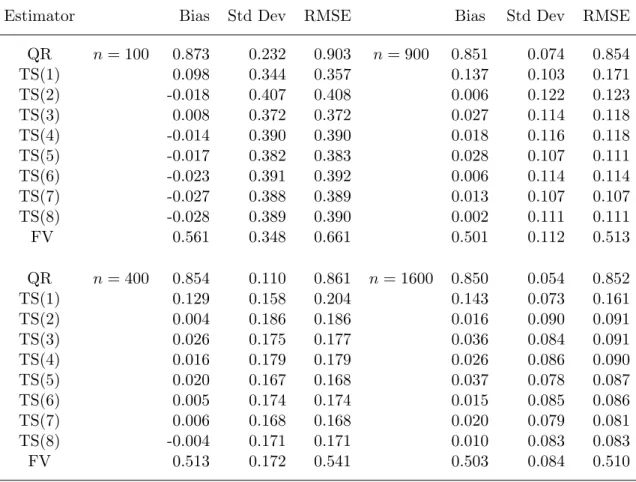
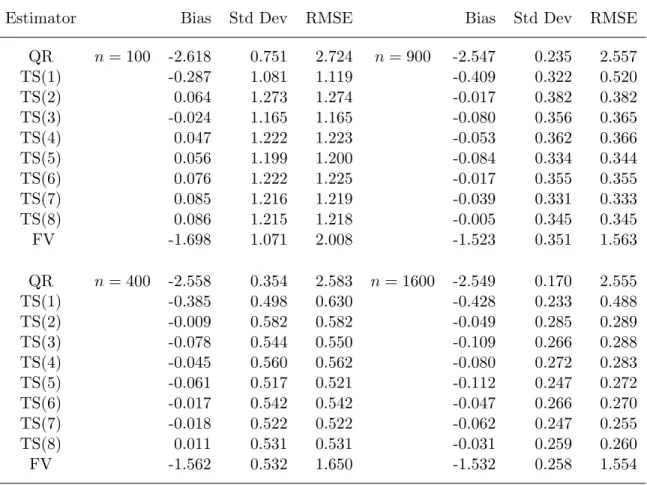
Tables 1 and 2 show results of the experiments forβandγ, respectively. Both the linear quantile regression (QR) estimator and fitted value (FV) estimator have large biases for all sample sizes. This is expected since they are inconsistent. The two-step estimator with a first order polynomial (TS(1)) has nonnegligible biases that result from the misspecification ofλτ. The two-step estimators with flexible polynomial approximations perform quite well.
The biases are rather negligible compared to the size of standard deviations and the root mean square errors (RMSE) shrink to zero roughly at a rate ofn−1/2. Furthermore, it can be seen that the estimator is not very sensitive to the choice of the order of polynomial approximations.
6
Empirical Examples
In this section, the estimation method is illustrated by applying it to two empirical appli-cations, demand for fish and the returns to schooling.
6.1 Demand for Whiting at the Fulton Fish Market
This section presents estimation results for the first empirical application. This application consists of using the data on demand for whiting at the Fulton fish market to estimate price elasticities of demand for fish. The data were used previously in Graddy (1995),
Angrist, Graddy, and Imbens (2000), and Chernozhukov and Hansen (2001). In particular, Chernozhukov and Hansen (2001) estimated quantile treatment effects (price elasticities at different quantiles of demand level) using wind speed as the instrument variable (without covariates).
The dependent variableY is the logarithm of the total quantity sold by a single dealer on each day and the endogenous explanatory variableX is the logarithm of the average daily price. The exogenous explanatory variablesZ1 are indicators for days of the week (Monday, Tuesday, Wednesday, and Thursday) and for weather conditions on shore (Rainy on shore and Cold on shore). The instrument variables are indicators for weather conditions at sea (Stormy and Mixed). The exogenous explanatory variables and instruments were those used by Angrist, Graddy, and Imbens (2000). See Angrist, Graddy, and Imbens (2000) for details about the data and variables. The sample size is 111.
The first step was carried out by a linear median regression of X on a constant term,
Z1 and instruments. In the second step, a third order polynomial approximation was used to estimate price elasticities at different values of τ. There was no trimming of the data (that is,t( ˆWi) = 1 for all i). The standard errors of the estimates were calculated by (11)
with the standard normal density as the kernel function andhn= ˆσε2n−3/20as a bandwidth,
where ˆσ2
ε is the empirical standard deviation of ˆετ. The estimation results were not very
sensitive to the choices of the order of polynomials andhn. To compare estimation results
with those of Chernozhukov and Hansen (2001), we also estimated the model using the wind speed as the instrument without Z1.
The estimation results are summarized in Figure 1. The price elasticities are shown in the absolute value. The left-hand panel of the figure shows price elasticities without the adjustment for endogeneity (dotted lines) and those with the adjustment for endogeneity (solid lines) for the model with Z1 using binary instruments (Stormy and Mixed). The price elasticities without the adjustment for endogeneity were estimated by linear quantile regressions. To show the accuracy of the adjusted estimates, 90% pointwise confidence intervals (dashed lines) of adjusted elasticities are superimposed in the figure. The right-hand panel shows the price elasticities for the model without Z1 using the wind speed as the instrument.
In both panels, adjusted elasticities are quite different from unadjusted elasticities, es-pecially at lower quantiles. This is consistent with previous findings of Chernozhukov and Hansen (2001). In fact, results in the right-hand panel are quite comparable to those in
Figure 1 of Chernozhukov and Hansen (2001). However, adjusted elasticities increase at higher quantiles in the left-hand panel, whereas those decrease in the right-hand panel. This difference may yield quite contradictory interpretations, but in view of rather small sample size, more careful analysis is needed to decide whether or not it is just an artifact of random sampling error.
6.2 Returns to Schooling Using Quarter of Birth as Instrument
This section presents estimation results for the returns to schooling. This empirical example consists of using the data of Angrist and Krueger (1991) to estimate returns to schooling at different quantiles. Angrist and Krueger (1991) estimated effects of compulsory schooling on earnings using quarter of birth as an instrument for schooling. We used a sample of 329,509 men born 1930-1939 from the 1980 census. This data set was used previously by Angrist, Imbens, and Krueger (1999) and is available at the Journal of Applied Econometrics web site.
The dependent variableY is the log weekly wage and the endogenous explanatory vari-able X is years of schooling. The exogenous explanatory variables Z1 are 10 indicator variables of year of birth. The instrument variables are 30 indicator variables of quarter of birth interacted with year of birth. This simple version of the Angrist-Krueger model is used here in an attempt to mitigate the ‘weak instruments’ bias. See, for example, Bound, Jaeger, and Baker (1995) and Staiger and Stock (1997) for the problem of weak instruments. It is quite plausible that quarter and year of birth is independent of taste and ability factors (Z is independent of V using the notation in previous sections). In that case, schooling residual V can be estimated (up to location) by any quantile regression or even by mean regression as well since years of schooling is bounded. Although schooling is conceptually continuous, years of schooling has only finite number of distinct values. To avoid this problem, the first step was carried out by a linear mean regression of X on Z1 and instruments. In the second step, a fifth order polynomial approximation was used to estimate returns to schooling at different values of τ. There was no trimming of the data. The standard error of the estimate was calculated similarly as in Section 6.1. Qualitative estimation results were not very sensitive to the choice of the order of polynomials.
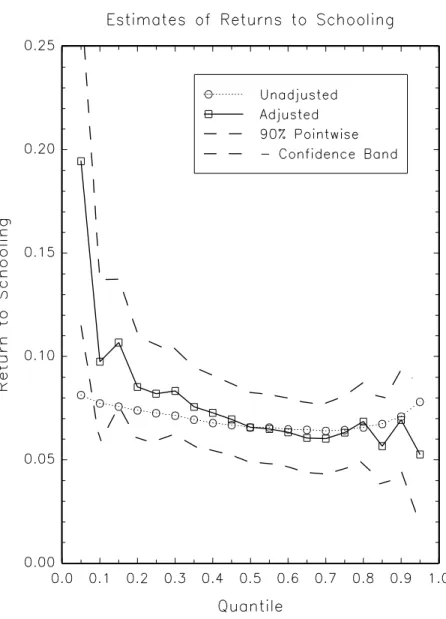
The estimation results are summarized in Figure 2. Following Buchinsky (1994), the re-turn to schooling at eachτ is defined as the derivative of the primary equation with respect to schooling, that is β(τ). If there is endogeneity, then returns to schooling obtained by
standard quantile regressions may be misleading. As in Figure 1, Figure 2 shows returns to schooling without the adjustment for endogeneity (dotted lines) and those with the adjust-ment for endogeneity (solid lines) along with 90% pointwise confidence intervals (dashed lines) of adjusted estimates.
It can be seen that unadjusted returns to schooling are between 0.7 and 0.8 and roughly constant over the range of quantiles. In contrast, adjusted returns to schooling are quite different from unadjusted returns at lowest quantiles. As was discussed in Angrist and Krueger (1991), the adjusted returns to schooling in this example may be interpreted as the structural effects of compulsory school attendance. Under this interpretation, our estima-tion results may suggest that effects of compulsory schooling are much stronger at lowest quantiles of earnings. The mean return to schooling estimated by the conventional two-stage-least-squares (2SLS) was 0.089 with standard error of 0.016, and the OLS estimate was 0.071 with standard error of 0.0003. Thus, as far as the mean effect is concerned, the bias due to endogeneity is small. However, it seems that the endogeneity bias is nonneg-ligible at the bottom of the distribution of earnings (τ = 0.05). Similar results have been presented previously by Andrew Chesher on October 2, 2003 at a lecture to inaugurate the academic year of the International Doctorate in Economic Analysis (IDEA) at Univeristad Autonoma Barcelona under the title ‘Identification of the distribution of policy impacts’. Using the same data set and a different method, Honor´e and Hu (2003) also found that quantile effects are larger at the lower end of the distribution of earnings.
7
Conclusions
This paper has presented the method for estimating quantile structural effects based on the control function approach. The paper has also provided empirical examples for which the new method has revealed some important features of endogeneity that could not easily be detected using standard methods like 2SLS.
The success of a control function approach depends crucially on the plausibility of as-sumptions about the stochastic relationship between the unobserved components U and
V and observed variables X and Z. Therefore, it would be useful to extend the basic model (1)-(3) to more complex situations such as some examples discussed in Section 4. It would be also useful to consider nonparametric estimation of the primary and reduced-form equations like Newey, Powell, and Vella (1999). These are topics for future research.
Another interesting topic is estimation of an intercept term of the primary equation. For applications considered in the paper, it is unnecessary to know the intercept term. However, in some cases such as estimating within-group wage inequality (Buchinsky (1994, 1998a, 1998b)), it is important to know the intercept term. Obviously, estimation of the intercept term requires an additional restriction. For example, one may use a condition like
QU(τ) = 0 to develop an estimator of the intercept term. To do so, rewrite the primary
equation in (1) as
Y =Xβ(τ) +Z10γ(τ) +ψ(τ) +U,
where ψ(τ) is the intercept term. Under the assumption that QU(τ) = 0, ψ(τ) can be
estimated by aτ-th sample quantile ofYi−Xiβˆ(τ)−Z0
1iˆγ(τ). Under some regularity
condi-tions, it would be straightforward to establishn−1/2-consistency and asymptotic normality of this estimator. However, it is beyond the scope of this paper to provide full details.
A
Appendix: Proofs
Throughout the Appendix, letC denote a generic positive constant that may be different in different uses. Let λmin(A) and λmax(A) denote minimum and maximum eigenvalues of a symmetric matrix A. For notational simplicity, we will suppress dependence on τ
and α. As shorthand notation, let Pκi = Pκ(Wi), ˆPκi = Pκ( ˆWi), ti = t(Wi), ˆti = t( ˆWi),
mi =Xiβ+Z10iγ+λ(Vi),fi=fε(0|Xi, Zi), andbκi=Pκi0 θκ0−mi. Define
˜ Φnκ=n−1 n X i=1 ˆ
tifiPˆκiPˆκi0 and
Φnκ=n−1 n X i=1 tifiPκiPκi0 . Lemma A.1. As n→ ∞, (a) max 1≤i≤nti ° ° °Pˆκi−Pκi ° ° °=Op h ζ1(κ)/n1/2 i =op(1). (b)kΦnκ−Φκk=Op £ ζ0(κ)2κ/n ¤ =op(1). (c) ° ° °Φ˜nκ−Φnκ ° ° °=Op h κ1/2ζ1(κ)/n1/2 i =op(1).
Proof. To prove part (a), notice that
max 1≤i≤nti ° ° °Pˆκi−Pκi ° ° °2= max 1≤i≤nti κ X k=1 [pk( ˆVi)−pk(Vi)]2 = max 1≤i≤nti κ X k=1 " ∂pk( ˜Vi) ∂v ( ˆVi−Vi) #2 = max 1≤i≤nti( ˆVi−Vi) 2Xκ k=1 " ∂pk( ˜Vi) ∂v #2 =Op £ ζ1(κ)2/n ¤ ,
where ˜Vi is between ˆVi and Vi. Part (b) can be proved as in the proof of Theorem 1 of
Newey (1997).
Now consider part (c). Notice that using arguments similar to those used in the proof of Lemma A3 of Newey, Powell, and Vella (1999),
n−1 n X i=1 ti|ˆti−ti|=Op µ max i ti| ˆ Vi−Vi| ¶ =Op(n−1/2), (19)
where the last equality follows from (10). Now, as in (A.5) of Newey, Powell, and Vella (1999), ° ° °Φ˜nκ−Φnκ ° ° °≤ ° ° ° ° °n −1 n X i=1
tiˆtifi[ ˆPκiPˆκi0 −PκiPκi0 ]
° ° ° ° °+ ° ° ° ° °n −1 n X i=1 (tiˆti−ˆti)fiPˆκiPˆκi0 ° ° ° ° ° + ° ° ° ° °n −1 n X i=1 (tiˆti−ti)fiPκiPκi0 ° ° ° ° ° ≤Cn−1 n X i=1 tiˆti µ° ° °Pˆκi−Pκi ° ° °2+ 2 ° ° °Pˆκi−Pκi ° ° °kPκik ¶ +Cζ0(κ)2n−1 n X i=1 ti|tˆi−ti| ≤Cn−1 n X i=1 ti ° ° °Pˆκi−Pκi ° ° °2 +C Ã n−1 n X i=1 tikPκik2 !1/2Ã n−1 n X i=1 ti ° ° °Pˆκi−Pκi ° ° °2 !1/2 +Cζ0(κ)2n−1 n X i=1 ti|ˆti−ti| =Op £ ζ1(κ)2/n ¤ +Op h κ1/2ζ1(κ)/n1/2 i +Op h ζ0(κ)2/n1/2 i .
Part (c) now follows from the fact thatζ1(κ)/n1/2 →0 andζ0(κ)≥Cκ1/2. Lemma A.2. As n→ ∞, max 1≤i≤nti ¯ ¯ ¯ ¯( ˆPκi−Pκi)0θκ0−dλdv(Vi)( ˆVi−Vi) ¯ ¯ ¯ ¯=op ³ n−1/2 ´ .
Proof. Let θκ(j0) denote the j-th component of θκ0. A Taylor series expansion gives
ti( ˆPκi−Pκi)0θκ0=ti κ X k=1 h pk( ˆVi)−pk(Vi) i θ(1+dz1+k) κ0 =ti κ X k=1 ∂pk( ˜Vi) ∂v θ (1+dz1+k) κ0 ( ˆVi−Vi) =ti " κ X k=1 ∂pk( ˜Vi) ∂v θ (1+dz1+k) κ0 − dλ( ˜Vi) dv # ( ˆVi−Vi) +ti " dλ( ˜Vi) dv − dλ(Vi) dv # ( ˆVi−Vi) +tidλ(Vi) dv ( ˆVi−Vi),
where ˜Vi is between ˆVi and Vi. The lemma now follows from the fact that maxiti|Vˆi −
Vi| = Op(n−1/2), sup
w∈W|∂λ(v)/∂v −[∂Pκ(w)/∂v]0θκ0| = O(κ−(r−1)), and dλ(v)/dv is continuously differentiable onW.
LetF(·|x, z) denote the cumulative distribution function ofY conditional onX =xand
Z =z. Define ˆ Gnκ(θ) =n−1Φ˜−nκ1 n X i=1 ˆ ti n τ −1£Yi≤Pˆκi0 (θ−θκ0) + ˆPκi0 θκ0 ¤o ˆ Pκi, Gnκ(θ) =n−1Φ−nκ1 n X i=1 ti n τ −1£Yi≤Pκi0 (θ−θκ0) +Pκi0 θκ0 ¤o Pκi, ˆ G∗nκ(θ) =n−1Φ˜−nκ1 n X i=1 ˆ ti n τ −F£Pˆκi0 (θ−θκ0) + ˆPκi0 θκ0 ¯ ¯Xi, Zi¤oPˆκi, G∗nκ(θ) =n−1Φ−nκ1 n X i=1 ti n τ −F£Pκi0 (θ−θκ0) +Pκi0 θκ0 ¯ ¯Xi, Zi¤oPκi, ˆ Hnκ(θ) = ˆGnκ(θ)−Gˆ∗nκ(θ),
and Hnκ(θ) = Gnκ(θ) − G∗nκ(θ). Let 1n be the indicator function such that 1n =
1{λmin( ˜Φnκ) ≥ λmin(Φκ)/2 and λmin(Φnκ) ≥ λmin(Φκ)/2}. By Lemma A.1 (b) and (c),
° ° °Φ˜nκ−Φκ ° ° °=op(1) andkΦnκ−Φκk=op(1). Thus, Pr(1n= 1)→1 asn→ ∞. Lemma A.3. As n→ ∞, 1n ° ° °Gˆnκ(ˆθnκ) ° ° °=Op[ζ0(κ)κ/n] =op(n−1/2).
Proof. To prove the lemma, it is useful to introduce some additional notation that is used in Koenker and Bassett (1978) and Chaudhuri (1991). LetN ={1, . . . , n}andHκ denote the
collection of alld(κ)-element subsets ofN. Also, letB(h) denote the submatrix (subvector) of a matrix (vector)B with rows (components) that are indexed by the elements ofh∈ Hκ.
In particular, let ˆPκ(h) denote thed(κ)×d(κ) matrix, whose rows are the vectors ˆPκi0 such
that i ∈ h, and let Yκ(h) denote the d(κ)×1 vector, whose elements are Yi such that
i∈h. In addition, let ˆPκ denote the n×d(κ) matrix, whose rows are the vectors ˆP0
κi for
i= 1, . . . , n. The matrix ˆPκ has rank =d(κ) almost surely for all sufficiently large n. By Theorem 3.1 of Koenker and Bassett (1978), there exists an index sethκ ∈ Hκ such
write 1nGˆnκ(ˆθnκ) = 1nGˆnκ1(ˆθnκ) + 1nGˆnκ2(ˆθnκ), where Gnκ1(ˆθnκ) =n−1Φ˜−nκ1 n X i=1,i∈hκ ˆ ti n τ−1£Yi ≤Pˆκi0 θˆnκ ¤o ˆ Pκi, and Gnκ2(ˆθnκ) =n−1Φ˜−nκ1 n X i=1,i∈hc κ ˆ ti n τ−1£Yi ≤Pˆκi0 θˆnκ ¤oˆ Pκi.
Notice that max1≤i≤n1nˆti
° °
°Φ˜−nκ1Pˆκi
° °
° = Op[ζ0(κ)] by Lemma A.1 and the fact that the smallest eigenvalue of ˜Φnκ is bounded away from zero (when 1n = 1). Thus, we have 1n ° ° °Gˆnκ1(ˆθnκ) ° ° °=Op[ζ0(κ)d(κ)/n]. Now consider ˆGnκ2(ˆθnκ). Define
Gnκ2=nGnκ2(ˆθnκ)0Φ˜nκPˆκ(hκ)−1.
By Theorem 3.3 of Koenker and Bassett (1978), each component inGnκ2 is between τ−1 andτ. Thus, ° ° °Gnκ2(ˆθnκ) ° °
°≤d(κ)1/2. Since the smallest eigenvalue of Φ
nκ is bounded away
from zero (when 1n= 1), we can find a constantC <∞(independent of κ) such that
1n ° ° °Pˆκ(hκ) ˜Φ−nκ1 ° ° °≤C ° ° °Pˆκ(hκ) ° ° °.
Also notice that
° ° °Pˆκ(hκ) ° ° °2 = trace[ ˆPκ(hκ)0Pˆκ(hκ)] = trace[ ˆPκ(hκ) ˆPκ(hκ)0] = X i∈hκ ° ° °Pˆκi ° ° °2 ≤Cζ0(κ)2d(κ). Hence, ° ° °Pˆκ(hκ) ° ° °≤Cζ0(κ)d(κ)1/2. Therefore, 1n ° ° °Gnκ2(ˆθnκ) ° ° °≤n−1 ° ° °Gnκ2(ˆθnκ) ° ° °1n ° ° °Pˆκ(hκ) ˜Φ−nκ1 ° ° °≤Cζ0(κ)d(κ)/n.
Since arguments used in this proof hold uniformly overhκ, the lemma follows immediately.
Lemma A.4. As n→ ∞,
(b) 1nkAHnκ(θκ0)k=Op¡n−1/2¢.
Proof. First, we will prove part (b). Notice that since the data are i.i.d.,fε(·|x, z) is bounded
away from zero in a neighborhood of zero for allxandz,t2
i =ti, and the smallest eigenvalue
of Φnκ is bounded away from zero (when 1n= 1),
E h 1nkHnκ(θκ0)k2 ¯ ¯ ¯X1, . . . , Xn, Z1, . . . , Zn i ≤1nn−2 n X i=1 ti h E hn
F£Pκi0 θκ0¯¯Xi, Zi¤−1£Yi ≤Pκi0 θκ0¤o2
¯ ¯ ¯Xi, Zi i Pκi0 Φ−nκ1A0AΦ−nκ1Pκi i ≤C1nn−2 n X i=1 trace h tiPκi0 Φ−nκ1A0AΦ−nκ1Pκi i ≤C1nn−2 n X i=1 h (min i fi) −1f i i trace h tiAΦ−nκ1PκiPκi0 Φ−nκ1A0 i ≤C1nn−1trace n AΦ−nκ1 h n−1 n X i=1 tifiPκiPκi0 i Φ−nκ1A0 o =C1nn−1trace ³ AΦ−nκ1A0 ´ ≤Cn−1(1 +dz1).
Therefore, part (b) of the lemma follows from Markov’s inequality. Part (a) follows by repeating the same arguments withA replaced by an identity matrix.
Lemma A.5. (a) As n→ ∞,
1nGˆ∗nκ(θ) =−1n(θ−θκ0)−1nn−1Φ−nκ1 n X i=1 tifidλdv(Vi)( ˆVi−Vi)Pκi+R∗nκ(θ), where kR∗ nκ(θ)k=op £ κ1/2n−1/2¤+O p £ κ−r+ζ 0(κ)kθ−θκ0k2+κ1/2n−1+κ1/2κ−2r ¤ . (b) As n→ ∞, 1nAGˆ∗nκ(θ) =−1nA(θ−θκ0)−1nn−1AΦ−nκ1 n X i=1 tifidλdv(Vi)( ˆVi−Vi)Pκi+ARnκ∗ (θ), where kAR∗nκ(θ)k=op £ n−1/2¤+Op £ κ−r+ζ0(κ)kθ−θκ0k2+n−1+κ−2r ¤ . Proof. First, we will prove part (a). Define
1nG˜∗nκ(θ) =−1n(θ−θκ0)−1nn−1Φ−nκ1 n
X
i=1
and 1nG¯∗nκ(θ) =−1n(θ−θκ0)−1nn−1Φ˜−nκ1 n X i=1 ˆ
tifi( ˆPκi−Pκi)0θκ0Pˆκi
−1nn−1Φ˜−nκ1 n X i=1 ˆ tifibκiPˆκi. Write 1nGˆ∗nκ(θ) = 1nG˜∗nκ(θ) +R∗nκ1(θ) +Rnκ∗ 2(θ), where R∗nκ1(θ) = 1nG¯∗nκ(θ)−1nG˜∗nκ(θ) and R∗nκ2(θ) = 1nGˆ∗nκ(θ)−1nG¯∗nκ(θ). Notice that 1nn−1 n X i=1 ° ° °Φ˜−nκ1Pˆκi ° ° °2 = 1nn−1 n X i=1 trace ³ ˜ Φ−nκ1PˆκiPˆκi0 Φ˜−nκ1 ´ ≤C1ntrace ³ ˜ Φ−nκ1 ´ =Op(κ). (20)
By Lemmas A.1 and A.2, equation (20), and the Cauchy-Schwartz inequality,
° ° ° ° °1nn −1Φ˜−1 nκ n X i=1 ˆ
tifi( ˆPκi−Pκi)0θκ0Pˆκi−1nn−1Φ˜−nκ1 n X i=1 ˆ tifidλdv(Vi)( ˆVi−Vi) ˆPκi ° ° ° ° ° ≤1nn−1 n X i=1 ° ° °Φ˜−nκ1Pˆκi ° ° °ˆtifi ¯ ¯ ¯ ¯( ˆPκi−Pκi)0θκ0− dλdv(Vi)( ˆVi−Vi) ¯ ¯ ¯ ¯ ≤1n à n−1 n X i=1 ° ° °Φ˜−nκ1Pˆκi ° ° °2 !1/2à n−1 n X i=1 ˆ tifi2 ¯ ¯ ¯ ¯( ˆPκi−Pκi)0θκ0−dλdv(Vi)( ˆVi−Vi) ¯ ¯ ¯ ¯ 2!1/2 =op ³ κ1/2n−1/2 ´ . (21)
Also, notice that 1nn−1 n X i=1 ° ° °ˆtiΦ˜−nκ1Pˆκi−tiΦ−nκ1Pκi ° ° °2 ≤C1nn−1 n X i=1 |ˆti−ti| ·° ° °Φ˜−nκ1Pˆκi ° ° °2+°°Φ−nκ1Pκi°°2 ¸ +C1nn−1 n X i=1 ° ° °Φ˜−nκ1Pˆκi−Φ˜−nκ1Pκi ° ° °2+C1nn−1 n X i=1 ° ° °Φ˜−nκ1Pκi−Φ−nκ1Pκi ° ° °2 ≤C1n max 1≤i≤n ·° ° °Φ˜−nκ1Pˆκi ° ° °2+°°Φ−nκ1Pκi ° °2¸ n−1 n X i=1 |ˆti−ti| +Op(1)n−1 n X i=1 ° ° °Pˆκi−Pκi ° ° °2+Op(1) ° ° °Φ˜nκ−Φnκ ° ° °2n−1 n X i=1 kPκik2.