MINIMALIST MULTI-ROBOT CLUSTERING OF SQUARE OBJECTS: NEW STRATEGIES, EXPERIMENTS, AND ANALYSIS
A Thesis by YONG SONG
Submitted to the Office of Graduate Studies of Texas A&M University
in partial fulfillment of the requirements for the degree of MASTER OF SCIENCE
Approved by:
Chair of Committee, Dylan A. Shell Committee Members, Dezhen Song
Desmond Ng Department Head, Hank Walker
May 2013
Major Subject: Computer Science
ABSTRACT
Studies of minimalist multi-robot systems consider multiple robotic agents, each with limited individual capabilities, but with the capacity for self-organization in order to collectively perform coordinated tasks. Object clustering is a widely stud-ied task in which self-organized robots form piles from dispersed objects. Our work considers a variation of an object clustering derived from the influential ant-inspired work of Beckers, Holland and Deneubourg which proposed stigmergy as a design principle for such multi-robot systems. Since puck mechanics contribute to cluster accrual dynamics, we studied a new scenario with square objects because these pucks into clusters differently from cylindrical ones. Although central clusters are usually desired, workspace boundaries can cause perimeter cluster formation to dominate. This research demonstrates successful clustering of square boxes - an especially chal-lenging instance since flat edges exacerbate adhesion to boundaries - using simpler robots than previous published research. Our solution consists of two novel be-haviours, Twisting and Digging, which exploit the objects’ geometry to pry boxes free from boundaries. Physical robot experiments illustrate that cooperation between twisters and diggers can succeed in forming a single central cluster. We empirically explored the significance of different divisions of labor by measuring the spatial dis-tribution of robots and the system performance. Data from over 40 hours of physical robot experiments show that different divisions of labor have distinct features, e.g., one is reliable while another is especially efficient.
ACKNOWLEDGEMENTS
I would like to thank my advisor, Dr. Dylan Shell, who has been a constant source of support and knowledge, for being a great mentor and inspiring me.
Thanks also go to my friends and colleagues for making my time at Texas A&M University a great experience.
TABLE OF CONTENTS Page ABSTRACT . . . ii ACKNOWLEDGEMENTS . . . iii TABLE OF CONTENTS . . . iv LIST OF FIGURES . . . v LIST OF TABLES . . . vi 1. INTRODUCTION . . . 1
2. MOTIVATION & RELATED WORK . . . 4
3. MATERIALS & METHODS . . . 8
4. THE BASIC STRATEGY . . . 10
4.1 A Baseline for Comparison . . . 10
4.2 Resulting Cluster Dynamics in the Basic Strategy . . . 10
5. THE MIXED STRATEGY . . . 12
5.1 Prying Boxes Loose: Two New Motions . . . 12
5.1.1 Twisting Behavior . . . 13
5.1.2 Digging Behavior . . . 15
5.2 Resulting Cluster Dynamics in the Mixed Strategy . . . 16
6. ANALYSIS OF DIVISION OF LABOR . . . 18
6.1 Clustering Performances of Differing Divisions of Labor . . . 19
6.2 Cluster Dynamics under Differing Divisions of Labor . . . 21
7. THE EFFECT OF THE NUMBER OF ROBOTS . . . 23
8. CONCLUSION . . . 26
LIST OF FIGURES
FIGURE Page
3.1 Anatomy of iRobot Creates. Source : http://wwww.irobot.com . . . 8 3.2 (a) initial configuration, (b) an example final configuration using the
basic strategy, and (c) an example final configuration using the mixed strategy (2 Twisters and 3 Diggers.) . . . 9 4.1 Flowchart showing the basic behavior. . . 10 5.1 Prying boxes away from the wall. . . 12 5.2 Trajectories of the twisters and diggers after the prying motion. . . . 13 5.3 Twisting and digging behaviors on the boundary. . . 13 5.4 Flowchart of the twisting behavior (the shaded part indicates the
pry-ing motion.) . . . 14 5.5 Flowchart of the digging behavior (the shaded part indicates the
pry-ing motion.) . . . 15 5.6 A comparison of clustering performance (20 boxes and 5 robots.)
Ver-tical axis is the size of the largest central cluster (essentially the same performance metric employed by [1].) The horizontal axis is time measured in minutes. . . 16 6.1 Averaged spatial distribution of robots (central versus boundary
re-gions) with respect to division of labor. . . 18 6.2 Averaged performance with respect to different Divisions of Labor. . 19 6.3 A ternary plot detailing the cluster dynamics for each trial for two
divisions of labor. . . 20 6.4 Clustering dynamics for particular Divisions of Labor. . . 22 7.1 A comparison of clustering performance (20 boxes and 10 robots.)
Vertical axis is the size of the largest central cluster. The horizontal axis is time measured in minutes. . . 23 7.2 Clustering dynamics with 10 robots. . . 24
LIST OF TABLES
TABLE Page
1. INTRODUCTION
Studies of self-organized multi-robot systems consider multiple agents, each with limited individual capabilities, but with the capacity for synergistic interaction in order to collectively perform tasks. Unlike the more common intentional distributed robot teams, the group’s functionality emerges through feedback mediated by the environment and is the product of action rather than representation or calculated reasoning [11]. Self-organized robot swarms have attractive potential advantages: simple hardware allows for the production cheap, specialized, robust units which exploit economies of scale. But designing a self-organized system to perform given task remains more art than science. This paper presents one success in this regard. We tackle an important variation of an archetypal task, first identifying the compli-cations that the arise in our particular instance, then proposing and demonstrating novel a solution.
We consider a variation of an object clustering task which involves gathering spa-tially distributed objects into a single central pile. Akin to raking leaves in a yard, clustering simplifies subsequent handling and is most useful as an early step in a pipeline of processing steps. The clustering domain was extremely influential in the early years of multi-robot research perhaps partly because of its analogy to ceme-tery organization and brood sorting by ants [3, 1, 6]. Although the task is ideal for studying the role of physics and environmental interactions in producing complex collective behavior, the recent trend has been toward explicitly coordinated robot systems. This is reflected in the fact that clustering drew only limited attention in
Part of this chapter is reprinted with permission from ”Self-Organized Clustering of Square
Objects by Multiple Robots” by Yong Song, Jung-Hwan Kim, and Dylan Shell,Swarm Intelligence,
the last decade. The focus of this paper is on clustering objects that are square, which is an important direction because [i] these objects are more potentially useful for applications (specifically, construction involving bricks), and [ii] the task is more challenging since the object geometry causes radically different packings and sensi-tivity to environmental boundaries which cause existing approaches to fail to form spatially centralized clusters.
In this paper, we propose two simple behaviorsTwisting andDigging that exploit the shape of the objects in order to pry them free of boundaries. A group of robots executing mixture of these two behaviors is able to repeatedly form central clusters. We examined the effect of different numbers of twisters and diggers on the system’s performance, empirically determining the most reliable and most efficient divisions of labor. We also present data from experiments with 5 and 10 robots, showing a decrease in mean time to form clusters and an increase in variance due to interference with the larger system. This study maintains the experimental tradition of work on self-organized clustering by focusing on data collected with physical robots. Data recorded from over 40 hours of experiments are reported.
The following are the paper’s primary contributions:
• Minimalism: In addition to tackling a more useful and more difficult clustering problem, the successful demonstration employssimplerrobots than prior published accounts. Chapter 2 details the basis for this claim.
• An assessment of theory: Data from experiments with 5 robtos,n = 5, empirically verify Kazadi’s cluster growth theory [7], until now validated solely with simula-tions of hypothetical robots. Data with n = 10 appear to show that his necessary condition may be violated in practice.
division of labor for clustering, and illustrates that it can play an important role.
• New way to address boundary effects: Previous research has indicated that cluster formation on the boundaries is a problem; a wide range of solutions have been pro-posed. This paper describes an effective solution which uses structured motion to take advantage of the physical packing of the items rather than relying on sensing information. Because this does not depend on the robot disambiguating particular circumstances (i.e.,the robot is unaware of the distinction between a boundary or any other obstacle), but rather it is the context within which the actions are exe-cuted that produces the desired outcome, this resolution is particularly satisfying from a self-organization perspective. The approach is more consistent than prior work in that the clustering process is also described as depending primarily on the physics of the robot-environment interaction for its success.
• Importance of spatial distribution: The approach employed in this paper is novel because the mixed twister and digger strategy operates primarily by manipulating the spatial distribution of robots. This is in contrast to other techniques which involve sophisticated rules for when objects are released (e.g.,[6].) Thus far, analysis techniques (e.g., [7, 10]) only consider spatially homogeneous distributions.
Further motivation and related work appear in Chapter 2. Chapter 3 describes the materials, the experimental environment, and methods. In Chapter 4, we present the primitive algorithm used for clustering and the new behaviors we introduce is described and examined in the following section. Chapter 6 presents the dynamics and empirical characterization of performance as a function of division of labor. We also examine the effect of the number of robots in Chapter 7.
2. MOTIVATION & RELATED WORK
Object clustering with multiple robots has widely been studied in robotics. In-spired by ants’ brood sorting, Deneubourg et al. [3] presented an early distributed sorting algorithm and applied to a simulated multi-agent system. Sorting was achieved with a simple algorithm with only a local density sensor and no direct communication between agents. Inspired by earlier biological models [4], Beckers et al. [1] conducted an early physical robot experiment and demonstrated clustering without needing a density sensor, employing a binary threshold sensor in its place. They also gave an initial explanation for the emergence of clusters on the basis of the geometry of the piles. Along with this own clustering demonstration [10], Martinoli [9] was able to quantify this geometric notion under the assumption of rotationally symmetric piles. The idea is essentially that in order to draw a puck away from a cluster, a robot must move past it at a particular angle. Small clusters have more angles at which pucks will be removed than big clusters and, additionally, larger clusters are proportionately more likely to be encountered for puck deposits. Thereafter, Kazadi et al. [7] introduced a model which formalizes precise conditions under which cluster formation will occur.
Holland and Melhuish [6] extended the task of object clustering to spatial sorting, requiring the classification of objects based on their types. Most relevant to this paper, they had a detailed description of the effect of environment boundaries. They conducted several experiments in which clusters formed at the edge of their arena. Flat boundaries, after all, have all the properties of a very large cluster. We believe
Part of this chapter is reprinted with permission from ”Self-Organized Clustering of Square
Objects by Multiple Robots” by Yong Song, Jung-Hwan Kim, and Dylan Shell,Swarm Intelligence,
that their paper is the most systematic empirical study of this boundary effect and how it might be overcome to date. They proposed an algorithmic solution to the problem: since their U-bots can detect and measure the distance to the boundary, the robots opted not to deposit frisbees (the objects they cluster) if they are too close to the boundary. Since our robots are unable to distinguish objects, robots, and boundaries, their solution cannot be applied to our scenario.
Bonabeau et al. [2] describe a similar “preference” for cluster formation along boundaries within a biological system. Several of the preceding studies [3, 1, 6] explained clustering through stigmergy, a term coined by Grass´e [5] in studying wasp nest construction. It describes how an environment, modified by agents’ actions previously, affects subsequent task performance by the agents. Although, far from being a concrete engineering principle, the observation that this idea is applicable in several contexts is powerful. More recent connections between robot clustering and biological models have been published [12].
Almost all previously published work in robotic clustering considers cylindrical pucks. Using square objects makes the task rather challenging because flat edges exacerbate adhesion to the boundary wall. Once against the wall, it is particularly difficult for a cylindrical robot to move a box into the center of the workspace. This can be observed in the video posted by Vaughan’s Autonomy Lab in which 36 iRobot Creates successfully created clusters of square objects running only their default demo program. Most of the clusters form on the boundary,
We thank Vaughan’s Autonomy Lab at SFU for posting this video as it inspired this paper.
W ork Puc ks/Seeds/Cub es/Bo xes En vironmen t Notes Sensing Manipulation Sensing Boundary & Effects Bec k ers et al. [1] ♦ Detect circu-lar puc ks with force sensor in C-shap ed sco op ♦ Push circular ob jects ♦ Con trol the n um b er of carried puc ks with a microswitc h ♦ Tw o IR sen-sors for obstacle a v oidance ♦ A square arena ♦ Side-steps the effect of b ound-ary b y using a deformable b o undary ♦ The rob ots can push puc ks trapp e d on the b oundary due to a deformable w all Martinoli [10] ♦ Discriminate b e tw ee n circu-lar seeds and obstacles with distinct IR sensor signatures ♦ Grasp, carry and release seeds ♦ Six IR pro xim-it y sensors for de-tecting obstacles ♦ A square arena ♦ Effect of the b o undary ignored ♦ The rob ots can recognize and access clusters g eome tr ically Holland & Melh uish [6] ♦ Detect circular puc ks b y sensing bac kw ard force on gripp er ♦ Grip, retain, and release ci r-cular puc ks with semicircular gripp er ♦ F our IR pro x-imit y sensors for sensing the b o undary ♦ An o ctag onal shap ed arena with rigid b ound-ary ♦ Use the proba-bilit y of detecting a w all ♦ Rob ots cannot discriminate b e-tw een other rob ots and the b oun dary ♦ The strategy of v arying the w all probabilit y in tro duces the false p ositiv e ♦ The rob ots o v ercome the effect of b oundar y with sensors Maris et al. [8] ♦ No sensing o f the cub es ♦ Cub es pushed un til obstacle detected ♦ Six IR pro xim-it y sensors for ob-stacle detection ♦ A square arena ♦ Consider pushed cub es against the b o undary as ”lost” ♦ The rob ots manipulate cub es b y only pushing b eha vior for clus-tering task ♦ Rob ots pass o v er cub es on the b oun dary V au ghan [unpublished] ♦ Detect square b o xes with bump e rs ♦ Push and lea v e a b o x b y a bump er’s threshold ♦ No sensor for detecting ob jects except for b o xes ♦ A rectangular arena ♦ Effect of the b o undary ignored ♦ Sev e ral clusters formed on the b oun dary This pap er ♦ Detect square b o xes with bump e rs ♦ Push and lea v e a b o x b y a bump er’s threshold ♦ A single IR pro ximit y sensor for sensing the ob jects on the righ t side ♦ An o ctag onal shap ed arena with rigid b ound-ary ♦ Ov ercome the effect of b ound-ary using motion strategies ♦ No puc k manipulator ♦ Use few sensor infor m a ti o n (1-bit IR sensor, 1-b it bump er) ♦ The rob ot unkno wingly o v ercomes the effect of b oundary without the sensor for distinguishing b oundary ( i.e. , real self-organi z ati on) T able 2.1: A comparison of rob ot capabilities within related researc h.
Table 2.1 is a comparative summary of robots’ capabilities and experimental environments in the most closely related work. It shows that all of the papers employ richer sensing: including sensors to detect and differentiate other robots, objects, and boundaries. Many of the robots are equipped with manipulation mechanisms of one sort or another (grippers, C-shaped scoops, shovel,etc.) that pick up or hold objects. We consider simpler robots with a front bumper and a single IR proximity sensor. The robots are able to recognize the existence of an obstacle in the IR sensor, but cannot ascertain its type. Interestingly, the rows in the table which describe the most simple robots either produce boundary clusters or give them special treatment. For example, Maris and Boeckhorst [8] considered objects to be “lost” once they were pushed against a wall.
3. MATERIALS & METHODS
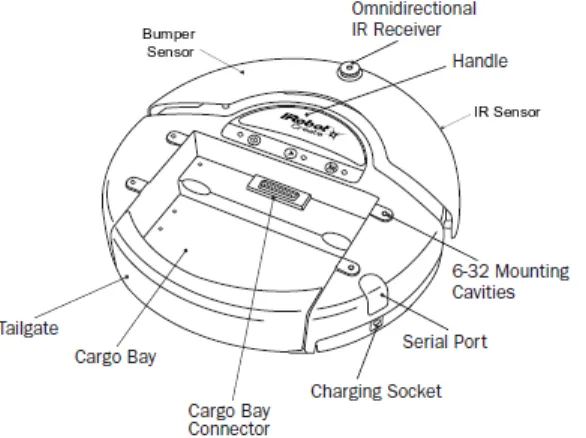
We use iRobot Creates, as shown in Figure 3.1, cheap robots about 30cm in di-ameter. The robots employ a differential drive mechanism with two wheels and a passive caster. Through this mechanism, the robot can move forward or backward, perform steering while moving, and turn in place. The robots have only two sensors. The robot has a bumper, which is used to detect the presence of objects in front of the robot. The bumper is only depressed when the force against them exceeds a predefined threshold. Also, the robot is equipped with a single IR proximity sensor on its right side, which is used for sensing the distance to an object. Those inputs do not enable the robots to determine the type of object detected.
Figure 3.1: Anatomy of iRobot Creates. Source : http://wwww.irobot.com
We consider square boxes (35cm×35cm), similar in size to the robot, as the ob-ject for clustering. For practicable operation with our robots, the boxes have the following crucial property: although an individual box has an insufficient mass to
Part of this chapter is reprinted with permission from ”Self-Organized Clustering of Square
Objects by Multiple Robots” by Yong Song, Jung-Hwan Kim, and Dylan Shell,Swarm Intelligence,
activate the bump sensor, two or more boxes together have adequate mass to depress the bumper. Similar to Melhuish and his group (e.g., [6, 12]), we use an octagonal shaped workplace (4.5m×4.5m.) Figure 3.2a shows the initial configuration used in all the experiments. Square boxes are uniformly distributed, and robots have fixed starting positions while their orientations are random.
(a) (b) (c)
Figure 3.2: (a) initial configuration, (b) an example final configuration using the basic strategy, and (c) an example final configuration using the mixed strategy (2 Twisters and 3 Diggers.)
In order to analyze the cluster dynamics of a motion strategy, three trials, each lasting 90 minutes, were conducted for each experimental condition. Experiments used either 5 or 10 robots and always 20 boxes. All experiments were recorded on a video camcorder and annotated by observing frames at intervals of 5 seconds. We employed the following criteria for analyzing cluster dynamics. The size of a cluster was defined as a group of more than three boxes, each touching at least one other. (Note that this is a stricter constraint than the usual requirements: most previous work permitted a small gap between objects; we opted for our definition as it is unambiguous.) Additionally, we distinguish between boundary clusters and central clusters since the goal of this work is to produce central clusters. A boundary cluster is defined as a group which has at least one box touching a wall.
4. THE BASIC STRATEGY
4.1 A Baseline for Comparison
Based on the controllers in [1, 6], we implemented the simple algorithm shown in Figure 4.1. In this strategy, robots move straight, they then turn to a random di-rection, and return to moving straight when their bumpers are pressed. The robots’ next operations are determined based only on local information, i.e., their bumper sensors. Start Bumper Pressed? Make a Random Turn Go Straight Yes No
Figure 4.1: Flowchart showing the basic behavior.
4.2 Resulting Cluster Dynamics in the Basic Strategy
Figure 3.2b shows the final configuration of the first execution of the basic strat-egy. In all three trials, the robots produced clusters of square boxes, but most clusters formed on the boundary. (cf. Experiment 2 in [1].) The results underscore the earlier statement: the boundary has a critical effect on the cluster formation since a wall
Part of this chapter is reprinted with permission from ”Self-Organized Clustering of Square
Objects by Multiple Robots” by Yong Song, Jung-Hwan Kim, and Dylan Shell,Swarm Intelligence,
has all the properties of a large cluster. The workspace walls buttress the partial structures, and the box’s flat edge means that the motion required to dislodge such boxes occurs only infrequently. Once a box is attached on the boundary, it is unlikely to move into the center.
5. THE MIXED STRATEGY
5.1 Prying Boxes Loose: Two New Motions
We propose two new behaviors to overcome the effect of the boundary and to increase the formation of a single central cluster of boxes. Our approach exploits the mechanics of square objects: as shown in Figure 5.1, hitting the corner of a box can pry it loose from a tight packing. This reduces the area in contact with the wall and makes subsequent separation more likely, especially if repetitive motions are used. Based on this concept, we introduce two new behaviors,twisting ordigging. Either of them have the prying motion. The next sub-sections show details of those behaviors. We call the overall approachmixed strategy because they involve two complementary behaviors that the robots in the group perform concurrently. We name a robot in the twisting behavior a twister and a robot in the digging behavior a digger. It is important to stress the simplicity of both operations. Compared to the basic strat-egy, only one IR proximity sensor is added to the robots.
Box Box
Box
Detect
Box 45˚
Figure 5.1: Prying boxes away from the wall.
Part of this chapter is reprinted with permission from ”Self-Organized Clustering of Square
Objects by Multiple Robots” by Yong Song, Jung-Hwan Kim, and Dylan Shell,Swarm Intelligence,
Digger Twister
To the central region
To the boundary Boundary
Figure 5.2: Trajectories of the twisters and diggers after the prying motion. Figure 5.2 shows trajectories of both motion behaviors on the boundary after a bump or time out (the latter, only for the twisters.) Diggers move along curved arc to find a wall, while twisters keep going into the center region in which a box might be pushed. Hypothetically, the twisters are more likely to push objects against a wall or bring objects into the central region. On the other hand, the diggers effectively generate gaps between boxes and boundaries, but there is a small chance for the objects to be brought into the central region since robots stay near the boundaries.
5.1.1 Twisting Behavior
The essential operation of a Twister is to strike a box at 45◦, and then drive straight for 3 seconds. The box is shifted through this prying motion. With luck other robots that reach the box subsequently butt the twisted box and bring the box into the center, as shown in Figure 5.3a.
45˚ (a) Twisting. Box Wall Following Wall Following (b) Digging.
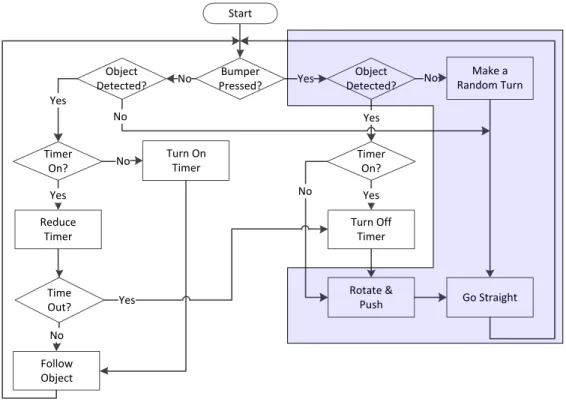
In the best case, a box may be removed from the boundary in only two actions. Thus, it suffices to increase the likelihood of generating central clusters. In order to raise the probability of contact with boundary boxes, the robot operates in a wall following mode when the IR sensor detects any sort of object. In the case that there is only one box in front of the robot, it cannot detect the box because an individual box has an insufficient mass to activate the bump sensor. The robot will simply keep pushing it into the corner of the workplace. Since it can be counter-productive to continue wall following, the robots only do so for 5 seconds, then perform a prying motion and moves toward the arena interior. The motion of the robot in the arena’s central region is the same as the basic strategy. Figure 5.4 shows the flowchart of the detailed algorithm.
Start Bumper Pressed? Timer On? Object Detected? Timer On? Reduce Timer Follow Object Time Out? Turn On Timer Turn Off Timer Rotate & Push Make a Random Turn No Yes No Yes Yes Yes No No Yes Go Straight No Object Detected? Yes No
Figure 5.4: Flowchart of the twisting behavior (the shaded part indicates the prying motion.)
5.1.2 Digging Behavior
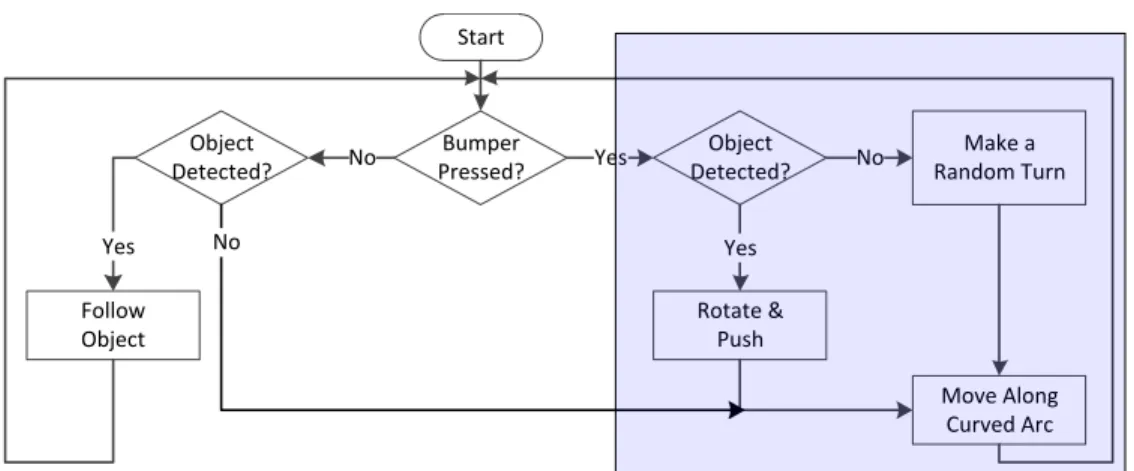
Although the robots in the twisting behavior can separate square objects from the boundary and produce central clusters, they are inefficient because the robots have the low chance of detecting a wall with their single IR sensor. To improve the overall performance, we propose aDigging Behavior. Figure 5.3b shows the principal objectives of the digging behavior: further separating the twisted boxes from walls and aiding in the prevention of boundary cluster growth. Unlike twisters, the robot remains in wall-following mode when its IR sensor detects an object. This method increases the probability that a robot will encounter a box on the wall and detach it. In addition, the robot tries to find a boundary with the movement in a curved path instead of a straight trajectory. Except for these two exceptions, the digging robots perform the same as the prying motion as twisters. The flowchart detailing the behavior is in Figure 5.5.
Start Bumper Pressed? Object Detected? Follow Object Rotate & Push Make a Random Turn No Yes Yes Move Along Curved Arc Object Detected? Yes No No
Figure 5.5: Flowchart of the digging behavior (the shaded part indicates the prying motion.)
5.2 Resulting Cluster Dynamics in the Mixed Strategy
We also carried out three experimental trials under the conditions identical to the basic strategy case in order to verify the clustering performance of the mixed strategy. Five robots were used in our trials for the mixed strategy, two employed the twisting behavior and three the digging behavior. Although the twisting and the digging operations are complementary, the division of labor affects the overall performance. We present the details of the performances and clustering dynamics under different divisions of labor in Section 6.
0 10 20 30 40 50 60 70 80 90 0 5 10 15 20 Time (min)
The size of the biggest
central cluster
Basic 2T3D
Figure 5.6: A comparison of clustering performance (20 boxes and 5 robots.) Vertical axis is the size of the largest central cluster (essentially the same performance metric employed by [1].) The horizontal axis is time measured in minutes.
Figure 3.2c shows the final configuration of the first trial in the mixed strategy. Unlike to the basic strategy, a single large cluster emerged in the middle of the arena in all three trials. The robots successfully detached the boxes in the boundary clusters and conveyed them to the central region. Figure 5.6 presents the average
size of the biggest central clusters and their standard deviations through the time for the basic and mixed strategies. Although several clusters were formed initially in the central region, frequent collisions with the robots, in the basic strategy, provoked the collapse of central clusters within 20 minutes in any of the trials. At the end, no central cluster had been constructed, while several boundary clusters emerged in the arena. In contrast, the average size of the remaining clusters with the mixed strategy after 90 minutes was 19.33 while no boundary cluster had formed. In addition, the average lifetimes of all boundary clusters were 2298.13 and 719.00 seconds, and standard deviations were 2083.71 and 403.01 seconds for basic and mixed strategies. The results verify that our proposed motion strategy can overcome successfully the boundary effect and collect spatially distributed objects into only one pile at the designated position. (Additional detail for the mixed strategy can be seen in the second figure on page 20.)
6. ANALYSIS OF DIVISION OF LABOR
The successful results of the mixed strategy caused us to broaden our scope to consider the problem of improving the overall efficiency by tuning the division of labor. Therefore, we extended the experiments to various cases with the different ratios of twisters to diggers, and then analyzed experimental results in each case.
0 20 40 60 80 100 Basic 0T5D 1T4D 2T3D 3T2D 4T1D 5T0D Di st ri b u ti o n R at io (% ) Central Region Boundary Region
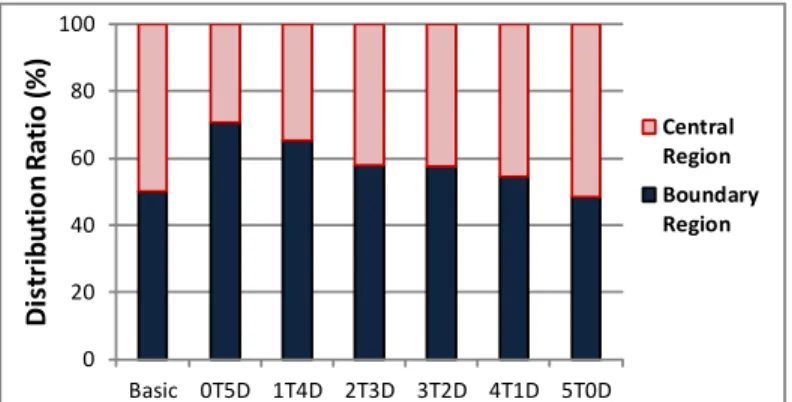
Figure 6.1: Averaged spatial distribution of robots (central versus boundary regions) with respect to division of labor.
The most significant difference between twisting and digging behaviors is the spa-tial distribution of the robots. Due to the low probability of detecting a wall for the twister, twisters end up going around the workspace, while diggers spend compara-tively more time near walls. Figure 6.1 shows the averaged spatial distributions of the robots for particular divisions of labor (these data were collected without any boxes as a baseline.) Note: we assume that the robots in basic strategy are uniformly distributed due to their random turn. The numbers of robots for each case are nor-malized by the number of robots in the basic case. As the ratio of diggers increases,
Part of this chapter is reprinted with permission from ”Self-Organized Clustering of Square
Objects by Multiple Robots” by Yong Song, Jung-Hwan Kim, and Dylan Shell,Swarm Intelligence,
a box on the boundary is more likely to be separated from the wall. However, it does not guarantee that the separated object will be brought into a central cluster since a digger will remain along the wall after the prying operation. From those analyses, we next consider how these differences in spatial distribution might affect clustering task progress.
6.1 Clustering Performances of Differing Divisions of Labor
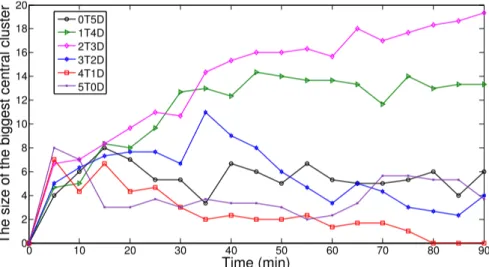
We conducted out three trials for all possible combinations of the twister (T) and the digger (D), from no twisters and five diggers (0T5D) to five twisters and no diggers (5T0D), under identical conditions as the previous experiments. Figure 6.2 shows the averaged size of the largest central clusters for each case.
0 10 20 30 40 50 60 70 80 90 0 2 4 6 8 10 12 14 16 18 20 Time (min)
The size of the biggest
central cluster 0T5D 1T4D 2T3D 3T2D 4T1D 5T0D
Figure 6.2: Averaged performance with respect to different Divisions of Labor.
Contrary to our expectation that all cases could achieve a satisfactory clustering performance, only three trials succeeded in forming a single central cluster having all 20 boxes within 90 minutes except for 2T3D case. The successful cases were the first and second trials in 4T1D, and the third trial in 0T5D. However, we observed that since experiments, not formed a single central cluster, were still performing the
clustering task at the end of the run, the robots could achieve the goal given more time. Even though many experiments failed to gather all distributed objects into a single central cluster within the given time, we were interested in the question of whether, given unlimited time, all combinations would form a single central cluster. We examine this question using Cluster Growth theory in the next section.
0 5
10 15
20
Number of Boundary Boxes
0
5
10
15
20 Number of Central Boxes
0 5
10 15
20
Number of Unclustered Boxes (a) 1T4D 0 5 10 15 20
Number of Boundary Boxes
0
5
10
15
20 Number of Central Boxes
0 5
10 15
20
Number of Unclustered Boxes (b) 2T3D
Figure 6.3: A ternary plot detailing the cluster dynamics for each trial for two divisions of labor.
Because Figure 6.2 is a comparative summary of many experiments and shows the means of the three trials for each division of labor, it hides a few interesting facts. For example, the 1T4D case appears to perform poorly compared to 2T3D. In fact, it was a very capable division of labor and once form a complete central cluster in the shortest observed time of 25 minutes. However, 1T4D also failed in one of its three trials. This illustrates that while 2T3D is to be preferred for reliable clustering, 1T4D may be preferred for efficient clustering. Figure 6.3 shows the box cluster dynamics for each of the three runs. Lack of spread in the random motion
on the ternary coordinate system gives an indication of how directed the cluster formation dynamics where. The blue trial for 1T4D was extremely efficient, while the magenta trial had some number of boxes on the boundary. The reliability (and comparatively longer time) is visible in the 2T3D case as all the paths converge to the lower right corner.
6.2 Cluster Dynamics under Differing Divisions of Labor
According to the theoretical dynamics of clustering systems, proposed by Kazadi et al. [7], a sufficient condition for the convergence of puck clustering systems is that the ratio of puck removal and puck deposit is monotonically decreasing. The cluster formation function,
g(n)= Total number of box removal in cluster size, n
Total number of box deposit in cluster size, n, (6.1)
describes the ratio of the rates of object attrition and accretion for a given cluster size, n. The original analysis ignores the effect of the boundary, so we separated the two cluster types. One would expect to have one g(n) for central clusters and another for the boundary clusters. Given our focus on central clusters, we are only interested in the former. To summarize Kazadi et al.’s results: g(n)<1 means that the cluster has an accretive tendency since deposits exceed removals; g(n)>1 means that the cluster has an attritional tendency because the number of boxes deposited is smaller than the number removed; and g(n) = 1 is an equilibrium condition.
In order to identify the effect of differing divisions of labor on generating a single central cluster, the dynamics of cluster formation in only the central region is suf-ficient. The slope of g(n) affects the cluster accretive tendency. From now on, we obtaing(n;t;d) by adding two parameters, the number of twisters,t, and the number of diggers, d. Through the experimental results, we obtained the curves of g(n;t;d)
2 4 6 8 10 12 14 16 18 20 0 0.2 0.4 0.6 0.8 1 1.2 1.4
The number of boxes in the central cluster
g(n,t,d): Removal/Depo sit g(n,0,5) g(n,1,4) g(n,2,3) g(n,3,2) g(n,4,1) g(n,5,0)
Figure 6.4: Clustering dynamics for particular Divisions of Labor.
for differing divisions of labor. Figure 6.4 shows g(·) functions, fitted using least-squares regression, to annotated data for both the numerator and the denominator expressions in (6.1). These represent the first empirically measured g(·) functions for physical robot experiments that we are aware of. As shown in Figure 6.4, ex-cept for the 0T5D case, all values of g(n;t;d) are monotonically decreasing and are located below 1. On the basis of Kazadi et al.’s result this would prove that each division of labor guarantees forming a single central cluster if sufficient time is al-lowed. (See Section 7 where we cast some doubt on their theoretical condition.) The case of 0T5D can be explained by the spatial distribution of the robots: the diggers effectively generate gaps between boxes and boundaries, but the objects are rarely brought into the central region because the robots tend to stay near the boundaries.
7. THE EFFECT OF THE NUMBER OF ROBOTS
We also explored the effect of additional robots on the characteristics of the clus-tering task performance Boeckhorst [8] showed that the size of a group is a critical factor in system performance since robot-to-robot interactions increase with greater numbers of robots. They present data showing that the mean time to achieve a single central cluster first decreases with additional robots, but then increases after the certain point. Although interactions can improve the overall performance, it can also be harmful, potentially breaking down existing clusters. In order to un-derstand the effect of the number of robots, we carried out experiments with 10 robots, maintaining proportions consistent with the previous case for 2T3D. The ba-sic strategy was also evaluated. In other words, we used four twisters and six diggers.
0 10 20 30 40 50 60 70 80 90 0 5 10 15 20 Time (min)
The size of the biggest
central cluster
Basic 4T6D
Figure 7.1: A comparison of clustering performance (20 boxes and 10 robots.) Verti-cal axis is the size of the largest central cluster. The horizontal axis is time measured in minutes.
Part of this chapter is reprinted with permission from ”Self-Organized Clustering of Square
Objects by Multiple Robots” by Yong Song, Jung-Hwan Kim, and Dylan Shell,Swarm Intelligence,
Figure 7.1 shows a clustering performance of the basic strategy and the mixed strategy (4T6D.) Compared to the 5 robot cases (see Figure 5.6), the task perfor-mances of both the basic and mixed strategies had qualitatively similar tendencies. In the basic strategy, few small central clusters were formed initially, but no central cluster emerged. In contrast, in the mixed strategy, the clustering performance in-creased gradually with time and formed the cluster having 19 boxes in the end in two of the three runs; the third run produced two central clusters, but no boundary clusters. However, some interesting differences between 5 and 10 robots experiments should be noted: the progress of clustering task was faster. With 10 robots, central clusters, in basic strategy, were easily broken down compared to the 5 robots case, taking an average time of 17 minutes (compared to 20 minutes) until all central clusters were disappeared. On the other hand, in the mixed strategy, less time was required to reach a single central cluster having 16 boxes (80%) as the number of robots changes from 5 to 10: the average time decreases from 48 minutes to 33 min-utes. Although the greater numbers of robots reduce the required time, it appeared to cause the performance to fluctuate more.
2 4 6 8 10 12 14 16 18 20 0.7 0.8 0.9 1 1.1 1.2 1.3 1.4
The number of boxes in the central cluster
g(n,t,d): Removal/Depo
sit
Basic(10 robots) g(n,4,6)
In the experiments involving 10 robots, we performed analysis analogous to that presented in 6.2. Figure 7.2 plots the clusters’ transitions and g(n) curves in the basic and mixed (4T6D) strategies for the 10 robots case. In the basic strategy, the
g(n) curve is below 1, and it means that luster cannot be formed in the central region. However, in the mixed strategy, the curve of g(n) is different although the cluster transition rate is analogous to the case using 5 robots. The condition of convergence identified by Kazadi et al. [7], decreasing monotonicity, appears to be violated. Nevertheless, in practice a single cluster is repeatedly and reliably formed. We believe that this is still reasonable since g(n) is less than one. This empirical result suggests that the convexity condition, while a sufficient condition, is not a necessary one. The experimental results with 10 robots also verify that our proposed strategy can successfully collect spatially distributed objects into only one pile with different numbers of robots.
8. CONCLUSION
This paper studied an object clustering task in a multi-robot system in which the robots employ simple local interaction rules to gather square objects into a single pile in the center of their workspace. Only implicit, environment mediated commu-nication is required by this minimalist system. Our work is differentiated by two key aspects: first, we cluster square objects. These are both more challenging and potentially more useful than previous cases. Secondly, we employ less capable robots than previous work.
Through physical robot experiments, we demonstrated that the combination of two complementary behaviors, twisting and digging, permits the robots to overcome effect of the boundary and successfully form only one central cluster. Since a single box is imperceptible to the robots, both behaviors resolve partial sensor blindness problem via open-loop control strategies. It does this actually exploiting the object geometry to break it free from the regular packing cluster that square boxes form. The approach we have taken uses mechanical interactions with boxes on the perime-ter, and emphasizes action rather than sensing. In this regard it is closer to the spirit underlying the self-organized clustering process itself.
Additionally, we investigated the affect of different proportions of diggers and twisters, illustrating that selection of the appropriate ratio is important. This repre-sents a new task domain for division of labor problems. we examined cluster growth properties through theoretical model of clustering system proposed by Kazadi et al. [7]. Kazadi’s theory requires some modification to describe the collective
behav-Part of this chapter is reprinted with permission from ”Self-Organized Clustering of Square
Objects by Multiple Robots” by Yong Song, Jung-Hwan Kim, and Dylan Shell,Swarm Intelligence,
ior of our multi-robot system. Our data are the first empirically determined cluster formation functions for physical robots that we are aware of. At least in the case of 10 robots, they present some challenges.
Our work focuses on managing the spatial distribution of robots rather than specialized manipulation of the objects. In this regard it is a departure from the focus within the literature, which assumes a uniform distribution of robots. It suggests that one way to direct such self-organized systems might be to influence where they spend their time in the environment. This simple idea, it seems, has not been the focus of existing implicitly coordinated minimalist robot systems.
REFERENCES
[1] R. Beckers, O.E. Holland, and J.L. Deneubourg. From Local Actions to Global Tasks: Stigmergy and Collective Robotics. In Artificial Life IV: Proceedings of the Fourth International Workshop on the Synthesis and Simulation of Living Systems, pages 181–189, Cambridge, MA, U.S.A., July 1994.
[2] E. Bonabeau, G. Theraulaz, V. Fourcassi´e, and J.L. Deneubourg. Phase-Ordering Kinetics of Cemetery Organization in Ants. Phys. Rev. E, 57(4):4568– 4571, Apr 1998.
[3] J.L. Deneubourg, S. Goss, N. Franks, A. Sendova-Franks, C. Detrain, and L. Chr´etien. The Dynamics of Collective Sorting Robot-Like Ants and Ant-Like Robots. In Proceedings of the First International Conference on Simulation of Adaptive Behavior on from Animals to Animals, pages 356–363, 1991.
[4] N. Franks and A. Sendova-Franks. Brood Sorting by Ants: Distributing the Workload Over the Work-Surface. Behavioral Ecology and Sociobiology, 30(2):109–123, mar 1992.
[5] P.P. Grass´e. La Reconstruction Du Nid Et Les Coordinations Interindividu-elles Chez Bellicositermes Natalensis Et Cubitermes SP. La Th´eorie De La Stig-mergie: Essai D’interpr´etation Du Comportement Des Termites Constructeurs.
Insectes Sociaux, 6(1):41–80, 1959.
[6] O. Holland and C. Melhuish. Stigmergy, Self-Organization, and Sorting in Col-lective Robotics. Artificial Life, 5:173–202, April 1999.
[7] S. Kazadi, A. Abdul-Khaliq, and R. Goodman. On the Convergence of Puck Clustering Systems. Robotics and Autonomous Systems, 38(2):93–117, 2002. [8] M. Maris and R. Boeckhorst. Exploiting Physical Constraints: Heap
For-mation Through Behavioral Error in a Group of Robots. In Proceedings of the IEEE/RSJ International Conference on Intelligent Robots and Systems (IROS’96), volume 3, pages 1655–1660, November 1996.
[9] A. Martinoli. Swarm Intelligence in Autonomous Collective Robotics: From Tools to the Analysis and Synthesis of Distributed Control Strategies. Unpub-lished doctoral manuscript, ´Ecole Polytechnique F´ed´erale de Lausanne Ph. D. Thesis, (2069), Lausanne, Switzerland, 1999.
[10] A. Martinoli, A. J. Ijspeert, and F. Mondada. Understanding Collective Ag-gregation Mechanisms: From Probabilistic Modelling to Experiments with Real Robots. Robotics and Autonomous Systems, 29(1):51–63, 1999.
[11] L. Parker. Multiple Mobile Robot Systems. Springer Handbook of Robotics, pages 921–941, Springer Berlin, NY, U.S.A., 2008.
[12] S. Scholes, A. Sendova-Franks, T. Swift, and C. Melhuish. Ants Can Sort Their Brood Without a Gaseous Template. Journal of Behavioral Ecology and Socio-biology, 59:531–540, 2005.


![Figure 5.6: A comparison of clustering performance (20 boxes and 5 robots.) Vertical axis is the size of the largest central cluster (essentially the same performance metric employed by [1].) The horizontal axis is time measured in minutes.](https://thumb-us.123doks.com/thumbv2/123dok_us/1444815.2693404/22.918.205.740.479.794/comparison-clustering-performance-vertical-essentially-performance-employed-horizontal.webp)