© 2015 IJSRSET | Volume 1 | Issue 6 | Print ISSN : 2395-1990 | Online ISSN : 2394-4099 Themed Section: Engineering and Technology
A Survey on Energy and Path Selection for Wireless Sensor
Networks
L. N. Pandey, Neha Kushwaha
Gyan Ganga College of Technology, Jabalpur, Madhya Pradesh, India
ABSTRACT
Wireless sensor networks are a web of sensor nodes with an arrangement of processor and restricted memory unit implanted in it. Dependable steering of parcels from the sensor hub to its base station is the most imperative undertaking for the systems. In remote sensor systems, steering is bit more unpredictable than other wired or remote systems. The steering conventions connected for alternate systems can't be utilized here because of its battery fueled hubs. Dissimilar to different remote systems directing in WSN ought to be the vitality effective one. This paper gives a review of the distinctive steering techniques utilized as a part of remote sensor systems and gives a brief working model of vitality effective directing conventions in WSN. We have likewise analyzed these distinctive steering conventions taking into account measurements, for example, versatility bolster, security, covering. The study finishes up with the proposals to the future bearing in the vitality effectiveness model for the sensor systems. Keywords: Wireless Sensor Networks, Mobility, Energy Efficiency
I.
INTRODUCTION
The basic thought of whenever and anyplace processing prompts the new field called versatile figuring. The advances in the remote innovation are additionally one of the real boosts for the development of versatile figuring. In any case, here in this omnipresent processing environment we can‟t take after the typical construction modeling and conventions which have been utilized as a part of the settled system because of its battery fueled gadgets included in the registering and transmission of the information. The progression in these small scale figuring model and remote transmission systems lead to the advancement of the remote sensor systems. Sensor systems are required in the applications like environment observing, mechanical control units, military applications and in the connection mindful figuring situation.
Since the whole sensor nodes are battery fueled gadgets, vitality utilization of hubs amid transmission or gathering of parcels influences the life-time of the whole system. To make steering, a vitality productive one,
number of conventions like LEACH and PEGASIS were created. In spite of the fact that they have accomplished proficiency by more than 8 times than the past conventions, still these are utilized for just static sensor hubs. In this paper we have proposed a novel way to deal with build up a vitality proficient directing for the portable sensor systems. The segment II in this paper depicts the current directing procedures in WSN and section III gives an overview about energy efficient routing protocols like LEACH, HEED, DECA and PEGASIS.
II.
METHODS AND MATERIAL
ROUTING STRATEGIES IN WSN
Figure 1: Hierarchical classification of routing strategies
The basic flooding sort steering conventions will be going under the immediate methodology. Despite the fact that it is straightforward in its execution, it is not a vitality proficient convention for the sensor systems.
In the Location based steering the base station corresponds with sensor hubs taking into account its area character. Here every one of the hubs is mindful of its area through GPS (Global Positioning System) recipients in the system.
In WSN as opposed to gathering data from every one of the hubs the application needs the information just from the hubs which fulfils its advantage and this data gathering procedure is generally called as the information driven approach or trait based directing. Direct dissemination and talk steering are the best samples for the property based steering or information driven methodology.
2.1 Location Based Routing
The routing of data to the nodes is done by the geographic location of the nodes (i.e.) nodes are identified by its location only. The location information of the individual nodes is obtained by the low power GPS receivers embedded in the nodes. Some of the most important protocols coming under the “Location Based Routing‟ strategies are
Greedy approach Compass routing
DREAM
GPSR GEAR
In the above mentioned protocols the first two follows the single path approach and next three follows the multi-path or flooding mechanism.
2.1.1 Greedy Approach
In [17] I. Stojmenovic et al. stated that the neighbouring node Y which is closer to the destination node D from the source or intermediate node S conducts the packet to the destination. The data flows through the intermediate nodes like this until it reaches the destination node D.
Figure 2: Implementation of Greedy approach in WSN
2.1.2 Compass Routing
In [16] E.Kranakis et.al stated that the source node S calculates the direction of the destination D and the neighbouring node Y which is having closest direction to the destination than SD is selected as the next eligible intermediate node to route the data from the source node.
Figure 3: Compass routing approach in WSN
2.1.3 DREAM [A distance Routing Effect Algorithm for Mobility]
Figure 4: Routing structure in DREAM protocol
Here in the above diagram the dotted nodes which fall under the tangents connecting the circle and the source node is only receiving the data.
2.1.4 GPSR [Greedy Perimeter Stateless Routing] The modified version of greedy-face-greedy algorithm is the Greedy perimeter stateless routing [14]. Here the combination of greedy and perimeter approach is taken. Initially the data is forwarded by using greedy approach and if the packet gets stuck at any point, perimeter approach comes to rescue of the situation. But this perimeter approach is followed till a node closer to the destination was found than the node at which the packet got stuck. It ensures the guaranteed delivery of packets number of nodes which is coming under the area when the tangents are flowing between the node x to the circle cantered to the destination.
2.1.5 GEAR [Geographic & Energy Aware Routing]
In [11] Y.Yu et. al takes the different approach than its previous protocols by considering the least cost path to route the packets to the destination node which is identified by its location information.
2.1.6 GAF [Geographic Adaptive Fidelity]
In [12] Y.Xu, D.Estrin et. al proposed that the nodes coming under the particular geographical range will be associated with a particular grid. The communication cost of nodes coming under the same grid will be same. During the routing decision any one node from the particular grid will wake up and takes part in routing and all other nodes in the same grid will go to the sleeping state to avoid unnecessary energy depletion.
2.2 Data Centric Routing
The basic view which separates the sensor network from the other wireless networks is the distinction between the address of the node and the content of the node. Here in the above said “Location Based Routing” strategy the entire sensor nodes in the particular region are viewed as the system rather than as the separate nodes. This lead the sensor network to take routing decisions based on data held by the nodes in the network rather than its destination address or geographic location. Some of the protocols which follow the data centric routing are,
Directed diffusion SPIN
Rumor routing
2.2.1 Directed Diffusion
In direct diffusion [13] the data generated in the nodes is identified by its attribute-value pair. Here the base station passes its „interest‟ all through the network. The issued user „interest‟ would be traveling all through the sensor networks and compared with the event record in the concerned node. If the event record matches with the „interest‟ the event record is sent to the base station otherwise the „interest‟ is passed to the neighbouring nodes. Here the use of gradients is an important factor in the direct diffusion technique. When the source node is responding to the base station, it will be receiving the data from multiple routes and again the base station have to select the gradient which is having minimum delay time than others. The elements used in Directed Diffusion are,
Interest propagation: The task is represented by the attribute- value pair and diffused through the network.
Data propagation: When the user „interest‟ matches with the event record, the data are forwarded back to the base station.
2.2.2 SPIN
„Sensor Protocols for Information Negotiation‟ [8] is the family of protocols based on data centric approach. It is also called as the 3-stage protocol since 3 subsequent steps are involved in data transformation between the nodes. When the node generates information, it is intimated to its 1-hop neighbours using ADV (advertisement) packet and if the neighbour node is in need of the information it will request the data through REQ (request) packet. Finally the original DATA packet will be sent to the neighbour node. Using this protocol redundancy in information is avoided in the sensor networks. The SPIN node will only take the data from its 1-hop neighbour nodes and only forward the best available data to the base station. The main drawback in this method is if a node which is in need of the data can‟t receive the data when it is not the 1-hop neighbour node to the source node which generates the required data
Figure 6: SPIN – (a) Data advertisement (ADV), (b) request (REQ) and (c) transferring of original DATA
2.2.3 Rumor Routing
As a further step apart from base station as the only initiator in information gathering for the data, the source node also acts as the initiator in passing their sensed data to the base station and this technique is widely called as the rumor routing [10]. Here, in this approach the data collected by the sensor nodes will be sent to its neighbouring nodes and it goes on till reaches the interested region or the end node of the network. At the same time the user interest is also sent through the network. When the two regions meet each other required data are gathered and given to the base station.
III.
RESULTS AND DISCUSSION
ENERGY EFFICIENCY IN ROUTING
Since energy efficiency is more important for wireless sensor networks than any other networks, more research works have already been done in routing in WSN. In general, data transmission in wireless communication
takes more power than data processing. Whenever the nodes are transmitting more number of data proportionately their battery power also get reduced. To reduce the data size we can go for data fusion or aggregation techniques. Data fusion is that in which the sensed data from different nodes are fused at certain point suitable for the transmission in its reduced size.
Even in the data aggregation concept there are two types of aggregation. The first type of data aggregation fuses the data gathered from different sources and sends the final fused data in reduced size. But the problem behind this approach is it lacks in accuracy and precision of data from various sensor nodes. The second approach combines the data from different sources under the single header and forwards it to the base station. Here header packets consolidates and pass it to the base station without any modification to the original data from the sensors. Hence accuracy is improved.
Study on energy efficient routing in WSN brings this two broad classification of approaches. They are, Clustering approach Tree based approach
3.1 Clustering Techniques
Dividing the sensor networks into small manageable units is called as clustering. Though the main reason behind the implementation of the clustering scheme is to improve the scalability of the network, it is an important factor in achieving energy efficient routing of data within the network. Apart from achieving scalability of the network it has more advantages like conserving communication bandwidth within the clusters, avoiding redundant message transfer between the sensor nodes, localizing energy efficient route setup within the clusters. Some of the energy efficient routing protocols based on clustering are LEACH, HEED, DECA, etc…
LEACH
Advertisement phase: This is the first step in LEACH protocol. The eligible cluster head nodes will be issuing a notification to the nodes coming under its range to become a cluster member in its cluster. The nodes will be accepting the offer based upon the Received Signal Strength (RSS).
Cluster set-up phase: In this step the nodes will be responding to their selected cluster heads. Schedule creation: After receiving response from the nodes the cluster head have to make a TDMA scheme and send back to its cluster members to intimate them when they have to pass their information to it.
Data transmission: The data collected by the individual sensors will be given to the cluster head during its time interval and on all other time the cluster members radio will be off to reduce it energy consumption.
Here in the LEACH protocol multi cluster interference problem was solved by using unique CDMA codes for each cluster. It helps to prevent energy drain for the same sensor nodes which has been elected as the cluster leader, using randomization for each time cluster head would be changed. The cluster head is responsible for collecting data from its cluster members and fuse it. Finally each cluster head will be forwarding the fused data to the base station. When compared with its previous protocols LEACH have shown a considerable improvement.
HEED
Though the LEACH protocol is much more energy efficient when compared with its predecessors the main drawbacks in this approach is the random selection of cluster head. In the worst case the CH nodes may not be evenly distributed among the nodes and it will have its effect on the data gathering. To avoid the random selection of CHs a new algorithm called HEED [6] was developed which selects the CHs based on both residual energy level and communication cost. The HEED protocol get executed in three subsequent phases, Initialization phase: During this phase the initial CHs nodes percentage will be given to the nodes. It is represented by the variable Cprob. Each sensor node compute its probability to become CH by the formula, CHprob=Cprob * Eresidual/Emax where Eresidual to residual energy level of the concerned node, Emax
corresponds to maximum battery energy. Since HEED supports heterogeneous sensor nodes Emax may vary for different nodes according to its functionality and capacity.
Repetition phase: Until the CH node was found with the least transmission cost, this phase was iterated. If the node cannot find the appropriate CH, then the concerned node itself was selected as the CH.
Finalization phase: The selection of CH is finalized here. The tentative CH now becomes the final CH node.
DECA
DECA is an improved Distributed Efficient Clustering Approach [5]. The basic difference between the HEED and DECA is how the nodes take the decision and the score computation. The phases involved in DECA operations are,
Start Clustering: In the initial phase all the nodes will compute its score with the help of the function score=w1E+w2C+w3I. E corresponds to residual energy, C stands for node connectivity, and I stand for node identifier. After some delay time the score value will be given to the neighboring nodes with the node ID and cluster ID if the computed score is a higher value.
Receive Clustering Message: When the node is receiving the score value higher than it and if it is not attached to any cluster it accepts the sender node as its CH.
Actual announcement: After the completion of second phase, when new nodes and already exciting nodes from some other cluster forming a cluster with a new head, the CHs ID, cluster ID and score value should be broadcasted.
Tree Based Approach
Apart from clustering techniques in WSN, another energy efficient way of routing the data over the network is tree based approach. In this approach a hierarchical manner of aggregation points are formed which resembles the tree structure. The leaves are the source nodes and the root is the sink node. The data when travelling gets aggregated in the intermediate nodes itself. The most successful energy efficient routing protocol which follows the tree based approach was PEGASIS.
PEGASIS
Though the Cluster based protocols like LEACH have shown a factor of 8 improvements when compared with its previous protocols further improvements were done by forwarding the packets to only one neighbor of the node. This method had been named as „Power Efficient Gathering in Sensor Information System‟ [7]. Instead of forwarding the packets from many cluster heads as like in LEACH protocol here in PEGASIS each node will form a chain structure to the base station through which the data would be forwarded to the BS node.
Here in PEGASIS energy efficient is achieved by transmitting the data to only one of its neighbour node. There the collected data is fused and the fused data will be forwarded to its immediate one hop neighbor. Since all the nodes are doing the data fusion at its place there is no rapid depletion of power for the nodes present near the Base station. Also in this method each node will be getting the chance to forward the gathered data to the base station.
But when the sensor measurements are aggregated to be a single packet, only fraction of the data generated by the sensor is given to the base station. In some applications when the particular sensor measurement is needed it fails to give it to base station. But apart from the function of the routing protocol we can make the sensor network database to follow the multi resolution scheme where the aggregated data will be present in the root node and the finer data can be obtained by further tree traversal mechanism.
Though the Directed Diffusion [13] and Rumor routing [10] techniques comes under tree based approach in
terms of energy efficiency it lacks behinds PEGASIS model.
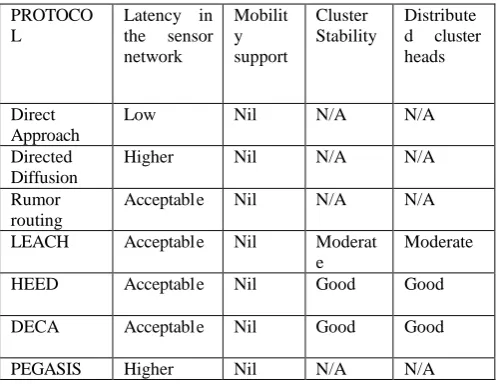
Table 1 Comparison of the protocols in terms of its related parameters
PROTOCO L
Latency in the sensor network
Mobilit y support
Cluster Stability
Distribute d cluster heads
Direct Approach
Low Nil N/A N/A
Directed Diffusion
Higher Nil N/A N/A
Rumor routing
Acceptabl e Nil N/A N/A LEACH Acceptabl e Nil Moderat
e
Moderate HEED Acceptabl e Nil Good Good DECA Acceptabl e Nil Good Good
PEGASIS Higher Nil N/A N/A
IV.
CONCLUSION
Thus the existing routing strategies in the wireless sensor networks and their corresponding protocols had been explained. Though the protocol like LEACH, HEED, DECA, SPIN, and PEGASIS are proved to be energy efficient than its previous models the main pitfalls in these protocols are that nodes are assumed to be static and stationary. The energy efficiency model is untested while the sensor nodes exhibit mobility. Future works may concentrate on achieving better energy efficiency in routing mechanism for mobile wireless sensor nodes.
V.
REFERENCES
[1] Yi-hua zhu, Wan-deng wu, Jian pan, Yi-ping tang, “An energy efficient data gathering algorithm to prolong lifetime of wireless sensor networks”, Computer Communications 33(2010) 639-647. [2] F.Bajaber, I.awan, “Centralized dynamic clustering
for wireless sensor network” in International Conference on Advanced Information Networking and Applications Workshops, 2009, pp 193-198.
[3] Ameer Ahmed Abbasi, Mohamed Younis, “A
[4] Kemal Akkaya, Mohamed Younis, “A Survey on routing protocols for Wireless Sensor Networks”, Ad Hoc Networks 3 (2005) 325-349.
[5] Miau Yu, Jason H.Li and renato Levy, “Mobility Resistant Clustering in Multi-Hop Wireless Networks”, Journal of Networks, Vol.1, No.1, May 2006.
[6] O. Younis, S. Fahmy, “HEED: A Hybrid,Energy- Efficient, Distributed clustering approach for Ad Hoc sensor networks”, IEEE Transactions on Mobile Computing 3 (4) (2004) 366–379.
[7] S. Lindsey, C. Raghavendra,"PEGASIS: Power- Efficient Gathering in Sensor Information
Systems," IEEE Aerospace Conference
Proceedings, 2002, Vol. 3. No. 9-16, pp. 1125 1130.
[8] J. Kulik, W. R. Heinzelman, and H. Balakrishnan, "Negotiation-based protocols for disseminating information in wireless sensor networks," Wireless Networks, Volume: 8, pp. 169-185, 2002.
[9] W.B. Heinzelman, A.P. Chandrakasan,
H.Balakrishnan , ”Application specific protocol architecture for wireless microsensornetworks”, IEEE Transactions on Wireless Networking (2002). [10] D. Braginsky, D. Estrin," Rumor Routing Algorithm for Sensor Networks," Proceedings of the 1 st Workshop on Sensor Networks and Applications (WSNA'02), Atlanta, GA, Oct.2002. [11] Y. Yu, D. Estrin, and R. Govindan,” Geographical
and Energy-Aware Routing: A Recursive Data Dissemination Protocol for Wireless Sensor Networks", UCLA Computer Science Department Technical Report, UCLA-CSD TR-01-0023, May 2001.
[12] Y. Xu, J. Heidemann, D. Estrin,” Geography-
informed Energy Conservation for Ad-hoc
Routing," In Proceedings of the Seventh Annual ACM/IEEE International Conference on Mobile Computing and Networking 2001, pp. 70-84. [13] Intanagonwiwat, C. Govindan R. and Estrin,D.
“Directed Diffusion: A Scalable and Robust Communication Paradigm for Sensor Networks”. In Proceedings of the Sixth Annual International Conference on Mobile Computing and Networks
(MobiCOM 2000), August 2000, Boston,
Massachusetts.
[14] B. Karp and H. T. Kung, “GPSR: Greedy perimeter stateless routing for wireless sensor networks", in the Proceedings of the 6th Annual ACM/IEEE
International Conference on Mobile Computing and Networking (MobiCom '00), Boston, MA, August 2000.
[15]P.Bose and P.morin. “Online routing in
triangulation”. In Proc. 10th International
Symbosium on Algorithm and
Computation(ISAAC ‟99), pages 113-122.
Springer- Verlag, LNCS 1741, 1999.
[16]E.Kranakis, H.Singh and J.Urrutis. “Compass routing on geometric networks. In proc. 11th
Canadian conference on Computational
Geometry”, Pages 51- 54, Vancouver, August 1999.
[17]I. Stojmenovic and X. Lin. “GEDIR: Loop-Free Location Based Routing in Wireless Networks", In International Conference on Parallel and Distributed Computing and Systems, Boston, MA, USA, Nov. 3- 6, 1999.