Isolation of Endophytic Bacteria and Phytoremediation of Soil
Contaminated with Polycyclic Aromatic Hydrocarbons Using Cajanus
cajan and Lablab purpereus
Riskuwa-Shehu, M.L.
1and Ismail, HY.
2*1 Department of Microbiology, Faculty of Science, Usmanu Danfodiyo University Sokoto, Nigeria.
2 Department of Microbiology, Faculty of Science, University of Maiduguri, Nigeria.
*Corresponding author: Ismail Haruna Yahya Department of Microbiology,
Faculty of Science, University of Maiduguri,
Nigeria.
Email: [email protected] Tel: +234 7036964407
INTRODUCTION
Since the beginning of 20th century, human activities have adversely affected natural environments especially through industrialisation and urbanisation. Soils and sediments are the cornerstone of Earth´s terrestrial biogeochemical cycles and the microbial communities they contain are essential to maintain the water-soil-atmosphere equilibrium. However, above a critical threshold, soil may lose its ability to recover from such disturbances entirely, leading to long term changes with often unpredictable consequences. The common source of concern is contamination of ecosystem with persistent petroleum hydrocarbons [1]. Polycyclic aromatic hydrocarbons (PAHs) are one of the most considered compounds due to the threat they pose to the environment and living organisms. These compounds have received so much attention due to their toxicity, carcinogenicity, mutagenicity and ubiquity [2,3]. It is believed that there is great risk of harm in short and long term exposure; and constant
long-term exposure of atmospheric PAHs can cause lung cancer and problems with reproductive systems in humans [4].
PAHs are colourless, white or pale yellow-green solids, planar, relatively inert and volatile in nature. They are hydrophobic compounds and their persistence in the environment is attributed to low water solubility (non-polar) and electrochemical stability [5]. More than 100 PAHs are known to exist, a number of which are listed by the United States Environmental Protection Agency (USEPA) as priority pollutants with carcinogenic potentials [6]. The major sources of PAHs are natural and anthropogenic. Natural sources of PAHs include forest and grass fires, oil seeps, volcanoes, plants, fungi and bacteria. Meanwhile, anthropogenic sources of PAHs include petroleum, electric power generation, refuse incineration, home heating, as well as the production of coke, carbon black, coal tar, asphalt and internal combustion engines [7].
HISTORY
Received: 11th Jan 2018
Received in revised form: 27th of Feb 2018 Accepted: 20th of March 2018
ABSTRACT
Polycyclic aromatic hydrocarbons (PAHs) are among the major compounds posing environmental and health problems worldwide. In the present study, phytoremediation of PAHs using Cajanus
cajan and Lablab purpereus in addition to isolation of endophytic bacteria associated with the
plant tissues was undertaken. Soil samples contaminated with PAHs were collected from a mechanic workshop in Sokoto metropolis and analysed using standard laboratory procedures. Seeds of the two plants species were sown in the contaminated soil and irrigated for eight weeks to determine the plants’ ability to remediate PAHs. Bacterial count revealed that the plants’ tissues contained 2.3×10⁴ cfu/g and 2.7×10⁴ cfu/g of endophytes. The endophytes were identified to be the members of Pseudomonas, Micrococcus, Bacillus, Rhodococcus and Flavobacterium. GC-MS analysis revealed that the soil samples contained 19.21 ppm PAHs, which were reduced to 2.34 ppm (12.18%) and 4.88 ppm (25.40%) in soils treated with C. cajan and L. purpureus,
respectively. Naphthalene was completely degraded in both cases, whereas pyrene, flourene and flouranthene were either completely degraded or significantly reduced. Only indeno (1,2,3 cd) pyrene was least degraded with more than 50% residual concentration. Therefore, the plant species was considered as an important tool in the remediation of PAHs contaminated soil and the role of their endophytes in degradation was thoroughly investigated.
KEYWORDS
PAHs phytoremediation
Cajanus cajan Lablab purpureus
endophytes
BIOREMEDIATION SCIENCE AND TECHNOLOGY
RESEARCH
Despite the fact that ecosystems show resilience and can often fully recover (through natural attenuation) after disturbance and transform into a new equilibrium beneficial to living organisms, the persistency of these compounds and health associated risks are the issues of global concern. As a result, the removal of these compounds from environment has become a major area that received much attention. A number of physical and chemical technologies like soil vapour extraction, stabilisation, oxidation, soil flushing and several kind of heating have been employed in fields and laboratories [8]. However, most of the techniques are unsustainable since they are expensive and may cause secondary contamination.
The use of bioremediation technology is believed to be a promising approach in PAHs decontamination. Bioremediation is the use of biological interventions for mitigation (and wherever possible, complete elimination) of the noxious effects caused by environmental pollutants in a given site [9]. Bioremediation is generally non-intrusive, cost effective, environment friendly and aesthetically acceptable. In most cases of PAHs bioremediation, microorganisms (especially bacteria and fungi) are typically used to convert contaminants into harmless or less toxic compounds while using them as sources of carbon and energy [10]. Bioremediation of PAHs in soils is often limited by the slow mass transfer of these hydrophobic compounds towards degrading microbes. This slow process may lead to bioavailability restrictions especially in the condition of massive contamination often faced by bioremediation technologies [11].
Some studies have suggested that phytoremediation can be used to clean up PAHs contaminated sites effectively [2,12]. Phytoremediation is a biological process that utilises natural plant processes to enhance degradation and remove contaminants in soil or groundwater. It is considered as a realistic and low-cost alternative for treating extensive areas of pollution by organic chemicals [13]. Soils polluted with PAHs are suitable for treatment by phytoremediation since several scientific studies, performed with well-designed controls have specifically demonstrated a high rate of PAHs biodegradation in whole soils planted with various species [11]. Three mechanisms namely degradation, containment and transfer of pollutants from soil to atmosphere have been identified as possible avenues through which plants achieve remediation [14]. However, there are speculations over the effectiveness of direct hydrocarbon degradation process by plants [15] as well as the involvement of endophytic bacteria [16].
Endophytic bacteria are microorganisms residing inside specific plant tissues and root cortex or xylem. They systematically colonise plant by the vascular or apoplast system. Endophytes can also colonise dead and hollow hyaline cells of plants [17]. It has been well documented that endophytic bacteria have many positive effects on plant establishment and survival in heavily contaminated soils such as increasing nutrient uptake, improving plant tolerance to pollutants, and degrading pollutants in plant tissues affecting the activities of plant enzymes and secreting hormones, siderophores, and other organic compounds [18–20]. Studies have demonstrated that endophytic microorganisms can efficiently accelerate phytoremediation by interacting with their host plants [21–23]. It was based on this information that the present study investigated the presence of bacterial endophytes in Cajanus cajan and Lablab purpereus and the ability of the plants to remediate soil contaminated with polycyclic aromatic hydrocarbons.
MATERIALS AND METHODS
Study area and sample collection
This study was carried out in Sokoto, Sokoto State, Nigeria. Sokoto is located in the extreme north west of Nigeria between longitudes 4º 8'E and 6º54'E and latitudes 12ºN and 13º 58'N. Soil samples were taken from J-allen area, Sokoto metropolis; a site heavily contaminated with petroleum hydrocarbons. Soils contaminated with polycyclic aromatic hydrocarbons were collected from the plough at 0 – 15 cm depth. Two plants species
of Cajanus cajan (pigeon pea) and Lablab purpereus (hyacinth
bean) were selected based on their previous performance during phytoremediation study [24,25]. Their seeds were purchased from Sokoto central market and authenticated in the Herbarium, Department of Biological science, Usmanu Danfodiyo University Sokoto (UDUS). Both samples were transported to the Microbiology research Lab, Department of Microbiology, Faculty of Science, UDUS.
Experimental design
The two plants species were grown in pots containing PAHs contaminated soil for eight weeks. In the pots, 2.5 kg of contaminated soil were placed. Subsequently, the soil samples were thoroughly mixed and moistened to 60% water capacity. After soil moistening, the seed of C. cajan and L. purpereus were sown (4 seeds per pot) in the PAHs contaminated soil. The plants were irrigated every day until the completion of the eight week plant growth cycle. After that, the plant roots were taken to laboratory for microbial isolation and identification of the endophytic bacteria and determination of residual PAHs.
Enumeration and Isolation of endophytic bacteria
Isolation of endophytic bacteria was carried out according to the work of Chen et al. [22] with modifications. The plant samples were subjected to surface disinfection by rinsing three times with deionised water and subsequently by sequential immersion in 75% (v/v) ethanol for 3 min, 2% sodium hypochlorite (v/v) for 3 min, and 70% ethanol for 30 sec. Finally, the plant samples were washed three times with sterilised distilled water to remove surface sterilisation agents. Endophytic populations were collected after surface disinfection of the roots of the plants. The roots and stems (10 g) of the plants were cut into pieces, homogenised and placed in 10 mL of sterile distilled water to obtain slurries.
The slurries were serially diluted, from which 100 µL aliquots of the appropriate dilutions (10-3) were collected and spread on nutrient agar (NA). As controls, uncut surface-disinfected and non-surface-disinfected roots were inoculated on the agar. All plates were then incubated for 7 days at 28°C. Colonies emerged after the incubation period were counted and expressed as CFU/g of plant materials. Distinct colonies were individually sub-cultured into NA with a view to obtain pure cultures. All pure cultures were preserved on slants and stored at 4°C for subsequent use.
Characterization and identification of isolates
All the isolates were characterised based on cultural, morphological and biochemical methods as outlined by Benson [26]. The isolates were identified based on the schemes of Holt
et al. [27] and Barrow and Feltham [28].
Determination of polycyclic aromatic hydrocarbons
One gram of each soil sample was accurately weighed into a cleaned 25 mL amber glass bottle and 10 mL of extraction solvent (methanol) was added, respectively. All bottles were sealed with screw cap closure lined with a PTFE-faced silicone rubber septum facing the bottle contents and vigorously shaken to suspend the contents. The bottles were sonicated in a high performance ultrasonic bath (Grant MXB14, Grant Instruments (Cambridge) Ltd, UK) with microprocessor control for precision time and temperature-controlled operation for 60 min at 50°C.
The sample bottles were intermittently inverted and shaken to continually re-suspend the samples. The extraction solutions were then centrifuged with the supernatant decanted into 4 mL amber vials and stored in the refrigerator until further use. GCMS analysis was conducted using GC System (Agilent Technologies 6890N Network) and Mass selective Detector (Agilent Technologies 5973 Network) coupled with 7683B Series Injector. The column used was capillary column (Agilent 122-5533) with specifications: DB-5ms, 0.25 mm × 30 m × 1 um. The carrier gas used was helium at a flow rate of 1.2 mL/min. The injection volume used was 1mL. The inlet temperature was maintained at 230°C. The oven temperature was initially programmed at 50°C for 5 min to 300°C at a rate of 10°C ending within 25 min. The temperature was held for 15 min with the total run time of 45 min. The ionisation mode used was electron ionisation mode at 70 eV. Total ion count (TIC) was used to evaluate compound identification and quantification.
The spectrum of separate compound was compared with database of the spectrum of known compound saved in the NIST02 Reference Spectra library. Data analysis and peak area measurement was carried out using software (Agilent Chemstation).
RESULTS AND DISCUSSION
Experiments to determine phytoremediation of PAHs by C. cajan
and L. purpereus were conducted. The presence of bacterial
endophytes was detected in the plants’ tissues. Table 1 displays the population of the bacteria after 7 days incubation. L.
purpereus was observed to harbour more bacteria than C. cajan
with a mean count of 2.7 × 10⁴ + 6.2 cfu/g and 2.3 × 10⁴ + 5.3 cfu/g, respectively. The bacterial populations observed in this study were relatively high and may have resulted from the plants’ growth phase at which samples were collected. It is believed that bacterial population in plant tissues is a factor of colonisation rate that depends on growth stage and changes from the young phase to maturity.
Studies have proposed that the early steps in colonisation of a plant depend on absorption of soil aggregates, biodiversity of plants and their physiology as well as microbial prevalence in soil [29]. Endophytic population in L. purpereus was shown to be more than that in C. cajan despite being in a close range. This might be attributed to variation in plants’ genotypes, the physiological status and types of plant tissues. Stępniewska and Kuźniar [17] reported similar observations in their studies using different plant species.
Results in Table 2 illustrated that a total of 11 endophytic bacteria were isolated and identified. Pseudomonas aeruginosa
(27%) was predominant followed by Bacillus (18%) and
Micrococcus (18) species. Other bacteria identified were Bacillus
subtilis, Pseudomonas putida and species belonging to
Rhodococcus and Flavobacterium with 9% occurrence each.
Endophytic bacteria are believed to occur virtually in every plant on earth and the diversity of the bacteria is important for
ecological and environmental studies. As observed in this study, diverse bacterial species were isolated and identified. This demonstrated the possibility of isolating different species of endophytes from plants tissues. It has been reported several particular plants that can host several endophytes, just as an endophyte may colonise several plants [17]. Pseudomonas and
Bacillus species were the most prevalent bacteria identified. A
number of studies have also demonstrated the presence of species belonging to these groups. Studies by Chen et al. [22] and Zhu et al. [16] have reported the presence of Pseudomonas spp. as predominant organisms. In other studies, bacteria identified in this study have been also reported, supporting the present findings. These include Micrococcus [30], Flavobacterium [22]
and Rhodococcus [31]. It is interesting to note that, endophytic
bacteria are diverse not only in plant hosts, but also in bacterial taxa. The diversity is said to be due to stochastic events, which are influenced by deterministic processes of colonisation and microenvironment in the soil [29].
Table 1. Endophytic bacterial count.
Sample Endophytic bacterial count
×104(cfu/g)
Mean ± sd Range
Cajanus cajan 2.3+ 5.6 1.8–2.9
Lablab purpureus 2.7+7.0 2.0–3.4
Table 2. Identified isolates.
Isolates Number Occurrence (%)
Pseudomonas aeruginosa 3 27
Micrococcus sp. 2 18
Bacillus sp. 2 18
Rhodococcus sp. 1 9
Flavobacterium sp. 1 9
Bacillus subtilis 1 9
Pseudomonas putida 1 9
Total 11 100
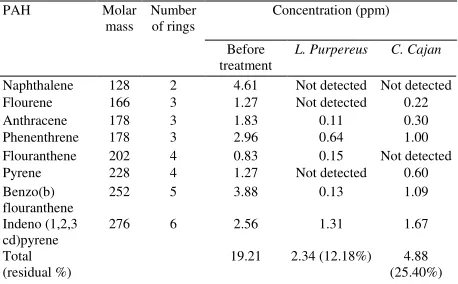
GC-MS analysis revealed that the soil samples contained eight (8) different PAHs with rings ranging from 2 to 6 (Table 3). Naphthalene (4.61 ppm) was observed to be most abundant followed by benzo(β)flouranthene (3.88 ppm) and phenenthrene (2.96 ppm). Occurrence of these compounds is not surprising considering that the sampling site, which happens to be a major mechanic workshop in Sokoto metropolis, is heavily contaminated with used petroleum products. Crude petroleum and its used products are the major sources of PAHs in the environment.
Table 3. Concentration of PAHs in contaminated soil before and after treatment.
PAH Molar
mass Number of rings
Concentration (ppm)
Before treatment
L. Purpereus C. Cajan
Naphthalene 128 2 4.61 Not detected Not detected Flourene 166 3 1.27 Not detected 0.22
Anthracene 178 3 1.83 0.11 0.30
Phenenthrene 178 3 2.96 0.64 1.00 Flouranthene 202 4 0.83 0.15 Not detected Pyrene 228 4 1.27 Not detected 0.60 Benzo(b)
flouranthene
252 5 3.88 0.13 1.09
Indeno (1,2,3 cd)pyrene
276 6 2.56 1.31 1.67
Total (residual %)
With a total of 19.21 ppm PAHs in the soil samples, the concentration can be considered very high as some studies conducted elsewhere reporting lesser PAHs in urban soils [32,33] although within the range reported by Zhang et al. [34] in Hong Kong. In engine oil contaminated soil, the occurrence of PAHs like phenanthrene, fluorene, benzo[k]fluoranthrene is a common result of indiscriminate discharge of the oil into the soil around. In a study conducted in Nigeria, Obini et al. [33] reported the occurrence of phenanthrene with concentration range of 0.0172±0.01 to 0.0193±0.02, fluorene (0.0189±0.01), benzo[a]anthracene (0.0162±0.05), chrysene (0.0209±0.02), benzo[b]fluoranthrene (0.0453± 0.02) and benzo[k]fluoranthrene (0.0389 ± 0.1) in automechanic workshop.
The presence of these compounds in high concentration and above recommended safety limits [4] is of environmental and health concern considering that most of the PAHs are either carcinogens or probable carcinogens. This has therefore called for the need of treating such soil to avoid serious health consequences. Phytoremediation of the soil samples was carried out for eight weeks using L. purpereus and C. cajan. After treatments with the plants species, it was observed that naphthalene, flourene and pyrene were completely absent in soils treated with L. purpereus and 12.18% residual PAHs was recovered. In C. cajan treated soil however, only naphthalene and flouranthene were completely degraded with 25.40% residual PAHs. Indeno (1,2,3 cd)pyrene (2.56) a six-ringed compound was least degraded in both treatments with 1.31ppm and 1.57 ppm residual concentration respectively.
The pattern of PAHs utilisation observed in this study may be associated with the complexity and number of rings contained in the compounds as well as plants’ morphological or physiological properties. Low molecular weight (LMW) PAHs are degraded faster than high molecular weight (HMW) PAHs. Similarly, LMW-PAHs may be adsorbed and transferred faster than HMW-PAHs by plant cells. In addition, HMW-PAHs are extremely water-insoluble and may partition preferentially into the humid fractions of soils rather than the aqueous phases, thus limiting their availability [2]. This might be reason why less than 50% degradation of Indeno (1,2,3 cd) pyrene was achieved in this study. It was apparent that treatment of the soil samples with L.
purpureus reduced PAHs more than C. cajan. Variation in plants’
physiology and metabolism could be the major factor involved even though both plants are leguminous. Arvanaghi et al. [8] suggested that plants’ morphological peculiarities such as waxy properties, specific leaf area, cell wall properties, root elongation, number of nodal root and metabolisms are factors that affect PAHs transfer and degradation in plant tissues.
Table 4. Extent of PAHs phytoremediation.
PAH Degradation rate (%)
L. Purpereus C. Cajan
Naphthalene 100 100
Flourene 100 82.68
Anthracene 94.00 83.61
Phenenthrene 78.38 66.22
Flouranthene 81.93 100
Pyrene 100 52.76
Benzo(b) flouranthene 96.65 71.91 Indeno (1,2,3 cd) pyrene 48.83 34.76
The extent of PAHs phytoremediation is shown in Table 4. It was recorded that naphthalene was completely degraded using both plants. Among all known PAHs, Naphthalene is believed to be readily biodegradable compared to others. L. purpereus was able to reduce Benzo (b) flouranthene, Anthracene and
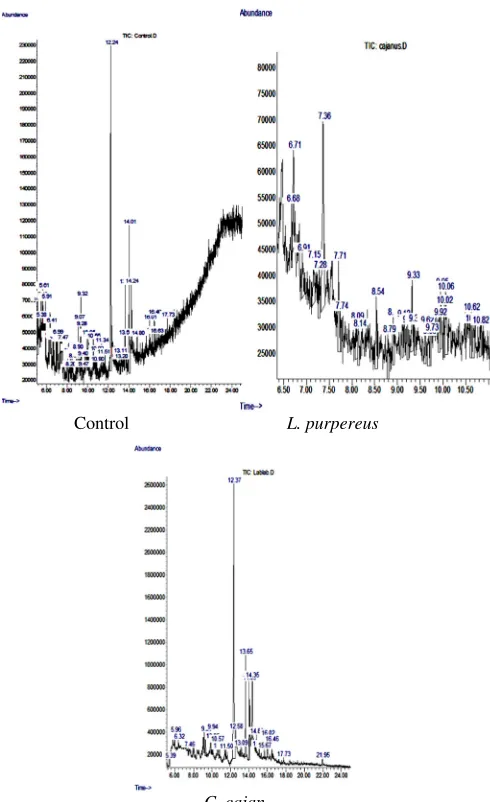
Flouranthene by 96.65%, 94% and 81.93% respectively. Anthracene (83.61%), flourene (82.64%) and benzo(b) flouranthene (71.91%) were the most degraded compounds in soil treated with C. cajan. Figure 1 presents the chromatograms of the PAHs before and after the phytoremediation studies.
There is sufficient evidence in the literature that some plant species can efficiently facilitate the significant reduction in PAHs concentration in polluted soil. Wang and Zhao [35] reported that 70-90% of phenanthrene and 65-90% of pyrene accumulated in seaweed tissues were metabolised after 10 days. Diab [36] observed greater efficiency of biodegradation of carcinogenic PAHs especially for pyrene (91.8%), benzo (a,h) anthracene (90.5%), benzo (a) pyrene (90.1%), chrysene (79.4%) and benzo (a) anthracene (76.6%) using Vicia faba. Even though this present study did not focus on the possible mechanisms through which the remediation was achieved, participation of rhizosphere and endophytic bacteria cannot be overruled.
Control L. purpereus
C. cajan
Fig. 1. Chromatograms of PAHs as detected in soil before and after treatment.
CONCLUSION
Results from this study indicated that C. cajan and L. purpureus
harbour a number of bacterial endophytes belonging to the genera
Pseudomonas, Bacillus, Micrococcus, Rhodococcus and
Flavobacterium. It was evident that the soil contained
appreciable concentration of PAHs and after eight weeks phytoremediation studies, the plants were able to reduce the PAHs concentration to about 25%. As naphtnalene, flourene, flouranthene and pyrene were completely degraded by treatment with either of the two plants, indeno (1,2,3 cd) pyrene was least degraded using both plants. Although this study was unable to establish link between PAHs degradation and role played by bacterial endophytes, there is need for future studies to focus on specific and complementary roles played by the plants, endophytes and rhizosphere microbes in achieving remediation.
REFERENCES
1. D’Souza R, Varun M, Lakhani A, Singla V, Paul MS. PAH Contamination of Urban Soils and Phytoremediation. In: Phytoremediation. Springer, Cham; 2015. p. 219–41.
2. Harvey PJ, Campanella BF, Castro PML, Harms H, Lichtfouse E, Schäffner AR, et al. Phytoremediation of polyaromatic hydrocarbons, anilines and phenols. Environ Sci Pollut Res. 2002;9(1):29–47.
3. Takáčová A, Smolinská M, Olejníková P, Mackuľak T, Čík G. A study of the phototoxic effect of Benzo[a] Pyrene on bacteria. Open Life Sci. 2013;8(11):1127–1134.
4. Mumtaz MM, George JD, Gold KW, Cibulas W, Derosa CT. ATSDR evaluation of health effects of chemicals. iv. polycyclic aromatic hydrocarbons (PAHs): understanding a complex problem. Toxicol Ind Health. 1195;12(6):742–971.
5. Chen B, Xuan X, Zhu L, Wang J, Gao Y, Yang K, et al. Distributions of polycyclic aromatic hydrocarbons in surface waters, sediments and soils of Hangzhou City, China. Water Res. 2004;38(16):3558–68.
6. Epps AV. Phytoremediation of petroleum hydrocarbons. In: Environmental Protection Agency Office of Solid Waste and Emergency Response Office of Superfund Remediation and Technology Innovation. Washington, DC; 2006. p. 171.
7. Eisler R. Polycyclic aromatic hydrocarbons. In: Handbook of chemical risk assessment. New York, NY: Lewis Publisher; 2000. 8. Arvanaghi H, Aminfar Y, Sadeghan A, Dolatabadi N. Phytoremediation of polycyclic aromatic hydrocarbons (PAHs): air-plant-soil interactions. J Biodivers Enviromental Sci. 2017;10(3):178–84.
9. Prasad M. Bioremediation, its applications to contaminated sites in India. Minist Environ For Governmenr India. 2011;
10. Asha L, Sandeep R. Review on bioremediation - Potential tool for removing environmental pollution. Int J Basic Appl Chem Sci. 2013;2013:2277–83.
11. Gałązka A, Gałązka R. Phytoremediation of polycyclic aromatic hydrocarbons in soils artificially polluted using plant-associated-endophytic bacteria and Dactylis glomerata as the bioremediation plant. Pol J Microbiol. 2015;64(3):241–52.
12. Kathi S, Khan AB. Phytoremediation approaches to PAH contaminated soil. Indian J Sci Technol. 2011;4(1):56–63. 13. Ma B, Chen H, He Y, Wang H, Xu J. Evaluation of toxicity risk of
polycyclic aromatic hydrocarbons (PAHs) in crops rhizosphere of contaminated field with sequential extraction. J Soils Sediments. 2010;10(5):955–63.
14. Cunningham SD (DuPont, Anderson TA, Schwab AP, Hsu FC. Phytoremediation of soils contaminated with organic pollutants. Adv Agron USA [Internet]. 1996 [cited 2018 Jul 24];
15. Frick CM, Farrell RE, Germida JJ. Assessment of phytoremediation as an in-situ technique for cleaning oil-contaminated sites. 1999: https://clu-in.org/download/remed/phyassess.pdf (Acessed 2nd Jan 2018)
16. Zhu X, Ni X, Waigi MG, Liu J, Sun K, Gao Y. Biodegradation of mixed PAHs by PAH-degrading endophytic bacteria. Int J Environ Res Public Health. 2016;13(8).
17. Stępniewska Z, Kuźniar A. Endophytic microorganisms— promising applications in bioremediation of greenhouse gases. Appl Microbiol Biotechnol. 2013;97(22):9589–96.
18. Suto M, Takebayashi M, Saito K, Tanaka M, Yokota A, Tomita F. Endophytes as producers of xylanase. J Biosci Bioeng. 2002;93(1):88–90.
19. Li JH, Gao Y, Wu SC, Cheung KC, Wang XR, Wong MH. Physiological and biochemical responses of rice (Oryza sativa L.) to phenanthrene and pyrene. Int J Phytoremediation. 2008;10(2):104–16.
20. Wen J, Gao D, Zhang B, Liang H. Co-metabolic degradation of pyrene by indigenous white-rot fungus Pseudotrametes gibbosa
from the northeast China. Int Biodeterior Biodegrad. 2011;65:600– 4.
21. Li HY, Wei DQ, Shen M, Zhou ZP. Endophytes and their role in phytoremediation. Fungal Divers. 2012;54(1):11–8.
22. Chen W, Tang Y, Mori K, Wu X. Distribution of culturable endophytic bacteria in aquatic plants and their potential for bioremediation in polluted waters. Aquat Biol. 2012;15(2):99–110. 23. Oliveira N de, Rodrigues AA, Alves MIR, Filho NA, Sadoyama G,
Vieira JDG. Endophytic bacteria with potential for bioremediation of petroleum hydrocarbons and derivatives. Afr J Biotechnol. 2012;11(12):2977–84.
24. Ismail HY, Ijah UJJ, Riskuwa ML, Allamin IA, Isah MA. Assessment of phytoremediation potentials of legumes in spent engine oil contaminated soil. 2014;2(2):6.
25. Riskuwa-Shehu M, Ijah U, Manga S, Bilbis LS. Evaluation of the use of legumes for biodegradation of petroleum hydrocarbons. Int J Environ Sci Technol. 2017;14(10):2205–14.
26. Benson H. Microbiological applications laboratory manual. 8th ed. New York: McGraw-Hill Companies; 2002.
27. American Society for Microbiology., Microbiology AS for, Bergey DH, Breed RS. Bergey’s manual of determinative bacteriology. 7th ed. Baltimore,: Williams & Wilkins Co.,; 1957. 1130 p.
28. Barrow G, Feltham K. Cowan and Steel’s manual for identification of medical bacteria. London: Cambridge University Press; 1993. 29. Hardoim PR, van Overbeek LS, Elsas JD van. Properties of
bacterial endophytes and their proposed role in plant growth. Trends Microbiol. 2008;16(10):463–71.
30. Syranidou E, Kalogerakis N. The role of endophytic bacteria in phytoremediation.:33.
http://www.area.agrif.bg.ac.rs/sites/default/files/nicolas_kalogerak is.pdf (accessed 18th Jan 2018).
31. Li J, Zhao GZ, Long LJ, Wang FZ, Tian XP, Zhang S, et al.
Rhodococcus nanhaiensis sp. nov., an actinobacterium isolated from marine sediment. Int J Syst Evol Microbiol. 2012;62(Pt 10):2517–21.
32. Zohair A, Salim A-B, Soyibo AA, Beck AJ. Residues of polycyclic aromatic hydrocarbons (PAHs), polychlorinated biphenyls (PCBs) and organochlorine pesticides in organically-farmed vegetables. Chemosphere. 2006;63(4):541–53.
33. Obini U, Okafor C, Afiukwa J. Determination of levels of polycyclic aromatic hydrocarbons in soil contaminated with spent motor rngine oil in Abakaliki auto-mechanic village. J Appl Sci Environ Manag. 2013;17(2): 169-175.
34. Zhang X, Cheng S, Zhu C, Sun S. Microbial PAH-degradation in soil: Degradation pathways and contributing factors. Pedosphere. 2006;16(5):5655–65.
35. Wang X, Zhao H. Uptake and biodegradation of polycyclic aromatic hydrocarbons by marine seaweed. J Coast Res. 36. Diab E. Phytoremediation of polycyclic aromatic hydrocarbons