© Universiti Tun Hussein Onn Malaysia Publisher’s Office
JTET
http://penerbit.uthm.edu.my/ojs/index.php/jtet
ISSN 2229-8932 e-ISSN 2600-7932
Journal of Technical Education and
Training
The Effect of Computerized-Adaptive Test on Reducing
Anxiety towards Math Test for Polytechnic Students
Mohd Ali
1, S., Norfarah, N.
2*, Ilya Syazwani, J.I.
3& Mohd Erfy Ismail
41,3School of Educational Studies, Universiti Sains Malaysia, 11800, Penang, MALAYSIA 2Graduate School of Business, Universiti Sains Malaysia, 11800, Penang, MALAYSIA
4Faculty of Technical and Vocational Education, Universiti Tun Hussein Onn Malaysia, MALAYSIA *Corresponding author
DOI: https://doi.org/10.30880/jtet.2019.11.04.004
Received 31st March 2019; Accepted 26th November 2019; Available online 31st December 2019
1.
Introduction
In line with the Malaysian aspiration to emerge as a developed nation, the Malaysian government has a vision to create 60 per cent technical-vocational-education-and-training (TVET) workforce in the country. Polytechnic is one of the higher education institutions in Malaysia that offered TVET programmes at diploma level. In Malaysia there are 36 Polytechnics under the purview of the Ministry of Education Malaysia and the courses are accredited by the Malaysian Qualification Assurance (MQA). MQA accreditations cover the aspects of teaching, learning and assessment. MQA stressed that assessments is an important aspect in determining the performance of learning outcome (Polytechnic Education Department, 2011a). Among the standards for the assessment are; the use of varied modes for evaluating students’ learning outcomes and competencies; summative and formative mode of testing; establishing a mechanism that ensures test validity, reliability, stability, fairness; and up to date. Some other criteria is to ensure the testing Abstract: Although much work has been done on computerized-adaptive test (CAT) in reducing anxiety towards exam, CAT in Malaysian educational setting is less explored among educational researchers. Some of the reason is due to technical difficulty in developing, maintaining the testing bank items, and insufficient hardware facilities for huge number of examinees in Malaysia. Hence, traditional assessment method is preferred to assess students’ performance. However, traditional assessment induced students’ anxiety towards examination. The effect of anxiety towards mathematics examination has deteriorated students’ performance particularly at polytechnics that offers technical-vocational-education-and-training (TVET). Therefore, this study aimed to examine the effect of CAT in reducing examinees’ anxiety towards mathematics examination in comparison with traditional testing approaches at three polytechnics in northern Malaysia that offered diploma certification in engineering. These three polytechnics were chosen because it is classified as conventional and accessibility of the researchers to these samples. In order to ensure the homogeneity of the samples, students in their first year of study who enrolled in engineering mathematics were chosen. This research used quasi-experimental research method with non-equivalent control group design involving 300 students. Item-response-theory was used to describe examinees’ interaction with the test items. The results show that CAT has reduced examinees’ anxiety towards mathematics test in comparison to those of traditional testing. This study implies that CAT has benefited students in term of reducing their anxiety towards mathematics examination in the case of Malaysian polytechnics students, and has the potential to be adopted in TVET because it improves testing efficiency.
methodology practiced is at par with the international standard, as the MQA accreditations is equivalents to those in Australia and New Zealand (MQA, 2009).
As a matter of fact, the use of the modern mode of testing such as computer-based test (CAT) is not being practiced despite the call for diversifying the mode of testing method in evaluation of students’ learning outcome (Jabatan Pengajian Politeknik, 2011a). The approach to examination and evaluation in Malaysian polytechnics are still using the traditional mode of paper-and-pencil (P&P). One of the reasons is the huge need to provide computer hardware facilities to accommodate computerized tests and the development of item (questions) for the test items bank to enable the adoption of CAT among the polytechnics in Malaysia need concerted efforts from various parties (i.e. the ministry and polytechnic lecturers). In the western countries application of CAT in educational setting has proven to be successful and helped in reducing students’ anxiety thus improve students’ performance (Chatzopoulou & Economides, 2010; Sanja et al., 2016; Schonenberg et al., 2013). Therefore, this study aims to test the effect of CAT approach using item bank of mathematics algebraic for polytechnics students’ in Malaysia and its’ effect on reducing students’ anxiety towards the test.
2.
Review of past literatures
According to the 2010 Executive Report, there is a shortage of research on the integration of ICT in Malaysian educational measurement (Bahagian Perancangan dan Penyelidikan KPT, 2011). Bakhtiar and Yusmadi (2012) further highlight the issue of assessment in the context of Malaysian polytechnics. According to the researchers, although Malaysian polytechnics have adopted outcome based education (OBE), the traditional mode of assessment is in use. Ironically, OBE emphasize the usage of various assessment methods including ICT integrated test. Therefore, there is a need to study on integration and acceptance of modern mode of assessment in polytechnics in Malaysia, the reason being, the current assessment using paper-and-pencil is out dated, intimidating students’ self-esteem and exert students’ anxiety.
Embse and Hasson (2012) claimed that aanxiety towards test put forth a negative impact on students’ self-esteem and self-confidence. Students real potential are suppress due to anxiety (Ashcraft & Moore, 2009; Embse & Hasson, 2012). The anxiety towards test is afflicted by the students’ prior experience, e.g. earning low marks and being reprimanded (Chamberlain, Daly, & Spalding, 2011; Aydin, 2012). Aydin (2012) showed that most sstudents are interested in the process of learning knowledge but felt uncomfortable when grades and marks are used as indicator to gauge their learning performance (Aydin, 2012).
From the synthesis of 562 researches, Hembree (1988) found that fear of failure is one of the main contributor for the increased of anxiety among students. Various ways have been suggested to deal with the problem of anxiety towards test among students; for example dealing with cognitive, behavioural and pyschological perspectives. Other ways to reduce anxiety is to shift the paradigm about test, and highlighted that learning process is the most important aspect of learning (Rothman, 2008). The change of perception would reduced the negative effect of anxiety with tests. There are suggestion to demolishing the grades and marks assessment system, and concentrating on the element of enrichment of knowledge and skills. Based on Linacre (2000), adaptivity of CAT would enable holistic assessment because it is designed to assess examinees unique abilities, and there is no concept of fail or pass in the test. The test would gauge the level of students ability and indicates students’ mastery of the targetted topics, hence CAT reduces the students’ anxiety towards testing.
A study was carried-out to compare the anxiety towards test in mmathematics, science and language found that students felt most anxious towards mmathematics test (Putwain, Connors, & Symes, 2010; Selkirk, Bouchey, & Eccles, 2010). Karjanto & Yong (2013) also found that engineering students have high anxiety towards mathematics test. In a research using samples of student who studied various subjects which required the use of frequent mmathematics concepts have a higher anxiety towards test compare to students who are in different fields (Rizwan & Nasir, 2010). Sachin (2006) found that there is a significant relationship between anxiety towards tests and anxiety towards mathematics. Therefore, there is a need to study more in depth about the relationship between these two variables. Additionally, there is a need to study on testing method that is both practical and reduce students’ anxiety towards testing (Conole & Warburton, 2005; Fiddes, Korabinski, McGuire, Youngson, & McMillian, 2001).
Smith (2004) suggested that anxiety towards mathematics can be reduced by substituting paper-and-pencil assessment with computerized-based testing mode. Joseph (2004) found the level of anxiety towards Math test itself is higher than the anxiety level towards math content. This is supported by Effandi and Norazah (2008) which studied the same issue on the sample of post secondary school student in Malaysia.
The test mode has an effect to student, therefore it is importance to study computer aided or computer based assessment and focuses on its development and implication (Wang, Jiao, Young, Brooks, & Olson, 2007). By considering CAT as a testing method to reduce anxiety and overcome the weaknesses of paper and pencil test, therefore, this study aim to study the effect of CAT on anxiety towards mmath test among ppolytechnic students.
The implementation of CAT is relevant in polytechnic environment. MQA has emphasized that a latest and fair assessment to be used for teaching and learning (Laporan Tahunan 2011 Jabatan Pengajian Politeknik, 2011). Polytechnics in Malaysia has promoted the use of technology in education such as the production learning materials in form of electronics and virtual environment or e-learning (Jabatan Pengajian Politeknik, 2011c). There are efforts to compile the question bank however; the question bank was developed in summative form for every subject. Moreover, there are no documented procedures for preparing question bank in formative form. The preparation of question bank for formative test purpose is not centralized as question bank for summative purpose (Jabatan Pengajian Politeknik, 2011b). Thus, with the adoption of CAT, centralization process for formative test items preparation made easy. In turn, this will help to guide and design for better item bank development for final examination questions.
In countries that has adopted CAT for students’ assessment; the effect of CAT on students’ performance is encouraging. Chatzopoulou & Economides (2010) study shows that CAT has successfully implemented for assessing Greek high school students’ computer programming knowledge in Greek national exam. Consistently, in Serbia, Sanja et al. (2016) studied on the use of CAT to assess Serbian polytechnics students majoring in computer engineering on C++ programming course. Sanja et al. (2016) found that students who are exposed to CAT achieved higher average score compared to the control group who involved in traditional assessment. Schonenberg et al. (2013) in a study for evaluating second language proficiency found satisfactory result and claimed that CAT has improved the security of the test and has improved the time efficiency in handling test. Ting & Kuo (2015) studied on 257 freshmen from a university in Taiwan using adaptive testing in calculus topic also found adaptive test has yield superior performance compared to traditional test method.
3.
Research Methodology
This section discussed on the research methodology used that comprises the sample of study, context and research design.
3.1
Context of Study
Morgan (1990) found that students who are in their first year of diploma in engineering faced difficulties to apply algebraic concept into their learning. In Malaysian polytechnic, algebra topic is embedded in the Engineering Math 1 (code BA101) which is a compulsory subject and students must earn at least a passed to graduate with engineering diploma. Therefore, based on the importance of algebra topic for diploma in engineering students this study was carried out at three conventional polytechnic that offers diploma in engineering. Conventional polytechnics were selected to ensure that the sample of students that involved in this study have similar education background based on the pre-requisite for entry to diploma of engineering course.
These polytechnics are located at northern peninsular Malaysia i.e. Penang, Kedah and Perlis. The students who involved in this study are either from the department of electrical, mechanical or civil engineering, and those who are currently enrolled in Engineering Math 1 subject. In this subject algebraic topic covers most of its content. This topic was chosen because algebra is the basis for application in engineering (Bakhtiar & Yusmadi , 2012) and it is suitable to be tested using CAT. Prior to this study, there is no evidence of CAT utilization in any Malaysian polytechnics. Thus, it conforms that the samples have no prior experience using CAT test.
3.2
Research Design and Control Factor
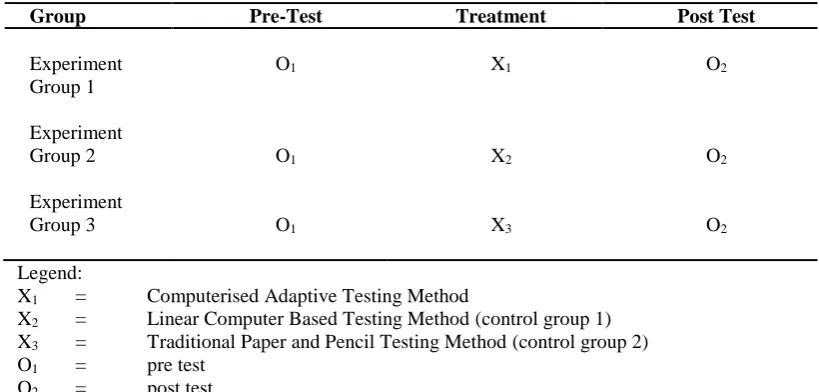
This study utilized quasi experimental method with non-equivalent control group design with pre and post-test (Fiels & Hole, 2003; Creswell, 2012). Quasi experimental design is used because the sample are from an intact group which already exist at the three selected polytechnics. There are three groups involved in this study, and those three groups have a similarity in characteristic such as; all are diploma of engineering first year students. This ensures the internal validity of the research design as the groups are homogenous. The research design are illustrated in Table 1.
Table 1: Non-Equivalent Group Control Design
Group Pre-Test Treatment Post Test
Experiment Group 1
O1 X1 O2
Experiment
Group 2 O1 X2 O2
Experiment
Group 3 O1 X3 O2
Legend:
X1 = Computerised Adaptive Testing Method
X2 = Linear Computer Based Testing Method (control group 1) X3 = Traditional Paper and Pencil Testing Method (control group 2) O1 = pre test
O2 = post test
CAT is different from the other two types of tests because it employs sequence of test questions to be presented to each student and the questions themselves vary since it is based on the examinee’s prior responses to test questions. Each question is automatically chosen to yield maximum information about the examinee, based on the skill level indicated by the examinee’s answers to the previous questions. The difficulty of the questions is promptly and automatically adapted to the capability of the individual examinee. This iterative process continues until it reaches the level of difficulty appropriate to the examinee’s ability (Lyman, 1998). This test is conducted through the use of the organized systems on computers and can be accessed online.
On the other hand, LCBT is a testing method in which the computer selects different questions without consideration of students’ prior performance. It consists of a full range of test questions from the easiest to the most difficult, but that does not necessarily in that order. Moreover, LCBT is scored in the same way as a paper-based test. Even though LCBT utilizes computer, but it is different from CAT because it has no adaptive test features. Therefore, LCBT does not have the ability to compile a reaction-based question on the ability of an examinee to answer the questions with the right or wrong answers. Lastly, the traditional P&P test is a conventional test form commonly used in polytechnics which requires students to indicate or write their answers on paper, the standardized number and length of questions for all examinees.
All three groups are administered with questionnaires related to examinees’ anxiety over the algebra test; before (pre-test) and after (post-test) the intervening period shown in Table 1. The FRIEDBEN Test Anxiety Scale test (the FTA) is used to measure students’ anxiety. This scale was developed by Friedman and Bendas-Jacob (1997) through several stages of pilot testing. It has 23-item scale consisting of six Guttman-shaped scales; scale 1 representing the statement of 'not at all describing myself' and scale 6 represents the statement of 'perfectly describe myself.' This instrument has been tested in a pilot study with respondents of the same age group and the Cronbach's alpha value is 0.93.
This instruments consisting of three subscales: (i) Social Derogation (worries of being socially belittled and deprecated by significant others following failure on a test); (ii) Cognitive Obstruction (poor concentration, failure to recall, difficulties in effective problem solving, before or during a test); and (iii) Tenseness (bodily and emotional discomfort) (Friedman & Bendas-Jacob, 1997). Table 2 below shows the three aspects that are measured with the item number in the instrument.
Table 2: Number of Items in Three Aspects in Friedben Anxiety Test
Aspects Items
Social Derogation 8 items
Cognitive Obstruction 9 items
Tenseness (bodily and emotional discomfort). 6 items
4.
Results
Multivariate Analysis of Covariance (MANCOVA) tests were conducted to identify whether there was a statistically significant difference of post-test mean scores for all three groups after the controlled effects of pre-test differences. Some basic conditions and assumptions have to be satisfied before the MANCOVA test is carried out such as; equality between test groups, test variance similarities, sample size and normality, covariant variant equivalence, linearity, multicollinearity and singularity, and homogeneity of regression slope (Pallant, 2011).
The results of MANCOVA analysis as in Table 3 found that there were significant effects from the test modes aspect; i.e. Computerized Adaptive Testing, Linear Computer Based Testing and Traditional Paper Test and Pencil with Multivariate Pillai's Trace = 0.321, F (6,586) = 18.675, p<0.05 and ŋp2= 0.161.
The results showed that there was a significant difference in the combination of linear mean score on post-test questionnaires of anxiety on tests (social views, cognitive impairment, physical and emotional tensions) for those three groups.
Table 3: Number of Items in Three Aspects in Friedben Anxiety Test
Effect Value F Hypothesis d.f. Error d.f. Sig. Partial Eta
Squared
Test
Pillai's Trace .321 18.675 6.000 586.000 .000 .161
Wilks' Lambda .684 20.368b 6.000 584.000 .000 .173
Hotelling's Trace
.455 22.075 6.000 582.000 .000 .185
Roy's Largest Root
.439 42.863c 3.000 293.000 .000 .305
a. Design: Intercept + b1_pre_social_views + b2_pre_cognitive_impairment + b3_pre_emotional_tension + test b. Exact statistic
c. The statistic is an upper bound on F that yields a lower bound on the significance level.
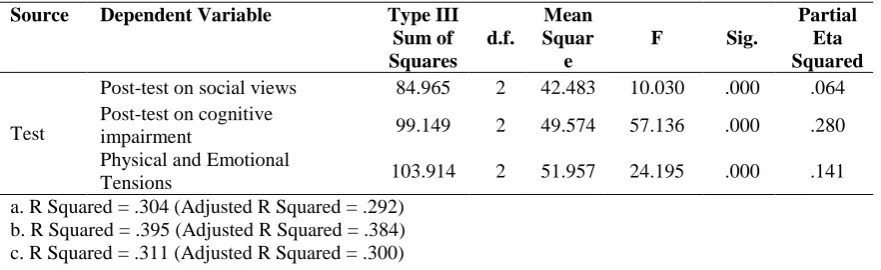
To reduce the ‘Type 1 Error’ due to repeated analysis of the three dependent variables, the Bonferroni Modification Method has been used (Pallant, 2011). The involvement of three independent variables, namely three constructs in the study justified the Alpha level significantly taken as 0.017 (obtained from 0.05 /3). Hence, the new significant Alpha value taken into account for the next analysis is 0.017. The results of the Effects Test Between Subjects in Table 4 showed that there was a significant difference (p <0.017) for the social views constructs post-test (F(2,294)=10.030, p<0.017, ŋp2= 0.064), Post-test of cognitive impairment (F(2,294)=57.136, p<0.017, ŋp2= 0.280) and post-test of physical and emotional tension constraints (F(2,294)=24.195, p<0.017, ŋp2= 0.141) between polytechnic students who sat on basic algebraic tests on Computerized Adaptive Test modes, Linear Computer Based Test modes and Traditional Paper and Pencil Test modes.
Table 4: Number of Items in Three Aspects in Friedben Anxiety Test
Source Dependent Variable Type III
Sum of Squares
d.f.
Mean Squar
e
F Sig.
Partial Eta Squared
Test
Post-test on social views 84.965 2 42.483 10.030 .000 .064 Post-test on cognitive
impairment 99.149 2 49.574 57.136 .000 .280
Physical and Emotional
Tensions 103.914 2 51.957 24.195 .000 .141
a. R Squared = .304 (Adjusted R Squared = .292) b. R Squared = .395 (Adjusted R Squared = .384) c. R Squared = .311 (Adjusted R Squared = .300)
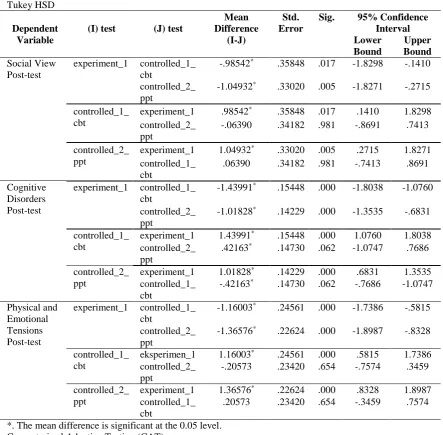
Since MANCOVA's result was significant and the comparison involving the three groups, the Post-hoc Test was carried out to see which pairs showed significant differences. Referring to Table 5 below, Turkey HSD Test results show from Social View Constructs, found that the following pairs showed a significant difference;
(i) The respondent group who answered the test using Computerized Adaptive Test with respondents who answered the test by Linear Computer Based Testing (p = 0.017).
Table 5: Post-hoc tests on CAT, LCBT and TP&P Effect Test Between Groups
Tukey HSD Dependent
Variable
(I) test (J) test
Mean Difference
(I-J)
Std. Error
Sig. 95% Confidence
Interval Lower Bound Upper Bound Social View Post-test
experiment_1 controlled_1_ cbt
-.98542* .35848 .017 -1.8298 -.1410 controlled_2_
ppt
-1.04932* .33020 .005 -1.8271 -.2715 controlled_1_
cbt
experiment_1 .98542* .35848 .017 .1410 1.8298 controlled_2_
ppt
-.06390 .34182 .981 -.8691 .7413 controlled_2_
ppt
experiment_1 1.04932* .33020 .005 .2715 1.8271 controlled_1_
cbt
.06390 .34182 .981 -.7413 .8691 Cognitive
Disorders Post-test
experiment_1 controlled_1_ cbt
-1.43991* .15448 .000 -1.8038 -1.0760 controlled_2_
ppt
-1.01828* .14229 .000 -1.3535 -.6831 controlled_1_
cbt
experiment_1 1.43991* .15448 .000 1.0760 1.8038 controlled_2_
ppt
.42163* .14730 .062 -1.0747 .7686 controlled_2_
ppt
experiment_1 1.01828* .14229 .000 .6831 1.3535 controlled_1_
cbt
-.42163* .14730 .062 -.7686 -1.0747 Physical and
Emotional Tensions Post-test
experiment_1 controlled_1_ cbt
-1.16003* .24561 .000 -1.7386 -.5815 controlled_2_
ppt
-1.36576* .22624 .000 -1.8987 -.8328 controlled_1_
cbt
eksperimen_1 1.16003* .24561 .000 .5815 1.7386 controlled_2_
ppt
-.20573 .23420 .654 -.7574 .3459 controlled_2_
ppt
experiment_1 1.36576* .22624 .000 .8328 1.8987 controlled_1_
cbt
.20573 .23420 .654 -.3459 .7574 *. The mean difference is significant at the 0.05 level.
Computerized Adaptive Testing (CAT) Linear Computer Based Testing (LCBT) Traditional Paper and Pencil Testing (TP&P)
Meanwhile, the following pairs showed no significant results;
(i) the respondent group who answered the test by Linear Computer Based Testing with respondents who answered the test using traditional paper and pencil tests (p = 0.981).
The results of the Turkey HSD test showed that for the Cognitive Impairment Constructs, the following pairs showed a significant difference;
(i) The respondent group who responded to the test on Computerized Adaptive Test with respondents who answered the test on Linear Computer Based Testing (p < 0.05).
However, the following pairs showed no significant results;
(i) the respondent group who answered the test by Linear Computer Based Testing with respondents who answered the test using traditional paper and pencil tests (p = 0.062).
The results of the Turkey HSD test showed that for the constructs of Physical and Emotional Tensions, the following pairs showed a significant difference;
(i) The respondent group who answered the test using Computerized Adaptive Test with respondents who answered the test by Linear Computer Based Testing (p<0.05).
(ii) the respondent group who answered the test using Computerized Adaptive Test with respondents who answered the test on a traditional test of paper and pencils (p<0.05)
Meanwhile, the following pairs showed no significant results;
(i) the respondent group who answered the test by Linear Computer Based Testing with respondents who answered the test using traditional paper and pencil tests (p = 0.654).
5
.
Discussion
Understanding learning process from the lens of theory drives this research to address learning issues i.e. reducing students’ anxiety towards testing. Based on theory of learning, learning environments and suitability of the learning material with students’ ability are vital. However, in the case of technical-vocational-education-training (TVET) particularly Malaysian polytechnic, the assessments for skill and cognitive to graduate with diploma in engineering has fall short to recognize that anxiety would hinder students to exhibit their true potential. Moreover Piaget emphasized that teaching materials should be tailor-made according to the diversity of students' cognitive level besides having the characteristics of equivalency to students’ ability to stimulate student learning assimilation and fulfillment, hence in line with the cognitive theory (Hergenhahn & Olson, 2001).
As such, in this research, Computerized-Adaptive Test (CAT) is an assessment tools that help to exercise the learning theory as it has the ability to produce unique set of tests for individual student based on the student's response to the assessment questions. Furthermore, CAT is also in line with the Malaysian Outcome Base Education (OBE) system conducted in polytechnics (Nooraza & Aminah Bibi, 2012) and meets the MQA criteria i.e. to produce effective, up-to-date testing that is of international standard. In addition, from psychological point of view, the mechanism used for CAT reduces students’ anxiety towards examination because the testing incorporate adaptive features that enable questions/items presented based on students' ability levels thus, less intimidating to low ability students and not boring for higher ability students (Linacre, 2000).
The findings of this research revealed that CAT reduces students’ anxiety towards math test among polytechnics students in Malaysia. In which the research were carried out by comparing students’ anxiety between those students that was exposed to CAT, Linear Computer Based Testing (LCBT) and traditional Paper and Pencil (P&P) test. Unlike CAT, traditional P&P test uses static approach, where the students were given the same set of questions regardless of the students' ability (Barker, 2008). For high ability students, they might find that easy questions is boring, however, for low ability students, finding hard questions and failure to obtain correct answers will stimulate their anxiety (Barker, 2008). With the adaptive feature of CAT, questions’ difficulties are matched to individuals’ ability hence, promotes stimulating testing environment.
The findings have several important implications for the TVET and polytechnic in Malaysia in formulating strategies to further enhance TVET and polytechnic education which as follows:
1. Adoption of Computer-Adaptive Test in Malaysian polytechnic
The research findings suggest that Polytechnics Assessments and Curriculum Committee should formulate a strategic plan to introduce the Computerized Adaptive Test (CAT) in the teaching and learning system at the polytechnics. The use of CAT in a Polytechnic Assessment System will provide variations to the testing method used. In addition, CAT also confirms to the tests features recommended by MQA such as reliable, stable, fair, up-to-date items, easy to administer and comply with international standards.
2. Improved Efficiency, Security and Cost Effective
marking process reduces the examiners bias and storing of examination results in secured database improved efficiency and cost effective.
6.
Conclusion
This research has achieved its aimed and found that CAT has a significant impact in reducing students’ anxiety towards math test using the samples of diploma of engineering students in three conventional polytechnics in Malaysia. The findings implied that the adaptive features in CAT have certainly improved the testing experience for examinees and examiners. Overall, the CAT intervention in the topic of algebraic received positive feedback and has the potential to be implemented in routine examination practice for polytechnic and TVET community. The computerized feature is a sustainable approach for testing particularly that involved huge number of examinees and simultaneously to be carried out at multiple locations in Malaysia. CAT also helped improved students’ performance in math because teachers obtained detail information of the areas where students did well and areas needed more support. This study implies that CAT for algebraic assessment proved to be feasible and user-friendly tools for polytechnic in Malaysia. In directly, CAT improved efficiency for testing and assists polytechnic lecturers to become effective teachers. As a conclusion, CAT adoption into TVET community and polytechnics would establish a testing mechanism that ensures validity, reliability, stability and fairness to facilitate the aspiration of the Ministry of Education Malaysia and the Malaysian Qualification Assurance.
Acknowledgement
This research has been funded by the Fundamental Research Grant Scheme (FRGS), Ministry of Education Malaysia (203 / PGURU / 6711486).
References
Agensi Kelayakan Malaysia (Ed.). (2009). Code of Practice for Institutional Audit (2nd ed.). Selangor, Malaysia: Agensi Kelayakan Malaysia.
Ashcraft, M. H., & Moore, a. M. (2009). Mathematics Anxiety and the Affective Drop in Performance. Journal of Psychoeducational Assessment, 27(3), 197–205. http://doi.org/10.1177/0734282908330580
Aydin, S. (2012). The effects of young EFL learners’ Perceptions of Tests on Test Anxiety. Education 3-13, 40(2), 189–204. http://doi.org/10.1080/03004279.2010.510119
Bahagian Perancangan dan Penyelidikan KPT (Ed.). (2011). Laporan Eksekutif Kajian Pengesanan Graduan IPT 2010. Putrajaya, Malaysia: Kementerian Pengajian Tinggi
Bakhtiar Md Shaari, & Yusmadi Yah Jusoh. (2012). The Outcome-Based Education ( Obe ) Curriculum for Electrical Engineering Departments at Malaysian Polytechnics. Educational Research Journal, 2(3), 66–74.
Bull, J. (1999). Computer-Assisted Assessment : Impact on Higher Education Institutions. Educational Technology & Society, 2(3), 123–126.
Chatzopoulou, D.I. & Economides, A.A. (2010). Adaptive Assessment of Student's Knowledge in Programming courses. Journal of computer assisted learning, 26(4), 258-269. https://doi.org/10.1111/j.1365-2729.2010.00363.x Conole, G., & Warburton, B. (2005). A Review of Computer-assisted Assessment. Alt-J, 13(1), 17–31. http://doi.org/10.1080/0968776042000339772
Effandi Zakaria, & Norazah Mohd Nordin. (2008). The Effects of Mathematics Anxiety on Matriculation Students as Related to Motivation and. Eurasia Journal of Mathematics, Science & Technology Education, 4(1), 27–30.
Embse, N. Von Der, & Hasson, R. (2012). Test Anxiety and High-Stakes Test Performance Between School Settings: Implications for Educators. Preventing School Failure: Alternative Education for Children and Youth, 56(3), 180–187. http://doi.org/10.1080/1045988X.2011.633285
Engelbrecht, J., Harding, a., & Du Preez, J. (2007). Long-term Retention of Basic Mathematical Knowledge and Skills with Engineering Students. European Journal of Engineering Education, 32(6), 735–744. http://doi.org/10.1080/03043790701520792
Fiddes, D. J., Korabinski, A. A., McGuire, G. R., Youngson, M. A., & McMillian, D. (2001). Does the Mode of Delivery Affect Mathematics Examination Results ? Alt-J, 10(1), 60–69.
Flegg, J., Mallet, D., & Lupton, M. (2012). Students’ Perceptions of the Relevance of Mathematics in Engineering.
Friedman, I. A., & Bendas-Jacob, O. (1997). Measuring Perceived Test Anxiety in Adolescents: A Self-report Scale. Educational and Psychological Measurement, 57(6), 1035-1046.
Hembree, R. (1988). Correlates, Causes, Effects, and Treatment of Test Anxiety. Review of Educational Research,
58(1), 47–77. http://doi.org/10.3102/00346543058001047
Jabatan Pengajian Politeknik. (2011a). Dasar dan Prinsip Pentaksiran Pengajian Politeknik Kementerian Pengajian Tinggi. Malaysia. Retrieved from www.jpp.gov.my
Joseph, K. K. (2004). Do High Ability Students Have Mathematics Anxiety ? Journal of Science and Mathematics
Education in SE Asia, 27(2), 135–152. Retrieved from
http://www.recsam.edu.my/R&D_Journals/YEAR2004/jour04no.2/joseph(135-152).pdf
Karjanto, N., & Yong, S. T. (2013). Test Anxiety in Mathematics Among Early Undergraduate Students in a British University in Malaysia. European Journal of Engineering Education, 38(1), 11–37. http://doi.org/10.1080/03043797.2012.742867
Linacre, J. M. (2000). Computer-Adaptive Testing: A Methodology Whoser Time Has Come. In S. Chea, U. Kang, & J. M. Linacre (Eds.), Development of Computerized Middle School Achievement Test. Seoul, South Korea: Komesa Press.
Lyman, H. B. (1998). Test Scores and What They Mean (6th ed.). Needham Heights, MA, US: Allyn & Bacon. Morgan, A. T. (1990). A Study of the Difficulties Experienced with Mathematics by Engineering Students in Higher education. International Journal of Mathematical Education in Science and Technology, 21(6), 975–988. http://doi.org/10.1080/0020739900210616
Onwuegbuzie, A. J. (2000). Attitudes Toward Statistics Assessments. Assessment & Evaluation in Higher Education,
25(4), 321–339. Retrieved from http://www.tandfonline.com/doi/full/10.1080/713611437
Pollock, M. J. (2002). Introduction of CAA into a Mathematics Course for Technology Students to Address a Change in Curriculum Requirements. International Journal of Technology and Design Education, 12(3), 249–270.
Putwain, D. W., Connors, L., & Symes, W. (2010). Do Cognitive Distortions Mediate the Test Anxiety–examination Performance Relationship? Educational Psychology, 30(1), 11–26. http://doi.org/10.1080/01443410903328866 Rizwan Akram Rana, & Nasir Mahmood. (2010). The Relationship Between Test Anxiety and Academic Achievement.
Bulletin of Education and Research, 32(2), 63–74.
Rothman, D. K. (2008). Journal of College Student New Approach to Test Anxiety. Journal of College Student Psychotherapy, 18(4)(October 2013), 37–41. http://doi.org/10.1300/J035v18n04
Sachin Jain. (2006). Test Anxiety and Mathematics Anxiety as a Function of Mediated Learning Experience and Metacognitive Skills. The University of Wyoming.
Sanja, M.C., Petar, C. and Robert, P. (2016). Evaluation of Knowledge in Object Oriented Programming Course With Computer Adaptive Tests. Computers & Education, 142, 92-93.
Schonenberg, N., Van Achter, I., Van Walle, A., Van Deun, K., Decoo, W., & Colpaert, J. (2013). ATLAS: An Adaptive Model for Measuring Language Proficiency. CALICO Journal, 11(2), 45-50.
Selkirk, L. C., Bouchey, H. a., & Eccles, J. S. (2010). Interactions Among Domain-Specific Expectancies, Values, and Gender: Predictors of Test Anxiety During Early Adolescence. The Journal of Early Adolescence, 31(3), 361–389. http://doi.org/10.1177/0272431610363156
Smith, M. R. (2004). Math Anxiety: Causes, Effect and Preventative Measures. Liberty University. Retrieved from http://digitalcommons.liberty.edu/cgi/viewcontent.cgi?article=1263&context=honors