Students’ Mathematics Problem-Solving
Strategies Based on Multiple Intelligences
Idawani, Rahmah Johar, Cut Morina Zubainur
Abstract—Problem-solving is one of the skills required by 21st-century students. Several students' intelligences that can strengthen their problem-solving skill is known as multiple intelligences. The various intelligence leads students to use different strategies in problem-solving a problem. This study employed descriptive research with a quantitative approach to study the students’ strategies in solving a mathematics problem based on their multiple intelligences. In this study, students’ multiple intelligences were investigated through multiple intelligences profiling questionnaire VII (MIPQ VII). Further, an interview was conducted to collect the data of the students’ problem-solving strategies. Twenty-nine students in one of the junior high schools in Banda Aceh participated in the study. The results revealed that there was a variety of intelligence among the students in Aceh. Students with intrapersonal intelligence tended to use the strategies of logical reasoning and viewing a problem from a different perspective. They were also able to create a new and unique strategy in solving the problem, but some errors calculation were found causing the wrong solution. Besides, the students with logical intelligence were inclined to solve the problem using logical consideration and trial-and-error strategies. They have not been able to create a new and unique strategy but can provide the right solution for a problem. However, the students with linguistic, spatial, and interpersonal intelligence used merely logical consideration strategy to solve the problem.
Keywords—Multiple intelligences, problem-solving strategy.
—————————— ——————————
1
I
NTRODUCTIONOne of the skills that students in the 21st century must be equipped with is problem-solving [1]. It is a significant part of mathematics learning. Through problem-solving, students can deepen their conceptual mathematics understanding by analyzing and synthesizing the knowledge [2]; [3].
Students’ intelligence is varied, and it can strengthen problem-solving [4]. One's intelligence can be seen from one's habit of solving problems. The way students solve the problems links to their intelligence as the source of one's intelligence comes from the habit of solving problems independently [5]. There are seven types of intelligences, known as Multiple Intelligences, namely linguistic, logical-mathematical, musical, spatial, kinesthetic, interpersonal, and intrapersonal intelligence [6].
Most students tend to solve the problems by memorizing the same solutions showed by the teacher [7]. Mimicking teacher solutions enable students to succeed in solving standard problems, but they will encounter difficulty in solving more complex problems [8].
It is more appropriate to describe one's problem-solving ability according to a range of skills, talents or mental abilities, called intelligence. This is because every individual has a different level of expertise and combination. The difference or diversity in the level of expertise contributes to the diverse strategies used by students in problem-solving. Among the strategies to solve mathematics problems are drawing or illustrating, working backwards, guessing and re-checking, finding patterns, organizing data, thinking logically, solving more straightfo1rward problems similar to the problem to be
1
solved, viewing a problem 2from different 3perspective,
considering every possibility, and paying attention to extreme cases [7].
Generally, the test designed by the teachers only measures two types of intelligence: logical and verbal
4intelligence, leading students to encounter difficulties in
solving a given problem [6]. Students having high logical intelligence will quickly learn mathematics and achieve the expected indicators compared to students without high logical intelligence, despite being highly intelligent in other aspects. Meanwhile, most students do not have high logical intelligence [9].
Students have various types and combination of intelligence. Thus, a teacher should pay attention to the problem-solving ability of all students, not only students with high logical or linguistic intelligence, but also other students with different problem-solving. Hence, this study aimed to investigate students' strategies in solving mathematics problems as viewed from their multiple intelligences.
2
L
ITERATURER
EVIEW2.1
Problem-solvingProblem-solving is a directly directed thinking to discover a solution for a specific problem [10], a process of synthesizing the existing knowledge and transferring it to a
2
Lecturer at Master Program of Mathematics Education Universitas Syiah [email protected]
3
new state [11], a process of using (transferring) the current knowledge and skills to address the unanswered problem or difficult situations [12].
The stages of problem-solving consists of the cognitive process of identifying problems (defining problems clearly), representing problems (presenting information in imaginative visual terms or visualizing by imagination), planning the solutions, realizing the plans, evaluating the plans, and evaluating solutions [10].
Some strategies to solve mathematics problems are drawing or illustrating, working backwards, guessing and re-checking, finding patterns, organizing data, thinking logically, solving more straightforward problems similar to the problem to be solved, viewing a problem from a different perspective, considering all possibility, and paying attention to extreme cases [13].
This study investigated the students’ strategies in solving problems.
2.2 Multiple intelligences
Everyone has a different level and combination of intelligence. All intelligence must be recognized to enable each student to grow and develop optimally. Intelligence is defined as the ability to solve everyday problems [6]. There are seven types of intelligences, known as multiple intelligences, i.e. logical intelligence, linguistic intelligence, spatial intelligence, kinesthetic intelligence, musical intelligence, interpersonal intelligence and intrapersonal intelligence [6].
Logical intelligence is one’s ability to analyze numbers or a skill to use logic. Someone with this intelligence tends to fond of counting, finding relationships, predicting, experimenting, and discovering patterns. Linguistic intelligence is one's ability to describe voices, meanings, language skills, including the content, structure, process, and grammar in conversation, and the ability to read. Spatial intelligence is one’s ability to identify the main characteristics of objects, such as size, orientation (direction), color, and movement (if any). Meanwhile, kinesthetic intelligence is the intelligence originating from the human body, such as the skills of athletes, dancers, actresses, typists and hunters.
Musical intelligence is one’s ability to play instruments, melodies, rhythms and others related to music. A person with this type of intelligence is usually motivated to work when accompanied by music. On the other hand, interpersonal intelligence is one's ability to pay attention to others’ moods, emotions and motivations. In other words, someone with this intelligence can feel others’ feelings. Intrapersonal intelligence is also one’s skills to understand her/himself, understand the desires and objectives, feel her/his own feelings, and even write or describe their feelings, such as the skills of a novelist [14].
This study will map the students' multiple intelligences before examining the mathematics problem-solving strategies used by students.
3
M
ETHODThis research is a descriptive study employing a qualitative approach and aimed to investigate students' strategies in solving mathematics problems as viewed from their multiple intelligences. The research was undertaken in one of the junior high schools in Banda Aceh. The school was chosen as it enabled students to use various strategies in solving mathematics problems. The research subjects were 29 students.
Data collection concerning students' multiple intelligences involved the Multiple Intelligences Profiling Questionnaire VII (MIPQ VII) Questionnaire. The questionnaire consisted of 28 items to identify the seven types of intelligence. This questionnaire was designed by Dr Kirsi Tirri and Dr Petri Nokelainen based on Howard Gardner's theory [15].
Students were grouped in their intelligence based on the percentage of students responses to the items measuring each intelligence. The dominant intelligence was indicated by the highest percentage of choices of the seven types of intelligence measured. The results of the questionnaire reported one student with linguistic intelligence, three students with logical intelligence, five students with spatial intelligence, six students with interpersonal intelligence and 14 students with intrapersonal intelligence. Next, one person from each type of intelligence was interviewed, including S1 (students with linguistic intelligence), S2 (students with logical intelligence), S3 (students with spatial intelligence), S4 (students with interpersonal intelligence) and S5 (students with interpersonal intelligence).
Student strategies in solving problem were investigated using the following problem.
4
R
ESULTS AND DISCUSSIONStudents employed different strategies in solving mathematics problems. Figure 1 presents the excerpt of S1’s solution (students with linguistic intelligence) in solving the problem.
The following is the interview excerpt of S1. Ani writes two fractions, namely 2
𝑚and 3
𝑛. If the sum of the two fractions is 1, determine all possible fraction written by Ani! Solve this problem using various strategies to obtain as many possible answers!
Q : How did you solve the problem?
S1 : So, there are 2 and 3. To make it equal, it is easy; we determine m and n. So why it is 5, because 2 plus 3 is equal to 5. In order to be 1, the denominator must also be 5. So, five-fifths equals 1.
P : Fine, great, that is the right answer. Is there any other way?
S1 : It's hard to find, miss.
Based on Figure 1 and the interview results, S1 solved the problem using a logical consideration strategy. S1 employed the concept of the addition procedure for fractions with the same denominators. S1 also mentioned that to generate the sum of the two fractions = 1, the numerator and denominator must be the same. The numerators of the two fractions are 2 and 3, when added, equals to 5. So, S1 concluded that the values of m and n are 5. S1 experienced difficulty in determining fractions which have different denominators to solve the test problems.
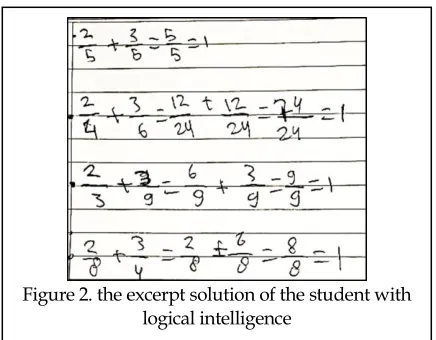
Figure 2 presents an excerpt of S2’s solution (students with logical intelligence) in solving the mathematics problems.
The following is the excerpt of the interview with S1. P : How to solve it?
S2 : Some fractions have the same denominator, and some have different denominators. 2
5and 3
5 have the same denominators. I tried all, then I checked.
Figure 2 and the interview results revealed that S2 employed two strategies in solving problems, namely: the logical consideration strategy as well as the trial and error strategy. S2 considered that the easiest fraction to add was the fraction with 5 as the denominator. Thus, 2
5 and 3
5 were the solution to the problem. S2 applied the trial and error strategy and found three different solutions.
Figure 3 displays the excerpt of S3's solution (students with intrapersonal intelligence)
The following is the excerpt of the interview with S3. P : How did you get it?
S3 : Two over n is a half, meaning the denominator must be four so that the fraction is 2
4. One more, 3
is also a half, meaning that n must be 6, and the fraction is 3
6. The result is 1, isn’t it?
2+2 = 1.
P : Okay, well done. Is there any other solution?
S3 : The denominator is made five. The numerator will be added, if both denominators are five, 2 plus 3 is 5. It makes 5
5, so the result is 1.
Figure 3 and the interview results showed that S3 applied two strategies to solve the problem, namely the strategies of logical thinking and viewing a problem from a different perspective. S3 solved the problem using a logical consideration strategy employing the concept of adding fraction. The sum of the two fractions is 5; then the same number was selected as the denominator to obtain the fraction equals to 1. So, the two fractions were 2
5 and 3
5. S3 also solved the problem using different points of view, the concept of equivalent fractions. S3 thought that two fractions that are equal to 1 are 2 and
2. S3 identified fractions that are equal to 2, but the numerators are 2 and 3 so that the fractions are 2
4 dan 3 6. S2 generated two solutions using the concept of equivalent fractions. In total, S2 presented three solutions using the strategies of logical thinking andviewing a problem from a different perspective. However, in the last solution, S3 did not specify a fraction equivalent to 4
2with the numerator of 3. The fraction should be 3.
Figure 2. the excerpt solution of the student with logical intelligence
Figure 3. The excerpt solution of the student
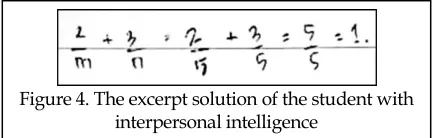
Figure 4 presents the excerpt of S4’s solution (students with interpersonal intelligence) in solving mathematics problems.
The excerpt of the interview is as follows. P : According to you, what is the fraction? S4 : 2/5 and 3/5.
P : How do you know they are 2/5 and 3/5?
S4 : The result is 1. So, the denominator and numerator must be equal. The denominator is 5 because of 2 plus 3. P : Okay, is there any other solutions?
S4 : How many…? I don’t know miss.
Figure 4 and the interview results indicated that S4 solved the problem using a logical consideration strategy employing the concept of the procedure of adding fractions with equal denominators and generated an accurate solution. S4 mentioned that numerator and denominator must be equal. As the sum of the two fractions is 5, S4 concluded that m plus n are 5. S4 provided only one correct solution using one strategy, the logical consideration strategy.
Figure 5 illustrates the excerpt of S5’s solution (students with spatial intelligence) in solving mathematics problems.
The following is the S5 interview excerpt. P : How did you solve it?
S5 : 2/5 plus 3/5 equal to 5/5 or 1. P : Why it must be 5/5? 7/7 is also 1!
S5 : Because 2 plus 3 is 5, if the denominator 5 means 5/5, so the result is 1.
P : Okay, Do you have any other ideas? S5 : No, I don't.
Figure 5 and the interview results revealed that S5 used a logical consideration strategy in solving the problem. S5 chose 5 as the denominators of the two fractions because the
numerators were 5. Similar to S1 and S4, S5 also could not think of another solution. S5 presented one solution only for the test problem.
Each student has varied intelligence in term of the capacities and combinations. This is in agreement with the theory of multiple intelligences arguing that there are seven types of intelligence, namely linguistic, logical-mathematical, musical, spatial, kinesthetic, interpersonal, and intrapersonal intelligence; each student can have all types of intelligences [6].
Each student solves a problem using different methods due to the differences in the types and combinations of their multiple intelligences. Students have various intelligence that can strengthen their skills in solving problems [4]. When students solve problems, it will closely link to these students intelligence, because the source of one's intelligence is his/her habit of solving problems independently [5].
All students could solve the problems using their respective strategies. S1, S2, S4, and S5 immediately wrote the solution without writing the information from the problem nor writing the solution design and reasons for choosing the particular solution. Thus, the researchers could not identify their strategies in solving the problems before the interview. This circumstances not necessarily mean that they did not understand the information provided or use the information as the main tool in resolving the problems. They saved the information in mind and did not write it on the answer sheet. Only one student (S3) wrote part of the reasons or the plan solution used in solving the problem.
S2 and S3 could solve problems using various methods and approaches. They were able to provide various correct answers and successfully developed ideas and approach by linking several concepts studied previously in solving the problems. Students who have logical intelligence love analyzing and counting; they also can solve the problems quickly, use several methods, and present various answers [6]. S2 solved the problem by employing the strategies of logical consideration and trial and error. S2 succeeded in presenting many solutions using these strategies but has not been able to generate new or unique strategies. In contrast to S2, S3 applied the strategies of logical consideration and viewing a problem from a different perspective. S3 was successful in creating a unique strategy using the concept of equivalent fractions. This strategy may be caused by the experience and initial knowledge of S3. Basic knowledge and experience are important in the success of problem-solving [16]; [17]; [18].
S1, S4 and S5 were not getting used to solving problems in various ways. They solved problems following the way they previously learned. They solved the problems in one way only and were not familiar with solving problems using various approaches nor creating new and unique ideas. This is in line Figure 4. The excerpt solution of the student with
interpersonal intelligence
Figure 5. The excerpt solution of the student with
with previous research reporting that Indonesian students solve fraction problems by limited one process only [19]. One reason is that school only required students to solve problems correctly and rarely demand them to solve problems in various alternatives or strategies. Hence, students found it challenging to create new and unique ideas or strategies. How students solve the problems depends on how they have been taught [20]. Students applied the typical method taught by the teacher in solving problems. Besides, students were not accustomed to using various methods in solving problems. The number of students who could provide their own ideas and novel ways of solving problems are limited.
5
C
ONCLUSIONStudents with intrapersonal intelligence use the strategies of logical reasoning and viewing a problem from a different perspective. They could generate unique or new strategies in solving problems, but some calculation errors were found, leading to the wrong solution. Students with logical intelligence solved problems using the strategies of logical reasoning and trial and error. They had not been able to create unique strategies, but they can provide many solutions to a problem, and all solutions were correct. Students with linguistic, spatial and interpersonal intelligence solved problems using only logical consideration strategy.
6
R
EFERENCES[1] Trilling, B., & Fadel, C. (2009). 21st Century Skills.: Learning for Life in Our Times. San Francisco: John Wiley & Sons.
[2] Krulik, S., Rudnick, J.A. (2003) Problem Solving: A Handbook for Senior High School Teachers. Antony Rowe Ltd., Eastbourne.
[3] Polya, G. (2004). How to solve it: A new aspect of mathematical method (No. 246). Princeton university press.
[4] Tanner, H., & Jones, S. (2000). Scaffolding for success: reflective discourse and the effective teaching of mathematical thinking skills. Research in Mathematics Education, 2(1), 19–32.
[5] Chatib, M. (2012). Sekolah anak-anak juara: berbasis kecerdasan jamak dan pendidikan berkeadilan. Kaifa.
[6] Gardner, H. (1993). Frames of mind: The theory of multiple intelligences. New York: Hachette UK.
[7] Posamentier, A. S., & Krulik, S. (2008). Problem-solving strategies for efficient and elegant solutions, grades 6-12: a resource for the mathematics teacher. Corwin press.
[8] Harskamp, E., & Suhre, C. (2007). Schoenfeld’s problem solving theory in a student controlled learning environment. Computers & Education, 49(3), 822-839.
[9] Martin, H. (1998). Multiple intelligences in the mahtematics classroom. Platine, IL: IRI. Skylight.
[10] Solso, R. L., MacLin, M. K., & MacLin, O. H. (1998). Cognitive psychology. Allyn and Bacon Boston, MA.
[11] Schoenfeld, A. (2009). Learning to think mathematically: roblem solving, metacognition, and sense-making in mathematics. Coleccion Digital Eudoxus, (7).
[12] Ormrod, J. E. (2016). Pisikologi Pendidikan: membantu siswa tumbuh dan berkembang. Erlangga.
[13] Reys, R. E., Lindquist, M., Lambdin, D. V, & Smith, N. L. (2014). Helping children learn mathematics. Virginia USA: John Wiley & Sons. [14] Armstrong, T. (2009). Multiple intelligences in the classroom. Virginia
USA: Ascd.
[15] Tirri, K., & Nokelainen, P. (2012). Measuring multiple intelligences and moral sensitivities in education (Vol. 5). Springer Science & Business Media.
[16] Charles, R. (1987). How To Evaluate Progress in Problem Solving. National Council of Teachers of Mathematics, 1906 Association Drive, Reston, VA 22901.
[17] Rudder, C. A. (2006). Problem solving: Case studies investigating the strategies used by secondary* American and Singaporean students. The Florida State University.
[18] Schoenfeld, A.: Learning to think mathematically: problem solving, metacognition, and sense making in mathematics. In: Grows, D.A. (ed.) Handbook of Research on Mathematics Teaching and Learning, pp. 334–370. Macmillan, New York (1992).
[19] Johar, R., Patahuddin, S. M., & Widjaja, W. (2017). Linking pre-service teachers’ questioning and students’ strategies in solving contextual problems: A case study in Indonesia and the Netherlands. The Mathematics Enthusiast, 14(1), 101-128.