1. Introduction
In general, there is no single optimal solution in multi-criteria problems, but rather a set of non-inferior (Pareto optimal) solutions from which the Decision Maker (DM) must select the most preferred or best compromise solution as the one to implement. One of the difficulties which occur in the application of mathematical programming is that the coefficients in the formulation are not constants but fluctuating and uncertain.
Fuzzy set theory introduced by Zadeh [32] makes a model has to be set up using data which is approximately known. Fuzzy numerical data can be represented by means of fuzzy subsets of the real line, known as fuzzy numbers [6]. Fuzzy linear constraints with fuzzy numbers were studied by Dubois and Prade[7]. A fuzzy linear programming problem has been formulated by Tanaka and Asai [28] to obtain a reasonable solution under consideration of the ambiguity of parameters. Rommelfanger et al. [23] solved the multi-objective linear optimization problem using the interactive method, where the coefficients of the objectives and/or the constraints are known exactly but imprecisely. Zimmerman [39] introduced fuzzy linear programming with multiple objective functions. Sakawa and Yano [24] introduced the concept of Pareto optimality of fuzzy parametric program. Bellman and Zadeh [1] introduced the concept of a maximizing decision making problem. Zhao et al. [37] introduced the
Corresponding author
E-mail address: [email protected] DOI: 10.22105/jarie.2018.148642.1054
On Solving Fully Fuzzy Multi-criteria De Novo Programming
via Fuzzy Goal Programming Approach
Hamiden Abdelwahed Khalifa
Operations Research Department, Institute of Statistical Studies and Research, Cairo University, Giza, Egypt.
A B S T R A C T P A P E R I N F O
In this paper, a Multi-criteria De Novo Linear Programming (F- MDNLP) problem has been developed under consideration of the ambiguity of parameters. These fuzzy parameters are characterized by fuzzy numbers. A fuzzy goal programming approach is applied for the corresponding multi-criteria De Novo linear programming (MDNLP) problem by defining suitable membership functions and aspiration levels. The advantage of the approach is that the decision maker's role is only the specification of the level and hence evaluate the efficient solution for limitation of his/ her incomplete knowledge about the problem domain. A numerical example is given for illustration.
Chronicle: Received: 13 June 2018 Revised: 03 October 2018
Accepted: 31 October 2018 Keywords:
Multi-criteria De Novo Programming. Fuzzy Numbers. α-efficient Solution. Linear Membership Function. Fuzzy Goal Programming.
optimal Compromise Solution.
Journal of Applied Research on Industrial
Engineering
complete solution set for the fuzzy linear programming problems using linear and nonlinear membership functions. Tang and Chang [29] developed a decision-making model and helped the DMs and researchers to understand the effect of multiple criteria decision-making on a capital budgeting investment, coefficients, and resources. They solved the problem based on the proposed method introduced by Gasimov and Yenimez [10]. Kiruthiga and Loganathan [16] reduced the Fuzzy MOLP problem to the corresponding ordinary one using the ranking function and hence solved it using the fuzzy programming technique. Hamadameen [11] proposed a technique for solving fuzzy MOLP problem in which the objective functions coefficients are triangular fuzzy numbers. Under uncertainty, vague, and imprecise of data, Garg [9] suggested an alternative approach for solving multi-objective reliability optimization problem. Chen et al. [5] applied fuzzy goal programming approach to treat equipment's purchasing problem for a flexible manufacturing cell.
De Novo programming is used as a methodology of optimal system design for reshaping feasible sets in linear systems. De Novo programming was proposed by Zeleny [33] ensures creation of an optimal-level model by economizing the constraints resources within the frame of a given budget. The major characteristic of De Novo hypothesis is to realize optimal system design instead of optimizing a given system [35]. Fiala [8] proposed approaches for solving multi-objective De Novo linear programming, also introduced possible extensions, methodological, and real applications. Umarusman and Turkmen [30] have been built the optimum production setting through the de novo programming with the global criterion method. Tabucanon [27] has been shown that the de novo programming formulation deal with the best mixture of input specified as well as the best mixture of the output. De novo programming problem was studied and developed by several authors [3, 4, 12, 36].
De Novo programming model with fuzzy coefficients was proposed by Li and Lee [18]. Also, Li and Lee [19] developed fuzzy goals and fuzzy coefficients for the De Novo programming model simultaneously. Fuzzy programming approach was firstly used by Zimmermann [38] to solve the multi-objective problems. Narasimhan [22] and Ignizio [13] used the fuzzy set theory for solving the problems having multiple goals. Ramadan Hamed Mohamed [20] introduced some new forms of fuzzy programs using the deviational variables concepts of fuzzy goal programming to transform the fuzzy programming into the corresponding crisp. Also, he applied the min-operator to convert the fuzzy programming into the corresponding crisp program. Charnes and Cooper [2] were the first ones presented the goal programming and hence this approach developed by Ijiri [14] and Lee [17]. Veeramani et al. [31] studied fuzzy MOLP problem with fuzzy technological.
The remainder of the paper is as: In Section 2, some preliminaries are introduced. In Section 3, a problem formulation and solution concepts is introduced. In Section 4, a fuzzy goal programming approach is applied. A solution procedure for solving the problem is suggested in Section 5. A numerical example is given in Section 6. Finally, some concluding remarks are reported in Section 7.
2. Preliminaries
Here, definition of fuzzy numbers, triangular fuzzy numbers, interval confidence, and some of arithmetic operations needed in order to discuss our problem conveniently are recalled [15, 21].
Let I(R)
[a,a]:a,aR(,),aa
denote the set of all closed interval numbers onR
.
] ,
[ ] , [ ) ( ] ,
[a a b b ab ab (1) ]
, [
] , [ ) ( ] ,
[a a b b ab ab (2) )]
. , . , . , . ( max ), . , . , . , . ( min [ ] , [ ) ( ] ,
[a a b b ab ab ab ab ab ab ab ab (3)
The order relation " " in I(R) is defined by: ] , [ ) ( ] ,
[a a b b , if a only if ab,ab. (4)
Definition 2. A fuzzy number a~ is a mapping: ],
1 , 0 [ : ~ R
a
with the following properties: a~(x) is an upper semi- continuous membership function;
~ais a convex fuzzy set, i. e., ~a(x1(1)x2)min{~a(x1),a~(x2)},for all x1,x2R,01. a~ is normal, i. e., x0Rfor which a~(x0)1.
Supp(a~){xR:~a(x)0}is the support of thea~, and its closure cl (supp(~a))is compact set.
Let F(R)denotes the set of all compact fuzzy numbers onR that is for any gF(R),gsatisfies the following:
xR:g(x)1.
For any 01,g [g, g] is a closed interval numbers on R.
Definition 3. The
cut set of ~aF(R),01, denoted by (a~)and is defined as the ordinary set:
0 )),
~ ( (sup
1 0
, ) ( : )
~
( ~
clx Rp a x
a a
In the F- MDNP problem, the following notions are used:
, ~
i
~
~
: ( ) ; ,
., ) ( : ~
, ; ) ( : ~
~
, , ; ) ( : ~
~
, ; ; ) ( : ~
~
~
~ ~
: 1
~ ) 1 (
~ ) 1 (
j i a
R a a
A
B R B B i p
R p p
p
s j d
R d d
D
k j c
R c c
C
ij a n m ij ij
B i
p m i
s j d n S s
j
k j c n K k
j
ij i
s j k j
Definition 4. (Sakawa [26]). A triangular fuzzy number (T. F. N.) is denoted by A~(a1,a2,a3) and its membership is defined as:
. ,
0
, ,
, ,
, ,
0
) (
3 3 2
2 3
3
2 1
1 2
1
1
~
a x
a x a a a
x a
a x a a a
a x
a x
x A
Also, T. F. N., parametric form for level
can be characterized as: . 1 0 ]; ) ( , ) [( ~3 2 3 1 1
2
a a a a a a
A
3. Problem Formulation and Solution Concepts
A typical multicriteria De Novo programming problem introduced by Zeleny [34] is presented with fully fuzzy parameters as:
(P1)
n j
j s j s
n j
j k j k
x d d
x W
x c c
x Z
1 1
~ ) ~ , ( ~ min
~ ) ~ , ( ~ max
Subject to
, ~
1
B b
p i
m i
i
. ,..., 2 , 1 ; ..., , 2 , 1 ,
0 j ni m
xj
that assumed to be characterized as the fuzzy numbers [7]. Note that ij j m
i
ia A
p ~ ~
~ 1
represents the unit
cost of product j. Referring toAj,problem (P1) may be reformulated as follows:
(P2)
n j
j s j s
n j
j k j k
x d W
x c Z
1 1
~ ~
min
~ ~
max
Subject to
j x
B x A R
x B A x
M j j
n j
j n
; 0 , ~ ~
: )
~ , ~ , (
1
.
The feasible region M(x,A~,B~) is assumed to be compact set. In this work, assume that all of fuzzy numbers~pi, B~,c~ , kj d~sjanda~ijF(R).
Definition 4. (Fuzzy efficient solution). x(c~,d~)M(x,A~,B~)is said to be fuzzy efficient solution of
the problem (P2) if ( ,~),
~ ) ~ , ( ~
c x Z c x
Zk k W~s(x,d~)W~s(x,d~), Z~k(x,c~)Z~k(x,c~),or ).
~ , ( ~ ) ~ , ( ~
d x W d x
Ws s
For a certain degree of
, the problem (P2) can be written as in the following non fuzzy form ( Sakawaand Yano [24] ):
(P3)
n j
j s j s
n j
j k
j k
x d W
x c Z
1 1
min max
Subject to
j x
B x A R
x B A x M
x j j
n j
j n
; 0 , :
) , , (
1
,
jk sj
js j
j
ij kj c d d A A a
Definition 5. (
efficient solution). x(c,d)M(x,A,B)(Mis the feasible region) is said to be
efficient solution of the problem (P3) if and only if there does not exist anotherx,ckj
~cjk ,
d A
A
a B
Bdsj ~sj , j ~j ~ij , ~ , such that Zk(x,c)Zk(x,c),Ws(x,d)Ws(x,d),and ),
, ( ) , ˆ
(x c Z x c
Zk k or Ws(xˆ,d)Ws(x,d),where the corresponding values of parameters
d A B
c k, s, , are called
level optimal parameters.Definition 6. (
optimal compromise solution). A feasible solution xM(x,A,B) is said to be
optimal compromise solution of problem (P3) if and only ifZ(x ,c) Z(x,c)E x
,
jk sj
sj j
j
ij k
j c d d A A a
c ~ , ~ , ~ ~ , and B~
B~, where referees to ''minimum'' and E is the set of
efficient solutions.4. Fuzzy Goal Programming for Solving Problem (P3)
4.1 Fuzzy Programming Approach
Bellman and Zadeh [1] introduced three basic concepts: Fuzzy goal(G), fuzzy constraints(C)
, fuzzy
decision
(D), and handling the application of these concepts under fuzziness for the decision-
making processes. Depending on the fuzzy goal and the fuzzy constraints, the fuzzy decision
)
(D
can be defined as:
G C
D (5)
Whose membership function is characterized as:
( ), ( )
min )
(x C x G x
D
(6)To describe the fuzzy goals for the problem (P3), let us introduce the linear membership functions
and L x Z
U x Z L L U
L c x Z
L x Z
x Z
k k
k k
k k k
k k
k k
k k
, ) ( ,
1
, ) ( ,
) , (
, ) ( ,
0 )) ( (
(7)
. ) ( ,
0
, ) ( ,
) , (
, ) ( ,
1 )) ( (
s s
s s
s s
s s s
s s
s s
U x W
U x W L L
U
d x W U
L x W
x W
(8)
k s
k U L
U , , , and Lsare the upper and lower bounds ofZk(x,c) and Ws(x,d). They are estimated at 0, as follows:
)) , ( ( min )),
, ( ( max )),
, ( (
max Z xc U W x d L Z xc
U k
M x k s
M x s k
M x k
, andL min (Ws(x,d)
M x s
),
, ..., , 2 ,
1 K
k s1,2,...,S. It is assumed that:Uk Lk and Us Ls.
By using the linear membership functions (7) and (8), and the fuzzy decision defined by (6), the problem (P3) can be rewritten as:
(P4)
( ( , )), ( ( , )
min max
..., , 2 , 1
..., , 2 , 1
d x W c
x Z
x k k s s
S s
K k
Subject to
n j
x B x A R
x B A x M
x j j
n j
j
n: , 0, 1,2,..., )
, , (
1
,
jk sj
sj j
j
ij kj c d d A A a
c ~ , ~ , ~ ~
, and
B~
B~.
By introducing the auxiliary variable
, the problem(P4)can be reduced to the following conventionallinear programming problem:
(P5)
max
Subject to
, ..., , 2 , 1 , ) , (
, ..., , 2 , 1 , ) , (
S s
L U
d x W U
K k
L U
L c x Z
s s
s s
k k
k k
n j
x B x A R
x B A x M
x j j
n j
j n
..., , 2 , 1 , 0 , :
) , , (
1
,
jk sj
sj j
j
ij kj c d d A A a
4.2 Goal Programming Approach
Fuzzy goal programming is a well-known approach in multi-criteria decision-making and its applications. To formulate the problem (P5) as a goal programming problem (Sakawa [26]), let us
introduce the negative and positive deviational variables as ,
,..., 2 , 1 , )
,
(xc d d Z k K
Zk k k k
and W (x,d ) q q Wˆ ,s 1,2,...,S. s
s s
s
Where,Zk
and Wˆsare the aspiration levels of the objective functions kand s, respectively. With these goals, problem (P5) can be rewritten as follows:
(P6)
max Subject to
, ..., , 2 , 1 , ) , (
K k
L U
L c x Z
k k
k k
, ..., , 2 , 1 , ) , (
S s
L U
d x W U
s s
s s
, ,..., 2 , 1 , )
,
(xc d d Z k K
Zk k k k
, ..., , 2 , 1 , ˆ )
,
(xd q q W s S
Ws s s s
, ..., , 2 , 1 , ..., , 2 , 1 , 0 , ,
,d q q k K s S
dk k s s
1 0
,
kj sj
sj j
j
ij kj c d d A A a
c ~ , ~ , ~ ~
, and
B~
B~,
n j
x B x A R
x B A x M
x j j
n j
j n
..., , 2 , 1 , 0 , :
) , , (
1
.
It is clear that problem (P6) is not linear programming, even all the membership functions defined in
Eqs. (7) and (8) are linear. To solve this problem using the linear programming technique, let us introduce the following two set-valued functions:
, ,...,
2 , 1 , ..., , 2 , 1
) , ( ( ;
..., , 2 , 1 ), , ( ( :
) , ( ) , (
1
n j
S s
d x W K
k c x Z R
x c
c U
s
s s k
k n
s j k
j j
n j
B x A R
x B A
V j
n j
j n j
j( , ) : , 1,2,...,
1
(10)
Proposition 1. (Sakawa [25]). (1) If
ckj1 ckj 2, then
. , .
, 2
1 k
j j k
j
j c U c
U , and if
1 s 2j s
j d
d , then
1 2
, . ,
. sj j sj
j d U d
U ; (2) If A1jA2j, then Vj
A1j,. Vj A2j,. , and if2 1
B
B , then
1 2, .
.,B V B
Vj j .
From the properties of the cut sets of fuzzyc~kj,d~sj,B~, andA~j, it should be noted thatckj,dsj, B~, and Aj,j1,2,...n,k1,2,...,K, s1,2,...,S, can be denoted by the intervals of confidence as
ckj , ckj ,j1,2,...,n
;
dsj ,dsj ,s1,2,...,S;
B,B
, and
Aj, Aj
,j1,2,...,n.Through the use of proposition 1 and the arithmetic operations of intervals of confidence, the problem (P6) can be rewritten as follows:
(P7)
max
Subject to
, ..., , 2 , 1 , ) , (
, ..., , 2 , 1 , ) , (
S s
L U
d x W U
K k
L U
L c x Z
s s
s s
k k
k k
, ,..., 2 , 1 , )
,
(xc d d Z k K
Zk k k k
, ..., , 2 , 1 , )
,
(xd q q W s S
Ws s s s
, ..., , 2 , 1 ; ..., , 2 , 1 , 0 , ,
,d q q k K s S
dk k s s
. 1 0
A A x B B x j nR x B A x M
x j j
n j
j j
n: , , , 0, 1,2,...,
) , , (
1 _
5. Solution Procedure
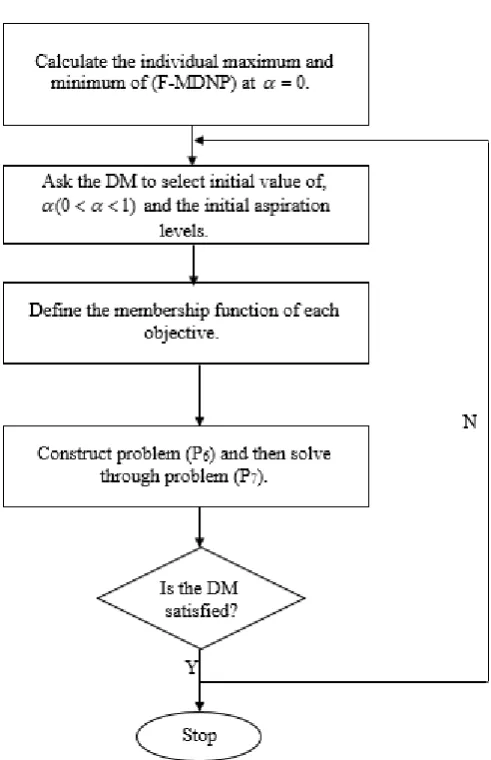
In this section, a solution procedure to solve problem (P7) can be summarized as:
Step 1. Calculate the individual minimum (lower bound) and the individual maximum (upper bound) of each
objective function under the given constraints at
0.
Step 2. Ask the decision maker to specify the initial value of(0 1) and the initial aspiration level. Step 3. Define the membership functions (7) and (8) and the initial aspiration level.
Step 4. Solve (P6) through (P7).
Step 5. Introduce the solution to the DM. If the DM satisfied, go to step6. Otherwise, go to step 2. Step 7. Stop.
6. Numerical Example
Consider the following F-MDNLP
4 3
2 1
1 (1,2,3) (3,5,6) (6,7,8) (0,1,2)
~
maxZ x x x x
,
, ) 13 , 11 , 10 ( ) 4 , 3 , 2 ( ) 2 , 1 , 0 ( ) 5 , 4 , 2 ( ~ 4 3 2 1
2 x x x x
Z
, ) 3 , 2 , 1 ( ) 2 , 1 , 0 ( ) 4 , 3 , 2 ( ) 10 , 9 , 7 ( ~ 4 3 2 1
3 x x x x
Z
, ) 3 , 2 , 1 ( ) 2 , 1 , 0 ( ) 2 , 1 , 0 ( ) 2 , 1 , 0 ( ~ , ) 4 , 3 , 2 ( ) 2 , 1 , 0 ( ) 3 , 2 , 0 ( ) 2 , 1 , 0 ( ~ min 4 3 2 1 2 4 2 2 1 1 x x x x W x x x x W
Subject to
. 0 , , , ), 155 , 150 , 145 ( ) 9 , 8 , 6 ( ) 3 , 2 , 1 ( ) 5 , 5 , 3 ( ) 4 , 3 , 2 ( 4 3 2 1 4 3 2 1 x x x x x x x x
Step1
.
At
0, the individual maximum and minimum of each objective function with respect to the given constraints is:
18.75,
28.4,
37.5,
50,
30.; 75 , 75 , 450 , 225 , 150 min 2 min 1 min 3 min 2 min 1 max 2 max 1 max 3 max 2 max 1 W W Z Z Z W W Z Z Z
Step2
.
Assume the DM selects
0.6, and the aspiration levels: . 75 ˆ , 75 ˆ , 450 ˆ , 225 ˆ , 150 ˆ 2 1 3 21 Z Z W W
Z
At
0.6, the problem corresponding to the F-MDNLP is as:
Step4
.
Solve problem (P6) through (P7) asmax
Subject to
. 1 6 . 0 032 . 0 018667 . 0 018667 . 0 018667 . 0 , 1 3333 . 0 04533 . 0 01867 . 0 032 . 0 018667 . 0 , 1 11 04267 . 0 016 . 0 06933 . 0 22933 . 0 , 1 9225 . 6 37324 . 0 09155 . 0 021127 . 0 12676 . 0 , 1 7 032 . 0 352 . 0 2453 . 0 0853 . 0 4 3 2 1 4 3 2 1 4 3 2 1 4 3 2 1 4 3 2 1 x x x x x x x x x x x x x x x x x x x x
. 0 , , , , , , , , , , , , , , 1 0 , 75 4 . 2 4 . 1 4 . 1 4 . 1 , 75 4 . 3 4 . 1 4 . 2 4 . 1 , 450 6 . 1 6 . 0 6 . 2 6 . 8 , 225 6 . 10 6 . 2 6 . 0 6 . 3 , 150 6 . 0 6 . 6 6 . 4 6 . 1 , 4 . 150 4 . 8 4 . 2 4 . 5 4 . 3 , 6 . 149 6 . 7 6 . 1 6 . 4 6 . 2 2 2 1 1 3 3 2 2 1 1 4 3 2 1 2 2 4 3 2 1 1 1 4 3 2 1 3 3 4 3 2 1 2 2 4 3 2 1 1 1 4 3 2 1 4 3 2 1 4 3 2 1 q q q q d d d d d d x x x x q q x x x x q q x x x x d d x x x x d d x x x x d d x x x x x x x x x x x x
The problem is solved using any software (say, Lingo) and the results are
:
]. 0581 . 52 , 3106 . 122 [ , ] 63505 . 307 , 8876 . 277 [ ], 6586 . 164 , 2370 . 122 [ , ] 4286 . 115 , 6811 . 85 [ , 5037334 . 0 , 94190 . 22 , 0 , 94190 . 22 , 0 , 1124 . 172 , 0 , 37355 . 96 , 0 , 31887 , 64 , 0 , 0 , 237233 . 5 , 0 , 94712 . 31 2 1 2 1 1 2 2 1 1 3 3 2 2 1 1 4 3 2 1 W W Z Z Z q q q q d d d d d d x x x x
Step5. Assume that the DM has been satisfied with the solution, go to Step6.
Table1. The fuzzy efficient solution
.
Variables Value Objective values
1
x 31.94712
2 1 3 2 1 ) 368706 . 74 , 184353 . 37 , 0 ( ) 945666 . 329 , 761313 . 292 , 62984 . 223 ( ) 684532 . 180 , 500179 . 143 , 368706 . 74 ( ) 739224 . 137 , 554871 . 100 , 370518 . 63 ( 5037334 . 0 W W Z Z Z 2 x 0 3
x 5.237233
4
7. Conclusion
In this paper, the fuzzy multi-criteria de novo programming problems was studied. Fuzzy goal programming approach was used to obtain
optimal compromise solution and to achieve satisfactory results for the DM. The decision maker's role only was the evaluation of the
efficient solutions to limit the influences of his/ her incomplete knowledge about the problem domain.Acknowledgements
The authors are very grateful to the anonymous reviewers for his/her insightful and constructive comments and suggestions that were led to an improved version of this paper.
References
[1] Bellman, R. E., & Zadeh, L. A. (1970). Decision-making in a fuzzy environment. Management science, 17(4), B-141.
[2] Charnes, A., & Cooper, W. W. (1968). Management models and the industrial applications of linear programming. John& Wiley, New York.
[3] Chen, Y. W., & Hsieh, H. E. (2006). Fuzzy multi-stage De-Novo programming problem. Applied mathematics and computation, 181(2), 1139-1147.
[4] Chen, J. K., & Tzeng, G. H. (2009). Perspective strategic alliances and resource allocation in supply chain systems through the De Novo programming approach. International journal of sustainable strategic management, 1(3), 320-339.
[5] Chen, Y. L., Chen, L. H., & Huang, C. Y. (2009). Fuzzy Goal Programming Approach to Solve the Equipment-Purchasing Problem of an FMC. International journal of industrial engineering: theory, applications and practice, 16(4).
[6] Dubois, D. J. (1980). Fuzzy sets and systems: Theory and applications (Vol. 144). Academic press. [7] Dubois, D., & Prade, H. (1980). Systems of linear fuzzy constraints. Fuzzy sets and systems, 3(1), 37-48. [8] Fiala, P. (2011). Multi-objective De Novo Linear Programming. Acta universitatis palackianae
olomucensis. Facultas rerum naturalium. Mathematica, 50(2), 29-36.
[9] Garg, H. (2018). Analysis of an industrial system under uncertain environment by using different types of fuzzy numbers. International journal of system assurance engineering and management, 9(2), 525-538. [10] Gasimov, R. R., & Yenilmez, K. (2002). Solving fuzzy linear programming problems with linear
membership function. Turkish journal of mathematics, 26(4), 375-396.
[11] Hamadameen, O. A. (2018). A noval technique for solving multi-objective linear programming problems.
Aro- the scientific journal of Koya University, 5(2): 1-8.
[12] Huang, J. J., Tzeng, G. H., & Ong, C. S. (2006). Choosing best alliance partners and allocating optimal alliance resources using the fuzzy multi-objective dummy programming model. Journal of the operational research society, 57(10), 1216-1223.
[13] Ignizio, J. P. (1982). On the (re) discovery of fuzzy goal programming. Decision sciences, 13(2), 331-336. [14] Ijiri, Y. (1965). Management goals and accounting for control (Vol. 3). North Holland Pub. Co.
[15] Kaufmann, A., & Gupta, M. M. (1988). Fuzzy mathematical models in engineering and management science. Elsevier Science Inc.
[16] Kiruthiga, M., & Loganathan, C. (2015). Fuzzy multi- objective linear programming problem using membership function. International journal of science, engineering, and technology, applied sciences, 5(8): 1171- 1178.
[17] Lee, S. M. (1972). Goal programming for decision analysis (pp. 252-260). Philadelphia: Auerbach Publishers.
[18] Li, R. J., & Lee, E. S. (1990). Multi-criteria de novo programming with fuzzy parameters. Journal of mathematical analysis and application, 19(1), 13-20.
[19] Li, R. J., & Lee, E. S. (1993). De Novo programming with fuzzy coefficients and multiple fuzzy goals. Journal of mathematical analysis and applications, 172(1), 212-220.
[21] Moore, R. E. (1979). Methods and applications of interval analysis (Vol. 2). Siam.
[22] Narasimhan, R. (1981). On fuzzy goal programming—some comments. Decision sciences, 12(3), 532-538. [23] Rommelfanger, H., Hanuscheck, R., & Wolf, J. (1989). Linear programming with fuzzy objectives. Fuzzy
sets and systems, 29(1), 31-48.
[24] Sakawa, M., & Yano, H. (1985). Interactive decision making for multi-objective linear fractional programmingproblems with fuzzy parameters. Cybernetics and system, 16(4), 377-394.
[25] Sakawa, M., & Yano, H. (1990). An interactive fuzzy satisficing method for generalized multi-objective linear programming problems with fuzzy parameters. Fuzzy sets and systems, 35(2), 125-142.
[26] Sakawa, M. (2013). Fuzzy sets and interactive multi-objective optimization. Springer Science & Business Media.
[27] Tabucanon, M. T. (1988). Multiple criteria decision making in industry (Vol. 8). Elsevier Science Ltd. [28] Tanaka, H., & Asai, K. (1984). Fuzzy linear programming problems with fuzzy numbers. Fuzzy sets and
systems, 13(1), 1-10.
[29] Tang, Y. C., & Chang, C. T. (2012). Multicriteria decision-making based on goal programming and fuzzy analytic hierarchy process: An application to capital budgeting problem. Knowledge-based systems, 26, 288-293.
[30] Umarusman, N., & Ahmet, T. (2013). Building optimum production settings using de novo programming with global criterion method. International journal of computer applications, 82(18).
[31] Veeramani, C., Duraisamy, C., & Nagoorgani, A. (2011). Solving fuzzy multi-objective linear programming problems with linear membership functions. Australian journal of basic and applied sciences, 5(8), 1163-1171.
[32] Zadeh, A. L. (1965). Fuzzy sets. Information and control,8(3), 338- 353.
[33] Zeleny, M. (1976). Multi-objective design of high-productivity systems. Joint automatic control conference (No. 13, pp. 297-300). IEEE.
[34] Zeleny, M. (1986). Optimal system design with multiple criteria: De Novo programming approach. Engineering costs and production economics, 10(1), 89-94.
[35] Engineering Costs and Production Economics, (10): 89- 94.
[36] Zelený, M. (1990). Optimizing given systems vs. designing optimal systems: The De Novo programming approach. International journal of general systems, 17(4), 295-307.
[37] Zhang, Y. M., Huang, G. H., & Zhang, X. D. (2009). Inexact de Novo programming for water resources systems planning. European journal of operational research, 199(2), 531-541.
[38] Zhao, R., Govind, R., & Fan, G. (1992). The complete decision set of the generalized symmetrical fuzzy linear programming problem. Fuzzy sets and systems, 51(1), 53-65.
[39] Zimmermann, H. J. (1978). Fuzzy programming and linear programming with several objective functions. Fuzzy sets and systems, 1(1), 45-55.