Int. J. of Engg. Sci. & Mgmt. (IJESM), Vol. 4, Issue 4:Oct.-Dec.: 2014, 160-165
INTERNATIONAL JOURNAL OF ENGINEERING SCIENCES &
MANAGEMENT
PERFORMANCE ANALYSIS OF PAPR REDUCTION TECHNIQUES IN MC-CDMA
SYSTEM
Akash Nigam
1, Mukesh Patidar
2, Prof. A. C. Tiwari
3M. Tech. Scholar
1, Asst. Prof.
2, Prof. & HOD
3Department of Electronics and Communication Engineering
Lakshmi Narain College of Technology, Indore (M.P.) India
[email protected]
1Abstract
MC-CDMA is the most promising technique for high data bit rate and high capacity transmission in wireless communication. One of the challenging issues of MC-CDMA system is very high PAPR due to large number of subcarriers which reduces the system efficiency. MC-CDMA or (OFDM-CDMA) multiple access has become a most likely technique for future generation broadband wireless communication system such as 4G. Reduction in PAPR have showed the way of consuming less power, improvement in spectral bandwidth, low bit error rate, lesser amount of complexity and cost. This paper describes the various PAPR reduction techniques for MC-CDMA system with used in communication channel and modulation techniques. The result it outcome with high Peak to Average Power Ratio which introduce solemn disturbances for instance lower resolution and reduction in battery life and the performance results is draw in PAPR versus CCDF.
Keywords: MC-CDMA, PAPR, CCDF, OFDM.
I.
INTRODUCTION
Wireless communications is, by many measure, the fastest growing segment of the communications industry and the broadband wireless at the confluence of the most remarkable growth stories of telecommunication industry in recent years. WiMAX (Worldwide Interoperability for Microwave Access) is an emerging broad- band wireless technology based on the IEEE 802.16 standard. Multi-Carrier Code Division Multiple Access (MC-CDMA) is a fusion of Orthogonal Frequency Division Multiplexing (OFDM) and Code Division Multiple Access (CDMA) techniques. In MC-CDMA, information symbols are spread using orthogonal codes and spread across frequency domain. It is most promising technique for high bit rate and high speed data transmission in mobile communications. It has merit for spectral efficiency and low cost implementation. [1]- [4] It is attractive technique for 3rd
and 4th generation of wireless communication. But it has critical trouble of high PAPR. With the high PAPR results that non-linear distortion in HPA (High Power Amplifier) and degrade the performance of the system. Other demerits also include like complexity of converter design, raise in interference, elevated cost, more owner consumption and reduction in batter life. To overcome this problem results in
consumption of low power and enrichment in batter life and bandwidth.
MC-CDMA is a powerful multiple access technique but it is not problem free. OFDM signal has large peak to average ratio (PAPR) which severely limits its applications, and as long as basic operation of OFDM-CDMA is identical to OFDM system, this undesirable property remains. High PAPR values causes a serious problem to the power amplifier (PA) used at transmitter. The power efficiency performance at such amplifiers decreases as PAPR increases.
Int. J. of Engg. Sci. & Mgmt. (IJESM), Vol. 4, Issue 4:Oct.-Dec.: 2014, 160-165
phase weighting factor to produce alternative sequences with low PAPR.
II.
MC CDMA SYSTEM MODEL
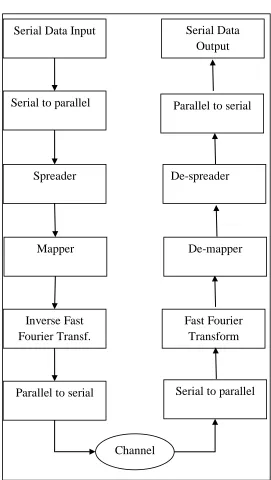
In Figure 1 illustrates the obstruct description of MC-CDMA. Data symbols are transmitted simultaneously on several narrow band sub channels. The spreading of data symbols is done using Inverse Fast Fourier Transform which are then modulated and mapped in frequency domain. Using spreading sequence, the data gets spreaded by the spreader in time domain which is then applied to mapper followed by conversion. Single chip are used to modulate orthogonal overlapping subcarriers obtained by the division of bandwidth using IFFT. Inter Symbol Interference can be overcome by inserting guard interval or cyclic prefix prior converting the data into serial form. The reverse operation takes place at the receiver.
Fig. 1: Block Diagram for MC-CDMA System
III.
OFDM
OFDM is a modulation technique which offers quite a few interesting features to mitigate frequency-selective channel impairments [4]. Huge bandwidth savings is possible due to the orthogonality among subcarriers as shown in Figure 1.2. The high-data rate is divided into several low-data rate streams which modulate orthogonal subcarriers. The narrow band signals are multiplexed together and sent through the channel. At the receiver, the signal is de-multiplexed in reverse order creating low-data rate streams which form the original
high-Serial Data Input
Spreader
Serial to parallel
Mapper
Parallel to serial
Inverse Fast
Fourier Transf.
Transform
Serial Data
Output
De-spreader
Parallel to serial
De-mapper
Serial to parallel
Fast Fourier
Transform
Int. J. of Engg. Sci. & Mgmt. (IJESM), Vol. 4, Issue 4:Oct.-Dec.: 2014, 160-165
data rate signal. Advantage of OFDM system is the efficient channel estimation/equalization as the broadband frequency-selective channel is split into several flat-fading channels due to narrow- band subcarriers. Discrete-time OFDM signal can be written as in equation (1).
xn = x( 𝑛𝑇
𝐽𝑁) =
1
√𝑁∑ 𝑋(𝑘+𝑁)× exp(
𝑗2𝜋𝑛𝑘
𝐽𝑁 )
𝑁 2−1⁄
𝑘=𝑁 2⁄ ,
n = 0,1,2,4,4,………..JN-1 (1)
IV.
SYNCHRONOUS MC-CDMA
SYSTEMS
MC-CDMA is the most promising technique for high bit rate and high capacity transmission in wireless communication. One of the challenging issues of MC-CDMA system is very high PAPR due to large number of sub-carriers which reduces the system efficiency. This paper describes the various PAPR reduction techniques for MC-CDMA system. Criterion for the selection of PAPR reduction technique and also the comparison between the reduction techniques has been discussed.
Multicarrier systems like CDMA and OFDM are now days being implemented commonly. MC-CDMA (or OFDM-CDMA) multiple access has become a most likely technique for future generation broadband wireless communication system such as 4G. We consider a synchronous K-user MC-CDMA system of N narrowband subcarriers. The block diagram is shown in Fig. 2.4. At time t, the data symbol 𝑏𝑘(𝑡) of the user
k, from the signal constellation B is spread by the signature sequence 𝑐𝑘= (𝑐𝑘1, … … . . , 𝑐𝑘𝑛). These signature sequences
must have low cross-correlations.
In this paper, an orthogonal Walsh-Hadamard set of size N is used as signature sequences. In this case, the maximum number of active users 𝑘𝑚𝑎𝑥that can be supported in the MC-CDMA
system is equal to the signature sequence length N; i.e., 𝑘𝑚𝑎𝑥=
N. The resultant N chips after spreading the symbol 𝑏𝑘(𝑡) are
modulated on the N different subcarriers using the IFFT operator and then transmitted through the channel. The propagation channel is described by the complex coefficients
ℎ𝑘𝑛, 𝑘 = 1; … … . . ; 𝐾and 𝑛 = 1; … … . ; 𝑁. The combination
of spreading and channel coefficients for all users can be expressed by the L× K matrix as in equation 2.
𝐷(𝑡) = (𝑐11ℎ11(𝑡) … … … 𝑐… … . . 𝑘1ℎ𝑘1(𝑡) … … . .
𝑐1𝑁ℎ1𝑁(𝑡) … . . … … … … . 𝑐𝐾𝑁ℎ𝐾𝑁(𝑡)
) (2)
Fig.3 Schematic diagram of synchronous MC-CDMA system
(A). Companding
The companding transformation is applied at the transmitter after IFFT block in order to attenuate the high peaks and amplify low amplitude of the MC CDMA signal, thus decreasing the PAPR. At the receiver, the de-companding process is applied by using the inverse companding function prior to FFT block in order to recover the original signal. The transmitted signal power is amplified by using HPA. However, fluctuations of signal amplitudes require expensive HPAs with very good linearity, large PAPR requires ADC and DAC with large dynamic range. Companding techniques are effective and simple for reduction of PAPR in MC CDMA. Companding technique describes compression in transmitter and expansion in receiver. μ-law companding technique, which enlarges only small signals so that average power increases, cause side lobe generation. Exponential companding scheme maintains constant average power and causes less spectrum side lobes. Exponential companding scheme offers better PAPR reduction, BER, phase error performance than μ-law companding technique.
Fig.4: MC CDMA with Companding
Int. J. of Engg. Sci. & Mgmt. (IJESM), Vol. 4, Issue 4:Oct.-Dec.: 2014, 160-165
V.
PAPR REDUCTION IN MCCDMA
The PAPR of the MC CDMA signal p (t) is defined as the ratio between maximum in stannous power and its average power during the MC CDMA signal.
𝑃𝐴𝑃𝑅 = max [|𝑝(𝑡)|2])
𝐸|𝑝(𝑡)|2 (3)
Where lower term is denotes expectation and complementary cumulative distribution function for MC-CDMA signal can be written as CCDF = probability (PAPR> P0).
PAPR of MC CDMA signal is mathematically defined as:
𝑃𝐴𝑃𝑅 = 10 log10
max [|𝑝(𝑡)|2]
1
𝑇 ∫ |𝑝(𝑡)|0𝑇 2𝑑𝑡
𝑑𝐵 (4)
A. Complementary CDF
The Complementary Cumulative Distribution function (CCDF) is used to measure the probability that the PAPR of a certain data block exceeds the given threshold. The CCDF of the PAPR of the data block is desired to compare outputs of various reduction techniques. It is defined as:
𝑃(𝑃𝐴𝑃𝑅 > 𝑧) = 1 − 𝑃(𝑃𝐴𝑃𝑅 ≤ 𝑧)
= 1 − (1 − 𝑒𝑥𝑝(𝑧)) (5.5)
Or
𝐶𝐶𝐷𝐹(𝑃𝐴𝑃𝑅 𝑥(𝑛)) = 𝑃𝑟 (𝑃𝐴𝑃𝑅 𝑥(𝑛)) > 𝑃𝐴𝑃𝑅0) (5.6)
Where 𝑃𝐴𝑃𝑅0 is a certain threshold value that is usually given
in decibels relative to the Root Mean Square (RMS) value.
VI.
SIMULATION RESULTS
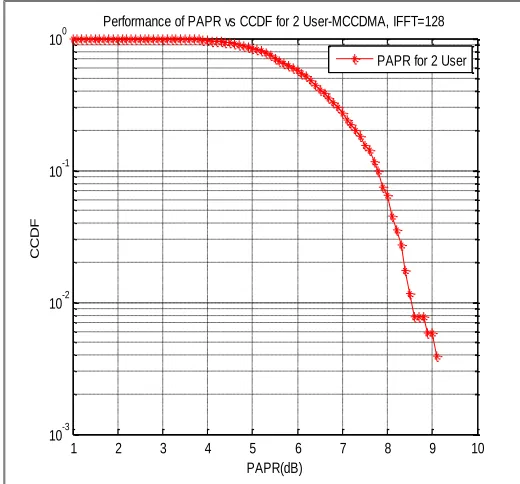
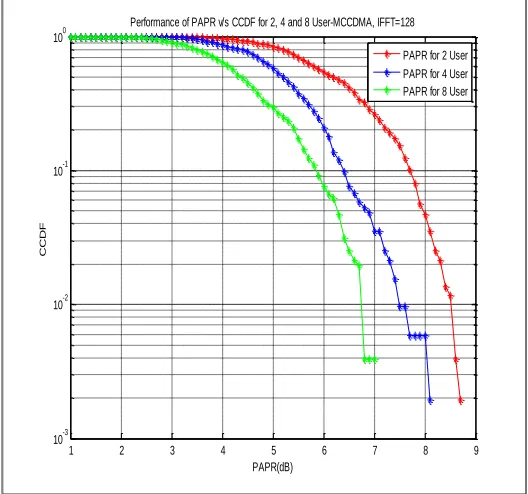
Figure 5, 6 and 7 shows the CCDF performance of MCCDMA system with respectively 2 user, 4 user and 8 user respectively and figure 8 shows compared curve for all users (2, 4 nd 8 users) MCCDMA with companding. The figure shows that when CCDF less than 10-3 in MCCDMA with the iterative method, the PAPR is reduced by 1dB (in user 2 to 4) and 0.6dB (in user 4 to 8).
Table. 1: Simulation Parameter Sr. No. Parameter Value
01 IFFT 128
02 OFDM symbol 512
03 No of Users 2, 4 and 8
04 Number of Bits 10-3
05 Modulation Techniques BPSK
06 Channel AWGN and Rayleigh
07 PAPR Calculations PAPR Versus CCDF
08 Cyclic Prefix T.(Add) & R. (Remove)
We are cosider in parameter in table1. In the transmiter side insert cyclic prefix and the reciver side remove cyclic prefix. And also cosider at the transmiter side IFFT and reciver side FFT, and midel term cosider AWGN and Rayleigh channel. The result is draw between CCDF versus PAPR with used Matlab Tool R2013a.
Fig. 5: Performance of MCCDMA for two users with IFFT=128
Fig. 6: Performance of MCCDMA for four users with IFFT=128
1 2 3 4 5 6 7 8 9 10
10-3
10-2
10-1
100
Performance of PAPR vs CCDF for 2 User-MCCDMA, IFFT=128
PAPR(dB)
CCDF
PAPR for 2 User
1 2 3 4 5 6 7 8 9
10-3 10-2 10-1 100
Performance of PAPR vs CCDF for 4 users-MCCDMA with IFFT=128
PAPR(dB)
CCDF
Int. J. of Engg. Sci. & Mgmt. (IJESM), Vol. 4, Issue 4:Oct.-Dec.: 2014, 160-165
Fig. 7: Performance of MCCDMA for Eight users with IFFT=128
Fig. 8: Performance of MCCDMA for two users with IFFT=128
VII.
CONCLUSION
MC-CDMA is an important multiple access candidate for 4G wireless communication system. The transmitted signal of an MC-CDMA system exhibits a very high peak-to-average power ratio (PAPR) when large numbers of sub-carriers are used. This
paper deals with PAPR reduction techniques for Multicarrier modulation transmission systems. We are observed that PAPR is increased by the number of users are increased. In future we are implement different modulation schemes and different fading channel are used and more improved our performance.
REFERENACES
[1] Gagandeep Kaur, Rajbir Kaur “An Overview of PAPR
Reduction Techniques for an MC-CDMA System” International
Journal of Advanced Research in Computer Engineering & Technology Volume 1, Issue 4, June 2012.
[2] S.Prabha, D.Meenakshi, N.R.Raajan “Impression of PAPR
Reduction Techniques in MC-CDMA” The International
Conference on Communication, Computing and Information Technology (ICCCMIT) 2012 pp 29-32.
[3] B.Sarala1 and D.S.Venkateswarulu2 B.N.Bhandari
“Overview of MCCDMA PAPR Reduction Techniques”
International Journal of Distributed and Parallel Systems (IJDPS) Vol.3, No.2, March 2012, pp 193-206.
[4] Jaswinder Kaur1, Komal Arora2, Gurjiwan Singh “PAPR
Reduction using Distortion and Non-Distortion Techniques in
MC-CDMA” IJCSCE Special issue on “Recent Advances in
Engineering & Technology” NCRAET-2013, pp 187-190. [5] ARMSTRONG, J., “Peak-to-average power reduction for
OFDM by repeated clipping and frequency domain filtering”,
Electronics Letters 28th February 2002, Vol.48, No. 5, pp. 246-247.
[6] R. V. Nee and R. Prasad, “OFDM for Wireless Multimedia
Communications,” Artech House Publishers, 2000.
[7] Muhammad Nadeem Khan, Sabir Ghauri, “The WiMAX
802.16e Physical Layer Model”, University of the West of
England, United Kingdom, ndm62 1 @hotmail.com,
[8] John G. Proakis “Digital Communication” International Edition 2001, McGraw-Hill Higher Education. pp 231-254 [9] Upen Dalal “Wireless Communication” Oxford University Press, fourth impression 2011. Pp 365-413, pp 591-631. [10] J. Armstrong, “Peak-to-average power reduction for
OFDM by repeated clipping and frequency domain filtering”
IEE Electronics Letters, vol. 48, pp. 246-247, February 2002.
1 2 3 4 5 6 7
10-3 10-2 10-1 100
PAPR vs CCDF for 8 users
papr(dB)
c
c
d
f
8 User
1 2 3 4 5 6 7 8 9
10-3 10-2 10-1 100
Performance of PAPR v/s CCDF for 2, 4 and 8 User-MCCDMA, IFFT=128
PAPR(dB)
CCDF