
ISSN (online): 2349-784X
Accelerometer Based Digital Pen for
Handwritten Digit Recognition
Miss. Veena Ravikiran Sarje
Department of Electronics and Telecommunication Engineering MGM’S College of Engineering, Nanded, Maharashtra India
Abstract
In this research we have planned Accelerometer based digital pen for handwritten digit recognition. In future it can be used for security purpose, Vehicle model analysis and Robotic application. This project work includes the status of hand written digits. On-line as well as offOn-line detection is included in this work. It consists of a 3D measuring instrument tool, Arduino Uno and zigbee module to collect accelerations of written digits. The popularity law includes acquisition of acceleration information, signal process, feature generation, feature selection and extraction. The rule is in use to convert time-series acceleration signals to desirable feature vectors. A pen mounted with measuring instrument signals are transferred to computer wirelessly for recognition. The kernel based class separability (KBCS) selects imperative options or features. The reduced options are sending to Linear Discriminative Analysis (LDA) to once more reduce dimension of feature house. Then for final recognition all the information is move to probabilistic neural network (PNN) for final recognition. Experimental outcome have with success valid recognition of numerical digits by digital pen. The system is predicated on AVR ATmega328P-PU microcontroller is integral on Arduino board, Zigbee and recognition algorithm. ADXL335 is employed to capture the motion data. The popularity rule familiar to settle for information from measuring system method and show the information. In future it can be used to detect hand gestures also. Keywords: Accelerometer, Microcontroller, handwritten Recognition Algorithm, kernel based class separability (KBCS), linear discriminate analysis (LDA), probabilistic neural network (PNN)
________________________________________________________________________________________________________ I. INTRODUCTION
Explosive increase of shrinking technologies in electronic circuits and elements it attenuated the dimension and weight of element, like mobile phones and hand-held computers and so created additional handy and convenient one. Attributable to the speedy development of technology, human-computer interface (HCI) techniques became an important part in our standard of living. Recently, a beautiful various, a conveyable device embedded with mechanical phenomenon sensors, has been projected to sense the activities of human and to capture his/her motion data from accelerations for recognizing handwritten digits. A significant advantage of mechanical phenomenon sensors for general motion sensing is that they will be operated with none external reference and restriction in operating environment. However, motion mechanical phenomenon recognition is comparatively sophisticated as results of totally different users have different speeds and designs to come up with numerous motion trajectories. Thus, several researchers have tried to slim down the matter domain for increasing the accuracy of handwriting recognition systems.
Recently, some researchers have targeting reducing the error of handwriting mechanical phenomenon reconstruction by manipulating acceleration signals. Users can use the pen to write digits or make hand gestures, and the accelerations of hand motions measured by the accelerometer are wirelessly transmitted to a computer for online trajectory recognition. In algorithm first extracts the time- and frequency-domain features from the acceleration signals and then, further identifies the most important features by a hybrid method: kernel-based class separability for selecting particular features and linear discriminant analysis for reducing the dimension of features. The reduced features are sent to a trained probabilistic neural network for recognition for final recognition [1].
Also dynamic time warping (DTW) based a accelerometer-based pen device implemented for online handwriting recognition applications. In this the accelerometer-based pen device consists of a triaxial accelerometer, a microcontroller, and an RF wireless transmission module. Users can hold the pen device to write numerals in air without space limitations.
The accelerations generated by hand motions are generated by the accelerometer embedded in the pen device, and are transmitted to a computer for further signal preprocessing via the wireless module. Subsequently, a dynamic time warping (DTW) algorithm is applied to align the accelerations and search class templates for each digit in the training stage.
Finally, the accelerations can be recognized via the alignment with the class templates in the testing stage. Also user-dependent and user in dependent recognition is performed [2].
to PC for recognition. In this process initially get the time domain and frequency domain features from pre-processed signal; later it performs linear discriminant analysis in order to represent features with reduced dimension. The dimensionally reduced features are processed with two classifiers State Vector Machine (SVM) and k-Nearest Neighbor (KNN) [3].
In this paper we propose an accelerometer-based digital pen. A microcontroller mounted on Arduino Uno board and a Zigbee module for sensing and collection co-ordinates of handwriting. The mechanical phenomenon recognition algorithmic rule includes the procedures of acceleration acquisition, signal processing, feature generation, feature choice and have extraction. The reduced options area unit sent to a trained probabilistic neural network (PNN) for recognition.
II.REVIEW OF LITERATURE
Jeen-Shing Wang and Fang-Chen Chuang introduced, An Accelerometer-Based Digital Pen with a Trajectory Recognition Algorithm for Handwritten Digit and Gesture Recognition. It consists of a tri-axial accelerometer, a microcontroller, and an RF wireless transmission module for sensing and collecting accelerations of handwriting and gesture trajectories. The recognition algorithm composes the procedures of acceleration acquisition, signal preprocessing, feature generation, feature selection, and feature extraction.
Users can use the pen to write digits or make hand gestures, and the accelerations of hand motions measured by the accelerometer are wirelessly transmitted to a computer for online trajectory recognition. The algorithm first extracts the features from acceleration signals and, then, further identifies the most important features by kernel-based class separability for selecting significant features and linear discriminate analysis for reducing the dimension of features. The reduced features are sent to a trained probabilistic neural network for recognition. This algorithm extracted the features from the accelerations, and then selected most important features using the kernel-based class separability (KBCS) and linear discriminate analysis (LDA). Finally, a probabilistic neural network (PNN) recognized the handwritten digits based on the reduced features and the recognition rate achieved at 98%. An Online Handwriting Recognition Using an Accelerometer-Based Pen Device is invented.
This work consists of a triaxial accelerometer, microcontroller and an RF wireless transmission module. Users can hold the pen device to write numerals in air. The accelerations generated by hand motions are embedded in the pen device, and transmitted to a personal computer for further signal preprocess via the wireless module. Subsequently, a dynamic time warping (DTW) algorithm is applied to align the accelerations and search class templates for each digit in the training stage. Finally, the accelerations can be recognized via the alignment with the class templates in the testing stage. The proposed automatic recognition algorithm consists of the following procedures: signal acquisition, signal preprocessing, and DTW recognizer.
Also an Analysis of Inertial Sensor Data Using Trajectory Recognition Algorithm is included in same research area. A digital pen based on IMU sensor for gesture and handwritten digit gesture trajectory recognition applications. Inertial measurement unit (IMU) sensors are based on multi axis combinations of precision gyroscopes, accelerometers, magnetometers, and pressure sensors. It allows human and Pc interaction. Handwriting Recognition is mainly used for applications in the field of security and authentication. By using embedded pen the user can make hand gesture or write a digit and also an alphabetical character. The embedded pen contains an inertial sensor, microcontroller and a Zigbee module for wireless transmitter to create handwriting and trajectories using gestures.
The trajectory recognition algorithm constitute the sensing signal attainment, pre-processing techniques, feature origination, feature extraction, classification technique. The user hand motion is measured using the sensor and the sensing information is wirelessly imparted to PC for recognition.
In this process initially extract the features from pre-processed signal. Later it performs linear discriminant analysis in order to represent features with reduced dimension.
The dimensionally reduced features are processed with two classifiers –State Vector Machine (SVM) and k-Nearest Neighbor (KNN). The proposed system involves the collection of the experimental data from the given experimental setup and then sending the data wirelessly using Zigbee transmission to the computer which consists of MATLAB software.
III. BLOCK DIAGRAM & CIRCUIT DIAGRAM
(IJSTE/ Volume 5 / Issue 1 / 017)
The block diagram of the proposed recognition algorithm consisting acceleration acquisition, signal pre-processing, feature generation, feature selection, and feature extraction is shown in Figure 4 .The motions for recognition include numeric digits. The acceleration signals of the hand motions are measured by a tri axial accelerometer and then pre-processed by filtering and normalization. Then, the features are extracted from the pre-processed data to represent the characteristics of different motion signals, and the feature selection process based on KBCS which picks p features out of the original 24 extracted features. To reduce the computational data and increase the recognition accuracy of the classifier, LDA is used to reduce the dimension of the selected features.
The reduced feature vectors are fed into a PNN classifier to recognize the motion to which the feature vector belongs. The detailed procedure of the proposed trajectory recognition algorithm as follows. The proposed trajectory recognition algorithm is explained in terms of block diagram as shown in fig-1.
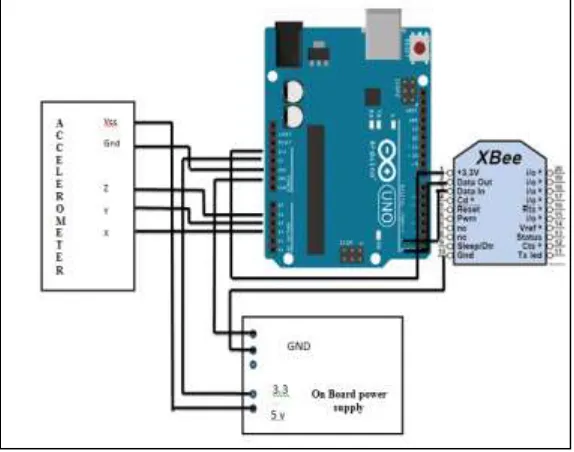
Fig. 2: Circuit diagram of digital pen
Digital pen consist of 3 measure hardware part. The circuit connections are shown in fig-5.
Mainly accelerometer, Aurduino Uno board and zigbee module is used. It required power supply of 5V as well as 3.3V. Here 3.3V power supply is required for accelerometer as well as zigbee module where as Aurduino Uno board required 5V and 3.3V power supply both. Accelerometer has 5 pins 1) VCC 2) GND 3) X-OUT 4) Y-OUT 5) Z-OUT. Whereas three output of accelerometer is connected to analog input of microcontroller. Here microcontroller is mounted on aurduino Uno board. Microcontroller converts analog signals coming from accelerometer into digital signals. The digital output of microcontroller is given to zigbee module’s DIN slot. DIN represent data input line. Zigbee transmitter transmits digital output from zigbee transmitter &
received at zigbee receiver.
IV. HARDWARE DESIGN FOR DIGITAL PEN
Our digital pen consists of a tri-axial measuring system (ADXL335), a micro-controller (Atmega328) and wireless transceiver. The tri-axial measuring system measures the acceleration signals generated by a user’s hand motion. The micro-controller collects the analog acceleration signals and converts the signals to digital ones via the A/D converter. The wireless transceiver transmits the acceleration signals wirelessly to a PC.
V.TRAJECTORY RECOGNITION ALGORITHM
The block diagram of the proposed trajectory recognition algorithm consisting of acceleration acquisition, signal preprocessing, feature generation, feature selection and feature extraction.
Signal Pre-Processing
The raw acceleration signals of hand motions square measure generated by the measuring device and picked up by the micro-controller. Due to attribute our hand perpetually trembles slightly whereas moving, that causes specific amount of noise. The signal preprocessing consists of activity, a moving average filter, a high-pass filter, and normalization. First, the accelerations are label to get rid of drift errors and offsets from the raw signals. The second step of the signal preprocessing is to use a moving average filter to cut back the high-frequency noise of the calibrated accelerations, and also the filter is expressed as
𝑦[t] =1
N∑ 𝑥(t + i)
𝑁−1
𝑖=1 ………. (1)
Where 𝑥[t]is that the sign, 𝑦[t] is that the sign and N is the number of points within the average filter. During this paper, we set N=8. The choice of victimization associate in nursing eight points moving average filter relies on our empirical tests. From our experimental results, we have a tendency to found that the perfect price of the moving average filter to attain the simplest recognition result’s eight. Then, we utilize a high-pass filter to get rid of the attractive force acceleration from the filtered acceleration to get accelerations caused by hand movement. In general, the scale of samples of every movement between quick and slow writers is completely different. Therefore, after filtering the info we have a tendency to first section every movement signal properly to extract the precise motion interval. Then we normalize every divided motion interval into equal sizes via interpolation. Once the preprocessing procedure is completed, the options may be extracted from the preprocessed acceleration signals.
Feature Generation
The characteristics of various hand movement signals may be obtained by extracting options from the preprocessed x-, y-, and coordinate axis signals, and that we extract eight options from the tri-axial acceleration signals, together with mean, STD, VAR, IQR, correlation between axes, MAD, RMS, and energy. They’re explicated as follows.
Mean:
The norm of the acceleration signals of every hand motion is that the dc element of the signal
Mean = 1
|W|∑ 𝑥𝑖
|W|
i=1 ………… (2)
Where, W is the length of each hand motion. STD:
STD is the square root of VAR
STD= √|W|−11 ∑|𝑊|𝑖=1(𝑥𝑖− 𝑚)2 ……. (3)
VAR
VAR= 1
|W|−1∑ (
|𝑊|
𝑖=1 𝑥𝑖− 𝑚)
2 ………. (4)
Where, 𝑥𝑖 is that the acceleration instance and 𝑚 is that the average of 𝑥𝑖.
IQR:
Once completely different categories have similar mean values, the inter quartile vary represents the dispersion of information and eliminates the influence of outliers within the data.
Correlation Among Axes:
The correlation among axes is computed because the quantitative relation of the co-variance to the merchandise of the STD for every combine of axes. as an example, the correlation 𝑐𝑜𝑣(𝑥, 𝑦)between 2 variables 𝑥 on coordinate axis and 𝑦 on coordinate axis is outlined as
Correlation(x, y)=𝑐𝑜𝑣(𝑥,𝑦)
𝜎𝑥𝜎𝑦 =
𝐸((𝑥−𝑚𝑥 )(𝑦−𝑚𝑦 ))
𝜎𝑥𝜎𝑦 ... (5)
Where, 𝐸 represents the arithmetic mean, 𝜎𝑥 and 𝜎𝑦 square measure STDs, and 𝑚𝑥 and 𝑚𝑦 square measure the expected values
of 𝑥 and 𝑦 severally. Correlation may be a helpful feature in discriminating motions that involve translation in precisely one dimension.
MAD (Mean Absolute Deviation)
MAD= 1
|W|∑ |
|𝑊|
𝑖=1 𝑥𝑖− 𝑚| ……….. (6)
RMS (Root Mean Squre)
Rms= √|W|1 xi2 ………. (7)
(IJSTE/ Volume 5 / Issue 1 / 017)
Energy:
Energy is calculated because the magnitudes of square Separate Quick Fourier rework (FFT) components of the signal during a window. The equation is follows as
Energy= 1
|W|∑ |
|W|
i=1 Fi|2 ………. (8)
Where, 𝐹𝑖 is that the ith FFT element of the window and 𝐹𝑖is that the magnitude of 𝐹𝑖
When the procedure of feature generation is completed, twenty four options are then generated. as a result of the quantity of the extracted options is massive, we tend to adopt KBCS to pick most helpful options so use LDA to scale back the size of options.
Feature Selection
Feature choice contains a range criterion and a groundwork strategy. The adopted choice criterion is that the KBCS. The KBCS are often computed as follows: Let (x, y) ∈ (Rd × Y) represents a sample, wherever Rd denotes a d-dimensional feature area, Y symbolizes the set of sophistication labels, and therefore the size of Y is that the range of sophistication c. This methodology comes the samples onto a kernel house, and m∅ i is outlined because the mean vector for the ith category within the kernel house, metallic element denotes the amount of samples within the ith category, m∅ denotes the mean vector for all categories within the kernel house, S∅B denotes the between-class scatter matrix within the kernel house, and S∅W denotes the within-class scatter matrix within the kernel house.
Let ∅(·) be a potential nonlinear mapping from the feature house Rd to a kernel house κ and tr(A) represents the trace of a matrix A. the subsequent 2 equations area unit employed in the category disconnection measure:
tr(Sϕ 𝐵 ) = 𝑡𝑟 ⌊𝑛𝑖 ∑(𝑚𝑖𝜙− 𝑚𝜙)(𝑚𝑖𝜙− 𝑚𝜙)𝑇 c 𝑖=1 ⌋ = ⌊ 𝑛𝑖∑ (𝑚𝑖𝜙− 𝑚𝜙)(𝑚𝑖𝜙− 𝑚𝜙)𝑇 c
𝑖=1 ⌋ ….
(9)
tr(Sϕ
𝑊 ) = 𝑡𝑟 ⌊∑ ∑ (𝜙(𝑋𝑖𝑗 ) − 𝑚𝑖𝜙 )(𝜙(X𝑖𝑗 ) − 𝑚𝑖𝜙 )𝑇
𝑛𝑖
𝑗=1 c
𝑖=1
⌋
=∑ ∑ (𝜙(X𝑖𝑗 ) − 𝑚𝑖𝜙 )𝑇 (𝜙(𝑋𝑖𝑗 ) − 𝑚𝑖𝜙 )
𝑛𝑖
𝑗=1 c
𝑖=1
…….(10)
The class disconnection within the kernel area are often measured as
Jϕ= 𝑡𝑟(Sϕ𝐵 )
𝑡𝑟(Sϕ𝑊 ) ………….. (11) To maintain the numerical stability within the maximization of Jϕ, the divisor 𝑡𝑟(Sϕ
𝑊 ) should be prevented from approaching
zero. So as to maximize category disjunction, we have a tendency to adopt the BIN because the search strategy. In the BIN, a variety criterion is severally applied to every of the options. The options with larger values of the given criteria area unit selected.
Feature Extraction
For pattern recognition issues, LDA is a good feature extraction (or spatiality reduction method) that uses a linear transformation to rework the initial feature sets into a lower dimensional feature area. the aim of LDA is to divide the information distribution in several categories and minimize the information distribution of constant category during anew area. First, 2 scatter matrices, a within-class scatter matrix compass point and a between-class scatter matrix SB, are introduced as follows: 𝑆𝑤𝑖= 1 𝑛𝑖 ∑ (𝑋𝑗 (𝑖) − 𝑚𝑖)(𝑋𝑗 (𝑖) − 𝑚𝑖)𝑇 𝑛𝑖 𝑗=1
𝑆𝑤 = 1
𝑛𝑖 ∑ 𝑛𝑖∗ 𝑆𝑤𝑖= ∑ ∑ (𝑋𝑗 (𝑖) − 𝑚𝑖)(𝑋𝑗(𝑖)− 𝑚𝑖)𝑇 𝑛𝑖 𝑗=1 𝑁 𝑖=1 𝑁 𝑖=1 …..(12)
(S𝐵 ) = ∑ 𝑛𝑖(𝑚𝑖− 𝑚𝑎𝑙𝑙)(𝑚𝑖− 𝑚𝑎𝑙𝑙)𝑇 c
𝑖=1 .. (13)
Where ni is that the number of samples within the ith category and x(i)j∈ Rd represents the jth sample of the ith category. d is that
the dimension of the feature area, and n and N area unit the entire numbers of the samples and categories, severally mi is that the mean of the ith category, and mall is that the mean of all categories. Note that SWi is that the variance matrix of the ith category, 𝑆𝑤
is that the total of the variance matrices, and S𝐵 is that the total of the square distances between the mean of every category and
therefore the means that of all categories.
The fundamental construct of LDA is to maximize the subsequent Fisher criterion to go looking for the foremost economical projection matrix 𝑤
J(W) = W𝑇 𝑆𝐵 W
W𝑇 𝑆𝑊 W ………… (14) Where W𝑇 𝑆
𝑊 W and W𝑇 𝑆𝐵 W are the new within-class scatter and between-class scatter within the new
used to maximize the quantitative relation of the between-class distance to the with at school distance. Note that x is that the original feature vector, and also the new feature vector y may be calculated by the equation y =WT x. In general, the optimum answer W in satisfies the subsequent equation:
𝑆𝐵 W = 𝜆𝑆𝑊 W ………….. (15)
If the inversion of point exists, W will be obtained by applying associate degree Eigen value decomposition of (S−1 W SB). Let k denotes the amount of categories for recognition. Since the between-class scatter matrix is that the summation of k rank-one matrices and solely k − one of them is freelance, there exist at the most k − one nonzero Eigen values. Consequently, the boundary of the dimension of options once reworking is k − one, that is, the columns of W square measure capable the Eigen vectors resembling the primary k-nonzero Eigen values. Once feature extraction these reduced options are fed into the PNN classifier to acknowledge completely different hand movements.
Classifier Construction
The PNN is certain to converge to a theorem classifier, and thus, it's an excellent potential for creating classification choices accurately and providing likelihood and responsibility measures for every classification. Additionally, the coaching procedure of the PNN solely desires one epoch to regulate the weights and biases of the specification. Therefore, the foremost necessary advantage of victimization the PNN is its high speed of learning. Typically, the PNN consists of Associate in Nursing input layer, a pattern layer, a summation layer, and a choice layer.
The operation of the neurons in every layer of the PNN is outlined as follows.
Fig. 4: Topology of a PNN classifier
Layer 1:
The primary layer is that the input layer, and this layer performs no computation. The neurons of this layer convey the input options x to the neurons of the second layer directly
𝑋 = [𝑥1 , 𝑥2, … . 𝑥𝑝] 𝑇
…… (16) Where, p is the number of the extracted features.
Layer 2:
The second layer is that the pattern layer, and also the variety of neurons during this layer is adequate NL. Once a pattern vector x from the input layer arrives, the output of the neurons of the pattern layer is calculated as follows:
𝜓𝑘𝑖(𝑥) = 1
(2𝜋)𝑑/2 σ𝑑 𝑒𝑥𝑝 (−
(𝑥−𝑥𝑘𝑖)(𝑥−𝑥𝑘𝑖)𝑇
2σ2 ) (17)
Where, 𝑥𝑘𝑖 is that the somatic cell vector, σ could be a smoothing parameter, d is that the dimension of the pattern vector x, and
ϕki is the output of the pattern layer. Layer 3:
(IJSTE/ Volume 5 / Issue 1 / 017)
𝑝𝑘(𝑥) = 1
(2𝜋)𝑑/2 σ𝑑
1
𝑁𝑖 𝑒𝑥𝑝 (−
(𝑥−𝑥𝑘𝑖)(𝑥−𝑥𝑘𝑖)𝑇
2σ2 ) ..….. (18) Where, 𝑁𝑖is the total number of samples in the kth neuron
Layer 4:
The fourth layer is the decision layer
𝑐(𝑥) = arg max{𝑝𝑘(x)}, 𝑘 = 1,2, … … 𝑚 …… (19)
Where, m denotes the amount of categories within the coaching samples and c(x) is that the calculable category of the pattern x.
In this paper, the output of the PNN is pictured because the label of the specified outcome outlined by users. as an example, in our written digit recognition, the labels ‘1’, ‘2’, ‘3’, ‘4’, ‘5’, ‘6’, ‘7’, ‘8’, ‘9’, and ‘10’ area unit wont to represent handwriting digits one, 2, . . ., 9, and 0, severally.
VI. RESULT
This section describes the conducted experiments, evaluates and compares the technique. In this part, the effectiveness of recognition algorithm was validated by handwritten digit recognition. The proposed trajectory recognition algorithm consists of acceleration acquisition, signal preprocessing, feature generation, feature selection, and feature extraction. We have generated ten sample files for each digit with different writing style. Used different combinations of feature selection, extraction methods and employed PNN to recognize handwritten digits. Also ANN classifier is used to recognize handwritten digits.
Handwritten Digit Recognition
We have generated 10 samples of acceleration signals for each digit in .txt format using Ardiuno Uno software. We can use more than 10 samples as well. Then .txt format of each digit is converted in.xls format using MATLAB. The acceleration signals acquired from the pen-type accelerometer module with X, Y and Z coordinates. Subsequently, the acceleration signals were filtered via the moving average filter to reduce the high-frequency noise. Finally, the gravitational acceleration was removed from the filtered acceleration signals using a high-pass filter to obtain accelerations caused by hand movement. With the preprocessed accelerations, 24 features are generated by the feature generation procedure. Then, KBCS was adopted to choose characteristic features from the generated features. We choose digits 1 and 8 to illustrate the effectiveness of the KBCS. Whereas we tried to recognize final output digit using two different methods: online and offline. In online recognition method user should have generate hand motion acceleration signals, process it and finally display output comparing with database.
In offline recognition method select data file which is already saved in database. So it will improve accuracy and recognition rate.
Recognition rate
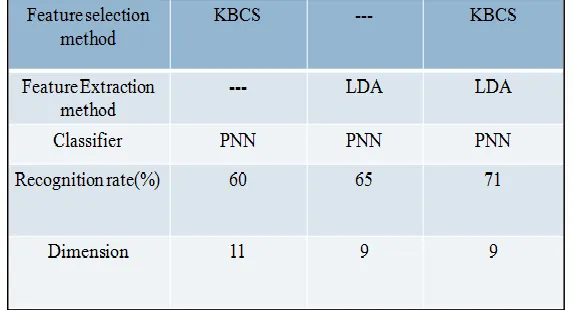
Table 1 includes how recognition rate improves with different combinations of feature selection, feature extraction & classifier method.
Table – 1
Recognition rate for different combinations of feature Selection and Extraction Method for online recognition.
Here, KBCS is used to select feature generated. KBCS has selected those feature which helps to recognize accurate result. In fist case we used KBCS and PNN classifier hence we got recognition rate is 60% with ‘11’ dimension of selected feature.
If second case KBCS is skipped LDA and PNN is used directly after feature generation so we got recognition rate 65% with ‘9’ feature selected in terms of dimension.
Table – 2
Recognition rate for different combinations of feature Selection and Extraction Method for offline recognition.
With KBCS and PNN classifier the accuracy rate is 85%. Here KBCS is used to select ‘11’ features and PNN is used to give final output.
In second column only LDA is used directly with skipping KBCS for feature selection. So LDA is extracted ‘9’ features and send to PNN classifier for final result with 90% accuracy. Finally with KBCS, LDA and PNN got 100% recognition rate.
We performed pattern recognition online as well as offline. We can also call as user dependent and user independent recognition method. In user dependent method, user can draw any digit in air, and then sensed raw data (with procedure) is compared with data base. After that those having highest probability it displayed as output digit. In case of used independent type we selected the data which is already available in our data base. So finally output displayed with highest probability using PNN classifier. In used in dependent type we got 100% probability.
The chart 3 gives information about calculation of online recognition rate with ‘100’ samples. Total numbers are ‘10’ and each having ‘10’ files.
Table – 3 Offline Confusion matrix
The confusion matrix depends on hand writing style of each person. In this project we have used 100 samples. Finally the result is displayed using PNN classifier. PNN is probabilistic neural network classifier.
Here query generated by user is proceed using KBCS and LDA, hence reduced or selective data transmitted to PNN classifier to identifies most closest feature from database. Finally result is displayed with highest probability.
Graphs for Digit ‘1’ and ‘8’
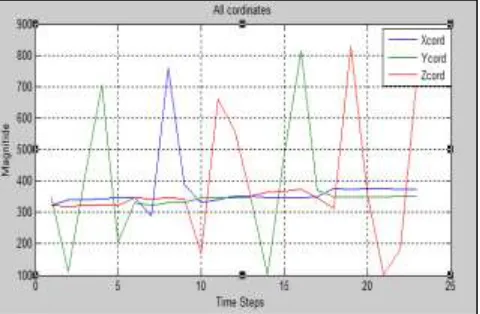
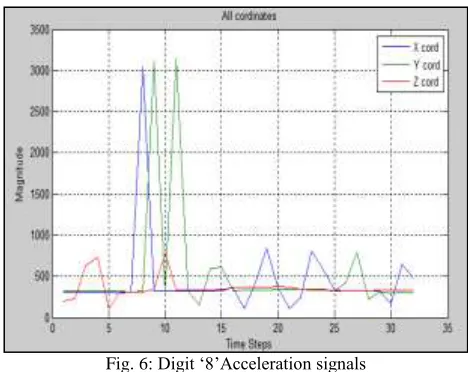
Fig 5 and Fig 6 shows X, Y and Z coordinates captured by accelerometer sensor and pre processed. X, Y and Z coordinator’s count depends on how much time is required to draw digit.
(IJSTE/ Volume 5 / Issue 1 / 017)
Fig. 6: Digit ‘8’Acceleration signals
In graphs there are three different waves are shown with different colors, X with blue, Y with green and Z with red.
Fig. 7: Digit ‘1’moving average filtered signals
Fig. 8: Digit ‘8’moving average filtered signals
Fig 7 and fig 8 shows behaviour of moving average filtered signal. In moving average filter the window of ‘8’ is used. The average is taken of sequential ‘8’ numbers in the form of moving window.
Fig. 9: Digit ‘1’ High pass filtered signal
Fig. 10: Digit ‘8’ High pass filtered signals
In this experiment, the STD and VAR features are not selected in the final reduced feature set because they are similar in nature. For the easy computation of feature selection these can be discarded from the set of features.
1 2 3 4 5 6 7 8 9 0
Fig. 11: Pictorial Numerical Digits [1]
From original set of features 11 significant features includes from 24 features by the KBCS. Finally, the dimension of the selected features was further reduced to 9 by the LDA for increasing the accuracy of classification. We have adopted the leave-one-out cross validation method to evaluate the recognition performance of the PNN.
VII. CONCLUSION
This work has conferred a scientific trajectory recognition algorithm framework which will construct effective classifiers for acceleration-based handwriting and gesture recognition. The proposed trajectory recognition algorithmic program capable of acceleration data acquisition, signal preprocessing, feature generation, feature selection and feature extraction with the help of LDA. Extracted features which are logically reduced data on which PNN is quickly trained as an efficient classifier.
(IJSTE/ Volume 5 / Issue 1 / 017)
REFERENCES
[1] Jeen-Shing Wang, Member, IEEE, and Fang-Chen Chuang “An Accelerometer-Based Digital Pen with a Trajectory Recognition Algorithm for Handwritten Digit and Gesture Recognition”, IEEE transactions on industrial electronics, vol. 59, no. 7, july 2012
[2] Jeen-Shing Wang, Yu-Liang Hsu,Cheng-Ling Chu “Online Handwriting Recognition Using an Accelerometer-Based Pen Device”, 2nd International Conference on Advances in Computer Science and Engineering (CSE 2013)
[3] Nagadeepa.Ch., Dr.N.Balaji and Dr.V.Padmaja “Analysis of Inertial sensor data using trajectory recognition algorithm”, International Journal on Cybernetics & Informatics (IJCI) Vol. 5, No. 4, August 2016
[4] Lei Wang, Kap Luk Chan “Learning Kernel Parameters by using Class Separability Measure”.
[5] International Journal on Cybernetics & Informatics (IJCI) Vol. 5, No. 4, August 2016, “ANN for Gesture Recognition using Accelerometer Data”, The 2012 Ibero american Conference on Electronics Engineering and Computer Science.
[6] Ahmad Akl, Student Member, IEEE, Chen Feng, Student Member “A Novel Accelerometer-Based Gesture Recognition System”, IEEE transactions on signal processing, vol. 59, no. 12, December 2011
[7] Yu-Liang Hsu, Cheng-Ling Chu, Yi-Ju Tsai, and Jeen-Shing Wang, “An Inertial Pen With Dynamic Time Warping Recognizer for Handwriting and Gesture Recognition” , IEEE sensors journal, vol. 15, no. 1, January 2015
[8] Nandini, G. Bhaskar Phani Ram (Asst. professor) “A Digital Pen with a Trajectory Recognition Algorithm” IOSR Journal of Electronics and Communication Engineering (IOSR-JECE)

![Fig. 11: Pictorial Numerical Digits [1]](https://thumb-us.123doks.com/thumbv2/123dok_us/1998102.1659428/10.612.183.428.46.429/fig-pictorial-numerical-digits.webp)
