International Journal of Innovative Technology and Exploring Engineering (IJITEE) ISSN: 2278-3075,Volume-8 Issue-12, October 2019
Abstract: This paper presents an overview of feature extraction methods for off-line recognition of segmented (isolated) digit/chratchter. Selection of a feature extraction method is probably the single most important factor in achieving high recognition performance in character recognition systems. Different feature extraction methods are designed for different representations of the digit/characters, such as solid binary characters, skeletons (thinned digit /characters), or gray level sub images of each individual character. Latest research in this area has been able to grown some new methodologies to overcome the complexity of Guajarati digit writing style. The recognition of handwritten digits which are written in proper way to easily readable. The problem is human can write digit in different styles so it is not identified by the computer but the some feature extraction methodologies like end point, junction point; straight lines etc. For features identification and character classification studied different algorithm and technique.
Keywords: Character Features Extraction, Digit Recognition, End Point, Junction Point, Classification of Digit.
I. INTRODUCTION
Optical character recognition refers to the branch of computer science that involves reading text from paper and translating the images into a form that the computer can manipulate (for example, into ASCII codes). More recently, the term Intelligent Character Recognition (ICR) has been used to describe the process of interpreting image data, in particular alphanumeric text. Forms containing characters images can be scanned through scanner and then recognition engine of the OCR system interpret the images and turn images of handwritten or printed characters into ASCII data (machine-readable characters). [14] Therefore, OCR allows users to quickly automate data capture from forms, eliminate keystrokes to reduce data entry costs and still maintain the high level of accuracy required in forms processing applications. The technology provides a complete form processing and documents capture solution. Usually, OCR uses a modular architecture that is open, scalable and workflow controlled. It includes forms definition, scanning, image pre-processing, and recognition capabilities. [16] The OCR challenges, first is layout detection like small fonts,
Revised Manuscript Received on October 05, 2019.
Mr. Abhishek Mehta, Parul Institute of Computer Application, Parul University, Vadodara and Calorx Teachers’’ University, Computer Science Department, Ahmadabad, India. Email: [email protected]
Dr. Ashish Chaturvedi, Calorx Teachers’’ University, Computer Science Department, Ahmadabad, India. Email: [email protected]
Mr. Dharmendrasinh Rathod, Parul Institute of Computer Application,
Parul University, Vadodara, India. Email:
curves types fonts, second is text type like broken character, chratchter mixed
with noise, characters in old documents that are not available in modern computer fonts, third is language issues like Historically spelling was not unified and consequently there are many different writing variants. Current most of the research is based on to identify the isolated, word, phrases, or the entire document. The Indian scripts are a composition of the constituent symbols in two dimensions. [18] In conventional Research, first the segmentation process is applied to word so that’s the word is segmented into its composite characters. A lot of research is still needed for word, sentence and document recognition, its semantics and lexicon. Gujarati is a regional language of state Gujarat in India. Gujarati characters are having different shapes and it’s very difficult to recognize that shapes. Gujarati Handwritten characters recognition is very difficult because it depends on various persons and their writing styles.[13] The main focus of the handwritten digit recognition from image. Handwritten digit recognition is an active topic in OCR applications and pattern classification/learning research. In OCR applications, digit recognition is dealt with in postal mail sorting, bank check processing, form data entry, etc. For these applications, the performance (accuracy and speed) of digit recognition is crucial to the overall performance. Digit recognition is work on template matching techniques were used for machine printed digit recognition.[18]
II. LITERATURE REVIEW
The term Intelligent Character Recognition (ICR) has been used to describe the process of interpreting image data, in particular alphanumeric text. So different method is used for Guajarati hand written digit recognition from image that methods are as follow:
1.Hand Written Digit Recognition Using Special Point: Extraordinary focuses in Image Processing, for example,
endpoints and intersection focuses are recognized while looking over and putting away diminished picture in lattice form.[1] They are characterized as focuses vertically, on a level plane, or askew associated with individually a couple of pixels of the diminished picture The End point is characterized as just a single of the eight
neighbors
as a "1s" and which "E" denotes.[1]Handwritten Digit Recognition from Digital
Image
The intersection point is characterized as pixel which has more than two "1s" among the eight
neighbors
. Be that as it may, this is getting numerous undesired intersection focuses, so we applying condition more than two "1s" as its twoneighbors
, the number 0 to 1 and 1 to 0 changes in the eight [image:2.595.75.269.176.310.2]neighborhoods
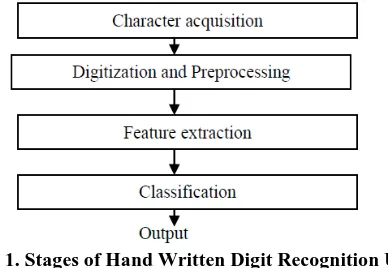
of pixel ought to be morenoteworthy than or equivalent to six. "J" means the intersection point. The two highlights, for example, end focuses and intersection point are utilized in arrangement stage.[1]Figure 1. Stages of Hand Written Digit Recognition Using Special Point
[image:2.595.313.543.255.382.2]The initial phase in this procedure is to obtain manually written numeral characters by scanner at 300 dpi. That yielded a twofold picture which in this manner put away in compacted position in memory.[1] In pre-handling the primer advances incorporate standardization, digitization and diminishing. It is critical to separate highlights so that the acknowledgment of various numerals ends up less demanding based on the individual highlights of every numeral. Highlight separated extraordinary purposes of digitized picture. Characterization is the vital stag for numeral character acknowledgment. The separated highlights extraordinary focuses are utilized to distinguish numeral. Having extricated the highlights, it is required to store them in some structure. Each example ought to interestingly distinguish a character and each character may speak to by a few particular examples. Lastly those digits are store in one content document like scratch pad, word record. Favorable position of this technique is fast, responsive and regular, less memory prerequisite. Inconvenience of this strategy is Application is just that specific digit like 3, 2 etc.[1]. The output of this method is recognition rates (in percentage) of handwritten numeral characters are as follow:
Figure 2. Result of recognition rates of handwritten numeral characters using special point
2. Handwritten Digit Recognition Using Image Processing and Neural Network:
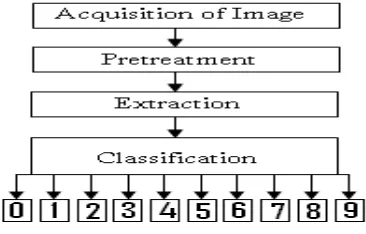
At the point when the reasonable structures have been physically filled by different people by then channel these structures with the help of scanner. So now we have pictures of hand making tries out of digits [2]. By and by possible to recognize the significance of any physically composed digit with the help of AI engine. [2] So now at whatever point any physically composed digit will be given as test commitment to the structure, the yield show will normally give the digit who's relating match regard is recognized. The above strategy is a diagram of human abstract thinking system. Neural framework is used anyway the digits are expelling from picture and store in to database the course of action technique is used. The stages of recognition using neural network are as follow:
Figure 3. Process of Hand Written Digit Recognition Using Neural Network
[image:2.595.69.273.578.725.2]International Journal of Innovative Technology and Exploring Engineering (IJITEE) ISSN: 2278-3075,Volume-8 Issue-12, October 2019
Figure 4. Result of recognition of handwritten numeral characters using Neural Network
3. Handwritten Digit Recognition Tested on the MNIST Database:
The neural systems are generally utilized for the acknowledgment for which angle calculation is utilized. It is principally partitioned into three layers:
1.The first layer relates to the retina implies it coordinates the info picture [3].
2.The second layer (concealed layer) relates to the extraction of qualities subsystems [3].
3.The third layer relates to the yield framework.
[image:3.595.80.263.535.652.2]Every neuron in this layer relates to one of the yield classes [3]. The process of the recognition digit using MNIST is as follow:
Figure 5. Process of Hand Written Digit Recognition Using MNIST Database
This method is describing the different detection and extraction digit in different zone. Three zones are there in these methods that are as follow:
A.Extraction of East Characteristic Zone:
A point of the picture has a place with the East trademark zone if and just if: This point does not have a place with the item (the white pixels in picture). Starting here, moving in a straight line toward the East, we don't cross the item. Starting here, moving in a straight line toward the south, north and west one crosses the item [3].
Figure 6. Extract the Digit East Characteristic Zone
(EZ)
B.Extraction of West Characteristic Zone:
A point of the picture has a place with the West trademark zone if and just if: This point does not have a place with the article (the white pixels in picture). Starting here, moving in a straight line toward the West, we don't cross the item. Starting here, moving in a straight line toward the south, north and East one crosses the item [3].
Figure 7. Extract the Digit West Characteristic Zone
(WZ)
C.Extraction of the Central Characteristic Zone:
A point of the picture has a place with the Central trademark zone if and just if: This point does not have a place with the breaking point of the item. Starting here, moving in a straight line toward the South, North, East and West we cross the article [3].
Figure 8.Central Characteristic Zone (CZ)
Figure 9.Digit Two after Surround and its Characteristic Zones
Figure 10.Digit Two after Surround and its Characteristic Zones
4.Feature Extraction based on DCT for Handwritten Digit Recognition:
Highlight extraction is a significant and testing venture in many example acknowledgment issues and particularly in written by hand digit acknowledgment applications [4]. Be that as it may, the extraction of the most enlightening highlights with profoundly biased capacity to improve the order precision and diminish multifaceted nature stays a standout amongst the most essential issues for this errand. The goal of this work is to recognize the ideal element extraction approach that accelerate the learning calculations while expanding the arrangement precision [4]. The database held for this work is the MNIST dataset that we will depict in more subtleties in the following segment [4].
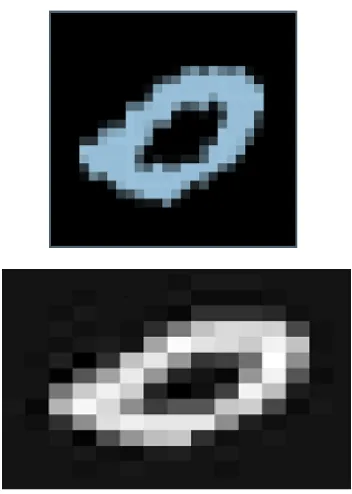
Figure 11. Simple Database for MNIST
DCT at first utilized for picture pressure, have been of developing enthusiasm among the example acknowledgment network [4]. DCT is a procedure to change over information of the picture into its basic recurrence parts. In this work we explore the viability of DCT highlights for transcribed digit acknowledgment. Consequently, we look at the execution of four variations of DCT coefficients specifically:
1. upper left corner (ULC) coefficients [4]. 2. DCT zigzag coefficients [4].
3. Block based DCT ULC coefficients[7]. 4. Block based DCT zigzag coefficients[7].
[image:4.595.329.534.51.169.2]
Figure 12. Example Of Initial Image 28*28 and Image reconstructed with only 15x15 DCT ULC coefficients
Figure 13. Selecting DCT coefficients in a zigzag fashion
So, Extraction based on DCT for Handwritten Digit Recognition the Discrete Cosine Transform (DCT) technique used for classification. The advantage is that maximizing the classification accuracy and disadvantages is that more time requires [9].
[image:4.595.72.278.225.305.2]III. COMPARISON TABLE OF ABOVE METHODS
Table- I: Comparison table of recognition methods
No Title Methodology Pros Cons
1 Hand
Written Digit recognition using pints
Junction point and endpoint Fast, responsive and natural, less memory requirement Applicati on is only that particular digit like 3
2 Hand
Witten Digit recognition using image processing and neural network Classification technique Highest accuracy and most natural different style digit recognition Require more memory because different style digit are stored.
3 Hand
Written Digit Recognitio n using MNIST Database
North, east, west style of digit recognition Most natural recognition Large database of different units Like MNIST database store different side for digit like north, east, west. More memory require
5 Feature
[image:4.595.91.267.470.717.2]International Journal of Innovative Technology and Exploring Engineering (IJITEE) ISSN: 2278-3075,Volume-8 Issue-12, October 2019
IV. CONCLUSION
Gujarati Handwritten digit acknowledgment in computerized pictures is a testing issue because of contrasts in size, style, introduction, and arrangement, just as low picture differentiation and complex foundation. Discover a totally hearty and summed up method for digit acknowledgment; it is hard to give proper contribution to the optical character acknowledgment (OCR) framework. Numerous calculations have been proposed for perceiving content information in a picture. Every strategy gives hearty outcomes for determined arrangement of pictures. We utilized after technique for digit extraction: picture pre-handling, Segmentation and limitation, highlight Extraction, and grouping.
REFERENCES
1. K.V vaghela, N.P Patel, International Journal of Innovative Research
in Science, Engineering and Technology, Automatic Text Detection Using Morphological Oerations and Inpainting, Volume 2, Issue 5, May 2013, ISSN: 0219-8753, P.P.No- 1333-1336.
2. D.S Sharma, D.G Gupta, International Journal of Computer
Applications, Isolated Handwritten Digit Recognition using Adaptive Unsupervised Incremental Learning Technique, Volume 7, Issue 4, September 2010, ISSN: 0975 – 8887, P.P.No- 27-33.
3. P. P. Chaudhari, K.R. Sarode, International Journal of Advanced Research in Computer Science and Software Engineering, Handwritten Digits Recognition Special point, Volume 4, Issue 3,March 2014, ISSN:2277-128X, P.P.No- 1467-1470.
4. P.A Agarwal, R.V Varna, International Journal of Innovative Research
in Science, Engineering and Technology, Text Extraction from Images, Volume 2, Issue 4,April 2012, ISSN:2231-0711, P.P.No- 1083-1087. 5. S.T Tehsin, A.M Masood and S.P Kausar, International Journal of
Image, Graphics and Signal Processing, Survey of Region-Based Text Extraction Techniques for Efficient Indexing of Image/Video Retrieval, , Volume 5, Issue 3,November 2014, ISSN:2567-2568, P.P.No- 53-64.
6. A.A Andhale, P.R Yeolekar, International Journal of Computer Technology & Applications, Survey on Optimized solution for efficient detection of Text from images, Volume 5, Issue 6,September 2013, ISSN:2229-6093, P.P.No- 1950-1954.
7. Faisal Tehseen Shah, K.Y Yousaf, International Journal of Proceedings
of the World Congress on Engine, Handwritten Digit Recognition Using Image Processingand Neural Networks, Volume 1, Issue 4,July2007, ISSN:2290-2293, P.P.No- 5-7.
8. G.L patel, H.G Zhang, , International Journal of Computer Technology
& Applications, A new Feature ExtractionMethod Based on Fourier Transform in Handwriting Digits Recognition, Volume 7, Issue 5,Jun 2013, ISSN:2278-2279, P.P.No- 1245-1250.
9. "Gujarati language - wikipedia," 16 February 2017. [Online]. Available: https://en.wikipedia.org/wiki/Gujarati_language.
10. "Tesseract OCR GitHub," 16 02 2017. [Online]. Available: https://github.com/tesseract-ocr.
11. M. A. Hasnat, M. R. Chowdhury, M. Khan and others, "Integrating Bangla script recognition support in Tesseract OCR," BRAC University, 2009.
12. N. Mishra, C. Patvardhan, V. C. Lakshimi and S. Singh, "Shirorekha Chopping Integrated Tesseract OCR Engine for Enhanced Hindi
Language Recognition," International Journal of Computer
Applications, vol. 39, no. 6, pp. 19-23, 2012.
13. C. Patel, A. Patel and D. Patel, "Optical character recognition by open source OCR tool tesseract: A case study," International Journal of Computer Applications, vol. 55, no. 10, 2012.
14. R. Smith, "An overview of the Tesseract OCR engine," Document Analysis and Recognition, 2007. ICDAR 2007. Ninth International Conference on, vol. 2, pp. 629-633, 2007.
15. Thien M. Ha and H. Bunke, “Image Processing Methods for Document
Image Analysis”, In: Handbook of Character Recognition and Document Image Analysis, pp.1-47, 1997.
16. Ulrich and Jurgen, “Pattern Classification Techniques Base on
Function Approximation”, In: Handbook of Character Recognition and Document Image Analysis, World Scientific Publishing Company, pp.
Handwriting Recognition, World Scientific Publications, pp. 19-28, 1997.
18. G. Rigoll, A. Kosmala, and D. Willet, “A Systematic Comparison of
Advanced Modeling Techniques For Very Large Vocabulary On-line Cursive Handwriting Recognition”, In: Advances in Handwriting Recognition, World Scientific Publications, pp. 69- 78., 1997. 19. Kam-Faichan and Dit-Yan Yeung, “A Simple Yet Robust Structural
Approach For On-line Handwritten Alphanumeric Character Recognition”, In: Advances in Handwriting Recognition, World Scientific Publications, pp. 39- 48, 1997.
20. Y. LeCun, B. Boaer, J. S. Denker, D. Henderson, R. E. Howard, W. Hubbard, and L. D. Jackel, “Handwritten zip code recognition with multilayer networks,” International Conference on Pattern Recognition, 1990, pp. 35-44.
21. K. Fukushlma, T. Imagawa, and E. Ashida, “Character recognition with
selective attention ,“ 1991 International Joint Conference on Neural Networks (I), pp. 593-598.
22. neocognitron,” IEEE 11-mw. on Neurral Networks, Vol. 2, No. 3, May
1991, pp. 355-365.
23. W. H. Joerding and J. L. Meador, “Encoding a priori information in
feedforward networks,” Neural Networks, Vol. 4, No. 6, December 1991, pp. 847-856.
24. J. S. N. Jean and J. Wang, „Weight smoothing to improve network generalization,” to appear in IEEE tins. On Neural Networks.
25. J. Wang and J. S. N. Jean, “Multirexolution neural work for omni font
character recognition, “submitted to 1999 IEEE International Conference on Neural Networks.
26. A. Rajavelu, M. T. Muaavi, and M. V. Shirvaikar, “A neural network
approach to character recognition,” Neuml Networks, Vol. 2, No. 5, 1989, pp. 387-389.
AUTHORS PROFILE
Mr. Abhishek Mehta is working as an Assistant Professor in Parul Institute of Engineering and Technology. He has 5 years and 10 months of teaching experience. His basic qualification is BCA (Computer Science) from Veer Narmad South Gujarat University & MCA from Shrimad Rajchandra Institute of Management and Computer Application, Uka Tarsadia University. Presently I was undertaken doctoral (PhD) in Calorx Teachers’ University, Ahmadabad on Emerging Technology of Image Processing and Natural Language Processing. A part from that Digital Image Processing, Natural Language Processing, Artificial Intelligence, Source Code Management, Information Systems is the area of interest of his research where could prepare a system that use in educational area. I had published 5 + research papers/ review papers in international journal as well as present 2+ research/ review paper in national/ international conference and I had attended 15+ seminars and workshops.
Dr. Ashish Chaturvedi is working as Professor in Computer Science Department in Calorx Teachers’ University. He was published 25 + research papers/ review papers in international journal as well as present 10+ research/ review paper in national/ international conference and attended 30+ seminars and workshops. He also received many awards and achievements.