ISSN (Online): 2320-9364, ISSN (Print): 2320-9356
www.ijres.org Volume 5 Issue 10 ǁ October. 2017 ǁ PP. 17-22
Numerical Modeling to Determine the Mechanical Behavior of
Polyurethane Foams
1*
Duong Pham Tuong Minh,
2Luong Viet Dung
*Faculty of Mechanical Engineering Thai Nguyen University of Technology, Vietnam *Corresponding author: *Duong Pham Tuong Minh
ABSTRACT:
The objective of this paper is to establish a numerical model for a Representative Volume Element (RVE) and perform calculations by using the finite element method (Abaqus) to determine the static behavior of polyurethane foams. The influence of the porosity, size, shape and aperture of bubbles on the static behavior of polyurethane foams was taken into account in this study. This model was validated by comparing the analytical results with the simulation results using Abaqus software for the static behavior in compression. We will use this model to homogenize a macroscopic volume of foam and obtain an equivalent homogeneous solid.Keywords:
Foam, Material, Cellular, Modelling, Simulation--- Date of Submission: 29-09-2017 Date of acceptance: 10-10-2017 ---
I.
INTRODUCTION
Polyurethane foams are widely used to manufacture soundproofing parts of car. It is important to study their mechanical behavior to improve their acoustic performance. The behavior of the foams depends on the polyurethane material, the porosity of foam, and form of bubbles in opened cell foams. Tension, compression and impact properties of a polyurethane foam have been measured as a function of foam density. Significant differences in the behavior of the foam were observed depending on the mode of testing. The power-law relationship for the modulus was the same for both tension and compression testing because of the elastic compliance of the cellular structure of the foam using a simple geometric model. For closed-cell cellular materials, they exhibit several interesting properties but these properties are very difficult to simulate and understand. This problem is mostly due to the highly complex organization of the cells and to their very fine walls.
Several studies have focused on the microstructure of the walls and its influence on mechanical properties [1-6]. X-ray tomography is used to create the model 3D and non-destructive visualization of the studied materials at the scale of their cellular microstructure. The simulations have been done on the same structure with 3D elements with a depth chosen equal to the thickness in order to represent beams with square sections and use cubic elements [1]. The initial microstructure and local deformation mechanisms of a polyurethane foam during a compression test are investigated by means of X-ray micro-tomography. The validation of the modelling procedure is performed in relation to the macroscopic mechanical response as well as to the local deformation mechanisms observed during the experiments [2-3].
This paper describes a procedure to produce the RVE model in Abaqus software. The proposed model has thearchitecture of closed-cell cellular solids as seen in tomography. The method is enriched by the fact that the thickness value of each element is measured in the tomographic image.
II.
PRESENT
THE
MODEL
IN
ABAQUS
2.1. Spherical cellule model
Fig 1.Dimension (left)and arrangement (right)of spherical cells
Table 1.The parameters of spherical model
Model number D (mm) t (mm) Model number D (mm) t (mm)
N01 0.08 0.0800 N13 0.10 0.0100
N02 0.08 0.0500 N14 0.10 0.0050
N03 0.08 0.0300 N15 0.10 0.0010
N04 0.08 0.0200 N16 0.10 0.0005
N05 0.08 0.0100 N17 0.12 0.0800
N06 0.08 0.0050 N18 0.12 0.0500
N07 0.08 0.0010 N19 0.12 0.0300
N08 0.08 0.0005 N20 0.12 0.0200
N09 0.10 0.0800 N21 0.12 0.0100
N10 0.10 0.0500 N22 0.12 0.0050
N11 0.10 0.0300 N23 0.12 0.0010
N12 0.10 0.0200 N24 0.12 0.0005
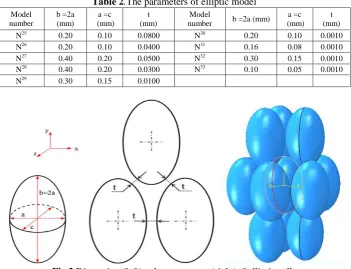
2.2 Elliptic cellule model 2.1.1Case 1: b=2a, c=a
This case is shown in Fig. 2. The values used for the parametric studies are shown in Table 2
Table 2.The parameters of elliptic model
Model number
b =2a (mm)
a =c (mm)
t (mm)
Model
number b =2a (mm) a =c (mm)
t (mm) N25 0.20 0.10 0.0800 N30 0.20 0.10 0.0010 N26 0.20 0.10 0.0400 N31 0.16 0.08 0.0010 N27 0.40 0.20 0.0500 N32 0.30 0.15 0.0010 N28 0.40 0.20 0.0300 N33 0.10 0.05 0.0010 N29 0.30 0.15 0.0100
Fig 2.Dimension (left)and arrangement (right)of elliptic cells
2.1.2Case 2 : a =2b=2c
Fig 3.Dimension (left)and arrangement (right)of elliptic cells
Table3.The parameters of elliptic model
Model number
b =2a (mm)
a =c (mm)
t (mm)
Model
number b =2a (mm)
a =c (mm)
t (mm)
N34 0.20 0.10 0.0800 N39 0.20 0.10 0.0010
N35 0.20 0.10 0.0400 N40 0.16 0.08 0.0010
N36 0.40 0.20 0.0500 N41 0.30 0.15 0.0010
N37 0.40 0.20 0.0300 N42 0.10 0.05 0.0010
N38 0.30 0.15 0.0100
III.
THE
REPRESENTATIVE
VOLUME
ELEMENT
AND
PROPETIES
OF
MATERIALS
From forms of cells defined above, we constructed RVE by repeating patterns periodically in three directions of space. We note that, this RVE must be large enough to represent the foam but small enough comparing to the size of the entire Polyurethane foam. The Fig.4 shows the dimensions of RVE (0.5 x 0.5 x 0.5 mm3).
Fig. 4. TheRVEof thePolyurethane foam
The mechanical properties of walls of polyurethane foams are resumed in Table 4 [2].
Table4.Mechanical properties of polyurethane foam
Mechanical properties Symbol Polyurethane Unity Modulus of elasticity Es 1600 MPa Coefficient of Poisson 0.38
Limit of elasticity e 40 MPa
IV.
RESULTS
AND
DISCUSSION
S = l2 = (0.5)2 = 0.25 mm2. The deformation is calculated from the imposed displacement u=0.005 mm. The results obtained for the spherical model and elliptical model are given in Table 5 and Table 6.
Fig.5. Von Mises stresses for the RVE
For the spherical model, Young's modulus decreases non-linearly and monotonously, depending on the porosity of the RVE. Cell size has no influence on the module (Fig. 6a). For elliptical models, Young's modulus decreases in a non-linear to a value porosity approximately 0.7, then appears to increase. This phenomenon is not practical; it may be due to a problem of meshing between cells. Indeed, when the porosity increases the space between the cells decreases and there is no element in this space (Fig. 6b).
Table 5.Young's modulus versus porosity for the spherical model
RVE
Model Porosity Ef (MPa) RVE Model Porosity Ef (MPa) N01 0.1120 1286.4120 N13 0.6064 0388.1616 N02 0.2224 1032.9640 N14 0.6664 0307.1304 N03 0.3192 0832.5680 N15 0.7224 0221.2512 N04 0.4264 0643.0880 N16 0.7312 0211.8604 N05 0.5416 0446.2920 N17 0.0880 1345.0320 N06 0.6344 0333.0628 N18 0.1840 1101.5840 N07 0.7192 0235.0304 N19 0.2704 0925.0000 N08 0.7312 0221.1576 N20 0.3808 0739.3760 N09 0.1600 1167.5760 N21 0.5304 0506.4320 N10 0.2392 0976.7360 N22 0.6152 0365.7952 N11 0.3664 0739.3160 N23 0.7024 0255.2956 N12 0.4848 0540.7280 N24 0.7152 0238.7244
An extensive study of micromechanical models of cellular material is presented by Gibson and Ashby [7], a relation has been proposed to determine Young's modulus as a function of porosity for the simple geometry of cells. They expressed the elastic modulus for closed cell foam as follows:
2
f f f 0
f
2 f
s s s s s
1
E ( 1 2 )
E E ( 1 / )
whereE represents the modulus of elasticity, is the density and is the fraction of the solid contained in the cell edges, the indices f refers to foam and s to the solid, fis the Poisson coefficient of the foam. The low initial
pressure of the gas0 (in our case, the atmospheric pressure), makes the third term of the equation negligible.
Table 6.Young's modulus versus porosity for the elliptic model
N32 0.6824 0307.3392 N41 0.6824 0236.4420 N33 0.7976 0387.8376 N42 0.7976 0361.0880
To validate proposed model, we have compared the numerical results with analytical results, as shown in Fig 7. We note that the simulation of Abaqus gives the results very close to the analytical results for the spherical models respectively (Fig. 7a). The comparison demonstrates that the modeling and numerical simulation for these models are quite effective for the prediction of the mechanical behavior of such materials. It can be used to homogenize a macroscopic volume of foam and obtain an equivalent homogeneous solid. We also found that the relative difference between the numerical model and analytical model is less than 30% for Young’s modulus of elasticity and porosity (Fig. 7b). This difference is due to the geometric form of the model (ellipse) used in the simulation which is quite different from the geometric of the model (cubic and tetrakaidecahedral) in the analysis. This difference also suggests a study to modify the analytical equation to introduce a parameter that takes into account the geometric shape of the cell.
Fig.6. The relations between the Young's Modulus and the Porosityfor
(a) the spherical model, (b)the elliptic model
Fig.7.Comparison of numerical results with analytical resultsfor (a) the spherical model, (b)the elliptic model
V.
CONCLUSION
REFERENCES
[1] Eric Maire, Arnaud Fazekasb, Luc Salvo, X-ray tomography applied to the characterization of cellular materials. Related finite element modeling problems,Composites Science and Technology 63, 2003, 2431–2443.
[2] S.Youssef, E. Maire, Finite element modelling of the actual structure of cellular materials determined by X-ray tomography, Acta Materialia 53, 2005, 719–730.
[3] O. Caty, E. Maire, Modeling the properties of closed-cell cellular materials from tomography images using finite shell elements,ActaMaterialia 56, 2008, 5524–5534.
[4] N.J. Mills, Finite Element Models for the viscoelasticity of open-cell polyurethane foam,Cellular Polymers, 25 (5), 2006, 293-316.
[5] Conor Briody, Dr. Barry Duignan, Characterization, material modelling and simulation of flexible polyurethane foam, International conference on materials, tribology, recycling, 2011, 23-36.
[6] Liying Zhang, Manish Gurao, King H. Yang, Material characterization and computer model simulation of low-density polyurethane foam used in a rodent traumatic brain injury model, Journal of Neuroscience Methods 198, 2011, 93–98.
[7] L.J.Gibson, M.F. Ashby,Cellular Solids, Structure and properties (Cambridge University Press, Cambridge, 1997).