The Plights Faced by Smart Grid with Its
Fortifications
SrikanthGowda R Rajeev Srinivas
Assistant Professor Student
Department of Computer Science and Engineering Department of Computer Science and Engineering Sapthagiri College of Engineering Bangalore, India Sapthagiri College of Engineering Bangalore, India
Abstract
The paper initiates by giving information about the smart grid, tending to the situations looked because of its security vulnerabilities and furthermore gives bits of knowledge into the cybersecurity issue utilized for dissecting the vulnerabilities of electric power organizes because of various attack classifications. The paper intends to furnish knowledge into security vulnerabilities alongside its countermeasures, to explain future research on smart grid security.
Keywords: Security, Vulnerabilities, Foes
________________________________________________________________________________________________________
I. INTRODUCTION
In past decades, the improvement of power grids has not been developing with the mechanical and social progressions which prompted the radical increment in the power supply. For instance, insights [1] legitimized that from 1950 to 2008, vitality generation and utilization rose roughly two and multiple times, individually. Specifically, open/business administrations, industry, and local locations are the most requesting zones for power. To adapt to such an interest, one major test is to proficiently deal with an assortment of vitality assets. In this manner, the National Institute of Standards and Technology (NIST) turned out national endeavors to build up the cutting edge electric power framework, normally alluded to as Smart Grid. An advanced society depends fundamentally on the best possible activity of the electric power appropriation and transmission framework, which is administered and controlled through supervisory control and data acquisition (SCADA) frameworks. Be that as it may, the activities of smart-grid totally depend on the help of a correspondence framework for productive electric administration and solid power circulation. Due, to such substantial reliance on data organizing unavoidably gives up the smart grid framework to potential vulnerabilities related to interchanges and systems administration framework. Any glitches of these tasks can postpone legitimate responses in the control focus and lead to huge social and monetary outcomes, for example, Northeast US Blackout of 2003. This paper centers around the developing attacks and best in class countermeasures in smart grid communication networks, where foes have intelligent abilities to dispatch attacks dependent on digital-physical reliance and system vulnerabilities. The rest of this paper is composed of pursues. In segment 2, we give the framework engineering of the smart grid alongside the issues ascending in the smart grid. In segment 3, we present the various classes of attacks on the smart grid. In segment 4, we present the framework technique and investigation of digital security issues. In segment 5, we talk about the performance evaluation of the smart grid. At last, we examine and finish up in segment 6.
II. SYSTEM ARCHITECTURE
Fig. 1: A smart grid is made out of power grid and communication networks for data trade and timely control
III. ATTACK CLASSIFICATION
Defenselessness Attack
This sort of attack is driven by the breakdown of a gadget or communication channel or the desynchronization of feedback data. The feedback data might be decayed by defective information conveyance or inconsistent channel conditions, which prompts an off base control process at the control focus. The Defenselessness attack is, for the most part, brought about by the inalienable dependability in the communication network rather than pernicious attacks with explicit endeavors, and it tends to be avoided by presenting the flaw conclusion conspire [3] to construe the shortcoming recognition and restriction.
Information Injection Attack
This sort of attack is first proposed in [5] to modify the estimations of certain meters to control the activities of the smart grid. In spite of the fact that the uprightness of meter information and directions is significant, their harm is generally restricted to income misfortune. The effects of the number of meters under control on the attack discernibleness are researched, and the littlest arrangements of meters adequate for the foe to control the shrewd framework are indicated in [6]. Plus, countermeasures are shown in [7] with which it is conceivable to shield against vindictive information infusion if a little subset of estimations can be made safe to the information injection attacks.
Deliberate Attack
On the off chance that a foe can have a full comprehension of the network topology, it can completely use the network structure to upset the network activities by deadening some parts of nodes with the most elevated degree, known as a deliberate attack [2]. The deliberate attack can be executed by means of an organized denial of service (DOS) attack and adds to arrange disturbance because of node detachments in the communication network. The deliberate attack is very powerful in crumbling the network and it is generally hard to be distinguished since the foe attacks just some focal yet not all nodes in the network. A fusion-based guard system is proposed in [11] to protect a deliberate attack by using the input data from every node for attack induction and resistance response.
IV. FRAMEWORK METHODOLOGY AND CYBERSECURITY
information attack can possibly prompt incorrect state gauges by the state estimator, which can bring about gross mistakes in OPF dispatch and CA. Thus, these can prompt to disasters of critical social and monetary outcomes. Specifically, [8] represents the attack development issue as a cardinality minimization issue to locate the sparsest attack including a given arrangement of objective estimations. [9], [12], [10] set up comparable improvement issues for the sparsest attack including a given estimation. The solution data of the above advancement issues can help network activities distinguish the vulnerabilities in the system and deliberately allot protection assets. The principle finish of this segment is that premise interest can without a doubt tackle the information attack development issue precisely, under the presumption on the net metering framework that no infusion estimations are metered.
Network Model and State Estimate
The states of the network incorporate transport voltage stage angles and transport voltage magnitudes, the last of which is commonly thought to be steady. Under DC power stream model . The estimation vector, signified as z, is identified with θ by: - z = Hθ + ∆z. ∆z can be either a vector of arbitrary error or deliberately additive information attack. The estimations z and the network data H are mutually used to discover a gauge of the network θˆ. Expecting that the system is discernible, it is well states indicated that the state gauge can be acquired utilizing the weighted least squares approach [7, Chapter 5] [8, Chapter 8].
θˆ = (HTWH)- 1WHT z
Where W is a positive unequivocal slanting weighting matrix, ordinarily weighing more on the more exact estimations. The state gauge θˆ is in this way nourished to the next fundamental SCADA functionalities, for example, OPF dispatch and CA. In this way, the precision and unwavering quality of θˆ are of central concern. In one average procedure, on the off chance that the standard of the lingering is too enormous, at that point the BDD caution will be activated.
Imperceptible Data Attack and Security Index
Utilize The BDD test is when all is said in done adequately to identify the nearness of ∆z in the event that it contains a solitary arbitrary error. Nonetheless, withstanding a planned malicious information attack of numerous estimations, the BDD test can come up short. In particular, [13] thinks about the imperceptible assault of structure
∆z = H∆θ. - (1)
For a discretionary ∆θ=Rn. Since ∆z, as characterized in the above equation, would bring about a zero leftover, it is imperceptible from the BDD point of view. This was likewise tentatively checked in [14] in a practical SCADA framework tried. To evaluate the vulnerability of a network to inconspicuous attacks, [13] presented the idea of a security index for a discretionarily determined estimation. The security index is the ideal target of the accompanying cardinality minimization issue.
Limit (∆θ∈Rn) ǁH∆θǁ0 - (2) Subject to H (k, :) ∆θ = 1,
Where k is given, showing that the security index is processed for estimation of k. The symbol | . ||0 indicates the cardinality of a vector and H (k, :) means the kth row of H. The security index is the base number of estimations an attacker needs to compromise to attack estimation k undetected.
Limit (∆θ∈Rn) ǁH∆θǁ0
Subject to H (k, :) ∆θ = 1, - (3) H (I, :) ∆θ = 0,
Problem Statement
As examined already, [15] paper proposes an effective answer for the security index (i.e., assault development) issue in (3). Be that as it may, the proposed outcome concentrates just on the speculation of an uncommon instance of (2). In this extraordinary case, H in (1) doesn't contain injection estimations.
H = PDBT - (4).
The confinement of the supposition in (4) is talked about alongside the verification in [15].
Proclamation of Main Result
[15] Provides a total method for taking care of the LP issue. On the off chance that the standard structure LP issue is attainable, at that point it contains, in any event, one fundamental achievable solution. Together with the fact that the objective worth is limited from beneath infers that the issue in [15] contains, in any event, one ideal fundamental possible solution, which can be utilized to build an ideal answer for an issue. Alternately, in the event that the possible set in (2) is unfilled, at that point the doable set in (3) should likewise be vacant in light of the fact that a doable answer for (2) can be utilized to build a practical solution for (3).To guarantee that an ideal essential plausible solution is found on the off chance that one exists, the simplex strategy can be utilized to tackle. The confirmation of this hypothesis is examined in [15].
V. EXECUTION EVALUATION
underline the effects of topological highlights on the network robustness, both synthetic network models and empirical information from the real-world networks are utilized to assess the cybersecurity of the smart grid communication network.
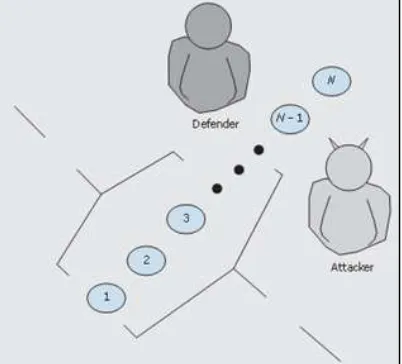
Fusion Defense Mechanism
Consider the fusion-based defense methodology where the fusion focus keeps reconnaissance on the feedback data of S = {1… N} nodes for the attack inference. We expect that every node feedbacks one-piece data to the fusion focus for the benefit of its present status to limit the extra correspondence overheads. For effortlessness, each node is accepted to have indistinguishable location likelihood PD and false alert probability PF. In view of the detection techniques [10, 13], there is an ideal discovery limit under a given defense technique S with the end goal that the combination focus affirms the nearness of an attack when the gathered data surpasses the identification edge. It is direct that the identification edge increments with S since it shows that the fusion center requires more feedback data for attack derivation. Also, the identification limit will be improved if the system has a higher false caution likelihood as the fusion center needs to make up for the harm brought about by wrong reports and false resistance responses.
Fig. 2: Delineation of the attack and resistance game.
Synthetic Model Mechanism
As various network structures have particular topological highlights and in this manner diverse critical values QC for permeation based connectivity, it is progressively tractable to lead guard mechanisms on synthetic network models for intensive examination and execution assessment. Moreover, since the system topology of the shrewd framework correspondence system isn't unmistakable now, we consider the Internet-arranged and power grid oriented synthetic network configuration as the exhibition metric of cybersecurity in the smart grid because of their development and well-created communication protocols.
With the network robustness characterized before, the result of the attack and guard game harmony can be utilized to assess the cybersecurity in the smart grid communication network. The protector is said to have a superior opportunity to win if the network robustness is more prominent than zero. Since various system arrangements bring about unmistakable basic qualities QC for the permeation based connectivity. Naturally, delicate network topology (small QC) and poor detection capability (low PD) will in general advantage the enemy, though the network furnished with strong system structure (high QC) and viable discovery capability (high PD) can keep the network from an interruption under deliberate attack.
VI. CONCLUSION
This paper explains the attacks and their countermeasures in smart grid communication networks and furthermore gives a short dialog about the cybersecurity examination issue. In the attacks referenced the enemy exploits the system topological highlights and it's convention vulnerabilities to control and disturb the whole framework. To upgrade cybersecurity, the fusion-based mechanism is utilized for attack derivation dependent on the gathered data from every node. An attack and guard game is shaped between the enemy and the protector, and the result of the game is utilized to assess the network's robustness of the whole framework. The outcomes demonstrate that the fusion-based mechanism can adequately upgrade cybersecurity by procuring one-piece data from every node, and distinctive system topologies to be sure impact affect the network robustness. This paper, in this manner, offers a theoretic structure of the network robustness and novel experiences on cybersecurity in smart grid communication networks.
REFERENCES
[1] The Cyber Physical System Security For Electric Power Grid” By S.A. Hahn, Pro. Ieee, Vol 100, No 1,Jan 2012, Pp 210-24. [2] “The View Of The System Of Modern Grid”, Netl, 2007, U.S. Doe.
[3] "The Dependency Graph Approach For Fault Detection And Localization For Secure Smart Framework," By M He And J, Ieee Trans. Smart Grid, Vol. 2, No. 2, June 2011, Pp.342–51.
[4] "False Data Injection Attacks Against State Estimation In Electric Power Grids," By Yp And M.K , Acm. Computer Security Nov. 2009, Pp.21–32. . [5] "Breakdown Of The Internet Under Intentional Data Attack," By R.Cohenetal , Phys Fire Up, Vol 86, No 16, Apr 2001, Pp 3682–3685. [6] "Framework Robustness And Percolation On Random Graphs," Phys Fire Up, Vol 85, No 25,Dec 2000,Pp 5468–71.
[7] “Distributed Detection And Data Fusion”, Springer-Verlag,1996. [8] ”Convex Optimization”, By S. Boyd And L Cambridge Univ. Press, 2004.
[9] "Generosity Of The European Power Grids Under Intentional Attack," Phys Fire Up , Vol 77, Feb 2008, Pp 026102.
[10] "False Information Infusion Assaults Against State Estimation In Electric Power Lattices" In The Sixteenth Acm Conference On Computer And Communication Security, New York, Ny, Usa, 2009, Pp
[11] "From Inadequate Arrangements Of Frameworks Of Conditions To Meager Demonstrating Of Sign And Pictures," By A.M, D.L, And M, Siam Review, Vol. 51,2009
[12] "Http://Www-01.Ibm.Com/Programming/Incorporation/Advancement/Cplex-Analyzer/”. [13] "Splendid Matrix Information Trustworthiness Assaults”, By E. M. Mcqueen.