ISSN 2307-4523 (Print & Online)
© Global Society of Scientific Research and Researchers
http://ijcjournal.org/
Clustering Data Text Based on Semantic
Parisa Zandieh
a*, Elham Shakibapoor
ba,bDepartment of Computer Management, Marvdasht Branch , Islamic Azad University, Marvdasht, Iran aEmail: [email protected]
bEmail: [email protected]
Abstract
Clustering is one of the most important data mining techniques which categorize a large number of unordered
text documents into meaningful and coherent clusters. Most of text clustering algorithms do not consider the
semantic relationships between words and do not have the ability to recognize and use the semantic concepts.In
this paper, a new algorithm has been presented to cluster texts based on meanings of the words. First, a new
method has been presented to find semantic relationship between words based on Wordnet ontology then, text
data is clustered using the proposed method and hierarchical clustering algorithm. Documents are preprocessed,
converted to vector space model, and then are clustered using the proposed algorithm semantically. The
experimental results show that the quality and accuracy of the proposed algorithm are more reliable than the
existing hierarchical clustering algorithms.
Keywords: Text mining; Text clustering; Hierarchical clustering; Ontology; Semantic relationship.
1.Introduction
Concerning the enhancement of text documents and the increasing growth of text information, organizing large
text sets into meaningful and controllable small groups plays important role in information retrieval, review,
revision and perception. By the increasing number of digital texts available in the web, text mining techniques
need to be take more consideration. Text mining discover and extract the unknown knowledge in a set of texts.
The unknown knowledge has been stored in the text via semantic relationships between information.
* Corresponding author.
There are three major methods throughout the world to organize such large size of unstructured information as
follows:
• Information retrieval
• information extraction
• knowledge discovery in the text
The first main phase in text mining is text pre-processing which aims to represent documents more
appropriately. Document-based and concept-based formats are produced in this phase. In Document-based
presentation format, the important thing is appropriate presentation of documents. It can be conversion of
documents to an intermediate or semi-structured format, or can be using index on it, or can be any other
presentations which make working on documents more efficient. In concept-based format, documents'
presentation is improved. The concepts and meanings available in documents, the relationship between them
and any conceptual information can be extracted from the text. The second phase is to extract knowledge from
middle forms of document's representation. In this phase, the concepts and meanings available in the document,
their relationships and any conceptual information can be extracted from the text. Clustering is one of the
presented techniques in data mining which extracts groups that are very similar to the elements inside the groups
and that are different from elements of other groups. In fact, clustering is an unsupervised classification in which
classes have not been predetermined and in that sets of data that are usually vectors in multidimensional space,
they are divided into a given number of clusters based on a similarity or dissimilarity measure. But any
similarity cannot be estimated numerically such as the distance between concepts of two words. If clustering is
performed based on concept and meaning of the object or words, clusters are not only a set of objects with
numerical similarity but also, they are a group of objects that represent the same concept whit each other [1].
This technique model data via clusters, however, presentation of data with a low number of clusters cause the
loss of details but it leads to simplification. High efficiency and accuracy of data clusters are two main and
important goals of document clustering. In this paper, first, a new technique is presented to find similarity and
semantic relationship between words using TF-IDF matrix and Wordnet ontology. Then, to increase accuracy
and quality, a new method is presented based on hierarchical clustering algorithms using Wordnet ontology that
categorizes data more accurately and qualitatively than existing hierarchical clustering algorithms. The rest of
this paper is organized as follows.in section 2, existing algorithms and suggested methods are reviewed. In
section 3, the suggested method is described. Section 4 presents the implementation and analysis of results
obtained from algorithm for different parameters and compares it with other algorithms. Conclusion and
suggestions is described in section 5.
2. Related work
Tar [2]presented a conceptual weight for text clustering system based on K-means algorithm and principles of
ontology such that the importance of words of a cluster can be determined by given weighted values. Moh'd
C-means and Fuzzy C C-means algorithms. The algorithm look for proper cluster centers locally and globally in
search space. Uysal[4] used a genetic algorithm in text classification to extract latent semantic features in a
text.Wei [5] presented a new method using Wordnet and lexical chain for clustering. In this method, hierarchical
structure of ontology is used to recognize similarity measure and to extract semantic features of text documents.
Gabrilovich [6]calculated semantic relationships using conceptual analysis based on Wikipedia that was used to
improve the calculation of words and text relationships. Witten and Milne [7] developed Wikipedia as external
knowledge for text clustering that efficiency was improved using the concept and information for interpretation
of texts. Song and his colleagues [8] suggested a genetic algorithm for text mining that it finds related concepts
by indexing hidden concepts using similarity ontology.
In clustering text data, it has been tried to extract hidden semantic features from the text using ontologies or
combination of the clustering algorithms with optimization algorithms that, text clustering is performed more
accurately, qualitatively and rapidly such that data of different clusters have maximum differences with each
other and data of a cluster are very similar to each other.
3.Suggested method
The main idea of proposed method is addition of semantic relation between the words in the input matrix for
text clustering that in this paper, Complete-Linkage clustering algorithm clusters text data using the proposed
matrix.
The input of problem is a set of text documents that are clustered based on semantic via suggested algorithm
after pre-processing and applying essential changes. The stages of suggested algorithm are as follows:
1- Deleting numbers and punctuations
2- Tokenizing documents and converting them to the smallest semantic unit (token)
3- Deleting stop words
4- Words' stemming
5- Representing documents in form of vector space model, creation of TF-IDF matrix
6- Making semantic TF-IDF matrix
7- Creating distance matrix
In order to cluster the texts, Firstly, they should be preprocessed and also converted to apprehensible format for
the system. In this paper, for the preprocessing of texts, first, numbers and punctuation marks are removed from
the text. Then, documents are tokenized into meaningful small units. In the next step, the defined stop words in
that language are removed from the text. Finally, stemming is performed by removing prefixes and suffixes. The
document-word matrix which determines the number of words' iterations in addition to the presence or absence
of a word in each document.
Since the number of word iterations is not a good criterion for measuring similarity between documents, the
words are weighed using TF-IDF as follows:
𝑇𝑇𝑇𝑇 ×𝐼𝐼𝐼𝐼𝑇𝑇�𝑡𝑡𝑘𝑘 ,𝑑𝑑𝑗𝑗�=𝑂𝑂𝑂𝑂𝑂𝑂�𝑡𝑡𝑘𝑘 ,𝑑𝑑𝑗𝑗�× log𝑁𝑁𝑁𝑁_𝑑𝑑𝑑𝑑𝑑𝑑(𝑡𝑡𝑁𝑁𝑁𝑁_𝑑𝑑𝑑𝑑𝑑𝑑
𝑘𝑘) (1)
Where Occ(tk,dj) is the number of words' iterations tk in document dj, Nb_doc is total number of existing
documents and Nb_doc (tk) is the number of documents where the word tk has been used at least one time. In
such method, words available in a small set of documents get higher weights and those available in most
documents get lower weights [9]. TF-IDF is used as a weighted factor in information retrieval and text mining,
it only shows importance of a word in a document and it doesn’t provide any semantic relationship between
words. Two documents may be semantically similar but they don’t have any same words, while there are many
words in documents that have semantic relationships, TF-LDF matrix do not be able to recognize such relations.
Therefore, the matrix has been changed in this research such that semantic relationships and similarities between
words and documents can be extracted. First, semantic similarity of all words in TF-IDF matrix is calculated
using wup similarity function which finds semantic relationship between words using wordnet ontology[10].
Then, the score of words which similarity is above the threshold limit is assimilated. Therefore, in entry of a
document, two words with semantic similarity and different TF-IDF score get higher TF-IDF score. The matrix
is called as Semantic TF-IDF. The basis of all hierarchical algorithms is a distance matrix which usually uses a
similarity criterion, such as Cosine or Euclidean similarity, in order to calculate the distance, in proposed
method, Semantic TF-IDF matrix is used to obtain the distance between documents. In the matrix, each
document has its own row which is considered as a vector. Then, the distance of all documents is calculated
using cosine or Euclidean criterion thus a distance matrix is made.
This is a symmetrical square matrix. If there is N documents, the matrix's dimensions is N×N. Each entry of
matrix shows the distance between two documents. The main diameter of the matrix is zero. According to the
Complete Linkage Algorithm is used in the Proposed Technique, when the distance matrix is created, two
documents which have the maximum distance are chosen in the distance matrix and combine as a cluster in this
matrix. Then, the distance matrix is updated and the distance between all other documents and the new cluster is
calculated. The process is repeated until all clusters are combined with each other and only one cluster is
remained. It is predicted that use of the Semantic TF-IDF matrix assists to identify words which are more
similar and have stronger semantic relationships, and consequently, in documents clustering based on their
words, documents which have contents close to each other are placed in one cluster.
4. Implementation and results
In this section, the proposed algorithm has been implemented on the database 20Newsgroups and the results
have been evaluated. MATLAB version R2015b is used to implement algorithm and system specifications are
A. Dataset
The 20Newsgroups dataset contains 20000 text documents of newsgroups which have been categorized into 20
different groups. This collection is a famous public dataset for text analysis and machine learning techniques
such as classification and clustering. In some versions of this dataset, groups that associate with each other are
combined and five groups have created.
B. Implementation proposed Algorithm
First, the pre-processing has been performed on the database to prepare data for clustering. After pre-processing,
documents are presented as vector space model leading to TF-IDF and Semantic TF-IDF matrices.
Proposed algorithm is executed on 100 documents by using SemanticTF-IDF matrix and Cosine and Euclidean
similarity measure. Since the database has been categorized in five categories, the number of clusters has been
considered as five in proposed algorithm.
C. Clustering quality evaluation
There are several criteria for clustering quality evaluation and they are divided into two categories:
1. Unsupervised evaluation indices known as internal criteria in scientific texts are responsible for
determining the quality of clustering operations according to the information available in the data set.
2. Supervised evaluation criteria known as external criteria evaluate the performance of clustering
algorithms using information outside the datasets under study.
In this paper, unsupervised evaluation criterion of Adjust Rand Index is used to evaluate the quality of clustering
and it is calculated as follows[11]:
𝐴𝐴𝑑𝑑𝐴𝐴𝐴𝐴𝐴𝐴𝑡𝑡𝐴𝐴𝑑𝑑𝑅𝑅𝑅𝑅𝑅𝑅𝑑𝑑𝐼𝐼𝑅𝑅𝑑𝑑𝐴𝐴𝐼𝐼= 𝑇𝑇𝑇𝑇−(𝑇𝑇𝑇𝑇+𝐹𝐹𝐹𝐹+𝐹𝐹𝑇𝑇+𝑇𝑇𝐹𝐹𝑇𝑇𝑇𝑇+𝐹𝐹𝐹𝐹)(𝑇𝑇𝑇𝑇+𝐹𝐹𝑇𝑇) (𝑇𝑇𝑇𝑇+𝐹𝐹𝐹𝐹)+(𝑇𝑇𝑇𝑇+𝐹𝐹𝑇𝑇)
2 −(𝑇𝑇𝑇𝑇+𝐹𝐹𝐹𝐹+𝐹𝐹𝑇𝑇+𝑇𝑇𝐹𝐹𝑇𝑇𝑇𝑇+𝐹𝐹𝐹𝐹)(𝑇𝑇𝑇𝑇+𝐹𝐹𝑇𝑇)
(2)
TP: number of data pairs that should be placed in a cluster.
TN: number of data pairs that should be placed in separate clusters and they have been included correctly in
separate clusters.
FP: number of data pairs that should be placed in a cluster but they have been included in separate clusters
FN: number of data pairs that should be placed in different clusters but they have been included in a cluster.
The possible values of Adjust Rand Index are [-1,+1]. The closer the value to one, the better the quality of
D. Result
Proposed algorithm has been implemented on 100 documents from the 20 newsgroups dataset in 2 states as
follows
• Use of SemanticTF-IDF matrix and Euclidean similarity criterion
• Use of SemanticTF-IDF matrix and cosine similarity criterion.
Then it has been evaluated by Adjust Rand Index.
E. Comparing proposed algorithm to similar algorithms
In this section, the results obtained by implementation of the proposed algorithm in Section III are compared
and analyzed with the results of similar existing algorithms. Proposed algorithm clusters text documents with
considerable accuracy and quality. As seen in Table 1, Adjusted Rand Index of proposed algorithm with input
matrix of semantic TF-IDF and cosine similarity is 0.2124, which is highly desirable.
The results of the proposed algorithm and the results of the implementation of clustering algorithms of
Complete-Linkage and Average-Linkage were obtained by the same dataset using TF-IDF matrix then, their
clustering qualities were calculated using Adjusted Rand Index(ARI) and they were compared with each other.
Furthermore, the results of the proposed algorithm with use of SemanticTF-IDF matrix and cosine and
Euclidean criteria were compared to [11] in which a clustering method has been presented on documents of
20Newsgroups dataset based on the Fuzzy C-means algorithm for clustering text data using the TF -IDF Matrix
and cosine and Euclidean similarity criteria and the quality of clustering has been determined by Adjusted Rand
Index (ARI).
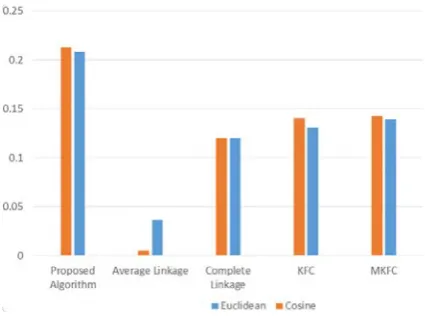
The results are shown in following tables and figure:
Table 1: Comparing hierarchical algorithms, proposed algorithm and algorithms of (11) in terms of ARI
MKFC KFC
Complete
Linkage Average
Linkage Proposed
Algorithm
0.139 0.131 0.1202
0.0364 0.2083
Euclidean
0.143 0.14
0.1202 0.0048
0.2124 Cosine
As seen in above table, proposed algorithm with use of the SemanticTF-IDF matrix as well as the TF-IDF
matrix and both cosine and Euclidean similarity criteria, had better results than hierarchical algorithms of
Complete –Linkage, Average-Linkage and such algorithm with cosine and Euclidean criteria as well as TF-IDF
Figure 1: Comparing ARI and Euclidean and cosine criteria in hierarchical algorithms, the proposed algorithm
and [17].
5.Conclusions
Proposed algorithm clusters automatically text documents and its clustering quality is better than conventional
hierarchical clustering algorithms. Therefore its quality and accuracy of clustering is increased by using
proposed Semantic TF-IDF matrix due to taking into consideration the meanings and concepts of words. Since
clustering is done based on meaning and concept, problems such as labeling nodes, quality, unpredictability of
quality and results, irrationality of clusters in the hierarchy in conventional clustering methods are settled.
6. Recommendations
The proposed algorithm has used one-point cross over operator. Other types of operators can be used such as
two-point, multi-point, map - reduce, order, cycle and uniform cross overs and then the proposed algorithm can
be implemented on them. Then, results obtained from above cross overs are compared to one-point cross over
thus the best cross over is found for the proposed algorithm. The proposed algorithm is the first combination of
hierarchical clustering algorithms with heuristic algorithms. It is suggested to combine other heuristic
algorithms with hierarchical algorithms such as bee, cuckoo, harmony search and to evaluate the results in
improvement of text clustering.
Acknowledgements
The present paper, text data clustering based on meaning, has been derived from M.A thesis of Department of
Computer Engineering-Software from Marvdasht Branch, Islamic Azad University, Marvdasht,Iran.
References
[1] A. K. Jain, "Data clustering: 50 years beyond K-means," Pattern recognition letters, vol. 31, no. 8, pp.
[2] H. H. Tar and T. T. S. Nyunt, "Ontology-based concept weighting for text documents," world Academy
of Science, engineering and Technology, vol. 57, pp. 249-253, 2011.
[3] O. Moh’d Alia, M. A. Al-Betar, R. Mandava, and A. T. Khader, "Data clustering using harmony search
algorithm," in International Conference on Swarm, Evolutionary, and Memetic Computing, 2011, pp.
79-88: Springer.
[4] A. K. Uysal and S. Gunal, "Text classification using genetic algorithm oriented latent semantic
features," Expert Systems with Applications, vol. 41, no. 13, pp. 5938-5947, 2014.
[5] T. Wei, Y. Lu, H. Chang, Q. Zhou, and X. Bao, "A semantic approach for text clustering using
WordNet and lexical chains," Expert Systems with Applications, vol. 42, no. 4, pp. 2264-2275, 2015.
[6] E. Gabrilovich and S. Markovitch, "Computing semantic relatedness using wikipedia-based explicit
semantic analysis," in IJcAI, 2007, vol. 7, pp. 1606-1611.
[7] I. Witten and D. Milne, "An effective, low-cost measure of semantic relatedness obtained from
Wikipedia links," in Proceeding of AAAI Workshop on Wikipedia and Artificial Intelligence: an
Evolving Synergy, AAAI Press, Chicago, USA, 2008, pp. 25-30.
[8] W. Song, C. H. Li, and S. C. Park, "Genetic algorithm for text clustering using ontology and evaluating
the validity of various semantic similarity measures," Expert Systems with Applications, vol. 36, no. 5,
pp. 9095-9104, 2009.
[9] W. K. Gad and M. S. Kamel, "Enhancing text clustering performance using semantic similarity," in
International Conference on Enterprise Information Systems, 2009, pp. 325-335: Springer.
[10] Z. Wu and M. Palmer, "Verbs semantics and lexical selection," in Proceedings of the 32nd annual
meeting on Association for Computational Linguistics, 1994, pp. 133-138: Association for
Computational Linguistics.
[11] H.-C. Huang, Y.-Y. Chuang, and C.-S. Chen, "Multiple kernel fuzzy clustering," IEEE Transactions on