
Covariant solution of the three-quark problem in quantum field theory:
the nucleon
G. Eichmann1,2,a, R. Alkofer2, A. Krassnigg2, and D. Nicmorus2
1 Institute for Nuclear Physics, Darmstadt University of Technology, 64289 Darmstadt, Germany 2 Institut f¨ur Physik, Karl-Franzens-Universit¨at Graz, 8010 Graz, Austria
Abstract. We provide details on a recent solution of the nucleon’s covariant Faddeev equation in an explicit three-quark approach. The full Poincar´e-covariant structure of the three-quark amplitude is implemented through an orthogonal basis obtained from a partial-wave decomposition. We employ a rainbow-ladder gluon exchange kernel which allows for a comparison with meson Bethe-Salpeter and baryon quark-diquark studies. We describe the construction of the three-quark amplitude in full detail and compare it to a notation widespread in recent publications. Finally, we discuss first numerical results for the nucleon’s amplitude.
1 Introduction
Abundant information on the structure of the nucleon is available from experiments, and here especially from elec-troweak probes at all energy scales. It is presently both an issue of paramount importance and a formidable theoret-ical challenge in contemporary hadron physics to under-stand the nucleon and its structure in terms of quarks and gluons which are the elementary degrees of freedom of quantum chromodynamics (QCD), i.e. the quantum field theory of the strong interaction.
The formalism which has been developed to treat the three-body bound-state problem has a longstanding history which dates back to the original work by Faddeev [1]. Non-relativistic Faddeev equations have found widespread application in the description of three-nucleon systems, see Ref. [2] for an overview. The covariant generalization of the Faddeev equation to the three-body analogue of a two-body Bethe-Salpeter equation (BSE) [3] was formulated in Refs. [4,5]; a comprehensive introduction can be found in [6]. Within such a framework, the equation describes the baryon as a bound state of three spin-1/2 valence quarks where the interaction kernel comprises two- and three-quark contributions.
The formalism of QCD’s Dyson-Schwinger equations (for recent reviews, see e.g. [7,8]) provides a way to em-bed the covariant three-quark Faddeev equation in a con-sistent quantum-field theoretical setup. The dynamical in-gredients in the equation can then be treated in perfect cor-respondence with studies of quark and meson properties as well as related aspects of QCD. A solution of the equa-tion relies upon knowledge of the dressed quark propagator and the three-quark kernel as well as a specification of the Poincar´e-covariant baryon amplitude. The relativistic spin structure of the latter has been explored in [9,10] and de-scribed in the light-front formalism in [11–14]. A complete
a e-mail:[email protected]
classification according to the Lorentz group and the per-mutation groupS3was derived in [15] in terms of covariant three-spinors.
The biggest obstacle on the way to a direct numer-ical solution of the three-body bound-state equation is its complexity. Upon implementing perturbative quark propagators it has been studied, for instance, in the works of Refs. [16,17], in the context of a three-body spectator approximation [18], or a Salpeter equation with instantaneous forces [6]. The corresponding equation of a scalar three-particle system with scalar two-body exchange based on the Wick-Cutkosky model [19,20] was recently investigated and compared to the light-front approach [21].
A different kind of simplification can be achieved by considering diquark correlations in the nucleon, see e.g. [22] for an overview. While maintaining full Poincar´e covariance, the quark-diquark model traces the nucleon’s binding to the formation of colored scalar- and axialvector diquarks, thereby simplifying the Faddeev equation to a quark-diquark BSE. This strategy has been applied to investigate nucleon and ∆ properties [23–31]. For more detailed studies of diquark properties in this approach, see [32,33]. Further support for the diquark concept has been provided by a study of diquark confinement in Coulomb-gauge QCD [34].
In a recent study we have reported the first fully Poincar´e-covariant computation of the nucleon’s mass and Faddeev amplitude beyond the quark-diquark approxima-tion [35]. The numerical soluapproxima-tion of the Faddeev equaapproxima-tion is performed after truncating the interaction kernel to a dressed gluon-ladder exchange between any two quarks, thereby enabling a direct comparison with corresponding meson studies as well as earlier investigations of baryons in the quark-diquark model. In the present work we pro-vide details of that calculation with regard to the covariant structure of the nucleon amplitude and its decomposition DOI:10.1051/epjconf/201003028
=
+
+
Fig. 1.Faddeev equation (2) in rainbow-ladder truncation.
into Dirac tensors, as well as details on the numerical solution of the Faddeev equation.
2 Faddeev amplitude and equation
In QCD baryons appear as poles in the three-quark scat-tering matrix. This allows one to derive a relativistic three-body bound-state equation:
Ψ =Ke(3)Ψ , Ke(3)=Ke(3)irr + 3 X
a=1 e
K(2)(a), (1)
where Ψ is the bound-state amplitude defined on the baryon mass shell. The three-body kernel Ke(3) comprises a three-quark irreducible contribution and the sum of permuted two-quark kernels whose quark-antiquark analogues appear in a meson BSE. The subscriptadenotes the respective accompanying spectator quark.
The observation of a strong attraction in the S U(3)C antitriplet qq channel has been the guiding idea for the quark-diquark model, namely that quark-quark corre-lations provide important binding structure in baryons. This motivates the omission of the three-body irreducible contribution from the full three-quark kernel. The resulting covariant Faddeev equation includes a sum of permuted qqkernels (cf. Fig. 1):
Ψαβγδ(p,q,P)= 3 X
a=1 Z
k e
Kαα(a)0ββ0γγ0Ψα0β0γ0δ(p(a),q(a),P),
(2) where Ke(a) denotes the renormalization-group invariant products of aqqkernel and two dressed quark propagators:
e
Kαα(a)0ββ0γγ0=δαα0Kββ00γγ00Sβ00β0(kb)Sγ00γ0(ekc). (3)
Here,{a,b,c}is an even permutation of{1,2,3}and linked to the respective Dirac index pairs.
The spin-momentum part of the full Poincar´e-covariant nucleon amplitude Ψαβγδ(p,q,P) is a spin-1/2 four-point function with positive parity and positive energy: it car-ries three spinor indices{α, β, γ}for the involved valence quarks and one indexδfor the spin-1/2 nucleon. The am-plitude depends on three quark momentap1,p2,p3which can be reexpressed in terms of the total momentumPand two relative Jacobi momenta pandq, whereP2 =−M2is
fixed. They are related via (cf. Fig. 1):
p=(1−ζ)p3−ζpd,
q= p2−p1
2 ,
P=p1+p2+p3,
p1=−q−p 2 +
1−ζ
2 P, p2=q− p
2 + 1−ζ
2 P, p3=p+ζP,
(4)
where we abbreviatedpd:=p1+p2. We have chosen equal momentum partitioning 1/2 for the relative momentumq and use the valueζ =1/3 in connection with the momen-tum p; this value maximizes the upper boundary for the nucleon mass with respect to restrictions arising from the quark propagator’s singularity structure [36]. The quark propagatorsS depend on the internal quark momentaki= pi−kandekj = pj+k. The internal relative momenta are given by:
p(1) =p+k, p(2) =p−k, p(3) =p,
q(1)=q−k/2, q(2)=q−k/2, q(3)=q+k.
(5)
The nucleon amplitude can be decomposed into 64 Dirac structures:
Ψαβγδ(p,q,P)= 64 X
k=1
fk(p2,q2,{z})τk(p,q,P)αβγδ, (6)
where the amplitude dressing functions fkdepend on the five Lorentz-invariant combinations
p2, q2, z0=cpT·qTb , z1=pˆ·Pˆ, z2=qˆ·Pˆ. (7)
Here, a hat denotes a normalized 4-vector andpµT =TµνP pν a transverse projection with respect to any four momentum P:TPµν=δµν−PˆµPˆν. We abbreviated the angular variables by the shorthand notation{z}={z0,z1,z2}. The Dirac struc-turesτk(p,q,P) will be explained in Section 4.
3 Rainbow-ladder truncation
breaking, leading e.g. to a generalized Gell-Mann–Oakes– Renner relation valid for all pseudoscalar mesons and all current-quark masses [37,38]. In particular the pion, being the Goldstone boson related to dynamical chiral symmetry breaking, becomes massless in the chiral limit, indepen-dent of the details of the interaction. Specifically, we de-scribe theqqkernel by a dressed gluon-ladder exchange:
Kαα0ββ0(k)=Z224πα(k
2) k2 T
µν k γ
µ
αα0γνββ0, (8)
wherekis the gluon momentum and Z2 the quark renor-malization constant. By virtue of the AXWTI, the kernel must also appear in the quark Dyson-Schwinger equation whose solution defines the renormalized dressed quark propagator:
S−1αβ(p)=Z2(ip/+m)αβ+ Z
q
Kαα0β0β(k)Sα0β0(q), (9)
where the bare quark massmenters as an input andk = p−q. The inherent color structure of the kernel leads to prefactors 2/3 and 4/3 for the integrals in Eqs. (2) and (9), respectively.
Eqs. (8–9) define the rainbow-ladder (RL) truncation which has been extensively used in DSE studies of mesons and baryons in the quark-diquark model, e. g. [39,27] and references therein. The non-perturbative dressing of the gluon propagator and the quark-gluon vertex are absorbed into an effective coupling α(k2) for which we adopt the ansatz [40,41]
α(k2)=πη7 k2
Λ2 !2
e−η2
k2
Λ2
+αUV(k2). (10)
The second term
αUV(k2)=
πγm
1−e−k2/Λ2 t
ln q
e2−1+1+k2/Λ2 QCD
2 , (11)
whereγm=12/(11NC−2Nf) is the anomalous dimension of the quark propagator, reproduces the logarithmic decrease of QCD’s one-loop perturbative running cou-pling and vanishes atk2 = 0. In our calculation we use
ΛQCD=0.234 GeV andγm=12/25 which corresponds to Nf =4. The infrared contribution (the first term in (10)) is parametrized by an infrared scaleΛand a dimensionless parameterηand yields the non-perturbative enhancement at small and intermediate gluon momenta necessary to generate dynamical chiral symmetry breaking and hence a constituent-quark mass scale. ({Λ, η} and the infrared parameters used in [41] are related by C = (Λ/Λt)3 and
ω=η−1Λ/Λt, withΛ
t=1 GeV.)
Beyond the present truncation, corrections arise from pseudoscalar meson-cloud contributions which provide a substantial attractive contribution to the ‘quark core’ of dynamically generated hadron observables in the chiral regime and vanish with increasing current-quark mass, but also from non-resonant contributions due to the infrared structure of the quark-gluon vertex. To anticipate such
corrections we exploit the freedom in adjusting the input scaleΛ. We adopt two different choices established in the literature in the context ofπandρproperties [41]:
Setup A is determined by a fixed scaleΛ=0.72 GeV, chosen in [40] to reproduce the experimental pion decay constant and the phenomenological quark condensate. Cor-responding results are therefore aimed in principle at a comparison to experimental data for meson and baryon properties (see [39,29] and references therein). Setup B de-fines a current-mass dependent scale which is deliberately inflated close to the chiral limit, whereΛ ≈ 1 GeV [41]. It is meant to describe a hadronic quark core which must subsequently be dressed by pion-cloud effects and other corrections. As a result,π,ρ,Nand∆observables are con-sistently overestimated, but (with the exception of the∆ -baryon) compatible with quark-core estimates from quark models and chiral perturbation theory (for a detailed dis-cussion, see [41,28,29]). Irrespective of the choice of Λ, hadronic ground-state properties have turned out to be in-sensitive to the value ofηin a certain range [40,39]. Con-sequently, with Eqs. (8–10) and Λ, the input of the Fad-deev equation is completely specified with all parameters already fixed to meson properties.
4 Structure of the nucleon amplitude
With the kernelKeof the Faddeev equation (2) determined, we still need to find expressions for the basis elements which constitute the nucleon amplitude according to Eq. (6). A general spinor four-point function which depends on 3 independent momenta involves 128 com-ponents of positive parity. These can be conveniently expressed through tensor products of two Dirac matrices, for which we adopt the following notation:
(A⊗B)αβ,γδ=AαβBγδ,
(A1⊗B1)(A2⊗B2)=(A1A2)⊗(B1B2), (A⊗B)T =AT⊗BT,
Tr{A⊗B}=Tr{A}Tr{B}.
We define a charge-conjugated four-point function via
(A⊗B) (p,q,P) :=
=(C⊗C)(A⊗B)T(−p,−q,−P)(C⊗C)T = =A(p,q,P)⊗B(p,q,P),
(12)
where C = γ4γ2 is the charge-conjugation matrix. A further classification into the 64-dimensional subspaces of positive and negative energy, describing the nucleon’s (1/2)+ and (1/2)+ states, is obtained by attaching the respective projectorsΛ±(P)=(1±P)ˆ/ /2 to the nucleon leg in the tensor product:A⊗BΛ±. The negative-parity states (1/2)− and (1/2)− constitute another 128-dimensional vector space generated from basis elements of the type Aγ5⊗BΛ±.
To construct a suitable basis for the positive-parity and positive-energy nucleon, we start from the expressions
Ωr(P)=Λr(P)γ
withr=±according to the projectorsΛr(P). In the quark-diquark model,Ω++Ω−=γ
5C⊗Λ+is related to the dom-inant scalar-diquark part in the nucleon amplitude. To in-clude the momentum dependence of the amplitude, it is convenient to choose a set of momenta{cpT,bqt,bP}which are orthonormal with respect to the Euclidean metric, i.e.
cpT2=bqt2=bP2=1,
cpT ·bqt=cpT·Pb=bqt·bP=0. (14)
This can be realized via
pµT :=TPµνpν, qµt :=TpµνTT
νλ P qλ=T
µν pTq
ν
T. (15) Consider now the four quantities
Γi(p,q,P)∈n1, 1
2[cpT/ ,qt]b/ , cpT/ , bqt/ o
(16)
where, because of Eq. (14), one has1
2[cpT/ ,qt]b/ =cpT/ qt. Theb/ linear span of the 8 matrices Γi(p,q,P)Λr(P) equals the linear span of the basis elements
{1, p/,q/,P/, p/P/,q/P/ , p/q/, p/q/P/ }, (17)
whereasΓi(p,q,P)Λ+(P) reduces this set to
{1, p/,q/,p/q/}Λ+ (18) sincebP/Λ+ =Λ+. Hence the quantities (Γ
i⊗Γj)Ωrdefine 32 linearly independent basis tensors.
A complete orthogonal basis for the nucleon amplitude is given by the 64-dimensional set{Sr
i j,Pri j}defined by
S
r
i j(p,q,P)
Pr
i j(p,q,P) :=
γ15⊗⊗1γ5
(Γi⊗Γj)Ωr, (19)
withi,j = 1. . .4. The symbolsS andP were chosen to reflect a combination of two scalar or pseudoscalar covari-ants whose product again exhibits positive parity. All pos-sible further basis elements, e.g.
Ar
i j(p,q,P)
Vr
i j(p,q,P)
Tr
i j(p,q,P) :=
γµTγ5⊗γµTγ5
γµT⊗γµT σµνT ⊗σµνT
(Γi⊗Γj)Ωr, (20)
whereγTµ = TPµνγν andσµν
T = −i[γ µ
T, γνT]/2, linearly de-pend on those in Eq. (19); respective relations are given in Table 1. For instance, the dominant contributions to the Faddeev amplitude are the elements
γ5C⊗Λ+= X
r=±
Sr11,
γµTC⊗γµTγ5Λ+= X
r=±
Ar11 =X r=±
rSr22+Pr33+Pr44.
In the quark-diquark model, these correspond to scalar-scalar and axialvector-axialvector combinations of diquark and quark-diquark amplitudes for either of the three dia-grams appearing in the Faddeev equation in Fig. 1.
A partial-wave decomposition (see Table 2 and App. B) leads to linear combinations of the{Sri j,Pri j}as eigenstates of quark-spin and orbital angular momentum operatorsS2 andL2 in the nucleon rest frame. The 64 basis covariants (32 each for total quark spins=1/2 ands=3/2, respec-tively) can be arranged into sets of 8 s-waves (l = 0), 36 p-waves (l=1), and 20d-waves (l=2) which we denote collectively by
X
r i j,1
Xr i j,2
:=
γ15⊗⊗1γ5
Ti jΩr, (21)
withi,j = 1. . .4 and r = ±. The Ti j carry the relative-momentum dependence and are defined in Table 2. For in-stance, the eigenstates ofs=1/2correspond toi=1,2 and read
T1j=Γ1⊗Γj,
T2j= √13(γTµ⊗γµT) (Γ1⊗Γj), (22) whereas the s =3/2eigenstates (i = 3,4) are more com-plicated. The relations between theXr
i j,kand the basis ele-ments{Sr
i j,Pri j,Ari j,Vri j}are stated in Table 2 as well. As illustrated in App. C, the basis elementsXr
i jcan be expressed in terms of quark three-spinors frequently used in the literature, e.g. Ref. [15]. Moreover, they satisfy the following orthogonality relation:
1
4Tr{Xri jXr
0
i0j0}= 14 Xri j
βα,δγ Xr
0
i0j0
αβ,γδ=δii0δj j0δrr0.
(23) As an example, consider the scalar-scalar combinations:
Sri j(p,q,P)=CΓi(−p,−q,−P)Λr(−P)γ 5CTCT
⊗CΓj(−p,−q,−P)Λ+(−P)TCT = =(CTγ5) (ΛrΓi) ⊗(Λ+Γj),
where we used the relations Λr(P) = CΛr(−P)TCT =
Λr(P) andΓi(p,q,P)=CΓi(−p,−q,−P)TCT. As a result one obtains
1
4Tr{Sri jSr
0
i0j0}=14Tr{ΓiΓi0Λr 0
Λr}Tr{Γ
jΓj0Λ+}=
=δii0δj j0δrr0,
sinceΛr0 Λr=δ
rr0Λrand Tr
n
ΓiΓi0Λr
o =2δii0.
The Pauli principle requires the Faddeev amplitude to be antisymmetric under exchange of any two quarks. The Faddeev kernelKe(3)is invariant under the permutation groupS3. The eigenstates of the Faddeev kernel can hence be arranged into irreducibleS3multiplets
ΨS, ΨA, ΨΨMA MS
!
, (24)
Table 1.Relations between the basis elementsAi j of Eq. (20) and{Si j,Pi j}. The corresponding relations forVi jare obtained by in-terchangingSi j ↔Pi j. Similar dependencies hold for theTi j, e.g.:T+11 =−2A+11. The superscriptsr =±are not displayed for better
readability.
A11=P33+P44+rS22 A12=P34−P43−rS21 A13=P31−P42+rS24 A14=P32+P41−rS23
A21=P43−P34−rS12 A22=P33+P44+rS11 A23=P32+P41−rS14 A24=P42−P31+rS13
A31=P13−P24+rS42 A32=P23+P14−rS41 A33=P11+P22+rS44 A34=P12−P21−rS43
A41=P14+P23−rS32 A42=P24−P13+rS31 A43=P21−P12−rS34 A44=P11+P22+rS33
Table 2.Orthonormal Dirac basisXr
i j,k of Eq. (21) constructed from a partial-wave decomposition. The first two columns denote the eigenvalues of total quark spin sand intrinsic orbital angular momentumlin the nucleon rest frame. The third and fourth columns define the relation between theXr
i jand the basis elements from Eq. (19-20). Each row involves 4 covariants; the superscriptsr=±are not displayed for better readability. The fifth column shows the momentum-dependent covariantsTi jwhich appear in Eq. (21); we have abbreviatedcpT→pandbqt→qfor clarity.
s l Xr
1j,1 Xr1j,2 T1j
1/2 0 S11 P11 1⊗1
1/2 1 S12 P12 1⊗1
2[p,/ q/]
1/2 1 S13 P13 1⊗p/
1/2 1 S14 P14 1⊗q/
s l √3Xr
2j,1
√ 3Xr
2j,2
√ 3T2j
1/2 0 V11 A11 γµ
T⊗γ µ T
1/2 1 V12 A12 γµ
T⊗γ µ T
1 2[p,/ q/]
1/2 1 V13 A13 γµ
T⊗γ µ Tp/
1/2 1 V14 A14 γµ
T⊗γ µ Tq/
s l √6Xr
3j,1
√ 6Xr
3j,2
√ 6T3j
3/2 2 3S33−V11 3P33−A11 3p/⊗p/−γµ
T⊗γ µ T
3/2 1 3S34−3S43−2V12 3P34−3P43−2A12 3 (p/⊗q/−q/⊗p/)−γµ
T⊗γ µ T[p,/ q/]
3/2 1 3S31−V13 3P31−A13 3p/⊗1−γµ
T⊗γ µ Tp/
3/2 1 3S41−V14 3P41−A14 3q/⊗1−γµ
T⊗γ µ Tq/
s l √2Xr
4j,1
√ 2Xr
4j,2
√ 2T4j
3/2 2 2S44+S33−V11 2P44+P33−A11 p/⊗p/+2q/⊗q/−γµ
T⊗γ µ T
3/2 2 S34+S43 P34+P43 p/⊗q/+ /q⊗p/ 3/2 2 −2S42+S31−V13 −2P42+P31−A13 q/⊗[q,/ p/]−1
2γ
µ T⊗[γ
µ T,p/]
3/2 2 2S32+S41−V14 2P32+P41−A14 p/⊗[p,/ q/]−1 2γ
µ T⊗[γ
µ T,q/]
Table 3.Irreducible multiplets of the permutation groupS3, constructed from the 8 covariants{Sr11,Pr11,Ar11,Vr11}.
ψ1
MA=S
+
11 ψ2MA=
P
rPr11+S−11 ψ3MA=
P
r
Vr
11−Pr11
+2S−
11 ψA= P
r
Vr
11+Pr11
−2S−
11 ψ1
MS=A
+
11 ψ2MS =
P
rrVr11−A−11 ψ3MS =
P
rr
Vr
11+3Pr11
+2A−
11 ψS= P
rr
−Vr
11+3Pr11
−2A−
0.0 0.2 0.4
0.0 0.2
-0.2 0.0
-0.2 0.0 0.0 0.2 0.4 0.6 0.8 1.0
0.0 0.5 1.0 1.5 0.0 0.5 1.0 1.5
1.17 0.86 0.63 0.46
0.32
0.22 0.15
0.09
0.00
0.05
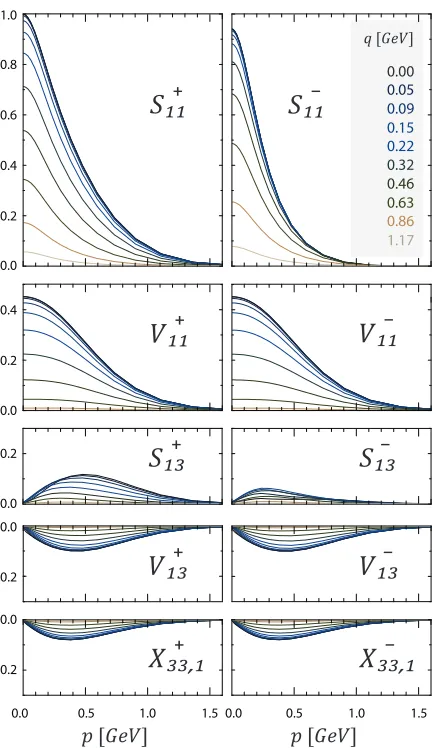
Fig. 2.Zeroth Chebyshev moments of the dressing functions
cor-responding to the dominant covariants in the Faddeev amplitude
ΨMA, plotted as a function of
p
p2and pq2. The various curves
represent the falloffin the variable pq2.
0th
1st
2nd
3rd
0.0 0.2 0.4 0.6 0.8 1.0
0.0 0.5 1.0 1.5 0.0 0.5 1.0 1.5
Fig. 3.First four Chebyshev moments in the variablez1 of the
dressing functions associated with the amplitudesSr
11, evaluated
atq2=0.
Taking into account the flavor and color structure, the full Dirac–flavor–color amplitude reads
Ψ(p,q,P)=nΨMATMA+ΨMSTMS
oεABC √
6 , (25)
whereεABC is the antisymmetric color-singlet wave func-tion and
TMA=
1 √
2iσ2⊗1, TMS=−
1 √
6σiσ2⊗σ (26) denote the isospin-1/2 flavor tensors involving the Pauli matricesσi. A projection onto the proton or neutron flavor states involves a contraction of the rearmost flavor index with either of the two isospin basis states (1,0) or (0,1).
A flavor-dependent kernel in the Faddeev equation will mix ΨMA and ΨMS whose dominant contributions
are given by S+11 and A+11, respectively. However, since the rainbow-ladder kernel presently employed is flavor-independent and we consider only equal quark masses, the equations for the Dirac amplitudes ΨMA andΨMS in
Eq. (25) decouple because of the orthogonality of the two flavor tensorsTMAandTMS:
Ψ=Ke(3)Ψ −→
ΨMA=Ke(3)ΨMA, ΨMS =Ke(3)ΨMS.
(27)
Hence one obtains two degenerate solutions of the Faddeev equation, where by virtue of the iterative solution method the symmetry of the start function determines the symme-try of the resulting amplitude.
Similarly to the analogous case of a diquark ampli-tude, the quark exchange symmetry does not reduce the number of Dirac covariants since the dressing functions fk(p2,q2,{z}) transform under the permutation group as well. For example, if we restrict ourselves to the eight momentum-independent covariants of Table 2 (with s=1/2,l=0) and apply theS3(anti-)symmetrizers, we can arrange these 8 basis elements into three mixed-symmetry doublets and one symmetric and one antisymmetric singlet which are shown in Table 3. If the coefficients fk were totally symmetric, e.g., by being constant or by depending only on certain symmetric combinations of p2,q2 and{z} as derived in Ref. [15], the nucleon amplitude would be a linear combination of the sixMAandMSbasis elements in Table 3:
ΨMA=
3 X
k=1 fkΨk
MA, ΨMS=
3 X
k=1 f0
kΨMkS. (28)
Since the coefficients fkcan appear in all symmetry repre-sentations, the inclusion of the remaining Dirac covariants
ψAandψS is however necessary, and the same reasoning holds if all 64 basis elements are implemented.
5 Results
from the five Lorentz-invariant momentum combinations of Eq. (7) upon which the amplitudes depend. In analogy to the separability assumption of the nucleon amplitude in the quark-diquark model we omit the dependence on the angular variablez0 =cpT ·qTb but solve for all 64 dressing functions fk(p2,q2,0,z
1,z2).
The resulting nucleon masses at the physical pion mass in both setups A and B are shown in Table 4. As a conse-quence of Eq. (27), the two statesΨMAandΨMSemerge as
independent solutions of the Faddeev equation. Both sep-arate equations produce approximately the same nucleon mass, where the deviation of∼ 2% is presumably a trun-cation artifact associated with the omission of the anglez0. For either solution typically only a small number of co-variants are relevant which are predominantlys-wave with a small p-wave admixture. The corresponding amplitudes for the mixed-antisymmetric solution are shown in Fig. 2. Comparing the relative strengths of the amplitudes allows to identify the dominant contributions:
ΨMA:
X
r n
Sr11, Vr11, S13r , Vr13, Xr33,1o,
ΨMS:
X
r n
Ar11, rVr11, rP11r , rVr13, Xr33,2o. (29)
Fig. 3 displays the angular dependence in the variable z1through the first few Chebyshev moments of the ampli-tudesS±
11 which contribute toΨMA. The angular
depen-dence in the variablez2 is small compared to z1. This is analogous to the quark-diquark model, where the depen-dence on the angle between the relative and total momen-tum of the two quarks in a diquark amplitude is weak.
The evolution of MN and theρ-meson mass from the BSE vs. m2
π is plotted in Fig. 4 and compared to lattice results. The findings for MN are qualitatively similar to those formρ: setup A, where the coupling strength is ad-justed to the experimental value of fπ, agrees with the lat-tice data. This behavior can be understood in light of a re-cent study of corrections beyond RL truncation which sug-gests a near cancellation in theρ-meson of pionic effects and non-resonant corrections from the quark-gluon vertex [42]. Setup B provides a description of a quark core which overestimates the experimental values while it approaches the lattice results at larger quark masses.
A comparison to the consistently obtained quark-diquark model result exhibits a discrepancy of only∼5%. This surprising and reassuring result indicates that a description of the nucleon as a superposition of scalar and axial-vector diquark correlations that interact with the remaining quark provides a close approximation to the consistent three-quark nucleon amplitude.
6 Conclusions and outlook
We have provided details on a fully Poincar´e-covariant three-quark solution of the nucleon’s Faddeev equation. The nucleon amplitude which is generated by a gluon ladder-exchange is predominantly described by s- and p-wave Dirac structures, and the flavor independence
Table 4.(adapted from Ref. [35]) Nucleon masses obtained from
the Faddeev equation in setups A and B and compared to the quark-diquark result. Theηdependence is indicated for setup B in parentheses.
Q-DQ [29] Faddeev (MA) Faddeev (MS)
Setup A 0.94 0.99 0.97
Setup B 1.26(2) 1.33(2) 1.31(2)
0.7 0.8 0.9 1.0 1.1 1.2 1.3 1.4 1.5 1.6
0 .
0 0.1 0.2 0.3 0.4 0.5
Set B
Set A
Fig. 4.(adapted from Ref. [35]) Evolution withm2
πofmρandMN compared to lattice data ([43,44] forMNand [45,46] formρ). The
quark-diquark model result forMN[28,29] is plotted for compar-ison. Dashed and dashed-dotted lines correspond to setup A; the solid line formρand the bands forMN(mixed-antisymmetric so-lution) are the results of setup B, where the variation withηis explicitly taken into account. Dots denote the experimental val-ues.
of the kernel leads to a mass degeneracy. The resulting nucleon mass is close to the quark-diquark model result which stresses the reliability of previous quark-diquark studies.
Due to the considerable computational efforts involved, more results and an in-depth investigation with regard to the complete set of invariant variables will be presented in the future. Further extensions of the present work will include an analogous investigation of the∆-baryon, more sophisticated interaction kernels, e.g. in view of pionic cor-rections, and ultimately a comprehensive study of baryon resonances.
Acknowledgements
Austrian Science Fund FWF under Projects No. P20592-N16, P20496-P20592-N16, and Doctoral Program No. W1203, and in part by the European Union (HadronPhysics2 project “Study of strongly interacting matter”).
A Numerical implementation
Similar to the analogous case of a two-body Bethe-Salpeter equation, the Faddeev equation (2) can be viewed as an eigenvalue problem for the kernelKe(3):
e
K(3)(P2)Ψi=λi(P2)Ψi, (30)
wherePis the total momentum of the three-quark bound state and enters the equation as an external parame-ter. Upon projection onto given quantum numbers, the eigenvalues of Ke(3) constitute the trajectoriesλi(P2). An intersection λi(P2) = 1 at a certain value P2 = −M2 i reproduces Eq. (2) and therefore corresponds to a potential physical state with mass Mi. The largest eigenvalue λ0 represents the ground state of the quantum numbers under consideration and the remaining onesλi≥1 its excitations; the associated eigenvectors Ψi are the bound-state am-plitudes. (Note that in this context one has to keep in mind the possibility of anomalous states in the excitation spectra of bound-state equation solutions [47].) To obtain the ground-state solution, Eq. (30) is solved via iteration within a ’guess range’P2∈ {−M2
min,−M2max}, whereMmax is determined from the singularity structure of the quark propagator (see e.g. [36,48]). Upon convergence of the eigenvalueλ0(P2) the procedure is repeated for different P2 untilλ
0(P2 =−M2) =1, thereby defining the nucleon massM.
From a numerical point of view, it is advantageous to split the Faddeev equation forKe(3)=KS Sinto an equation for a ’wave function’Φ = S SΨ which can be evaluated outside the loop integral, and a subsequent integrationΨ= KΦthat is carried out by calling the wave functionΦwith the loop momenta as its arguments:
Φ(a)(p,q,P)=S(pb)S(pc)Ψ(p,q,P),
Ψ(p,q,P)= 1
λ(P2) 3 X
a=1 Z
k
K(a)(k)Φ(a)(p(a),q(a),P).
The indexa = 1. . .3 denotes the three permutations of the Faddeev kernel, and{a,b,c}is an even permutation of {1,2,3}. For a complete Dirac basis the wave functionΦ(a) can be projected onto the same basis elements as the am-plitude, cf. Eq. (6), and we denote its dressing functions by
˜
fk(a). Exploiting the orthogonality relations (23) yields cou-pled equations for the amplitude and wave function dress-ing functions:
fi(s)=X j
3 X
a=1 Z
k
Ki j(a)(s,t) ˜fj(a)s(a),
˜
fi(a)(s)=X j
G(i ja)(s)fj(s),
(31)
where the kernelK(i ja)and quark propagator matrixG(i ja)are the matrix elements of K(a) andS S upon projection onto ‘outer’ basis elements from the left and ‘inner’ basis ele-ments on the right. We abbreviated the five outer momen-tum variables by s = {p2,q2,z
0,z1,z2}and the respective inner variables bys(a): they depend onsand the four com-binationst:={k2,kˆ·Pˆ,kˆ·pˆ,kˆ·qˆ}.
Eq. (31) involves an iterated (multidimensional) matrix-vector multiplication, where in a straightforward implementationKandGwould be computed in advance whereas the s(a) dependence of the ˜f(a)
j must be interpo-lated in each iteration step. The biggest obstacle in such an approach is the memory requirement of the kernel which, for reasonable accuracy, is of the order of Petabytes and hence far beyond the capacities of today’s computing resources. In this respect it is advantageous to split the kernelKinto the following three contributions:
K(i ja)(s,t)=K1(k) µν
K2(a)µνi j K3(a)(s,t)i j, (32) where K1 stems from the rainbow-ladder kernel (8) modulo its Dirac structure and only depends on the gluon momentum k; K2 contains all Dirac traces but is momentum-independent; and K3 carries the remaining loop-momentum dependence inherent in theΓiof Eq. (16) which enter the basis elements.K1andK2are independent of the baryon momentum P2 and can be calculated and stored outside of the iterated matrix-vector multiplication. K3 is computed in each iteration step anew but includes only simple products of the loop momenta which, in the absence of any Dirac structure, are evaluated compara-tively quickly. A construction analogous to Eq. (32) can be applied to the propagator matrixG(i ja)as well; however, here the situation is much less severe since no integration and hence no dependence ontis involved.
Moreover, using the set of orthogonal momenta defined in Eq. (15) turns out to be extremely efficient: for instance, choosing the momentum alignment
p= q
p2
0, 0,
q 1−z2
1, z1
,
q= q
q2
0,
q 1−z2
2 q
1−z2 0,
q 1−z2
2z0, z2
(33)
yields in the baryon’s rest frame:
b
P={0,0,0,1}, cpT ={0,0,1,0}, qtb={0,1,0,0}.
As a consequence, all outer basis elements effectively do not depend on any momentum variable at all, and the mo-mentum dependence is solely carried by the inner basis el-ements which contribute toK(i ja)(s,t).
into Chebyshev polynomials of the first kind in the re-maining angles z(1a),z(2a) that appear in the wave function coefficients inside the integral. The resulting run times are accessible by a parallel cluster.
The different solutionsΨMA andΨMS of the Faddeev
equation are obtained by choosing suitable start functions for the amplitudesfi(s). To arrive atΨMA, we start from the
structureS+
11and set all other amplitudes to zero; forΨMS
we use the initial amplitudeA+11. The full structure of the nucleon amplitude in either case is subsequently generated by iterating Eq. (31).
B Angular momentum decomposition
The Dirac basis elementsXr
i j,kin Table 2 can be classified with respect to their quark-spin and orbital angular mo-mentum content in the nucleon’s rest frame. Only the total angular momentum j = 1/2 of the nucleon is Poincar´e-invariant while the interpretation in terms of total quark spin and orbital angular momentum will differ in every frame. The spin is described by the Pauli-Lubanski opera-tor:
Wµ= 1 2
µναβPˆνJαβ, (34) where we chose the total momentumPto be normalized. JµνandPµare the generators of the Poincar´e algebra satis-fying the usual commutation relations. The eigenvalues of the square of the Pauli-Lubanski operator,
W2=1 2J
µνJµν+PˆµPˆνJµαJαν−→ j(j+1) (35)
define the spin jof the particle. For a system of three par-ticles with total momentumPand relative momentapand q, the total angular momentum operator consists of the to-tal quark spinSand the relative orbital angular momentum L = L(p) +L(q). Subsuming them into Lorentz-covariant operators
Sµ=1 4µναβPˆν
σαβ⊗1⊗1+perm., Lµ(p) = i
2
µναβPˆνpα∂β p−pβ∂αp
1⊗1⊗1, (36)
Lµ(q) =2iµναβPˆνqα∂βq−qβ∂αq
1⊗1⊗1
withWµ=Sµ+Lµ (p)+L
µ
(q)yields the identities
S2=9
41⊗1⊗1+14
σµνT ⊗σµνT ⊗1+perm.,
S·L(p)=2iepµe∂νp
σµνT ⊗1⊗1+perm.,
L2(p)=2ep·e∂p+epµepνe∂µpe∂νp−ep2e∂2p, L(p)·L(q)=epµeqνe∂νpe∂µq−(ep·eq) (e∂p·e∂q), where we abbreviated
epµ=Tµν P pν, e
qµ=Tµν P qν,
e∂µ
p=TPµν∂/∂pν, e∂µ
q =TPµν∂/∂qν,
(37)
andσµνT =−i[γµT, γν
T]/2. From these relations one can ver-ify that theXri j,kare eigenfunctions ofW2with j=1/2 as well as eigenfunctions ofS2−→s(s+1) andL2−→l(l+1) which, in the nucleon’s rest frame (where L2 = L2 and S2=S2), assume the interpretation of total quark spin and intrinsic quark orbital angular momentum. Such a partial-wave decomposition yields 32 basis elements for each total quark spins=1/2 ands=3/2, respectively, and a classi-fication into sets of 8swaves (l=0), 36 pwaves (l=1), and 20dwaves (l=2).
C Multispinor notation
The basis elementsXr
i j,k can be expressed in terms of the Dirac spinorsUσ(P),Vσ(P)=γ
5Uσ(P) which satisfy the free Dirac equation for a spin-1/2particle, i.e. which are eigenspinors of the positive and negative energy projectors
Λ±. Normalized toUρ(P)Uσ(P)=δρσ, they are given by
Uσ(P)= r
ε+M
2M
w
σ
σ·P ε+Mwσ
, w
↑ =(1,0)
w↓ =(0,1) (38)
withε = √P2+M2. A 64-dimensional basis for the nu-cleon wave function was constructed in Ref. [15] from the quark three-spinors UUU, VVU, VUV, UVV and their parity-reversed counterpartsVVV,UUV,UVU, andVUU by equipping them with the 8 possible spin-up/down ar-rangements↑↑↑,↑↑↓, and so on. Identities such as
Λ+=U↑U↑+U↓U↓, Λ+γ5C=U↓U↑−U↑U↓ (39) allow to derive the following relations for the momentum-independents-wave basis states of Table 2:
−S+11U↑=(U↑U↓−U↓U↑)U↑, −S−
11U↑=(V↑V↓−V↓V↑)U↑, −P+
11U↑=(V↑U↓−V↓U↑)V↑, −P−
11U↑=(U↑V↓−U↓V↑)V↑
and
A+11U↑ =(U↑U↓+U↓U↑)U↑−2U↑U↑U↓, −A−
11U↑ =(V↑V↓+V↓V↑)U↑−2V↑V↑U↓,
V+
11U↑ =(V↑U↓+V↓U↑)V↑−2V↑U↑V↓, −V−
11U↑ =(U↑V↓+U↓V↑)V↑−2U↑V↑V↓.
Due to the Poincar´e-covariant construction of Eqs. (19-21), the remaining 56 covariants depend on the relative mo-menta. For instance, the Dirac structure S−
13 satisfies the relation
iS−13U↑=(V↑V↓−V↓V↑) [cp
T]1+i[cpT]2
V↓+[cp T]3V↑
.
(40) Using the special momentum alignment (33) leads to
and similar relations for the remaining basis elements in Table 2. From a three-spinor perspective, Eq. (41) is at the same time the ’parity-flipped’ counterpart ofS+
11,
−(γ5⊗γ5)S+11(γT5 ⊗U↑)=(V↑V↓−V↓V↑)V↑, (42) which would appear in the amplitude of a negative-parity nucleon (1/2−) and that of a positive-parity antinucleon (1/2+). Nevertheless this seemingly odd-parity structure still contributes to the (1/2+) state through Eq. (40), where the parity flip induced by the spinor replacementU → V is saturated by an odd parity carried by the relative mo-mentumcpT. As a consequence, indeed all 64 three-spinor combinations contribute to the nucleon’s amplitude.
References
1. L.D. Faddeev, Sov. Phys. JETP12, 1014 (1961) 2. W. Gloeckle, H. Witala, D. Huber, H. Kamada, J.
Go-lak, Phys. Rept.274, 107 (1996)
3. E.E. Salpeter, H.A. Bethe, Phys. Rev.84, 1232 (1951) 4. J.G. Taylor, Phys. Rev.150, 1321 (1966)
5. M. Boehm, R.F. Meyer, Annals Phys.120, 360 (1979) 6. U. Loring, K. Kretzschmar, B.C. Metsch, H.R. Petry,
Eur. Phys. J.A10, 309 (2001)
7. C.S. Fischer, J. Phys.G32, R253 (2006)
8. C.D. Roberts, M.S. Bhagwat, A. Holl, S.V. Wright, Eur. Phys. J. ST140, 53 (2007)
9. S. Machida, H. Nakkagawa, Prog. Theor. Phys. 54, 243 (1975)
10. A.B. Henriques, B.H. Kellett, R.G. Moorhouse, Ann. Phys.93, 125 (1975)
11. H.J. Weber, Ann. Phys.177, 38 (1987)
12. M. Beyer, C. Kuhrts, H.J. Weber, Annals Phys.269, 129 (1998)
13. V.A. Karmanov, Nucl. Phys.A644, 165 (1998) 14. X.P. Sun, H.J. Weber, Int. J. Mod. Phys.A17, 2535
(2002)
15. C. Carimalo, J. Math. Phys.34, 4930 (1993) 16. P. Kielanowski, Z. Phys.C3, 267 (1979) 17. P. Falkensteiner, Zeit. Phys.C11, 343 (1982)
18. A. Stadler, F. Gross, M. Frank, Phys. Rev.C56, 2396 (1997)
19. G.C. Wick, Phys. Rev.96, 1124 (1954) 20. R.E. Cutkosky, Phys. Rev.96, 1135 (1954)
21. V.A. Karmanov, P. Maris, Few Body Syst. 46, 95 (2009)
22. M. Anselmino, E. Predazzi, S. Ekelin, S. Fredriksson, D.B. Lichtenberg, Rev. Mod. Phys.65, 1199 (1993) 23. G. Hellstern, R. Alkofer, M. Oettel, H. Reinhardt,
Nucl. Phys.A627, 679 (1997)
24. M. Oettel, R. Alkofer, L. von Smekal, Eur. Phys. J.A8, 553 (2000)
25. R. Alkofer, A. Holl, M. Kloker, A. Krassnigg, C.D. Roberts, Few Body Syst.37, 1 (2005)
26. A. Holl, R. Alkofer, M. Kloker, A. Krassnigg, C.D. Roberts, S.V. Wright, Nucl. Phys.A755, 298 (2005) 27. G. Eichmann, A. Krassnigg, M. Schwinzerl,
R. Alkofer, Annals Phys.323, 2505 (2008)
28. G. Eichmann, I.C. Cloet, R. Alkofer, A. Krassnigg, C.D. Roberts, Phys. Rev.C79, 012202 (2009) 29. D. Nicmorus, G. Eichmann, A. Krassnigg, R. Alkofer,
Phys. Rev.D80, 054028 (2009)
30. G. Eichmann, R. Alkofer, A. Krassnigg, D. Nicmorus, PoSCONFINEMENT8, 077 (2008)
31. D. Nicmorus, G. Eichmann, A. Krassnigg, R. Alkofer, PoSCONFINEMENT8, 052 (2008)
32. P. Maris, Few Body Syst.32, 41 (2002) 33. P. Maris, Few Body Syst.35, 117 (2004)
34. R. Alkofer, M. Kloker, A. Krassnigg, R.F. Wagen-brunn, Phys. Rev. Lett.96, 022001 (2006)
35. G. Eichmann, R. Alkofer, A. Krassnigg, D. Nicmorus (2009), arXiv:0912.2246
36. G. Eichmann, Ph.D. thesis, University of Graz (2009), arXiv:0909.0703
37. P. Maris, C.D. Roberts, P.C. Tandy, Phys. Lett.B420, 267 (1998)
38. A. Holl, A. Krassnigg, C.D. Roberts, Phys. Rev.C70, 042203 (2004)
39. A. Krassnigg, Phys. Rev.D80, 114010 (2009) 40. P. Maris, P.C. Tandy, Phys. Rev.C60, 055214 (1999) 41. G. Eichmann, R. Alkofer, I.C. Cloet, A. Krassnigg,
C.D. Roberts, Phys. Rev.C77, 042202 (2008) 42. C.S. Fischer, R. Williams, Phys. Rev. Lett. 103,
122001 (2009)
43. A. Ali Khan et al. (QCDSF-UKQCD), Nucl. Phys. B689, 175 (2004)
44. R. Frigori et al., PoSLAT2007, 114 (2007)
45. A. Ali Khan et al. (CP-PACS), Phys. Rev. D65, 054505 (2002)
46. C.R. Allton, W. Armour, D.B. Leinweber, A.W. Thomas, R.D. Young, Phys. Lett.B628, 125 (2005) 47. S. Ahlig, R. Alkofer, Annals Phys.275, 113 (1999) 48. M. Oettel, L. Von Smekal, R. Alkofer, Comput. Phys.


![Table 4. (adapted from Ref. [35]) Nucleon masses obtained fromthe Faddeev equation in setups A and B and compared to thequark-diquark result](https://thumb-us.123doks.com/thumbv2/123dok_us/9039165.1440203/7.595.330.557.143.433/adapted-nucleon-obtained-fromthe-faddeev-equation-compared-thequark.webp)
