IJEDR1703001
International Journal of Engineering Development and Research (
www.ijedr.org
)
607
A Novel Approach for Minimizing Energy Utilization
and Maximizing Network Lifetime for Mobile
Wireless Sensor Networks
Vuyyuru.Lalitha, V. Vittal Reddy M.Tech Student, Associate Professor
Department of ECE, Gudlavalleru Engineering college
_______________________________________________________________________________________________
Abstract: Wireless sensor networks are used in many applications. Normally sensor networks are formed with sensor nodes. Each sensor node has limited energy, packet transition range. Resource limitations have to be taken into account when designing WSN infrastructure energy consumption plays major role. So the main goal is to minimize energy consumption and maximize network life time of the sensor network. This paper proposes a new routing method for WSN to minimize energy utilization using a combination of fuzzy logic and star algorithm with leach protocol. The proposed method is gives high throughput, and decreases the packet drop ratio, and minimum energy consumption of sensor nodes. The proposed method is simulated using ns2.
Keywords: fuzzy logic, star algorithm, leach protocol, wireless sensor networks.
_______________________________________________________________________________________________
I.INTRODUCTION
Sensor nodes in the large scale data-gathering networks are generally powered by small and inexpensive batteries in expectation of surviving for a long period. Each sensor node makes its decisions based on its mission, the information it currently has, knowledge of its computing, communication, and energy resources. Due to limitations in the communication range, sensor nodes transmit their sensed data through multiple hops. Each sensor node acts as a routing element for other nodes for transmitting data. Energy is therefore of utmost importance in power-constrained data-gathering sensor networks. Energy consumption should be well managed to maximize the network lifetime
Y.Y. Shih, W.H. Chung,[1] they explained about a mobility-aware node deployment and tree construction framework for zigbee wireless networks. In zigbee networks, a tree topology is often used to construct a wireless sensor network for data delivery Applications.
L. Karim and N. Nasser, [2] explains about Reliable location-aware routing protocol for mobile wireless sensor network. And they Designing energy efficient and reliable routing protocols for mobility centric applications of wireless sensor network(WSN) such as wildlife monitoring, battlefield surveillance and health monitoring is a great challenge since topology of the network changes frequently. Existing cluster-based mobile routing protocols such as LEACH-Mobile, LEACH-Mobile- Enhanced and CBR-Mobile consider only the energy efficiency of the sensor nodes’. Deng, J. Li, and L. Shen, [3] “Mobility-based clustering protocol for wireless sensor networks with mobile nodes,” propose a mobility-based clustering (MBC) protocol for wireless sensor networks with mobile nodes. In the proposed clustering protocol, a sensor node elects itself as a cluster-head based on its residual energy and mobility. A non-cluster head node aims at its link stability with a cluster head during clustering according to the estimated connection time. A.E kandhani, K.Lakshmanan, and R. Ragunathan, [4] “Low latency energy efficient neighbour discovery protocol C. K. Ng et al. [5] He explains Portable Wireless Sensor Network is having versatile hubs in the system. Both the sensor hubs and versatile sink can be portable or there can be blended sensor hubs i.e. versatile and static sensor hubs in the system taking into account the application necessities. Directing in portable remote sensor system postures research issues as hubs are versatile, so it needs to send the information as indicated by the steering convention while it is moving. So the steering conventions have been gives considering versatile hubs in the system concentrating on examination issues like parcel misfortune, vitality utilization, and postponement. In this paper, the group based directing conventions that have been gives for portable remote sensor system are talked about and examination is done among them.The rest of this paper is organized as follows. In Section II, the paper describes a brief background of Fuzzy approach and A star algorithm. The routing model for the proposed routing method is presented in Section III Performance evaluation is presented in Section IV. Finally, conclusion and discussion are presented in Section V. II. FUZZY APPROACH AND A-STAR ALGORITHM
A). FUZZY APPROACH
Fuzzy logic was first introduced in the mid-1960s by Lotfi- Zadeh in [16]. Since then, its applications have rapidly expanded in adaptive control systems and system identification. It has the advantages of easy implementation, robustness, and ability to approximate to any nonlinear mapping [7].
IJEDR1703001
International Journal of Engineering Development and Research (
www.ijedr.org
)
608
output space respectively are defined by combinations of fuzzy sets. Considering a fuzzy system with p inputs and one output with M rules, then the Lth rule has theForm : Rl:IFx
1 is F1l and....and xp is Fpl THEN y is Gl.
Where F1l...Fpl and Gl denote the linguistic variables defined by fuzzy and L=1...M.
Fig1: shows the typical structure of a fuzzy system. It consists of four components namely; fuzzification, rule base, Inference engine and defuzzification.
Figure1: Typical structure of fuzzy approach
The processes of making crisp inputs are mapped to their fuzzy representation in the process called fuzzification. This involves application of membership functions such as triangular, trapezoidal, Gaussian etc. The inference engine process maps fuzzified inputs to the rule base to produce a fuzzy output. A consequent of the rule and its membership to the output sets are determined here. The defuzzification process converts the output of a fuzzy rule into crisp outputs by one of defuzzification strategies.
Fig2: flow chart of fuzzy logic
B). A-STAR ALGORITHM
A-star search algorithm is a widely used graphic searching algorithm. It is also a highly efficient heuristic algorithm used
IJEDR1703001
International Journal of Engineering Development and Research (
www.ijedr.org
)
609
f(n)=g(n)+h(n).(1) Where g (n) is the actual cost from the initial node (start node) to node n (i.e. the cost finding of optimal path), h (n) is the estimated cost of the optimal path from node n to the target node (destination node), which depends on the heuristic information of the problem area .Generally, A-star algorithm maintains two lists, an OPEN list and a CLOSE list. The OPEN list is a priority queue and keeps track of the nodes in it to find out the next node with the least evaluating function to pick. The CLOSE list keeps track of nodes that have already been examined. Initially, the OPEN list contains the starting node. When it iterates once, it takes the top of the priority list, and then checks whether it is the goal node (destination node). If so, the algorithm is done. Otherwise, it calculates the evaluate function of all adjacent nodes and adds them to the OPEN list. After the A-star algorithm is completed, it will find a solution if a solution exists. if it doesn’t find a solution it guarantee no such solution exists. A-star algorithm will find a path with the lowest possible cost. This will depend heavily upon the quality of the cost function and estimates provided.
Fig3: flow chart of A-star algorithm
C) LEACH PROTOCOL
IJEDR1703001
International Journal of Engineering Development and Research (
www.ijedr.org
)
610
Fig4: flow chart of leach protocol III. Fuzzy approach and A-Star algorithm with Leach protocol.
In this paper, the topology of a WSN is modelled as a directed graph G (N, A), where N is the set of nodes, and A is the set of direct links between the nodes. A sink node is responsible for collecting data from all other nodes within its transmission range [8]. The routing schedule is computed by the base station. It calculates optimal routing schedule and broadcasts it. Every node follows this schedule. The process of finding the optimal path, and broadcasting it in the network and sending data from all nodes to the source nodeby following this routing schedule is repeated in every round. Computation of routing schedule is done dynamically with the consideration of current level of some criteria of each node. For this, normally it may require the nodes to report the in criterion periodically to the base station. The source node can then determine the routing schedule based on this updated information.
The proposed method assumes that: i) all sensor nodes are randomly distributed in the area and every sensor node is assumed to know its own position as well as that of its neighbours and the sink. ii) The main goal is to make cluster and select the cluster head for each of the cluster by choosing the sensor node with maximum energy and all sensor nodes have the same Maximum transmission range. iii) Each node has a certain amount of traffic pending in node's queue. The node's queue includes the application traffic and also the traffic that a node has already committed to forward.
One of the important measures of WSN is the network lifetime. For the proposed model, whenever any sensor node runs out of energy, communication links between various sensor nodes and the source node will break. This is considered as the end of the network lifetime. Since the lifetime of each sensor node depends on energy consumption, it is important to preserve residual energy of these nodes in such a way that overall network lifetime is extended. The primary goal of proposed method that will prolong the lifetime of the WSNs through limiting energy cost as well as equal distribution of energy consumption. To achieve this, we make use of both Fuzzy approach and A-star algorithm with leach protocol.
A) IMPLEMENTATION OF FUZZY APPROACH AND A-STAR ALGORITHM WITH LEACH PROTOCOL.
In the new routing method, the source node prepares the routing schedule and broadcast it to each cluster A-star algorithm which is used to find the optimal route from the node to the source node is applied to each node A-star algorithm creates a tree structure in order to search optimal routing path from a given node to the base station.
The tree node is explored based on its evaluation function f(n) The function we used is given as: F(n)=NC(n)+(1/MH(n)).
Where NC (n) is the node cost of node n, which takes value [0…1] and can be calculated by the fuzzy approach. The fuzzy approach is considered for the remaining energy and the traffic load of node n to calculate the optimal cost for node n. MH (n) is the short distance from node n to the base station. As a result, the node n that has largest f (n) value will be chosen as the optimal node. The goal of the fuzzy part of the proposed protocol is to determine the optimal value of the node consuming energy.
IJEDR1703001
International Journal of Engineering Development and Research (
www.ijedr.org
)
611
Fig5: flow chart of Fuzzy approach and A-Star algorithm with Leach protocol
IV. Performance Evaluation
To demonstrate the effectiveness of the proposed method in terms of minimum energy consumption and maximizing network lifetime, the method is compared with normal leach algorithm.
a)Simulation Setup
In order to appraise the performance of our proposed system, and simulated our system using NS2. To consider a wireless sensor network with 23 nodes distributed randomly in 840m X 840m field. A source node send data packet to destination in sensing field. Consider packet size of 500 bytes. And compare our proposed system with existing system. In both the existing system and proposed system we are consider the same number of nodes (i.e. 100) and the area of the field also same (i.e. 840 X 840). The table 7.1 shows the simulation parameters used in WSN. WSN is uses the Omni-directional antenna and two ray ground radio propagation model.
Table 1. Network Simulation parameters
Parameter Value
Routing Protocols Leach Protocol
Algorithm Star Algorithm
MAC Layer 802.11
Terrain Size 840*840
Number of nodes 23
Channel Type Wireless Channel
Antenna Model Omni Antenna
Radio Propagation Model Two Ray Ground Interface Queue Length 50
Interface Queue Type Drop Tail/Pri Queue
Simulation Time 40 sec
IJEDR1703001
International Journal of Engineering Development and Research (
www.ijedr.org
)
612
b) Simulation ResultsThe fuzzy approach and star algorithm with leach protocol should address the following performance metrics such as minimizing energy utilization of senor nodes and maximize network life time with low packet drop ratio and gives high throughput.
Fig6: cluster head selection of sensor nodes.
Then data packets are transmitted form source node to destination node through cluster heads based on fuzzy approach and star algorithm with leach protocol.
IJEDR1703001
International Journal of Engineering Development and Research (
www.ijedr.org
)
613
Fig8.Comparing Energy Consumption
In the fuzzy logic and star algorithm with leach protocol the energy consumption is compared with other normal Leach protocol. The fig8 shows the energy consumption of sensor nodes.
Fig9.Comparing Packet Drop Ratio
IJEDR1703001
International Journal of Engineering Development and Research (
www.ijedr.org
)
614
Fig10: Comparing Throughput
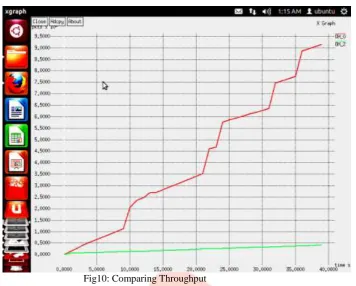
In the fuzzy logic and star algorithm with Leach protocol throughput is compared with other normal leach protocol. The fig 10 shows the throughput of sensor network.
The Table.2 shows the comparison between the Existing system and proposed system. Compared to Existing system the proposed system is increase the Throughput and decrease the Packet Drop Ratio, and Energy usage. The below all parameters are compare at 35 sec time in both Existing system and Proposed system
Table 2: Comparison between Existing and Proposed systems Parameter Existing
System
Proposed System Throughput [kbps] 0.572 7.542
PDR high low
Initial Energy [joules]
70 70
Consuming Energy [joules]
69 41
Remaining Energy [joules]
1 29
V. Conclusion:
In wireless sensor networks where nodes operate on limited battery energy efficient utilization of the energy is very important. One of the main characteristics of these networks is that the network lifetime is highly related to the route selection. Unbalanced energy consumption is an inherent problem in a WSN. To efficiently route data through transmission path from node to node and to prolong the overall lifetime of the network, we proposed a new approach by using a combination of both Fuzzy approach and A-star algorithm with leach protocol. Using this approach gives high throughput and minimum consuming energy of sensor nodes and less packet drop ratio for maximizing network life time.
References:
[1] Y.Y. Shih, W. H. Chung, P.C. Hsiu, and A.-C. Pang, “A mobility-aware node deployment and tree construction framework for Zig Bee wireless networks,” IEEE Trans. Veh. Technol., vol. 62, no. 6,
pp. 2763–2779, Jul. 2013.
[2] L. Karim and N. Nasser, “Reliable location-aware routing protocol for mobile wireless sensor network,” IET Commun., vol. 6, no. 14, pp. 2149–2158, Sep. 2012
IJEDR1703001
International Journal of Engineering Development and Research (
www.ijedr.org
)
615
[4] Kandhalu, K. Lakshmanan, and R. Ragunathan, “Low latency energy efficient neighbor discovery protocol,” in Proc. Of 9hInt. Conf. on processing information in sensor network (PISN), 2010[5] F. Yu, S. Park, E. Lee, and S.H. Kim, “Elastic routing: A novel geographic routing for mobile sinks in wireless sensor networks,” IET Commun., vol. 4, no. 6, pp. 716–727, Apr. 2010
[6] S. AB. Awwad, C. K. Ng, N. K. Noordin and M. F. A. Rasid, “IEEE 802.15.4 Standard MAC protocol for wireless sensor network,” in Proc. Int. Symp. Collaborative Technol. Syst. (CTS), pp. 233–241, 2009.
[7] Jhumka and L. Mottola, "On consistent neighborhood views in wireless sensor networks," in Proc.of the 28th IEEE Symp. on Reliable Distributed Systems (SRDS), 2009.
[8] P.Dutta and D. Culler, “practical neighbor discovery and rendezvous for mobile sensing applications,” in Proc. Of the 6thInt. Conf. on sensor systems (SenSys), 2008.
[9] Dunkels F.Osterlind and Z. He,” adaptive communication architecture for wireless sensor networks,” in Proc. of the 5th Int. Conf. on Embedded Networked Sensor Systems (SenSys), 2007.
[10] A Dunkels, B. Gronvall, and T Voigt, “Low power low cost data rate WPAN,” in Proc. of 1 st IEEE workshop on embedded network sensor (EMNETS-1), 2004.
[11] R Zheng, J. C. Hou, and L. Sha,"Asynchronous wakeup for ad hoc networks," in Proc. of the 4th Int. Symp. on Mobile ad hoc networking & computing (MobiHoc), 2003.