3275
Quality Evaluation In Higher Education: Dynamic
Data Accumulation And Aggregation
Silvia Gaftandzhieva, Rositsa Doneva, George TotkovAbstract: The paper presents a comprehensive approach for quality evaluation of higher education through data accumulation and aggregation. The proposed approach is tested for data accumulation and aggregation for NEAA criteria systems in Bulgaria. For this purpose, the criteria systems that this agency applies for quality evaluation in higher education are analysed. The possibilities for automated data accumulation and aggregation from different university information systems are explored. Experiments have been carried out to automate evaluation and accreditation procedures in a Bulgarian higher education institution.
Index Terms: Data Aggregation. Data Accumulation, Higher Education, NEAA Criteria System, Institutional Accreditation, Quality Evaluation, Monitoring. —————————— ——————————
1.
INTRODUCTION
The external quality assurance in higher education is an important and indispensable component of the Bologna process. In accordance with the priorities and policies of the Bologna process, independent (often more than one) quality assurance agencies in higher education operate in almost all European countries (e.g. Bulgaria - NEAA, UK - QAA, ODLQC, etc.). Today, 51 of these national quality assurance organizations (from 30 countries) are full members of the European Association for Quality Assurance in Higher Education (ENQA). Their systems for quality assurance follow the Standards and Guidelines for Quality Assurance in the European Higher Education Area (ESG) [1]. The Higher Education Law in Bulgaria [2] (Article 11.) defines the legal framework for the existence of the Bulgarian National Evaluation and Accreditation Agency (NEAA). Quality evaluation, accreditation and control in HE (after 2016) is performed by NEAA [3] on the basis of criteria systems, depending on the type of procedure and in accordance with ESG [1] developed by ENQA. The quality evaluation of higher education is based on a large number of criteria for a variety of objects and processes. This requires the processing of huge amounts of data to objective evaluation. Another important point is the requirement that the evaluation has to be carried out periodically and to reflect the results of processes and states of objects in different time periods. Dynamic monitoring of the procedures and activities related to the quality evaluation in higher education involves the collection (on the basis of automated accumulation, aggregation, analysis and interpretation) of a huge amount of data that function or are results of institutional information and management systems of the higher education institution (for the learning process, academic staff development, etc.), learning management systems, digital repositories, etc. Concrete results have been achieved in the field of automation of procedures for (self)assessment and quality management in higher education [4].
For example, the quality management system of the University of Graz (Austria) generates a large amount of data allowing quality monitoring [5]. A web-based application for monitoring of academic performance in real time based on business intelligence and service-oriented architecture has been developed in Indonesia [6]. The system of the Arab International University extracts and aggregates data from quality assurance and management systems for training, human resources and finance [7]. The system generates reports for the implementation of syllabuses, student performance, feedback, etc. A specific feature of these automated systems is the application of specific methods and approaches in computer modelling of procedures and data related to quality evaluation in higher education. In some cases, this is related to the use of different methodologies for quality evaluation and in others to the absence of a common approach to solve the problem of accumulation and aggregation of the various information resources necessary for quality evaluation. In any case, the issue of dynamic monitoring and quality management has not been satisfactorily resolved. An attempt to overcome these problems has been made in [4], where a model and prototype of a system of dynamic quality evaluation in higher education are proposed. On the basis of these results, the paper presents a comprehensive approach for dynamic accumulation and aggregation of data necessary to the quality evaluation in higher education. The proposed approach is tested for data accumulation and aggregation for NEAA criteria systems. For this purpose, analysis of the possibilities for automated accumulation and aggregation of data from university information system which can be used for the evaluation of criteria from NEAA criteria systems have been done. The paper presents in details the performed experiment for data accumulation and aggregation for automated quality evaluation in the case of institutional accreditation of Bulgarian higher education institutions.
2.
APPROACH
FOR
DATA
ACCUMULATION
AND
AGGREGATION
FOR
QUALITY
EVALUATION
IN
HIGHER
EDUCATION
The quality evaluation of objects of higher education is carried out according to adopted evaluation models, presented in different formats - more or less formalized. In all cases, it is expected the areas for object evaluation to be clearly identified and specified, as well as rules, measures and procedures to be formulated, usually in the form of a quality management systems and/or quality evaluations system. Models for quality ————————————————
• Silvia Gaftandzhieva, Assistant Professor, University of Plovdiv “Paisii Hilendarski”, Bulgaria, Email: [email protected]
• Rositsa Doneva, Professor, University of Plovdiv “Paisii Hilendarski”, Bulgaria, Email: [email protected]
3276 evaluation are built on a hierarchical basis. They contain a
number of levels representing components/elements of the object (called standards, criteria, characteristics, etc.). Each quality criteria is associated with a norm (for measurement or comparison), by which the degree of conformity of states and/or results related to the evaluated object is determined in the context of the evaluation. The degree of conformity is evaluated on the basis of evidence (text descriptions or information resources). Information resources (Evidence) containing accumulated data for quality evaluation can be generated in the form of the following 3 types of documents: Type 1. Reports, which by a task that includes parameter values concerning certain aspects, properties, elements, relations and qualities of the evaluated object in the information context, return information resources from the institutional digital repository having the specified metadata; Type 2. Reports with survey results generated using standard survey analysis software;
Type 3. Reports - the result of the work of a specialized software that dynamically generates information-resources (evidence) by scheduling activities and places them in a digital repository for future use. Systems from accumulative functions suitable for attaching to different level from the model for quality evaluation should be designed for the automated accumulation and aggregation of information resources, suitable for attaching and up-to-date for different time periods for the quality evaluation of an object by a model. The set of data obtained as a result of the process of accumulating information resources related to the quality evaluation of a specific object in a time-period can be modelled as an information structure which contains three components. The first component is a computer model of the hierarchical model for quality evaluation of the object which represents the system of components/elements of the object for data accumulation and aggregation for its quality evaluation by a model. These components/elements comply with different level from the quality evaluation model, as to each level can be attached suitable information resources available in different digital repositories. The second component is a set of lists to each component/element from the model identifying information resources located in a repository or in the information infrastructure of the institution. The third component is lists of accumulative functions for all components/elements of the quality evaluation model, including functions for an accumulation of text, information resources from digital repositories, generated reports which depend by a parameter, etc. and a schedule for launching the accumulative functions. On the basis of the computer model of the multiple results of a data accumulation process, when initial times for starting data accumulation activities for individual components/elements from the quality evaluation model are set, these activities should be "started" in absolute time moments. Before starting the data accumulation process, the lists to each component/element contain only references to information sources that are not a product of the current process but are relevant (of interest) to it. Besides the periods to which the quality evaluation procedure will be done and the relative times for the start-up of the accumulative functions, the task for the automated accumulation and aggregation of data necessary for the quality evaluation of the object may also contain additional guidance for the overall organization of the procedure for quality evaluation. The accumulation of data and supporting documents (evidence) must be well organized
before the launch of a specific procedure for quality evaluation of the object. In cases when the relevant procedure has not been planned in advance, the accumulation of data and supporting documents for previous time periods may not be possible. For this reason, when designing possibilities for data accumulation for the evaluated object, special attention should be paid to the development of tools for periodic collection and analysis not only of data relevant to different time periods but also of such data that could later be used to create documents (evidence) for other objects. Experts in the subject area are involved in the process of collecting and creating documents related to data accumulation and aggregation for quality evaluation of the object. When attaching a document to a component/element from the computer model of the quality evaluation model, the expert must confirm the attachment of the information resource (located in the institutional digital repository or information infrastructure). If an information resource that can be attached is not offered for the component/element from different level of the computer model of the quality evaluation model, the expert may create it by using special accumulation functions, for example: to write a text for the indicator via an online co-editing text editor; to write a document and attach it to the component/element from the computer model of the quality evaluation model; to insert link to document, etc. When the monitoring of the object complete, an expert must select the information resources accumulated during the evaluation period. The quality evaluation of the object ends with the automated creation of a final evaluation report. This report is a hypertext document (based on the input from experts) and a list of appendixes with accumulated information resources (located in the digital repository, information infrastructure or external repositories and identified with references to them). After the quality evaluation process is completed, the generated evaluation report is stored in the repository.
3.
DATA
ACCUMULATION
AND
AGGREGATION
FOR
NEAA
CRITERIA
SYSTEM
NEAA performs quality evaluation, accreditation and control of in all higher education institutions in Bulgaria on the basis of the following criteria systems, developed in accordance with ESG [1]:
Criteria system for institutional accreditation [8]; Criteria system for programme accreditation of
professional fields and majors from the regulated professions [9];
Criteria for programme accreditation of doctoral programme [10];
Criteria for evaluation of projects for opening or transformation of a higher education institution [11]; Guidelines and criteria for assessment of distance
learning in a professional field [12];
Criteria for determining/altering the capacity of the higher education institution [13].
3277 information systems (for the management of the learning
process, development of academic staff, human resources, etc.) and how evidence documents can be accumulated automatically from these systems.
Analysis of NEAA Criteria Systems aim to determine: which components of the object (institution) each
indicator evaluates - regardless of its level (standard, criteria, content of criteria);
how norms which measure them get values (quantitatively or by an expert).
These analysis have been made after a thorough examination of NEAA documents and university information systems. For each indicator of different levels (standards, criteria, content of criteria), in accordance with their original numbering from the NEAA Criteria, it is described:
for which components of the evaluated object it relates;
what is the norm for its measurement;
possible evidence for the object (defining the assessment), that may be accumulated from university information systems.
All analysis show that the types of supporting documents (Evidence) which can be attached to indicators from NEAA Criteria are in different forms (their forms are not explicitly mentioned in the analysis):
Elements created by the organizational structure (by members of university centers, units, committees, etc.);
Systems (for management of different activities, testing procedures, quality maintenance and control, university information systems, units’ information systems, etc.);
Groups of subjects (teachers, students, etc.) and objects (educational documentation for the university, units, etc. for a time period);
Documents - Regulations, Reports, Decisions, Orders, Minutes, Surveys, Contracts, Plans, Financial Documents, Implementation of Recommendations from Previous Accreditation, etc.
Results;
Internet resources.
Some types of supporting documents (regulatory documents, systems, etc.) should be created by experts who store them in specially created folder in the digital repository of the institution. Other documents could be accumulated through retrieving data from university information systems (e.g. by users who have permission to generate reports in the reports system). As an example of the conducted analysis in Table 1 is extracted a part of the analysis related to Standard 3. Student-centred learning, teaching and assessment from NEAA Criteria System for Institutional Accreditation [8].
TABLE-1:ANALYSIS OF STANDARD 3.STUDENT-CENTRED LEARNING,
TEACHING AND ASSESSMENT Standard/Criteria/Content of Criteria/Norm
Evidence
3. Student-centred learning, teaching and assessment
3.1. Methodological standards for educational documentation
Standard/Criteria/Content of Criteria/Norm
Evidence
(curricula)
3.1.1. Training material Relevance
Evidence documents (aggregated through retrieving data from university information systems):
1. Report with data for the number of completed procedures for the
development, improvement and approval of academic
documentation;
2. Report with data for number of bilateral agreements with employers to ensure educational practice and internships for the students;
3. Reports with information sources on the training programs and development opportunities, offered by the higher education institution;
4. Analysis of the results of student surveys on the relevance of the training material;
5. Analysis of the results of employer surveys on the relevance of the training materials.
3.1.2. Modern methods and forms of teaching Organization to maintain and develop
Evidence documents (aggregated through retrieving data from university information systems):
1. Report with data for promoted innovative research and innovation performance;
2. Report with data for the use of interactive forms of multimedia products.
3.1.3. Quality of teaching Periodically evaluation
Evidence documents (aggregated through retrieving data from university information systems):
1. Report with results of conducted audits and evaluations of authorities’ decisions about assessing the professional fields. 3.1.4. System of testing procedures
Officially published
Criteria and methods of verification and assessment of students’ knowledge and skills
3.1.5. Procedure for review of students’ complaints Functional
Evidence documents (aggregated through retrieving data from university information systems):
1. Report with number of procedures carried out and decisions on the review of students’ complaints.
Evidence documents (uploaded manually in the repository by an expert):
1. Documents regulating the procedures for the development of educational documentation in the taught educational degrees; 2. Document regulating the administrative control of educational documentation;
3. Minutes of meetings of the managing bodies, which include analyses and solutions to enhance the quality of educational documentation;
4. Documents from committees, which have conducted surveys of the opinions of students and employers on the quality of educational documentation;
5. Officially published system of testing procedures for checking and assessment students’ knowledge and skills;
6. Regulatory administrative control procedures for systems maintenance;
7. Officially provided opportunity for reporting students’ opinions; 8. Regulated system for education quality maintenance and control in higher education institution;
9. Regulatory procedures to evaluate the quality of education in higher education institution and to provide opportunities to make decisions for improvement with the students’ and other stakeholders’ participation; 10. Regulatory provided opportunities to involve students and PhD students in research;
3278 Standard/Criteria/Content of Criteria/Norm
Evidence
12. Rules for handling student complaints;
13. Methods for using modern methods and forms of teaching.
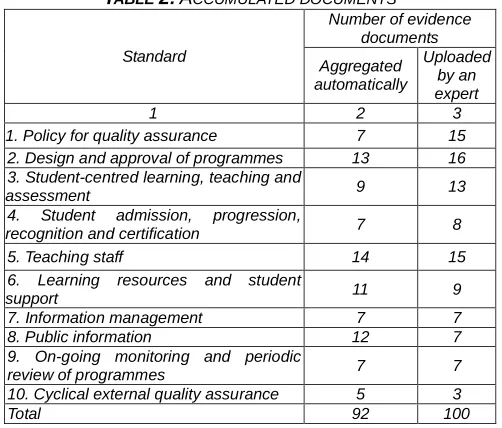
Table 2 presents summary data from the result of the analysis of possibilities for automatically accumulation of evidence documents to support the evaluation of a higher education institution by NEAA criterion system for institutional accreditation. Column 2 presents the number of evidence documents that can be automatically accumulated through accumulative functions which aggregate documents filled out with data retrieved from university information systems. Column 3 presents the number of evidence documents which should be stored in the digital repository by an expert for each standard.
TABLE 2:ACCUMULATED DOCUMENTS
Standard
Number of evidence documents
Aggregated automatically
Uploaded by an expert
1 2 3
1. Policy for quality assurance 7 15
2. Design and approval of programmes 13 16
3. Student-centred learning, teaching and
assessment 9 13
4. Student admission, progression,
recognition and certification 7 8
5. Teaching staff 14 15
6. Learning resources and student
support 11 9
7. Information management 7 7
8. Public information 12 7
9. On-going monitoring and periodic
review of programmes 7 7
10. Cyclical external quality assurance 5 3
Total 92 100
To confirm the conclusions of the analysis, an experiment to accumulate documents from university information systems that could be used as evidence documents has been performed. Software tools have been created through JasperSoft[14]. A digital repository has been developed in which data from the university information systems are accumulated in accordance with NEAA criteria systems. During the monitoring of the object, experts can upload in the digital repository all necessary documents related to the evaluated object.
Figure 1. Digital Repository
All criteria systems have 3 levels. The first level represents
standards, the second level represents criteria and the third level represent the content of criteria. Fig. 1 presents a part of the developed digital repository for NEAA Criteria system for institutional accreditation. Automatically generated evidence documents which aggregate data from university information systems are creating by a set of software tools, designed as templates in JasperSoft Studio design tool. These templates allow retrieving of evaluation data and generating of evidence documents that contain summary information about the NEAA criteria. When the expert launch templates before the procedure for accreditation starts he or she have to set values for all local (e.g. faculty, school year, etc.) and global parameters (e.g. time when the system will generate evidence document by the template). All evidence documents generated by templates are accumulated and stored in the corresponding folders in the digital repository (see Fig. 1). Fig. 2 presents a part of an evidence document generated by aggregation of data from university information systems and stored automatically in the digital repository. This document contains data retrieved from the system for the learning process.
Figure 2. Evidence document
The results of analysis of the other NEAA criteria systems which are not presented in details in this paper are also encouraging.The results show that evidence documents can be dynamically aggregated for the evaluation of a high percentage of their contents of criteria, e.g.:
86% of the contents of criteria from the NEAA Criteria system for programme accreditation of professional fields and majors from the regulated professions can be evaluated on the basis of 62 accumulated documents with aggregated data from university information systems;
82% of the contents of criteria from the NEAA Criteria system for programme accreditation of doctoral programme can be evaluated on the basis of 36 accumulated documents with aggregated data from university information systems;
87% of the contents of criteria from the NEAA Guidelines and criteria for assessment of distance learning in a professional field can be evaluated on the basis of 64 accumulated documents with aggregated data from university information systems.
3279 management in higher education, oriented towards meeting
the NEAA criteria.
4.
CONCLUSION
The application of the proposed approach would increase the efficiency of the evaluation process and the reliability of the results obtained. The conducted experiment proves the benefits from the application of the developed model for dynamic data accumulation and aggregation for quality evaluation in higher education, specified in the case of institutional accreditation of higher education institutions in Bulgaria. On the one hand, the proposed approach can be applied to evaluate the quality of each higher educational institution in Bulgaria. In this case, some changes related to the information systems used in the institution can be made. On the other hand, due to the fact that the model is tested with NEAA Criteria system developed in accordance with ESG and all members of ENAQ should develop their evaluation systems on the basis of ESG, the proposed approach can be easily adapted to evaluate the quality according to quality criteria of all other members of ENQA. In the future, research will focus on the design and development of a comprehensive dynamic quality management system for retrieving and processing data from a university information infrastructure.
5
REFERENCES
[1] Standards and Guidelines for Quality Assurance in the European Higher Education Area (ESG), ISBN: 978-9-08-168672-3, Brussels, Belgium, 2015, pp. 32. [2] Higher Education Law, State Gazette, No. 98, 2018. [3] NEAA, https://www.neaa.government.bg.
[4] S. Gaftandzhieva, R. Doneva, G. Totkov, “Dynamic Quality Evaluation in Higher Education”, TEM Journal, Vol. 7, Iss. 3, pp. 526-542, 2018.
[5] FINHEEC, Audit of the University of Graz, ISBN 978-952-206-236-9, 2013.
[6] Wisnubhadra., “Service Oriented Business Intelligence for Monitoring Academic Quality”, Proc. of the 2nd Intern. Conf. on DEI, ISBN: 978-0-9853483-5-9, pp. 136- 143, 2013.
[7] F. Diko, Z. Alzoabi, F. Alnoukari, “Enhancing Education Quality Assurance Using information Systems-QAAS System”, Intern. Symposium on Information Technology, ITSIM 08, 2008.
[8] NEAA, Criteria for institutional accreditation in accordance with ESG Part 1(1-10) and pursuant to
Art. 77, Para 2 of HEA,
https://www.neaa.government.bg/images/Criteria_EN/ Kriterii_IA_EN.pdf, 2016.
[9] NEAA, Criteria for program accreditation of a professional field / major of the regulated professions in accordance with ESG- Part 1 (1-10) and pursuant
to Art. 78, para. 3 of HEA,
https://www.neaa.government.bg/images/Criteria_EN/
Kriterii_PN_SRP_EN.pdf, 2016.
[10] NEAA, Criteria for Programme Accreditation of Doctoral Programmes in Accordance with ESG - Part 1 (1-10) and pursuant to Art. 78, para. 3 of HEA, https://www.neaa.government.bg/images/Criteria_EN/
Kriterii_ONS_EN.pdf, 2016.
[11] NEAA, Criteria for evaluation of projects for opening and transformation of Higher Education Institutions (HEI) in accordance with ESG - Part 1 (1-10) and
pursuant to Art. 81, para. 6 of the HEA, https://www.neaa.government.bg/images/Criteria_EN/
Kriterii_proekt_otkrivane_VU_EN.pdf, 2016.
[12] NEAA, Guidelines and Criteria for assessment of distance learning in a professional field, https://www.neaa.government.bg/images/Criteria_EN/
Kriterii_DFO_EN.pdf, 2016.
[13] NEAA, Criteria for determining/altering the capacity of the higher education institution, https://www.neaa.government.bg/images/Criteria_EN/
kriterii_kapacitet_eng.pdf, 2016.