Design Of Mathematical E-Module Based On
Inquiry Learning Model To Stimulate The Creative
Skills
Syaiful Nur Aziz, SuparmanAbstract: Creative thinking is one of the essential skills students must have in 21st-century learning. Creative thinking skills also affect students in solving PISA questions. Teaching material that does not stimulate students' creative thinking skills can have an impact on the ineffectiveness of achieving educational competence. This article aims to design an E-learning Module that can encourage students' creative thinking skills. The research in this article uses the ADDIE development model (Analysis, Design, Development, Implementation, and Evaluation). The development procedure in this article is limited to two stages, namely analysis, and design. The research subjects were teachers, and students of class X IPA Ali Maksum Krapyak High School. Research objects include creative thinking skills, e-modules, and inquiry learning models. The research instrument used test questions, questionnaires, and interview guidelines. The data analysis technique used is qualitative. Research results obtained include a) In the analysis phase, the results obtained, students' creative thinking skills are still relatively low. This is because students have difficulty in learning material from existing learning resources. Besides, the learning methods used in classrooms are still classical, so students only receive content from the teacher in the same direction. The inquiry learning model is a learning model that can stimulate students' creative thinking skills. b) At the design stage, the results are obtained, the design of E-Module mathematics learning based on inquiry learning models to stimulate students' creative thinking skills. This research can be extended into the stages of development, implementation, and evaluation to produce E-Modules of mathematics learning that are feasible to use, practical, and effective.
Index Terms: Creative Thinking, E-Module Design, Inquiry Learning Model.
—————————— ——————————
1 INTRODUCTION
Creativity can be defined as a person's ability to create various alternative answers to solve problems [1] [2]. While creative thinking is a series of individual cognitive activities to find multiple solutions to the issues obtained [3] [4]. The hallmark of creative thinking is the creation of something new from an idea achieved and applying the concept [5] [6].According to the Law of the Republic of Indonesia, one of the goals of national education is to develop the ability of students to become creative humans. Wardono et al. [7] conveyed, students who have creative thinking skills will gain individual success. Therefore, learning in the 21st century must be carried out and planned to improve students' creative thinking skills [8]. Mathematics is one of the subjects that allow students to learn a lot about creativity [9]. Akgul and Kahveci [10] convey, solving various forms of mathematical problems, can foster students' creativity. Creative thinking on mathematics can also demonstrate the ability of the level of thought and mathematical knowledge of these students [11]. Besides the students' creative mathematical thinking skills, it is very influential in solving PISA questions [12]. The results of the PISA study published by the OECD, 2015, put Indonesia in 63rd place out of 70 countries [13]. While the data obtained from TIMSS [14] shows that Indonesian students ranked 45th out of 50 countries participating in the TIMSS study. Inquiry learning strategy is a useful learning model used in modern learning [15]. Besides being proven to be able to improve the quality of education [16], the inquiry learning model is an alternative learning model that can motivatestudents and is oriented to enhance the ability to think creatively [17]. Duran and Dokme [18] conveyed that the inquiry approach made students more active in the learning process because the inquiry approach was student-centered. The inquiry allows students to make decisions about the problems they are investigating, helping move them towards meaningful engagement and deeper learning [15]. Inquiry learning is a process that provides opportunities for students to be actively involved in learning activities [19]. The inquiry experience will help students become more comfortable in learning science [20]. Increased student activity in inquiry learning occurs in conducting investigations, answering, responding, expressing ideas, and drawing conclusions based on solutions obtained from problem-solving [17]. In the inquiry learning process that will be carried out, media/teaching materials are needed that can support the learning process. Based on an assessment of learning resources/teaching materials used by teachers in a school, the authors found several findings. First, learning resources/teaching materials used have not yet led to inquiry learning models. Second, learning resources/teaching materials used have not, however, fostered students' creative thinking skills.On the other hand, the authors also provide tests to determine the level of students' creative thinking skills. The test results show that the level of creative thinking skills of most students is still relatively low. Questionnaires are also given to students to find out material that is considered difficult by students. Results of the survey, it was concluded that the trigonometric content of the subject of the related angles was material that was deemed to be difficult for most students. Dewi and Harahap [21] said that the development of appropriate teaching materials would encourage students to develop students' creative mathematical thinking skills. Modules are teaching materials that can be considered as one of the right media, which can be used in the learning process [22].This article aims to clarify several questions. First, the module design is by the inquiry learning model and can foster students' creative thinking skills. ___________________________________________
Syaiful Nur Aziz is currently pursuing a master's degree program in Mathematics Education at Ahmad Dahlan University, Indonesia, PH-+6281225288050. E-mail: [email protected]
Suparman is an associate professor in Mathematics at Ahmad Dahlan University, Indonesia, PH-+6281328201198. E-mail:
4807 Second, to produce module designs that are feasible to
develop. This article has four parts. The first part contains a description of the introduction. The second part includes the discussion of research methods. The third part consists of the presentation of research results and discussion. The fourth part contains conclusions.
2
RESEARCH
METHODS
This article is part of development research to produce an E-Module design with inquiry learning models to stimulate students' creative thinking skills. The development model used is the ADDIE model, which consists of 5 stages, namely: analysis, design, development, implementation, and evaluation [23],[24],[25],[26],[27],[28], as in figure 1 :
Figure 1. ADDIE Model
This article is limited to the analysis and design phase. In the analysis phase, the authors analyze the needs of students about learning modules with inquiry learning models to foster creative thinking skills. To find out this, the author interviewed the teacher. Interviews were conducted to find out the learning model, advantages and disadvantages of the teaching materials used, as well as the characteristics of students. Besides, the authors also distributed questionnaires to students to find out the level of learning difficulties and the need for learning media. At the design stage, the writer designs the objectives of the learning to be achieved, and the model of learning activities to be carried out, and the selection of media to be used. The design phase in this study was carried out through a product preparation framework (teaching material), namely the E-Module. Some experts will validate the product in the form of teaching material design. The validation of the model of teaching materials was carried out to provide assessment and input as revised materials so that the teaching materials were appropriate and of good quality. The research process in this article was conducted at Ali Maksum Krapyak High School. The research subjects were teachers and students of Ali Maksum Krapyak High School. Qualitative data analysis techniques used in the research in this article. Data is reduced, presented, then conclusions drawn. Data obtained from the results of questionnaires, tests,
and interviews conducted at school are then summarized and concluded.
3 RESULT
AND
DISCUSSION
3.1. Analysis Phase
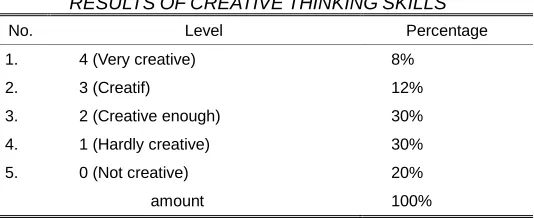
The data analysis phase is carried out with a theoretical and empirical analysis of the needs of students about learning modules with inquiry learning models to stimulate creative thinking skills. The observations and interviews conducted show that the learning process is still conventional. Students only get knowledge from what is explained by the teacher classically. The teacher has not implemented a learning model that can facilitate students to participate in learning activities actively. Besides, the learning process carried out has not been able to stimulate students' creative thinking skills. The results of tests of creative thinking skills that have been carried out in the previous stages are stated in the following table 1 :
TABLE1
RESULTSOFCREATIVETHINKINGSKILLS
No. Level Percentage
1. 4 (Very creative) 8%
2. 3 (Creatif) 12%
3. 2 (Creative enough) 30%
4. 1 (Hardly creative) 30%
5. 0 (Not creative) 20%
amount 100%
From table 1, it can be seen that 80% of students have not yet entered the creative or very creative level; even 20% of them are classified as not creative. This shows the students' creative thinking skills are still quite low. 20% of students who are classified into the primary level and are very creative are students who are generally quite talented in mathematics learning activities in the classroom. This is consistent with research by Klavir and Gorodetsky [29], namely: 1) Talented students tend to be more creative than their peers. 2) Their creativity is very prominent in tasks that involve thinking.From interviews with teachers, several results were obtained, first, KI and KD from handbooks that were following the material. Second, the existing guides are felt to be still lacking in facilitating students to be able to foster students' creative thinking skills. This is because the language and thinking flow of the book cannot be/challenging to understand by students well. Third, according to the teacher teaching material that can foster creative thinking skills, among others: 1. Easy to understand by students; 2. Students get learning experiences that are more than the teaching materials provided; 3. Teaching materials based on e-modules, not just print, so students are more interested in learning mathematics; 4. Teaching materials are following learning models that are oriented to fostering students' creative thinking.
3.2. Design Phase
compiled:
3.2.1 E-Module Cover
The E-Module cover is made more colorful and with attractive images so that students are motivated to learn the material presented. The E-Module cover is formed, as shown in the following figure 2 :
Figure 2. E-Module Cover
3.2.2 Instructions for the use of E-Modules
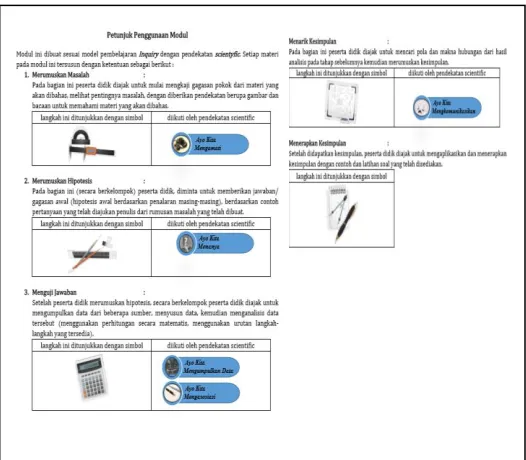
The E-Module Usage Guide is made as a guide for students to use the E-Module based on the steps in the inquiry learning model, as in figure 3 :
Figure 3. Instructions for the use of E-Modules
3.2.3 Basic Competence and Learning Objectives
Essential competencies are designed as a reference for students about what must be achieved in studying the material in the E-Module. While learning objectives are made as learning outcomes that are expected to be owned, or mastered by students after studying the material in the E-Module. Essential Competencies, and Learning Objectives,
arranged as shown in the following figure 4 :
Figure 4. Basic Competence and Learning Objectives
3.2.4 Motivation
Motivation sheets are made as an initial description of the material presented in the E-Module. Motivation sheet is equipped with illustrations in the form of comic drawings, so that students are increasingly interested in learning the material in the E-Module, as in figure 5 :
Figure 5. Motivation
3.2.5 Learning Materials
Learning materials are arranged in more detail and communicative and equipped with a scientific approach. The design used is more colorful, so it is expected to foster students' creative thinking skills. The learning material in this E-Module is made according to the inquiry learning model, with the following steps [30]:
1. Formulate the Problem:
4809 2. Formulate Hypothesis:
In this section (in groups) students, are asked to provide ideas / initial ideas (hypotheses) based on sample questions that have been raised from the formulation of the problem.
3. Test the answers:
After formulating hypotheses, groups of students are invited to collect data from several sources, compile data, then analyze the data (using mathematical calculations, using a sequence of steps available).
4. Conclude:
In this section, students are invited to look for patterns and meaning of relationships from the results of the analysis in the previous stage then formulate conclusions.
5. Application / Application of Conclusions:
After getting findings, students are invited to apply and apply conclusions with examples and exercises that have been provided.
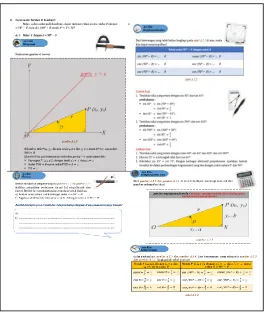
The form of learning material that fits the inquiry steps is presented, as shown in figure 6 :
Figure 6. Learning Materials
3.2.6 Examples and Practice Questions
The discussion in the example questions is made with various alternative solutions, as information material for students in doing the problem exercises. The problem exercises are used to determine students 'mastery of the document and to measure students' creative thinking skills by following indicators of fluency, flexibility, and novelty [31]. Examples and practice questions are made, as in figure 7 :
Figure 7. Examples and Practice Questions
Validation by experts was also carried out on the following E-Module designs, as a correction material for the weaknesses and strengths of the E-Module model. Besides, validation is done in the hope that the E-Module will be made feasible to use, more practical, and useful. Here are some validation results from experts.
TABLE 2
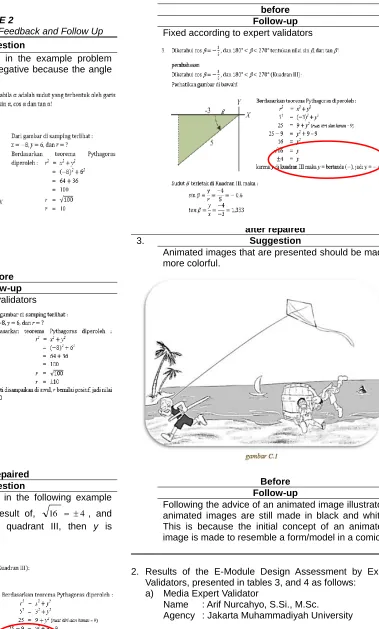
Validator Suggestions and Feedback and Follow Up
No. Suggestion
1. The discussion presented in the example problem follows: tan α should be negative because the angle
α is located in quadrant II
before Follow-up Fixed according to expert validators
after repaired
2. Suggestion
The discussion presented in the following example
problem: should be the result of, 16 4, and because y is located in quadrant III, then y is negative, then y = 4
before Follow-up Fixed according to expert validators
after repaired
3. Suggestion
Animated images that are presented should be made more colorful.
Before Follow-up
Following the advice of an animated image illustrator, animated images are still made in black and white. This is because the initial concept of an animated image is made to resemble a form/model in a comic.
2. Results of the E-Module Design Assessment by Expert Validators, presented in tables 3, and 4 as follows:
a) Media Expert Validator
Name : Arif Nurcahyo, S.Si., M.Sc. Agency : Jakarta Muhammadiyah University
TABEL 3
Results of the Media Expert Validator Assessment
4811 1 A Content Feasibility 17
2 B Presentation Feasibility 21 3 C Feasibility of Graphic 54
Average 30,67
Amount 92
Cumulative Criteria Very good
b) Material Expert Validator Name : Annisa Amalia, S.Pd.
Agency : Muhammadiyah 1 Yogyakarta High School
TABEL 4
Results of Assessment of Material Expert Validators
No.
Statement Item Total
Validator Score aspect
1 A Content Feasibility 46
2 B Linguistic 12
3 C Presentation Feasibility 15
4 D Conformity to the Inquiry
Learning Model 19
Average 23,00
Amount 92
Cumulative Criteria Good
4 CONCLUSION
The existing learning process has not been able to stimulate students' creative thinking skills. This is because the learning methods used by teachers in classrooms are still classical, so they have not been able to facilitate students to be able to think creatively. Besides, existing learning resources are also not able to foster students' creative thinking skills because most students still have difficulty in using these learning resources. The test results also show that there are still many students whose creative thinking skills are still relatively low. The inquiry learning model is a learning method that can stimulate students' creative thinking skills.Following the ADDIE development research model, this article can be developed in the development of learning resources in the form of E-Modules based on inquiry learning models. The e-Module to be extended also integrates students' creative thinking skills. From the results of expert validation, the design of the E-Module belongs to the first category, with a total score of 92 from the media aspect. While from the material element, the E-Module design is classified in both groups, with an overall rating of 92.
5
ACKNOWLEDGMENT
The author would like to thank profusely, the first to Ahmad Dahlan University, for providing opportunities and motivation, as well as facilitating the authors in completing this article. Second, to the school, Ali Maksum Krapyak High School teachers and students who have assisted in writing this article. Third, to the expert validators who have taken the time to validate the instruments in the E-Module design, with the hope that the E-Modules will be developed to be better.
6
REFERENCES
[1] F. Maulidia and R. Johar and Andariah, "A Case Study Of Students' Creativity In Solving Mathematical Problems Through Problem Based Learning", Infinity Journal of Mathematics Education, Volume 8, No. 1, February 2019. [2] S. Ridho and N.S. Aminah and A. Supriyanto, "The Effects of
Creativity and Student-Teacher Interaction on Scientific Literacy Skill", 5th ICRIEMS Proceedings, Published by Faculty Of Mathematics And Natural Sciences Yogyakarta State University, 2018.
[3] B. Birgili, "Creative and Critical Thinking Skills in Problem-based Learning Environments", Journal of Gifted Education and Creativity, 2 (2), 71-80. 2015.
[4] H. Susanti, et al., "How to Improve Students' Creative Thinking Skills In Learning Prism Nets Through Problem-Based Learning", International Journal of Scientific Research and Management (IJSRM), Vol. 5, Issue. 08, Pages. 6789-6793, 2017.
[5] T.Y.E. Siswono, "Identifying Creative Thinking Process Of Students Through Mathematics Problem Posing", International Conference on Statistics and Mathematics and Its Application in the Development of Science and Technology, Bandung Islamic University, October 4-6, 2004. : https://www.researchgate.net/publication/282946292
[6] T.C. Bayuni and H.K. Surtikanti and W. Sopandi, "Identification Creative Thinking Skills in Primary School", International Conference on Mathematics and Science Education of Universitas Pendidikan Indonesia. Volume 3, 2018.
[7] W.S.B. Wardono and M.S. Scolastika and D. Candra, "Mathematics Literacy on Problem Based Learning with Indonesian Realistic Mathematics Education Approach Assisted E-Learning Edmodo", Journal of Physics, Conference Series 693, 2016.
[8] S. Srikoon and T. Bunterm and T. Nethanomsak and K.N. Tang, "Effect Of 5p Model On Academic Achievement, Creative Thinking, And Research Characteristics", Kasetsart Journal of Social Sciences, 39, 488-495, 2018.
[9] K. Brunkalla, "How To Increase Mathematical Creativity-An Experiment", The Mathematics Enthusiast, 6(1), 257-266, 2009.
[10]S. Akgul and N.G. Kahveci, "A Study on the Development of a Mathematics Creativity Scale", Eurasian Journal of Educational Research, 62, 57-76, 2016.
[11]R. Klavir and S. Hershkovitz, "Teaching and Evaluating 'Open-Ended' Problems", International Journal for Mathematics Teaching and Learning, 20 (5), 23. 2008.
[12]R. Novita and M. Putra, "Using Task Like Pisa's Problem To Support Student's Creativity In Mathematics", Journal on Mathematics Education, Volume 7, No. 1, pp. 31-42, January 2016.
[13]N. Aini and Suparman, "Development of PISA-Like Mathematics Tasks Design of Change And Relationship Content to Assess Mathematical Representation Skills", Asian Journal of Assessment in Teaching and Learning, Vol 9, Issue 1, 28-36, 2019.
[14]TIMSS, International Results in Mathematics, 2015.
[15]Buchanan, et al., "Inquiry-Based Learning Models, Information Literacy, And Student Engagement", School Libraries Worldwide, 22(2), pp. 23-39. 2016.
[17]Kadir and Lucyana and G. Satriawati, "The Implementation of Open-Inquiry Approach to Improve Students' Learning Activities, Responses, And Mathematical Creative Thinking Skills", JME Journal on Mathematics Education, volume 8, no. 1, pp. 103-114, January. 2017.
[18]M. Duran and I. Dökme, "The Effect Of The Inquiry-Based Learning Approach On Student's Critical-Thinking Skills", Eurasia Journal of Mathematics, Science & Technology Education, 12(12), 2887-2908, 2016.
[19]Yumiati and M. Noviyanti, "Analysis Of Mathematics Representation Ability Of Junior High School Students In The Implementation Of Guided Inquiry Learning", Infinity Journal on Mathematics Education, volume 6, no. 2, pp. 137-148, September. 2017.
[20]L.H. Barrow, "Encouraging Creativity with Scientific Inquiry", Journal Creative Education, 1, 1-6, 2010.
[21]I. Dewi and M.S. Harahap, "The development of geometry teaching materials based on constructivism to improve the student's mathematic reasoning ability through cooperative learning jigsaw at class VIII of SMP Negeri 3 Padang Sidimpuan”, J. Educ, Pract. 7, 68–82, 2016.
[22]D. Zulyadaini, "A Development of Student's Worksheets Based on Contextual Teaching and Learning", IOSR Journal of Mathematics, 13(01). 3038, 2017.
[23]M. Molenda, "In Search Of The Elusive Addie Model”, International Society for Performance Improvement, vol. 54, no. 2, February 2015.
[24]I. Andriani and Suparman, "Design Of Module To Increasing Critical Thinking Ability For Seventh Grade Students", International Journal of Scientific and Technology Research Vol. 8, Issue 12, pp. 853-856, 2019.
[25]L. Anggraeni and Suparman, "Design Of Mathematics Module Based On Guided Discovery To Train Student Creativity", International Journal of Scientific and Technology Research Vol. 8, Issue 11, pp. 3896-3899, 2019.
[26]S. Suprotun and Suparman, "Development Learning Design Lift Material Flap With Character Education To Improve Problem Solving Abilities", International Journal of Scientific and Technology Research Vol. 8, Issue 12, pp. 2806-2810, 2019.
[27]N. Puspandari and Suparman, "Design Of Mathematics Learning Multimedia Base On PBL Model To Improve Student’s Creative Thinking Skill", International Journal of Scientific and Technology Research Vol. 8, Issue 12, pp. 486-489, 2019.
[28]F. Marian and Suparman, "Design of Student Worksheet Based On Discovery Learning to Improve the Ability of Mathematics Reasoning Students of Class VII Junior High School", J. Phys.: Conf. Ser., Vol. 1306, No. 012036, 2019. [29]R, Klavir and M, Gorodetsky, "Features of Creativity as
Expressed in the Construction of New Analogical Problems by Intellectually Gifted Students", Journal Creative Education, Vol.2, No.3, 164-173, 2011.
[30]Unesco Regional Office for Education in Asia and the Pacific, " Teaching Methodologies for Population Education", 1986. [31]T.Y.E. Siswono, "Level Of Student's Creative Thinking In