© 2016 IJSRST | Volume 2 | Issue 6 | Print ISSN: 2395-6011 | Online ISSN: 2395-602X Themed Section: Science and Technology
RFID Student Navigation System
Rumana Anjum , Vijaya Kamble
1
M.Tech, Department of Computer Science, Gurunanak Institute of Engineering and Technology, Nagpur, Maharashtra, India
2
Senior Lecturer, Department of Computer Science, Gurunanak Institute of Engineering and Technology, Nagpur, Maharashtra, India
ABSTRACT
As a result of the challenges of the manual method of taking attendance in schools and colleges in Nigeria, an automated attendance system needs to be adopted. The challenges include difficulty in keeping the attendance list over a long period of time, unnecessary time wastage during writing or signing, improper documentation, students forgetting to write or sign the attendance paper, lecturers forgetting the attendance list in the classroom, students writing or signing illegally for an absentee among others. This paper implements Radio frequency identification (RFID) automatic attendance system in GNIET institutions which provides the functionalities of Admin login, registering students, Lecture Time Table, recording attendance, This work eradicates the deficiencies associated with the manual attendance system with an automated approach implemented through Radio frequency identification (RFID) technology
Keywords: GNIET, RFID, 89S52 Microcontroller, CMOS, IC, UART, RF
I.
INTRODUCTION
Traditionally the attendance at an establishment is usually done in a book or register. It is time consuming. It is very difficult to verify the attendance over long periods. This method is very time consuming and very difficult to verify the attendance over a week or above. Keeping attendance registers is space consuming. Here chances of doing malpractice in marking attendance are high. RFID based attendance system uses RFID tags for each person. A person marks the attendance by swiping the tag near RFID reader module and the message will be send whenever the card is swept or any attendance is marked.
Attendance monitoring is very simple. This System assigns a unique id for each card given to Students. A Student places the RFID card in the RFID card Reader. The RFID card Reader reads down the Student details. The Interface software is responsible to control the marking of attendance in the software. The holding capacity (number of Students) depends upon the
memory interfacing, i.e., whether interfacing with PC or separate RAM units. This project is implemented using RFID card reader, 89S52 microcontroller and monitor is used to display the tag details
Without a line of sight from the reader; In any orientation to the reader; Several at a time
To eradicate the deficiencies associated with the manual attendance system, an automated approach is implemented through Radio frequency identification (RFID) technology.
taking the course examination, if the class attendance percentage is less than 60.
II.
METHODS AND MATERIAL
1. RFID Technology
Radio frequency identification (RFID) is a technology that transmits data using radio waves from an RFID tag attached to an object by the reader for tracking and identifying objects [5]. RFID system contains two main components; the reader and the tags. The tag is normally attached to the objects to be monitored and carries information in a microchip. The reader on the other hand detects tags that are within it frequency range and writes to or read from the tags [2].
1.1.The RFID Tag
The RFID tag is primarily is a kind of a memory device that can transmits its contents when being scanned by the reader. The memory consists of binary digits called the bits, and the transmission and receiving of data has a communication channel. The tag can be an electronic circuit with its own power supply (an active device) or a very low power integrated circuit (passive device) which taps energy from the scanner to transmit its content. In a tag, the transmission power is very low and is measured in millionths of watt i.e. microwatts [1]. Tag can be passive, semi-passive or active. It can also be categorized based on memory type and based on the transmission channel. Passive RFID tags have no internal energy source; energy supplied to the antenna by the incoming radio frequency waves induced enough energy for the CMOS integrated circuit in the tag to get activated and transmits a response. The semi passive tag is similar to passive tag, but has an addition of small power source (battery). This battery constantly powers the integrated circuit of the tag and the need for an aerial to tap energy from the incoming signal is removed [3]. Active tags have their own internal energy source which supplies energy for the integrated circuit producing the outgoing signal. They are more sophisticated and reliable due to their ability to conduct a session with the reader. As a result of their onboard energy source, they can transmit at a higher power level than passive tags, allowing them to be of more effective in RF challenged environments such as water, metal or at longer distances.
They can transmit signal over a greater distance and their random access memory (RAM) gives them the ability to store up to 32,000 bytes of data. A battery can live up to 10 years and have practical ranges of hundreds of meters. Types of tags that were used in the RFID system are ISO card, clamshell card and also soft label. Tag used in this project is passive tag and the model of RFID reader is RFIDIDR-232N [2].
1.2.The RFID Reader
The RFID reader sends a pulse of radio waves to the tags and listens for its response. The tag detects this pulse and sends back a response; the tag ID number and possibly other information as well [4]. The RFID reader can be classified based on the design and technology used (read or read-write) or based on the fixation of the device [5]. The read only RFID reader only reads data from tags, usually a microcontroller based unit with a wound output coil, peak detector hardware, comparators and firmware which are designed to transmit energy to tags and read information back from them by detecting their backscattering modulation, different types for different protocols and standards existing. The read/write reader reads data from/to tags. While in stationary reader, the device is attached in a fixed way.
2. Review of Related Works
handheld RFID reader respectively. In the electronic platform, the attendance management system depicts a simple client (antennae placed at classroom entrance) /server (privileged student database) system. Students can visually see their names as they entered class on the screen and they are assured that their presence has been entered in the instructor’s database. However, one important drawback about this system is the RFID tag read rates degrade tremendously as it comes closer to electronic devices. Authors in [6] also reviewed and proposed biometric system using fingerprint identification for attendance automation of employees in an organization. Consequently, authors in [7] proposed student wolf pack club tracking system to simplify and speed up the process of student wolf pack club ticket distribution for athletic event. Our proposition emphasizes a simple, reliable and cost effective model for face to face classrooms’ attendance management that uses existing student ID card chip as the passive tag with additional short message services to parents as weekly summary.
III.
RESULT AND DISCUSSION
1. System Architecture and Implementation
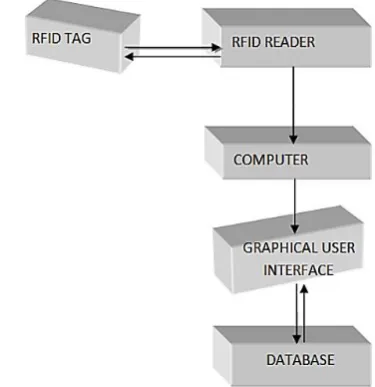
The development of the RFID based automatic attendance system is divided into two main parts; the hardware and software. The hardware part consists of the RFID reader, tags and the host computer. The software part is the host system application designed using VB.net incorporated with Microsoft access database. Administrator or lecturer can login into the system and check necessary information in the application, which keeps a log of the ID, time and date of every student that enters the lecture room for lecture. It also can register new student using the tag ID of each tag. In connecting the RFID reader to the PC, UART is incorporated by through the RS-232 (Serial Port) cable. The complete system (see Figure 1) is placed at the entrance door of the lecture room [11].
A RFID tag is given to each student in the department (which is embedded into their ID cards) and this is scanned at the entrance of the lecture room by the reader. The RFID contains a unique code that is scanned by the reader. On every scan by the student, the name, matriculation number of the student, the course to be
taken and the date are displayed on the user interface if the tag number matches that which is stored in the database.
Figure 1. Overview of the RFID Student Navigation System
2. Implementation
The RFID system was successfully integrated with graphic user interface on the host system. The system consists of login form, admin form, database form, main menu form, class record form, and admin registration form and database record form interface using USB UART serial communication with the RFID reader. The system performs two main functions which are class attendance system and students’ evaluation for eligibility to sit for examination.
2.1 Graphical User Interface
The graphical user interface is created with visual basic 2010 and it consists of the database system used to store all the student details, date and time. There are seven tables built in Microsoft Access database to store the RFID based automatic attendance system’s information. There are eight frames designed in vb.net/C# which are frame login, class record, admin, database, student evaluation, admin registration, student record and course record.
2.2 Login Window Form
The administrator needs to create his user name and password to log in this system. Therefore, the administrator needs to key in the correct username and password to access this system and can quit this system by clicking the exit button to turn off the system. The administrator can make selection either to login to the admin page or attendance page.
2.3 Main Window Form
When the administrator login to the software, he can register students, edit, update or delete student’s information at any time. From this form, he can register new Lecturers and edit, update or delete their respective information. He also has rights to set time of each lectures and breaks in the college. With this form, he can mark attendance of each student also. At any time administrator can close the application by selecting Exit option from the Application Menu on the Main Form.
2.4 Add / Edit / Delete Student
The login window is built with tightened security which allows only authenticated person to access this system. The administrator needs to create his user name and password to log in this system. Therefore, the administrator needs to key in the correct username and password to access this system and can quit this system by clicking the exit button to turn off the system. The administrator can make selection either to login to the admin page or attendance page.
2.5 Add / Edit / Delete Lecturers / Faculties
Clicking Faculties button, faculty details form is opened, where new faculty / lecturer can be registered with their respective rfid card tags. Here, the user of the application can search, edit, update or delete a lecturer / faculty, if required.
2.6 Edit Lecture Time Table
Clicking this button, Lecture Time Table form is opened where the user can change the time schedule of the college.
2.7 Mark Attendance
This form is most important in our project. Here, rfid card is used to mark attendance of a student. When the administrator opens this form, the student is asked to show his rfid card to the rfid reader module. Here, rfid reader module reads the rfid card of the student, searches in the database for its existence by using sorting algorithm and when it finds the card registered, his entry and exit time is marked into the database. Depending upon the time of the attendance, his attendance for the respective lecture is marked.
IV.
CONCLUSION
The design and implementation of a RFID based automatic attendance system which is the aim and objective of this paper was successfully implemented. This system provides an effective and more convenient method of taking attendance when compared to the manual system. Data are more organized, the system is user friendly, data manipulation and retrieval is done via the graphical interface. The system can be implemented in any educational institution.
V.
REFERENCES
[1] N. Amiyana and M. Alias, "Attendance and Access Control System Using RFID System", (2011).
[2] C. E. Geoffrey, "Automatic Access Control System using Student's Identification Card based on RFID Technology", Unpublished Thesis Faculty of Electrical Engineering, University of Teknologi Malaysia, (2012).
[3] M. P. V. Mojares, G. A. T. Litan and J. G. Mojares, iNotified: An SMS and RFID-Based Notification System of Lipa City Colleges", Journal of Applied Global Research, vol. 6, no. 18, (2013).
[4] B. M. Stephen, E. S. Sanjay and R. W. John, "RFID Technology and Applications", Cambridge University Press, (2008).
[5] www.rfid.org.
[6] Maltoni D, D. Maio, A. K. Jain, S. Prabhaker (2003),"Handbook of Fingerprint Recognition", Springer, New York, Pp 13-20.
[8] Liu C.M and Chen L.S (2009), "Applications of RFID technology for improving production efficiency in an Integrated-circuit packaging house," International Journal of Production Research, vol 47, no. 8, pp. 2203- 2216.
[9] RFID SensNet Lab (2005), A white paper on automatic Attendance System. Texas A & M University, Texas, USA.
[10] Nambiar A.N. (2009)," A supply chain perspective of RFID Systems", World Academy of Science, Engineering and Technology Journal, Volume 6, pp15.