Students’ Perception Of Engineering Programs;
Case Study Of Students In Wa Polytechnic
Vitus M. Tabie, Adams Yunus
Abstract: The low enrolment in engineering programs in Wa Polytechnic in the upper west region of Ghana is obviously traceable to people’s perception about technical and vocational education and training (TVET). As a result of this, the study identified some perceptual variables affecting the enrolment in engineering programs. It also explored the influence of Engineering Lecturers/personnel and graduates on the student’s perception over engineering. Random sampling method was used for the study. A sample size of 80 respondents was used. The study was limited to the respondents in Wa Polytechnic. The statistical tools employed for analysis were SPSS and basic excel tools. The study reveals that Wa Polytechnic students believe technical and vocational education is important for national development and they are highly motivated to pursue study in engineering. However, they think Wa Polytechnic need to improve on hands-on or practical training. In line with the findings of the study, the summary, conclusion and recommendations were put forward by the researcher for the Polytechnic and interested stakeholders in the area of resource mobilization.
Key Terms: Perception, Engineering programs, Technical and vocational education (TVET), Polytechnic education.
————————————————————
1 INTRODUCTION
Recruitment of people with the necessary skill and ability is significant to the development of any enterprise or organization. Technical and vocational education (TVET) is a major agent for industrial development and economic and social progress of any country [1]. Eventhoughenrolment at basic and second cycle institutions has increased
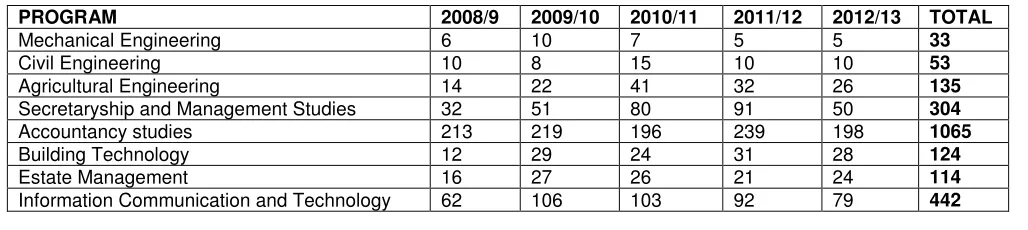
tremendously over the years, Technical and vocational programs still battle with low enrollment. Growing numbers of students are opting for studies in Law, the Biological and Medical Sciences, and Business Studies. The table 1 shows admitted into HND programs at Wa Polytechnic between 2008 and 2013.
Table 1: Students Admitted into HND programs at Wa Polytechnic from 2008 – 2013
PROGRAM 2008/9 2009/10 2010/11 2011/12 2012/13 TOTAL
Mechanical Engineering 6 10 7 5 5 33
Civil Engineering 10 8 15 10 10 53
Agricultural Engineering 14 22 41 32 26 135
Secretaryship and Management Studies 32 51 80 91 50 304
Accountancy studies 213 219 196 239 198 1065
Building Technology 12 29 24 31 28 124
Estate Management 16 27 26 21 24 114
Information Communication and Technology 62 106 103 92 79 442
Various studies have shown that for a successful industrial and technological takeoff to occur in Ghana there is the need to train a higher number of science and technology graduates up to the tertiary level so as to create the necessary favourable environment for their absorption into the labour and productive sector of the economy. There is a national policy that tertiary institutions should on the average have 60% student enrolled at the science or science-related programs. Despite the many science and technology related programs at Wa Polytechnic, the average enrolment in these programs is as low as 35%. With similar trends in other tertiary institutions throughout Ghana it is of critical importance that educational researchers, with interests in TVET ascertain why young people are not choosing to study TVET related subjects beyond compulsory education.
2 LITERTURE REVIEW
In the 1960s, Ghana just after attaining independence in 1957 came out with an industrial development policy to aid technological progress. A dazzling gap in the nation’s manpower needs was acknowledged in this policy. Ghana had three Universities at that time which graduated administrators and clerks while the skilled manpower needed at the lower, middle level, hands-on, skilled labour to move and push for industrial development was vacant [2]. Three premier technical schools were established in Accra, Kumasi and Takoradi to train the needed manpower skills to fill this gap. An industrial development policy was also formulated in 1963. Later some of the technical institutions were re-designated as Polytechnics. Two issues accounted for this move according to [2]:
• Ghana needed technicians with higher level of knowledge in skills acquisition.
• The Universities were able to absorb only 5% of the Senior Secondary Schools graduates’ as at 1992. The government of Ghana therefore needed to create an avenue to augment the Universities in take at that time. This resulted in the emergence of 10 Polytechnics from the existing technical schools and the government’s white paper on tertiary ______________________
• Vitus M. Tabie is a lecturer in the Department of Mechanical Engineering, Wa Polytechnic- Ghana. E-mail: [email protected].
140 education in 1993 gave prominence to the role and
nature of polytechnic education in Ghana. Currently there are ten regionally based polytechnics in Ghana which represent equity to give each region the opportunity to train its needed manpower. The Polytechnic law, PNDCL 321, which gave backing to upgrade of Polytechnics to tertiary status, assigned these aims and objectives to them. Wa Polytechnic was established in 1999. It’s the youngest of the ten polytechnics in Ghana. As at 2012/2013 academic year the Polytechnic offered eight programs – Mechanical Engineering, Civil Engineering, Agricultural Engineering, Building Technology, Estate Management, Information Communication and Technology, Accountancy and Secretaryship and Management. At Wa Polytechnic like the other polytechnics in Ghana, students need to undergo three years of study before graduation with Higher National Diploma (HND). Every semester, students will experience different learning activities from different lecturers with different teaching and learning styles. Students are also exposed to real workplace experience through industrial attachment. This cycle gives them opportunity to receive new knowledge and information and gain new skill and learning experience. According to [3], students’ perception may develop from the information and experience received. The more information they obtained through their learning process, the wider perception in them can be developed. Hence, we can conclude that the learning process will influence the student perception indirectly.
This research was conducted to identify student’s perception of engineering programs at Wa Polytechnic based on their learning experience. From the information, the Polytechnic can reflect its strength and reputation among its own students, hence improvement could be planned accordingly.
3 METHODOLOGY
3.1. Questionnaire Design
Based on relevant validated variables from previous studies ([4],[5],[6],[7]and [8]) for measuring peoples’ perception on aspects of education, a total of 29 items relevant to the Ghanaian context were adapted and included in the questionnaire. The 29 items were grouped into five categories.
Category 1 -- Perceptions Concerning Teacher Role and Facilitation
RESEARCH QUESTION 1: To what extent do qualified teachers in engineering programs facilitate the desire of students to undertake such programs? This research question sought to examine the extent to which qualified engineering lecturers facilitate the desire of students to undertake such programs. It also examined the difficulties faced by both teachers and students in the effective delivery of engineering programs.
Category 2 -- Perceptions Concerning Access to Workshops, equipment and Learning Facilities
RESEARCH QUESTION 2: To what extent do access to workshops, equipment and learning facilities facilitate the desire of students to undertake such programs?
Category 3 -- Perceptions on Interest and Relevance RESEARCH QUESTION 3: To what extent do interest and relevance in engineering programs facilitate the desire of students to undertake such programs?
Category 4 -- Perceptions on curricula
RESEARCH QUESTION 4: To what extent do curricula and entry requirements into engineering programs facilitate the desire of students to undertake such programs? These questions attempted to gain data that would provide a realistic insight into how students view Engineering courses.
Category 5 -- Perceptions on engineering graduates RESEARCH QUESTION 5: To what extent do graduates in engineering programs facilitate the desire of students to undertake such programs? Table three shows students' responses in relation to statements concerning engineering careers and society. The questionnaire was pretested on 20 students of Wa Polytechnic for reliability evaluation using Cronbach’s alpha. The Cronbach’s alpha is one of the most widely used reliability measures and for any basic research; a reliability value of > 0.7 is considered satisfactory ([9] and [10]). Twenty out of the twenty nine items of the questionnaire passed the reliability test with a maximum Cronbach’s alpha of 0.762 and 0.704 as minimum thus exhibiting a high internal consistency. Nine items of the questionnaire however failed the test and were therefore excluded from the final questionnaire for the study.
3.2 Respondents
The population for the study was Students of Wa Polytechnic. Research Assistants approached respondents at the lecture halls to ensure that students from all the eight programs ran at the polytechnic was included in the sample. At the end of a weeklong survey and evaluation of the questionnaires, a total of 80 out of 100 questionnaire administered were completed and accepted for analysis. All the information gathered were critically analysed using SPSS and basic excel tools.
4 RESULTS
Table 2: Responses Made on the Perceptions Concerning Teacher Role and Facilitation
No STATEMENT RESPONSE (%)
S/A A DA S/DA
8 There is no incentive package for engineering Lecturers 26.3 47.5 16.3 10.0
10 Lecturers use better teaching methods in teaching engineering courses 27.5 43.8 21.3 7.5
11 Lecturers attend classes punctually 20 36.3 36.3 7.5
Figure 1: Responses on Lecturers usage of Better Teaching Methods
Table 3 : Responses Made on the Perceptions Concerning Lack of Skilled personnel
Frequen cy
Perce nt
Valid Perce nt
Cumulativ e Percent
Valid
Strongly
Agree 31 38.8 38.8 38.8
Agree 27 33.8 33.8 72.5
Disagree 14 17.5 17.5 90.0
Strongly
Disagree 8 10.0 10.0 100.0
Total 80 100.0 100.0
Table 4 Responses Made on the Perceptions Concerning Inadequate Practical
Frequen cy
Perce nt
Valid Perce nt
Cumulativ e Percent
Valid
Strongly Agree 45 56.3 56.3 56.3
Agree 18 22.5 22.5 78.8
Disagree 9 11.3 11.3 90.0
Strongly
Disagree 8 10.0 10.0 100.0
Total 80 100.0 100.0
From tables 3 and 4, at least 70% agree there are inadequate workshop personnel or practical. This is traceable to lack of equipment and machines for a young
142 over their own learning. The responses made on
perceptions on interest and relevance are on table 5. Student interest can drive their motivation in learning experience [11]. [12] stated that the learners will be energized when their interest is activated. Interest also has a potential to positively connect with a cognitive, affective, motivational and volitional process. Majority (70-90%) of the students also have interest to studying engineering or taking up careers in engineering. This interest also reflects in their resolve to encouraging their peers to take up engineering programs. At least 98% also agree technical or vocational education is important to the development of Ghana. This falls in line with [1] assertion that without skilled technical manpower produced by the polytechnics, technical and vocational institutes for industry, commerce and agriculture, national development would virtually grind to a standstill. The responses made on perceptions on engineering curricula are on Table 6. About 53% of the
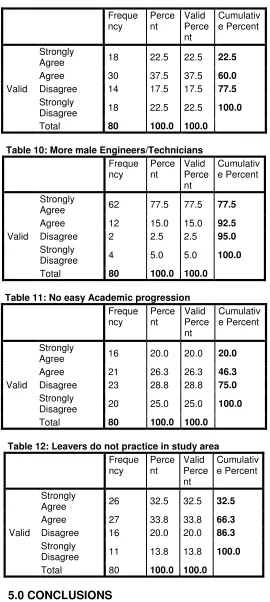
respondents agree that students admitted into engineering programs have sufficient knowledge in Pre-tech/vocational skills. Nonetheless respondents think engineering courses are relatively difficult. Also, 43% think it is for the academically good students. This strengthens the view of [7] that students find practical sessions stimulating and more meaningful largely because practical sessions offer them more autonomy and control over their own learning. The responses made on perceptions on engineering graduates are tabulated on Table 7-11. 95% of the respondents have the view that engineering training offers a wide range of jobs. Respondents also have the perception that it is not very difficult in getting a job. 57.5% agreed to this fact. 60% also think engineers are well paid and 95% perceive males are more in engineering programs. 75% and 86.3% do not believe engineering graduates have difficulty in academic progression and practice in their field respectively
Table 5: Responses Made on Perceptions on Interest and Relevance
No STATEMENT
RESPONSE (%)
S/A A DA S/DA
16 I would like to study engineering at a higher level 58.8 27.5 8.8 5.0 17 I am considering an engineering related career 52.5 38.8 5.0 3.8 18 I think engineering is important to the economic development of Ghana 91.3 7.5 0.0 1.3
29 I always encourage other students to take up engineering programs 70.0 20.0 7.5 2.5
Table 6 : Responses Made on Perceptions on Technical/Vocational Curricula
No STATEMENT RESPONSE
S/A A DA S/DA
6 Most of the students admitted into engineering programs have much
knowledge in Pre-tech/voc skills 22.5 31.3 31.3 15.0
15 Students find it difficult to understand engineering courses 17.5 33.8 33.8 15.0
24 Engineering is meant for the academically goodstudents 25.0 18.8 26.3 30.0
Table 7: Perception on Engineering Offering Wide Range Careers
Freque ncy
Perc ent
Valid Perc ent
Cumulati ve Percent
Valid
Strongly
Agree 54 67.5 67.5 67.5
Agree 22 27.5 27.5 95.0
Disagree 3 3.8 3.8 98.8
Strongly
Disagree 1 1.3 1.3 100.0
Total 80 100.0 100.0
Table 8: Perception on Difficulty of getting of Job after Engineering Training
Freque ncy
Perce nt
Valid Perce nt
Cumulati ve Percent
Valid
Strongly
Agree 23 28.8 28.8 28.8
Agree 23 28.8 28.8 57.5
Disagree 14 17.5 17.5 75.0
Strongly
Disagree 20 25.0 25.0 100.0
Table 9: Perception on well-paid Careers Freque ncy Perce nt Valid Perce nt Cumulativ e Percent Valid Strongly
Agree 18 22.5 22.5 22.5
Agree 30 37.5 37.5 60.0
Disagree 14 17.5 17.5 77.5
Strongly
Disagree 18 22.5 22.5 100.0
Total 80 100.0 100.0
Table 10: More male Engineers/Technicians Freque ncy Perce nt Valid Perce nt Cumulativ e Percent Valid Strongly
Agree 62 77.5 77.5 77.5
Agree 12 15.0 15.0 92.5
Disagree 2 2.5 2.5 95.0
Strongly
Disagree 4 5.0 5.0 100.0
Total 80 100.0 100.0
Table 11: No easy Academic progression Freque ncy Perce nt Valid Perce nt Cumulativ e Percent Valid Strongly
Agree 16 20.0 20.0 20.0
Agree 21 26.3 26.3 46.3
Disagree 23 28.8 28.8 75.0
Strongly
Disagree 20 25.0 25.0 100.0
Total 80 100.0 100.0
Table 12: Leavers do not practice in study area Freque ncy Perce nt Valid Perce nt Cumulativ e Percent Valid Strongly
Agree 26 32.5 32.5 32.5
Agree 27 33.8 33.8 66.3
Disagree 16 20.0 20.0 86.3
Strongly
Disagree 11 13.8 13.8 100.0
Total 80 100.0 100.0
5.0 CONCLUSIONS
The findings presented in this paper constitute an insight into students’ perceptions of engineering training. However, the research provides only a snapshot and much more investigation is needed to complete the picture. In order to fully understand the problem of influencing more young people to consider study and career options in engineering
the data from this research provides a contemporary record of how Wa Polytechnic students view engineering training. It highlights students’ apparent interest in engineering. Furthermore, participating students highlight the impact on them of restricted involvement in practical/hands on sessions in technical and vocational. In contrast the engineering curriculum places priority on hands on activity with much less theoretical input. Of great concern are the students’ perceptions regarding Lecturers remuneration and incentive. In an anxious move to see engineering training improve, 71.6% responses suggest the need to motivate engineering lecturers/personnel to attract more qualified instructors into teaching. It is observed that the most serious constraint faced by TVET institutions is the unavailability of qualified technical teachers [13]. [6] Opined that good and qualified instructors could easily be attracted to the TVET sub-sector if motivation is paramount. In conclusion, the findings show that the Wa Polytechnic students believe technical and vocational education is important for national development and they are highly motivated to pursue study in engineering programs. However, they think Wa Polytechnic need to concentrate more on hands on or practical training. To achieve this, investment into workshop equipment and infrastructure has to be undertaken. Workshop technicians and personnel should be given the right training and remuneration to boost their performance. This they believe would increase graduate performance on the job and consequently increase enrolment in the engineering programs of the polytechnic
REFERENCES
[1] Budu- Smith, J. The need for Polytechnics to assert and create a niche for themselves among tertiary institutions in National Human Resource Development efforts. Paper presented at Sunyani Polytechnic Council meeting; 2005.p.1.
[2] Kwegyiriba A. Access to Polytechnic Education and Distance Learning in Ghana: The Enrollment Factor at Takoradi Polytechnic. Current Research Journal of Social Sciences 2013; 5(2): 54-59.
[3] Lichtenstein C, Loshbaugh H G, Chen H L, Jackson K, Sheppard S D. An engineering major does not (necessarily) an engineer make: Career decision making among undergraduate engineering majors. Journal of Engineering Education 2009;98(3):227-234
[4] Bevins S, Brodie M, Brodie E. A study of UK secondary school students' perceptions of science and engineering. European Educational Research Association Annual Conference 2005. Available from Sheffield Hallam University Research Archive (SHURA) from: http://shura.shu.ac.uk/956/
144 [6] Alhassan U. Stakeholders' Perception of Technical
Education in the Bawku Municipality [MEd thesis]. Institute for Educational Planning and Administration, Faculty of Education, University of Cape Coast 2005.
[7] Osborne J, Collins S. Pupils' and parents' views of the school science curriculum. Kings College London/Wellcome Trust 2000. Available from: http://www.kcl.ac.uk/sspp/departments/education/web-files2/ppt.pdf
[8] Martey N A. Factors Affecting Students Participation in Technical Programmes at the Sunyani Polytechnic [MEd thesis]. Institute for Educational Planning and Administration, Faculty of Education, University of Cape Coast 2010.
[9] Churchill G A. Marketing Research: Methodological Foundation. 5th Ed. The Dryden Press, New York; 1991.
[10] Litwin M S. How to Measure Survey Reliability and Validity. Sage Publications, London; 1995.
[11] Norbahiah M, Sarifah N S S. Undergraduate Student’s Perception towards Engineering Program at UKM. 6th International Forum on Engineering Education (IFEE 2012). Procedia - Social and Behavioral Sciences 102; 2013. p. 110 – 115.
[12] Alexander P A, Murphy P K, Woods B S, Duhon K E, Parker D. College instruction and concomitant changes in student’s knowledge, interest and strategy use: A study of domain learning. Contemporary Educational Psychology; 1997. p.125-146.