e-ISSN: 2278-7461, p-ISSN: 2319-6491
Volume 5, Issue 5 [May 2016] PP: 01-07
Effect of Exhaust Gas Recirculation on Performance and
Emission Characteristics of MOME Blended
Fuel C.I. Engine
B Kondaiah
1and
#B Durga Prasad
21Research scholar, PBR VITS Kavali, Andhra Pradesh, India,
2JNTUA, Anantapuramu, Andhra Pradesh, India
Abstract: Petroleum diesel consumption increases leads to depleting the diesel fuel and increasing the environmental pollution. One of the alternatives is producing a biodiesel to meet the energy demand. Mahua oil methyl ester (MOME) is produced by transesterification process and prepared the blends (B0, B25, B50, B75, & B100) with diesel to compare the Engine performance and Emission characteristics with and without exhaust gas recirculation (EGR) at different loads. The results show the brake thermal efficiency (BTE) and emissions of B25is almost nearer to diesel. The BTE with EGR is higher than the B.T.E without EGR for all the blends. The emissions (smoke, HC, CO, NOx, ) of engine with EGR are lower than without EGR for all the blends.
Keywords: Mahua oil, Biodiesel, EGR, BSFC, BTE, Emissions.
I. INTRODUCTION
As population increases day by day, the utilization of petroleum diesel usage also increases. This leads to depletion of the diesel within few years as well as the environmental pollution increases. Then it is required to search for alternative fuel. Among various alternatives, biodiesel is one of the alternatives obtained from vegetable oils, which is renewable and environmental friendly fuel. Vegetable oils are mainly two types such as edible and non edible. Biodiesel production from edible oils leads to food scarcity. That’s why, biodiesels obtained from non edible oils can be considered as better alternatives. Some of the non edible oils like karanja, jatropha, neem, rubber, mahua are being used as alternative fuels. Shashikant et al. [1] investigated the production of biodiesel from mahua oil using acid (H2SO4) and alkaline (KOH) catalysts and suggested that the KOH is a better catalyst for production. Sukumar puhan et al. [2] studied the performance of methyl, ethyl, butyl esters of mahua oil, and they concluded that the mahua oil methyl esters had better performance than other esters and diesel. They also expressed that except NOx emissions remaining emissions (HC,CO) are less for methyl esters, but NOx found to be less for ethyl ester.
Pugazhvadivu et al. [3] conducted the experiments to investigate the suitability of preheated mahua oil as fuel in diesel engine and they concluded that preheated mahua oil can be used in emergency. Sukumar puhan et al. [4] also studied the performance of methyl ester of mahua oil and explained the suitability of MOME to diesel engine. Banapurmath et al. [5] studied the effect of biodiesel derived from honge oil and its blends with diesel when directly injected at different injection pressures and injection timings in a single cylinder water cooled C.I. engine. The results show that honge oil and honge oil methyl ester gave better results for B20 blend at retarded injection timing of 19◦ BTDC and injection pressure of 260 bar. Anirudh Gautam et al. [6] studied performance, emission and combustion characteristics of a cotton seed biodiesel fueled in four stroke locomotive diesel engine. They suggested that B20 can be implemented because it shows the performance same as the diesel. This has one more advantage that it produces less smoke.
Sharanappa et al.[10] studied the performance and emission characteristics of a Kirloskar HA 394 diesel engine operated on mahua oil methyl ester and they concluded that B20 shows higher efficiency and produces less emissions. Ratnakara Rao et al.[11] conducted experiments with varying compression ratios(13.2, 13.9, 14.8, 15.7,16.9, 18.1 and 20.2) to optimize the compression ratio for a mahua fuelled C.I. engine. The results show that 15.7 is the best compression ratio with mahua oil, and they concluded that at low and high compression ratios, thermal efficiency is less due to poor combustion and dilution of charge respectively. Raheman et al.[12] studied the effect of compression ratio and injection timing on performance of diesel engine with biodiesel as fuel. They found decreased BTE, where as BSFC and EGT increases as biodiesel percentage increases in blend at all compression ratios from 18 to 20 and injection timings of 35 -450 BTDC. However the changes in the efficiency is decreased with increasing the compression ratio and injection timing. They also mentioned that 20 % biodiesel can safely blend with diesel at all compression ratios.
Reddy et al. [13] investigated mahua oil esters as an alternative fuel for duel fuel engine. Their result shows that diesel gave better efficiency at lower loads, where as MEMO efficiency is same as diesel at higher loads. Their results also proved that emissions with MEMO are less than the diesel. Hence MEMO could be used as pilot fuel in dual fuel engine. Kapilan et al. [14] conducted tests on single cylinder direct injection diesel engine using MO, MOME, and B20 as fuels. The test results gave much smoke when MO used as a fuel, this may be due to high viscosity which results poor atomization, spray formation and combustion of fuel. Efficiency B20 was found to be higher than efficiency of diesel. Halek et al. [15] studied biodiesel as an alternative fuel for diesel engines. They produced biodiesel from rapeseed oil with 1.8% H2SO4 as catalyst and MeOH / oil of molar ratio 2:0.1 and reaction temperature 650C for a period of 3 hrs. The fatty acid methyl easter quality is observed as same as biodiesel standards.
Based on the above literature, the MOME fuels found to be suitable oil which runs the engine smoothly. In the present work, MOME is prepared by transesterification process and tested in single cylinder 4-stroke C.I. engine to evaluate its performance and emission characteristics and compared with and without EGR at different loads.
II. PRODUCTION OF BIODIESEL
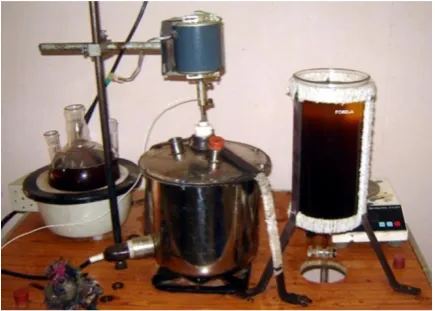
In this study, biodiesel of mahua oil is produced with the transesterification process. The transesterification is commonly used process for production of biodiesel. Hass [16] explained the process of transesterification in preparation of alkyl ester and glycerol. In that process, alcohol and triglyceride are made to react in the presence of a catalyst. He stated that alkali catalysts and acid catalysts can be used to promote the reaction. Due to high reaction capability, the alkali catalysts are more oftenly used as catalyst in production of biodiesel than acid catalyst [16]. Shashikant et al. [1] also stated that biodiesel can be produced from mahua oil having free fatty acids with KOH catalyst. In the present study, transesterification process is used to produce biodiesel from mahua oil with catalyst as KOH. As shown in the Figure 1, transesterification is carried out to prepare biodiesel. Transesterification is process that takes triglyceride molecule (Mahua oil), neutralizes the free fatty acids, removes glycerin and produces mahua oil methyl ester (MOME). Theoretically, transesterification reaction is an equilibrium reaction. In this reaction, more amount of methanol is used to shift the reaction equilibrium to the right side and produce more methyl esters.
Figure 1Photographic view of Biodiesel preparation plant (transesterification process)
III. PREPARATION OF BLENDS
characteristics with and without EGR. In the present study B0, B25, B50, B75, and B100 blends are prepared and used in experimentation.
IV. EXPERIMENTATION
As shown in Figure 2, experimental setup is prepared with a single cylinder, 4-stroke diesel engine test rig. The engine has specifications of 87.5mm of bore size, 110mm of stroke length, 7BHP of rated power at 1500 rpm. The engine is provided with an eddy current dynamometer to apply different loads on the engine. The setup has a stand-alone panel box consisting of air box, fuel tank, manometer, fuel measuring unit, transmitters for air and fuel flow measurements. Rotameters are provided for measuring water flow through the engine and calorimeter. As per experimental plan, experiments are conducted on single cylinder four stroke compression ignition engine by varying load, and blends with and without EGR.
Figure 2. Four stroke engine with eddy current dynamometer test rig
V. RESULTS AND DISCUSSION
Experiments have been conducted to study the performance and emission characteristics for different blends. Characteristics like BTE, smoke density, emissions of CO, HC, NOx, heat release rate and rate of pressure rise have been discussed.
4.1 Analysis of BTE
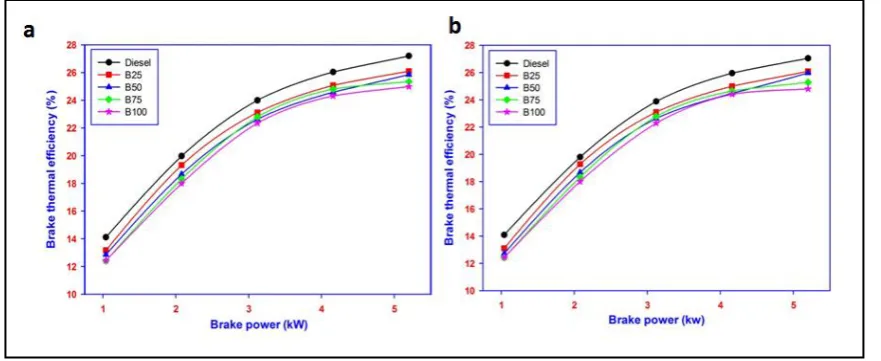
Figures 3(a) and (b) explain the variation of BTE with the change in load for different blends of 0%, 25%, 50%, 75% and100% MOME in diesel without and with EGR respectively. As shown in the Figure 3, there is substantial increment in BTE with increase of load. The same trend is observed for all the blends. However, BTE of different blends found to be closer at lower loads and at higher loads, the BTE of same blends are yielding more difference. The BTE of blends with EGR is slightly increased when compared without EGR for all blends. This may be happening due to higher operating temperature. The BTE of B25 is almost nearer to diesel. The BTE decreases with increase of blend due to lower calorific value of biodiesel when compared with diesel.
4.2 Analysis of emissions
Figures 4 (a) and (b) depicts the smoke density variation without and with EGR at different loads. As load increases smoke density increases for all the blends, this may be due to more amount of fuel burning at higher loads. As blend percentage increases smoke density also increases with and without EGR. This may be due to increased viscosity with increased blends. The smoke density is less with EGR when compared without EGR due to higher temperature of air fuel mixture which leads to complete combustion.
Figure 4(a). B.P vs smoke density without EGR and (b) B.P vs smoke density with EGR
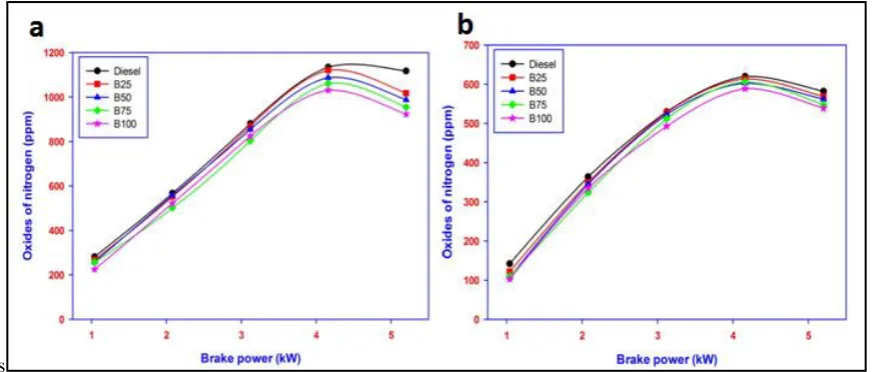
The variation of NOx emissions without and with EGR at different loads for all the blends as shown in figure 5(a) and (b). NOx emissions increase with increase of load due to high exhaust gas temperature at higher loads. As blend percentage increases, NOx emissions decreases with and without EGR. The NOx emissions are reducing with EGR when compared without EGR due to reducing exhaust gas temperatures.
s
Figure 5. (a) B.P vs NOx without EGR and (b) B.P vs NOx with EGR
Figure 6.(a) B.P vs HC without EGR and (b) ) B.P vs HC with EGR
Figures 7(a) and (b) depicts the variation of CO emissions without and with EGR at different loads for all the blends. As load increases COemissions are slightly increases up to three fourth load and followed by rapid increase in emission. As blend percentage increases CO emissions increase with and without EGR. This may be due to higher viscosity of blends. It was also observed that the COemissions are getting reduced with EGR when compared without EGR due to complete combustion.
Figure 7(a). B.P vs CO without EGR and (b) B.P vs CO with EGR
4.3 Analysis of heat release rate
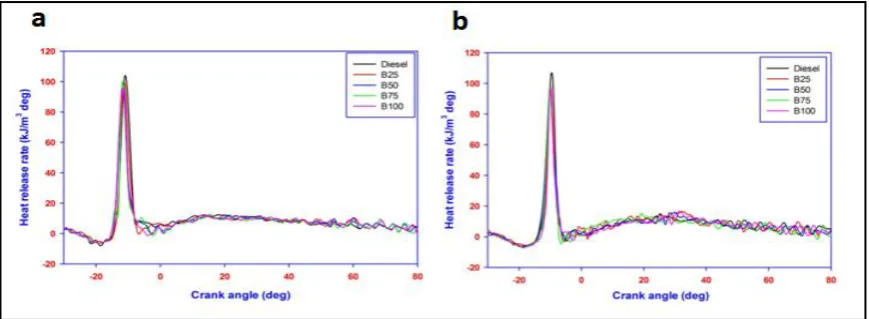
Figures 8 (a) and (b) depicts the heat release rate at different crank angles without EGR and with EGR respectively. The heat release rate with EGR is slightly more than the heat release rate without EGR. This also provides evidence for B.T.E variation with and without EGR.
4.3 Combustion analysis
Figures 9 (a) and (b) depicts the variation of pressure at different crank angles with out and with EGR respectively. From the figures, the rate of pressure rise and peak pressure is found to be slightly less with EGR when compared with out EGR. This may be due to dilution of charge.
Figure 9(a). Cylinder pressure vs Crank angle without EGR and (b) Cylinder pressure vs Crank angle withEGR
VI. CONCLUSIONS
In the present work, MOME is prepared by transesterification process and tested in single cylinder 4-stroke C.I. engine to evaluate its performance and emission characteristics and compared with and without EGR at different loads. Characteristics like BTE, smoke density, and emissions of CO, HC, NOx, heat release rate and rate of pressure rise have been studied. The following conclusions can be drawn from this work:
The B25 can be utilized as a fuel in diesel engine without modification of the engine, since its performance is almost nearer to diesel.
With the use of EGR, B.T.E for all blends slightly improved.
With the use of EGR, emissions of engine for all blends slightly reduced.
With the use of EGR, heat release rate for all blends slightly increased.
With the use of EGR, rate of pressure rise is lightly lower for all blends.
Finally, EGR can be suggested to implement due to its higher efficiency and lower emissions.
REFERENCES
[1]. Shahikant Vilas Ghadge; Hifjur Raheman. Biodiesel production from mahua oil having high free fatty acids, Biomass and Bioenergy, 2005, 28, pp. 601-605.
[2]. Sukumar puhan; vedaraman, N.; Rambrahamam, B.V.; Nagarajan, G. Mahua seed oil: A source of renewable energy in India, Journal of Scientific & Industrial Research, November 2005, 64, pp. 890-896. [3]. Pugazhvadivu, M.; sankaranarayanan, G. Experimental studies on a diesel engine using mahua oil as fuel,
Indian Journal of Science and Technology, 2010, 3(7), pp.787-791.
[4]. Sukumar Puhan; Vedaraman, N.; Boppanna,V. B. Ram; sankaranarayanan, G.; Jeychandran, K. Mahua oil methyl ester as biodiesel preparation and emission characteristics, Biomass and Bioenergy, 2005, 28, pp. 87-93.
[5]. Banapurmath, N.R.; Tewari, P.G.; Hosmath, R.S. Effect of biodiesel derived from Honge oil and its blends with diesel when directly injected at different injection pressures and injection timings in single-cylinder water-cooled compression ignition engine, JProc. IMechE Part A: J. Power and Energy, 2009, 223, pp. 31-40.
[6]. Anirudh Gautam; Avinash Kumar Agarwal. Experimental investigations of comparative performance, emission and combustion characteristics of a cottonseed biodiesel-fueled four-stroke locomotive diesel engine, International J of Engine Research, 14(4), pp.354–372.
[7]. Raheman, H.; Ghadge, S.V. Performance of compression ignition engine with mahua biodiesel, Fuel, 2007, 86, pp.2568-2573.
[9]. Bhatt, Y.C.; Murrthy, N.S.; Datta, R.K. Use of mahua oil as a diesel fuel extender, IE journal, 2004, 85, pp.10-14.
[10]. Sharanappa Godiganur; Suryanarayana Murthy, Ch; Rana Prathap Reddy. Performance and Emission Characteristics of a Kirloskar HA 394 Diesel Engine operated on Maha oil Methyl ester, Thammasat Int J Sc. Tech, 2010, 15(3), pp.32-39.
[11]. Ratnakara Rao, G.V.N.S.R.; Ramachandra Raju, V.; Muralidhara Rao, M. Optimising the compression ratio for a mahua fuelled C.I. engine, APRN Journal of engineering and applied sciences, 2009, 4(3), pp. 35-37.
[12]. Raheman, H.; Ghadge, S.V. Performance of diesel engine with biodiesel at varying compression ratio and ignition timing, Fuel, 87, 2008, pp.2659-2666.
[13]. Reddy, P.B.; Kapilan, N.; Reddy, R.P. Experimental investigation of esters of mahua oil as an alternative fuel for dual fuel engine, IE journal, 2008, 89, pp.7-10.
[14]. Kapilan, N.; Reddy, R.P.; Evaluation of methyl esters of mahua oil as diesel fuel J Am Chem soc 2008, 85, pp.185-188.
[15]. Halek, F.; Kavousi, A.; Banifatemi. Biodiesel as an alternative fuel for diesel engines, World academy of Science, engineering and technology 2009, 57, pp.460-462.