THE GOOD, THE BAD AND THE UGLY:
OPINION MINING ANALYSIS ON USER
TWEETS IN TWITTER
Joseph Philip1, Ann Baby2(Corresponding Author) and A.Kannammal3 1,2Rajagiri College of Social Sciences, Cochin, Kerala
3Coimbatore Institute of Technology, Coimbatore, Tamil Nadu
Abstract : Opinion mining evaluates people's opinions, sentiments, assessments, outlooks, and feelings from a written language. One of the most dynamic research areas in natural language processing, it is also extensively studied in fields of data mining like web mining and text mining. Opinion mining also finds its vast applications in management sciences and social sciences due to its importance to business and society asa whole. The emergent importance of opinion analysis parallelswithexpansion of socialmedia such as Facebook, Twitter, and social networks. This research suggests a stand-alone platform which enables users to perform opinion analysis which makes use of Twitter API to gather information aboutthe tweets and its users. The proposed model is used to analyse whether the opinion in a text is neutral, positive ornegative. As users tend to post frank and blunt comments in twitter, it has emerged as a platform to check people’s feedback.The inclusion of hashtags to attract social attention also is a trigger for opinion mining. Twitter Search and Streaming APIs with the Stanford NLPlibrary are used to opine the data collected. The pre-processed data passes through the opinion generation phase where opinion classes are defined for polarity. Words are labelled with opinions, and the general opinion of a tweet is thus analysed, in this research paper.
IndexTerms - Twitter, Opinion Mining, Opinion Classes. I. INTRODUCTION
Opinion Mining, is the method of computationally classifying and labelling opinions(feelings/sentiments) articulated in a portion of text, to conclude aboutthe writer's attitude towards an idea is, negative, positive or neutral using the concept of computational linguistics[1]. The idea could be a topic or product on which the user can opine freely. The customer’s opinion for a product, also known as Voice of Customer (VOC) is crucial for organizations [2]. VOC is used widely to analyse customer’s needs, infer his wants and to obtain timely feedback from the customers. Nowadays, VOC is widely considered as a market exploration and research procedure to produce a thorough and comprehensive picture of customer wants and needs, organized into a hierarchical arrangement, and then ranked in terms of relative prominence and satisfaction with current replacements.
1.1 Opinion Analysis
Opinion analysis is the process of contextually mining text to identify and categorize the subjective opinions expressed by the users and writers[3]. It is widely used to decide whether the user’s/writer’s attitude towards a particular topic or product, etc. isnegative, positive or neutral[4]. It is also used by businesses to help them apprehend the social sentimentality of their product, brand, or services while observingand monitoring online conversations[5].
1.2 Mining and Analysis of Twitter Data
Twitter, the gold mine of data is different from other social platforms. The tweets of almost all users are public and retrievable. The asymmetric network infrastructure of “friends” and “followers” in Twitter permits a user to include tweets from accounts whose content the user finds current and interesting. The incredibly high number of users in Twitter adds to the fact that it is widely used as a marketing tool. It is also used as a transport layer for third-party messaging services [6]. Thus Twitter has a widespread collection of APIs, to build customised networks.
Web-blogs are used to construct bodies for opinions analysis and emotion icons are treated to be mood indicators [7]. Conditional Random Fields (CRF)and Support vector Machines (SVM) are used to classify opinions at sentence level. Various strategies are analysed to define the overall opinion of a document. The winning structure is thus defined by considering the opinion of the last sentence of the document.
1.3 Opinion mining of Twitter Data
II. THEPROPOSEDMODELFOROPINIONANALYSISINTWITTER
In opinion analysis, the mood of a comment or tweet can be quantified by the number of negative and positive words which occur in the comment or tweet. A score can be generated by subtracting the number of negative counts from the positive counts[12]. At present, information can be gathered through individual interviews, online questionnaires, contextual enquiries, ethnographic methods etc. All these methods involve a sequence of structured in-depth interviews, which give focus to the experience of customers about the products and alternatives they are currently endorsing. Theneeds statements are thenmined andstructured into a more usable hierarchy, and laterranked by the customers[13]. The process is a tedious one where analysts need to examine the entire data, extract the opinion about the statement and then determine the statement’s opinion. The proposed system is a stand-alone web application which enables the user to perform the opinion analysis. In this research, information available through the Twitter API is utilized togather information about the tweets and their users. As Twitter has a restriction where tweets are to be less than 140 characters in length,comments of users usually have a tendency to be frank, straightforward and blunt. In addition, due to the large influence of Twitter people are lured to include hashtags in their tweets so that h they can gain social attraction and prominence.Thus, Twitter has become a great platform to study people’s criticism and feedback[14]. This research which focusses on the “opinion-filled, sentiment-filled” Twitteruses Twitter Search and Streaming to retrieve the tweets and Stanford NLP library to detect the opinions. Results are stored onto a database on a real-time basis which can be retrieved later. The schematic workflow of the proposed opinion mining technique is described in Figure 1.
Data Collection Tokenization Sentence Splitting Parts-of-speech Tagging Named Entity Recognition Sentiment Analysis Result Visualisation
Figure 1 – Schematic workflow for opinion mining in Twitter
In the initial phase of data collection,users register through a registration module where the system permits users to enrol themselves with their personal details along with their user name, password and with a pair of Twitter authentication tokens foraccessing the Twitter APIs. Users with the help of their customisable dashboard, users can either upload a text document or can manually enter the desired texts in the provided user interface to perform the opinion analysis and the results can be stored to database if required for further retrieval. Data is pre-processed and cleaned for stopwords removal, punctuation removal, stemming etc. Tokenization splits the tweets into relevant tokens. As tweets may containseveral opinions about the data which are expressed differently by various users, they need to be tokenized. The twitterdataset used in this research work is already labelled into two classes of negative and positive separation. This enables theopinion analysis of the data becomes easy to observe the effect of various features[4]. Stop words removal has been omitted in this research as it decreases the performance, as it depends entirely on the tokenized data. Sentence splitting is performed to together with tokenization, as the opinions of each sentence need to be determined. Twitter user-defined hashtags in tweets are used for classification of opinion type using punctuations, single words, n-grams and patterns as different feature types, which are then combined into a feature vector for opinion classification. SVM strategy is used to assign opinion labels by constructing a feature vector for each example in the training and test set [15]. Parts of speech like nouns, nouns, proper nouns and Named Entity Recognitions (NER), which are good pointers of biased opinions are used to generate patterns, as they are good indicators of opinions. Users can fetch the social media subjects related to hashtags or profile content to perform the opinion analysis. The content is fetched via Twitter’s API with the help of the authentication token which is provided on the sign up process. Contextual mining is also performed in this phase in cases where users tweet continuously about a product (noun). In the NERphase, Java implementation of the Stanford NER is adopted [16]. In NER, word sequences in a test are labelled as either names of persons, companies, places, things etc.Feature extraction is performed in this stage where major recognizers for the English language are classified into three classes, namely PERSON, ORGANIZATION and LOCATION. Training for this is performed on the CoNLL 2003 English training data. In the below example for the English sentence “I am from Delhi”, the LOCATION class is tagged.
Eg: I am from Delhi ORGANIZATION LOCATION PERSON
1 depicts the classification of the classes based on their polarity.Natural language processing is used to tag each word with anopinion and the overall score or opinion that the statement would get, depends on the underlyingword opinion.
Table 1. Opinion Classes
Class Opinion
0 Very Negative
1 Negative
2 Neutral
3 Positive
4 Very Positive
Opinion trees are constructed from the tweets based on the maximum class obtained at each node of the tree. Figure 2 depicts the opinion tree for the English text “SC likely to hear Ayodhya appeals from July 25” [17]. Figure 3 depicts the graphical opinion of the final opinion node, where very negative shows a score of 6, negative 36, neutral 35, positive 20 and very positive 4. Thus, the above sentiment shows a final “Negative” opinion.
Figure 2 – Opinion Tree for “SC likely to hear Ayodhya appeals from July 25” [17]
Figure 3 – Graphical Opinion of the Final Opinion Node.
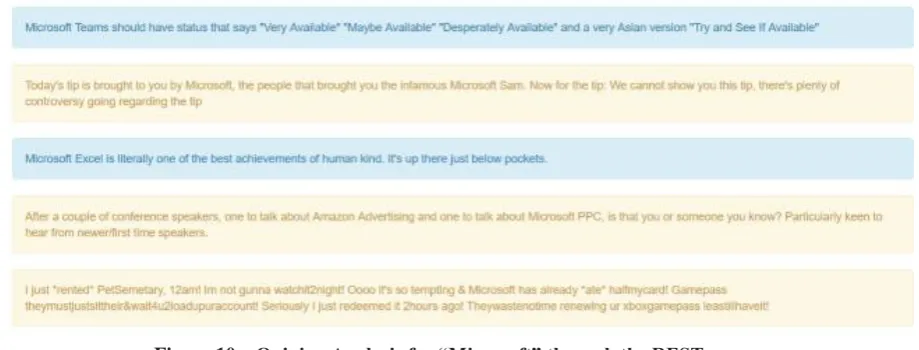
In contrast with the Stanford Core NLP Package which takes input from the user, the proposed system takes in input from real-time tweets. For each sentence, theopinion value is marked with legends. Metadata of the tweet which includes individual user details, all users involved in the process, user location, NERs, nouns, verbs, date/time of tweet, and all other relevant details of the tweet are highlighted[18]. The system is integrated with a Representational State Transfer (REST)web server so that the user can perform the opinion analysis over the Internet, irrespective of the network. Thus, guest users can also avail the analysis facility to overcome the desktop, to offer as a service
III. FINDINGS
the Colour Legends are attached to each opinion in the proposed model. The colour coding schemes as represented in figure 4 are followed for the opinion analysis.
Opinion Legend
Very Negative
Negative Neutral
Positive Very Positive
Figure 4 – Colour Legends for Opinions
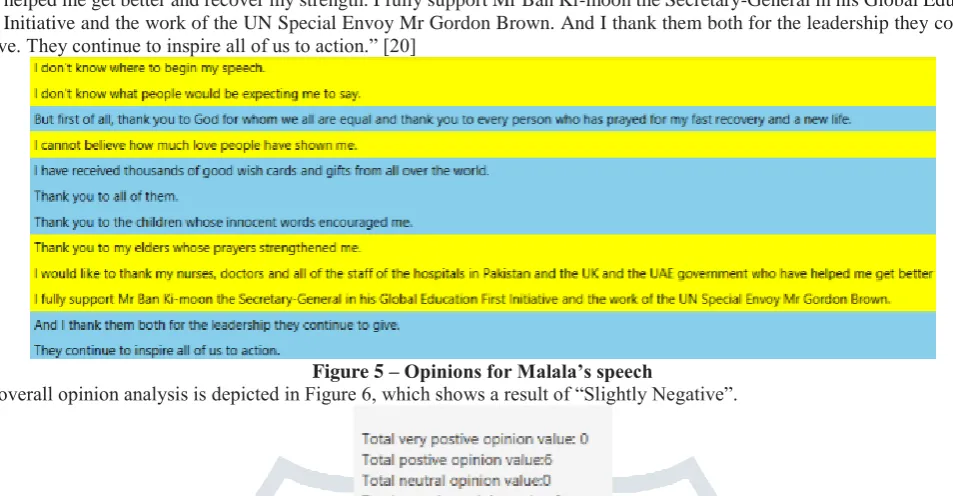
I would like to thank my nurses, doctors and all of the staff of the hospitals in Pakistan and the UK and the UAE government who have helped me get better and recover my strength. I fully support Mr Ban Ki-moon the Secretary-General in his Global Education First Initiative and the work of the UN Special Envoy Mr Gordon Brown. And I thank them both for the leadership they continue to give. They continue to inspire all of us to action.” [20]
Figure 5 – Opinions for Malala’s speech
The overall opinion analysis is depicted in Figure 6, which shows a result of “Slightly Negative”.
Figure 6 – Analysis of Malala’s speech
In the proposed model, Twitter Keyword searching gathers the tweets from twitter which have the mentioned keywords, and opine it based on the context of the text[21]. The gathered tweets are scrapped off their user credentials, location details, and timestamps in the pre-processing stage. Once the opinion analysis is performed, the tweets are colour classified based on the colour coding scheme adopted for the study. Figure 5 shows the opinion analysis for the keyword “World cup 2019”. Latest tweets (tweets occurred in the last seven days) are gathered through the twitter-developer API and the red tweets show negative opinions, and the green tweets show positive opinions. Figure 7 depicts the twitter keyword searching for “World cup 2019”.
Figure 7 – Twitter keyword Search for “World Cup 2019”
Figure 8 –Tweet Analysis for “World Cup 2019”
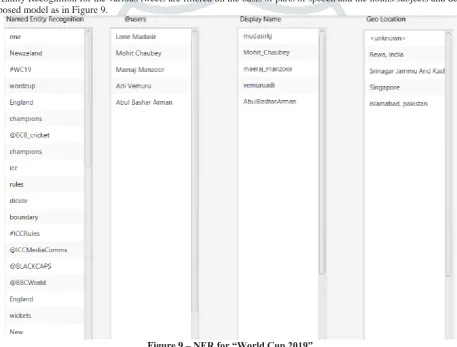
Named Entity Recognition for the various tweets are filtered on the basis of parts of speech and the nouns/subjects and detailed in the proposed model as in Figure 9.
Figure 9 – NER for “World Cup 2019”
Figure 10 – Opinion Analysis for “Microsoft” through the REST server.
I. SCOPE FOR FUTURE WORK
The proposed system performs opinion mining of user tweets on the social media. Though optimal accuracy is achieved, the system needs further enhancement to deal with sarcasm(E.g.: Brutus is an honourable man). Thwarted comments and frustrations in tweets can be a further area of study using complex real-time models. Tweets including a negative and a positive word (E.g.: Not good) could lead to neutrality, though the final answer rests on the data in the tweet. There are also cases of faulty acceptances, which can be a further area of study using advanced natural language processing tools.
IV. CONCLUSION
This research can be plugged into product based enquiry tools and online review platforms to gather general opinions from the public tweets. Opinion analysis is widely used in applications that use reviews from websites which include product reviews, comments about a particular service, feedback on political issues etc. It is also now included as a sub-component in various recommender systems. It also has wide applications in business intelligence where opinions are extracted from online reviews to improve the products and thus increase customer satisfaction. It is also finding applications in sports, medical and smart ho me deployment areas. Opinion analysis clubbed together with Internet of Things (IoT) can be employed for further research. Opinion analysis will also play a major role in real time trend prediction analysis.
REFERENCES
[1] B. Pang and L. Lee, "Opinion mining and sentiment analysis," Foundations and Trends in Information Retrieval, vol. 2, no.
1, pp. 1-135, 2008.
[2] C. Aguwa, M. H. Olya and L. Monplaisir, "Modeling of fuzzy-based voice of customer for business decision analytics.,"
Knowledge-Based Systems, vol. 125, no. 1, pp. 136-145, 2017.
[3] F. Benamara, M. Taboada and Y. Mathieu, "Evaluative language beyond bags of words: Linguistic insights and
computational applications," Computational Linguistics, vol. 43, no. 1, pp. 201-264, 2017.
[4] V. Kharde and P. Sonawane, "Sentiment analysis of twitter data: a survey of techniques.," vol. arXiv preprint arXiv:1601.06971., 2016.
[5] S. Mukherjee and P. Bhattacharyya, "Sentiment analysis: A literature survey.," vol. arXiv preprint arXiv:1304.4520., 2013. [6] M. A. Russell, Mining the Social Web, Publisher: O'Reilly Media, Inc., Februray 2011.
[7] Y. Changhua, H.-Y. L. Kevin and C. Hsin-Hsi, "Emotion classification using web blog corpora.In," in WI ’07: Proceedings
of the IEEE/WIC/ACM International Conference on Web Intelligence,IEEE Computer Society., Washington, DC, USA. , 2007.
[8] R. Jonathon, "Using emoticons to reduce dependency in machine learning techniques for sentiment classification," The
Association for Computer Linguistics, vol. 3, no. 1, pp. 43-48, 2005.
[9] A. Go, L. Huang and R. Bhayani, "Twitter sentiment analysis," Final Projects from CS224N for Spring 2008/2009., 2009.
[10] B. Pang and L. Lee, "Seeing stars: Exploiting class relationships for sentiment categorization with respect to rating scales,"
43rd annual meeting on association for computational linguistics, vol. 1, no. 2, pp. 115-124, 2005.
[11] B. O'Connor, R. Balasubramanyan, B. R. Routledge and N. A. Smith, "From tweets to polls: Linking text sentiment to public
opinion time series," Fourth International AAAI Conference on Weblogs and Social Media., 2010.
[12] S. Mukherjee and P. Bhattacharyya, "Sentiment analysis in twitter with lightweight discourse analysis," in COLING 2012
(pp. 1847-1864)., 2012 December.
[13] O. Turel, A. Serenko and P. Giles, "Integrating technology addiction and use: An empirical investigation of online auction
users," MIS Quarterly, vol. 35, no. 4, pp. 1043-1062, 2011.
[14] E. Lahuerta-Otero and R. Cordero-Gutiérrez, "Looking for the perfect tweet. The use of data mining techniques to find
influencers on Twitter," Computers in Human Behavior, vol. 64, pp. 575-583, 2016.
[15] P. Chikersal, S. Poria, E. Cambria, A. Gelbukh and C. E. Siong, "Modelling public sentiment in Twitter: using linguistic
patterns to enhance supervised learning," International Conference on Intelligent Text Processing and Computational
Linguistics, Springer, pp. 49-65, 2015.
[17] "The Hindu," [Online]. Available: https://www.thehindu.com/todays-paper/sc-likely-to-hear-ayodhya-appeals-from-july-25/article28393815.ece. [Accessed 12 7 2019].
[18] F. H. Khan, U. Qamar and S. Bashir, "A semi-supervised approach to sentiment analysis using revised sentiment strength
based on SentiWordNet.," Knowledge and information Systems, vol. 51, no. 3, pp. 851-872, 2017.
[19] "Wikipedia," [Online]. Available: https://en.wikipedia.org/wiki/Malala_Yousafzai. [Accessed 16 8 2019].
[20] "United Nations," [Online]. Available: https://www.un.org/News/dh/infocus/malala_speach.pdf. [Accessed 16 8 2019]. [21] S. Poria, H. Peng, A. Hussain, N. Howard and E. Cambria, "Ensemble application of convolutional neural networks and
![Figure 2 – Opinion Tree for “SC likely to hear Ayodhya appeals from July 25” [17]](https://thumb-us.123doks.com/thumbv2/123dok_us/1353026.1643962/3.595.137.477.213.501/figure-opinion-tree-likely-hear-ayodhya-appeals-july.webp)