Editorial
A Focus on Soft Actuation
Aslan Miriyev1,2
1 Materials and Technology Center of Robotics, Empa- Swiss Federal Laboratories for Materials Science and
Technology, Überland Str. 129, 8600 Dübendorf, Switzerland; [email protected]
2 Aerial Robotics Lab, Imperial College London, South Kensington, London SW7 2AZ, UK
Received: 9 October 2019; Accepted: 12 October 2019; Published: 23 October 2019
Abstract:The present editorial paper analyzes the hundred recent research works on soft actuation to understand the current main research focus in the light of the grand challenges in the field. Two characteristic paper types were obtained: one focuses on soft actuator design, manufacturing and demonstration, while another includes in addition the development of functional materials. Although vast majority of the works showcased soft actuation, evaluation of its robustness by multi-cyclic actuation was reported in less than 50% of the works, while only 10% described successful actuation for more than 1000 cycles. It is suggested that broadening the research focus to include investigation of mechanisms underlying the degradation of soft functional material performance in real cyclic actuation conditions, along with application of artificial intelligence methods for prediction of muscle behavior, may allow overcoming the reliability issues and developing robust soft-material actuators. The outcomes of the present work might be applicable to the entire soft robotics domain.
1. Introduction
Soft actuation remains one of the key challenges in the creation of nature-like soft, adaptive and collaborative robotics. Actuator materials and design play crucial role in development of soft actuation
systems [1]. Functional materials may change their shape as a response to an external stimulus and thus
exert (actuation) force, while proper designs may allow application of the force in desired directions, as well as maximizing the actuation strain. Special Issue on “New Materials and Designs for Soft Actuators” aimed at highlighting the latest research on materials and design “under the same roof” and facilitating the engineering of soft actuators with superior performance.
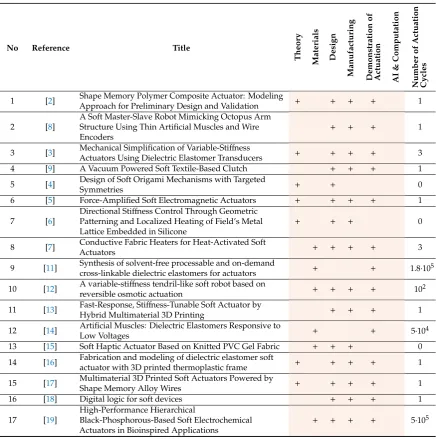
The research published in this Special Issue spans from theoretical [2–7] and applied [2,3,5,7–9] methods for actuator design to actuation materials [7] and showcasing of actuation systems [2,3,5,7–9]. For research contributions in the field, the main measure of success would be the new theoretical and practical knowledge allowing overcoming the challenges towards creation of robust, reliable soft actuation. To evaluate the impact of the current Special Issue and of the publications in the field in general, here I analyzed a hundred recent research papers on soft actuation. The main research focus areas and the contribution to actuation robustness were assessed for each analyzed work.
2. Results and Discussion
From the analysis of hundred recent research papers on soft actuation, the works’ contents may
be classified into five main focus areas (see TableA1in the AppendixA):
• Theory: theoretical work, including calculations, modelling and computer simulations;
• Materials: chemical synthesis and/or material development;
• Design: design of an actuator or actuation system;
• Manufacturing: fabrication/manufacturing of an actuator or an entire robot with an actuator;
• Demonstration: demonstration of an actuator prototype in one or several actuation scenarios
and/or as a part of a robot.
An additional focus area, namely Artificial Intelligence (AI) and Computation, covering applications of AI techniques and advanced computational algorithms, is worth mentioning, despite
the fact that only one paper [10] among the analyzed works on soft actuation has implemented AI.
Using AI methods in soft actuation research will be discussed here in the further text.
Figure1a shows a color map of the analyzed works’ contents, reflecting combinations of multiple
focus areas. It may be seen that all the works combine at least two focus areas. According to the
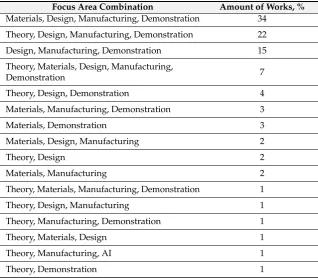
combinations of focus areas (Figure1b; TableA2in the AppendixA), two typical paper structures
were obtained. First deals with actuator design, its manufacturing and subsequent demonstration of an actuation scenario (37%; includes the following focus area combinations: Design, Manufacturing, Demonstration- 15%; Theory, Design, Manufacturing, Demonstration- 22%). The second type includes research on materials, covering the cycle from development of a functional material, through design and manufacturing of an actuator, to showcasing the actuation (41%; includes the following focus area combinations: Materials, Design, Manufacturing, Demonstration- 34%; Theory, Materials, Design, Manufacturing, Demonstration- 7%).
Actuators 2019, 8, x FOR PEER REVIEW 3 of 13
Soft
actuation
research
is
strongly
multidisciplinary
and
includes
multiple
focus
areas.
Focus
area
combinations
form
two
main
types
of
soft
actuation
research
papers:
the
first
includes
the
actuator
design,
its
subsequent
manufacturing
and
demonstration
of
actuation,
while
the
second
focuses
on
actuator
material
development
(with
subsequent
actuator
design,
manufacturing
and
demonstration).
Although
the
results
showed
large
amount
of
works
involving
material
development,
the
robustness
and
reliability
of
soft
actuators
remains
one
of
the
key
challenges.
Less
than
50%
of
the
analyzed
works
showed
actuator
robustness
assessment
using
multi
‐
cyclic
actuation
testing,
while
only
10%
reported
on
actuators
capable
of
working
for
more
than
a
thousand
actuation
cycles.
It
was
suggested
that
applying
materials
science
expertise
to
understand
and
overcome
the
mechanisms
of
material
degradation
during
multi
‐
cyclic
actuation
in
real
conditions,
as
well
as
using
artificial
intelligence
methods
with
minimal
amount
of
multi
‐
cyclic
actuation
experiments
for
prediction
of
the
actuation
performance
might
pave
the
way
to
development
of
reliable
soft
actuators.
Figure 1. Analysis of hundred recent research works on Soft Actuation: (a) Main focus areas for each
work‐ a color map; (b) Main focus area combinations, forming two main research paper types: one
focuses on design, manufacturing and demonstration, while another includes also materials
development; (c) Amount of works focusing on a specific area; for the Special issue and for all the
analyzed works; (d) Number of reported actuation cycles for each work.
4.
Methods
An
extensive
bibliographic
search
was
conducted
to
find
recent
published
peer
‐
reviewed
journal
papers
on
soft
actuation
(databases:
Scopus,
ScienceDirect,
Web
of
Science,
Scholar).
The
list
of
hundred
allocated
works,
including
the
eight
papers
published
in
the
special
Actuators
issue
on
“New
Materials
and
Designs
for
Soft
Actuators”,
is
provided
in
Appendix
A.
The
works
were
analyzed
by
classification
into
focus
areas
and
assessment
of
multi
‐
cyclic
actuation
testing
performance,
including
the
number
of
the
reported
actuation
cycles.
It
should
be
mentioned
that
the
Figure 1. Analysis of hundred recent research works on Soft Actuation: (a) Main focus areas for
each work- a color map; (b) Main focus area combinations, forming two main research paper types:
one focuses on design, manufacturing and demonstration, while another includes also materials
development; (c) Amount of works focusing on a specific area; for the Special issue and for all the
analyzed works; (d) Number of reported actuation cycles for each work.
Compared to the general picture of research in the field, the works published in the current Special Issue on “New Materials and Designs for Soft Actuators” focus on actuator design rather
than on material development (Figure1c). As a result, the works did not focus on material testing or
testing was performed. Multi-cyclic testing is one of the most important criterions in evaluation of soft actuators, showing their ability to retain the actuation behavior along multiple cycles and reflecting possible material degradation under real actuation conditions. However, the analysis of the recent research in the field shows that more than 50% of the published works show only up to one actuation
cycle (11% did not demonstrate actuation, 42% showed one actuation cycle) (Figure1d). It may be
seen that about one fifth of the works demonstrated between two and ten actuation cycles (19%), 12% showed results in the range of 11 to 100 cycles, 6% included reports in the range of 101 to 1000
cycles, and only 10% of the works reported more than 1000 actuation cycles (see also TableA1in the
AppendixA).
Here it is suggested to broaden the research focus and include studies on robustness of functional materials for soft actuation in addition to development of new materials. Without any doubt, developing new stimuli-responsive materials is of a primary importance for the field. Simultaneously, improving the performance of existing promising material-actuators may lead to development of robust and highly reliable soft actuators, so lacking today. Although it may seem that improving the performance to meet specific requirements is a task of an industry, there is a broad number of related unanswered scientific questions, requiring the attention of the soft actuation community. It is necessary to understand the phenomena occurring during materials’ cyclic response to a stimulus, study the mechanisms of material degradation under continuous as well as interrupted actuation conditions, and explore the microstructure-synthesis-processing-composition-performance relations to overcome the limits of functional materials’ capacity and pave the way to durable and reliable soft actuation.
In addition, it is suggested to use computational methods, such as machine learning, for prediction
of an actuator performance at any actuation cyclen. This method is expected to allow prediction of
an actuator behavior without performing large number of complex and time-consuming multi-cycle actuation experiments. Instead, it will allow minimizing the amount of experiments to the amount required for training the computational algorithm. Determining the number of such experiments allowing successive prediction is one of the open research challenges.
Despite different target functionalities, main systems of the future soft intelligent robots, namely
actuation, sensing and computation, will require similarity (or, at least, compatibility) of materials comprising them. Therefore, the challenges and suggested methods of their overcoming, mentioned above, are potentially applicable also for soft sensing and computation. Thus, the discussion and the outcomes of this paper might be relevant for the entire soft robotics domain.
3. Conclusions
Soft actuation research is strongly multidisciplinary and includes multiple focus areas. Focus area combinations form two main types of soft actuation research papers: the first includes the actuator design, its subsequent manufacturing and demonstration of actuation, while the second focuses on actuator material development (with subsequent actuator design, manufacturing and demonstration). Although the results showed large amount of works involving material development, the robustness and reliability of soft actuators remains one of the key challenges. Less than 50% of the analyzed works showed actuator robustness assessment using multi-cyclic actuation testing, while only 10% reported on actuators capable of working for more than a thousand actuation cycles. It was suggested that applying materials science expertise to understand and overcome the mechanisms of material degradation during multi-cyclic actuation in real conditions, as well as using artificial intelligence methods with minimal amount of multi-cyclic actuation experiments for prediction of the actuation performance might pave the way to development of reliable soft actuators.
4. Methods
An extensive bibliographic search was conducted to find recent published peer-reviewed journal papers on soft actuation (databases: Scopus, ScienceDirect, Web of Science, Google Scholar). The list
“New Materials and Designs for Soft Actuators”, is provided in AppendixA. The works were analyzed by classification into focus areas and assessment of multi-cyclic actuation testing performance, including the number of the reported actuation cycles. It should be mentioned that the present communication might not include all the recent papers on soft actuation, as the performed bibliographic search could unintentionally miss them. Thus, the statistical data from this paper (such as percentage of works focusing on a specific area, a number of papers performing multi-cyclic tests, etc.) should not be taken
as absolute quantitative results, but rather as a qualitative and/or semi-quantitative data allowing to
describe the state of the art in the field.
Conflicts of Interest:The author declares no conflict of interest.
Appendix A
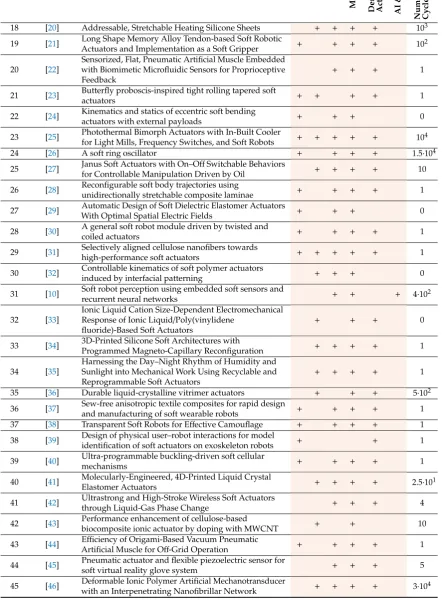
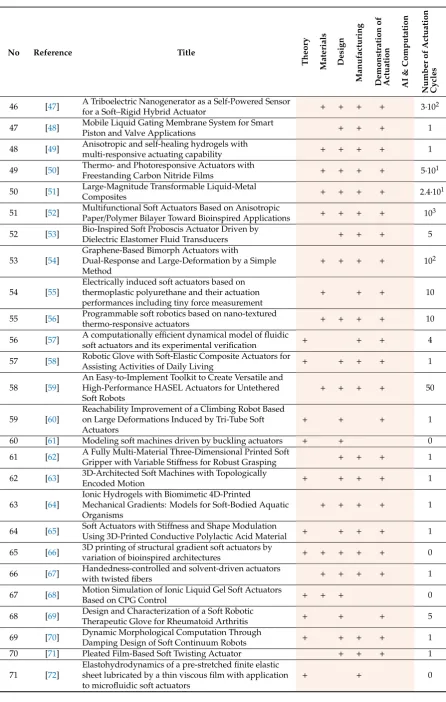
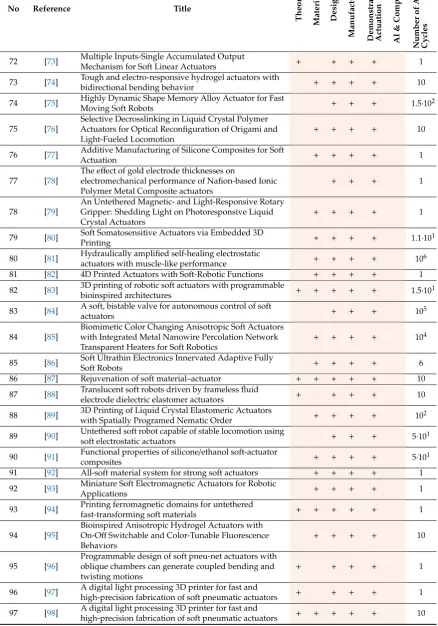
Table A1. Focus areas in the analyzed works. The focus areas: Theory (theoretical work, including
modelling and simulations), Materials (chemical synthesis and/or material development), Design,
Manufacturing, Demonstration (of actuation), AI (artificial intelligence) and Computation. If the work
focused on a specific area, the value for that focus area in the table will be “+”; if not- the cell in the table
will remain empty. Additional rubric: “Number of actuation cycles” shows the number of actuation cycles reported in each analyzed work (peer-reviewed published journal papers).
No Reference Title
Theory
Materials Design
Manufacturing Demonstration
of
Actuation AI
&
Computation
Number
of
Actuation
Cycles
1 [2] Shape Memory Polymer Composite Actuator: Modeling
Approach for Preliminary Design and Validation + + + + 1
2 [8]
A Soft Master-Slave Robot Mimicking Octopus Arm Structure Using Thin Artificial Muscles and Wire Encoders
+ + + 1
3 [3] Mechanical Simplification of Variable-Stiffness
Actuators Using Dielectric Elastomer Transducers + + + + 3
4 [9] A Vacuum Powered Soft Textile-Based Clutch + + + 1
5 [4] Design of Soft Origami Mechanisms with Targeted
Symmetries + + 0
6 [5] Force-Amplified Soft Electromagnetic Actuators + + + + 1
7 [6]
Directional Stiffness Control Through Geometric
Patterning and Localized Heating of Field’s Metal Lattice Embedded in Silicone
+ + + 0
8 [7] Conductive Fabric Heaters for Heat-Activated Soft
Actuators + + + + 3
9 [11] Synthesis of solvent-free processable and on-demand
cross-linkable dielectric elastomers for actuators + + 1.8·105
10 [12] A variable-stiffness tendril-like soft robot based on
reversible osmotic actuation + + + + 102
11 [13] Fast-Response, Stiffness-Tunable Soft Actuator by
Hybrid Multimaterial 3D Printing + + + 1
12 [14] Artificial Muscles: Dielectric Elastomers Responsive to
Low Voltages + + 5·104
13 [15] Soft Haptic Actuator Based on Knitted PVC Gel Fabric + + + 0
14 [16] Fabrication and modeling of dielectric elastomer soft
actuator with 3D printed thermoplastic frame + + + + 1
15 [17] Multimaterial 3D Printed Soft Actuators Powered by
Shape Memory Alloy Wires + + + + 1
16 [18] Digital logic for soft devices + + + 1
17 [19]
High-Performance Hierarchical
Black-Phosphorous-Based Soft Electrochemical Actuators in Bioinspired Applications
Table A1.Cont.
No Reference Title
Theory Materials Design
Manufacturing Demonstration
of
Actuation AI
&
Computation
Number
of
Actuation
Cycles
18 [20] Addressable, Stretchable Heating Silicone Sheets + + + + 103
19 [21] Long Shape Memory Alloy Tendon-based Soft Robotic
Actuators and Implementation as a Soft Gripper + + + + 102
20 [22]
Sensorized, Flat, Pneumatic Artificial Muscle Embedded with Biomimetic Microfluidic Sensors for Proprioceptive Feedback
+ + + 1
21 [23] Butterfly proboscis-inspired tight rolling tapered soft
actuators + + + + 1
22 [24] Kinematics and statics of eccentric soft bending
actuators with external payloads + + + 0
23 [25] Photothermal Bimorph Actuators with In-Built Cooler
for Light Mills, Frequency Switches, and Soft Robots + + + + + 104
24 [26] A soft ring oscillator + + + + 1.5·104
25 [27] Janus Soft Actuators with On–OffSwitchable Behaviors
for Controllable Manipulation Driven by Oil + + + + 10
26 [28] Reconfigurable soft body trajectories using
unidirectionally stretchable composite laminae + + + + 1
27 [29] Automatic Design of Soft Dielectric Elastomer Actuators
With Optimal Spatial Electric Fields + + + 0
28 [30] A general soft robot module driven by twisted and
coiled actuators + + + + 1
29 [31] Selectively aligned cellulose nanofibers towards
high-performance soft actuators + + + + + 1
30 [32] Controllable kinematics of soft polymer actuators
induced by interfacial patterning + + + 0
31 [10] Soft robot perception using embedded soft sensors and
recurrent neural networks + + + 4·102
32 [33]
Ionic Liquid Cation Size-Dependent Electromechanical
Response of Ionic Liquid/Poly(vinylidene
fluoride)-Based Soft Actuators
+ + + 0
33 [34] 3D-Printed Silicone Soft Architectures with
Programmed Magneto-Capillary Reconfiguration + + + + 1
34 [35]
Harnessing the Day–Night Rhythm of Humidity and Sunlight into Mechanical Work Using Recyclable and Reprogrammable Soft Actuators
+ + + + 1
35 [36] Durable liquid-crystalline vitrimer actuators + + + 5·102
36 [37] Sew-free anisotropic textile composites for rapid design
and manufacturing of soft wearable robots + + + + 1
37 [38] Transparent Soft Robots for Effective Camouflage + + + + 1
38 [39] Design of physical user–robot interactions for model
identification of soft actuators on exoskeleton robots + + 1
39 [40] Ultra-programmable buckling-driven soft cellular
mechanisms + + + + 1
40 [41] Molecularly-Engineered, 4D-Printed Liquid Crystal
Elastomer Actuators + + + + 2.5·101
41 [42] Ultrastrong and High-Stroke Wireless Soft Actuators
through Liquid-Gas Phase Change + + + 4
42 [43] Performance enhancement of cellulose-based
biocomposite ionic actuator by doping with MWCNT + + 10
43 [44] Efficiency of Origami-Based Vacuum Pneumatic
Artificial Muscle for Off-Grid Operation + + + + 1
44 [45] Pneumatic actuator and flexible piezoelectric sensor for
soft virtual reality glove system + + + 5
45 [46] Deformable Ionic Polymer Artificial Mechanotransducer
Table A1.Cont.
No Reference Title
Theory
Materials Design
Manufacturing Demonstration
of
Actuation AI
&
Computation
Number
of
Actuation
Cycles
46 [47] A Triboelectric Nanogenerator as a Self-Powered Sensor
for a Soft–Rigid Hybrid Actuator + + + + 3·102
47 [48] Mobile Liquid Gating Membrane System for Smart
Piston and Valve Applications + + + 1
48 [49] Anisotropic and self-healing hydrogels with
multi-responsive actuating capability + + + + 1
49 [50] Thermo- and Photoresponsive Actuators with
Freestanding Carbon Nitride Films + + + + 5·101
50 [51] Large-Magnitude Transformable Liquid-Metal
Composites + + + + 2.4·101
51 [52] Multifunctional Soft Actuators Based on Anisotropic
Paper/Polymer Bilayer Toward Bioinspired Applications + + + + 103
52 [53] Bio-Inspired Soft Proboscis Actuator Driven by
Dielectric Elastomer Fluid Transducers + + + 5
53 [54]
Graphene-Based Bimorph Actuators with
Dual-Response and Large-Deformation by a Simple Method
+ + + + 102
54 [55]
Electrically induced soft actuators based on thermoplastic polyurethane and their actuation performances including tiny force measurement
+ + + 10
55 [56] Programmable soft robotics based on nano-textured
thermo-responsive actuators + + + + 10
56 [57] A computationally efficient dynamical model of fluidic
soft actuators and its experimental verification + + + 4
57 [58] Robotic Glove with Soft-Elastic Composite Actuators forAssisting Activities of Daily Living + + + + 1
58 [59]
An Easy-to-Implement Toolkit to Create Versatile and High-Performance HASEL Actuators for Untethered Soft Robots
+ + + + 50
59 [60]
Reachability Improvement of a Climbing Robot Based on Large Deformations Induced by Tri-Tube Soft Actuators
+ + + 1
60 [61] Modeling soft machines driven by buckling actuators + + 0
61 [62] A Fully Multi-Material Three-Dimensional Printed Soft
Gripper with Variable Stiffness for Robust Grasping + + + 1
62 [63] 3D-Architected Soft Machines with Topologically
Encoded Motion + + + + 1
63 [64]
Ionic Hydrogels with Biomimetic 4D-Printed
Mechanical Gradients: Models for Soft-Bodied Aquatic Organisms
+ + + + 1
64 [65] Soft Actuators with Stiffness and Shape Modulation
Using 3D-Printed Conductive Polylactic Acid Material + + + + 1
65 [66] 3D printing of structural gradient soft actuators by
variation of bioinspired architectures + + + + + 0
66 [67] Handedness-controlled and solvent-driven actuators
with twisted fibers + + + + 1
67 [68] Motion Simulation of Ionic Liquid Gel Soft ActuatorsBased on CPG Control + + + 0
68 [69] Design and Characterization of a Soft RoboticTherapeutic Glove for Rheumatoid Arthritis + + + 5
69 [70] Dynamic Morphological Computation ThroughDamping Design of Soft Continuum Robots + + + + 1
70 [71] Pleated Film-Based Soft Twisting Actuator + + + 1
71 [72]
Elastohydrodynamics of a pre-stretched finite elastic sheet lubricated by a thin viscous film with application to microfluidic soft actuators
Table A1.Cont.
No Reference Title
Theory Materials Design
Manufacturing Demonstration
of
Actuation AI
&
Computation
Number
of
Actuation
Cycles
72 [73] Multiple Inputs-Single Accumulated Output
Mechanism for Soft Linear Actuators + + + + 1
73 [74] Tough and electro-responsive hydrogel actuators with
bidirectional bending behavior + + + + 10
74 [75] Highly Dynamic Shape Memory Alloy Actuator for Fast
Moving Soft Robots + + + 1.5·102
75 [76]
Selective Decrosslinking in Liquid Crystal Polymer Actuators for Optical Reconfiguration of Origami and Light-Fueled Locomotion
+ + + + 10
76 [77] Additive Manufacturing of Silicone Composites for Soft
Actuation + + + + 1
77 [78]
The effect of gold electrode thicknesses on
electromechanical performance of Nafion-based Ionic Polymer Metal Composite actuators
+ + + 1
78 [79]
An Untethered Magnetic- and Light-Responsive Rotary Gripper: Shedding Light on Photoresponsive Liquid Crystal Actuators
+ + + + 1
79 [80] Soft Somatosensitive Actuators via Embedded 3D
Printing + + + + 1.1·101
80 [81] Hydraulically amplified self-healing electrostatic
actuators with muscle-like performance + + + + 106
81 [82] 4D Printed Actuators with Soft-Robotic Functions + + + + 1
82 [83] 3D printing of robotic soft actuators with programmable
bioinspired architectures + + + + + 1.5·101
83 [84] A soft, bistable valve for autonomous control of soft
actuators + + + 105
84 [85]
Biomimetic Color Changing Anisotropic Soft Actuators with Integrated Metal Nanowire Percolation Network Transparent Heaters for Soft Robotics
+ + + + 104
85 [86] Soft Ultrathin Electronics Innervated Adaptive Fully
Soft Robots + + + + 6
86 [87] Rejuvenation of soft material–actuator + + + + + 10
87 [88] Translucent soft robots driven by frameless fluid
electrode dielectric elastomer actuators + + + + 10
88 [89] 3D Printing of Liquid Crystal Elastomeric Actuators
with Spatially Programed Nematic Order + + + + 102
89 [90] Untethered soft robot capable of stable locomotion using
soft electrostatic actuators + + + 5·101
90 [91] Functional properties of silicone/ethanol soft-actuator
composites + + + + 5·101
91 [92] All-soft material system for strong soft actuators + + + + 1
92 [93] Miniature Soft Electromagnetic Actuators for Robotic
Applications + + + + 1
93 [94] Printing ferromagnetic domains for untethered
fast-transforming soft materials + + + + + 1
94 [95]
Bioinspired Anisotropic Hydrogel Actuators with
On-OffSwitchable and Color-Tunable Fluorescence
Behaviors
+ + + + 10
95 [96]
Programmable design of soft pneu-net actuators with oblique chambers can generate coupled bending and twisting motions
+ + + + 1
96 [97] A digital light processing 3D printer for fast and
high-precision fabrication of soft pneumatic actuators + + + + 1
97 [98] A digital light processing 3D printer for fast and
Table A1.Cont.
No Reference Title
Theory Materials Design
Manufacturing Demonstration
of
Actuation AI
&
Computation
Number
of
Actuation
Cycles
98 [99]
Dielectric elastomer actuators with increased dielectric permittivity and low leakage current capable of suppressing electromechanical instability
+ + 5·104
99 [100] Soft Biomimetic Fish Robot Made of Dielectric
Elastomer Actuators + + + + 1
100 [101] Stretchable composite monolayer electrodes for low
voltage dielectric elastomer actuators + + + + 10
Table A2.Focus area combinations.
Focus Area Combination Amount of Works, %
Materials, Design, Manufacturing, Demonstration 34
Theory, Design, Manufacturing, Demonstration 22
Design, Manufacturing, Demonstration 15
Theory, Materials, Design, Manufacturing,
Demonstration 7
Theory, Design, Demonstration 4
Materials, Manufacturing, Demonstration 3
Materials, Demonstration 3
Materials, Design, Manufacturing 2
Theory, Design 2
Materials, Manufacturing 2
Theory, Materials, Manufacturing, Demonstration 1
Theory, Design, Manufacturing 1
Theory, Manufacturing, Demonstration 1
Theory, Materials, Design 1
Theory, Manufacturing, AI 1
Theory, Demonstration 1
References
1. Miriyev, A.; Stack, K.; Lipson, H. Soft material for soft actuators.Nat. Commun.2017,8, 596. [CrossRef]
2. Ameduri, S.; Ciminello, M.; Concilio, A.; Quadrini, F.; Santo, L.; Ameduri, S.; Ciminello, M.; Concilio, A.;
Quadrini, F.; Santo, L. Shape Memory Polymer Composite Actuator: Modeling Approach for Preliminary
Design and Validation.Actuators2019,8, 51. [CrossRef]
3. Allen, D.P.; Bolívar, E.; Farmer, S.; Voit, W.; Gregg, R.D.; Allen, D.P.; Bolívar, E.; Farmer, S.; Voit, W.; Gregg, R.D.
Mechanical Simplification of Variable-Stiffness Actuators Using Dielectric Elastomer Transducers.Actuators
2019,8, 44. [CrossRef]
4. Gillman, A.; Wilson, G.; Fuchi, K.; Hartl, D.; Pankonien, A.; Buskohl, P.; Gillman, A.; Wilson, G.; Fuchi, K.;
Hartl, D.; et al. Design of Soft Origami Mechanisms with Targeted Symmetries. Actuators 2018, 8, 3.
[CrossRef]
6. Allen, E.; Swensen, J.; Allen, E.A.; Swensen, J.P. Directional Stiffness Control Through Geometric Patterning
and Localized Heating of Field’s Metal Lattice Embedded in Silicone.Actuators2018,7, 80. [CrossRef]
7. Cartolano, M.; Xia, B.; Miriyev, A.; Lipson, H. Conductive Fabric Heaters for Heat-Activated Soft Actuators.
Actuators2019,8, 9. [CrossRef]
8. Furukawa, S.; Wakimoto, S.; Kanda, T.; Hagihara, H.; Furukawa, S.; Wakimoto, S.; Kanda, T.; Hagihara, H.
A Soft Master-Slave Robot Mimicking Octopus Arm Structure Using Thin Artificial Muscles and Wire
Encoders.Actuators2019,8, 40. [CrossRef]
9. Sadeghi, A.; Mondini, A.; Mazzolai, B.; Sadeghi, A.; Mondini, A.; Mazzolai, B. A Vacuum Powered Soft
Textile-Based Clutch.Actuators2019,8, 47. [CrossRef]
10. Thuruthel, T.G.; Shih, B.; Laschi, C.; Tolley, M.T. Soft robot perception using embedded soft sensors and
recurrent neural networks.Sci. Robot.2019,4, eaav1488. [CrossRef]
11. Caspari, P.; Nüesch, F.A.; Opris, D.M. Synthesis of solvent-free processable and on-demand cross-linkable
dielectric elastomers for actuators.J. Mater. Chem. C2019,7, 12139–12150. [CrossRef]
12. Must, I.; Sinibaldi, E.; Mazzolai, B. A variable-stiffness tendril-like soft robot based on reversible osmotic
actuation.Nat. Commun.2019,10, 344. [CrossRef] [PubMed]
13. Zhang, Y.; Zhang, N.; Hingorani, H.; Ding, N.; Wang, D.; Yuan, C.; Zhang, B.; Gu, G.; Ge, Q. Fast-Response,
Stiffness-Tunable Soft Actuator by Hybrid Multimaterial 3D Printing.Adv. Funct. Mater.2019,29, 1806698.
[CrossRef]
14. Sheima, Y.; Caspari, P.; Opris, D.M. Artificial Muscles: Dielectric Elastomers Responsive to Low Voltages.
Macromol. Rapid Commun.2019,40, 1900205. [CrossRef]
15. Park, W.-H.; Shin, E.-J.; Yoo, Y.; Choi, S.; Kim, S.-Y. Soft Haptic Actuator Based on Knitted PVC Gel Fabric.
IEEE Trans. Ind. Electron.2019,67, 677–685. [CrossRef]
16. Zhou, F.; Zhang, M.; Cao, X.; Zhang, Z.; Chen, X.; Xiao, Y.; Liang, Y.; Wong, T.-W.; Li, T.; Xu, Z. Fabrication
and modeling of dielectric elastomer soft actuator with 3D printed thermoplastic frame. Sens. Actuators
A Phys.2019,292, 112–120. [CrossRef]
17. Akbari, S.; Sakhaei, A.H.; Panjwani, S.; Kowsari, K.; Serjouei, A.; Ge, Q. Multimaterial 3D Printed Soft
Actuators Powered by Shape Memory Alloy Wires.Sens. Actuators A Phys.2019,290, 177–189. [CrossRef]
18. Preston, D.J.; Rothemund, P.; Jiang, H.J.; Nemitz, M.P.; Rawson, J.; Suo, Z.; Whitesides, G.M. Digital logic for
soft devices.Proc. Natl. Acad. Sci. USA2019,116, 7750–7759. [CrossRef]
19. Wu, G.; Wu, X.; Xu, Y.; Cheng, H.; Meng, J.; Yu, Q.; Shi, X.; Zhang, K.; Chen, W.; Chen, S.
High-Performance Hierarchical Black-Phosphorous-Based Soft Electrochemical Actuators in Bioinspired
Applications.Adv. Mater.2019,31, 1806492. [CrossRef]
20. Bilodeau, R.A.; Yuen, M.C.; Kramer-Bottiglio, R. Addressable, Stretchable Heating Silicone Sheets.Adv. Mater.
Technol.2019,4, 1900276. [CrossRef]
21. Lee, J.-H.; Chung, Y.S.; Rodrigue, H. Long Shape Memory Alloy Tendon-based Soft Robotic Actuators and
Implementation as a Soft Gripper.Sci. Rep.2019,9, 11251. [CrossRef]
22. Wirekoh, J.; Valle, L.; Pol, N.; Park, Y.-L. Sensorized, Flat, Pneumatic Artificial Muscle Embedded with
Biomimetic Microfluidic Sensors for Proprioceptive Feedback.Soft Robot.2019. [CrossRef]
23. Sol, J.A.H.P.; Peeketi, A.R.; Vyas, N.; Schenning, A.P.H.J.; Annabattula, R.K.; Debije, M.G. Butterfly
proboscis-inspired tight rolling tapered soft actuators.Chem. Commun.2019,55, 1726–1729. [CrossRef]
24. Yang, C.; Kang, R.; Branson, D.T.; Chen, L.; Dai, J.S. Kinematics and statics of eccentric soft bending actuators
with external payloads.Mech. Mach. Theory2019,139, 526–541. [CrossRef]
25. Li, J.; Zhang, R.; Mou, L.; Jung de Andrade, M.; Hu, X.; Yu, K.; Sun, J.; Jia, T.; Dou, Y.; Chen, H.; et al.
Photothermal Bimorph Actuators with In-Built Cooler for Light Mills, Frequency Switches, and Soft Robots. Adv. Funct. Mater.2019,29, 1808995. [CrossRef]
26. Preston, D.J.; Jiang, H.J.; Sanchez, V.; Rothemund, P.; Rawson, J.; Nemitz, M.P.; Lee, W.-K.; Suo, Z.; Walsh, C.J.;
Whitesides, G.M. A soft ring oscillator.Sci. Robot.2019,4, eaaw5496. [CrossRef]
27. Song, Y.; Liu, Y.; Jiang, H.; Xue, J.; Yu, Z.; Li, S.; Han, Z.; Ren, L. Janus Soft Actuators with On–OffSwitchable
Behaviors for Controllable Manipulation Driven by Oil.ACS Appl. Mater. Interfaces2019,11, 13742–13751.
[CrossRef]
28. Kim, S.Y.; Baines, R.; Booth, J.; Vasios, N.; Bertoldi, K.; Kramer-Bottiglio, R. Reconfigurable soft body
29. Chen, F.; Liu, K.; Wang, Y.; Zou, J.; Gu, G.; Zhu, X. Automatic Design of Soft Dielectric Elastomer Actuators
With Optimal Spatial Electric Fields.IEEE Trans. Robot.2019,35, 1150–1165. [CrossRef]
30. Tang, X.; Li, K.; Liu, Y.; Zhou, D.; Zhao, J. A general soft robot module driven by twisted and coiled actuators.
Smart Mater. Struct.2019,28, 035019. [CrossRef]
31. Kuang, Y.; Chen, C.; Cheng, J.; Pastel, G.; Li, T.; Song, J.; Jiang, F.; Li, Y.; Zhang, Y.; Jang, S.-H.; et al. Selectively
aligned cellulose nanofibers towards high-performance soft actuators.Extrem. Mech. Lett.2019,29, 100463.
[CrossRef]
32. Tan, H.; Liang, S.; Yu, X.; Song, X.; Huang, W.; Zhang, L. Controllable kinematics of soft polymer actuators
induced by interfacial patterning.J. Mater. Chem. C2019,7, 5410–5417. [CrossRef]
33. Correia, D.M.; Barbosa, J.C.; Costa, C.M.; Reis, P.M.; Esperança, J.M.S.S.; De Zea Bermudez, V.;
Lanceros-Méndez, S. Ionic Liquid Cation Size-Dependent Electromechanical Response of Ionic Liquid/Poly
(vinylidene fluoride)-Based Soft Actuators.J. Phys. Chem. C2019,123, 12744–12752. [CrossRef]
34. Roh, S.; Okello, L.B.; Golbasi, N.; Hankwitz, J.P.; Liu, J.A.-C.; Tracy, J.B.; Velev, O.D. 3D-Printed Silicone Soft
Architectures with Programmed Magneto-Capillary Reconfiguration.Adv. Mater. Technol.2019,4, 1800528.
[CrossRef]
35. Chen, Q.; Qian, X.; Xu, Y.; Yang, Y.; Wei, Y.; Ji, Y. Harnessing the Day–Night Rhythm of Humidity and
Sunlight into Mechanical Work Using Recyclable and Reprogrammable Soft Actuators.ACS Appl. Mater.
Interfaces2019,11, 29290–29297. [CrossRef]
36. Chen, Q.; Li, Y.; Yang, Y.; Xu, Y.; Qian, X.; Wei, Y.; Ji, Y. Durable liquid-crystalline vitrimer actuators.Chem. Sci.
2019,10, 3025–3030. [CrossRef]
37. Connolly, F.; Wagner, D.A.; Walsh, C.J.; Bertoldi, K. Sew-free anisotropic textile composites for rapid design
and manufacturing of soft wearable robots.Extrem. Mech. Lett.2019,27, 52–58. [CrossRef]
38. Li, P.; Wang, Y.; Gupta, U.; Liu, J.; Zhang, L.; Du, D.; Foo, C.C.; Ouyang, J.; Zhu, J. Transparent Soft Robots for
Effective Camouflage.Adv. Funct. Mater.2019,29, 1901908. [CrossRef]
39. Hamaya, M.; Matsubara, T.; Teramae, T.; Noda, T.; Morimoto, J. Design of physical user–robot interactions
for model identification of soft actuators on exoskeleton robots.Int. J. Robot. Res.2019. [CrossRef]
40. Janbaz, S.; Bobbert, F.S.L.; Mirzaali, M.J.; Zadpoor, A.A. Ultra-programmable buckling-driven soft cellular
mechanisms.Mater. Horizons2019,6, 1138–1147. [CrossRef]
41. Saed, M.O.; Ambulo, C.P.; Kim, H.; De, R.; Raval, V.; Searles, K.; Siddiqui, D.A.; Cue, J.M.O.; Stefan, M.C.;
Shankar, M.R.; et al. Molecularly-Engineered, 4D-Printed Liquid Crystal Elastomer Actuators.Adv. Funct.
Mater.2019,29, 1806412. [CrossRef]
42. Boyvat, M.; Vogt, D.M.; Wood, R.J. Ultrastrong and High-Stroke Wireless Soft Actuators through Liquid-Gas
Phase Change.Adv. Mater. Technol.2019,4, 1800381. [CrossRef]
43. Yang, L.; Sun, Z.; Li, F.; Du, S.; Song, W. Performance enhancement of cellulose-based biocomposite ionic
actuator by doping with MWCNT.Appl. Phys. A2019,125, 547. [CrossRef]
44. Lee, J.-G.; Rodrigue, H. Efficiency of Origami-Based Vacuum Pneumatic Artificial Muscle for Off-Grid
Operation.Int. J. Precis. Eng. Manuf. Technol.2019,6, 789–797. [CrossRef]
45. Song, K.; Kim, S.H.; Jin, S.; Kim, S.; Lee, S.; Kim, J.-S.; Park, J.-M.; Cha, Y. Pneumatic actuator and flexible
piezoelectric sensor for soft virtual reality glove system.Sci. Rep.2019,9, 8988. [CrossRef]
46. Kim, S.Y.; Kim, Y.; Cho, C.; Choi, H.; Park, H.W.; Lee, D.; Heo, E.; Park, S.; Lee, H.; Kim, D.H. Deformable
Ionic Polymer Artificial Mechanotransducer with an Interpenetrating Nanofibrillar Network. ACS Appl.
Mater. Interfaces2019,11, 29350–29359. [CrossRef]
47. Chen, J.; Chen, B.; Han, K.; Tang, W.; Wang, Z.L. A Triboelectric Nanogenerator as a Self-Powered Sensor for
a Soft–Rigid Hybrid Actuator.Adv. Mater. Technol.2019,4, 1900337. [CrossRef]
48. Liu, W.; Wang, M.; Sheng, Z.; Zhang, Y.; Wang, S.; Qiao, L.; Hou, Y.; Zhang, M.; Chen, X.; Hou, X. Mobile
Liquid Gating Membrane System for Smart Piston and Valve Applications.Ind. Eng. Chem. Res.2019,58,
11976–11984. [CrossRef]
49. Qin, H.; Zhang, T.; Li, N.; Cong, H.-P.; Yu, S.-H. Anisotropic and self-healing hydrogels with multi-responsive
actuating capability.Nat. Commun.2019,10, 2202. [CrossRef]
50. Cai, Z.; Song, Z.; Guo, L. Thermo- and Photoresponsive Actuators with Freestanding Carbon Nitride Films.
ACS Appl. Mater. Interfaces2019,11, 12770–12776. [CrossRef]
51. Wang, H.; Yao, Y.; Wang, X.; Sheng, L.; Yang, X.-H.; Cui, Y.; Zhang, P.; Rao, W.; Guo, R.; Liang, S.; et al.
52. Hu, Y.; Xu, A.; Liu, J.; Yang, L.; Chang, L.; Huang, M.; Gu, W.; Wu, G.; Lu, P.; Chen, W.; et al. Multifunctional
Soft Actuators Based on Anisotropic Paper/Polymer Bilayer Toward Bioinspired Applications.Adv. Mater.
Technol.2019,4, 1800674. [CrossRef]
53. Lin, P.-W.; Liu, C.-H.; Lin, P.-W.; Liu, C.-H. Bio-Inspired Soft Proboscis Actuator Driven by Dielectric
Elastomer Fluid Transducers.Polymers2019,11, 142. [CrossRef]
54. Chang, L.; Huang, M.; Qi, K.; Jing, Z.; Yang, L.; Lu, P.; Hu, Y.; Wu, Y. Graphene-Based Bimorph Actuators
with Dual-Response and Large-Deformation by a Simple Method.Macromol. Mater. Eng.2019,304, 1800688.
[CrossRef]
55. Li, C.; Xia, H.; Yao, J.; Ni, Q.-Q. Electrically induced soft actuators based on thermoplastic polyurethane and
their actuation performances including tiny force measurement.Polymer2019,180, 121678. [CrossRef]
56. Kang, D.J.; An, S.; Yarin, A.L.; Anand, S. Programmable soft robotics based on nano-textured
thermo-responsive actuators.Nanoscale2019,11, 2065–2070. [CrossRef]
57. Wang, T.; Zhang, Y.; Zhu, Y.; Zhu, S. A computationally efficient dynamical model of fluidic soft actuators
and its experimental verification.Mechatronics2019,58, 1–8. [CrossRef]
58. Heung, K.H.L.; Tong, R.K.Y.; Lau, A.T.H.; Li, Z. Robotic Glove with Soft-Elastic Composite Actuators for
Assisting Activities of Daily Living.Soft Robot.2019,6, 289–304. [CrossRef]
59. Mitchell, S.K.; Wang, X.; Acome, E.; Martin, T.; Ly, K.; Kellaris, N.; Venkata, V.G.; Keplinger, C.
An Easy-to-Implement Toolkit to Create Versatile and High-Performance HASEL Actuators for Untethered
Soft Robots.Adv. Sci.2019,6, 1900178. [CrossRef]
60. Kanada, A.; Giardina, F.; Howison, T.; Mashimo, T.; Iida, F. Reachability Improvement of a Climbing Robot
Based on Large Deformations Induced by Tri-Tube Soft Actuators.Soft Robot.2019,6, 483–494. [CrossRef]
61. Wang, G.; Li, M.; Zhou, J. Modeling soft machines driven by buckling actuators. Int. J. Mech. Sci. 2019,
157–158, 662–667. [CrossRef]
62. Zhu, M.; Mori, Y.; Wakayama, T.; Wada, A.; Kawamura, S. A Fully Multi-Material Three-Dimensional Printed
Soft Gripper with Variable Stiffness for Robust Grasping.Soft Robot.2019,6, 507–519. [CrossRef]
63. Goswami, D.; Liu, S.; Pal, A.; Silva, L.G.; Martinez, R.V. 3D-Architected Soft Machines with Topologically
Encoded Motion.Adv. Funct. Mater.2019,29, 1808713. [CrossRef]
64. McCracken, J.M.; Rauzan, B.M.; Kjellman, J.C.E.; Su, H.; Rogers, S.A.; Nuzzo, R.G. Ionic Hydrogels with
Biomimetic 4D-Printed Mechanical Gradients: Models for Soft-Bodied Aquatic Organisms. Adv. Funct.
Mater.2019,29, 1806723. [CrossRef]
65. Al-Rubaiai, M.; Pinto, T.; Qian, C.; Tan, X. Soft Actuators with Stiffness and Shape Modulation Using
3D-Printed Conductive Polylactic Acid Material.Soft Robot.2019,6, 318–332. [CrossRef]
66. Ren, L.; Li, B.; Song, Z.; Liu, Q.; Ren, L.; Zhou, X. 3D printing of structural gradient soft actuators by variation
of bioinspired architectures.J. Mater. Sci.2019,54, 6542–6551. [CrossRef]
67. Fang, B.; Xiao, Y.; Xu, Z.; Chang, D.; Wang, B.; Gao, W.; Gao, C. Handedness-controlled and solvent-driven
actuators with twisted fibers.Mater. Horizons2019,6, 1207–1214. [CrossRef]
68. Zhang, C.; He, B.; Ding, A.; Xu, S.; Wang, Z.; Zhou, Y. Motion Simulation of Ionic Liquid Gel Soft Actuators
Based on CPG Control.Comput. Intell. Neurosci.2019,2019, 8256723. [CrossRef]
69. Chua, M.C.H.; Lim, J.H.; Yeow, R.C.H. Design and Characterization of a Soft Robotic Therapeutic Glove for
Rheumatoid Arthritis.Assist. Technol.2019,31, 44–52. [CrossRef]
70. Di Lallo, A.; Catalano, M.G.; Garabini, M.; Grioli, G.; Gabiccini, M.; Bicchi, A. Dynamic Morphological
Computation Through Damping Design of Soft Continuum Robots.Front. Robot. AI2019,6, 23. [CrossRef]
71. Ahn, C.H.; Wang, W.; Jung, J.; Rodrigue, H. Pleated Film-Based Soft Twisting Actuator. Int. J. Precis.
Eng. Manuf.2019,20, 1149–1158. [CrossRef]
72. Boyko, E.; Eshel, R.; Gommed, K.; Gat, A.D.; Bercovici, M. Elastohydrodynamics of a pre-stretched finite
elastic sheet lubricated by a thin viscous film with application to microfluidic soft actuators.J. Fluid Mech.
2019,862, 732–752. [CrossRef]
73. Cho, K.H.; Kim, H.M.; Kim, Y.; Yang, S.Y.; Choi, H.R. Multiple Inputs-Single Accumulated Output Mechanism
for Soft Linear Actuators.J. Mech. Robot. 2018,11, 011007. [CrossRef]
74. Jiang, H.; Fan, L.; Yan, S.; Li, F.; Li, H.; Tang, J. Tough and electro-responsive hydrogel actuators with
bidirectional bending behavior.Nanoscale2019,11, 2231–2237. [CrossRef]
75. Huang, X.; Kumar, K.; Jawed, M.K.; Mohammadi Nasab, A.; Ye, Z.; Shan, W.; Majidi, C. Highly Dynamic
76. Jiang, Z.-C.; Xiao, Y.-Y.; Tong, X.; Zhao, Y. Selective Decrosslinking in Liquid Crystal Polymer Actuators
for Optical Reconfiguration of Origami and Light-Fueled Locomotion. Angew. Chem. Int. Ed. 2019,58,
5332–5337. [CrossRef]
77. Miriyev, A.; Xia, B.; Joseph, J.C.; Lipson, H. Additive Manufacturing of Silicone Composites for Soft Actuation.
3D Print Addit. Manuf.2019, in press.
78. Yilmaz, O.C.; Sen, I.; Gurses, B.O.; Ozdemir, O.; Cetin, L.; Sarıkanat, M.; Seki, Y.; Sever, K.; Altinkaya, E.
The effect of gold electrode thicknesses on electromechanical performance of Nafion-based Ionic Polymer
Metal Composite actuators.Compos. Part B Eng.2019,165, 747–753. [CrossRef]
79. Pilz da Cunha, M.; Foelen, Y.; Raak, R.J.H.; Murphy, J.N.; Engels, T.A.P.; Debije, M.G.; Schenning, A.P.H.J.
An Untethered Magnetic- and Light-Responsive Rotary Gripper: Shedding Light on Photoresponsive Liquid
Crystal Actuators.Adv. Opt. Mater.2019,7, 1801643. [CrossRef]
80. Truby, R.L.; Wehner, M.; Grosskopf, A.K.; Vogt, D.M.; Uzel, S.G.M.; Wood, R.J.; Lewis, J.A. Soft Somatosensitive
Actuators via Embedded 3D Printing.Adv. Mater.2018,30, 1706383. [CrossRef]
81. Acome, E.; Mitchell, S.K.; Morrissey, T.G.; Emmett, M.B.; Benjamin, C.; King, M.; Radakovitz, M.; Keplinger, C.
Hydraulically amplified self-healing electrostatic actuators with muscle-like performance.Science2018,359,
61–65. [CrossRef] [PubMed]
82. López-Valdeolivas, M.; Liu, D.; Broer, D.J.; Sánchez-Somolinos, C. 4D Printed Actuators with Soft-Robotic
Functions.Macromol. Rapid Commun.2018,39, 1700710. [CrossRef] [PubMed]
83. Schaffner, M.; Faber, J.A.; Pianegonda, L.; Rühs, P.A.; Coulter, F.; Studart, A.R. 3D printing of robotic soft
actuators with programmable bioinspired architectures.Nat. Commun.2018,9, 878. [CrossRef] [PubMed]
84. Rothemund, P.; Ainla, A.; Belding, L.; Preston, D.J.; Kurihara, S.; Suo, Z.; Whitesides, G.M. A soft, bistable
valve for autonomous control of soft actuators.Sci. Robot.2018,3, eaar7986. [CrossRef]
85. Kim, H.; Lee, H.; Ha, I.; Jung, J.; Won, P.; Cho, H.; Yeo, J.; Hong, S.; Han, S.; Kwon, J.; et al. Biomimetic Color
Changing Anisotropic Soft Actuators with Integrated Metal Nanowire Percolation Network Transparent
Heaters for Soft Robotics.Adv. Funct. Mater.2018,28, 1801847. [CrossRef]
86. Wang, C.; Sim, K.; Chen, J.; Kim, H.; Rao, Z.; Li, Y.; Chen, W.; Song, J.; Verduzco, R.; Yu, C. Soft Ultrathin
Electronics Innervated Adaptive Fully Soft Robots.Adv. Mater.2018,30, 1706695. [CrossRef]
87. Miriyev, A.; Trujillo, C.; Caires, G.; Lipson, H. Rejuvenation of soft material—Actuator.MRS Commun.2018,
8, 556–561. [CrossRef]
88. Christianson, C.; Goldberg, N.N.; Deheyn, D.D.; Cai, S.; Tolley, M.T. Translucent soft robots driven by
frameless fluid electrode dielectric elastomer actuators.Sci. Robot.2018,3, eaat1893. [CrossRef]
89. Kotikian, A.; Truby, R.L.; Boley, J.W.; White, T.J.; Lewis, J.A. 3D Printing of Liquid Crystal Elastomeric
Actuators with Spatially Programed Nematic Order.Adv. Mater.2018,30, 1706164. [CrossRef]
90. Cao, J.; Qin, L.; Liu, J.; Ren, Q.; Foo, C.C.; Wang, H.; Lee, H.P.; Zhu, J. Untethered soft robot capable of stable
locomotion using soft electrostatic actuators.Extrem. Mech. Lett.2018,21, 9–16. [CrossRef]
91. Miriyev, A.; Caires, G.; Lipson, H. Functional properties of silicone/ethanol soft-actuator composites.
Mater. Des.2018,145, 232–242. [CrossRef]
92. Bilodeau, R.A.; Miriyev, A.; Lipson, H.; Kramer-Bottiglio, R. All-soft material system for strong soft actuators.
In Proceedings of the 2018 IEEE International Conference on Soft Robotics (RoboSoft), Livorno, Italy, 24–28 April 2018; pp. 288–294.
93. Do, T.N.; Phan, H.; Nguyen, T.-Q.; Visell, Y. Miniature Soft Electromagnetic Actuators for Robotic Applications.
Adv. Funct. Mater.2018,28, 1800244. [CrossRef]
94. Kim, Y.; Yuk, H.; Zhao, R.; Chester, S.A.; Zhao, X. Printing ferromagnetic domains for untethered
fast-transforming soft materials.Nature2018,558, 274–279. [CrossRef] [PubMed]
95. Ma, C.; Lu, W.; Yang, X.; He, J.; Le, X.; Wang, L.; Zhang, J.; Serpe, M.J.; Huang, Y.; Chen, T. Bioinspired
Anisotropic Hydrogel Actuators with On-Off Switchable and Color-Tunable Fluorescence Behaviors.
Adv. Funct. Mater.2018,28, 1704568. [CrossRef]
96. Wang, T.; Ge, L.; Gu, G. Programmable design of soft pneu-net actuators with oblique chambers can generate
coupled bending and twisting motions.Sens. Actuators A Phys.2018,271, 131–138. [CrossRef]
97. Ge, L.; Dong, L.; Wang, D.; Ge, Q.; Gu, G. A digital light processing 3D printer for fast and high-precision
fabrication of soft pneumatic actuators.Sens. Actuators A Phys.2018,273, 285–292. [CrossRef]
98. Haghiashtiani, G.; Habtour, E.; Park, S.-H.; Gardea, F.; McAlpine, M.C. 3D printed electrically-driven soft
99. Caspari, P.; Dünki, S.J.; Nüesch, F.A.; Opris, D.M. Dielectric elastomer actuators with increased dielectric
permittivity and low leakage current capable of suppressing electromechanical instability.J. Mater. Chem. C
2018,6, 2043–2053. [CrossRef]
100. Shintake, J.; Cacucciolo, V.; Shea, H.; Floreano, D. Soft Biomimetic Fish Robot Made of Dielectric Elastomer
Actuators.Soft Robot.2018,5, 466–474. [CrossRef]
101. Ji, X.; El Haitami, A.; Sorba, F.; Rosset, S.; Nguyen, G.T.M.; Plesse, C.; Vidal, F.; Shea, H.R.; Cantin, S.
Stretchable composite monolayer electrodes for low voltage dielectric elastomer actuators.Sens. Actuators
B Chem.2018,261, 135–143. [CrossRef]
©2019 by the author. Licensee MDPI, Basel, Switzerland. This article is an open access
article distributed under the terms and conditions of the Creative Commons Attribution