www.nonlin-processes-geophys.net/16/77/2009/ © Author(s) 2009. This work is distributed under the Creative Commons Attribution 3.0 License.
Nonlinear Processes
in Geophysics
Advection/diffusion of large scale magnetic field in accretion disks
R. V. E. Lovelace1, G. S. Bisnovatyi-Kogan2, and D. M. Rothstein3
1Department of Astronomy, Cornell University, Ithaca, NY 14853, USA 2Space Research Institute, Russian Academy of Sciences, Moscow, Russia 3Department of Astronomy, Cornell University, Ithaca, NY 14853, USA
Received: 30 October 2008 – Revised: 12 January 2009 – Accepted: 12 January 2009 – Published: 13 February 2009
Abstract. Activity of the nuclei of galaxies and stellar mass systems involving disk accretion to black holes is thought to be due to (1) a small-scale turbulent magnetic field in the disk (due to the magneto-rotational instability or MRI) which gives a large viscosity enhancing accretion, and (2) a large-scale magnetic field which gives rise to matter out-flows and/or electromagnetic jets from the disk which also enhances accretion. An important problem with this picture is that the enhanced viscosity is accompanied by an enhanced magnetic diffusivity which acts to prevent the build up of a significant large-scale field. Recent work has pointed out that the disk’s surface layers are non-turbulent and thus highly conducting (or non-diffusive) because the MRI is suppressed high in the disk where the magnetic and radiation pressures are larger than the thermal pressure. Here, we calculate the vertical (z) profiles of the stationary accretion flows (with ra-dial and azimuthal components), and the profiles of the large-scale, magnetic field taking into account the turbulent vis-cosity and diffusivity due to the MRI and the fact that the turbulence vanishes at the surface of the disk. We derive a sixth-order differential equation for the radial flow veloc-ityvr(z)which depends mainly on the midplane thermal to magnetic pressure ratioβ>1 and the Prandtl number of the turbulenceP=viscosity/diffusivity. Boundary conditions at the disk surface take into account a possible magnetic wind or jet and allow for a surface current in the highly conduct-ing surface layer. The stationary solutions we find indicate that a weak (β>1) large-scale field does not diffuse away as suggested by earlier work.
Correspondence to: R. V. E. Lovelace ([email protected])
1 Introduction
Early work on disk accretion to a black hole argued that a large-scale poloidal magnetic field originating from say the interstellar medium, would be dragged inward and greatly compressed near the black hole by the accreting plasma (Bisnovatyi-Kogan and Ruzmaikin, 1974, 1976) and that this would be important for the formation of jets (Lovelace, 1976). Later, the importance of a weak small-scale magnetic field within the disk was recognized as the source of the turbulent viscosity of disk owing to the magneto-rotational instability (MRI; Balbus and Hawley, 1991). Analysis of the diffusion and advection of a large-scale field in a disk with a turbulent viscosity comparable to the turbulent mag-netic diffusivity (as suggested by MRI simulations) indicated that a weak large-scale field would diffuse outward rapidly (van Ballegooijen, 1989; Lubow, Papaloizou, and Pringle, 1994; Lovelace, Romanova, and Newman, 1994, 1997). This has led to the suggestion that special conditions (nonax-isymmetry) are required for the field to be advected inward (Spruit and Uzdensky, 2005). Recently, Bisnovatyi-Kogan and Lovelace (2007) pointed out that the disk’s surface layers are highly conducting (or non-diffusive) because the MRI is suppressed in this region where the magnetic energy-density is larger than the thermal energy-density. Rothstein and Lovelace (2008) analyzed this problem in further detail and discussed the connections with global and shearing box mag-netohydrodynamic (MHD) simulations of the MRI.
disk structure were done earlier by K¨onigl (1989), Li (1995), Ogilvie and Livio (2001) but without taking into account the absence of turbulence at the disk’s surface. Recent work calls into question theα-description of the MRI turbulence in ac-cretion disks and develops a closure model which fits shear-ing box simulation results (Pessah, Chan, and Psaltis, 2008). Furthermore, there is evidence that the MRI turbulence re-tains dependences on the microscopic viscosity and diffu-sivity and consequently on the microscopic Prandtl number (Lesur et al., 2007; Fromang et al., 2007). Analysis of these issues is deferred to a future study.
2 Theory
We consider the non-ideal magnetohydrodynamics of a thin axisymmetric, viscous, resistive disk threaded by a large-scale dipole-symmetry magnetic field B. We use a cylin-drical(r, φ, z)inertial coordinate system in which the time-averaged magnetic field is B=Brrˆ+Bφφˆ+Bzz, and the time-ˆ averaged flow velocity is v=vrrˆ+vφφˆ+vzz. The main equa-ˆ tions are
ρdv
dt=−∇p+ρg+ 1
cJ×B+F
ν, (1)
∂B
∂t= ∇×(v×B)−∇ ×(η∇ ×B). (2) These equations are supplemented by the continuity equa-tion, by ∇ ×B=4πJ/c, and by ∇ ·B=0. Here, η is the magnetic diffusivity, Fν=−∇ ·Tν is the viscous force with Tj kν=−ρν(∂vj/∂xk+∂vk/∂xj−(2/3)δj k∇ ·v)(in Cartesian coordinates), andνis the kinematic viscosity.
We assume that both the viscosity and the diffusivity are due to magneto-rotational (MRI) turbulence in the disk so that
ν=Pη=αc
2 s0
K
g(z), (3)
whereP is the magnetic Prandtl number of the turbulence assumed a constant of order unity, α≤1 is the dimension-less Shakura-Sunyaev (1973) parameter,cs0is the midplane
isothermal sound speed,K≡(GM/r3)1/2is the Keplerian angular velocity of the disk, andMis the mass of the central object. The functiong(z)accounts for the absence of turbu-lence in the surface layer of the disk (Bisnovatyi-Kogan and Lovelace, 2007; Rothstein and Lovelace, 2008). In the body of the diskg=1, whereas at the surface of the disk, at sayzS, gtends over a short distance to a very small value ∼10−8, effectively zero, which is the ratio of the Spitzer diffusivity of the disk’s surface layer to the turbulent diffusivity of the body of the disk.
We consider stationary solutions of Eqs. (1) and (2) for a weak large-scale magnetic field. These can be greatly sim-plified for thin disks where the disk half-thickness, of the
order of h≡cs0/ K, is much less than r. Thus we have the small parameter ε=h/r=cs0/vK1. In the following we use the dimensionless height ζ≡z/ h. The three mag-netic field components are assumed to be of comparable magnitude on the disk’s surface, butBr=0=Bφon the mid-plane. On the other hand the axial magnetic field changes by only a small amount going from the midplane to the surface, 1Bz∼εBrBz(from∇·B=0) so thatBz≈const inside the disk. As a consequence, the∂Bj/∂r terms in the magnetic force in Eq. (1) can all be dropped in favor of the∂Bj/∂z terms (withj=r, φ). The velocity components are assumed to satisfy vz2cs20 and v2rv2φ. Consequently, vφ(r, z) is close in value to the Keplerian value vK(r)≡(GM/r)1/2. Thus,∂vφ/∂r=−(1/2)(vφ/r)to a good approximation.
With these assumptions, the radial component of Eq. (1) gives
∂br ∂ζ =
βρ˜
ε 1−kpε
2−u2 φ
+
α2β ∂ ∂ζ
˜
ρg∂ur ∂ζ
, (4) where ρ˜≡ρ(r, z)/ρ0 with ρ0≡ρ(r, z=0). The midplane
plasma beta isβ≡4πρ0c2s0/B02 , wherekp≡−∂lnp/∂lnr is assumed of order unity andp=ρcs2. Note thatβ=c2s0/v2A0, wherevA0=B0/(4πρ0)1/2 is the midplane Alfv´en velocity.
The rough condition for the MRI instability and the asso-ciated turbulence in the disk isβ>1 (Balbus and Hawley, 1991). In the following we assumeβ>1, which we refer to as a weak magnetic field. We normalize the field compo-nents byB0=Bz(r, z=0), withbr=Br/B0,bφ=Bφ/B0, and
bz=Bz/B0≈1. Also, uφ≡vφ(r, z)/vK(r)and the accretion speedur≡− vr/(αcs0). For the assumed dipole field
sym-metry,br andbφ are odd functions ofζ whereasur anduφ are even functions.
In a similar way one can derive an equation for ∂bφ/∂ζ from the toroidal component of Eq. (1). Thez-component of Eq. (1) corresponds to hydrostatic equilibrium forβ>1. Equations for∂uφ/∂ζ and∂br/∂ζ follow from Eq. (2).
Integration of the ∂bφ/∂ζ equation from ζ=0 (where bφ=0 and∂uφ/∂ζ=0) to the exterior of the disk (ζS+where g=0) gives the average accretion speed,
ur=u0−
2bφS+
αβ6˜ , (5)
which is the sum of a viscous contribution,u0≡3εkν (with kν≡∂ln(ρcs20r2/ h)/∂ln(r)>0 of order unity), and a mag-netic contribution (∝ bφS+) due to the loss of angular momentum from the surface of the disk where necessarily bφS+≤0 (Lovelace, Romanova, and Newman, 1994). Here ur≡R0ζSdζ ρu˜ r/6,˜ 6˜≡R0ζSdζ ρ, and the˜ S+subscript in-dicates evaluation outside the disk. A similar integration of the∂br/∂ζ equation implies that
brS=PζShuri, (6) whereh. . .i=RζS
The equations forur, uφ, br, &bφcan be combined to give a single equation forur(ζ ),
α4β2 ∂
2
∂ζ2
g ∂ ∂ζ
˜
ρg ∂ ∂ζ
1
˜
ρ ∂ ∂ζ
˜
ρg∂ur ∂ζ
−α2βP ∂ 2
∂ζ2
g ∂ ∂ζ
˜
ρg ∂ ∂ζ
u
r
˜
ρg
−α2βP ∂ 2
∂ζ2
1
˜
ρ ∂
∂ζ
˜
ρg∂ur ∂ζ
+α2β2 ∂
2
∂ζ2
˜
ρg ur−gu0
+P2 ∂ 2
∂ζ2
u
r
˜
ρg
+3βP2ur
g =0. (7) This equation is integrated fromζ=0 out to the surface of the diskζS where the boundary conditions apply. Becauseur is an even function ofζ, onlyur(0),u00r(0), anduivr (0)need to be adjusted in order to satisfy the boundary conditions at the disk surface (Lovelace et al., 2009).
Note that the value ofbφS+≤0 is not fixed by the solution for the field/flow inside the disk. Its value can be determined by matching the calculated surface fieldsbrS andbφS+onto an external magnetic wind or jet solution. Stability of the wind or jet solution to current driven kinking is predicted to limit the ratio of the toroidal to axial magnetic field com-ponents at the disk’s surface|bφS+|to values∼<O(2π r/Lz) (Hsu and Bellan, 2002; Nakamura, Li, and Li, 2007), where Lzis the length-scale of field divergence of the wind or jet at the disk surface. From known wind and jet solutions we es-timate 2π r/Lz≈π(Lovelace, Berk, and Contopoulos, 1991; Ustyugova et al., 1999; Ustyugova et al., 2000; Lovelace et al., 2002). The quantityur/u0−1=2|bφS+|/(αβ6u˜ 0)is the
faction of the accretion power going into the jets or winds (Lovelace et al., 1994). For the mentioned upper limit on
|bφS+|, we findur/u0−1∼<O[2π/(αβ6u˜ 0)]. From Eq. (6)
we havebrS=(PζSu0)(huri/u0). Therefore, forβ1 and
huri≈u0, we havebrS≈PζSu0.
The matching of internal and external field/flow solutions has been carried out by K¨onigl (1989) and Li (1995) for the case of self-similar [Bz(r,0)∼r−5/4] magnetocentrifu-gally outflows from the disk’s surface. These outflows occur under conditions where the poloidal field lines at the disk’s surface are tipped relative to the rotation axis by more than 30◦which corresponds tob
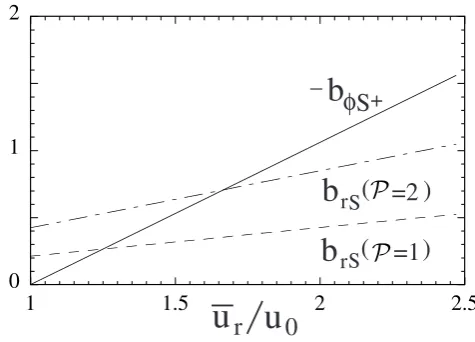
rS>3−1/2≈0.577 (Blandford and Payne, 1982). The outflows typically carry a significant mass flux. For the internal field/flow solutions discussed in §4 with β1, we conclude thatbrS is sufficiently large for magne-tocentrifugal outflows only for turbulent magnetic Prandtl numbers, P∼>2.7. Shu and collaborators (e.g., Cai et al., 2008, and references therein) have developed detailed “X-wind” models which depend on the disk having Prandtl num-bers larger than unity.
b
φ
S
b
r S
u
r
u
0
0
1
2
1
1.5
2
2.5
b
r S
P
P
=1
=2
(
)
(
)
+
Fig. 1. Radial and toroidal field components (normalized toBz)
at the disk’s surface as a function of the average accretion speedur
(normalized by the viscous accretion speedu0). For this plotβ=100
and Prandtl numbersP=1 and 2. Note thatbφS+is given by Eq. (5)
and is independent ofPandbrS is given by Eq. (6).
For Prandtl numbers sayP∼<2.7, the values ofbrS are too small for there to be a magnetocentrifugal outflow. In this case there is an outflow of electromagnetic energy and an-gular momentum from the disk (with little mass outflow) in the form of a magnetically dominated or “Poynting flux jet” (Lovelace, Wang, and Sulkanen, 1987; Lovelace, et al., 2002) also referred to as a “magnetic tower jet” (Lynden-Bell, 1996, 2003). MHD simulations have established the occurrence of Poynting-flux jets under different conditions (Ustyugova et al., 2000, 2006; Kato, Kudoh, and Shibata, 2002; Kato, 2007). Laboratory experiments have allowed the generation of magnetically dominated jets (Hsu and Bellan, 2002; Lebedev et al., 2005).
Figure 1 shows the dependences of the surface field com-ponents on the accretions speed forα=0.1 andβ=100.
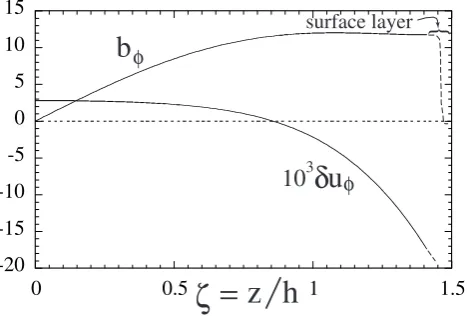
Figures 2 and 3 show a sample solution of Eq. (7) for ε=0.05, α=0.1, β=100, and P=1 where we find ur/u0=1.30,bφS+=−0.321, andbrS=0.276 . For this so-lution both the density ρ(ζ ) and g(ζ ) are take to be step functions going to zero atζm=
√
2 (see Lovelace et al., 2009). Note that the solution has a “channel” structure with the mid-plane region of the disk flowing radially outward and the re-gions closer to the disk’s surfaces flowing radially inward.
3 Conclusions
A study is made of stationary axisymmetric accretion flows
0 2 4 -2
-4 -6
r
01
-1
z
h
ζ
=
h
B
pv
rv
r disk surfacev
rFig. 2. Radial flow speedvr=−ur (normalized toαcs0) as a
func-tion ofζ=z/ hand a sample poloidal(Br, Bz)magnetic field line
forβ=102andP=1.
-20 -15 -10 -5 0 5 10 15
0 0.5 1 1.5
b
u
φδ
10
3 φz h
ζ =
{
surface layer
Fig. 3. Toroidal magnetic fieldbφ=Bφ/Bz and toroidal velocity
δuφ=(vφ−vK)/vK (withvK the Keplerian velocity) for the case
whereβ=100 andP=1. The jump in the toroidal magnetic field at the disk’s surface is shown by the dashed line.
Lovelace (2008). We derive a sixth-order differential equa-tion for the radial flow velocityvr(z)which depends mainly on the ratio of the midplane thermal to magnetic pressures β>1 and the Prandtl number of the turbulenceP= viscos-ity/diffusivity. Boundary conditions at the disk’s surfaces take into account the outflow of angular momentum to mag-netic winds or jets and allow for a surface current flow in the highly conducting surface layers. In general we find that there is a radial surface current but no toroidal surface cur-rent. Stability of the winds or jets will limit the ratio of the toroidal to axial field at the disk’s surface|bφS+| to values
∼
<π. The stationary solutions we find indicate that a weak (β1), large-scale field does not diffuse away as suggested by earlier work (e.g., Lubow et al., 1994) which assumed brS≥3−1/2.
The flow/field solutions found here in a viscous/diffusive disk and are different from the exponentially growing chan-nel flow solutions found by Goodman and Xu (1994) for an MRI in an ideal MHD unstable shearing box. Channel solu-tions in viscous/diffusive disks were found earlier by Ogilvie and Livio (2001) and by Salmeron, K¨onigl, and Wardle (2007) for conditions different from those considered here. In general we find that the magnitude of the toroidal magnetic field component inside the disk is much larger than the other field components. The fact that the viscous accretion speed is very small,∼αεcs0, means that even a small large-scale
field can significantly influence the accretion flow. We find that Prandtl numbers larger than a critical value estimated to be 2.7 are needed in order for there to be magnetocentrifugal outflows from the disk’s surface. For smallerP, electromag-netic outflows are predicted. Owing to the stability condi-tion, |bφS+|∼<π, the fraction of the accretion power going
into magnetic outflows or jets is∼<constβ−1∼Bz2.
Analysis of the time-dependent accretion of the large-scale B−field is clearly needed to study the amplification of the field and build up of magnetic flux in the inner region of the disk. One method is to use global 3-D MHD simula-tions (Igumenshchev et al., 2003; Hirose et al., 2004; De Villiers et al., 2005; Hawley and Krolik, 2006; McKinney and Narayan, 2007; Igumenshchev, 2008), but this has the difficulty of resolving the very thin highly conducting sur-face layers of the disk. Another method is to generalize the approach of Lovelace et al. (1994) taking into account the results of the present work. This is possible because the ra-dial accretion time (r/|ur|) is typically much longer than the viscous diffusion time across the disk (h2/ν).
Acknowledgement. R. V. E. L. was supported in part by NASA grant NNX08AH25G and by NSF grants AST-0607135 and AST-0807129. G. B.-K. was partially supported by RBFR grants 08-02-00491 and 08-02-90106, and RAN program P-04. D. M. R. is supported by an NSF Astronomy and Astrophysics Postdoctoral Fellowship under award AST-0602259.
Edited by: T. Passot
Reviewed by: P. Hennebelle and another anonymous referee
References
Balbus, S. A. and Hawley, J. F.: A powerful local shear instability in weakly magnetized disks. I. linear analysis, Astrophys. J., 376, 214–222, 1991.
Bisnovatyi-Kogan, G. S. and Ruzmaikin, A. A.: The accretion of matter by a collapsing star in the presence of a magnetic field, Astrophys. Space Sci., 28, 45–59, 1974.
II. Self-consistent stationary picture, Astrophys. Space Sci., 42, 401–424, 1976.
Bisnovatyi-Kogan, G. S. and Lovelace, R. V. E.: Large-scale B-field in stationary accretion disks, Astrophys. J., 667, L167–L169, 2007.
Blandford, R. D. and Payne, D. G.: Hydromagnetic flows from ac-cretion discs and the production of radio jets, Mon. Not. R. As-tron. Soc., 199, 883–903, 1982.
Cai, M. J., Shang, H., Lin, H. H., and Shu, F. H.: X-winds in action, Astrophys. J., 672, 489–503, 2008.
De Villiers, J.-P., Hawley, J. F., Krolik, J. H., and Hirose, S.: Mag-netically driven accretion in the Kerr metric, III. Unbound out-flows, Astrophys. J., 620, 878–888, 2005.
Fromang, S., Papaloizou, J., Lesur, G., and Heinemann, T.: MHD simulations of the magnetorotational instability in a shearing box with zero net flux, II. The effect of transport coefficients, Astron. Astrophys., 476, 1123–1132, 2007.
Goodman, J. and Xu, G.: Parasitic instabilities in magnetized dif-ferentially rotating disks, Astrophys. J., 432, 213–223, 1994. Hawley, J. F. and Krolik, J. H.: Magnetically driven jets in the Kerr
metric, Astrophys. J., 641, 103–116, 2006.
Hirose, S., Krolik, J. H., De Villiers, J.-P., and Hawley, J. F.: Mag-netically Driven Accretion Flows in the Kerr metric, II. Structure of the magnetic field, Astrophys. J., 606, 1083–1097, 2004. Hsu, S. C. and Bellan, P. M.: A laboratory plasma experiment for
studying magnetic dynamics of accretion disks and jets, Mon. Not. R. Astron. Soc., 334, 257–261, 2002.
Igumenshchev, I. V., Narayan, R., and Abramowicz, M. A.: Three-dimensional magnetohydrodynamic simulations of radiatively inefficient accretion flows, Astrophys. J., 592, 1042–1059, 2003. Igumenshchev, I. V.: Magnetically arrested disks and the origin of Poynting jets: a numerical study, Astrophys. J., 677, 317–326, 2008.
Kato, S. X., Kudoh, T., and Shibata, K.: 2.5 dimensional non steady magnetohydrodynamic simulations of magnetically driven jets from geometrically thin disks, Astrophys. J., 565, 1035–1049, 2002.
Kato, Y.: Magnetic tower jet solution for launching astrophysical jets, A&SS, 307, 11–15, 2007.
K¨onigl, A.: Self-similar models of magnetized accretion disks, As-trophys. J., 342, 208–223, 1989
Lebedev, S. V., Ciardi, A., Ampleford, D. J., Bland, S. N., Bott, S. C., Chittenden, J. P., Hall, G. N., Rapley, J., Jennings, C. A., Frank, A., Blackman, E. G., and Lery, T.: Magnetic tower out-flows from a radial wire array Z-pinch, Mon. Not. R. Astron. Soc., 361, 97–108, 2005.
Lesur, G. and Longaretti, P.-Y.: Impact of dimensionless numbers on the efficiency of magnetorotational instability induced turbu-lent transport, Mon. Not. R. Astron. Soc., 378, 1471–1480, 2007. Li, Z.-Y.: Magnetohydrodynamic disk-wind connection:
self-similar solutions, Astrophys. J., 444, 848–860, 1995.
Lovelace, R. V. E.: Dynamo model of double radio sources, Nature, 262, 649–652, 1976.
Lovelace, R. V. E., Wang, J. C. L., and Sulkanen, M. E.: Self- colli-mated electromagnetic jets from magnetized accretion disks, As-trophys. J., 315, 504–535, 1987.
Lovelace, R. V. E., Berk, H. L., and Contopoulos, J.: Magnetically driven jets and winds, Astrophys. J., 379, 696–705, 1991. Lovelace, R. V. E., Romanova, M. M., and Newman, W. I.:
Implo-sive accretion and outbursts of active galactic nuclei, Astrophys. J., 437, 136–143, 1994.
Lovelace, R. V. E., Newman, W. I., and Romanova, M. M.: Jet outbursts from fast accretion in a disk with zebra-stripe magnetic field, Astrophys. J., 484, 628–636, 1997.
Lovelace, R. V. E., Rothstein, D. M., and Bisnovatyi-Kogan, G. S.: Advection/Diffusion of large-scale B-field in accretion disks, in preparation, 2009.
Lubow, S. H., Papaloizou, J. C. B., and Pringle, J. E.: Magnetic field dragging in accretion discs, Mon. Not. R. Astron. Soc., 267, 235–240, 1994.
Lynden-Bell, D.: Magnetic collimation by accretion discs of quasars and stars, Mon. Not. R. Astron. Soc., 279, 389–401, 1996.
Lynden-Bell, D.: On why discs generate magnetic towers and colli-mate jets, Mon. Not. R. Astron. Soc., 341, 1360–1372, 2003. McKinney, J. C. and Narayan, R.: Disc-jet coupling in black hole
accretion systems – I. General relativistic magnetohydrodynamic models, Mon. Not. R. Astron. Soc., 375, 513–530, 2007. Nakamura, M., Li, H., and Li, S.: Stability properties of magnetic
tower jets, Astrophys. J., 656, 721–732, 2007.
Ogilvie, G. I. and Livio, M.: Launching of jets and the vertical structure of accretion disks, Astrophys. J., 553, 158–173, 2001. Pessah, M. E., Chan, C.-k, and Psaltis, D.: The fundamental
differ-ence between shear alpha viscosity and turbulent maagnetorota-tional stresses, Mon. Not. R. Astron. Soc., 383, 683–690, 2007. Rothstein, D. M. and Lovelace, R. V. E.: Advection of magnetic
fields in accretion disks: Not so difficult after all, Astrophys. J., 677, 1221–1232, 2008.
Salmeron, R., K¨onigl, and Wardle, M.: Angular momentum trans-port in protostellar discs, Mon. Not. R. Astron. Soc., 375, 177– 183, 2007.
Shakura, N. I. and Sunyaev, R. A.: Black holes in binary sys-tems: Observational appearance, Astron. Astrophys., 24, 337– 355, 1973.
Spruit, H. C. and Uzdensky, D. A.: Magnetic flux captured by an accretion disk, Astrophys. J., 629, 960–968, 2005.
Ustyugova, G. V., Koldoba, A. V., Romanova, M. M., Chechetkin, V. M., and Lovelace, R. V. E.: Magnetocentrifugally driven winds: Comparison of MHD simulations with theory, Astrophys. J., 516, 221–235, 1999.
Ustyugova, G. V., Lovelace, R. V. E., Romanova, M. M., Li, H., and Colgate, S. A.: Poynting jets from accretion disks, Magnetohy-drodynamic simulations, Astrophys. J., 541, L21–L24, 2000. Ustyugova, G. V., Koldoba, A. V., Romanova, M. M., and Lovelace,
R. V. E.: Propeller regime of disk accretion to rapidly rotating stars, Astrophys. J., 646, 304–318, 2006.