A deterministic width function model
C. E. Puente and B. Sivakumar
Department of Land, Air & Water Resources, University of California, Davis, USA Received: 11 September 2002 – Revised: 13 March 2003 – Accepted: 15 May 2003
Abstract.
Use of a deterministic fractal-multifractal (FM) geometric method to model width functions of natural river networks, as derived distributions of simple multifractal measures via fractal interpolating functions, is reported. It is first demon-strated that the FM procedure may be used to simulate natural width functions, preserving their most relevant features like their overall shape and texture and their observed power-law scaling on their power spectra. It is then shown, via two nat-ural river networks (Racoon and Brushy creeks in the United States), that the FM approach may also be used to closely approximate existing width functions.
1 Introduction
The width function,w(r), defined such that w(r)dr is the area of a basin whose flow distance to the outlet is between randr+dr, is an important geomorphological qualifier of a river network. As such a function captures the essential features of the basin’s response as implied by the instanta-neous unit hydrograph (Rodriguez-Iturbe and Rinaldo, 1997; Gupta and Waymire, 1998), its proper modeling has become increasingly relevant.
Recently, a variety of sophisticated stochastic models for the width function have been introduced (Marani et al., 1994; Veneziano et al., 2000). While the work of Marani et al. (1994) relied on fractional Brownian motion and on ran-dom multiplicative cascades in order to capture, respectively, the power spectra and the multifractal characteristics of nat-ural width functions; Veneziano et al. (2000) introduced an iterated random pulse (IRP) model that, while accounting ex-plicitly for the self-similarity of natural river networks, prop-erly captures their non-negativity, non-stationarity, and the power-law decay of their spectral density function.
The purpose of this article is to illustrate by means of few examples that a deterministic fractal-multifractal (FM)
rep-Correspondence to: C. E. Puente ([email protected])
resentation (Puente, 1992, 1994), successfully employed to model data sets corresponding to a host of geophysical pro-cesses, such as rainfall (Puente and Obreg´on, 1996; Obreg´on et al., 2002a, b), turbulence (Puente and Obreg´on, 1999), and groundwater contamination transport (Puente et al., 2001a, b), may also be used to represent the overall structure of the width function of natural catchments.
2 The Fractal-Multifractal approach
Figure 1 illustrates the construction of a derived distribu-tion via the FM approach (Puente, 1992, 1994). As is seen, such a set named dy is found transforming a (determinis-tic) binomial multifractal measure, dx, (bottom left), via a (deterministic) fractal interpolating function f. The set dy is obtained considering all relevant events in x corre-sponding to a level y and adding their contributions, i.e. dy(B)=dx{x :f (x)∈B}, for all Borel subsetsBony.
For a given set of N + 1 points in the plane {(x0, y0), (x1, y1), . . . , (xN, yN);x0 < x1 < . . . < xN},
measuresdx anddy may be calculated iterating a suitable set ofN contractile affine mappings (according to an appro-priate set ofN weightspnthat dictate the intermittencies of
dx) and counting over a desired number of bins (the resolu-tion of the records to be fitted) overx andy(Puente, 1994). Such mappings have the specific form
wn
x y
=
an 0
cn dn
x y
+
en
fn
, (1)
wherean, cn, en, andfnare related to the interpolating points
and the free scaling parametersdn,0 ≤ |dn| < 1, via the
conditions wn
x0 y0
=
xn−1 yn−1
(2) and
wn
xN
yN
=
xn
yn
x
y
dy
f
dx
Figure 1:
Fig. 1. The fractal-multifractal framework in two dimensions. A multifractal measuredx is transformed via a fractal interpolating functionf into a derived measuredy.
forn = 1,2, . . . , N, and yield a fractal interpolating func-tion whose graph’s dimensionDf is: (a) 1, ifP|
dn| ≤ 1,
and (b)≥1, fromP| dn|aDf
−1
n =1, ifP|dn|>1
(Barns-ley, 1988).
A vast class of deterministic derived measures dy may be obtained by varying the parameters of f and dx, i.e. (xn, yn), dnandpn, and by allowing projections to be found
at directions other thany, i.e. at anglesθdifferent from 0 de-grees. At the end, the FM methodology results in a large universe of “data sets”, that, depending on the fractal di-mensionDf, include a wide variety of multifractal records, even having “chaotic” or “stochastic” properties, and Gaus-sian distributions, in the limit whenDf tends to two (Puente, 2004). The geometric approach may easily be tailored to generate sets of arbitrary resolutions (e.g. Obreg´on et al., 2002b) which turn out to have the desirable feature of be-ing neither self-similar nor self-affine (as seen in Fig. 1), as found in many practical applications.
It so happens that the setdy in Fig. 1 (and many others) has a similar shape and texture as found in width functions of natural river networks and such observation motivates us-ing the FM approach to represent natural width functions. In what follows, it is shown how the FM approach may in-deed be employed to simulate general width functions and to model specific width functions as observed in nature.
Figure 2:
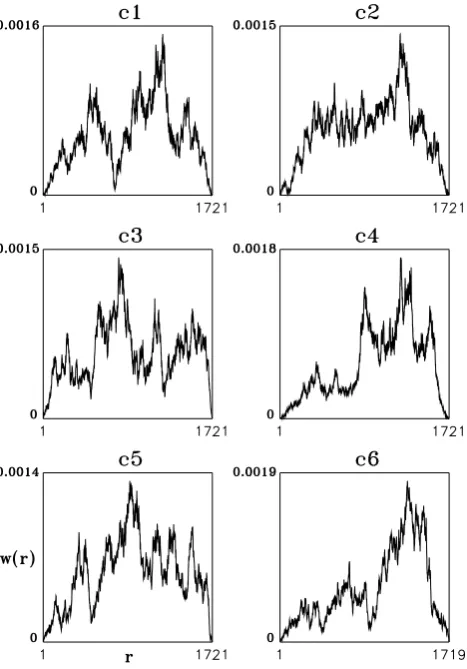
Fig. 2. Examples of (normalized) width functions, c1 to c4 are gen-erated via the FM procedure, while c5 and c6 correspond to Racoon and Brushy creeks.
3 Simulated and natural width functions
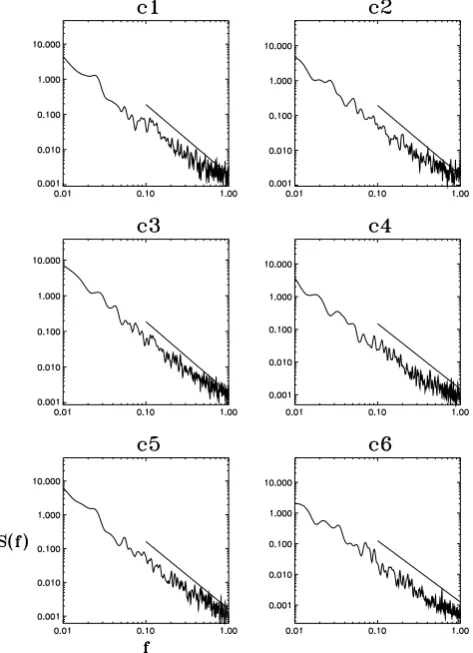
As explained in Veneziano et al. (2000), natural width functions possess three important characteristics: (a) non-negativity, (b) non-stationarity, and (c) power-law decay of the spectral density function,S(f ) ∼ f−β, with values of β typically ranging between 1.6 and 2.0. To illustrate such features, Fig. 2 includes six such plausible graphs (normal-ized so that their areas equal one unit), cases c1 to c6, made of 1 721 data points for c1 to c5 and 1 719 points for c6, and Fig. 3 shows their corresponding power spectra.
As seen in Fig. 2, all such graphs are indeed non-negative, they possess similar high-frequency textures, and they are also non-stationary as they begin and end at zero. As shown in Fig. 3, the power spectra of these sets have similar decay and their exponents β are bounded by the value of 2.0, as shown by the straight lines on all graphs.
Figure 3:
Fig. 3. Power spectra of the width functions shown in Fig. 2.
Table 1. FM parameters for simulated width functions c1 to c4 as shown in Fig. 2. Values not presented below are set as follows: x0=0, y0=0, andx2=1.
“Basin” Coordinates Angleθ
x1 x3 y1 y2 y3
c1 0.700 1.800 0.800 0.0
c2 0.700 1.500 1.800 0.800 0.000 8.0
c3 0.600 2.000 1.000 0.0
c4 0.600 2.000 1.300 12.0
“Basin ” Scalings Intermittencies
d1 d2 d3 p1 p2 p3
c1 0.600 -0.800 0.500 0.500
c2 0.540 -0.730 -0.500 0.440 0.330 0.230
c3 -0.800 -0.630 0.510 0.490
c4 -0.890 -0.630 0.470 0.530
Basin Coordinates Angleθ
x1 y1 y2
Racoon 0.607 2.015 1.095 -0.67
Brushy 0.550 2.494 2.077 9.90
Basin Scalings Intermittencies
d1 d2 p1 p2
Racoon -0.881 -0.615 0.530 0.470
Brushy -0.917 -0.653 0.492 0.508
Pennsylvania and Brushy creek of 322 km2 situated in Al-abama, both extending for about 50 km from their respective outlets (Veneziano et al., 2000). These results show that the FM approach provides, by varying its key parameters, great many outcomes that may be considered suitable represen-tations (simulations) of natural width functions, simulations which, by varying smoothly with respect to their parameters, provide an opportunity to represent natural width functions, at any given resolution, in their entirety.
In what follows, it shall be shown how the FM approach may be used to find suitable approximations of natural width functions, considering the aforementioned creeks.
4 FM approximations to Racoon and Brushy creeks
This section presents the results obtained while solving the inherent inverse problem to approximate the width functions for the Racoon and Brushy creeks.
Based on previous experience with other data sets (Obreg´on et al., 2002a, b), an objective function account-ing for the cumulative distributions of the records and their derivatives was minimized, performing the search via a ge-netic algorithm (Duan et al., 1992). Specifically, an objec-tive function1was used adding: (a) the sum of square dif-ferences between cumulative distributions of real (normal-ized) width functions and FM sets (P
12); and (b) the sum of square differences between cumulative distributions of normalized absolute one-lag derivatives of real (normalized) width functions and FM sets (P
12d).
Figure 4:
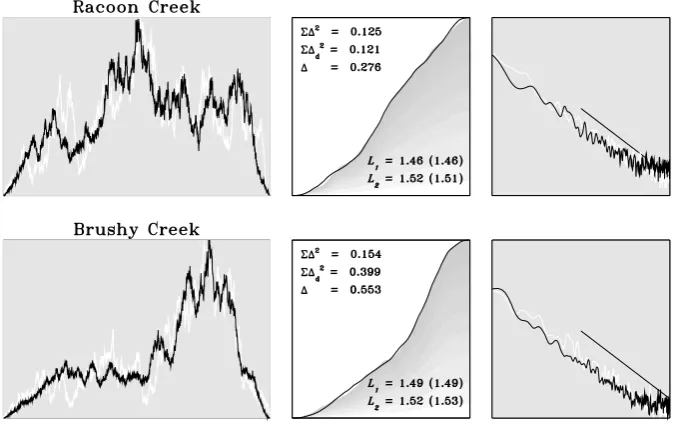
Fig. 4. Actual and FM fitted width functions, cumulative distributions, and power spectra for Racoon and Brushy creeks. For the actual sets, the width function and the power spectra are shown in white, whereas the cumulative distribution is highlighted in gray. The horizontal and vertical scales for the three graphs corresponding to Racoon creek are: [1, 1721], [0, 0.0014]; [0, 1], [0, 1]; and [0.01, 1.0], [0.001, 10.0] as in c5 in Fig. 3. Those scales for Brushy creek are: [1, 1719], [0, 0.0019]; [0, 1], [0, 1]; and [0.01, 1.0], [0.001, 10.0], as in case c6 in Fig. 3.
As may be inferred, the FM representations for the Racoon and Brushy creek catchments are based on binomial multi-fractal measures and on multi-fractal interpolating functions pass-ing by three points (leadpass-ing to seven free parameters, see Table 2, for x0, y0 andx2 were kept fixed), whose graphs
have dimensions of 1.60 and 1.66, respectively. These results stem from very faithful descriptions of the records’ cumula-tive distributions and of their derivacumula-tives (not shown), as im-plied by very low values of the attributesP
12, P 12d, and hence1(all less than 1), that started, as the search began, at values greater than 20. The closeness of such fits may also be appreciated in the close agreement in the quantitiesL1 and L2 (real values in parenthesis), that give the lengths of
cu-mulative distributions of the records and of their derivatives, when calculated from (0, 0) to (1, 1), such that the records’ domain is set to one unit.
As may be seen in Fig. 4, the obtained FM width tions capture the overall trends present in the actual func-tions, including good approximations of the peaks, and pos-sess similar textures that translate into good agreement of the power-law decay in the power spectra for both catchments. Notice that this happens despite small deviations from the scaling lines at high frequencies, as the FM approximations shown, that do not optimize the desired scaling law, turned out to produce smoother width functions compared to the ac-tual sets.
As typical width functions share similar features to the ones included here (see for example Rodriguez-Iturbe and Rinaldo, 1997), the results in Fig. 4 further illustrate that the FM approach may be used to model them, using fractal in-terpolating functions whose graphs have fractal dimensions ranging between 1.4 and 1.7. As specific fits of other width functions may certainly be obtained in a similar fashion, it is envisioned that a “physical” meaning may be assigned to their FM geometric parameters (or groups of them) in terms of actual characteristics of the underlying watersheds,
as it has been found in other applications (e.g. Puente et al., 2001a, b). Such an exercise may ultimately lead to a regional parameterization of a host of width functions.
5 Conclusions
This article has shown that the FM methodology may be employed to obtain suitable approximations of width func-tions of natural catchments as derived distribufunc-tions of sim-ple multifractal measures via fractal interpolating functions, in a rather parsimonious way. As such, it has been shown that such a deterministic procedure may be used to not only simulate sets that properly preserve all essential features, as captured by stochastic models (Veneziano et al., 2000), but also fit specific width function sets, which random models, due to their specific random structure, cannot easily do.
The FM approach, while providing parsimonious descrip-tions of whole width funcdescrip-tions leading to vast compression ratios (1721 to 7 or about 246 to 1 in the examples consid-ered), represents a new approach for understanding the com-plexities of natural width functions such that their inherent geometries are fully captured and at any given resolution. Due to its scope, the FM method cannot be safely compared with other existing (stochastic) procedures that by definition are able to simulate plausible realizations of width functions (even if with fewer parameters than a wholistic FM repre-sentation may have). In a sense, the FM methodology, by representing specific width functions, just parameterizes re-alizations as given by stochastic representations.
interpre-ported in part by the USEPA via Grant GAD # R82 4780 and by NASA under Grant NAG5–7441.The data sets used in this work were kindly provided to us by Glenn E. Moglen. Comments by anonymous reviewers are gratefully acknowledged.
References
Barnsley, M. F.: Fractals Everywhere, Academic, San Diego, Calif., 1988.
Duan, Q., Sorooshian, S., and Gupta, V.: Effective and efficient global optimization for conceptual rainfall-runoff models, Water Resour. Res., 28(4), 1015–1031, 1992.
Gupta, V. K. and Waymire, E. C.: Spatial variability and scale in-variance in hydrologic regionalization, in Scale Dependence and Invariance in Hydrology, edited by G. Sposito, Cambridge Univ. Press, New York, 88–135, 1998.
Marani, A., Rigon, R., and Rinaldo, A.: A note on fractal channel networks, Water Resour. Res., 27, 3041–3049, 1991.
Marani, M., Rinaldo, A., Rigon, R., and Rodr´ıguez-Iturbe, I.: Ge-omorphological width functions and the random cascade, Geo-phys. Res. Lett., 21(19), 2123–2126, 1994.
Obreg´on, N., Sivakumar, B., and Puente, C. E.: A deterministic ge-ometric representation of temporal rainfall: Sensitivity analysis
Puente, C. E.: Multinomial multifractals, fractal interpolators, and the Gaussian distribution, Phys. Lett. A, 161, 441–447, 1992. Puente, C. E.: Deterministic fractal geometry and probability, Int.
J. Bifurcations Chaos, 4(6), 1613–1629, 1994.
Puente, C. E.: A universe of projections: May Plato be right?, Chaos, Solitons and Fractals, 19/2, 241–253, 2004.
Puente, C. E. and Obreg´on, N.: A deterministic geometric represen-tation of temporal rainfall: Results for a storm in Boston, Water Resour. Res., 32(9), 2825–2839, 1996.
Puente, C. E. and Obreg´on, N.: A geometric platonic approach to multifractality and turbulence, Fractals, 7(4), 403–420, 1999. Puente, C. E., Robayo, O., D´ıaz, M. C., and Sivakumar, B.: A
fractal-multifractal approach to groundwater contamination, 1. Modeling conservative tracers at the Borden site, Stoch. Env. Res. Risk Assess., 15(5), 357–371, 2001a.
Puente, C. E., Robayo, O., and Sivakumar, B.: A fractal-multifractal approach to groundwater contamination, 2. Predicting conserva-tive tracers at the Borden site, Stoch. Env. Res. Risk Assess., 15(5), 372–383, 2001b.