PROBABILISTIC APPROACH FOR VULNERABILITY
ANALYSIS USING GNAVE ALGORITHM FOR NODE
CAPTURE ATTACKS IN WSN
Manjula H.T
1, Amreen Khanam
2, Sumathi D
31, 2, 3
Asst Prof, Dept. of CSE, HKBK College of Engineering, (India)
ABSTRACT
The impact of node capture attacks on the confidentiality and integrity of network traffic, where it is attempted
to map the compromise of network traffic to the flow of current through an electric circuit and propose a metric
for quantifying the vulnerability of the traffic using the circuit mapping. It computes the vulnerability metric as
a function of the routing and the cryptographic protocols used to secure the network traffic and formulate the
minimum cost node capture attack problem as a nonlinear integer programming problem. Due to the
NP-hardness of the minimization problem, a greedy heuristic is implemented that approximates the minimum cost
attack by providing examples of node capture attacks using the vulnerability metric and show that the adversary
can expand significantly less resources to compromise target traffic by exploiting information leakage from the
routing and cryptographic protocols. Finally, the framework is targeted to design where it can formalize node
capture attacks using the vulnerability metric as a nonlinear integer programming minimization problem and
with the proposed GNAVE algorithm, a Greedy Node capture Approximation using Vulnerability Evaluation
with a discussion on the availability of security parameters to the adversary and show that unknown parameters
can be estimated using probabilistic analysis.
Index Terms: Wireless Networks, Security, Routing, Node Capture Attacks, Adversary Models.
I. INTRODUCTION
The successful commercialization of many applications of wireless networks relies on the assurance of the
confidentiality and integrity of the data communicated through the network. Confidentiality is defined as the
ability to keep data secret from all but a set of authorized entities, and integrity is defined as the ability to verify
that data has not been maliciously or accidentally altered while in transit. It has demonstrated that these
properties can be efficiently compromised by physically capturing network nodes and extracting cryptographic
keys from their memory. Such node capture attacks are possible due to the potential unattended operation of
wireless nodes and the prohibitive cost of tamper-proof hardware in portable devices. Using the cryptographic
keys recovered in a node capture attack, an adversary can compromise the confidentiality and integrity of any
messages secured using the compromised keys .For symmetric key assignment in wireless sensor and adhoc
networks, node capture attacks aim at the compromise of individual node-to-node wireless links. However, a
message traversing multiple links between a source and destination node is compromised if any of the traversed
links in the route becomes insecure. The overall security of a routed message is thus at best that of the least
secure or most vulnerable link traversed by the message. Hence, the impact of the node capture attack is a
function of both the cryptographic protocol which provides link security and the routing protocol which
II. RELATED WORK
In [1] they mapped compromise of network traffic to the flow of current through an electric circuit and
formulated the minimum cost node capture attack as a nonlinear integer programming minimization problem
using the route vulnerability metric and provided a greedy heuristic solution called GNAVE to approximate the
NP-hard minimization problem and showed that an adversary can significantly decrease the resource
expenditure by intelligently capturing nodes using the proposed route vulnerability metric.
In [2] they presented a new key management scheme for large- scale DSNs. This approach was scalable and
flexible. They illustrated the effect of modifying design parameters using both analysis and simulations.
In [3], they investigated the problem of modeling node capture attacks in heterogeneous wireless ad hoc and
mesh networks. It is shown that probabilistic heuristic attacks can be performed effectively even under storage
randomization.
In [4]&[5] Pairwise key establishment was used as a fundamental security service in sensor networks, which
enables the sensor nodes to communicate securely with each other using cryptographic techniques
In [7] they derived a practical guideline based on the energy histogram and developed a spectrum of new
techniques to enhance the routing in sensor networks.
In [8] they showed that attacks in adversary model correspond to NP-hard optimization problems and discuss
the behavior of a reasonable heuristic algorithm. They demonstrated the use of the attack decomposition model
for derivation of attack metrics and discuss the potential use of this decomposition technique for the purposes of
defense against node capture attacks.
III. EXISTING SYSTEM
The previous studies on node capture attacks focused on the ability of an adversary to compromise the security
of single-hop wireless links. Messages in a wireless network traverse multiple links and paths between a source
and destination node, and a message may be compromised by traversing insecure link. A symmetric key
assignment for resource-constrained devices has focused on node capture attacks in which an adversary chooses
the captured nodes independently at random.
In the existing system, it is seen that an intelligent adversary can reduce the resource expenditure required
for the node capture attack using information leaked from the key assignment protocol.
In particular, the adversary can learn which keys are assigned to individual nodes in the network by
eavesdropping on or participating in the secure link establishment protocol and are also based on the single
mission-key solution which is inadequate because the capture of any sensor node may compromise the
entire DSN since selective key revocation is impossible upon sensor-capture detection.
Pair wise keys [4] allow for secure key establishment with low complexity, but the storage requirement of
(N-1) pair wise keys for each of the N nodes may be prohibitive for large networks.
IV. PROPOSED WORK
To address the problems and the issues in existing system, the vulnerability of network traffic is used as a
measure of the adversary’s ability to compromise a message traversing a particular route in the given framework
(WSN).
4.1 Advantages of the Proposed System
Node capture attacks result from the combination of passive, active, and physical attacks by an intelligent
adversary.
To initialize or set up an attack, the adversary will collect information about the WSN by eavesdropping on
message exchanges, either local to a single adversarial device or throughout the network with the aid of a
number of adversarial devices deployed throughout the network.
Even if message payloads are encrypted, the adversary can extract information about the network operation
and state, effectively learning about the network structure and function.
In addition to passive learning, the adversary can actively participate in network protocols, probing the
network for information and maliciously injecting information into the network.
Once a sufficient amount of passive and active learning has taken place, the adversary can physically
capture nodes.
The gathered information can be used to help the adversary make an informed decision of which sensor
nodes to capture in order to optimize the performance of the attack with respect to a specific attack goal.
4.2 Network Setup Module
The network simulation environment is developed here where constant bit rate traffic sources will be used. The
radio model in the simulator will be based on Linksys WLAN 802.11 providing an optimum transmission rate.
The link layer model will be simulated in IEEE 802.11 WLAN standard where a 15-20 mode network in a field
with approximate dimensions of 670x670 will be used. The source-destination pair are separated randomly over
the network. A specific data byte packet will be used where simulations are run for 500 simulated seconds. The
major objective of design of the network setup module is to discover certain important network parameters like:
1. Network Region.
2. Channel Capacity.
3. Transmission Range
4. Size of Data Packet.
5. Minimum Mobility Speed.
6. Maximum Mobility Speed.
4.3 Key Assignment Module
We assume the existence of a secure key assignment mechanism as follows: Let K be a set of symmetric
cryptographic keys and L be a corresponding set of publicly available key labels. Each node i
N is assigned asubset Ki
K and the corresponding subset Li
L. We denote the subset of keys shared by nodes i and j asKij = Ki
Kj and allow communication between i and j if and only if Kij
0¸. We assume that nodes i and juse the entire set Kij of shared keys to secure the link (i, j), so the strength of the link security is directly related
to the number of shared keys. We assume that nodes i and j compute the intersection Lij = Li
Lj in order todetermine the set of shared keys Kij using a protocol from one of the following classes:
1. The class of public label exchange protocols consists of any protocol which provides necessary information
for any node j
N to compute the set Li of key labels for any node i
N.2. The class of privacy-preserving set intersection protocols consists of any protocol which provides necessary
information for any node j
N to only compute the set Lij of key labels shared with any node i
N without4.4 Adversarial Module
We consider a polynomial-time adversary with the ability and resources to eavesdrop on and record messages
throughout the network, capture nodes, and extract cryptographic keys from the memory of captured nodes. We
assume that the adversary has knowledge of the key assignment and routing protocols, including protocol
parameters, and can participate actively in any network protocols by assuming the roles of captured, replicated,
or fabricated nodes. We further assume that the route subgraph Gsd for each (s,d)
T is available to theadversary or is computable using traffic analysis and estimation.
The primary goal of the adversary is to compromise the confidentiality and integrity of all messages routed
between a target set of source-destination pairs denoted TA
T by extracting cryptographic keys from thememory of captured nodes C
N with minimum resource expenditure. The adversary thus captures nodesintelligently by associating an individual weight or cost wi with the resource expenditure
required to capture node i
N, We do not address further attacks on network protocols and services that can beperformed as a result of message compromise
4.5 Node Capture Attack Formulation Module
We define a class of route vulnerability metrics (RVMs) to quantify the effective security of traffic traversing a
given route Rsd. Using the RVM definition, we formulate the minimum cost node capture attack problem as a
nonlinear integer programming minimization problem. Since determining the optimal node capture attack is
likely infeasible, we propose the GNAVE algorithm using a greedy heuristic to iteratively capture nodes which
maximize the increase in route vulnerability.
In order to evaluate the effect of a node capture attack on the effective security of traffic traversing a route
Rsd,we formally define link, path, and route compromise due to the capture of a subset C
N of network nodes.We denote the set of keys recovered by the adversary in capturing the subset C as KC = UiNKi. If a message
traverses a link which is secured by keys in KC, the security of the message is compromised. The compromise
of individual links in the network, with respect to the network and routing models. we devise a node capture
strategy that maximizes the progression toward the goal of compromising all routes Rsd for (s, d)
A. Thechoice of subset C requiring the minimum resource expenditure is thus given by the minimum cost node capture
problem. To maximize the route vulnerability with minimum resource expenditure, it is beneficial to the
adversary to attempt to maximize the vulnerability resulting from the capture of each individual node using the
information recovered from previously captured nodes.
Based on this greedy approach, we propose the GNAVE algorithm as follows GNAVE Algorithm:
Given: Li, wi for i
N, Rsd for (s,d)
TAC 0
While there exists (s,d)
TA with Vsd (C)< 1 doI* i i
N i
W
C
v
u
max
(
)
/
arg
CC U{i*}
End while
[L]= Set of ordered pair of one-hop neighbor nodes
W=weight or cost of capturing nodes
Rsd =Set of paths forming the route from s to d
D=Destination
TA=Adversary Target subset
C=Captured nodes
Vsd =Route Vulnerability
The GNAVE algorithm being greedy implies that the attack performance depends only on the order of the
weighted node values for the nodes
4.6 Implementing RVM realizations Module
In this section, we propose two RVM realizations satisfying the certain conditions, noting that there is a high
degree of freedom in the given conditions. We present each RVM realization for each of the routing protocol
classes discussed in network model setup, hereafter denoting the route vulnerability for independent and
dependent path routing protocols. The RVM here is represented by set theory as well as in circuit theory.
4.7 Comparison of RVM Realizations
We provide a pair of examples to illustrate cases in which the RVMs are evaluated using the provided
definitions. Each of the examples demonstrates a scenario where one metric provides more information to the
adversary in choosing which nodes to capture. Both examples are presented using the network for a source and
destination with intermediate nodes. The number of shared keys for each link is also defined, and the costs to
capture are assumed to be infinity. The other nodes present in the network have unit cost to capture and are of
two types and the adversary must choose between two nodes by computing the node values using GNAVE
algorithm
V. EXPERIMENTAL RESULTS
The following snapshots are some experimental results for vulnerability analysis using GNAVE algorithm for
node capture attacks in WSN.
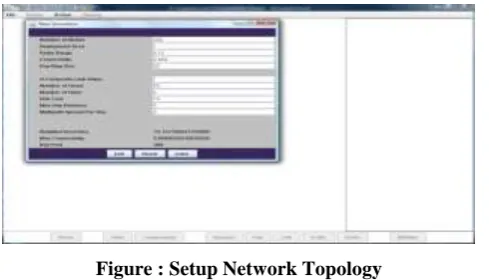
5.1 Network Setup Module
Figure : Setup Network Topology
This screen is used to pass the parameters so that the network will be constructed in the simulation mode such as
the number of nodes, Deployment Area, Radio Range, connectivity, Key ring size, Q composite value, number
of flows, number of hubs, hub cost, maximum hop distance, multipart spread per hop, neighborhood size,
maximum connectivity, and key pool has to be defined and once the user select the enter button, number of
5.2 Wireless Network Region
Figure: Wireless Communication Networks
This screen shows the nodes and links in a network. The right side in the figure shows the status of the network.
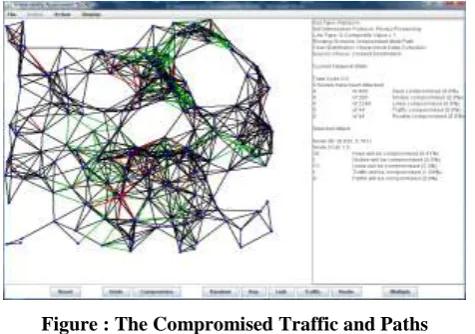
5.3 Key Assignment Module
Figure : The Compromised Traffic and Paths
This screen shows the keys compromised, nodes compromised, links compromised, Traffic compromised, paths
compromised.
5.4 Adversary Module
The figure below shows the user to initiate multiple nodes to be attacked in WSN the user has to enter multiple
icons which is seen on the screen. We get a dialog box indicating the number of nodes to be attacked, user has to
enter the number of nodes to be attacked, keys to be attacked, links to be attacked, traffic to be attacked, route to
This screen shows that when the user initiates multiple attacks the nodes compromised in the simulation mode
.Once the user enters multiple attacks then all the nodes will be compromised in the simulation mode.
VI. CONCLUSION
In this paper we present the major contribution of the node capture attack using GNAVE algorithm in WSN.
The probabilistic approach for vulnerability analysis using GNAVE algorithm for node capture attacks in WSN
has the following unique features:
Nodes are captured independently at random, serving as the baseline performance for the adversary.
Nodes are captured iteratively to maximize the number of compromised keys by choosing the node with
maximum at each iteration.
Nodes are captured iteratively to maximize the number of compromised links by choosing the node which
compromises the maximum number of additional links, independent of the routing protocol. Under
privacy-preserving protocols, this attack uses the estimation techniques.
Nodes are captured iteratively to maximize the amount of network traffic routed through captured nodes,
independent of the key assignment protocol.
Nodes are captured using the GNAVE algorithm and the RVM using information from both the routing and
key assignment protocols.
REFERENCES
[1] Vulnerability of Network Traffic under Node Capture Attacks using Circuit Theoretic Analysis Patrick
Tague, David Slater, Jason Rogers,and Radha Poovendran Network Security Lab (NSL), Electrical
Engineering Department, University of Washington, Seattle, Washington, IEEE 2008
[2] A Key Management Scheme for Distributed Sensor Networks Laurent Eschenauer, Virgil D. Gligor
Electrical and Computer Engineering Department University of Maryland College Park, MD, USA IEEE
2002
[3] Modeling adaptive node capture attacks in multi-hop wireless networks Patrick Tague, Radha Poovendran
Network Security Lab (NSL), Department of Electrical Engineering, University of Washington IEEE 2007
[4] A Pairwise Key Predistribution Scheme for Wireless Sensor Networks Wenliang Du, Jing Deng,
Yunghsiang S. Han, Pramod K. Varshney IEEE 2003
[5] Establishing Pairwise Keys in Distributed Sensor Networks Donggang Liu, Peng Ning Cyber Defense
Laboratory Department of Computer Science North Carolina State University, IEEE 2003
[6] Secure Network Coding Ning Cai_and Raymond W. Yeungy: IEEE 2008
[7] Energy Efficient Routing In Wireless Sensor NetworksCurt Schurgers, Mani B. Srivastava Networked &
Embedded Systems Lab (NESL), Electrical Engineering Department University of California at Los
Angeles
[8] Modeling Node Capture Attacks in Wireless Sensor NetworksPatrick Tague and Radha Poovendran
Network Security Lab (NSL), Electrical Engineering Department, University of Washington, Seattle,