R E S E A R C H
Open Access
Prediction error preprocessing for perceptual
color image compression
Kuo-Cheng Liu
Abstract
In this article, a prediction error preprocessor based on the just noticeable distortion (JND) for the color image compression scheme is presented. The dynamic range of prediction error signals we can reduce, the lower bit rate of the reconstructed image we can obtain at high visual quality. We propose a color JND estimator that is
incorporated into the design of the preprocessor in the compression scheme. The color JND estimator is carried out in the wavelet domain to present good estimates to the available amount masking. The estimated JND is used to preprocess the signal and is also used to incorporate into the design of the quantization stage in the
compression scheme for higher performance. Simulation results show that the bit rate required by the
compression scheme with the preprocessor is lower at high visual quality of the reconstructed color image. The preprocessor is further applied to the input color image of the JPEG and JPEG2000 coders for better performance.
Keywords:prediction error preprocessor, just noticeable distortion, visual masking
1. Introduction
In the Internet, where the transmission bandwidth is limited, the growing demand for representing high-qual-ity color images is expected. Since human eyes are ulti-mate receivers of visual in-formation, color image compression that is perceptually lossless to human visual perception is required. The color image compres-sion scheme should take into account the properties of the human visual system (HVS) when considering the image quality as the critical performance to be achieved. The goal of the perceptual image compression is to represent a digital image at the lowest possible bit rate without intro-ducing perceivable distortion. To reach this goal, the perceptual coder has to remove not only statistical redundancy, but also perceptual redundancy of images. Accurately measuring the perceptual redun-dancy is important to the success of perceptual coding. Perceptual redundancy can quantitatively be measured as error detection thresholds or noise amplitudes of just noticeable distortion (JND) [1], by which signals can be neither undercoded nor overcoded.
In the research efforts of perceptual image coding, the determination of proper quan-tization steps with JND has been so far focused. Once the JND profile of the
image is accurately measured, the quantization step size can appropriately be determined such that the coding distortion can properly be distributed and shaped with less objective distortion. By combining band sensitivities, background luminance, and texture masking, Safranek and Johnston [2] measured the JND threshold for each coefficient in a given subband to set the quantization level in a differential pulse code modulation (DPCM) quantizer. In [3], quantization matrices for the use in DCT-based compression were designed by exploiting visibility thresholds that are experimentally measured for quantization errors of the DCT coefficients. In [4], a JPEG compliant encoder utilizing perceptually based quantization was proposed to produce a perceptually equivalent image that has a high compression ratio. Chou and Li [5] estimated the JND threshold by the dominant between the luminance masking and the tex-ture masking. The estimated JND profile is incorporated to tune the step size of a uniform quantizer in the pro-posed subband image coder. In [6], a model of the HVS based on the wavelet transform was proposed. The model has a number of modifications that make it more amenable to potential integration into a wavelet-based image compression scheme. The author concludes with suggestions on how the model can be used to determine a visually optimal quantization strategy for wavelet Correspondence: [email protected]
Information Educating Center, Taiwan Hospitality & Tourism College, Taiwan
coefficients and produce a quantitative measure of image quality. In [7], the masking thresholds derived in a locally adaptive fashion based on subband decomposi-tion are applied to the design of a locally adaptive per-ceptual quantization scheme for achieving high performance in terms of quality and bit rate. Tang [8] further investigated perceptual video coding by incor-porating the motion attention model, visual sensitivity model, and visual masking model for the purpose of adaptive quantization. In [9], the sensitivity of the HVS to edges is considered to construct a classified vector quantization method for image compression. Neverthe-less, these research efforts focused on developing the coding schemes for grayscale images. The perceptual compression schemes that are designed for color images can be found in [10-13]. Yang et al. [10] proposed a nonlinear additive model to estimate the spatial JND profiles for color image processing. In [11], the wavelet-based color image compression by exploiting the con-trast sensitivity function (CSF) was presented. The method implements the CSF measure over spatial fre-quency of luminance and chrominance components into the task of noise spectrum shaping and achieves a visually optimal compression quality. Based on the uni-formity of the uniform color space, Liu and Chou [12] built a color visual model that can estimate the percep-tual redundancy for each color pixel as a visibility threshold of color difference to design the quantization strategy of the locally adaptive perceptual compression scheme for color images. In [13], the same visual model proposed in [12] is modified and incorporated into the JPEG-LS and JPEG2000 coder to improve the perfor-mance in both cases.
Based on the JNDs of images, most research efforts of perceptual coding have been concentrated on the design of proper quantizers. They attempt to discriminate between signal components which are and are not detected by human eyes [1]. The main idea in percep-tual coding is to hide the quantization error below the detection threshold. Meanwhile, perceptually irrelevant signal information is also removed to improve the stan-dard coding paradigm of redundancy removal. Besides using JND thresholds to adapt quantization step sizes for image coding, the JND thresholds can also effectively be applied to certain stages in the image coding. In this article, a prediction error preprocessor based on the JND is investigated for higher performance in the design of the color image compression scheme. The proposed method is investigated under the guidance of visual tol-erance such that the dynamic range of the prediction error signals is reduced to obtain lower coding bit rates without decreasing the visual quality of the recon-structed color image. That is, the prediction error pre-processor will be adapted by the JNDs of the color
image to achieve this. Since the measure of JND profiles of the color image dominates this study, the JND esti-mator for color images will be designed. In this article, the wavelet-domain JND of each coefficient in lumi-nance and chromilumi-nance components of color images are estimated in a locally adaptive fashion based on the wavelet decomposition. For the coefficient in luminance component, its visual tolerance is measured by using the visual masking effects given coefficient by coefficient by taking into account the luminance content and the tex-ture of grayscale images. On the other hand, for the coefficient in chrominance components, its visual toler-ance is measured by combining not only the visual masking effects, but also the effect given by the variance within the local region of the target coefficient while considering that the HVS is insensitive to chrominance than to luminance. The preprocessor is then designed by adjusting an appropriate quantity regulated by the JND profiles to shape the prediction error signals such that the perceptual distortion of the reconstructed color image can be reduced. Furthermore, for any standard color image coding scheme, the proposed preprocessor that is independent of image cod-ers can be also used to preprocess the input color image such that the pro-cessed signal can be coded with higher performance. The rest of this article is organized as follows. In Section 2, the estimation of subband JND profiles for color images is described. The proposed prediction error pre-processor based on the estimated subband JND profiles for color image compression is presented in Section 3. The simulation results on overall performance of the coding scheme are given in Section 4. In Section 5, the conclusions of this article are made.
2. Subband JND profiles for color images
coefficient in luminance and chrominance components is estimated to preprocess each coefficient signal.
Measurement of the receptive fields shows that the multi-channel frequency- and orientation-selective com-ponents demonstrate approximately a dyadic structure. The measurement can be approached by the dyadic structure of the pyramid wavelet transformation that decomposes the input image into subbands that have different levels and orientations. The subband differs from each other in terms of its sensitivity and visual masking properties. By using such characteristics, the wavelet-domain JND of each coefficient in luminance (Y) and chrominance (Cband Cr) components of color images can be estimated in a locally adaptive fashion based on the wavelet decomposition. The estimated JND of the wavelet coefficient at location (i, j) in the subband with transform levell and orientationθof color com-ponentOin the color im-age is represented
dO(λ,θ,i,j) =dO,D(λ,θ,i,j)·aO(λ,θ,i,j) forO= Y, Cb, Cr (1)
where dO, D(l, θ, i, j) is the luminance-adapted base detection threshold andaO(l,θ, i, j) is the visual mask-ing adjustment. The indexmask-ing for locatmask-ing each wavelet subband is shown in Figure 1.
2.1. Luminance-adapted base detection threshold,dO, D(l, θ, i, j)
The threshold is measured for signals presented against a specified uniform luminance background. The inten-sity-based contrast sensitivity model proposed in [2,7] is
adopted here. The mathe-matical model used to mea-sure the base detection thresholddO, base(l, θ) of the (l, θ) subband inOcolor component can be found in [14]. The contrast sensitivity is measured while a however uniform background intensity level is fixed. Table 1 shows the base detection threshold for each subband of four-level 9/7 DWT. It is easily found that the base sen-sitivity threshold is lowest for the lowest frequency band while higher frequency bands have higher thresholds.
In fact, the detection threshold actually varies with the background intensity. This is the so-called“luminance adaptation.” It denotes the variations in the sensitivity depend on the local mean of luminance component in color images. That is, the variations in local mean lumi-nance within the color image will result in substantial variations in wavelet thresholds. In this article, the lumi-nance adaptation factor, fY,l(l, θ, i, j), is given by the power function proposed in [3] and is described as
fY,l(λ,θ,i,j) =
z
Y(λmax,θ,i,j) zY,mean
α
fori=i/2(λmax−λ)andj=j/2(λmax−λ) (2)
where ⌊ ⌋is the operator of rounding to the nearest smaller integer, a the parameter that is suggested a value of 0.649 [3], zY, mean is the LL subband constant corresponding to the mean luminance of the display (128 for 8-bit image), andzY(lmax,θ, i’,j’) is the wavelet coefficient at location (i’, j’) in the subband with the highest level lmax and orientation θ of the luminance component Y. According to the intensity-based contrast sensitivity model proposed in [2,7], the luminance-adapted base detection threshold is therefore computed as
dO,D(λ,θ,i,j) =dO,base(λ,θ)·fY,l(λ,θ,i,j) forO= Y, Cb, Cr (3)
Herein, the model designed for gray image is also applied to chrominance components since the human
Figure 1The indexing of subbands in a three-level wavelet decomposition.
Table 1 Base detection threshold for each subband of four-level 9/7 DWT [14]
Color channel Orientation Level
1 2 3 4
Y 1 7.02 5.55 5.68 7.25
2 11.51 7.34 6.35 7.08
3 29.38 14.20 9.77 8.93
4 11.51 7.34 6.35 7.08
Cb 1 27.62 23.28 24.22 29.99
2 43.39 30.24 27.28 30.24
3 107.92 58.72 43.37 40.61
4 43.39 30.24 27.28 30.24
Cr 1 12.52 9.64 9.83 12.80
2 30.01 17.17 13.64 14.25
3 92.32 38.78 23.72 19.73
visual perception is more sensitive to luminance compo-nent than to chrominance compo-compo-nents.
2.2. Visual Masking Adjustment,aO(l,θ, i, j)
This adjustment is a measure used to increase the detection threshold while taking visual masking effects into account. For luminance component, the contrast masking effect and the crossed masking effect are con-sidered in this article. The visual masking adjustment is defined as
aY(λ,θ,i,j) = max(aY,c(λ,θ,i,j), aY,cross(λ,θ,i,j)) (4)
whereaY,c(l, θ, i, j) is the contrast masking adjust-ment and aY, cross(l, θ, i, j) is the crossed masking adjustment at location (i, j) of the (l, θ) subband in Y component. The contrast masking effect means that the visual sensitivity of stimuli is reduced by the increasing spatial non-uniformity of the background luminance. That is, human eyes are more sensitive to noises in smooth regions than in textured regions. In the subband image coding, the sensitivity to a particular coefficient’s quantization error is affected by the magnitudes of other coefficients. In [2], the contrast masking adjustment of a coefficient is a function of“texture energy”of the neigh-boring coefficients at the same location in different sub-bands. In [3], this masking is strongest when both target and masking components are of the same spatial fre-quency, orientation, and location. To reduce the com-plexity of measuring detection thresholds in luminance, the contrast masking adjustment presented in [15] is simplified and shown as
aY,c(λ,θ,i,j) = max
1,
|
zY(λ,θ,i,j)| dY,D(λ,θ,i,j)
β
(5)
wherebis an exponent that lies between 0 and 1. In this article, b = 0 for LL band and b = 0.4 for other bands are determined by the experiments. The crossed masking effect is given by the interaction between lumi-nance and chromilumi-nance components in color images. It denotes the masking between the luminance masker and the chrominance target, or between the chrominance masker and the luminance target. The research results in [16,17] suggest that the rather substantial masking on luminance signals by chromatic masks is worth incor-porating into the masking model. In [18], it shows that luminance masks have little effect on color contrast detection while chromatic masks greatly affect the detectability of luminance contrast. In this article, the crossed masking adjustment is obtained by modifying the elevation factor presented in [19] as
aY,cross(λ,θ,i,j) = max
max
1,
|z
Cb(λ,θ,i,j)|
dCb,D(λ,θ,i,j) η
, max
1, |z
Cr(λ,θ,i,j)|
dCr,D(λ,θ,i,j) κ
(6)
where dCb(l, θ, i, j) anddCr(l,θ, i, j) denote visibility thresholds of the coefficients at location (i, j) of the (l,
θ) subband in Cband Crcomponents, respectively, and
h and the parameters that are allowed to vary with frequency and perceptual color channel [17]. The larger the values of hand are set, the greater the crossed masking effect can be given. When hand are set by the values of 0, no crossed masking occurs and the crossed masking adjustment is constant at 1. Through experiments,h= 1.0 and= 1.0 for all bands are deter-mined in this article.
Also, masking effects exist in chrominance compo-nents of the color image and affect the sensitivity to chrominance components of a target color pixel. It can-not easily be identified since masking effects in chromi-nance components involves complex human vision mechanisms. This makes the estimation of noise detec-tion thresholds in chrominance become difficult. In [20], it is clearly shown that the perceptibility of color differ-ence depends on local contents of the color image. The research results presented in [21] further describe that masking by intense dynamic white noise will certainly elevate the distortion thresholds. The conventional interpretation of this elevation is that the noise adds variance to the decision factor. This masking situation will involve the so-called noise masking effect and is another area in need of clarification. Authors of [14] suggest that the visually effective variance should be used to compute the distortion thresholds. We apply the idea proposed in [14,21] to chrominance components of color images to simplify the estimation of the chromatic JND that is related to the complex features of the HVS. The visual masking adjustment for chrominance compo-nents is therefore defined by computing a measure of variance within the local region of a target coefficient that is scaled by the visibility of the coefficient.
aO(λ,θ,i,j) =
1 + σ
2
O(λ,θ,i,j)
d2O,base(λ,θ) 1
2
forO= Cb, Cr(7)
where σ2
O(λ,θ,i,j) is the local variance measured inO
component. The local region that is used to calculate the local variance contains the coefficients in the same subband that lies within a window centered at the loca-tion of (i, j).
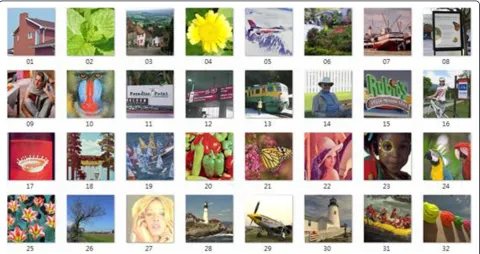
image set is shown in Figure 2. OK} The two color images are displayed side by side on the LCD monitor (ViewSonic VP2365), against which the subject observes the image pair in a dark room at a viewing distance of six times the image height [1,2,24]. In this case, the test image of 512 × 512 pixels is inspected with a viewing angle close to 10 and at a resolution of 54 pixels per degree. Under this viewing condition, the parameters are adjusted until the distortion between the two images is perceivable. The adjustment that results in JND is then recorded to determine the corresponding parameter.
3. Perceptual color image compression scheme In this article, a prediction error preprocessor built by uti-lizing the estimated JNDs of one achromatic and two chromatic components is proposed to integrate into a per-ceptual color image compression scheme using the DPCM technique. The JNDs mainly attempt to design a predic-tion error preprocessor that can shape the predicpredic-tion error signals more smooth instead of investigating the adaptive prediction while the same visual quality of the recon-structed color image for lower compression bit rates is achieved. Then, it aims at varying the quantization level to
constrain the quantization error under the visual tolerance for higher quality of the reconstructed image.
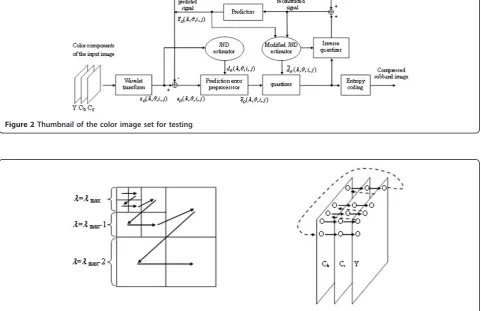
The functional block diagram of the proposed percep-tual compression scheme for color images in the wavelet domain is given in Figure 3, where zO(l, θ, i, j),
˜
zO(λ,θ,i,j), eO(l, θ, i, j), e˜O(λ,θ,i,j), and dO(l, θ, i, j), re-spectively, denote the original current wavelet coeffi-cient, the predicted coefficoeffi-cient, the prediction error before the preprocessing, the prediction error after the preprocessing, and the JND value for the coefficient located at (i, j) of the (l, θ) subband in the O color component of the color image. The subband JND pro-files of the input color image obtained by using the JND estimator presented in Section 2 are incorporated into the proposed prediction error preprocessor to shape the prediction error and decide the reconstruction level for achieving the increased performance in terms of bit rate at a specified visual quality.
In the proposed compression scheme, the fixed pre-diction mode that uses the same set of coefficients for every image to be coded is adopted such that the perfor-mance given by the proposed JND-based preprocessor can clearly be verified. As shown in Figure 3, the predic-tion error is obtained by the difference between the
Figure 2Thumbnail of the color image set for testing.
current signal and its predicted signal and is given as
eO(λ,θ,i,j) =zO(λ,θ,i,j)− ˜zO(λ,θ,i,j) forO= Y, Cb, Cr (8)
The dynamic range of prediction error signals we can reduce, the less objective distortion of the reconstructed color image for a given bit rate we can achieve [25]. In order to shape the prediction error for higher perfor-mance, the prediction error preprocessor utilizes the JND profiles to process the prediction error signals such that the dynamic range of processed prediction error signals can be reduced to achieve lower bit rate or bet-ter reconstructed image quality. Each prediction error signal is adjusted by the preprocessor and is shown as
˜ eO(λ,θ,i,j) =
⎧ ⎨ ⎩
eO(λ,θ,i,j) +γO·dO(λ,θ,i,j), ifeO(λ,θ,i,j)<−γO·dO(λ,θ,i,j)
eO(λ,θ,i,j)−γO·dO(λ,θ,i,j), else ifeO(λ,θ,i,j)> γO·dO(λ,θ,i,j)
eO(λ,θ,i,j), otherwise (9)
where gOis the parameter used to make a trade-off between the visual quality and the coding bit rate of the reconstructed color image for the color component
O. The constraint of gOÎ0,1] is to avoid introducing the perceptual distortion into prediction errors in the JND-based preprocessor. If the estimated JNDs accu-rately approximates to the actual JNDs for human eyes, the preprocessor with gO = 1 can extremely adjusts each prediction error signal of the color image to its critical and just visible bound for human eyes to shape the signals for the highest performance. In this article, the gO value is conservatively used in the
experiment. In the stage of quantizing the prepro-cessed prediction error signal, the proposed compres-sion scheme uses a locally adaptive perceptual quantization method. The strategy of using the locally adaptive perceptual quantization is to adapt the quan-tization step size of each coefficient in each subband to the actual amount of locally varying masking thresh-old. However, the main problem that results from adopting the strategy is that both the encoder and decoder are required to calculate these local masking thresholds. This would require transmitting side infor-mation to the decoder to guarantee reconstruction of the coded image. In order to avoid sending a large amount of side information to the decoder, the idea proposed in [7] is extended to eliminate the need for transmitting side information for each step size of each coefficient in each subband of the color image by esti-mating the available masking from the already received data and a prediction of the transform coefficient to be quantized. That is, the already received data and a pre-diction of the transform coefficient to be quantized are utilized in the measure of the estimate JND,
˜
dO(λ,θ,i,j), of the coefficient in color images to
approximate the actual amount of masking. The prop-erties of the human visual perception to natural color images, including flatness and smooth color transition, allow to present good estimates to the available amount of masking. This is illustrated by the modified
JND estimator shown in Figure 3. In order to carry out the synchronization of achieving the estimate JND pro-files at the coder and the decoder in the proposed compression scheme, the design of the scanning order for sub-band coefficients is needed (Figure 4). As shown in Figure 4a, the subbands are scanned from the highest subband to the lowest subband in each color component. In each subband, the coefficients are scanned row-wise in the order of Cb, Cr, and Y com-ponents (Figure 4b). The quantization step sizes for each coefficient in subbands of the Y, Cb, and Cr com-ponents are thus given by
O(λ,θ,i,j) = 2φO· ˜dO(λ,θ,i,j) (10)
whereOis the step size multiplier whose value can be chosen such that the compression distortion is uniformly distributed over the reconstructed image while a tight entropy (bit-rate) budget is required. In this article,Y= 1.0,Cb= 1.0, andCr= 1.0 are used to achieve the per-ceptually lossless visual quality of the reconstructed
image for the variable uniform mid-riser quantizer in the proposed compression scheme.
4. Simulation results
To evaluate the performance of the proposed compres-sion scheme, the scheme has been implemented by incorporating the proposed prediction error preproces-sor into the DPCM coder for compressing color images. A variety of color images that represent a great of diver-sity of visual information is used in the experiments. The size of each color image is 512 × 512 with color depth of 24 bits in the RGB color space. Since the com-pression performance achieved by the proposed predic-tion error preprocessor is emphasized, the stage of entropy coding is not further discussed in this article. In the simulation, the proposed compression scheme there-fore makes use of entropies rather than bit rates to represent its performance while a specified visual quality of the reconstructed color image is obtained. Mean-while, the subjective viewing test for assessing the visual quality of the compressed color image is conducted in the simulation.
First, the simulation of the proposed compression scheme with gO= 0 andO= 1.0 is carried out. That is, the proposed scheme is implemented by incorporating the perceptual quantization (O= 1.0) without using the prediction error preprocessor (gO= 0). To evaluate the visual quality of the compressed color images, the same subjective viewing test and viewing condition based on the method presented in [22-24] are used in the simula-tion (the same test used in Secsimula-tion 2). Twenty subjects of age between 21 and 26 who have normal eyesight or had been corrected to be normal take part in the test.
Table 2 Subjective rating criterion for visual quality of an image pair
Subjective score Description
3 The right one is much better than the left one 2 The right one is better than the left one 1 The right one is slightly better than the left one 0 The right one has the same quality as the left one -1 The right one is slightly worse than the left one -2 The right one is worse than the left one -3 The right one is much worse than the left one
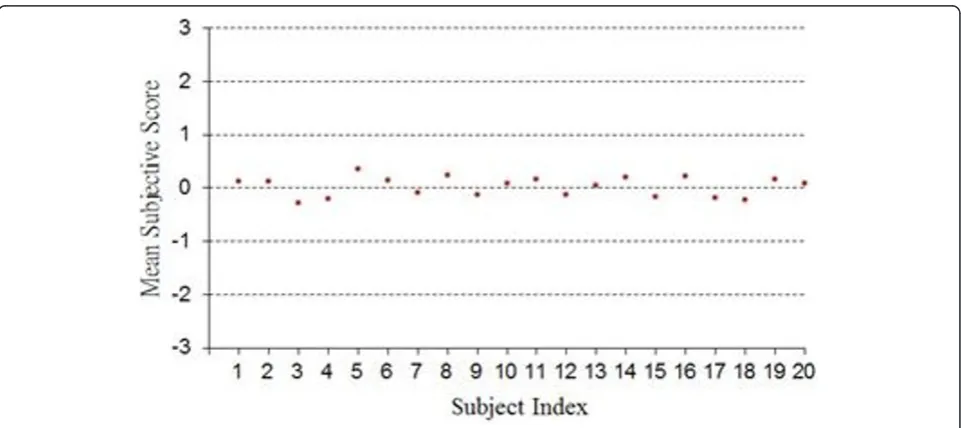
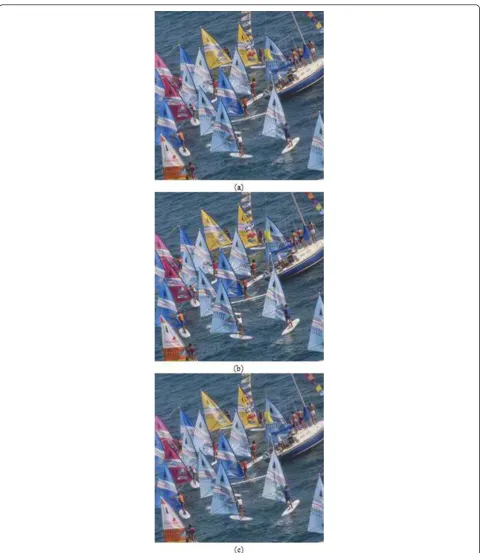
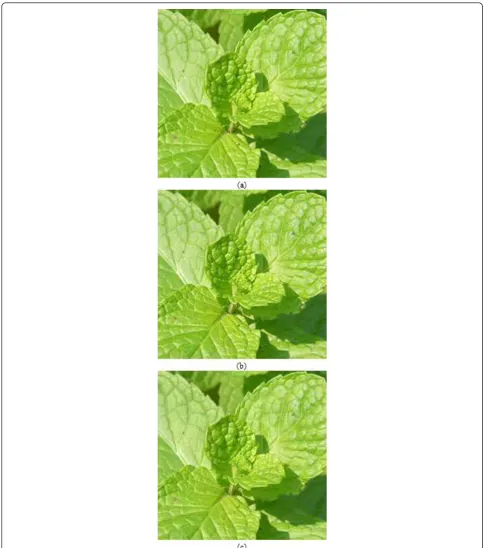
As mentioned above, the test is carried out in the dark room when the subject observes the image on the screen of the monitor at a viewing distance of six times the image’s height [1,2,24]. The thumbnail of the color image set for testing is shown in Figure 2. In each view-ing test, the original image and its compressed image are displayed side-by-side on the screen of the monitor for evaluating the perceptual difference between the two images. According to the subjective rating criterion [23,24] shown in Table 2, subjects are then asked to vote on the comparative quality of the two images while subjects view them for at least 2-3 s. In order to achieve a fair comparison and evaluation, the presentation order of the image pairs is randomized and the compressed image is randomly displayed on the right or left side of the screen. The results of mean subjective scores by all subjects for the 32 compressed color images are shown in Figure 5. It can be found that the mean subjective scores are all close to zero. Meanwhile, most of the associated standard deviations are quite small in com-parison with the range of the subjective rating criterion from -3 to 3. The overall subjective scores are calculated to obtain the mean of 0.024 with the associated standard deviation of 1.079. This indicates that the compressed color image by the proposed compression scheme is hardly distinguishable from its original color image for most subjects. That is, the perceptually lossless visual quality of the compressed image is achieved by the pro-posed perceptual color image compression scheme. In the above subjective viewing test, the compressing out-puts for the original color“Sail”and“Leaf” images (Fig-ures 6a and 7a) are shown in Fig(Fig-ures 6b and 7b, respec-tively, where the peak signal-to-noise ratio (PSNR) of the compressed “Sail” image is of 35.36 dB at en-tropy of 0.739 and the PSNR of the compressed“Leaf” image is of 34.73 dB at entropy of 0.491. This means that if the PSNR of the compressed image can be as low as possible while the visual quality of the compressed image remains the same as the original image under the
specified viewing condition, thus the visual model is effectively incorporated into the compression scheme for color images. Except for the above subjective viewing test, the representative objective quality metrics based on the image structure features in according to HVS perception are used to verify the visual quality of the compressed image. The metrics of structural similarity (SSIM) [26], visual information fidelity (VIF) [27], visual-SNR (VSNR) [28], weighted-SNR (WSNR) [29], and PSNR HVS masking (PSNR-HVS-M) [30] are com-puted and shown in Figures 6 and 7, respectively. From the values computed by these objective measures, the visual quality of the compressed color images is diffi-cultly distinguished from that of the corresponding ori-ginal color images. This indicates that the estimated JNDs indeed give the satisfied estimates to the available amount masking and the proposed visual model is suc-cessfully used to increase the compression performance.
Second, we assume that half of the reconstruction error of each signal is induced by the quantization error of the perceptual quantizer and the other is induced by the prediction error from the preprocessed signals. We use a simple condition to restrict both parts of the reconstruction error of the signal within half of its visi-bility threshold such that the overall reconstruction error is under the JND value. That is, the simulation with the conditiongO= 0.4 and O= 0.5 is implemen-ted. As described in Section 3, the conservative con-straint of gO= 0.4 (instead of gO = 0.5) is used in the simulation. In the same viewing condition, the resulting
“Sail”image (Figure 6c) with lower PSNR generates con-sistent visual quality at lower entropy. The same result for the “Leaf” image is shown in Figure 7c. To clarify the performance of the proposed prediction error pre-processor for a variety of color images, Table 3 com-pares the entropies obtained using the proposed compression scheme with gO = 0.4 and O = 0.5 with those obtained using proposed compression scheme gO = 0 and O= 1.0 for the same high quality compression
Table 3 Entropies of the proposed compression scheme with preprocessor, without prepro-cessor and the Watson’s compression method at nearly the same visual quality of the reconstructed color images
Image Variance Entropy Gain
Prediction error Preprocessed prediction error Watson’s method Proposed scheme Proposed scheme G1(%) G2(%)
(gO= 0,O= 1.0) (gO= 0.4,O= 0.5)
Baboon 128.79 116.55 1.296 1.089 1.035 15.98 20.09
Barbara 93.81 89.79 0.697 0.637 0.621 8.65 10.99
Goldhill 72.93 70.38 0.775 0.752 0.738 3.05 4.77
Leaf 117.14 113.23 0.575 0.491 0.465 14.55 19.13
Lena 102.51 99.06 0.542 0.510 0.495 5.90 8.79
Monarch 75.98 72.92 0.565 0.512 0.489 9.49 13.44
Sail 82.26 78.51 0.863 0.739 0.717 14.36 16.91
as described above. One can see that the proposed pre-diction error preprocessor indeed improves the perfor-mance of the proposed compression scheme. The compression results of other test color images are depicted in Table 3 in which the dynamic range of the prediction error signal and the preprocessed prediction error signal is estimated in terms of variance. The results confirm that entropies of the reconstructed image are lower at nearly the same perceived quality when the dynamic range of prediction error signals is effectively reduced by the JND-based prediction error preprocessor.
The proposed compression scheme is also compared with the compression method proposed by Watson et al. [14] to show the performance of compressing color images. The Watson’s method uses a perceptual quanti-zation matrix to compress color images, in which the quantization step size of each subband of the color image is determined by the base JND [14] within the subband. In order to make a fair comparison, the same observers took part in the subjective viewing tests. Table 3 lists the entropies of the Watson’s compression method while its reconstructed color image is nearly no loss in perceptual quality at a viewing distance equals to six times the image height. The entropy gains, G1 and G2, are, respectively, evaluated while comparing the pro-posed schemes with the above two conditions with the Watson’s method. From the G2shown in the table, it is obvious that the proposed compression scheme achieves better performance when the prediction error prepro-cessor is applied. Furthermore, the G1 of the proposed compression scheme only using the perceptual quantiza-tion also shows better results, since the JNDs of the wavelet coefficients are effectively estimated to calculate the quantization step sizes for each coefficient as shown in Equation (12).
For the image coding standards, the proposed prepro-cessor can also be used to pre-process the input color image such that the input signal has smaller dynamic
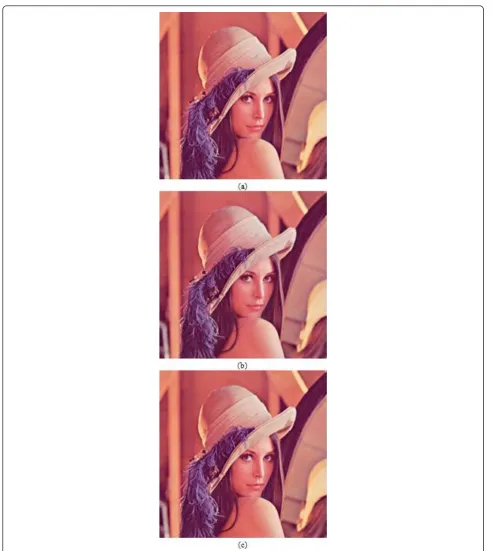
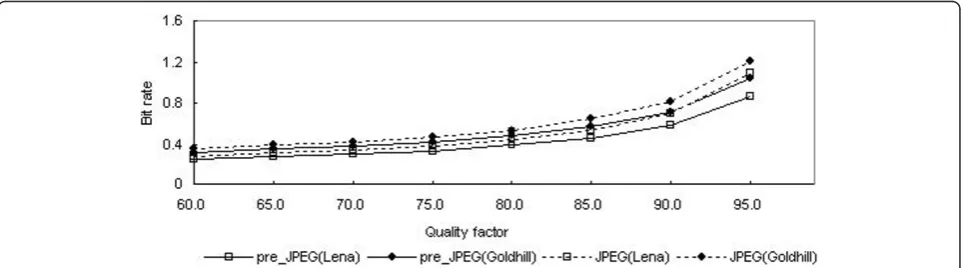
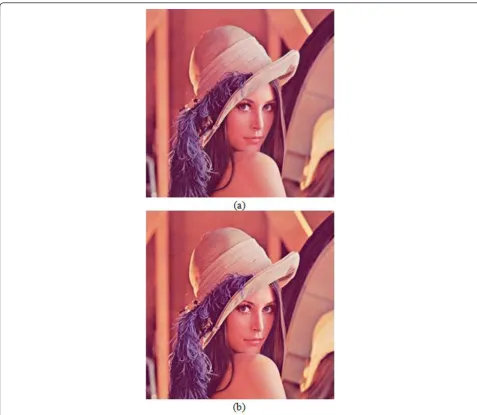
range resulting in lower bit rates at the same image quality of the reconstructed color image. Figure 8 com-pares the results of coding the “Lena” color image obtained using the conventional JPEG coding with those obtained using the JPEG coding incorporated with the proposed preprocessor in terms of the bit rate at the same JPEG quality factor. At the JPEG quality factor of 85, the JPEG coding with the proposed preprocessor results in the reconstructed image (Figure 8b) with the bit rate of 0.45 bits per pixel (bpp) while the conven-tional JPEG coding results in the reconstructed image (Figure 8c) with the bit rate of 0.54 bpp. The JPEG cod-ing with the proposed preprocessor preserves the low bit rate much better than the conventional one, while the objective quality measures of using SSIM, VIF, VSNR, WSNR, and PSNR-HVS-M for the JPEG coder with and without the proposed preprocessor are close. As described in Section 2, the proposed preprocessor is successfully reduce the dynamic range of the input color signals to achieve better performance in terms of bit rates when maintaining the nearly same image quality. Figure 9 illustrates the bit rate comparison of the repre-sentative “Lena” and“Goldhill”color images under tests, between the conventional JPEG coder (JPEG) and the one incorporated with the pro-posed preprocessor (pre_JPEG). The results confirm that the preprocessor can be independent of the JPEG coding standard and applied to color images for higher performance at any specified quality factor. For the JPEG2000 coding stan-dard [31], the comparison results of coding the“Lena” color image at the lossless coding mode is shown in Fig-ure 10. The better performance can also be seen while the JPEG2000 coding with the proposed preprocessor is adopted.
5. Conclusions
A prediction error preprocessor is presented with the goal to reduce the dynamic range of the prediction error signals of the color image to be compressed. The lower
Figure 9Comparison of bit rate of coding the“Lena”and“Goldhill”color images between the conventional JPEG coder (JPEG) and
bit rate of the reconstructed image can be obtained by using the preprocessor while reaching high visual qual-ity. For this purpose, a color JND estimator that takes into account various masking effects of human visual perception is proposed and incorporated into the pre-processor for the design of the perceptual color image compression scheme using the DPCM technique. The proposed compression scheme with the preprocessor generates consistent quality images at a lower entropy when comparing with that without prediction error pre-processor and the existing compression method. At the same quality factor of the coding standard, the prepro-cessor is also applied to the input color image of the JPEG and JPEG2000 coders to provide compatible
bitstream and to achieve higher performance in terms of bit rate.
Acknowledgements
The study was supported by the National Science Council, Taiwan, under contract NSC99-2221-E-278-001 and the Image & Video Processing Laboratory, National Dong Hwa University, Taiwan.
Competing interests
The author declares that they have no competing interests.
Received: 13 July 2011 Accepted: 16 March 2012 Published: 16 March 2012
References
1. Jayant N, Johnston J, Safranek R:Signal compression based on models of human perception.Proc IEEE1993,81(10):1385-1422.
2. Safranek RJ, Johnston JD:A perceptually tuned subband image coder with image dependent quantization and post-quantization data compression.InProc IEEE Int Conf Acoust, Speech, Signal Processing. Volume 3.Glasgow, Scotland; 1989:1945-1948.
3. Watson AB:DCT quantization matrices visually optimized for individual images.InProc SPIE Int Conf Human Version, Visual Processing, and Digital Display-IV. Volume 1913.San Jose, CA, USA; 1993:202-216.
4. Safranek RJ:A JPEG compliant encoder utilizing perceptually based quantiza-tion.InProc SPIE Int Conf Human Vision, Visual Processing, and Digital Display - V. Volume 2179.Bellingham; 1994:117-126.
5. Chou CH, Li YC:A perceptually tuned subband image coder based on the measure of just-noticeable-distortion profile.IEEE Trans Circ Syst Video Technol1995,5(6):467-476.
6. Bradley AP:A wavelet visible difference predictor.IEEE Trans Image Process 1999,8(5):717-730.
7. Höntsch I, Karam LJ:Locally adaptive perceptual image coding.IEEE Trans Image Process2000,9(9):1472-1483.
8. Tang CW:Spatiotemporal visual considerations for video coding.IEEE Trans Multimedia2007,9(2):231-238.
9. Al-Fayadh A, Hussain AJ, Lisboa P, Al-Jumeily D:An adaptive hybrid classified vector quantization and its application to image compression.
Proc European Symp Computer Modeling and SimulationCambridge, UK;
2008, 253-256.
10. Yang XK, Lin WS, Lu Z, Ong EP, Yao S:Just-noticeable-distortion profile with nonlinear additivity model for perceptual masking in color images.
InProc IEEE Int Conf Acoustics, Speech, Signal Processing. Volume 3.Hong Kong; 2003:609-612.
11. Nadenau MJ, Reichel J, Kunt M:Wavelet-based color image compression: exploiting the contrast sensitivity function.IEEE Trans Image Process2003,
12(1):58-70.
12. Liu KC, Chou CH:Locally adaptive perceptual compression for color images.IEICE Trans Fund Electron Commun Comput Sci2008, E91-A(8):2213-2222.
13. Chou CH, Liu KC:Colour image compression based on the measure of just noticeable colour difference.IET Image Process2008,2(6):304-322. 14. Watson AB, Yang G, Solomon JA, Villasenor J:Visibility of wavelet
quantization noise.IEEE Trans Image Process1997,6(8):1164-1175. 15. Teo PC, Heeger DJ:Perceptual image distortion.Proc IEEE Int Conf Image
ProcessingAustin, Texas, USA; 1994, 982-986.
16. de Valois KK, Switkes E:Simultaneous masking interactions between chromatic and luminance gratings.J Opt Soc Am1983,73(1):11-18. 17. Watson AB:Perceptual optimization of DCT color quantization matrices.
Proc IEEE Int Conf Image ProcessingAustin, Texas, USA; 1994, 100-1044. 18. Le Callet P, Saadane A, Barba D:Interactions of chromatic components on
the perceptual quantization of the achromatic component.InProc SPIE Human Vision and Electronic Imaging. Volume 3644.San Jose, CA, USA; 1999:121-128.
19. Meng Y, Guo L:Color image coding by utilizing the crossed masking.
Proc IEEE Int Conf Acoust, Speech, Signal ProcessingPhiladelphia, Pennsylvania, USA; 2005, 389-392.
20. Imai FH, Tsumura N, Miyake Y:Perceptual color difference metric for complex images based on Mahalanobis distance.J Electron Imag2001,
10(2):385-393.
21. Watson AB, Solomon JA:Model of visual contrast gain control and pattern masking.J Opt Soc Am A1997,14(9):2379-2391.
22. Longere P, Zhang X, Delahunt PB, Brainaro DH:Perceptual assessment of demosaicing algorithm performance.Proc IEEE2002,90(1):123-132. 23. Yang XK, Lin WS, Lu ZK, Ong EP, Yao SS:Just noticeable distortion model
and its applications in video coding.Signal Process: Image Commun2005,
20(7):662-680.
24. Berger T:Rate Distortion TheoryPrentice-Hall, Englewood Cliffs, NJ; 1971. 25. Jia YT, Lin WS, Kassim AA:Estimating just-noticeable distortion for video.
IEEE Trans Circ Syst Video Technol2006,16(7):820-829.
26. Wang Z, Bovik AC, Sheikh HR, Simoncelli EP:Image quality assessment: from error visibility to structural similarity.IEEE Trans Image Process2004,
13(4):600-612.
27. Sheikh HR, Bovik AC:Image information and visual quality.IEEE Trans Image Process2006,15:430-444.
28. Chandler DM, Hemami SS:VSNR: a wavelet-based visual signal-to-noise-ratio for natural images.IEEE Trans Image Process2007,16(9):2284-2298.
29. Damera-Venkata N, Kite TD, Geisler WS, Evans BL, Bovik AC:Image quality as-sessment based on a degradation model.IEEE Trans Image Process 2000,4:636-650.
30. Ponomarenko N, Silvestri F, Egiazarian K, Carli M, Astola J, Lukin V:On between-coefficient contrast masking of DCT basis functions.Proc of the 3rd Int Workshop on Video Processing and Quality Metrics for Consumer ElectronicsScottsdale, Arizona, USA; 2007.
31. JPEG2000 latest reference software (Jasper Version 1.900.1).[http://www. ece.uvic.ca/~frodo/jasper/].
doi:10.1186/1687-5281-2012-3
Cite this article as:Liu:Prediction error preprocessing for perceptual color image compression.EURASIP Journal on Image and Video Processing
20122012:3.
Submit your manuscript to a
journal and benefi t from:
7Convenient online submission 7Rigorous peer review
7Immediate publication on acceptance 7Open access: articles freely available online 7High visibility within the fi eld
7Retaining the copyright to your article
![Table 1 Base detection threshold for each subband offour-level 9/7 DWT [14]](https://thumb-us.123doks.com/thumbv2/123dok_us/900182.1587595/3.595.301.537.556.731/table-base-detection-threshold-subband-offour-level-dwt.webp)